A Promotion Post Turned Tuesday Into a Status Chase, Then a Pause

The Promotion Post That Turned Tuesday into a Status Chase
You are a capable mid-career professional in an expensive city, doing fine until one former classmate's LinkedIn promotion turns a normal evening into a Career Comparison Anxiety spiral.
Maya gave me the timestamp because it had lodged in her memory: 10:47 p.m. on a Tuesday in Toronto. An unfinished campaign brief glowed on her laptop while the fan whirred beside cold tea. Her phone felt warm in her hand as she reread a former colleague's promotion post, then opened salary reports, an executive course application, and a blank document titled “Three-Year Plan.”
“I was doing fine until I saw what she was doing,” Maya told me. “Then the whole evening became an emergency meeting about my life. I keep calling it ambition, but it feels more like catching up.”
I could see the pattern in her jaw before she finished the sentence. Her sense of inadequacy seemed to work like a floor that dropped half an inch every time the feed refreshed: nothing in her actual life had vanished, yet her body was suddenly bracing as though she had missed the last safe step. She wanted to feel securely successful, but she feared that being visibly behind meant being worth less.
“I am not going to put your ambition on trial,” I said. “We are going to separate the goals you genuinely want from the goals recruited to calm a comparison trigger. Let us make a practical map of this fog and return the final decision to you.”

Choosing the Compass Beneath the Career Comparison Spiral
I asked Maya to place both feet on the floor, take one unforced breath, and hold her question in plain language: “Why do I chase the next status marker whenever I feel behind?” I shuffled slowly. The pause was not mystical theatre; it was a transition from reacting to observing.
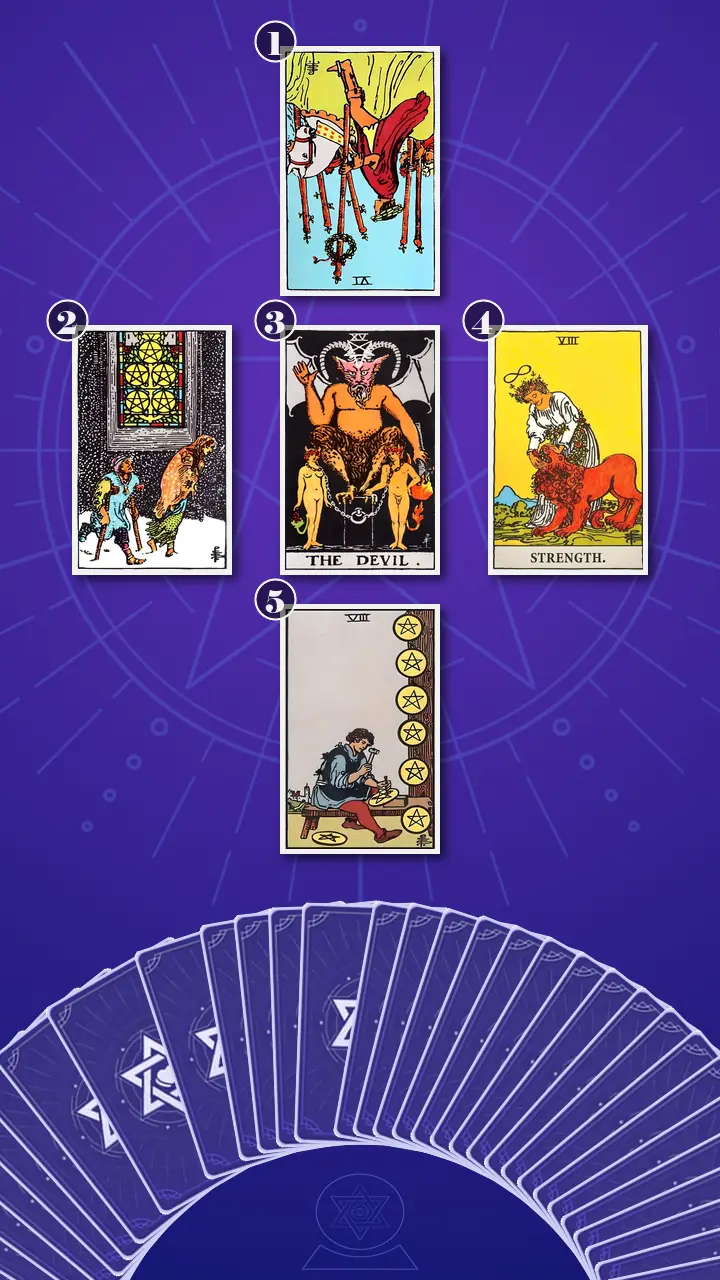
I chose The Shadow Spread, a five-card Shadow Spread for uncovering status anxiety, conditional self-worth, and a values-led practice. For anyone wondering how tarot works in my practice, I use a spread like this as a structured cognitive tool, not as a prediction. Its positions keep us from mistaking the loudest symptom for the whole problem, and its card meanings gain value through context, questions, and the querent's own evidence.
The cards formed a compact cross, like a key turning in a lock. The first position would show Maya's visible status-chasing behaviour. The second would reveal the hidden feeling beneath it. At the centre, the third would name the binding bargain that kept the pattern active. The fourth would reclaim an inner resource, and the fifth would ground that resource in a repeatable next step.
I explained why I was keeping the map this focused. A larger Celtic Cross could have added external influences and possible outcomes, but Maya was not asking which opportunity would win. She was asking why the same internal sequence kept selecting opportunities for her. Five positions were enough to trace that sequence without adding more noise.
The Wreath That Could Not Hold Its Applause
Position One: Six of Wands Reversed and the Public Scoreboard
I turned over the card representing Maya's visible status-chasing behaviour, including the urge to replace current priorities whenever somebody else appeared further ahead. It was the Six of Wands, reversed.
In the Rider-Waite-Smith image, a laurel-crowned rider moves through an admiring crowd. Reversed, the recognition energy was blocked: achievement reached Maya, but it did not settle into durable self-belief. Her LinkedIn feed had become a live leaderboard where every refresh could demote a week that had been perfectly reasonable five minutes earlier.
I brought the card directly back to 10:47 p.m. Maya had an unfinished brief open, saw a former colleague's promotion, and stopped evaluating the brief by its usefulness. Instead, she began evaluating her whole life by what might generate an equally legible announcement. The internal line was brutally efficient: “I was doing fine until I saw her title; now I need a stronger title by next year.”
“Before adopting a new marker,” I said, “ask whether you want the ordinary lived experience behind it or mainly the announcement attached to it. If the title could never be posted, would you still want the Tuesday that comes with doing the job?”
Maya gave a short, bitter laugh. Her chin dipped, then her thumb rubbed the edge of her mug. “That is painfully accurate. Almost rude.”
“Accurate does not mean guilty,” I replied. “This card is not saying public recognition is shallow. It is showing us that applause currently leaks out faster than it can become confidence.”
Position Two: Five of Pentacles and the Warm Room Across the Snow
I turned over the card representing the hidden emotional trigger beneath the chase: the contracted experience of exclusion, scarcity, and being late relative to peers. It was the Five of Pentacles, upright.
The card showed two figures moving through snow beneath an illuminated window. I described the modern version: Maya sitting at a Queen West brunch while friends discussed a management role, graduate school, and a condo viewing. The espresso machine hissed, heat climbed her neck, and unrelated milestones merged into one imaginary entrance test for adulthood.
The energy here was not proof that Maya lacked resources. It showed attention becoming overconcentrated on scarcity until her existing income, skills, relationships, and completed work faded from view. Another person's visible difference became a verdict: “They are already inside the life I was supposed to have; I am still trying to qualify for entry.”
I was careful not to turn Toronto housing costs or salary concerns into a mindset problem. Material pressure can be real. The card asked for a distinction: was there a specific financial gap requiring a practical response, or had someone else's milestone made Maya feel socially exiled from security?
Her fingers tightened around the mug, went still, and then released. “I do not just think they have more,” she said quietly. “I think they belong there more.”
I nodded. “The goal always looks personal until you ask where you found it.”
When Four Browser Tabs Became a Loose Chain
Position Three: The Devil and the Bargain Behind the Goal
I turned over the central card, representing the core shadow bargain that maintained the cycle: treating public achievement as proof of worth, belonging, and control. It was The Devil, upright.
I kept my attention on the loose chains around the figures' necks. I did not interpret them as permanent captivity. They showed pressure with a point of consent still available. Maya's modern chain was already visible: LinkedIn profile, salary report, executive-course checkout, and a new three-year plan, each tab connected by the same unspoken agreement.
“You do not only want the course,” I said. “You want it to prove that you are intelligent, secure, employable, respected, and not behind. That is an impossible workload for one credential. You may not want the marker as much as you want what it seems to prove.”
This was where I used a diagnostic tool I call Analysis Paralysis Deconstruction. I stripped away the abstract what-ifs and placed only the immediate realities on the table: Maya had a real campaign deadline, a course with no enrolment deadline, several unfinished programmes, limited evening capacity, a manageable current budget, and legitimate longer-term salary questions that could be reviewed during working hours. None of those facts required a purchase at 10:47 p.m.
For a moment, I remembered years of conversations held over cooling coffee, each one cluttered by a dozen impressive options that were secretly trying to answer one frightened question. The details changed, but the invoice was often sent to the same account: “Please prove I am allowed to respect myself.”
The Devil represented excess attachment to external proof and a blockage of conscious choice. Yet it was also the catalyst. The course checkout still required Maya's consent. “Urgency can mark a trigger without creating a deadline,” I said. “The urge is loud, but loud is not the same as compulsory.”
Maya's eyes moved as if she were replaying the tabs in sequence. Her breathing slowed, and she let out a low “Oh.” She had not lost every choice. She had simply been giving comparison automatic decision rights.
When Strength Put Calm Hands on Urgency
Position Four: Strength as the Antidote to Comparison-Driven Ambition
The room became noticeably quieter when I reached the card representing Maya's reclaimable inner resource: meeting the urge to catch up with compassionate self-command before choosing a goal. Rain traced the window, and the radiator gave one dry click as I turned over Strength, upright.
The woman in the card places calm hands near the lion's jaws. She neither attacks the animal nor lets it choose the route. In energy terms, this was balance: courage without force, patience without passivity, and ambition held in relationship rather than managed through punishment.
At 10:47 p.m., the campaign brief was still open while a promotion post glowed on Maya's phone. Her tea had gone cold, her jaw had tightened, and three new career tabs had begun to feel like a plan. She was caught between obeying the urge and shaming herself for having it.
The urge to catch up is a vulnerable need asking for attention, not an authority entitled to rewrite your goals.
I let the sentence settle before giving her the card's message in full.
You do not have to obey the belief that urgency proves you are behind; meet the status-hungry impulse with steady choice, as the figure in Strength meets the lion with calm hands.
I watched Maya's breath stop. Her fingers hovered above the table, her pupils widened, and her gaze slipped away from the card as though the last few years were replaying somewhere behind my shoulder. Then resistance arrived before relief. “But if I can choose,” she said, her voice suddenly sharper, “does that mean I have been doing this wrong the whole time?”
“No,” I said. “It means planning and overworking helped you recover control when comparison hurt. The strategy made sense. Now it costs more than it gives, so you are allowed to revise it without condemning the person who needed it.”
Her jaw shifted, her hands opened, and a long breath left her chest. The release brought a brief, unsteady blankness with it, the vulnerable recognition that choice also meant responsibility. I asked, “Using this new perspective, can you remember a moment last week when this insight might have changed how you felt?”
“At brunch,” she said. “I could have said, 'A part of me wants a degree right now because it is scared everyone else has become a real adult.' I could have listened without applying that night.”
That was the breakthrough: not the disappearance of envy, fear, or ambition, but the first movement from contracted inadequacy and comparison-driven urgency to steady self-respect and grounded, personally chosen practice. Strength gave the status-hungry impulse a voice without giving it the deciding vote.
The Tool That Was Already in Her Hand
Position Five: Eight of Pentacles and Announcement-Free Progress
I turned over the final card, representing the practical integration of the reading: one personally chosen, repeatable practice that could build skill or meaning without requiring public validation. It was the Eight of Pentacles, upright.
The craftsperson in the card focuses on the pentacle currently beneath the tool while completed work remains visible nearby. This was balanced earth energy, steady enough to support continuity. It contrasted with Maya's habit of abandoning useful work whenever a more prestigious target appeared.
I pictured the practical scene with her: salary and course tabs closed, the campaign brief reopened, and one quiet twenty-five-minute block protected for strategic writing. She would record what she tried and learned, not how the result might look in a future announcement. Recognition could still arrive, but it would no longer be required to make the practice count.
“Choose the practice you would still value without the announcement,” I said. “What unfinished work comes to mind?”
Maya looked down at the Eight of Pentacles for several seconds. “The campaign narrative,” she said. “I actually want to get better at that. I keep leaving it for projects people are more likely to notice.”
I saw her posture change by only a degree, but it mattered. She was no longer trying to redesign three years. She was choosing what to do with twenty-five minutes.
The Coffee Bean Filter: Turning Urgency Back into Choice
I drew the whole reading together through its symbols. The reversed wreath showed recognition that could not stay absorbed. The lit window revealed the fear of being outside. The loose chain exposed the bargain that one more marker would certify worth. Strength's calm hands restored decision rights, and the Eight of Pentacles returned those rights to the work already waiting.
The pattern was like running up an escalator whose speed was controlled by other people's highlight reels. Each milestone briefly moved Maya upward, but the feed adjusted the pace before she could inhabit what she had achieved. The absence of Cups and Swords in the suit sequence added another clue: feelings and interpretations were being converted into research, purchases, and labour before Maya could name or examine them.
Her blind spot was not ambition. It was treating physical urgency as evidence that a new goal was objectively necessary, then hoping more research could solve a question about worth. The direction of change was specific: choose the next weekly commitment by whether it builds a personally valued skill, relationship, or lived experience, not by how quickly it can prove status.
“But Toronto rent is not emotional noise,” Maya said when I introduced the practical exercise.
“Correct,” I replied. “A real salary gap, deadline, workload problem, or housing constraint belongs with the facts and deserves action. This filter is for separating those realities from the story that somebody else's promotion proves you are late.”
I call the method the Coffee Bean Filter Protocol. It combines pausing non-urgent status goals and choosing one weekly commitment for a personally valued skill, relationship, or lived experience. The point is not to reject advancement. It is to stop a triggered evening from silently rewriting the entire project roadmap.
- Run the 24-Hour Coffee Bean Filter.After the next promotion, salary, qualification, or home-ownership trigger, set a seven-minute timer. Write four lines in a phone note: “Trigger,” “Status marker I suddenly want,” “What I imagine it would prove,” and “What I actually need tonight.” Then sort each variable into “Absolute Must-Haves” or “Emotional Noise.” Emotional Noise does not mean meaningless; it means a feeling or social verdict that deserves attention but is not an objective constraint. Wait twenty-four hours before buying, applying, volunteering, or changing the calendar.Tip: Keep genuine deadlines and necessary work. If seven minutes feels like too much, take one slow exhale and write only the trigger. The choice to pursue the goal remains available tomorrow.
- Protect One Announcement-Free Practice Block.Choose one existing project by asking which skill, relationship, or lived experience it supports. Schedule one private twenty-five-minute block this week. At the end, write one line: “What I tried,” “What I learned,” or “What I want to test next.” For Maya, this meant revising one section of the campaign narrative and asking a trusted colleague for feedback on its clarity, not for a verdict on her entire career.Tip: Reduce the block to ten minutes if needed. Stop at the planned endpoint even if the catch-up impulse demands extra work; keeping the boundary is part of the practice.
I asked Maya to treat both actions as experiments, not commandments. Tarot had made the pattern easier to inspect, but no card could decide which course, promotion, salary target, or project belonged in her life. That authority remained hers.

A Week Later, the Quiet Proof
Six days later, I received a message from Maya. Another former colleague had announced a senior title. Her jaw tightened, and she opened the executive course page again. This time, she made the four-line note before touching her calendar.
“Fact: she was promoted,” Maya wrote. “Story: I am running out of time. Need: reassurance and a realistic salary review. I waited. The course still looked interesting today, but it did not look like an emergency.”
She had also completed one twenty-five-minute block on the campaign narrative and sent a single section to a colleague for specific feedback. No new title appeared. No polished announcement followed. She simply returned to work she had chosen before the comparison trigger and stayed long enough to learn something.
She slept through the night, then woke with the thought, “What if I am still behind?” The question remained, but it no longer had admin access to her calendar.
I did not read that message as proof that Maya had solved comparison. I read it as the first practical evidence of clarity: she could notice the external scoreboard, acknowledge what it activated, and still make a grounded choice. The cards had not granted her control. They had helped her recognise where she could take it back.
When someone else's win makes your jaw lock and your mind start drafting a new life before you have finished your tea, slowing down can feel as if it will expose you as worth less. Yet noticing the live leaderboard, naming the loose chain, and placing one calm hand on the urge means comparison is no longer operating completely unseen.
If the urge did not get to rewrite your week tonight, which small piece of work, relationship, or lived experience would remain in your “Absolute Must-Haves” column, even if there were never an announcement?