Fixing Friends to Feel Needed: A Consent Check Before Advice

Why Fixing Friends Became an 11:40 p.m. Assignment
If you are the office friend in a high-rent city who turns one late-night voice note into six research tabs before your own work is finished, I know how friendship fixer burnout can hide inside being the reliable one.
Jordan brought the evidence into my Toronto studio on her laptop: six tabs about recruiters, tenant rights, résumé wording, and message templates, all opened at 11:40 p.m. after a friend sent a three-minute voice note about a bad day at work. As Jordan described the night, rain ticked against my window. I could almost hear the laptop fan whirring in her condo, taste the cold peppermint tea she had forgotten beside it, and feel the warm phone she kept turning over while her own unanswered campaign emails waited behind the browser.
“I know she didn’t ask,” Jordan said, rubbing the centre of her chest, “but I could already see what would fix it. Then she didn’t reply, and I kept wondering whether I’d said the wrong thing.”
Her need to be valued seemed to sit beneath her sternum like a phone stuck on vibrate: invisible from the outside, impossible for her body to ignore. She wanted her friend to be okay. She also wanted the friend’s need for her plan to prove that the friendship was secure.
“So the question isn’t whether you care,” I told her. “Your care is obvious. We’re looking at why care turns into an emergency-response shift, and why stepping back can feel like becoming replaceable.”
Jordan let out a quick breath. “That’s it. If I’m not the helpful one, I honestly don’t know what I bring.”
I did not hear a confession of selfishness or a character flaw. I heard someone who had learned to convert the unbearable uncertainty of “Do I matter?” into tasks she could complete. Emotional over-functioning in friendships often looks impressive from the outside: fast replies, useful links, remembered appointments, polished plans. Inside, it can feel like swimming with one hand while using the other to keep everyone else’s head above water.
“Let’s make a map of the difference between supporting someone and taking responsibility for them,” I said. “The goal today isn’t to make you colder. It’s to find a form of care that leaves both people with choice.”

Choosing the Bridge: A Five-Card Relationship Spread
I asked Jordan to place both feet on the floor and take one slow breath before touching the deck. I invited her to hold a precise question in mind: “What happens inside my friendships when I try to earn my place by fixing?” The pause was not a mystical test. It was a way to let her attention leave the open chats for a moment and arrive in the room.
I chose a classic five-card Relationship Spread. For anyone wondering how tarot works in a situation like this, I use the cards as a structured reflection tool, not as a way to predict whether a friendship will last or claim access to another person’s motives. Card meanings in context can make a repeating dynamic visible, but Jordan remains the person who decides what the pattern means and what she wants to do next.
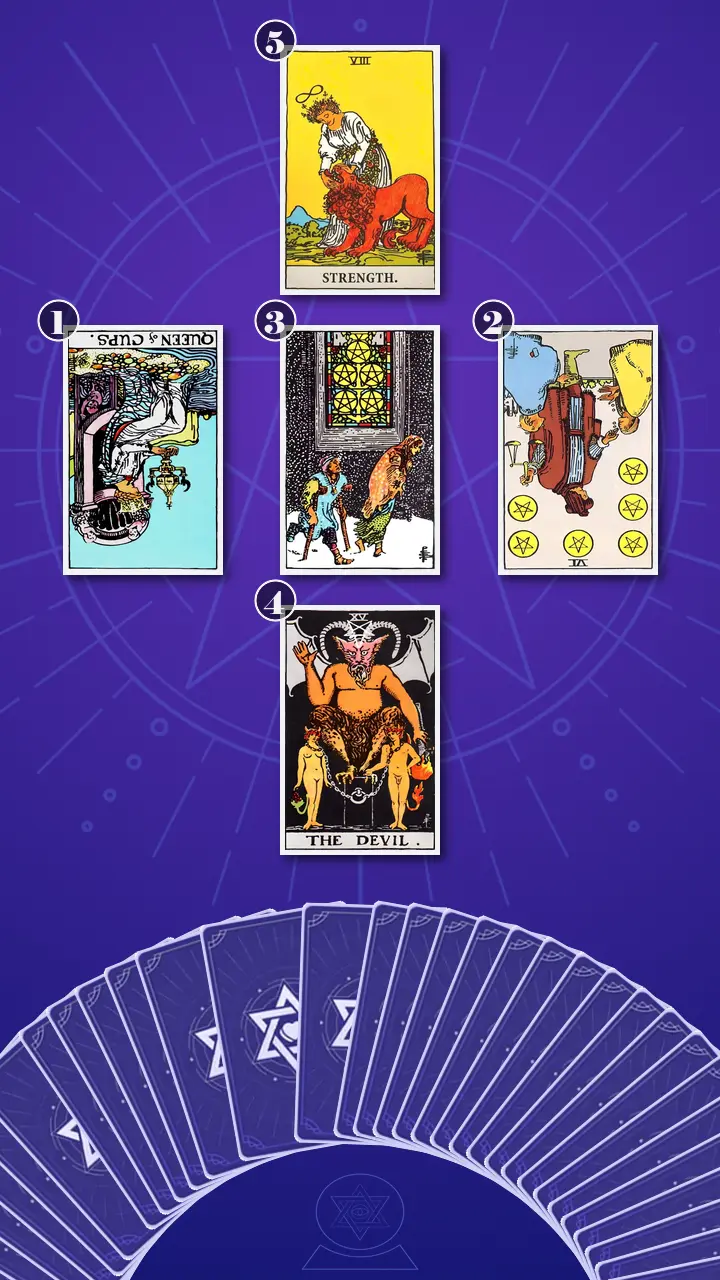
More specifically, I selected this five-card Relationship Spread for examining friendship fixing, unequal support roles, belonging fears, and consent-based care. It was the smallest structure that could show the whole sequence without adding speculative future outcomes: Jordan’s stance, the role her help creates for the other person, the belief beneath the bond, the challenge that maintains the pattern, and the constructive direction available now.
I laid the third card at the centre. I placed the first card to its left and the second to its right, creating a horizontal bridge between self and other. Beneath the centre went the fourth card, the hidden weight under the bond. Above it went the fifth, the integrating direction. The layout would let me read from visible behaviour to relational effect, descend into the contract beneath it, and then rise toward a different form of care.
I explained the key positions before turning anything over. The first would show how Jordan automatically responds when a friend struggles. The central card would reveal why another person’s independence can land like exclusion. The lower card would expose the bargain keeping the cycle alive. The final card would show how Jordan might remain compassionate without making herself indispensable.
“No card here gets to hand down a verdict,” I said. “Think of the spread as a production map. It can show us the scene you keep entering, the role you keep playing, and where you may have room to change the script.”
Reading the Bridge Between Care and Control
Position One: The Cup That Filled the Whole Screen
Now the card I turned over was the one representing Jordan’s tendency to absorb friends’ emotions and move immediately into fixing mode. It was the Queen of Cups, reversed.
The Queen normally sits beside the water holding an ornate, closed cup in both hands. Her gaze is so concentrated that the vessel seems to occupy her entire world. Reversed, that receptivity has tipped into blockage: sensitivity is still present, but it no longer moves through clear boundaries or self-attunement.
I returned Jordan to 11:40 p.m. A distressed voice note had played through one earbud while she reread the transcript, opened six solution tabs, and rehearsed the perfect reply. Her own campaign report remained untouched. The modern meaning was not that she had too much empathy. It was that her friend’s mood had filled her whole field of attention before Jordan checked what had been requested or what she could realistically give.
“The water energy here is blocked by over-identification,” I explained. “You feel with your friend, then your body quietly changes the job description. Suddenly you are responsible for making the feeling stop.”
I placed her inner sequence into words: “If I can find the right answer, then I can make this feeling stop, and then I will know I matter.” The first half sounded like care. The second half revealed why her chest stayed tight while the chat remained silent.
Jordan gave a small, bitter laugh instead of nodding. “That’s so accurate it feels a bit brutal.” Her fingers tightened around her mug, then loosened as she looked back at the card.
“Then we slow it down,” I said. “The card is not calling your care fake. It is separating feeling with someone from feeling responsible for them. That distinction gives you more choice; it doesn’t take your kindness away.”
I asked what her friend had actually requested in the voice note. Jordan looked towards the rain-dark window for a few seconds.
“She said, ‘I just need to vent.’ I heard that, but I still built a plan.”
That answer mattered. The Queen of Cups reversed had made the first part of the pattern concrete: Jordan turned her friend’s bad night into her assignment, then abandoned her own capacity to complete it.
Position Two: The Help With an Unspoken Invoice
Now the card I turned over was the one showing how friends are placed in a recipient role when support becomes fixing, without making assumptions about their intentions. It was the Six of Pentacles, reversed.
In the card, a standing figure holds scales while dispensing coins to two people below. Reversed, the energy of giving has moved into excess while balance and mutual choice are blocked. Generosity can still be sincere, but the giver controls the form, timing, and amount of help. The recipient is left to accept, decline, or find a way out of a plan already in motion.
I gave Jordan a familiar scene. A friend says Toronto rent is brutal. Jordan produces a colour-coded spreadsheet, landlord resources, three listings, and an offer to make calls. The friend reacts with a heart but chooses another route. Jordan refreshes the chat like she has sent an unsolicited project plan and is waiting for approval.
“I said there were no strings attached,” Jordan murmured, “so why does their silence hurt that much?”
“Because the help may be generous, but the reassurance request is still hiding inside it,” I said. “You are not consciously issuing a bill. But some part of you is waiting for the response to confirm that the time, labour, and care made you necessary.”
I sometimes use my Clique Power Dynamics lens when a friend group has developed an implicit hierarchy that no one openly chose. In Jordan’s case, the hierarchy was not about proving that her friends were exploitative or jealous. It was visible in the roles themselves: Jordan became the capable person standing with the scales, while her friends were repeatedly positioned as recipients whose crises she could organise. The more competent she appeared, the less room the friendship had for her uncertainty, needs, or limits.
“Your help can unintentionally reduce their agency while also trapping you in the expert position,” I told her. “That means nobody needs to be the villain for the exchange to become tilted.”
Jordan’s expression tightened. She looked down at the card, touched one corner with her index finger, and went quiet. When she spoke, her voice was lower.
“I do get resentful. I’ll spend my whole lunch break on something, then feel ridiculous when they don’t use it. But I never say that. I just send one more link.”
I told her resentment was not proof that she was uncaring. It could be evidence that she had given beyond her capacity while privately hoping the effort would create closeness. The Six of Pentacles reversed asked for a cleaner exchange: one bounded offer, freely accepted or declined, with the friend still holding the scales of her own decision.
The Lit Window Beneath the Friendship
Position Three: When Independence Felt Like Exclusion
Now the card I turned over was the one locating the fear that not being needed would expose a lack of worth or belonging. It was the Five of Pentacles, upright.
Two figures move through falling snow beneath an illuminated stained-glass window. Their clothes are worn, one walks with crutches, and warmth appears close enough to see but difficult to feel. In this position, scarcity energy is strongly activated while Jordan’s ability to register available connection has fallen into deficiency.
I asked whether she remembered a recent moment when a friend handled something without her. Jordan described the Line 1 platform at Bloor-Yonge: harsh TTC lights, wet coats smelling of rain, brakes shrieking along the rails. Her phone had felt hot in her palm as she watched an Instagram Story announcing that a friend had accepted a job after seeking advice from someone else.
“I was happy for her,” Jordan said. “Then my stomach dropped. My first thought was, ‘If she can do this without me, maybe I’m already outside.’”
The image on the card could not have been more precise. Jordan was not responding only to a job announcement. Her personal algorithm had treated one independent choice as proof that the whole connection was losing relevance. Usefulness had become Toronto’s rental market applied to belonging: every place felt scarce, competitive, and easy to lose unless she kept proving she deserved the lease.
“A friend’s autonomy is not a notice of your eviction,” I said. “Independence and rejection can feel identical in your chest, but they are not the same event.”
Jordan’s breathing paused. Her eyes lost focus as if she were replaying the platform, the fluorescent light, and her thumb hovering over Reply. Then a long breath left her chest, and her shoulders dropped by a fraction.
I pointed to the illuminated window. “What evidence of connection was still present, even though she did not need your advice for that decision?”
Jordan took her time. “She told me the news before she posted it. She invited me out to celebrate. She remembers every weird detail about my work drama. We laugh constantly.”
“That is the light in the window,” I said. “The card does not deny the cold drop in your body. It asks whether your fear has been filtering out forms of belonging that do not arrive dressed as dependence.”
Position Four: The Contract That Kept Auto-Renewing
Now the card I turned over was the one mapping the pattern in which usefulness becomes an unspoken contract for closeness, along with its cost to mutuality. It was The Devil, upright.
The figures beneath The Devil wear chains, but the loops around their necks are loose enough to remove. I kept Jordan’s attention on that detail. The card represents attachment and compulsion, yet it also shows available choice once the bargain becomes visible.
I brought in another scene Jordan had described. At 6:40 p.m. on a Sunday, a friend texted, “Dating is a mess again.” Jordan paused her laundry, abandoned her Monday campaign prep, and drafted three possible replies the friend could send. The machine hummed behind her, dryer heat stuck to her skin, and her jaw ached by bedtime. For ten minutes she felt necessary. Later she felt both depleted and resentful.
“The Devil shows the pattern as an auto-renewing subscription,” I said. “A friend brings distress. You supply labour. A short burst of closeness renews the agreement. Then their next independent choice activates the fear again.”
The compulsion energy was in excess; open communication and conscious choice were blocked. Jordan knew the pattern cost her time, sleep, and honest reciprocity, but stopping seemed more dangerous than continuing because stopping removed the quickest available proof that she mattered.
“The hidden contract says: I solve, you need me, therefore I belong.”
Jordan went still. Her lips pressed together, and the lamp beside us cast the card’s chain across the table in a thin diagonal shadow.
“So was I manipulating them?” she asked. The question came out sharper than anything she had said before. “Because that’s not what I wanted.”
“No fixed label is useful here,” I answered. “Your care can be real and still carry an unspoken need. The point is not to prosecute your intentions. It is to make the contract legible, because you cannot renegotiate terms you are forbidden to acknowledge.”
I told her the payoff and cost could coexist. Fixing gave her short-term certainty. It also concealed her need to be checked on, invited, heard, or valued when she had nothing useful to contribute. The loose chains made this a pattern she could interrupt, not an identity she had to accept.
Jordan looked at the card again. “I know this is draining me,” she said, “but stopping still feels like I’d be giving up the one reason people keep me around.”
That was the hinge of the reading. I did not rush to reassure her out of the fear. I let it sit between us long enough to become specific: not “I am bad at boundaries,” but “I am afraid my ordinary presence will not be enough.”
When Strength Asked Her to Loosen Her Hands
Position Five: The Courage to Stay Without Taking Over
Now the card I turned over was the one embodying consent-based support, compassionate restraint, mutuality, and the ability to tolerate not being indispensable. It was Strength, upright.
The rain outside softened to a fine hiss against the pavement. On the card, a woman rests relaxed hands at a lion’s jaws. She does not abandon the animal, and she does not wrestle it into submission. The infinity sign above her suggests a steadiness that can meet powerful instinct without becoming ruled by it.
At 11:40 p.m., one distressed voice note had become six research tabs and an unfinished inbox. Jordan called it support, yet the silent phone tightened her chest around the harder question: if her friend did not need the plan, would her friend still need her?
You do not have to control the lion to prove your care; choose gentle presence, clear consent, and the strength to let another person lead her own life.
I let the sentence remain in the room without explaining it away.
Jordan’s breath stopped halfway in. Her fingers, which had been pinching the cuff of her sweater, froze. For several seconds she stared at the woman’s hands as if the image had interrupted a memory already playing behind her eyes. Her pupils widened, then her mouth tightened; I watched recognition arrive before relief did. A flush moved across her cheeks. Her fingers opened slowly and settled flat on her thighs, while her shoulders lowered from the posture they had held since the Queen of Cups appeared. “Oh,” she said, barely above a whisper. Then her eyes shone and she gave a trembling exhale that sounded almost like a laugh. “That sounds so much kinder than what I’ve been doing to myself.” A beat later, vulnerability crossed her face. “But if I stop being the fixer, what if there isn’t anything else?” The clarity had removed a weight, but it had also revealed the open space where the old role used to be.
“Now, with this new perspective, think back to last week,” I said. “Was there a moment when this insight could have made you feel different?”
Jordan recalled a Friday night at a crowded Queen West bar. A friend had described a rough week while glasses clinked and bass vibrated through the table. Jordan had started listing therapists, managers, and budgeting apps until the friend said, “I don’t need a plan. I just wanted to tell you.”
“I thought the silence meant I had nothing to contribute,” Jordan said. “With this card, I think I could have heard her boundary as an invitation to stay, not a request to disappear.”
That was where my Sidekick Syndrome Diagnosis became useful. I use it to identify the restrictive character a friend group has learned to expect from someone: the clown, the therapist, the planner, the crisis manager. No one needs to have assigned the part maliciously. Repetition can write a role before anyone notices there is a script.
Jordan had become the always-open help desk, the group-chat researcher, and the person who supplied everyone’s missing answer. Strength did not ask her to storm off the set or stop caring for the cast. It invited her to resign from being a supporting character in her own life and return as an equal participant: sometimes helpful, sometimes uncertain, sometimes the person with a need.
“The lion is the rescue impulse,” I told her. “Strength does not shame it, suppress it, or let it write the message. You can feel the urge without making it the other person’s instruction.”
I asked Jordan to open one active friend chat without sending anything. She drafted: “I’m here. Do you want listening, ideas, or practical help?” Then she set a ten-minute timer and placed the phone face down beside the Strength card. Her thumbs twitched once. She noticed the tight place in her chest and did not treat it as a command.
The energy here was balance: warmth remained available, but urgency no longer controlled the exchange. If the friend chose listening, Jordan could listen. If practical help was requested, she could offer one bounded option. If the friend wanted space or solved the problem alone, Jordan could let that choice belong to her.
“Presence does not need admin access to another person’s life,” I said.
This was not certainty arriving all at once. It was the first movement from earning belonging through constant usefulness to trusting mutual connection built on consent, presence, and reciprocity. Jordan still felt the drop in her chest. Strength showed her that the sensation could be held without converting it into another hour of labour.
Editing the Fixer Out of the Next Scene
When I gathered the five cards into one story, I could see a sequence of hands. The reversed Queen gripped the closed cup until another person’s emotion filled the frame. The reversed Six distributed resources from above and waited for the exchange to confirm her value. The Five placed Jordan outside a lit window whenever a friend acted independently. The Devil revealed the loose chain of the usefulness-for-belonging contract. Strength finally offered hands that could touch without forcing.
The past influence I could responsibly name was not a speculative childhood cause or a tarot prediction. It was the environment Jordan had already described: a hybrid marketing job that rewarded fast answers, group chats that treated her as the default organiser, and an online culture where other people’s friendships appeared effortless. Her workplace algorithm had trained her to treat every notification as a support ticket, and she had carried that operating system into relationships where feelings were not problems with service-level deadlines.
The current problem was not the amount of compassion Jordan possessed. It was the sequence that compassion triggered. A friend struggled; Jordan’s body heard a threat to belonging; practical labour created temporary calm; silence or independence then reopened the fear. Her own needs stayed off-screen, so she offered more instead of asking for reciprocity.
Her cognitive blind spot was the belief that because her help was generous, it could not also contain a hidden request for reassurance. She had been measuring closeness by dependence while overlooking shared humour, invitations, remembered details, mutual pleasure, and the ordinary choice to remain in each other’s lives.
I thought of the hours I have spent editing visual work. A scene can be honest and beautifully performed while still lasting longer than the story can carry. Jordan did not need to condemn the fixer role; it had helped her create connection and survive uncertainty. She could thank it for its work, end its contract as the lead strategy, and write a more mutual next act.
The missing element in the suited cards was air: direct language. Jordan had plenty of feeling and plenty of practical action. What she had not been using was one clear question, followed by enough silence for the answer to matter. I gave her two small experiments as actionable next steps, not tests she had to pass.
Two Experiments for Consent-Based Support
- The Ten-Minute Rescue Pause When one non-emergency distressed message arrives this week, set a ten-minute phone timer before offering a solution. In Notes, write: “What was actually requested?” and “What do I realistically have capacity to offer?” Name where the rescue impulse appears in your chest, jaw, shoulders, or thumbs without treating the sensation as an instruction. If ten minutes feels too activating, use one slow breath as the minimum version. For an urgent safety concern, use appropriate real-world or emergency support rather than a friendship script.
- The Role Resignation Act In one active friend chat, gracefully resign from the automatic fixer character by writing: “I’m here. Do you want listening, ideas, or practical help?” Wait for the answer. If practical help is chosen, offer one bounded option such as, “I can review one page before 8 p.m.” This is a resignation from the assigned role, not from the friendship. Keep the lowest-effort version conversational: “Vent or brainstorm?” If the answer is listening, send one reflecting sentence and one open question without adding links or next steps.
I reminded Jordan that she was allowed to stop either experiment. The point was not to perform boundaries perfectly or make a friend respond in a preferred way. The point was to collect new evidence: care could remain warm after control left the room, and belonging could survive a moment in which Jordan was not useful.

A Week Later: The Quiet Proof in an Unopened Search Bar
Six days later, I received a message from Jordan. A friend had sent another voice note about work. Jordan had felt her chest tighten, opened a search tab by reflex, then closed it before typing anything. She set the timer and sent, “Listening, ideas, or practical help?”
The friend replied, “Honestly, just listening.” Jordan reflected back what she heard and asked one question. No links. No recruiter list. No follow-up plan. The conversation moved into a ridiculous story about the friend’s manager, and they ended up laughing.
Jordan admitted that after the chat ended, she stared at the empty search bar for a minute and felt the old hollow drop. Then she returned to her own campaign report, finished it, and made fresh peppermint tea. The evening was lighter, though not magically secure.
That was enough evidence for a first act of change. Tarot had not repaired Jordan’s friendships or guaranteed that every relationship would become mutual. It had given us an objective frame for a pattern she could recognise. Jordan supplied the pause, the question, the limit, and the courage to tolerate the answer.
I think of this as the real Journey to Clarity: not receiving a perfect ending from the cards, but noticing where the pen has returned to your hand. Jordan was moving from rescuer to companion, and from conditional usefulness toward a belonging spacious enough to include her ordinary presence.
When someone we love stops needing our solution, that small drop in the chest can feel less like ordinary independence and more like the terrifying possibility that we have lost our reason to be kept close. If that feeling visits you, I hope you remember the loose chain, the lit window, and Strength’s hands resting without force.
If you let one moment of care belong to presence instead of problem-solving this week, what small sign of connection might you become curious enough to notice through that lit window?