Finding Clarity in the 6:18 p.m. TTC Knot
If you're a late-20s city office worker who can handle client feedback all day but still freezes when the group chat says 'drinks Friday?', this is probably boundary guilt, not bad manners. When Maya, a 27-year-old junior marketing coordinator in Toronto, sat down with me, she told me she had been searching variations of the same question for weeks: why do I feel guilty saying no to plans, and how do I decline a group invite without sounding rude?
I could already feel the shape of it in the scene she described. It was 6:18 p.m. on a Thursday, Line 1 southbound after work, one hand on the pole and the other around a phone that had gone warm in her palm. The brakes shrieked, somebody's perfume mixed with the metallic subway air, and her group chat lit up with 'patio tomorrow?' Her stomach knotted before she even finished reading. Her body leaned away, but her mind was already opening Apple Notes, drafting softer language, trying to look nice while disappearing.
'I know I don't want to go,' she said, looking down at her cup, 'so why does saying no feel mean?' The guilt sat on her like a damp wool scarf pulled too tight across the ribs: not dramatic enough to justify panic, but enough to make every breath feel negotiated. I told her gently, 'That doesn't sound like bad manners to me. It sounds like your nervous system is treating a casual invite like a referendum on belonging. Let's draw a map through the fog and find the clarity underneath it.'
Choosing the Compass: Relationship Spread · Context Edition
I asked Maya to take one slow breath, not as a mystical flourish, but as a way to let the real question rise above the social noise. Then I shuffled slowly and had her focus on the exact moment the notification lands—before the explanations, before the imagined fallout, before the Notes app draft.
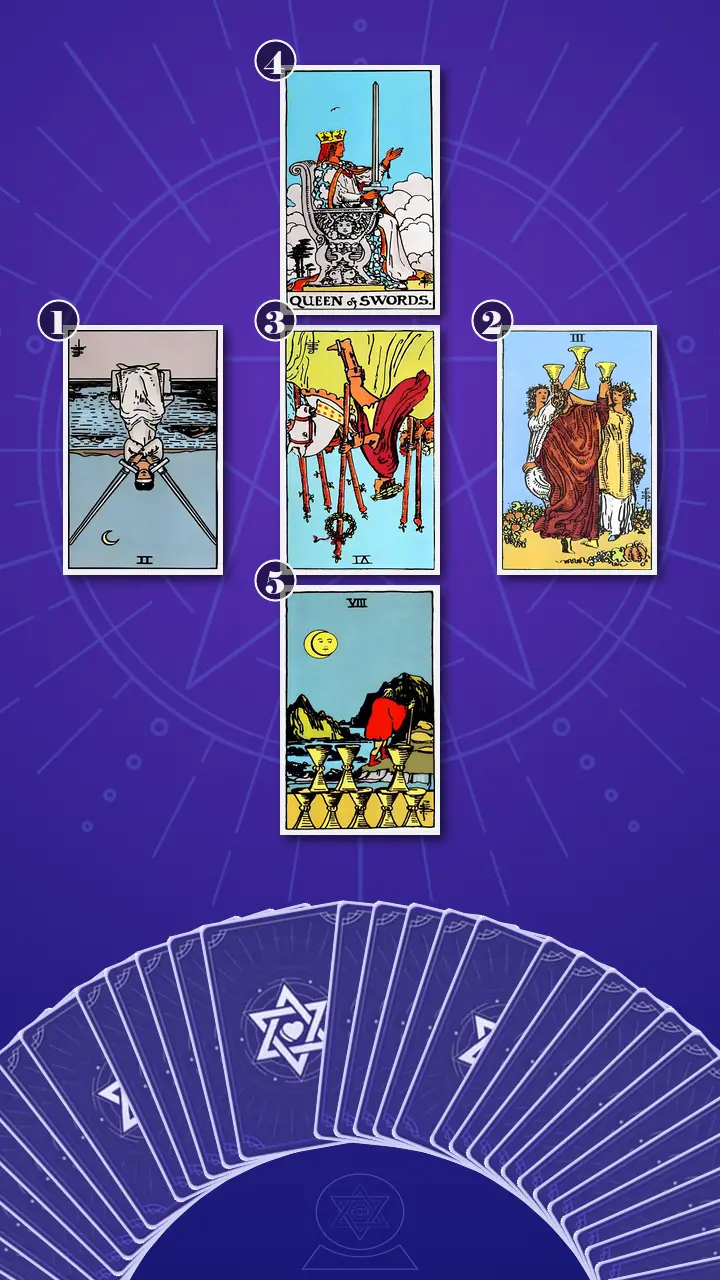
I chose a five-card spread I use often for friendship guilt and boundary clarity: the Relationship Spread · Context Edition. When people ask me how tarot works for something as modern as group chat anxiety, this is the part I point to. I don't use card meanings as floating slogans; I use them in context. Because Maya's struggle lived at the intersection of external invitations and internal guilt, a relationship spread was more precise than a purely introspective line. I needed to see her immediate response, the group's actual energy, the hidden pattern between those two things, the boundary lesson, and the next practical step.
I told her how I would read it. The first card would show the freeze response that takes over when she gets an invite she doesn't want. The second would show what the group is truly offering. The center card would reveal the approval bind—the emotional knot. The fourth card, above it, would name the truth that could break the pattern. And the final card would point toward healthier, more selective belonging: not isolation, not performance, just the next honest move.
Reading the Social Compass
Position 1: The Freeze That Calls Itself Politeness
I turned over the card that shows the immediate guilt-and-delay response when Maya receives an invite she does not want. It was the Two of Swords, reversed.
I showed her the image and translated it into the life she was already living. This was Maya on a Thursday commute, reading 'patio tomorrow?' and feeling an immediate no in her body, then trying to buy time by doing nothing. She locks her phone, reopens the thread, checks whether anyone has followed up, and drafts softer language in Notes instead of answering the actual question. The blindfold becomes pretending she doesn't already know her answer. The crossed swords over the chest become self-protection through delay. The still water under the moon becomes all the unspoken emotion underneath a supposedly simple RSVP.
Energetically, I read this as blocked Air. Her mind thinks it is staying neutral, but her body experiences it as holding a breath too long. I told her, 'An unanswered invite still keeps your nervous system at the party.' This card didn't say she was indecisive by nature. It said a clean choice had started feeling socially dangerous, so she used silence as a softer-looking boundary.
Maya let out a short laugh that carried more sting than amusement. 'That's accurate to an insulting degree,' she said. Her thumb kept rubbing the edge of her phone case, then finally stopped. I smiled and answered, 'Good. Accuracy means we're at the real problem, not the polite decoy. The question isn't whether the plan is good. It's whether being seen making a clear choice feels more threatening than the plan itself.'
Position 2: Friendly Is Not the Same as Fitting
Next I turned over the card that shows what the group is actually bringing: casual social inclusion rather than deep personal attunement. It was the Three of Cups, upright.
This card was important, because it removed the need for villains. In modern life, it looks like birthdays, patio drinks, loose brunch plans, the kind of group warmth that is genuinely friendly on paper. Nobody has to be malicious for the fit to still be wrong. The three raised cups and circular motion told me the group's energy was socially open and balanced, but light. Communal Water, not intimate attunement.
As a perfumer, I have learned that a fragrance can be beautiful in the air and still completely wrong on someone's skin. That thought flashed through me as I looked at the card. I told Maya, 'This doesn't say these people are bad for you. It says they may be pleasant in the room and still not be your scent, your rhythm, your depth. Being included is not the same as being aligned.'
Her shoulders dropped a fraction. 'That makes me feel less mean,' she said. I nodded. 'Exactly. This is not about proving you're above anyone. It's about admitting that friendly and nourishing are not the same category.' I could feel her defensiveness loosen there, because she no longer had to justify wanting distance from people who were, technically, nice enough.
Position 3: The Invisible Likability Leaderboard
Then I turned the center card—the one that reveals the hidden bind, the place where visible participation gets tangled with likability, approval, and belonging. It was the Six of Wands, reversed.
This was the hinge of the whole reading. In real life, this card is the moment a casual invite stops being about the actual plan and starts feeling like a public likability test. Maya declines or delays, then checks stories, reactions, or read receipts as if they might contain a verdict. I described the exact scene back to her: Saturday night, takeout open on the couch, genuinely relieved she stayed home—until Instagram Stories starts rolling patio clips anyway. Clinking glasses. Flash-lit selfies. The ice in someone else's drink louder than it should be through the phone speaker. And suddenly the inner scoreboard lights up: They probably noticed. They probably talked about it. They probably think I'm weird now.
Energetically, this is reversed Fire—recognition energy turned inward and unstable. Visibility gets overcharged. The plan is small; the imagined audience becomes huge. I said it plainly: 'The plan is not what gets huge in your mind; the imagined audience does. You're turning one Friday RSVP into a social performance review nobody officially announced.'
She went still in three waves. First her breathing paused. Then her eyes shifted past the table as if she were replaying dozens of tiny scenes at once: the unread bubble, the follow-up text, the Instagram Stories afterward. Then came the drop in her chest, visible even in the way her shoulders softened. 'This is exactly what I do after I say no,' she said quietly. I answered, 'Then we know the guilt isn't proof you should go. It's proof you've learned to treat attendance like evidence of worth.'
When the Queen Lifted Her Sword
Position 4: Kindness Without Over-Availability
When I reached for the card above the center, the room changed. A wash of grey afternoon light moved across the table from the window, and for a second the air looked as clear and sharp as glass. This was the lesson card—the antidote. It was the Queen of Swords, upright.
I looked at Maya and gave the truth its proper space. She knew on the train home that her answer was already no. The hardest part was never deciding whether she wanted the plan. The hardest part was deciding what that no would mean about her.
The Sentence That Changed the Room
Stop hiding behind the crossed pause of indecision; lift the Queen's sword and answer with one clear truth that protects your peace without attacking anyone.
A respectful no is not cruelty. It is the moment social access stops being the price of your self-worth.
I let that sit between us for a beat. Then I showed her the card in the language of her real life: this is the brief, respectful text that says she will pass, instead of three softening paragraphs built to prove she is still a good person. Upright sword: one clean truth. Open hand: courtesy without over-access. Clear gaze: trusting what her body already knew. No defense speech. No disappearing act. Just one true sentence.
This is also where I brought in one of the diagnostic tools I use most naturally, what I call an Aura Permeability Diagnosis. In scent work, some rooms are not objectively toxic, but they are too porous for a certain nervous system; every note in the space seeps in too fast, too deep, until a person can no longer tell what is theirs and what belongs to the room. I told Maya, 'That's what has been happening here. Not because you're weak, and not because this group is evil. Your boundary gets too permeable around their casual social energy, so an ordinary invite diffuses straight into your self-worth. The Queen of Swords is how you reduce that permeability. She doesn't harden you. She clarifies the air.'
Maya froze again, but this time the stillness was different. First the mug stopped halfway to her mouth. Then her eyes unfocused, as if the entire pattern were rewinding inside her—the train ride, the Notes drafts, the silent monitoring, the weekends lost to a two-minute RSVP. Then the exhale came, long and shaky, and I watched the tension leave her jaw. Relief arrived with anger threaded through it. 'But if that's true,' she said, voice low and suddenly sharper, 'doesn't that mean I've been bending myself into knots for people who maybe weren't even asking that much of me?' Her eyes glossed, not dramatically, just enough to show the sting of recognition. There is always a strange, dizzy second after a burden lifts: a little blankness, a little grief, the first sober glimpse of responsibility. I kept my tone warm. 'It means you learned to manage access as if it were safety. Now you get to separate the two. That is not failure. That's maturity.' In that moment, I could feel the shift clearly: from guilt-driven delay and imagined social judgment to the first solid inch of selective belonging and self-respecting honesty.
I asked her, 'Using this lens, can you think of a moment last week when this would have changed how you felt?' She nodded immediately. 'When they sent, Are you coming? I thought I needed the perfect wording so I wouldn't sound cold.' I answered, 'Exactly. The wording wasn't the whole issue. The issue was that you thought clarity needed to earn innocence first.' A respectful no is not a character flaw.
Position 5: The Quieter Path That Still Counts as Belonging
Finally, I turned over the guidance card, the one offering the next step toward selective, self-respecting connection instead of guilt-based compliance. It was the Eight of Cups, upright.
I love this card because it is quieter than people expect. It is not dramatic social exile. It is not deleting everyone, burning bridges, or proving a point. In modern life, it looks like leaving more mismatched invites with a clean no and making room for something that actually feels like yourself again: a walk with one friend, an early night, a smaller community, an evening where your voice doesn't feel edited before it even leaves your mouth.
Energetically, this is purposeful Water. Something can be available and still not be nourishing. The stacked cups stay standing; the figure still walks away. I told Maya, 'This card says you are not rejecting connection. You are redirecting it. Available is not the same as aligned, just as friendly is not the same as restorative.'
Her expression softened into something almost wistful. 'I miss leaving social time more energized than depleted,' she said. 'Then that's your compass,' I told her. 'Not maximum inclusion. Not perfect likability. Fit. This is the first step out of feeling stuck in a crowded doorway. You don't have to go everywhere just because the door is open.'
From Insight to Action: The One-Sentence No
When I looked back over the full spread, the story was remarkably clean. First, the Two of Swords reversed showed Maya's freeze response: the browser tab left open in her mind, the unread invite pretending to be neutrality while quietly draining her. Then the Three of Cups showed the group's actual offering: casual inclusion, light social warmth, not deep fit. At the center, the Six of Wands reversed named the real blockage: she had been treating visible participation like proof of likability. Above that, the Queen of Swords separated kindness from over-availability. And below it, the Eight of Cups turned the insight into movement: less guilt-management, more chosen alignment.
I told her the blind spot directly. 'You have been equating responsiveness with goodness. That is why one text can trigger decision fatigue, group chat anxiety, and the urge to over-explain. But the transformation here is simpler than it feels: move from trying to be socially acceptable at all costs to using honest discernment about fit.' If you need a three-paragraph excuse, you may be trying to buy innocence, not clarity.
Because Maya's body was absorbing the whole room before her mind even replied, I gave her the somatic tool I use when someone's boundaries feel too porous: The Scent Bubble Protocol. Before opening a draining group thread, place one hand lightly on the center of the chest, inhale for three slow counts, and imagine a clean perimeter of air around your body—nothing icy, nothing hostile, just a breathable boundary. Courtesy can pass outward. Pressure does not get automatic access inward.
- The One-Sentence NoTonight, save this exact text in your Notes app: 'Thanks for thinking of me — I'm going to pass this time, but hope you have fun.' Then, on one low-stakes invite this week, send it within 15 minutes of opening the message and mute the chat for 10 minutes afterward.If your body spikes, use the Scent Bubble Protocol first and remember: brevity is not cruelty. Your job is to answer the question, not design the emotional weather for everyone else.
- The Plan vs Reassurance CheckBefore your next RSVP, open a note and write two headings: 'Do I want the plan?' and 'Do I want the reassurance of being included?' Give yourself one honest line under each before you reply.If the second answer is louder, treat that as useful data, not a reason to say yes. If stories make the spiral worse, mute them for the night.
- One Protected EveningPick one evening this week and put it in your calendar as 'mine.' Use part of that time either to rest without staying vaguely available or to text one person you actually feel relaxed around and suggest a coffee, walk, or voice-note catch-up.Keep it small. This is not a social life overhaul. It is the first proof that selective belonging creates space instead of drama.
The goal is not to become harder. It is to become clearer. That is why I return to the Relationship Spread · Context Edition so often for friendship boundaries: it doesn't tell you who to cut off. It shows you where your energy is getting distorted, and how to take your own agency back.

A Week Later: The Quiet Proof
A week later, Maya sent me a screenshot. The text was plain: 'Thanks for thinking of me — I'm going to pass this time, but hope you have fun.' Underneath it she wrote, 'Muted the chat. Felt like I was about to be arrested for six minutes. Then... literally nothing catastrophic happened.' One person sent a heart reaction. Another said, 'No worries.' That was it. No tribunal. No social collapse.
She had also marked one midweek evening as hers and used part of it to text a friend from work she actually felt calm around. They got coffee instead of doing the whole loud-group routine. She told me she left that conversation feeling strangely awake. Clear but still a little tender, she slept a full night, and in the morning her first thought was still, What if they think I'm cold? This time, though, she smiled, made coffee, and let the thought pass through instead of building a life around it.
I have learned, over many readings and many quieter forms of courage, that this is what a real Journey to Clarity usually looks like. Not a personality transplant. Not the sudden disappearance of every old fear. Just the first clean piece of evidence that your self-respect can survive someone else's access to you becoming smaller. Tarot did not make Maya's choice for her. It helped her hear the choice her body had been making all along.
Sometimes the tightness in your chest is not a sign that you are doing something wrong; it is what it feels like when you are trying to stay welcome in a room your body has already stepped back from.
If being invited did not have to decide your worth, what might your next small, honest response make room for inside your own clean air?
This story is adapted from psychological research, written so that those in a similar struggle can see their own pattern in it — and find their next step clearly.These insights are not a substitute for professional psychological, medical, legal, or financial advice.
Learn more about our Journey to Clarity.
How did this insight land for you?
🫂 This Resonates Deeply
🌀 Living This Story
✨ Now I See Clearly
🌱 Seeing New Possibilities
🧰 Useful Framework
🔮 The Confirmation I Needed
💪 Feeling Empowered
🚀 Ready for My Next Step
Author Profile
 AI
AI“As a perfumer for fifteen years, I’ve learned to perceive human boundaries through the delicate metaphor of scent. Relationships need the right amount of space to breathe, and I've seen too many kind souls exhaust themselves trying to please everyone. I’m here with warmth and understanding—not to teach you to be guarded, but to help you gently clear the air and rediscover the comforting, safe boundaries that are rightfully yours.”
In this Social Tarot Reading :
Core Expertise
- Aura Permeability Diagnosis: Using scent as a metaphor to identify environments where your personal boundaries are too porous, allowing toxic group vibes to permeate.
- Sensory Overload Management: Diagnosing the physical and emotional exhaustion caused by absorbing the chaotic energy of crowds.
Service Features
- The Scent Bubble Protocol: A visualization and somatic anchoring technique to establish an impenetrable energetic perimeter before entering draining social ecosystems.
Also specializes in :
Explore Related Patterns:
Boundary DiscernmentMaya's clarity begins when the group is allowed to be friendly without automatically becoming a fit. The story repeats this distinction several ways: casual inclusion is real, but it is not the same as attunement; available is not the same as aligned; a door being open does not mean she has to walk through it. Boundary Discernment is the pattern of filtering access without turning every no into rejection. It uses differentiated thinking: what belongs to the group, what belongs to you, what is courteous, and what is over-availability. That distinction lets You stop treating a normal invitation as a demand for emotional compliance. This pattern is especially relevant because the healthier endpoint is not isolation. Maya still chooses connection, but she redirects it toward a calmer coffee with someone she actually feels relaxed around. The audit is not "Should I be more social or less social?" It is "Which social access actually fits my nervous system, my values, and my real desire?"
Conditional Self-WorthMaya's guilt spikes because the group chat invite starts carrying more weight than the plan itself. The story makes this explicit when she treats attendance like evidence of worth and responsiveness like proof of goodness, even while her body already knows she does not want to go. Conditional Self-Worth shows up when your sense of being acceptable depends on performing the right version of yourself for other people. Here, the condition is social availability: reply warmly enough, attend visibly enough, stay easy enough, and maybe you still count as likable. That rule turns an ordinary RSVP into a self-esteem audit. The pattern matters because Maya is not simply unsure about drinks. She is trying to protect her identity as a good, included person by managing how much access others have to her. The moment she learns that a respectful no can survive a neutral group response, the old equation begins to loosen: being invited does not have to decide your worth, and declining does not have to become evidence against you.
Guilt-Driven People-PleasingMaya's first impulse is not to ask whether she wants the patio plan; it is to make sure her no does not make her seem mean. She drafts softer language, delays the reply, and tries to look nice while disappearing, even though the invite itself is casual and the group is not shown as demanding anything extreme. That is the core mechanism of Guilt-Driven People-Pleasing: the boundary gets filtered through moral self-protection. You are not only deciding whether to go out; you are trying to prove that your preference does not make you cold, rude, or ungrateful. The guilt becomes a defense against social disapproval, but it also keeps you over-attuned to everyone else's possible reaction. In this story, the pattern is visible because Maya equates responsiveness with goodness and attendance with worth. The group may be friendly enough, but her nervous system treats declining as a threat to belonging. The useful audit point is that kindness does not require over-availability; a respectful no can preserve connection without turning your social access into the price of being acceptable.
Spotlight EffectAfter Maya says no or even delays, her attention moves to Stories, reactions, read receipts, and imagined conversations about her absence. She is relieved to be home, but patio clips on Instagram quickly turn the quiet evening into a mental courtroom where she assumes the group has noticed and judged her. The Spotlight Effect is the cognitive bias that makes your own visibility feel much larger than it is to other people. In Maya's case, the plan stays small, but the imagined audience becomes huge. Her mind treats one Friday RSVP like a social performance review, even though the later evidence shows a heart reaction, a "No worries," and no real fallout. This pattern directly explains why ignoring or declining the invite feels bad. The discomfort is not proof that the group needs more access to you; it is the pressure of feeling over-watched. Once you can separate actual feedback from imagined surveillance, the boundary becomes less like a public verdict and more like a private, reasonable choice.
Assertive CommunicationMaya's turning point comes through one plain sentence: "Thanks for thinking of me — I'm going to pass this time, but hope you have fun." The response answers the invite without disappearing, defending, apologizing for existing, or building a three-paragraph case for why she is still a good person. Assertive Communication is the mechanism that lets clarity and courtesy coexist. It does not require emotional hardness; it requires a clean boundary that does not outsource its legitimacy to other people's perfect approval. The story frames this as one clear truth that protects peace without attacking anyone. For You, the practical insight is that the guilt is partly intensified by the communication gap between what your body knows and what your message tries to perform. A brief, respectful no closes that gap. It gives the other person enough information while refusing the old job of designing the emotional weather for the entire group.
Explore Related Struggles:
Access-Belonging FusionMaya’s body answers the invite before her message does: she leans away, feels the knot, and already knows she does not want to go. The trouble starts when that simple no gets pulled into the larger question of whether she still counts if she becomes less available. The group is not framed as cruel or unsafe; it is casually friendly, open, and light. That makes the bind sharper, because there is no obvious villain to push against. You can feel the pressure of being included by people you do not truly click with, then mistaking that access for proof that you still belong. Access-Belonging Fusion names the moment an invitation becomes more than an invitation. You are not only deciding whether to attend drinks; you are trying to protect your place in a social field that may never have asked for that much of you. The clarity begins when belonging stops being measured by how often you keep the door open.
Inner Tribunal LockMaya stays home with takeout and feels relief, until the patio clips start rolling through Instagram Stories. The plan is already over for her body, but the imagined audience is just beginning to speak. Read receipts, reactions, silence, and group photos become evidence in a case no one else has officially opened. She scans them for a verdict: whether they noticed, whether they talked, whether she has become weird or cold. The real feedback arrives later and quietly, when one person sends a heart and another says no worries. Inner Tribunal Lock names the internal courtroom that keeps judging a choice after the outside world has barely reacted. You are not only afraid of the group’s response; you are carrying a review panel inside the moment. Clarity returns when those signals become data points again, not sentencing documents.
Perfect Innocence TrapMaya opens Notes before she opens her mouth. A casual RSVP turns into a search for the perfect sentence, not because she lacks an answer, but because the answer feels like it has to prove she is still kind. The invite only asks whether she is coming, yet her draft tries to solve a much bigger problem: how to decline without leaving any trace of coldness, rejection, or selfishness. That is why the wording feels so heavy. The message has become a moral defense brief for a boundary that was already valid. Perfect Innocence Trap captures the bind where clarity feels unacceptable unless it arrives with enough softness to erase every possible discomfort. You are not being asked to design everyone else’s emotional weather before you answer. You are allowed to let a respectful no be complete without turning it into evidence of your goodness.
Relational Boundary DriftThe group does not need to be hostile for Maya’s boundary to become porous around it. In the story, the room is merely casual, friendly, and not quite right for her, yet its pressure still travels inward faster than her own preference can hold its shape. Courtesy is supposed to move outward as a clean response. Instead, possible disappointment, imagined judgment, and the group’s loose social energy move inward and start occupying her sense of self. That is why one ordinary invite can feel disproportionate without being imaginary. Relational Boundary Drift describes the slow loss of separation between someone else’s access to you and your own inner ground. You are not trying to cut everyone off; you are rebuilding a breathable perimeter where kindness can still leave your body, but social pressure no longer gets automatic permission to decide your worth.
Self-Editing ExhaustionMaya knows the answer on the train, but by the time it reaches the text box, it has been softened, padded, and edited into something safer-looking. The sentence has to decline the plan while also proving she is not rejecting the people. That constant editing has a cost. Her real preference gets compressed into polite camouflage, and every extra phrase asks her to become smaller so the boundary will seem less disruptive. The more she tries to sound harmless, the farther the message moves from the clean truth her body already knew. Self-Editing Exhaustion is the strain of making your own voice acceptable before you let it exist. You are not trying to be fake; you are trying to survive the imagined consequences of sounding clear. The work is not to become blunt or cold, but to stop treating honesty as something that must be endlessly diluted before it can be received.
Social Exit ParalysisMaya does not go, but she does not fully leave either. She locks the phone, reopens the thread, checks whether anyone has followed up, and lets the unanswered invite keep occupying the evening. Silence looks like a low-conflict option from the outside, but inside the story it keeps her nervous system at the party. The group chat becomes a crowded doorway: stepping in would betray her real no, while stepping out would make her choice visible. Social Exit Paralysis names that suspended state where leaving a mismatched social space feels harder than enduring it. You are not stuck because the plan is complicated. You are stuck because a clean exit has been loaded with exposure, judgment, and the fear of becoming less welcome.
Approval-Safety FusionMaya’s delayed replies are not random hesitation. She keeps the social door open because access has started to feel like a safety signal, even when the specific room does not fit her. The invitation is ordinary on the surface: drinks, patio, loose group warmth. Inside, it carries the weight of whether she is still acceptable. That mismatch makes a small act of nonattendance feel larger than the actual social stakes shown in the story. Approval-Safety Fusion is the bind where being liked starts to feel like being protected. You may know the group is not your rhythm, yet still feel exposed when your availability becomes smaller. The work is to let approval become pleasant but nonessential, rather than the thing your body uses to decide whether it is safe to choose honestly.
Explore Related Emotions:
Boundary GuiltOn the Thursday commute, you already know the answer is no, but your body reacts as if the RSVP has to say something about your character. You open Apple Notes, soften the language, and keep trying to sound kind while disappearing, which shows how quickly a boundary turns into self-surveillance. That is why the feeling reads as Boundary Guilt. The invite is not only a plan; it becomes a moral test, and the no starts to feel like it has to prove that you are still good.
Conditional Belonging FearA casual invite turns into a referendum on belonging, so the question is never only whether you want to go. It becomes whether your place in the group still feels secure if you do not show up. Conditional Belonging Fear fits because the story keeps linking attendance with worth. The guilt gets heavier when social access starts to feel like something you have to purchase with compliance.
Approval AnxietyOnce the message lands, the pressure shifts from the plan itself to how you will be read. You start tuning the reply so it will not sound cold, and the later checking of stories and read receipts shows how much weight the imagined audience carries. That is Approval Anxiety in a social setting that rewards being easy to read. The fear is not only rejection; it is being seen as rude, weird, or too much for choosing honestly.
Self-Betrayal AcheYour body leans away before your mind does, but your hand still reaches for Apple Notes and a softer version of the same answer. That split is the ache: the no is already there, yet you keep editing it until your own answer feels distant. Self-Betrayal Ache names the cost of that split. The hurt is not just about missing a plan; it comes from having to negotiate against your own signal in order to stay socially safe.
Explore Related Contexts:
Access as Proof PressureMaya already knows on the train that her answer is no, but the hard part is deciding what that no will mean about her. The invite is no longer just access to patio drinks. It has become proof that she still belongs, and declining it seems to put that proof at risk. Access as Proof Pressure shows up when being invited starts to function like a measure of worth. The group offers casual inclusion, while Maya pays with over-availability, careful wording, and the effort of staying easy to reach. You feel the pressure most sharply when you do not even want the room, but you still want the reassurance of being welcome in it. The story's central knot is that access and alignment have been fused together. Once those separate, the invite can become what it actually is: an option, not a referendum on whether you are acceptable.
Conditional Participation PressureMaya knows the group is friendly on paper, but the fit is wrong. The patio invite is casual, and nobody has to be cruel for the pressure to work. Her guilt comes from the way attendance starts to feel like evidence that she is still easy to like, easy to include, and safe to keep around. That is the structure of Conditional Participation Pressure. The group offers light social warmth, but the cost of staying inside the circle seems to be repeated visible participation. When she stays home with takeout and watches the patio clips roll through Instagram Stories, absence turns into a question about whether she has failed the group's unwritten participation rule. You may feel bad ignoring invites because the invite is carrying more than a plan. It is carrying a hidden belonging test, where saying no seems to risk your place even when the people involved are not openly demanding anything from you.
Notification GuiltMaya is on the 6:18 p.m. TTC when the group chat lights up with a casual patio invite, and her first move is not a clear yes or no. She locks the phone, reopens the thread, watches for follow-up, and starts drafting softer language in Notes before she has even answered the actual question. The external pressure is built into the digital setting. A notification is not just information here; it arrives with read receipts, timing expectations, visible group momentum, and the risk that silence will be interpreted as a social statement. You are not simply deciding whether to go out. You are managing a tiny public doorway where response speed, warmth, and absence all seem readable. Notification Guilt fits because the pain point begins at the moment access appears on the screen. The phone becomes a pressure point between your real preference and the social demand to stay available, pleasant, and easy to include.
Social Performance LoopMaya declines or delays, then checks Stories, reactions, read receipts, and follow-up texts as if they might contain a verdict. Saturday night is not just takeout on the couch; it becomes a replay booth where clinking glasses and flash-lit patio clips seem to comment on whether she is still socially acceptable. The loop is external because the social field keeps producing visible cues. Group chats, story posts, and reaction icons create a stage where even a small RSVP can feel like a performance review. You end up evaluating your own status through the group's digital afterimage instead of through the simple fact that you did not want the plan. Social Performance Loop names the repeated structure where the invite, the delay, the declined plan, and the post-event checking all feed each other. The actual plan stays small, but the imagined audience expands until your no feels like something you have to publicly survive.
Friendship Boundary NegotiationMaya's practical shift begins with a single sentence: thanks for thinking of me, I am going to pass this time, but hope you have fun. She does not disappear, write three paragraphs, or turn the group into villains. She answers the actual question and then mutes the chat long enough to let the boundary hold. Friendship Boundary Negotiation is the external work of staying courteous without handing over unlimited access. The group is friendly but mismatched, so the task is not dramatic rejection. It is learning how to occupy a legitimate social position where you can decline, stay kind, and stop using over-explanation as proof that you are still good. This context directly answers the question because ignoring the invite is not the only option between compliance and withdrawal. You can build a cleaner social rule: brief honesty outward, less automatic pressure inward, and more room for connections that do not require you to edit yourself before you speak.