When Your Degree Stops Fitting

A grounded look at nonstandard study routes, related tarot cards, and reading insights from similar academic pressure.

Off-script Academic Path

What is this situation?

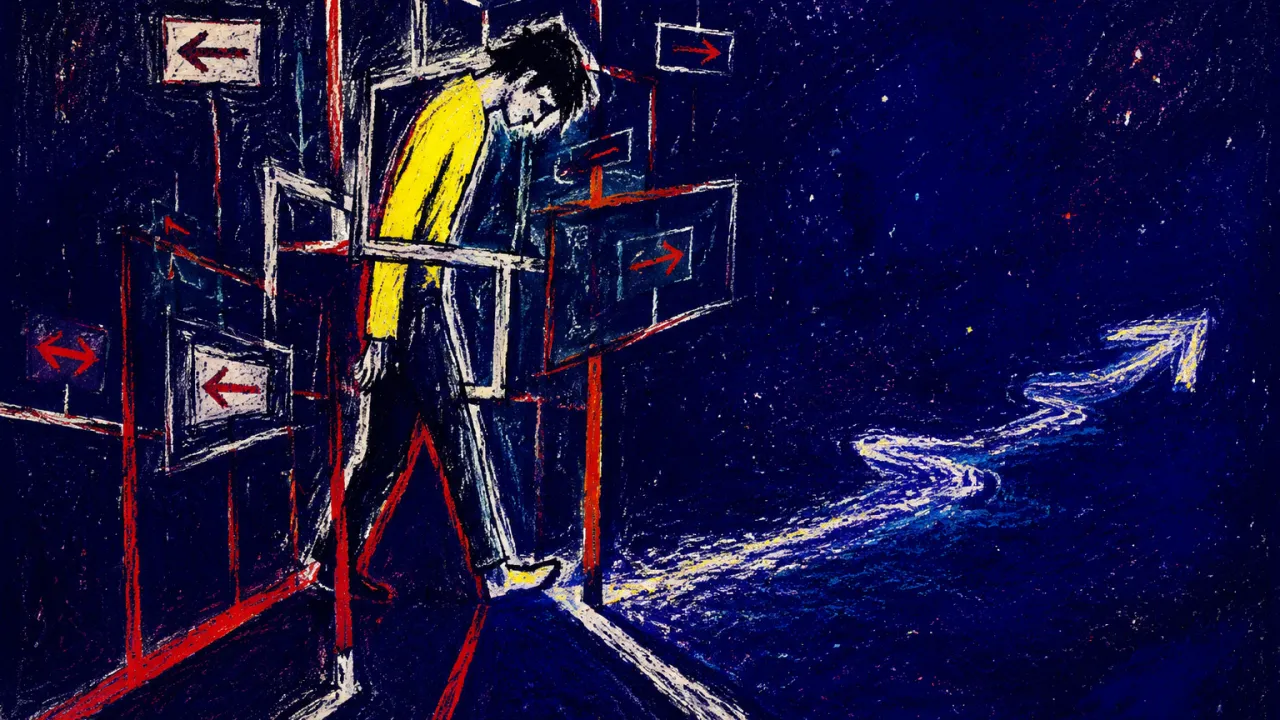
Off-Script Academic Path — you first notice it when the neat academic sequence everyone seems to understand stops matching the route in front of you. Maybe it happens in a registrar portal at midnight, when the credits do not line up cleanly; maybe it happens in an advisor's office, where your plan gets treated like a problem to simplify; maybe it happens when classmates talk about internships, grad school, or the next expected step and your own answer needs three explanations before anyone stops looking confused. You may be changing majors late, returning to study after time away, mixing disciplines, transferring, leaving a prestige track, building an independent research direction, or choosing a program that does not sound impressive in the usual shorthand. The institution still asks for forms, deadlines, prerequisites, references, funding logic, and a clean narrative, but the route you are trying to take was not built into the default map. Advisors may be helpful and still limited by policy; friends may mean well and still keep asking when you will “settle”; relatives may frame the safer option as obvious; departments may reward the path they already know how to measure. So your week becomes a sequence of translation work: explaining why the switch is not random, why the delay is not failure, why the unusual combination has a method, why your transcript does not tell the whole picture. The exhaustion comes from having to keep academic seriousness visible when the surrounding system is designed to recognize linear progress first. By the time you finish another email, another application box, another conversation about whether this “counts,” the path can feel like open air with no marked corridor under your feet, much like The Fool standing outside the road, carrying only a small bundle while the body itself becomes the route.

Why it's not you?

This is not a sign that you are unfocused or unserious. Degree maps, advising systems, scholarship timelines, and department expectations are usually built around linear routes, so anything mixed, delayed, or self-directed has to fight harder to be recognized. The friction belongs to the academic structure around you, not to some personal defect in your desire to study differently.

Off-script Academic Path in Tarot Cards

The Off-Script Academic Path is not just a private preference; it shows up in advisor meetings, degree audits, transfer rules, and the need to keep explaining why your route makes sense. That tightness in your chest before another conversation about credits or plans belongs to an environmental, structural dynamic where the system recognizes straight lines faster than mixed, delayed, or self-built routes. The cards below do not tell you which program to choose; they reflect the visible shape of this academic pressure. These Tarot Cards map the contours of a path that has to build its own coordinates.

The Fool Upright
The Fool stands outside the marked road, dressed in symbolic layers, holding a rose, and carrying only a small bundle into open air. Nothing in the image resembles a classroom corridor, a ranked ladder, or a standardized sequence; the body itself becomes the route. That visual structure fits an academic path that does not follow the expected script. You may be changing majors, returning to study later, combining credentials, leaving a prestige track, or choosing a learning route that other people cannot easily categorize. The card does not romanticize being unconventional. The cliff edge shows the cost of leaving inherited maps behind: the freedom is real, but so is the need to build your own coordinates, because the institution may not provide them once you stop moving in a familiar line.
The Magician Upright
The figure stands alone at a self-contained table, not inside a classroom, lecture hall, or institutional corridor. The garden and work surface create a private operating field where the path has to be made through focused use of the available tools. Academically, this fits the student who is considering a major change, an unusual research direction, a nontraditional program, or a self-built learning route. You are not being placed outside legitimacy; the scene shows a route where legitimacy has to be constructed through method, evidence, and sustained output rather than inherited from the default script.
The High Priestess Upright
The High Priestess sits at the threshold between two pillars, not choosing one side by collapsing into it. Her posture holds the middle space with discipline, suggesting a path that has to be legitimized from within before it is legible from the outside. In academic life, that image fits the student considering a major change, interdisciplinary route, independent study, return to education, or graduate direction that does not follow the expected script. The issue is not rebellion for its own sake; it is the work of building coherence between two academic worlds that do not automatically recognize each other. The card gives the off-script path a stable center. It shows that a nonstandard route still needs structure, boundaries, and a language of legitimacy, so the question becomes how to make the path intelligible without flattening the reason it matters.
The Chariot Upright
The chariot is parked at the edge of the city rather than moving neatly through its streets. The driver has status, tools, and direction, but the scene is a threshold image: the old institutional center is behind him, and the route ahead has not yet become a paved academic road. This is the outer context of changing majors late, leaving a default program, building an independent study plan, or choosing a field that does not match the expected script. You are still dealing with applications, credits, advisors, and institutional legitimacy, but the path now requires more self-navigation than inherited sequence. The Chariot supports this reading because its power is not passive drift; it is directed movement through opposing pulls. The card names the real academic pressure of going off-script: you need enough structure to move, but not so much borrowed structure that it drives you back into a route that no longer fits.
The Hermit Upright
The Hermit is not pictured inside a classroom, library, or institution; he stands apart on a high ridge with his own lamp. The scene gives him perspective, but it also removes the comfort of a shared route, a cohort path, or a visible academic script. In study life, this describes the student who is changing fields, returning to education, designing an unusual research focus, learning independently, or choosing a route that does not look linear on paper. The solitude is not empty; it is the cost of building a path that existing structures do not fully map. The card keeps the emphasis on agency without romanticizing isolation. You have a light and a vantage point, but the academic system may still ask you to translate your path into forms, deadlines, references, and explanations that were built for more conventional trajectories.
The Hanged Man Upright
Feet above the head and one leg folded into an inverted shape make the whole body read as a legitimate form that refuses the normal standing order. The image does not scatter; it stays centered inside the frame while the direction of the body contradicts the default orientation. In academic life, that visual structure mirrors a major, thesis topic, study route, or graduate plan that no longer follows the expected track. You may still be inside the institution, but the path asks to be evaluated by its own logic rather than by the straight-line script other people recognize fastest.
Death Upright
The rider crosses the card without asking the fallen crown, the kneeling figures, or the praying authority to approve the direction of movement. Behind the disruption, a river and a distant route continue toward the towers, showing that the path forward exists outside the old arrangement of rank and permission. For academic life, this speaks to the moment when the expected route no longer matches the actual shape of your learning. The pressure may come from a prestigious major, a family-approved track, a supervisor's preferred topic, or a degree sequence that made sense on paper but no longer fits the work you are becoming able to do. This card links to an off-script academic path because the visible movement is not random escape. It is a forced reorientation of space: You are not trying to abandon seriousness, but to find a study route where effort, curiosity, and institutional reality can occupy the same ground.
The Sun Upright
The white horse moves without reins or bridle, and the child does not hold the animal in the usual way. The wall behind them marks a boundary already crossed, while the open body shows movement that is not being managed by a conventional control system. In academic terms, this reflects the pressure of choosing an independent research route, changing majors, designing a self-directed study plan, or stepping away from the expected credential path. You are not outside structure entirely; the card shows a threshold where the default script no longer provides enough steering, so the path has to be evaluated by fit, coherence, and real support.
Eight of Cups Upright
The solitary figure is not drifting in place; the red clothing, staff, and uphill route make departure visible as a chosen movement through difficult terrain. The path does not lead back into the cup structure, and the higher ground suggests a vantage point that cannot be reached by staying inside the old arrangement. For study, this maps onto the moment when the approved academic script stops matching the actual direction of growth. A conventional major sequence, prestige track, or expected postgraduate route may still look orderly, but the path that carries your attention has moved elsewhere. The card does not romanticize the alternative route. The landscape is dark, wet, and uneven, which makes the off-script path a real structural threshold rather than a clean rebrand. Its value lies in naming the difference between avoidance and a serious relocation of academic direction.
Knight of Cups Upright
The white horse moves toward the river at a measured pace, with the cup held forward like a meaningful academic offering rather than a trophy already secured. The landscape gives enough direction to move, but the bank beyond the water is not fully mapped, so progress depends on careful crossing rather than automatic compliance with a preset route. That visual structure fits the student who is choosing a less standard course combination, research topic, transfer plan, or graduate route. You may have a real intellectual pull, but the institutional path around it is thinner, less signposted, and harder to explain to people who expect a conventional sequence. The card does not frame the off-script route as random wandering. It shows a disciplined crossing where meaning has to be protected while practical navigation stays active, making the academic question less about whether the desire is valid and more about what structure can carry it across the next threshold.
Two of Wands Upright
The castle contains an established domain, but the figure's gaze is pulled past it toward sea, coastline, mountains, and the globe in his hand. The familiar structure is still solid beneath him, yet the visual field keeps insisting on a wider academic territory. In study, this becomes the pressure of moving outside the default route: an interdisciplinary topic, a transfer, a research question your department does not automatically reward, or a graduate path that does not match the standard script. The old structure still has value, but it no longer contains the whole map. The Two of Wands gives this off-script path a disciplined frame. It does not romanticize the leap; it asks whether the wider route has enough real terrain, support, and timing to become more than a private fantasy of escape.
Seven of Wands Upright
The figure is not standing on a smooth road; he is balancing on rugged high ground with his feet split across an unstable edge and a small stream. The wand becomes an extension of his body, so the position he defends is not just an idea but a chosen route through difficult terrain. In academic life, this fits the student who is defending a nonstandard research question, a major switch, an interdisciplinary project, a transfer plan, or a postgraduate route that does not look linear from the outside. The pressure comes from having enough perspective to see the path, while still having to justify it to people standing in more conventional positions. The card gives the situation a clean frame: the off-script route is not automatically reckless, but it does require a stronger visible rationale. You are being asked to translate personal academic direction into a form the surrounding system can recognize.
Knight of Wands Upright
The open desert and distant pyramids give the rider a target without offering a paved road. The scene has direction, but its route must be made through sparse terrain rather than handed over by a settled institution. When you are considering an unusual major, research niche, transfer route, or fieldwork path, the card points to the cost and power of leaving the obvious track. The path is not empty; it asks you to build coordinates, supplies, and pacing around a route that may not yet be socially legible.

Off-script Academic Path in Tarot Card Reading Insights

When an Off-Script Academic Path starts affecting applications, advisor meetings, course choices, or the way people read your transcript, it often becomes something people bring into readings. The focus shifts from the card list to how this academic pressure appears when others sit with similar questions. Tarot Reading Insights from sessions on nonstandard study routes.

Psychological contexts related to Off-script Academic Path