The Revolving Door: Returning to a Relationship Despite a Values Mismatch
If you have already told your friends that the boundary is final but spend Sunday night switching between the Notes app and the chat, I know the pressure is not abstract. It is the fear that a quiet week means you gave up your only real connection, the private question behind so many searches for why you keep breaking no contact.
I met Maya (name changed for privacy) at 11:40 p.m. on a Sunday in her shared Toronto apartment. The Notes app was open to a list titled Why I left, but the chat sat one tap away; blue light lay across the duvet, the radiator clicked in the corner, and her phone felt warm against her palm. I watched her type I miss you too, delete it, replay three old voice messages, and send the reply anyway.
She looked up at me and said, I know why I left, so why does that reason feel less real the moment I miss them? Why do I keep going back when this relationship clashes with my values?
Her longing looked to me like a browser tab she had closed for her own clarity, then reopened because the blank screen felt more frightening than the unfinished conversation. Her chest had tightened, her thumb kept hovering over the phone, and the warmth of an old message was asking to become evidence that the relationship was compatible.
I said, I do not doubt that you miss them; I doubt what missing them is being asked to prove. We do not have to shame the affection or force a decision tonight. We can give the feeling a shape, look at the pattern, and draw a map toward clarity together.

Choosing a Compass for the Return Loop
I invited Maya to put the phone face down, take three slow breaths, and name the question without trying to solve it. I shuffled slowly while she focused on the difference between what she valued and what she feared losing. The purpose was not to summon an outside authority; it was to create a clean pause in which her own observations could become easier to hear.
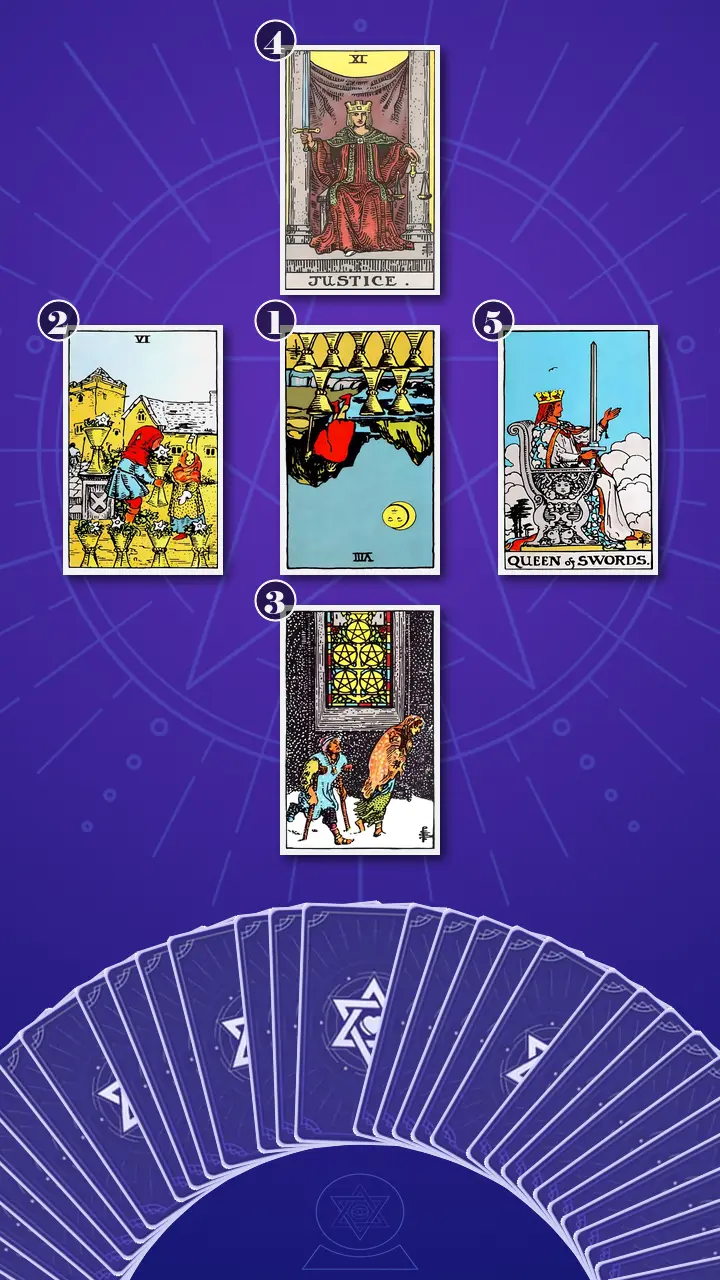
Today I used a five-card spread called The Shadow Spread. I chose it because the relationship is the setting, but the real question concerns Maya's repeated behavior, the emotional trigger, the hidden fear, the truth that can reorganize the pattern, and the practice that can bring that truth into daily life. In the F5 Inner Excavation framework, it is the smallest structure that covers the full movement from visible pattern to integration.
For anyone wondering how tarot works in a grounded reading, this is the difference between prediction and reflection. The cards do not decide what the other person will do, whether the relationship will last, or what Maya must choose. They give card meanings in context: a visual language for comparing her lived experience with the standards she already says matter to her.
I placed the first card in the center as the observable return behavior, the second to the left as the nostalgic trigger, the third below as the fear of losing belonging, the fourth above as the values-based corrective, and the fifth to the right as the boundary practice. The cross looked like a compass centered on a revolving door. We would begin with the loop, trace what pulled her back, descend to the fear beneath it, rise into discernment, and finish with a form of communication she could actually maintain.
Reading the Map Before the Message Wins
Position 1: The Reopened Chat, Eight of Cups Reversed
I said, Now I am turning over the card representing the observable return behavior: resuming contact before the value conflict has been addressed. The card was the Eight of Cups, in reversed position.
The cloaked figure on the card has already turned away from eight carefully arranged cups, yet the reversed position makes the departure stall. The missing space in the row is important: something has been recognized, but the distance has not yet become a stable boundary. The moon hangs above a steep path, and the emotional landscape beyond the familiar cups looks harder to enter than the chat window Maya already knows how to open.
This is a blockage in the energy of leaving. Maya has enough clarity to write Why I left, but not enough separation from the immediate discomfort to let that clarity guide the next ten minutes. The overcorrection is understandable: to prove she is not cold, rigid, or unfair, she replies quickly, explains too much, and agrees to meet without new conditions. Access to the relationship returns before the original incompatibility has had to answer for itself.
I connected the card directly to her Sunday ritual. She closes the chat, reopens it within minutes, rereads the affectionate exchanges, and tells herself, I already decided, but maybe I need one more piece of context. The phone becomes a revolving door that offers the relief of indoor warmth while returning her to the same exit. She is not discovering that the conflict was imaginary; she is trying to make familiarity quiet the uncertainty of holding her boundary.
Maya gave a small, bitter laugh. That is too accurate. Almost cruel. Her thumb pressed into the edge of the phone, then released. I told her that the card was naming a sequence, not judging her character: the win was noticing the loop before interpreting the return as proof that leaving had been wrong. I asked her to watch the ten minutes before a reply and to let a twenty-four-hour pause protect the decision from the emotional spike.
Position 2: The Edited Memory, Six of Cups Upright
I said, Now I am turning over the card representing the immediate emotional trigger that makes returning feel more compelling than maintaining the boundary. The card was the Six of Cups, in upright position.
I asked Maya to picture herself at Bloor-Yonge Station at 7:26 p.m. on a Thursday, one earbud in, an old voice message playing while the platform smelled faintly of rain and warm concrete. The person's laugh came through the recording, the announcement echoed overhead, and her face softened before her stomach dropped as the reason for leaving returned. This was the child offering a flower-filled cup: a small, tender gift from the past that makes the whole courtyard feel safe for a moment.
The Six of Cups shows nostalgia with its emotional volume turned up. The warmth is genuine, but the memory is protected and edited. A shared Spotify playlist, a familiar restaurant, an old photograph, or one affectionate iMessage can make the relationship's kindest moments fill the entire frame while the unresolved values conflict slips outside it. The energy is not false; it is incomplete. When it becomes the only evidence Maya consults, selective tenderness overpowers present-day discernment.
I said, A warm memory is evidence that the warmth was real, not evidence that the conflict disappeared. I watched Maya remove the earbud and look toward the imagined tracks beyond the card. She nodded once, but her mouth tightened. She could honor the relationship's sweetness without using that sweetness to erase what had repeatedly made her step away.
She told me, I keep treating chemistry like evidence of compatibility. I asked her to let chemistry remain what it was: a real feeling, a meaningful history, perhaps even a source of grief, but not a complete compatibility audit. A photo carousel can crop the conflict out of every frame. The work was to widen the frame without insulting the picture.
Position 3: The Lit Window in the Snow, Five of Pentacles Upright
I said, Now I am turning over the card representing the hidden fear of losing connection and belonging that sustains the return cycle. The card was the Five of Pentacles, in upright position.
I brought Maya to the scene at 5:48 p.m. on a quiet Sunday in her apartment. She checked Google Calendar and saw no plans until Wednesday. The refrigerator hummed, a mug of cold tea sat beside her laptop, and the hallway light shone beneath the door while the rest of the room felt hollow. The two figures passing beneath the illuminated stained-glass window became the part of her that assumed warmth existed only inside this relationship.
The Five of Pentacles puts the physical weight of relational scarcity on the table. Separation is not only the loss of this person; in the hardest moments, it begins to look like evidence that meaningful connection is scarce and that protecting her values will leave her outside of love. That belief makes an incompatible connection feel safer than an uncertain social future. Renewed contact then regulates two pains at once: longing for the person and fear of an empty week.
Maya's breathing paused first. Then her gaze drifted beyond the cards, as if she were replaying the blank calendar and noticing the difference between being alone tonight and being abandoned forever. Finally, she let out a long breath from deep in her chest, and her shoulders fell an inch.
She whispered, If I hold the boundary, who is left? I answered, Sometimes the urge to go back is asking for belonging, not asking for this particular relationship. I did not use that distinction to pretend the relationship had not mattered. I used it to give her more than one route toward warmth: a friend, a low-pressure call, a walk, a public place, a group chat, or simply a change of setting before the phone became the only lit window.
The Five of Pentacles was the catalyst card because it showed what the Six of Cups had been protecting her from feeling. The return was not irrational or shameful. It was a familiar attempt to solve the pain of exclusion quickly. Once the fear had a name, it no longer had to disguise itself as proof that this particular relationship was the only possible home.
When Justice Held the Scales
Position 4: The Standard That Stays, Justice Upright
I paused before turning the next card. The room grew quiet enough for me to hear the radiator click once, and the blue glow from the phone no longer seemed to command the table.
I said, Now I am turning over the card representing the key transformation: the truth that challenges the belief that longing should outweigh evidence of values incompatibility. The card was Justice, in upright position, the antidote in this reading. Its invoked energy was values-based discernment, self-accountability, and the ability to hold affection without surrendering personal standards.
The balanced golden scales ask Maya to compare her stated values with what has consistently happened, not with the latest affectionate message. The upright sword cuts through exceptions invented during longing. The seated figure between two pillars does not decide for her; the figure models the internal authority required to apply her own standard when the emotional weather changes.
As an artist, I often think in scenes and edits. My mind went to a film timeline with one beautifully lit clip stretched across the whole screen. The clip may be real, but it cannot stand in for the full sequence. Justice asks for the unedited cut: the warm messages, the value conflict, the repeated behavior, the promises, the consequences, and the boundary Maya set when she was thinking clearly.
I also used my signature diagnostic lens, Toxic Script Identification. I asked Maya to notice the roles the interaction kept offering her. One was the Boundary Explainer, who builds a perfect case and keeps adding context in the hope that precise wording will make a painful mismatch safe. The other was the Hopeful Exception-Maker, who treats one affectionate message as permission to suspend the standard. When those roles meet in the chat, the conversation invites the other person into a Reassurer or Negotiator role, and the old pattern can restart without either of them having to address the central value conflict.
I told her that these were not permanent labels, diagnoses, or proof of what the other person intended. They were recurring parts in a script. Naming them created distance from the script, and distance created choice.
At 11:40 p.m. on Sunday, Maya had Why I left open in Notes while the chat filled the screen with warmth. She was not choosing between feeling and values; she was trying to make loneliness decide which one counted. Her hand hovered above the message, waiting for permission from the feeling to abandon the standard she had already written down.
You do not need to treat longing as a verdict; let your values hold the scales and let your next response answer to what is consistently true.
For a moment, Maya's thumb froze above the screen and her breath stopped halfway in. Then her eyes lost focus, as if the old conversations were playing behind the wall in a different room. I saw her mouth part, her pupils widen, and the tight line between her brows soften. Her fingers had been curled around the phone; one by one, they loosened. She drew in a shaky breath, held it, and released it with a quiet sound that was almost a laugh and almost grief. Her shoulders dropped, but the relief brought a brief lightheadedness, the strange blankness that can arrive when a familiar burden is set down and responsibility is still visible in its place.
She said, So I can care about them and still let the pattern count. I said, Exactly. Longing can be present without being the person who makes the decision. I asked, Now, use this new perspective to revisit one moment from last week. Was there a time when this distinction could have made the next ten minutes feel different?
We spent ten quiet minutes writing one value, one specific behavior that had conflicted with it, and one observable change that would need to exist consistently before renewed contact felt aligned. I asked her to set the note aside before rereading the chat. The point was not to force a final answer or make grief disappear. It was the first movement from urgent longing, confusion, and weakened self-trust toward values-based discernment and steadier self-respect.
Position 5: The Doorway with a Clear Sign, Queen of Swords Upright
I said, Now I am turning over the card representing the conscious practice through which this insight can become an everyday boundary. The card was the Queen of Swords, in upright position.
The Queen's raised sword is precise language. Her open left hand is receptivity without surrender. Together they show Maya that a boundary can acknowledge affection without turning itself into a debate. The wind-bent trees beneath a clearing sky suggest the mental space that appears when she no longer has to explain herself until the other person approves of her decision.
I asked Maya to imagine the long message she usually drafts: paragraphs of context, apologies for sounding harsh, reminders of the good times, and carefully softened language that leaves the door open for negotiation. Then I asked her to reduce it to two sentences: I care about what we shared, and I am not available to restart contact while this value conflict remains unresolved. I am taking space rather than debating this boundary by text.
She looked uneasy. I do not want to sound cold. I told her, Precision is not punishment. You can be kind about what you felt and precise about what you will no longer negotiate.
Here I used my Dialogue Loop Auditing lens. We identified the phrases that pulled the exchange toward a dead end: I miss you, maybe this time, perhaps I was too absolute, and any sentence that made Maya responsible for proving the boundary was reasonable. I asked her to underline the trigger, remove the explanation that invited another round, and notice when she started playing the Boundary Explainer again.
Then I introduced my communication practice, The Pattern Interruption Script. I had Maya role-play the familiar scene twice. First, she played the old response: immediate reassurance, a long explanation, and an agreement to meet before asking what had changed. Then she changed one line: I care about what we shared. I am taking twenty-four hours before deciding whether contact is right for me. The small delay shifted the entire dynamic. It stopped the emotional spike from writing the next scene.
Maya did not look euphoric. She looked more present. The Queen of Swords was not promising that a boundary would feel painless. She was showing that self-respect could speak clearly while affection remained in the room.
From Longing to Actionable Next Steps
When I placed all five cards together, I could see the whole story. The reversed Eight of Cups showed a departure that stalled whenever distance became uncomfortable. The Six of Cups supplied selective memories that made the past feel safer than the full relationship. The Five of Pentacles revealed the fear underneath: if Maya protected her values, she might lose not only this person but her sense of belonging. Justice restored a stable standard, and the Queen of Swords turned that standard into humane, repeatable language.
The spread moved from water caught between attachment and nostalgia, through the earth-level fear of scarcity, and into the air of comparison, language, and boundaries. No Wands card appeared. That mattered to me. Another surge of chemistry was not the missing solution. The next movement had to come from a deliberate standard and a small communication practice, not from feeling more intensely.
The cognitive blind spot was treating longing as information about compatibility instead of information about attachment, grief, and belonging. Maya also kept assuming that a boundary had to be defended until the other person agreed with it. The key shift was simpler: review a written values-and-boundaries checklist before responding to renewed contact, then let observable compatibility and consistent behavior share the scales.
The Evidence Before Contact Practice
I told Maya that finding clarity did not require solving the entire relationship in one night. These were the next steps I wanted her to test as small experiments, with an exit point at every stage.
- Evidence Before ContactThis week, whenever a message creates the urge to reply, Maya will open a Notes page titled Evidence before contact, set a twenty-four-hour reminder, and write three observable answers: which value was previously compromised, what has materially changed since the last separation, and what behavior would show that change consistently over time. After the reminder, she can reply, decline, or leave the message unanswered.If the body reaction becomes too strong, close the chat and mute notifications before writing. The pause is a boundary around decision-making, not a punishment. On a difficult day, write only one value and one observable behavior.
- The Two-Sentence BoundaryBefore any emotionally charged conversation, Maya will draft her message in Notes and read it once aloud in the bathroom or on a quiet TTC platform. She will run a Dialogue Loop Audit, remove the paragraph that invites a debate, and use The Pattern Interruption Script to practice the new response before sending anything. Her starting version is: I care about what we shared, and I am not available to restart contact while this value conflict remains unresolved. I am taking space rather than debating this boundary by text.Keep the message to two sentences. If the exchange becomes circular, use one closing line and end the conversation. The boundary does not need an immediate reply from the other person in order to be valid.
- Belonging Beyond One DoorBefore the next Sunday loneliness spike, Maya will put one ten-minute connection on Google Calendar for 6 p.m. She can text a trusted friend for a short call, join a group chat, take a walk with a podcast, or sit in a coffee shop. Afterward, she will write one sentence about what the contact actually provided: company, reassurance, laughter, practical help, or simply a change of setting.A concrete request is easier than explaining the whole breakup-and-reunion history: Can you talk for ten minutes while I walk home? If nobody is free, choose a public library, cafe, or familiar podcast. The purpose is not to replace the relationship overnight; it is to give her nervous system more than one route to warmth.
I reminded Maya that these practices were options, not tests of worth. She remained free to decide what contact she wanted. The cards had not taken her agency; they had helped her return to it with more evidence in view.

The First Quiet Proof
A week later, I received a message from Maya before her morning Slack check-in: I waited the twenty-four hours. I wrote the value beside the behavior. I still miss them, but I sent the two sentences instead of the essay. She had not solved her whole emotional life. She had interrupted the revolving door once.
Maya told me she slept a full night after sending the boundary, then woke with the familiar thought, What if I am wrong? She made coffee, sat alone in a cafe, and let the question remain without reopening the chat. The morning was lighter, but not perfectly bright; the difference was that uncertainty no longer had automatic access to her phone.
I saw that as the first evidence of the transformation: from urgent longing and weakened self-trust toward steadier self-respect, not through indifference but through affection without self-abandonment. The Shadow Spread did not tell Maya whether to stay, leave, reply, or never reply again. It helped her stop asking longing to issue a verdict and helped her make the next choice from what was consistently true.
When your phone lights up with the person you left, your chest can tighten around two truths at once: you still want their warmth, and you are scared that protecting your values will leave you outside of love. I want you to know that holding both truths does not mean you are back at the beginning. It may be the moment you can finally see the whole frame.
If you let longing be information rather than an instruction, what small sentence would you want to place on your values-and-boundaries checklist before deciding whether to reply?
Every reading at AceTarot is a journey to connect with inner wisdom and empower the path ahead. This reading shared here is a psychological mirror, not a private record—crafted to reflect universal emotional loops and help restore personal clarity. Please note that these insights do not replace professional psychological, medical, legal, or financial advice, and should not serve as the sole basis for major life decisions.
Learn more about our Journey to Clarity.
How did this insight land for you?
🫂 This Resonates Deeply
🌀 Living This Story
✨ Now I See Clearly
🌱 Seeing New Possibilities
🧰 Useful Framework
🔮 The Confirmation I Needed
💪 Feeling Empowered
🚀 Ready for My Next Step
Author Profile
 AI
AI Juniper Wilde
1056 readings | 537 reviews
“I’ve always felt our lives are films currently in production. As an artist, I know that when you feel stuck, it’s often because you’ve bravely stayed in a painful scene for just a little too long. I’m not here to coldly analyze you. I want to sit closely with you, look at those difficult moments with profound empathy, and gently hand you the pen so you have the courage to write your next beautiful act.”
In this Love Tarot Reading :
Core Expertise
- Toxic Script Identification: Recognizing the repetitive, destructive roles you both automatically play (e.g., the Savior and the Victim) during conflicts.
- Dialogue Loop Auditing: Analyzing the specific triggering phrases that consistently escalate your arguments into dead ends.
Service Features
- The Pattern Interruption Script: A creative role-play directive to consciously change your default response to a known trigger, forcing the relationship dynamic to shift.
Also specializes in :
Explore Related Patterns:
Emotional ReasoningMaya has the "Why I left" note open when an old message warms the screen, yet the reason for leaving feels less real as soon as she misses the person. Her affection is genuine, but its intensity changes the apparent credibility of evidence that was already available, turning a temporary emotional state into a verdict about compatibility. When you use the strength of a feeling to decide whether a boundary was justified, immediate relief can outweigh patterns that took much longer to recognize. The useful audit is not whether you still miss the person; it is whether missing them provides new evidence that the values conflict has materially changed. Separating feeling from proof allows you to respect the attachment without asking it to overrule what has been consistently true.
Outsourced Self-SoothingMaya replays old voice messages and reopens the chat when the apartment feels hollow and her calendar is empty. Contact provides immediate warmth while reducing two forms of discomfort at once: missing the person and fearing that no other belonging is available. When one relationship becomes your fastest or only reliable route to emotional settling, compatibility and self-soothing can become difficult to separate. You may return because contact works in the short term, even while the original mismatch remains intact. This does not make the urge irrational; it shows that the relationship has acquired a regulatory job. Building other concrete routes to company, grounding, and reassurance gives you enough internal space to evaluate the relationship on its actual terms.
Self-AbandonmentMaya replies quickly, explains at length, and agrees to meet without new conditions even though the incompatibility that led her to leave has not been addressed. In the emotional spike, preserving access to the relationship takes priority over the standard she wrote down when she had more reflective distance. Self-abandonment here is not the fact that you still care or that part of you wants to return. It occurs when maintaining connection requires you to suspend your own evidence, values, or conditions before anything relevant has changed. You can allow affection to remain fully real while refusing to make self-erasure its price. The boundary then becomes a record of what you need, not a punishment you must withdraw whenever longing appears.
Chemistry ChasingMaya names the mechanism herself when she says she keeps treating chemistry as evidence of compatibility. Each return of warmth makes renewed contact feel compelling before the central values conflict has had to answer for itself, so intensity becomes a shortcut around a slower review of behavior and standards. Chemistry can tell you that attraction, affection, or emotional recognition is present; it cannot establish that a relationship can consistently accommodate what matters to you. When you chase the return of that feeling, you may repeatedly restart the relationship at its most persuasive moment while bypassing the conditions that made you leave. The clarifying question is not whether the connection still has energy, but whether anything observable has changed where compatibility previously broke down.
Nostalgia BiasMaya replays three old voice messages, revisits affectionate exchanges, and lets familiar places and shared media bring the relationship's warmest moments into the foreground. Those memories are not fabricated, but they are selectively preserved; while their emotional volume rises, the unresolved values conflict moves outside the frame. When nostalgia becomes the main source of evidence, you can find yourself comparing the discomfort of the present with an edited version of the past. The pattern does not mean the good moments were meaningless. It means their reality is being asked to prove something they cannot prove: that the full relationship is currently compatible with your values. Widening the frame lets tenderness and incompatibility count at the same time.
Scarcity MindsetMaya sees no plans on her calendar until Wednesday, sits in a quiet apartment, and begins to experience the familiar relationship as the only lit window available to her. The absence of connection tonight expands into an assumption that meaningful connection itself is scarce, making the known relationship feel safer than an uncertain social future. When your mind equates one person's availability with your overall access to belonging, returning can feel less like a relationship decision and more like protection from permanent exclusion. That pressure can make values appear expensive because holding them seems to risk all future warmth. Distinguishing "I need connection" from "I need this particular connection" creates more than one route toward belonging and prevents scarcity from making the compatibility decision for you.
Defensive OverexplainingMaya's usual boundary message grows into paragraphs of context, apologies, reminders of good times, and softened language that leaves the decision open for negotiation. The extra explanation protects her from the feared identity of being cold, rigid, or unfair, while also seeking reassurance that the other person considers her limit reasonable. When you overexplain a boundary, more detail can feel like a way to make the decision safer and kinder. In practice, each additional justification gives the conversation another point to contest, which keeps you in the role of proving that your standard deserves to exist. Precision interrupts that defense: you can acknowledge what you felt, state what you are unavailable for, and let the boundary remain valid without winning agreement.
Boundary DiscernmentMaya's two-sentence message acknowledges that she cares about what they shared while stating that she is unavailable to restart contact during the unresolved values conflict. The language separates emotional truth from relational access and removes the invitation to debate her boundary by text. Boundary discernment means recognizing that care, availability, agreement, and compatibility are different variables. You can care without reopening the relationship, and the other person can disagree without making your limit invalid. This distinction protects autonomy on both sides: you do not have to portray them as entirely bad to say no, and you do not have to surrender your standard to prove that your affection was real.
Values-Based Decision MakingMaya writes down one value, the specific behavior that conflicted with it, and the observable change that would need to exist before renewed contact felt aligned. After waiting twenty-four hours, she sends two precise sentences instead of allowing the latest affectionate message to define the entire situation. Values become usable when you translate them from abstract ideals into decision criteria that can survive changing emotional weather. This does not require you to suppress longing or force a permanent answer in one night. It asks you to compare contact with consistent behavior, material change, and the standards you already identified. That structure returns authority to your own observations without pretending that the relationship's warmth was unreal.
Explore Related Struggles:
Value-Desire SplitMaya keeps a note titled "Why I left" open while she types, deletes, and eventually sends "I miss you too." The relationship still carries real warmth, but the values conflict that made her leave remains equally real, placing desire and discernment on opposite sides of the same immediate choice. You can miss someone without discovering that the incompatibility was imaginary. The struggle appears when affection is asked to overrule the standards that affection cannot satisfy, leaving you to hold two valid truths without allowing either one to erase the other.
Nostalgic Belonging LockMaya replays three old voice messages and lets the person's familiar laugh soften the moment before the reason for leaving returns. The tenderness in those recordings is genuine, but the selected memory fills the frame so completely that the unresolved values conflict temporarily disappears from the active comparison. You become locked to a remembered form of belonging when proof that the relationship once felt warm is made to carry proof that it works now. The past then supplies comfort and a decision standard at the same time, making it difficult to honor what was meaningful without reopening a structure that has not materially changed.
Partial Exit LockMaya closes the chat, reopens it within minutes, rereads the affectionate exchanges, and asks whether one more piece of context might change the decision. Contact resumes before the original incompatibility has been addressed, so every attempted departure returns her to the same unresolved threshold. You are not fully inside the relationship or fully outside its reach when leaving repeatedly stops at the first wave of discomfort. The unresolved exit keeps familiarity immediately available while preventing enough distance for your stated boundary, the other person's consistent behavior, and life beyond the relationship to become clear evidence.
Scarcity Compass LockMaya checks an almost empty calendar and asks, "If I hold the boundary, who is left?" In that quiet apartment, renewed contact does more than reconnect her with one person; it offers an immediate answer to the fear that warmth may not be available anywhere else. You can know that a relationship conflicts with your values and still let it direct you when the alternative looks like relational emptiness. The lock forms when uncertainty about future belonging gives one familiar connection the authority of the only available home, narrowing your choices before the relationship itself has provided new evidence of compatibility.
Agreement-Agency SplitMaya's usual boundary message expands into paragraphs of context, apologies, and reminders of the good times. Each addition is meant to make her decision sound kind and reasonable, yet the extra explanation keeps the conversation open for negotiation and restores access before anything material has changed. You lose decision-making ground when your boundary must earn the other person's agreement before it can govern your own participation. The central tension is between acting from your stated standard and waiting for relational consensus to authorize that standard, which turns personal agency into an argument that never feels fully finished.
Explore Related Emotions:
Cautious Self-TrustA week later, Maya reports that she waited twenty-four hours, wrote the value beside the behavior, and sent two sentences instead of the essay. The next morning she still wakes with What if I am wrong?, but she makes coffee, sits alone in a cafe, and lets the question remain without reopening the chat. Cautious Self-Trust does not require certainty, indifference, or a perfectly bright morning. It grows when you let your observations guide one small action even while doubt and attachment remain present. Each pause becomes evidence that you can hear emotional pressure without automatically obeying it. The trust is careful because the old route is still familiar, but it is real because your behavior has begun to answer to what you consistently know.
Clarity ReliefMaya's fingers loosen around the phone when she realizes that caring about the person and allowing the pattern to count can coexist. She writes one value, one behavior that conflicted with it, and one observable change that would need to appear consistently before renewed contact could feel aligned. The pressure eases because the decision no longer requires you to prove that the affection was false. Clarity Relief arrives when each piece of evidence is allowed to keep its proper weight: warmth can confirm warmth, while repeated behavior informs compatibility. That fuller frame does not make the choice painless, but it releases you from asking one intense feeling to deliver the entire verdict.
Conditional Belonging FearMaya checks her calendar and sees no plans until Wednesday. Cold tea sits beside her laptop, the apartment feels hollow, and the phone begins to resemble the only lit window available to her. Her question shifts from whether this relationship fits her values to the much larger question she whispers aloud: if she holds the boundary, who is left? When one connection appears to contain the entire supply of warmth, protecting your values can feel like choosing exclusion. Conditional Belonging Fear names the inner threat that love and inclusion may remain available only if you accept terms that do not fit you. That feeling helps explain the return without declaring the relationship irreplaceable. It also reveals that the immediate need may be for belonging itself, which gives you more than one possible route toward contact and warmth.
Nostalgia Loop AnxietyMaya replays three old voice messages, rereads affectionate exchanges, and lets a familiar laugh soften her face before the reason for leaving returns to her body. A playlist, photograph, restaurant, or warm message can fill the whole frame while the unresolved values conflict temporarily disappears beyond its edges. You are not imagining the tenderness or invalidating it by remembering the rest. Nostalgia Loop Anxiety emerges when genuine warmth is repeatedly recruited to settle a present-day decision it cannot fully answer. The past becomes emotionally vivid enough to make distance feel wrong, even though nothing material has changed. Naming the loop allows a memory to remain meaningful without turning it into an instruction to reopen the relationship.
Quiet Self-RespectMaya sends the two-sentence boundary instead of the long explanation: she acknowledges what they shared and declines to restart contact while the value conflict remains unresolved. She does not look euphoric afterward. She simply looks more present, and a week later uncertainty no longer has automatic access to her phone. Quiet Self-Respect is the understated feeling of remaining on your own side without needing to become cold. It lets affection stay true while refusing to make that affection an exemption from your standards. There is no dramatic victory in this state, only the steadier knowledge that your values deserve to count when the emotional weather changes. That quietness matters because the boundary is no longer a performance for the other person; it has become an expression of how you intend to treat yourself.
Self-Betrayal AcheMaya has already written Why I left, yet she sends I miss you too and restores access before the original incompatibility has had to answer for itself. The reason she documented does not vanish; it simply feels less real while the affectionate message is warm in her hand. Each return without changed conditions asks the immediate ache of separation to outrank your own recorded experience. Self-Betrayal Ache is the pain of noticing that your clearest observations keep losing authority at the moment they are most needed. It does not make affection a mistake or turn the return into a character judgment. It identifies the internal cost of leaving your standard behind, which allows the next choice to include both what you feel and what you have consistently observed.
Relational UrgencyMaya keeps Why I left open while the chat sits one tap away. Her chest tightens, her thumb hovers, and she types, deletes, replays three old messages, then sends the reply before the incompatibility has been addressed. When renewed contact becomes the fastest available exit from the pressure of separation, the next few minutes can feel more urgent than the evidence collected over weeks. You may know exactly why you stepped away and still experience waiting as almost unbearable. Relational Urgency names that compressed inner weather; it is the pressure to restore contact now, not proof that the relationship has become compatible. Recognizing urgency as a temporary state creates room for your observations to re-enter the decision.
Boundary GuiltMaya replies quickly, explains too much, and agrees to meet without new conditions because she does not want to appear cold, rigid, or unfair. Even her usual draft contains apologies, reminders of the good times, and softened language that leaves the decision open for negotiation. A boundary becomes difficult to maintain when its firmness feels like evidence of personal unkindness. You may begin treating the other person's approval as the test of whether your limit is fair, then keep explaining until the limit loses its shape. Boundary Guilt names the discomfort that arises when self-protection appears morally suspect from the inside. Separating precision from punishment allows care to remain visible without requiring you to debate away your own standard.
Bittersweet ReleaseMaya's fingers uncurl one by one, and her shaky breath sounds almost like laughter and almost like the weight of loss. Her shoulders drop, yet the moment carries a strange blankness because setting down a familiar burden leaves responsibility visible in its place. Bittersweet Release holds that mixed texture without forcing it into a clean ending. You can experience space opening around the decision while still grieving the warmth, history, and possibility attached to the relationship. The release comes from no longer requiring those feelings to cancel each other out. It is incomplete by design: affection remains in the room, but it no longer has to control the doorway.
Explore Related Contexts:
Chemistry to Consistency TestMaya says that she keeps treating chemistry as evidence of compatibility, then identifies the behavior that conflicted with her value and the observable change she would need to see over time. The affectionate messages remain real, but they are no longer being asked to complete the entire compatibility assessment. This shifts the relationship out of an intensity-based evaluation and into a consistency test. Chemistry can establish attraction and meaningful history; only repeated conduct can show whether the conditions that caused the separation have materially changed. When you evaluate consistency, you do not have to invalidate the connection in order to protect your standards. You can ask what has changed, how that change is being demonstrated, and whether it remains visible when the conversation is no longer at its warmest.
Nostalgia Timing TrapAt Bloor-Yonge Station, an old voice message softens Maya's expression before the reason she left returns; on Sunday night, she replays three messages and sends a reply with Why I left still open beside the chat. Playlists, photographs, familiar places, and affectionate texts repeatedly bring selected moments of warmth into the foreground. These digital and environmental cues preserve genuine tenderness while stripping away much of the surrounding context. The timing matters because the archived relationship becomes most available when the present week is quiet and the full record of incompatibility is easiest to lose from view. When nostalgia arrives, you can treat it as evidence that warmth existed without allowing it to certify present compatibility. Widening the frame to include the repeated conflict, current conduct, and any observable change gives you more information than the most emotionally vivid clip can provide on its own.
On Again Off Again RelationshipMaya closes the chat, reopens it within minutes, and resumes contact before the values conflict has been addressed. She has already recorded why she left, yet familiar warmth restores access to the relationship without new conditions or evidence of change. That sequence creates a revolving relationship structure rather than a single change of mind. Separation relieves the incompatibility for a time, renewed contact relieves the discomfort of distance, and neither movement establishes a stable relational position. When you recognize an on again off again relationship as a repeated access pattern, each return no longer has to count as proof that leaving was wrong. You can examine what materially changed between exit and reentry and decide whether the next contact is creating a different relationship or merely reopening the same one.
Post-Boundary Reassurance LoopMaya's usual response after renewed contact is to reply quickly, reassure the other person, explain her boundary at length, and sometimes agree to meet before asking what has changed. The long message includes affection, apologies, and enough context to reopen negotiation. That communication sequence turns a limit into an ongoing case for approval. Reassurance restores relational access and lowers the immediate tension, but it also allows both people to resume familiar roles without requiring the values conflict to be resolved first. When you notice this loop, you can distinguish acknowledging someone's importance from reopening every term of the relationship. A concise response, a defined delay, and a clear end to circular discussion let you decide what access is appropriate without making the other person's agreement a condition of your boundary.
Values Alignment CrossroadsMaya writes down one value, the specific behavior that conflicted with it, and the observable change that would need to exist consistently before renewed contact could be aligned. A week later, she reviews that evidence, waits twenty-four hours, and sends a boundary instead of reopening the relationship through a long explanation. The crossroads is not a choice between caring and becoming indifferent. It is a live decision about which standard will govern access when affection, loneliness, and consistent evidence point in different directions. At a values alignment crossroads, you can keep warmth in the record without giving it sole authority over the outcome. Naming the value, defining the required conduct, and allowing time to reveal consistency give you a navigable route through the decision while preserving your freedom to choose what contact remains acceptable.