When the Uber App Is Open but Leaving Feels Like Failure
If you're a late-20s city professional who can handle a client call, a work mixer, and a crowded birthday dinner but still freeze the second someone says, 'You're leaving already?', I know that flinch. I have heard it from enough clever, capable people to recognize the pattern before the first card is even touched.
Maya, a 28-year-old marketing coordinator in NYC, described it with painful precision: 10:48 PM, the too-bright bathroom of a Williamsburg bar, tote still on her shoulder, thumb refreshing Uber while bass rattled the mirror and citrus cleaner cut through tequila. Her jaw was tight, her cheeks hurt from smiling, and her body wanted to go home before her mouth could say it. 'Why does saying goodnight feel more dramatic than staying miserable?' she asked me.
She was not asking for permission to become antisocial. This was not TikTok's Irish goodbye discourse. She wanted to leave cleanly and kept stalling instead, because staying felt safer than being seen leaving. Self-conscious anxiety had tightened around her like a subway turnstile stuck mid-swing: all motion halted at the exact point she most needed to pass through.
I told her gently, 'That makes sense. Opening Uber isn't the problem. Needing permission to leave is.' Then I added what I always mean in readings like this: we were not there to judge the fracture. We were there to map it. Our journey that evening was toward clarity—the simple, durable kind that lets a person move.

Choosing the Compass: A Situation-Obstacle-Advice-Outcome Spread
I asked Maya to take one slower breath and hold the exact moment in mind: phone warm in her palm, bag already on her shoulder, smile still performing though her social battery was long past done. Then I shuffled—not as theatre, but as a way to gather a scattered mind into one honest question.
For this reading, I used a Situation-Obstacle-Advice-Outcome spread. When people ask me how tarot works in a case like this, this is what I mean: not prediction, but structure. Maya's issue was not whether she should leave the party. It was why an ordinary exit kept getting translated into social failure. This four-card spread is ideal for boundary guilt and party exit anxiety because it moves in a straight, useful line: symptom, deeper block, corrective energy, and grounded outcome.
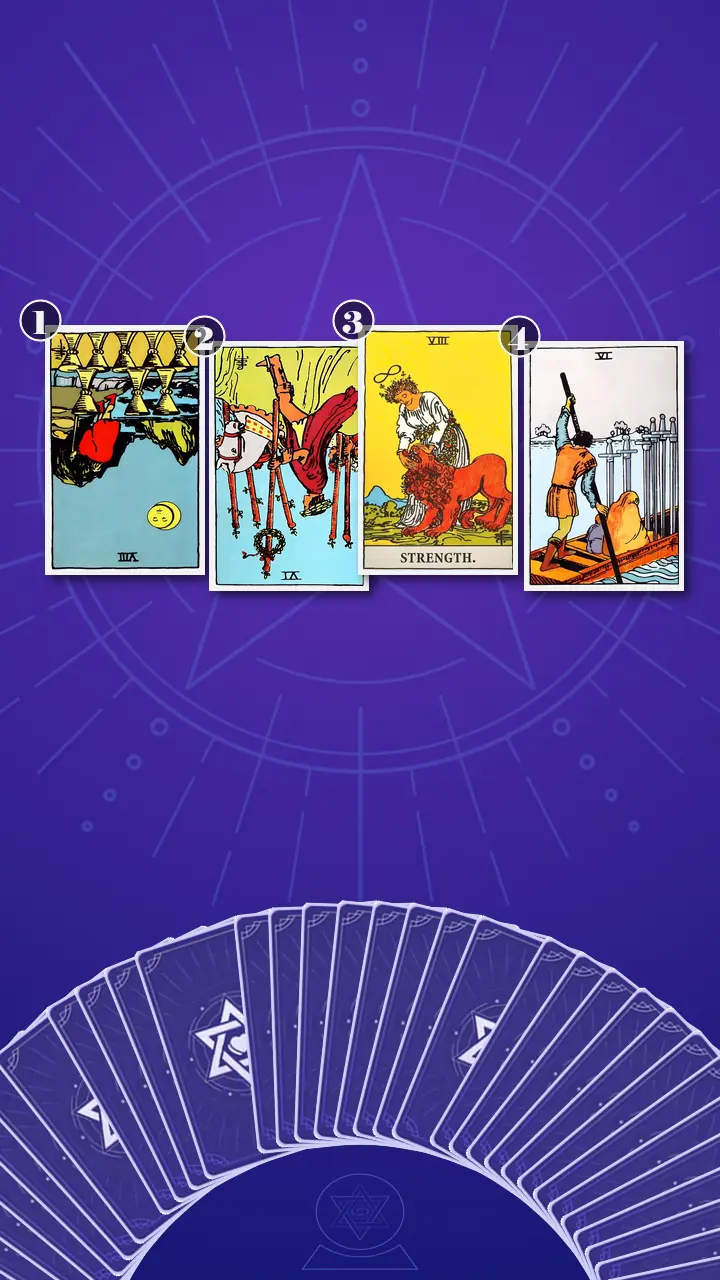
I laid the cards from left to right in a single row. The first would show the stuck exit itself. The second would reveal why the room suddenly felt like a scoreboard. The third—the turning point at the center—would show the inner stance that could interrupt the loop. The fourth would point toward what finding clarity looks like once self-trust becomes stronger than self-surveillance.
Reading the Map: What Kept Her in the Room
Position 1: The Stalled Doorway — Eight of Cups Reversed
I turned over the card representing the live symptom: the stalled moment where Maya wanted to leave but could not bring herself to do it cleanly. It was the Eight of Cups, reversed.
In modern life, this card looked exactly like Maya at 11:07 PM: route home already checked, bag shifted onto one shoulder, mind halfway in the Uber, yet somehow she was back in the kitchen laughing at a story she had stopped caring about twenty minutes earlier. The night was already over in her body; the exit was the part that was stuck.
Reversed, the energy here is blocked Water—emotionally complete, behaviorally suspended. It is the checkout page left open because clicking feels too final. 'I want to go,' the body says. 'Don't make it a thing,' says the social survival script. Sometimes the loneliest part of a party is pretending you're still in it.
Maya gave a short laugh with no amusement in it. 'That is offensively accurate,' she said. Her fingers tightened around her sleeve and then let go. I nodded. 'Good. Exact is useful. It means we are not dealing with a vague flaw. We are dealing with a specific unfinished motion.'
Position 2: The Room as a Scoreboard — Six of Wands Reversed
I turned to the card representing the deeper block beneath the behavior: the fear that being seen leaving would threaten her social worth or belonging. It was the Six of Wands, reversed.
This is the card of public recognition flipped inside out. In Maya's life, it looked like one casual 'Already?' landing like post analytics in the first five minutes after a creator uploads—as if a tiny metric could decide the value of the whole thing. The room became a live Yelp review of her personality. Every face was data. Every pause was a rating.
Here the energy is distorted Fire: too much attention burning outward, not enough warmth held at the center. This is how approval-seeking boundary guilt works. It converts a clean social choice into a performance review. Her job in marketing rewarded fluency, stamina, and seeming easy to be around; under strain, she had quietly started treating endurance as proof that she belonged. The room was not a scoreboard, but her nervous system was reading it like one.
Years on archaeological digs taught me that the shard nearest the surface is rarely the oldest truth. I told her I call this Cognitive Stratigraphy: the loaded comment is the surface artifact, but the older layer beneath it is the rule that wakes up instantly—'If I leave first, I am boring; if I am boring, I am forgettable; if I am forgettable, I do not really belong.' Once that buried rule is active, neutral social cues stop being neutral.
Her whole chest rose on a breath she had been holding. She looked away from the cards and toward the rain on my window. 'Yes,' she said quietly. 'It's never just the party.'
When Strength Put Its Hand on the Lion
Position 3: The Antidote at the Center — Strength
I turned over the third card, the one representing the key psychological shift that could loosen the pattern and help Maya tolerate the discomfort of an honest boundary. It was Strength, upright.
The room changed when that card appeared. Outside, a bus hissed through the wet street; inside, the radiator clicked and fell silent, as if the evening itself wanted a cleaner hearing.
Strength is not about becoming louder, cooler, or magically unbothered. In Maya's real life, it is the moment she feels the heat of 'do not make this awkward,' steadies her breath, looks at one person near the door, and says, 'I'm heading out—good to see you.' She does not wait until the timing is perfect. The win is not zero discomfort. The win is staying kind without abandoning herself. This is balanced Fire: courage regulated instead of outsourced.
The Dig Beneath the Trigger
Before I said more, I asked her to picture the bathroom scene again: bag strap digging into her shoulder, Uber open, bass thudding through the wall, a perfectly ordinary goodbye rehearsed in her head and still somehow impossible. She nodded. The visible feeling was awkwardness. The buried fear was exile.
Staying until you are emptied out is not proof of closeness; hold the lion of other people's reactions gently, and choose the exit that keeps you connected to yourself.
You do not have to overstay your own limits to prove that you belong.
Staying drained is not proof you belong.
She did not relax immediately. First came the freeze: her mouth parted, but no sound emerged, and her thumb stopped halfway across the rim of her paper cup. Then came the inward replay; I could see it happen in her face, that brief unfocusing as if last Friday's bathroom mirror, a Midtown rooftop heater, and every half-joking 'You're leaving already?' were suddenly stacked in one frame. Then anger flashed before relief did. 'But if that's true,' she said, more sharply than before, 'then what have I been doing all this time?' Her shoulders were still high, but now with outrage rather than shame.
'Surviving an old rule,' I said. 'Not failing.' I told her Strength is where Cognitive Stratigraphy becomes useful in real time. The comment is the surface artifact. The lion is the body spike. The deeper ruin underneath is the obsolete belief that belonging must be purchased with stamina. Strength does not ask her to crush that fear or argue with it like a lawyer. It asks her to hold it the way one steadies a nervous dog long enough to clip the leash—not forcing, just regulating—so she can make one clear move anyway.
Something softened then. Her jaw unclenched first. One shoulder dropped, then the other, almost with surprise. She let out a breath that sounded half laugh, half grief—the slight dizziness people get when a long-carried weight is suddenly no longer required. 'I think I thought staying drained was how you proved you were easy to love,' she said.
'Exactly,' I replied. 'And this is the turning point from self-conscious exit anxiety to calm, boundary-based social confidence. Not perfect certainty. Just a different source of authority.' I leaned in slightly. 'Now, with this new lens, think back to last week: was there a moment when this would have changed how you felt?' She closed her eyes, nodded once, and whispered, 'In the hallway. I could have just left.'
Position 4: The Bridge Part of the Ride — Six of Swords
I turned to the final card, the one showing the integrative direction that becomes possible when Maya acts from self-trust instead of social self-surveillance. It was the Six of Swords, upright.
I always like the honesty of this card. It does not promise fireworks. It promises passage. In Maya's world, it is the back seat of the Uber crossing the Williamsburg Bridge, city lights blurred against the window, AC on an overheated face, and the deepest relief arriving before she is even home—because the argument with herself has stopped.
This is Air arriving after all that tight, approval-driven Fire: thoughts still present, but no longer steering the boat. A clean exit is not a bad review. And I could not ignore the architecture of the spread here: the first Six had outsourced balance to the crowd; this second Six restored balance through self-directed movement. The party might still be going on somewhere. Instagram Stories might still show the after-after. But her leaving no longer had to mean she failed the night.
Maya's expression grew quieter. She touched her keys in her bag as if testing the feel of them. 'That part is real,' she said. 'The ride home is when I finally feel like myself again.'
From Insight to Action: The Clean Exit Script
Once all four cards were on the table, the story was clear. Maya's problem was not weak boundaries in the abstract. It was a precise approval loop. The Eight of Cups reversed showed the stalled doorway: her body knew the night was done before her social self would admit it. The Six of Wands reversed showed the engine underneath: she was turning the room into a scoreboard and treating endurance as proof of belonging. Strength interrupted that loop by relocating worth inside the self. The Six of Swords showed the consequence of that shift: not social loss, but mental relief.
Her blind spot was subtle and brutal. She was not merely afraid of awkwardness; she was treating awkwardness as evidence. That is how a two-second goodbye becomes a character reference. From where I sat, this was not a personality defect at all. It was what I think of as Ruins Restoration Thinking: an old social structure built around over-functioning had begun to crack, and the crack itself was the invitation. The point was not to become cold or aloof. The point was to rebuild belonging on a foundation that could survive an honest limit.
I told her the same thing I tell many people searching for how to leave a party early without being rude: the awkward 10 seconds are cheaper than the extra 90 minutes. Then I gave her three practical next steps.
- The Clean Exit Script Before her next birthday dinner, work happy hour, or crowded apartment party, I asked Maya to save one line in Notes: 'I'm heading out, good to see you' or 'I'm gonna call it, thanks for tonight.' I asked her to say it to one anchor person only—the host, her closest friend there, or the person nearest the door—and to pick up her coat, bag, or keys first so her body and words matched. If the sentence feels formal, shorten it to five words. If eye contact feels too intense, text the host from the hallway. New does not mean wrong.
- The 30-Minute Truth Check I asked her to set one discreet alarm 60 to 90 minutes into the event labeled 'Do I want another 30?' During a bathroom break or hallway pause, she would name three neutral facts—'It's loud. My jaw is tight. I'm tired.' If someone said 'Already?', I wanted her to answer once, without defending: 'Yeah, I'm wiped. Have a good rest of the night.' Neutral is not rude. One clear sentence regulates faster than a long apology spiral. A smartwatch buzz works if the phone alarm feels too obvious.
- The Trigger Excavation Exercise On the ride home, instead of checking Stories to see whether the real fun started without her, I asked Maya to open Notes for two minutes and write three lines: 'What was the trigger?' 'What did my brain say it meant?' 'How old is that rule, really?' This was my adaptation of a boundary-before-battery-zero practice: catch the first clear wave of wanting to go, book the ride then—not the third or fourth wave—and separate the present event from the older epoch it woke up. Keep it brief. The goal is not a thesis. The goal is to stop asking the room to grade your exit and to notice whether the fear belongs to tonight or to an older layer.
Those were actionable advice, not commandments. Tarot, at its best, does not hand out destiny. It helps a person recognize the mechanism, interrupt it once, and gather evidence that a different ending is possible.

A Week Later: The Quiet Proof
Six days later, Maya sent me a message after a work happy hour in Midtown. 'Did the line,' she wrote. 'Alarm went off, I noticed my jaw was basically concrete, and when someone said I was leaving early I just said, “Yeah, I'm wiped—have fun.” Then I booked the Uber on the first clear wave instead of the fourth.' A minute later she added, 'I still wanted to check Instagram Stories in the car. Didn't. Sat there with my AirPods and watched the bridge.'
That was the whole proof I needed. Not that her social life was solved. Not that she would never feel the little spike again. Just that she had completed one clean exit without turning it into a verdict. That is what I want a Situation-Obstacle-Advice-Outcome spread to do: turn self-attack into a readable pattern, and pattern into choice.
The older I get, the more I trust small archaeological facts over grand speeches. A single uncovered foundation stone can tell me an entire building is being rebuilt on better ground. Maya had not become less warm, less social, or less worth missing. She had simply stopped requiring self-betrayal as the ticket price of belonging.
If tonight you find yourself with your bag already on your shoulder, your smile going thin, and the little lion of other people's reactions starting to pace, please remember this: we have all had that moment where leaving feels less scary than the thought that someone might decide we were not worth missing, and merely seeing that pattern already means you are no longer trapped inside it.
So when your social battery is low but your hand is still hovering over the Uber app, what five-word goodbye would let honest limits count as social confidence at your next door?
This story is adapted from psychological research, written so that those in a similar struggle can see their own pattern in it — and find their next step clearly.These insights are not a substitute for professional psychological, medical, legal, or financial advice.
Learn more about our Journey to Clarity.
How did this insight land for you?
🫂 This Resonates Deeply
🌀 Living This Story
✨ Now I See Clearly
🌱 Seeing New Possibilities
🧰 Useful Framework
🔮 The Confirmation I Needed
💪 Feeling Empowered
🚀 Ready for My Next Step
Author Profile
 AI
AI“Having spent a lifetime at Cambridge and on archaeological digs, I’ve witnessed the rise and fall of countless civilizations. Please know that your current struggles are not a permanent fate, but merely a necessary fracture before rebuilding. I won't lecture you; instead, I invite you to sit with me in the ruins, using a patient, historical perspective to gently dust off the true, enduring value hidden beneath your temporary doubts.”
In this Introspection Tarot Reading :
Core Expertise
- Cognitive Stratigraphy: Treating sudden emotional triggers as 'surface artifacts', systematically digging down to locate their foundational trauma or obsolete belief system.
- Ruins Restoration Thinking: Reframing fragmented identities and chronic mental exhaustion as a necessary phase of profound internal transition.
Service Features
- The Trigger Excavation Exercise: A logical framework to trace a current, disproportionate emotional reaction back to its original 'epoch', separating the past from the present.
Also specializes in :
Explore Related Patterns:
Approval SeekingMaya's ordinary exit becomes loaded the moment the room starts feeling like a scoreboard. A casual 'You're leaving already?' does not stay casual in her nervous system; it turns into a small public metric, as if every face in the room is quietly rating whether she is fun enough, loyal enough, or worth keeping around. That is the internal logic of Approval Seeking: the self stops asking, 'What do I actually need right now?' and starts asking, 'How will this look to them?' The body has already answered with a tight jaw, a thin smile, and the Uber app open, but the approval system keeps scanning the room for permission to trust that answer. You can see why leaving feels like failing here. The exit is no longer just movement toward home; it has been converted into a social performance review. Naming the pattern gives you a cleaner target: the work is not to become less warm or less social, but to stop making the group's imagined evaluation the final authority on your limit.
Conditional Self-WorthMaya's fear is not only that someone might make a comment at the door. The sharper mechanism is the rule that wakes up underneath the comment: if she leaves first, she is boring; if she is boring, she is forgettable; if she is forgettable, she does not really belong. Conditional Self-Worth makes belonging feel earned rather than inherent. In Maya's case, the currency is stamina: staying longer, smiling longer, seeming easy to be around longer, even when her body is already asking to leave. That is why the Uber app can be open and the exit can still feel impossible. The practical choice has been fused with a worth test. Once you see that fusion, the clean goodbye becomes more than a social skill; it becomes a small refusal to keep proving your value through self-erasure.
Permission SeekingMaya already has enough information to leave: the bag is on her shoulder, the route is checked, and her body is finished with the night. The freeze happens because her own signal does not feel sufficient once another person might notice the exit. Permission Seeking turns a personal boundary into something that has to be socially approved before it can count as legitimate. Instead of treating tiredness as usable data, the mind waits for the room to make the departure feel acceptable, and even one half-joking comment can pull authority away from the self. You can hear the deeper rule underneath it: if leaving first means being boring, and being boring means being forgettable, then the goodbye starts to feel like a test of belonging. The pattern is not that you lack a reason to go; it is that the reason does not feel valid until someone else silently signs off on it.
Self-AbandonmentMaya keeps smiling after the smile has become effort, keeps laughing after the story has stopped mattering, and keeps standing in the room after her body has already left in every way except physically. The cost is not just tiredness; it is the repeated override of her own limit. Self-Abandonment appears when staying connected to other people requires disconnecting from yourself. In this story, the trade is precise: she preserves the image of being easygoing, available, and not awkward by making her own exhaustion secondary. The most revealing line is her realization that she thought staying drained was how you proved you were easy to love. That turns the party exit into a deeper audit of self-worth. You are not just deciding whether to go home; you are confronting the learned equation that says belonging must be bought with endurance.
Emotional ReasoningMaya names the blind spot clearly: she is not merely afraid of awkwardness; she is treating awkwardness as evidence. The body spike at the doorway starts to mean that leaving must be wrong, rude, or socially risky. Emotional Reasoning turns an internal state into a conclusion about reality. Because the goodbye feels dramatic, the mind assumes it is dramatic. Because the comment feels exposing, the mind assumes exposure is actually happening. That is the mechanism that makes leaving feel like failing even when the external facts are ordinary. You are not failing because the exit feels uncomfortable; you are encountering a discomfort signal that has been mislabeled as proof.
Spotlight EffectMaya's mind turns small social cues into oversized evidence. One 'Already?' lands like analytics, every pause becomes a rating, and the room starts to feel as if it is watching her exit far more closely than the story shows. The Spotlight Effect is the bias that makes your own visible move feel central to everyone else's attention. In the party scene, it inflates a normal goodbye into a public moment, which makes leaving feel socially louder than staying miserable. This matters because the fear is not built from confirmed rejection; it is built from imagined visibility. When you can name the magnification, the exit becomes smaller again: a person leaving a party, not a room issuing a verdict.
Assertive CommunicationMaya's corrective move is deliberately small: steady the breath, look at one person near the door, and say, 'I'm heading out—good to see you.' The point is not to deliver a perfect explanation; it is to make the inner decision visible without turning it into a negotiation. Assertive Communication works here because it gives the boundary a clear behavioral form. It lets her remain warm while refusing the old script that says kindness requires overexplaining, apologizing, or staying past the point of self-respect. The shift is subtle but important. You do not need zero discomfort before you speak; you need a sentence that can carry your limit while your nervous system catches up. That is how a goodbye becomes self-trust in motion rather than a performance for the room.
Boundary DiscernmentMaya's boundary becomes possible when the question changes from 'Will they approve of this?' to 'Can I recognize my own limit without making it hostile?' The story does not ask her to become colder; it asks her to stop confusing warmth with limitless availability. Boundary Discernment is the capacity to separate an honest limit from social rejection. In this case, leaving early is not an attack on the party, the host, or the group. It is a self-directed choice made with enough clarity to stay kind and still go. That distinction directly answers why leaving has felt like failing. The old system treats every boundary as relational risk. The new system lets the boundary become a clean line: this is what I need, and other people's reactions do not get to erase that need.
Explore Related Struggles:
Approval-Safety FusionThe room stops being just a party for Maya and starts behaving like a scoreboard. A half-joking 'Already?' lands like analytics, and every pause or face becomes data about whether she is fun enough, easy enough, and still worth including. You are watching approval turn into a safety system. When belonging feels measured by how long you can keep performing, leaving early no longer feels like a neutral choice; it feels like removing yourself from the evidence that proves you are wanted. Approval-Safety Fusion fits because the story keeps showing social approval doing the job of inner security. Maya is not simply hoping people like her; she is using their imagined reactions as the signal for whether her own boundary is safe to act on.
Availability-Worth FusionMaya keeps giving the party a version of herself after her actual capacity has run out. The smile stays up, the body stays in the room, and endurance starts to look like proof that she is warm, low-maintenance, and easy to love. You can feel the cost in the line that staying drained had become how she proved she belonged. Availability stops being a choice and becomes a currency. The longer she remains accessible, agreeable, and socially usable, the more secure the connection seems to feel. Availability-Worth Fusion names the way presence gets mistaken for value. The struggle is not generosity; it is the moment your continued availability becomes the evidence you use to reassure yourself that you still matter.
Permission ParalysisOpening Uber gives Maya the mechanics of leaving, but it does not give her the felt authority to leave. The phone can offer a route home; it cannot answer the older rule that says a clean goodbye needs social clearance before it counts as acceptable. You see the bind in the way one casual 'Already?' becomes louder than her own tiredness. Her limit is clear, but it is not treated as valid until it survives an imagined review from the room. That is the point where permission becomes more powerful than preference. Permission Paralysis names the internal stall beneath the practical decision. The problem is not that Maya lacks a script; it is that her own yes to leaving has been made conditional on other people not seeming disappointed, surprised, or unimpressed.
Social Exit ParalysisMaya is already halfway out of the party before she moves an inch. The Uber route is open, the bag is on her shoulder, and her body has stopped participating, but one imagined comment at the door turns an ordinary exit into a public test. That is why the goodbye freezes. You can know exactly what you need and still stall when leaving feels like it will be witnessed as a social verdict. The body is trying to cross the threshold while the social self is still asking the room not to make the crossing visible. Social Exit Paralysis fits because the struggle is not about wanting isolation or lacking manners. It is the specific lock that happens when an exit becomes loaded with the fear of being judged, missed less, or quietly downgraded for having a limit.
Social Self-Judgment LockMaya does not only hear the room; she grades herself through it. A face, a pause, or a throwaway comment becomes evidence she can use against herself, as if the party has been silently appointed to review her personality. You can see how quickly that turns the exit into a courtroom. Leaving is no longer a movement from one place to another; it becomes a moment where the self might be judged as boring, forgettable, or not worth missing. Social Self-Judgment Lock fits because Maya’s attention gets trapped in the imagined audience response. The room does not have to reject her for the mechanism to work; it only has to feel like it could.
Self-Editing ExhaustionMaya’s face keeps doing the social job after her body has already resigned from the night. The room gets the polished laugh, the easy presence, and the smooth continuation, while the part of her that is tired has to wait offstage. That split is the exhausting part. You are not only staying longer than you want; you are editing the evidence of your own limit so no one else has to feel the friction of it. The self that remains visible is the version most likely to keep the atmosphere intact. Self-Editing Exhaustion fits because the drain comes from constant social adjustment, not from the party alone. Maya is tired because she is managing how her boundary will be read before she is allowed to express it.
Explore Related Emotions:
Approval AnxietyOne casual “Already?” lands in Maya’s system like a public metric, and the whole party starts to feel like it is quietly reviewing her. Faces become data points. Pauses become ratings. A normal goodbye gets pulled into the same mental machinery that tracks whether she is fun enough, easy enough, and worth keeping in the social frame. Approval Anxiety names the inner weather created by that surveillance loop. You are not simply worried that someone will comment; you are bracing for the comment to reveal your social value. The problem is not the room’s actual power, but the way attention starts burning outward until every neutral cue feels like feedback. This is what makes leaving feel like failing. The exit is no longer an exit. It becomes a visible test of whether you still belong when you stop performing.
Boundary GuiltMaya has the Uber app open, her bag already on her shoulder, and a body that has clearly reached the end of the night, yet the goodbye still feels too loaded to complete. The ordinary boundary is not treated like a neutral preference. It starts to feel like a social debt she has not earned the right to stop paying. That is why Boundary Guilt fits the story so tightly. You are not watching someone who lacks manners or warmth; you are watching a person whose limit has been translated into possible harm, rejection, or disappointment. The room does not have to demand much for the guilt to activate, because the old rule already says that staying longer is the safer proof of care. The emotional bind is that leaving would protect her energy, but staying protects the version of herself she thinks other people will approve of. The guilt lives in that split, where self-respect and social belonging feel like they are competing for the same ten seconds at the door.
Conditional Belonging FearThe buried rule in Maya’s story is brutally clear: if she leaves first, she is boring; if she is boring, she is forgettable; if she is forgettable, she does not really belong. That chain is what turns a two-second goodbye into something that feels much bigger than the party. Conditional Belonging Fear is the deeper weather underneath the exit anxiety. You are not just trying to avoid awkwardness. You are trying to avoid the feeling that your place in the group depends on staying entertaining, available, and tireless. This fear makes endurance feel like a membership fee. Leaving starts to feel like failing because the old rule says belonging has to be proven by how long you can override yourself before anyone notices the cost.
Performance FreezeThe route home is already checked, the tote is already on Maya’s shoulder, and her body has left the party before her mouth can make it official. She is not confused about what she wants. The freeze happens at the moment the private decision has to become a public gesture. Performance Freeze captures that threshold lock. You can know the next move and still feel your system halt when the move will be witnessed. The bathroom, the warm phone, the tight jaw, and the rehearsed goodbye all point to the same stuck motion: the action is available, but the social meaning attached to it jams the exit. The ache here is specific. It is not laziness or indecision. It is the body holding still because being seen choosing yourself feels more exposed than staying miserable.
Regulated CourageMaya’s turning point is small and concrete: one steadier breath, one person near the door, one clean sentence. She does not wait until she feels perfectly confident. She moves while the discomfort is still present, which is why the moment has real weight. Regulated Courage is the feeling of carrying the spike without letting it take over the steering wheel. You are not becoming cold, dramatic, or untouchable. You are staying kind while refusing to hand your limit back to the room for approval. The courage here is regulated because it does not need a grand performance. It needs enough inner authority to book the Uber on the first clear wave, say the simple goodbye, and let honest limits count as social confidence.
Self-Betrayal AcheMaya says she thought staying drained was how you proved you were easy to love, and that sentence changes the shape of the whole party. The pain is no longer only about getting out of a bar. It is about realizing how often she has made her own limit disappear so nobody else has to feel the edge of it. Self-Betrayal Ache names the soreness that appears when the old bargain becomes visible. You can see how much energy went into being agreeable, low-maintenance, and socially fluent, while the body kept quietly asking to be taken home. The ache is not self-blame. It is the sharp recognition that connection has been purchased with self-abandonment for too long. Once that is seen, the exit stops being rude and starts becoming a way back to yourself.
Clarity ReliefThe back seat of the Uber crossing the Williamsburg Bridge brings relief before Maya is even home. Nothing spectacular has happened. The party is still going on somewhere, but the argument with herself has stopped. Clarity Relief names the calm that arrives when the pattern becomes readable and the next move becomes simple. You are no longer asking the room to grade your exit, and you are no longer treating a tired body as evidence of social failure. The relief is quiet because it is built from evidence, not fantasy. One clean exit, one unperformed limit, one ride home without checking Stories. The system learns that leaving can be a return to self, not a verdict against belonging.
Social BurnoutMaya’s jaw is tight, her cheeks hurt from smiling, and the bass in the bathroom keeps hitting a body that has already had enough. The story makes the depletion physical before it makes it psychological. Her smile is still working, but the person underneath it is done. Social Burnout fits because the issue is not that she hates the party or the people in it. You can be warm, socially capable, and still hit the point where every extra minute costs more than it gives back. The body starts sending simple facts before the social self is ready to accept them. That drained state matters because it lowers the threshold for shame, guilt, and approval tracking. When you are already emptied out, a small “Already?” can feel enormous because there is no spare energy left to hold your own reality steady.
Explore Related Contexts:
Conditional Belonging PressureYou are not just trying to leave a party early. You are inside a rule that teaches stamina to count as social proof, so staying longer starts to look like the price of being seen as warm, easy, and worth holding onto. That is why a casual 'You're leaving already?' can land like a verdict. The room starts behaving like a live review board, and a normal goodbye gets translated into a test of whether you still belong in the circle.
Strategic Social ExitYou are in a too-bright Williamsburg bathroom with Uber already open, the tote still on your shoulder, and the noise of the bar pressing through the mirror. The body has already moved toward home, but the exit is still stuck at the moment where leaving has to become visible. The story keeps returning to that handoff from staying to going. It is not a transport problem or a timing problem; it is the social cost of crossing the threshold in front of other people, which makes a clean exit feel heavier than the hours already spent inside.