One More Status Update—and the Question That Led to a Small Test

The 8:40 p.m. Tracker Loop
I meet Jordan on a Tuesday evening, after the kind of workday that looks enviable from the outside. They are a 29-year-old project coordinator in Toronto: organized, responsive, trusted with ambiguous work, the person whose calendar has color-coded answers before anyone else has finished naming the problem.
Before our session, Jordan tells me about 8:40 p.m. at their small kitchen table. Their project tracker was already current, but they reopened it anyway and changed one harmless sentence in a status update. The laptop fan hummed beside the refrigerator. Blue light rested across their hands. Their shoulders had crept nearly to their ears, and the upper part of their chest felt as though it had been cinched by an invisible drawstring.
“Nothing is wrong,” they say. “So why can I not relax?”
I recognize the pattern immediately, not as a failure of gratitude, but as success-shaped avoidance. Jordan keeps doing the next competent thing because the next private question is harder to ask: What am I avoiding because this role looks successful? The relief of polishing a finished task lasts a few minutes. Then the room is quiet again, and the tightness returns.
“Nothing is wrong is not the same as everything feels right,” I tell them. “You do not need to prove this job is terrible in order to look at what it may be leaving unanswered. Today, I want us to make a map for that fog, not make a verdict about your career.”

Four Drawers in the Same Desk
I ask Jordan to take one slow breath and hold the question lightly: not Should I quit?, but What becomes harder to hear when I keep proving that this role works? I shuffle slowly, using the movement as a clean transition from the noise of Slack, calendars, and other people’s expectations into a more deliberate conversation.
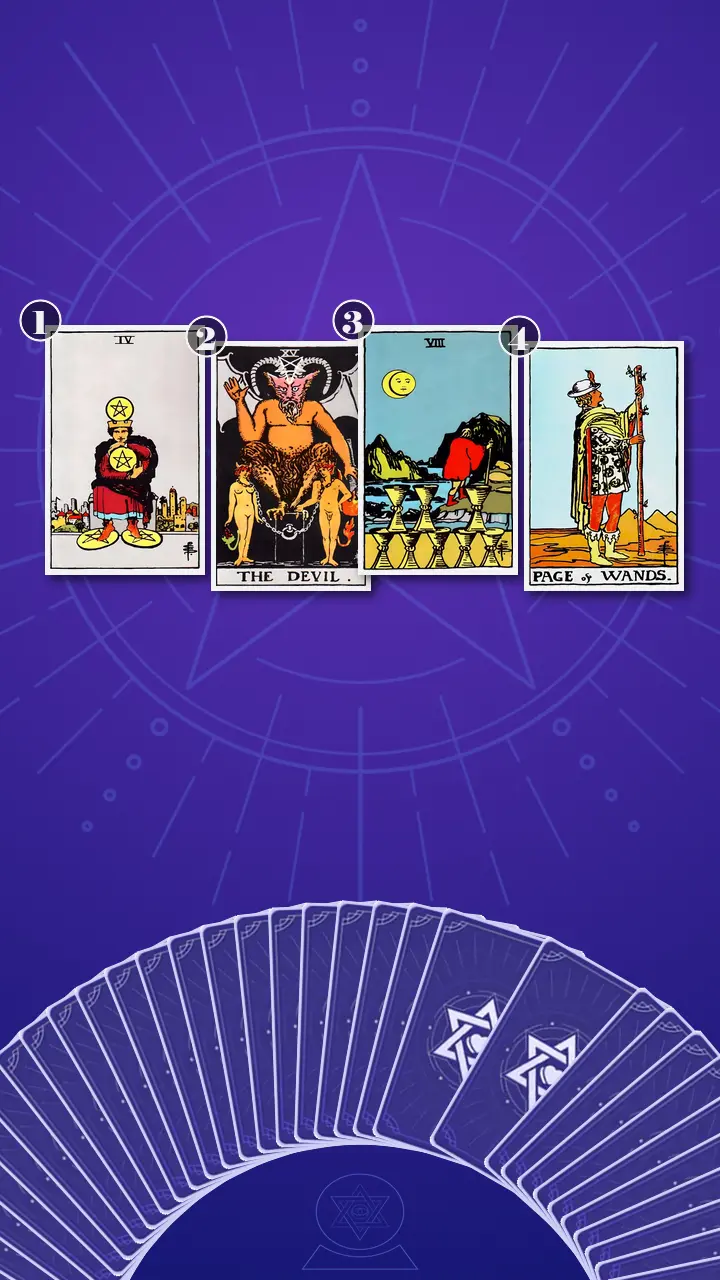
I choose The Shadow Spread. It is a four-card tarot spread for examining career avoidance without predicting a future or forcing a major decision. I use it here because Jordan’s question has four practical layers: the visible pattern of competence, the hidden protection beneath it, the unmet need being kept out of view, and one grounded response.
For readers wondering how tarot works in a career crossroads, this is the useful part: the cards do not issue instructions. They offer a structured way to separate observable facts from the internal rules built around those facts. In this spread, the first card shows what Jordan visibly holds. The second shows what makes that grip feel necessary. The third names the question beneath the grip. The fourth offers a small, reversible next step.
Reading the Map of a Successful-Looking Role
The Competence Held Against the Chest
I turn over the first card. “This is the card representing the successful-looking role and the pattern of holding onto familiar competence rather than making room for reflection.”
Four of Pentacles, upright.
I point to the figure with one pentacle pressed tightly to the chest, two pinned beneath the feet, and another balanced above the head. “This is the 8:40 p.m. version of a successful-looking role. A stable title, reliable praise, and a full project calendar can begin to feel like objects you must physically hold in place. The tracker stays open. The familiar task gets another polish. The question about fulfillment stays pinned beneath your feet.”
The Four of Pentacles is not telling me that Jordan’s security is false. Its Earth energy is real and useful: regular income, earned trust, a role they worked hard to build. But here, security has tipped into excess. The role is being protected so thoroughly that there is no blank page left in Jordan’s internal Notion dashboard.
“When you finish familiar work that proves you are capable,” I ask, “what do you do instead of making room for the question you keep postponing?”
Jordan lets out a short laugh that has no real amusement in it. “I clean something up. My inbox, Jira, a deck that is already fine. That is painfully accurate.” Their fingers curl around their mug, then loosen. “It is a little brutal, actually.”
The Loose Chain Behind the Automatic Yes
I turn over the second card. “This is the card representing the protective attachment beneath the need to preserve the role’s appearance of success, including the fear of losing control over your direction.”
The Devil, upright.
The room goes quieter in the way it often does when a card names a pattern people have been calling responsibility. I look at the loose chains around the figures’ necks. “This is not a card of permanent entrapment. It is a card of a binding agreement that has started to feel compulsory.”
I ask Jordan to picture the last time a manager said they were the person everyone trusted with messy, ambiguous work. Jordan does not have to search long. They tell me about typing, Sounds good, I can take that, before they checked their calendar, their energy, or their willingness. The moment brought a fast hit of competence. Later, staring at a crowded week, their stomach dropped.
“The loose chain is the internal contract,” I say. “Because people rely on me, I must keep saying yes. Because the job looks good, I am not allowed to question it. Because I do not have a complete alternative, I must not disturb what works.”
I know this contract from another language. Years on Wall Street taught me how easily a useful role can become an identity one feels obligated to defend. On a trading floor, a number can be factual and still conceal the leverage that created it. I apply the same discipline here: I do not confuse Jordan’s visible success with the rule they have attached to it.
“If I question this,” Jordan says, barely above a whisper, “I might expose that I do not know what I am doing.”
“That is the protection speaking,” I reply. “Your achievements are facts. The belief that they forbid inquiry is an expectation. Those are not the same thing.”
The Devil’s energy is blockage, not destiny. Jordan is not powerless, and the job is not the enemy. The card shows how genuine security can harden into a rule that approval must be protected at all costs. Success can be evidence, not a sentence.
When the Eight of Cups Opens the Interior Door
The Question That Praise Cannot Answer
I turn over the third card, the bridge of the entire reading. “This is the card representing the avoided truth or unmet need that becomes difficult to acknowledge when staying successful is treated as the only safe option.”
Eight of Cups, upright.
Rain taps briefly at my window, and I think of the scene Jordan described after a high-visibility launch: Slack reactions landing in a glass meeting room, a paper cup going cold in their hand, their professional smile holding while something inside them dropped. The cups in this card stand upright. The accomplishments are real. Nothing has been knocked over. Yet the cloaked figure walks toward the uneven hills because being full is not always the same as being satisfied.
“This card does not ask you to reject the role,” I tell Jordan. “It asks whether the role is the whole emotional story. A role can be worth keeping and still leave a question unanswered. This is appreciation versus curiosity, not staying versus quitting.”
Jordan’s breathing pauses. Their thumb freezes above the rim of the mug. Their eyes move away from the card and lose focus for a second, as if replaying every post-launch moment when praise should have felt like a finish line but became a cue to open another task.
Stop treating visible success as an instruction to stay silent; let the Eight of Cups' departing figure make room for one honest question and one small exploration.
I leave a quiet beat for the sentence to land.
A successful role can be real, hard-earned, and still not be the whole emotional story. You do not have to reject what works in order to investigate what feels unfinished. Success can be evidence about your life, not a sentence that silences your curiosity.
Jordan’s first response is not relief. Their brow pulls together. Their shoulders rise, then hold. “But does that mean I was wrong to stay?” they ask, a sharp edge appearing in their voice. “Like I have spent years making the wrong choice?”
“No,” I say. “It means your past choice may have served you, and you are allowed to audit whether its terms still fit. You can value what you built without letting it veto every question about what comes next.”
I use my own lens here: Transferable Asset Pricing. I ask Jordan to price their current role honestly, like an asset rather than a verdict. What does it genuinely return? Structure, dependable income, project judgment, trust under pressure. What does it cost? Unused curiosity, little room to learn, an identity that makes beginnerhood feel embarrassing. A good asset can still be overallocated. That does not make it worthless; it makes review necessary.
Jordan’s mouth opens, then closes. Their fingers press once into the sleeve of their sweater. I watch the thought move through them: first the stillness, then the memory, then a long breath that seems to come from below the ribs. Their eyes redden slightly, though they do not cry. Their shoulders descend by degrees, and with that release comes a small, unsteady blankness, the sensation of standing on level ground after carrying a heavy box for too long.
“I think I have been waiting for a reason dramatic enough to justify being curious,” they say. “And I have been treating the lack of drama as proof that I should not ask.”
“Now, with this perspective,” I ask, “can you think of a moment last week when this insight might have changed how you felt?”
“Sunday on the streetcar,” Jordan says. “I saw a former coworker’s promotion post, and I made a perfect plan for my week instead of admitting I felt jealous. Not jealous of the title. Jealous that they seemed to have permission to want something.”
This is the shift from restless containment and success-protecting self-doubt toward honest curiosity. It is not a decision about leaving. It is permission to recognize the gap without turning that recognition into an emergency.
The Curious Apprentice Does Not Need a Five-Year Plan
I turn over the fourth card. “This is the card representing a grounded way to integrate the insight through a small exploratory action that does not require an all-or-nothing decision.”
Page of Wands, upright.
The Page studies a sprouting wand rather than raising it like a trophy. Open yellow ground stretches behind them. “This is beginner energy,” I say. “Not a career rebrand. Not a resignation plan. Just a living interest receiving direct attention.”
I translate the card into Jordan’s real life: one informational conversation with someone in an adjacent role, one introductory event, or forty-five minutes with a practical beginner project. The Page of Wands brings Fire as balanced curiosity. It counterweights the static grip of the Four of Pentacles by making movement small enough to be safe and real enough to generate evidence.
“But I cannot even find five minutes most weeks,” Jordan says. “I keep taking the next thing because it is easier than explaining why I need space.”
“Then the first experiment is not finding your future,” I answer. “It is protecting ten minutes from the automatic yes. A question is not a resignation letter. Do not ask the first experiment to become your future; ask it to give you better evidence.”
The Page’s lesson is not that Jordan must become someone new overnight. It is that they can temporarily stop performing as the established competent person and become a learner. Curiosity is not a failure to be grateful. It is a practice of gathering firsthand information.
The Bounded Curiosity Test
When I place the four cards together, their sequence is clear. The Four of Pentacles shows Jordan holding visible competence so tightly that reflection has nowhere to sit. The Devil reveals the Captive Contract underneath: approval, security, and self-worth have been linked as though questioning one would endanger all three. The Eight of Cups names the gap between accomplishment and fulfillment. The Page of Wands offers a response: not an escape, but a small experiment.
The cognitive blind spot is the belief that a role which works on paper must not be inspected until Jordan has a complete replacement plan. The transformation direction is more practical: treat discomfort as a prompt for one bounded, low-stakes inquiry. Jordan can keep what is genuinely working while allowing one unanswered question back into the room.
I give Jordan two actions, small enough to fit into an ordinary week and structured enough to interrupt the familiar loop.
- The 10-Minute Fulfillment Gap CheckOn one evening before Sunday, set a 10-minute timer and write: “My successful role genuinely gives me...” and “I keep using this role to avoid....” Then name one fulfillment question that can be investigated without changing your title, income, or schedule.Use neutral language: information, not verdict. Stop when the timer ends. The minimum version is one honest sentence in your phone notes.
- The Leverage Mapping ProtocolBefore accepting the next familiar task, take 30 seconds to check three bargaining chips: actual time, available energy, and genuine willingness. Use the holding response, “Let me check my capacity and come back to you tomorrow.” Protect the recovered ten minutes for one adjacent-role conversation or research step.Start with a low-stakes request. A capacity pause is professional information, not a rejection of your team or your reputation.
- The 20-Minute Curious Apprentice CallBy Wednesday, message one person in an adjacent role and ask for a 20-minute informational conversation. Ask about their ordinary week, the skills they use most, and what they wish they had known before moving into the work. Afterward, take two minutes to note curiosity, resistance, and neutrality.One conversation is enough. Do not grade it as proof that you should leave or stay; it is a bounded curiosity test, not a career decision.
These are not prescriptions from the cards. They are ways for Jordan to create evidence where overthinking has created only pressure. The change belongs to Jordan because they choose what to protect, what to question, and what to test.

A Week Later, the Quiet Proof
Six days later, I receive a message from Jordan. They did not announce a pivot, delete LinkedIn, or solve their career in one clean sweep. They used the holding response before accepting a nonessential coordination task, then spent twenty minutes speaking with someone who designs internal learning programs.
“I woke up today and my first thought was still, ‘What if I am wrong?’” Jordan writes. “But I smiled a little. I have one question now: why do I feel more awake when people talk about building systems that help others grow?”
I picture them on the TTC with their phone in their hand, not locked into the same comparison scroll, but carrying a question that belongs to them. The uncertainty has not vanished. It has become lighter, more specific, and less lonely.
That is what this Journey to Clarity offered Jordan: not certainty, but a steadier relationship with uncertainty. From restless containment to honest curiosity, the first proof was not a new job. It was a protected pause, a real conversation, and the recovery of their right to ask.
When praise lands but your chest still feels tight, it can be unsettling to realize that you may be protecting a role that works on paper from the questions that could make your direction feel like yours. But clarity is sometimes simply the interior door opening in a well-lit room.
If you could keep the parts of your role that genuinely work while opening that interior door for ten minutes, what unanswered question might you be willing to investigate without turning it into a decision?