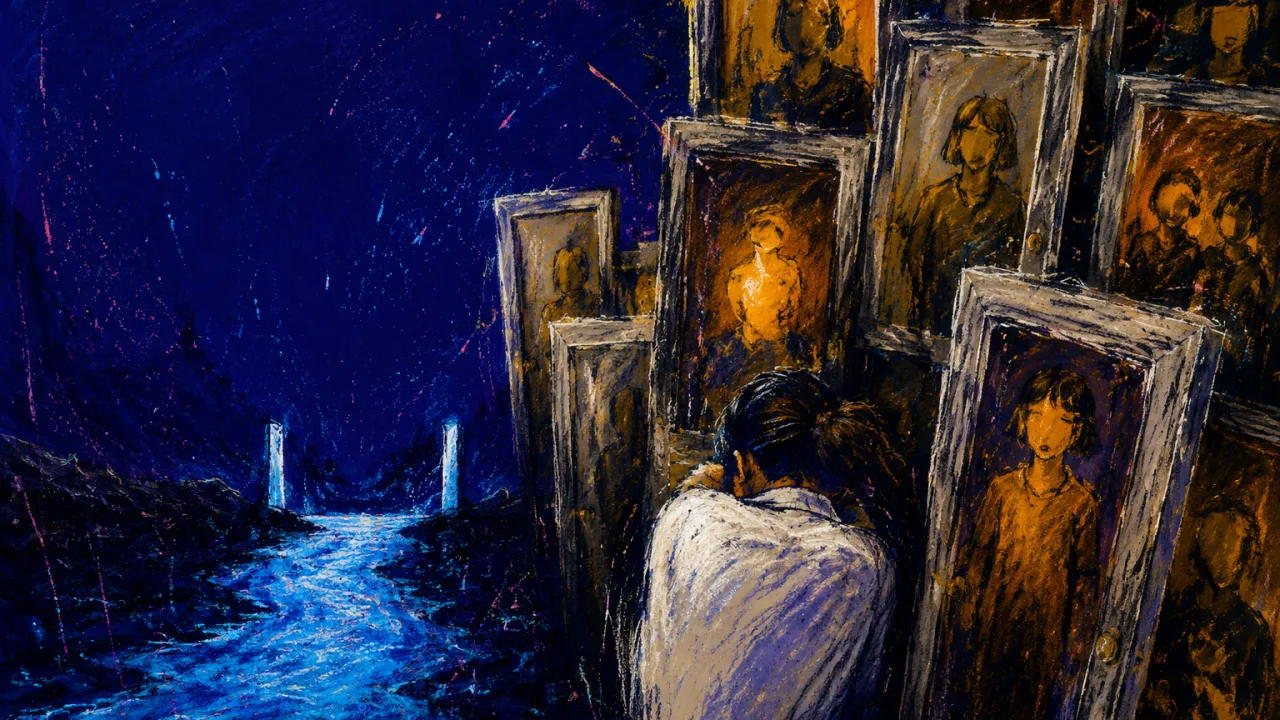
Family Estrangement Threshold is the point where ordinary contact stops feeling ordinary because every reply, visit, or explanation seems to reopen the same terms of access. The tight chest before a family text, the careful wording before a visit, and the drained feeling afterward are part of the body's record of the situation. This is an environmental, structural dynamic, not a private overreaction: the family setting itself has made contact carry consequences. The Tarot Cards below reflect the shape of that threshold, where distance, access, loyalty, and self-protection all become visible at once.
The Fool ReversedThe cliff in front of the Fool is not a hallway, a road, or a negotiable doorway. It is a threshold where continued movement changes the entire relationship between body, ground, and consequence. In family terms, this is the point where ordinary contact no longer feels like ordinary contact. Repeated boundary failures, guilt loops, and unresolved power struggles can bring the relationship to an edge where low contact, no contact, or a major communication reset becomes the structure needing to be seen clearly.
The Hermit ReversedThe ice field gives the Hermit height, but not warmth. The cliff-like summit, blank background, and absence of a shared road create a scene where remaining in place and moving away both carry weight. In a family system, this is the threshold where minimal contact, low contact, or deeper distance starts to become thinkable because ordinary repair routes have narrowed. The pressure is not just conflict; it is the repeated discovery that the shared field may not have enough safety or reciprocity to support the adult self. The card holds estrangement as a structural edge rather than a dramatic gesture. It shows the cold geometry around the decision, where access, history, guilt, and self-protection all meet on the same ridge.
The Hanged Man ReversedFloating between the tree and the empty white field, the figure has one remaining tether and no ground beneath him. The image is not a clean departure and not a settled return; it is a threshold where attachment remains visible while ordinary belonging no longer functions. That is the charged space before estrangement becomes a defined boundary. You may still answer, visit, explain, or hope the family can meet you differently, but the old container no longer gives enough ground to stand on. The card helps name the threshold itself, so the question becomes less about sudden cutoff and more about what kind of contact can exist without suspending your whole life from one remaining knot.
Death UprightThe skeletal rider crossing over the fallen ruler shows an old access structure losing its authority in public view. The figures are not simply scattered; they are arranged around a line of passage that can no longer be managed by rank, pleading, innocence, or ritual. In a family reading, that visual pressure maps onto the point where contact itself becomes the contested structure. You are not looking at a minor disagreement but at a threshold where the old rules of availability, obligation, and permission have to be audited before any form of access can continue. The river and distant towers keep the scene from becoming a dead end. They show that a boundary can be a passage into a different relational architecture, not only a severing point, and that your agency begins with naming what kind of contact still has a workable structure.
The Devil ReversedThe dark chamber offers no neutral third space, only the raised figure, the cube, the ring, and the collars. The scene makes distance hard to imagine because every position is already organized around the same central authority. At a family estrangement threshold, the question is not whether you are allowed to need distance. The structure asks you to see which connection points still function as control points, and which forms of contact leave you with no workable place to stand.
The Star ReversedThe figure is alone at the water's edge, with no other human body in the scene. The landscape is clear rather than chaotic, which makes the distance more exact: separation is becoming visible as a possible structure, not merely a mood after a hard conversation. In a family context, this points to the threshold where reduced contact, stricter terms, or a major relational boundary moves from unthinkable to thinkable. The card does not dramatize the break; it shows the quiet geometry of one person standing outside the old emotional traffic long enough to see the system from a distance. For you, the important detail is the combination of exposure and solitude. The Star suggests that distance may be functioning as a way to recover orientation, especially if closeness has repeatedly required you to give up privacy, autonomy, or emotional steadiness.
Four of Cups ReversedThe seated figure has not left the scene, but his closed eyes and folded body create a hard pause between himself and every cup. There is no road, doorway, or shared gesture that carries the contact forward. Estrangement often begins before a clean break; it begins as repeated non-movement around offers that no longer feel relationally usable. You are looking at the threshold where staying available costs too much, while leaving is not yet a settled decision, and the structure needs to be named before the next contact defines it for you.
Five of Cups ReversedThe river cuts across the card while the bridge sits outside the figure's immediate orientation. This is the visual logic of a family estrangement threshold: connection is not absent, but the route back has become hard to approach without losing the boundary that distance created. The cloaked body stands apart from both the remaining cups and the distant dwelling. In family terms, that distance can mark the point where ordinary contact no longer feels like contact; it feels like re-entry into a system that has not changed its terms. The threshold is not a command to leave or return. The card makes the boundary visible so You can distinguish a bridge that supports repair from a bridge that only leads back to the same spill site.
Eight of Cups UprightThe lone figure walking away from eight intact cups gives family distance a physical shape: the structure behind him was real, organized, and once meaningful, but it still contains a visible gap. The river in front of him turns separation into a threshold rather than a passing mood. In a family system, this image maps the moment when contact itself becomes the terrain that has to be crossed. You are not looking at a clean rejection of the past; you are looking at the point where the old arrangement can no longer explain the missing piece. The uphill path matters because the card does not freeze the person beside the cups. It shows movement toward perspective, which makes Family Estrangement Threshold a context of boundary, grief, and adult relocation rather than simple abandonment.
Five of Pentacles UprightThe two figures pass the glowing window without entering, moving through snow on a path that offers motion but not comfort. The scene captures a threshold state: the family structure is still nearby, still visible, and still symbolically powerful, yet the lived experience remains outside its warmth. Family Estrangement Threshold appears when contact has not vanished but has become physically and emotionally costly. You may still answer messages, attend gatherings, or keep a narrow line open, while also recognizing that the old terms of closeness expose you to the same cold pattern again. The card's realism is important here. It does not turn distance into punishment or moral failure; it shows distance as a boundary formed under harsh conditions, where the next step requires clarity about what the family system can actually offer, not only what it claims to represent.
Four of Swords ReversedThe knight rests on a tomb-like platform inside a grey chamber, separated from ordinary movement and living exchange. The image is not busy with drama; its weight comes from the threshold quality of the scene, where a relationship can no longer keep operating as if nothing has changed. Family estrangement threshold appears when distance stops being a temporary mood and becomes a possible boundary around future access. The swords above the figure show why reentry carries pressure: the same unresolved blades are still waiting in the room. You are looking at a point of structural seriousness. The card does not require a final severing; it reveals the moment when the old terms of family contact may no longer be usable without a different boundary, pace, or level of truth.
Five of Swords ReversedThe shoreline sits between solid ground and water, with a faint opposite bank in the distance and figures already moving away. The scene has not fully become departure, but the direction of travel is visible and the old field no longer feels stable. That is the threshold where family contact starts to feel like a repeated return to the same sharp ground. You may still see the family bond, the history, and the possibility of refuge, but the card shows why distance begins to appear as a structural option rather than a passing mood.
Six of Swords ReversedThe far shore is visible but washed pale, and the boat has not yet fully arrived anywhere. The old bank is no longer the center of the image, while the new ground has not become solid enough to stand on. Family Estrangement Threshold belongs to that suspended space. You may be close to no contact, a major distance shift, or a long silence, but the decision still carries people, history, and practical consequences in the boat. The card frames estrangement as a threshold with real structure, not a single dramatic moment.
Ten of Swords UprightTen swords driven into the fallen figure's back create an image of a relationship structure that has stopped pretending it can keep moving. The body lies at the riverbank, close to a crossing, but the route is blocked by the accumulated weight of what has already happened. Family Estrangement Threshold appears here because the card turns repetition into a visible endpoint. You are not looking at one awkward conversation or one bad visit; you are looking at the moment where repeated violations, loyalty tests, or betrayals make automatic access to you structurally impossible without a new boundary. The thin yellow light on the horizon matters because the scene is not only collapse. It marks the first evidence that clarity can exist after the family script loses its authority over your next move.
Queen of Swords ReversedThe Queen's body is angled away while the sword still marks a formal line of contact. Low clouds fill the lower field, and the elevated seat creates a distance that can no longer be crossed casually. That arrangement fits the threshold before estrangement, where the relationship has not necessarily ended but ordinary access no longer works. The family system may still have names, roles, and rituals, yet the practical bridge between people has narrowed to a guarded passage. For You, this context captures the edge where staying in the same pattern carries a visible cost. The card does not romanticize cutting contact; it shows the structural conditions that make distance become thinkable when repair, recognition, and mutual respect cannot circulate.
Three of Wands ReversedThe figure is past the old threshold, but the sea ahead is too wide to treat as a casual next step. The cliff creates a clean separation between where he has been standing and the route that would carry him farther away. That is the visual logic of a family estrangement threshold. The issue is not a single argument; it is the moment when distance itself becomes a serious structural option because the old terms of contact no longer hold. The card does not force a final cut. It frames the threshold as something to inspect with precision: what contact costs, what distance protects, and whether the relationship can survive without requiring you to step back behind the old wands.
No cards available for this filter.