The 8:42 p.m. Victoria Line Notification
If your first move after “We need to talk” is opening Notes to write a perfectly calm paragraph… and then sending “Are we okay?” anyway, I want you to hear this clearly: that’s a classic attachment trigger, not “being dramatic.”
Jordan told me this while we sat near the window of a small café off Old Street—rain doing that London thing where it’s technically falling, but mostly just hanging in the air. She was still in her work clothes, lanyard tucked into her coat pocket like she’d tried to hide her day.
“It happened on the Victoria line,” she said, the way people say it happened in an elevator—like the location itself is part of the crime scene. “8:42. Tuesday. My phone buzzes, and it’s just… Can we talk? Nothing else.”
As she talked, I watched her body tell the story before her words could catch up: throat tightening like a drawstring, chest going hot and shallow, one leg bouncing under the table in an almost imperceptible rhythm. She mimed the reflex: unlock, open WhatsApp, stare at the thread, scroll up, scroll down—like refreshing a stock ticker for meaning.
“I know it’s just a conversation,” she said, and her laugh came out sharp and small, like it surprised her. “But my body treats it like a breakup.”
That line held the core contradiction perfectly: wanting closeness and clarity… while bracing for rejection the moment the conversation starts.
Her fear wasn’t abstract. It was physical—like a low-battery fire alarm that goes off in your flat at 2 a.m.: loud, urgent, impossible to ignore, and not always accurate. And then shame arrived right on schedule—why am I like this?—followed by irritation at herself for not being “more secure,” as if secure attachment is something you can perform on demand like a well-edited Reel.
I leaned in, keeping my voice steady in the way I wish every “Can we talk?” conversation started. “We’re not going to shame your nervous system for trying to protect you,” I told her. “But we are going to map the pattern. Today is a Journey to Clarity—not to force certainty, but to help you stay connected to yourself while you ask for what you actually need.”

Choosing the Compass: Celtic Cross · Context Edition
I’m Juniper Wilde. I’m a New York artist who’s in London this month for a small show—paintings that borrow light and shadow from old films. When I read Tarot, I do it the same way I build a canvas: not to invent drama, but to reveal composition. What’s foreground? What’s background? What’s the real source of tension?
I asked Jordan to take one breath that was for her body, not for politeness. Then I shuffled slowly—no spooky performance, just a deliberate transition. A way of telling the brain: we’re leaving the spiral and entering a structured conversation.
“For this,” I said, “I want to use the Celtic Cross · Context Edition.”
And for you reading this: I chose it because Jordan’s question isn’t just “what does this text mean?” It’s a full chain—present trigger, main challenge, subconscious driver, attachment-history replay, conscious aim, near-term direction, and then the integration path. The Celtic Cross is built for that kind of cause-and-effect clarity. In this adapted version, position 4 explicitly holds the attachment echo, and position 10 is framed as a growth practice—not a fated ending.
I pointed to the invisible map on the table as I laid it out. “The center shows what happens in you the moment that notification hits. The crossing card shows what makes ambiguity feel dangerous. And the top card—our integration—shows the most grounded way forward when your body is screaming for certainty.”
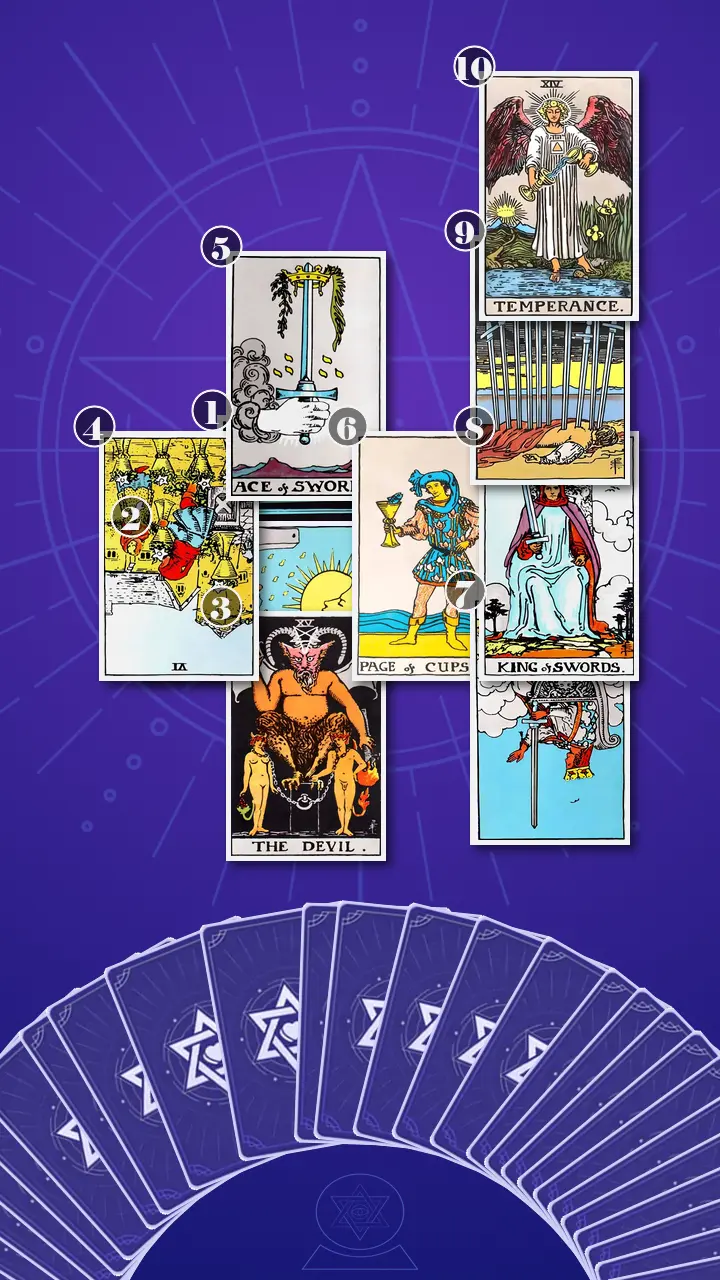
Reading the Map: From Panic to Pattern (Card Meanings in Context)
Position 1 — Present trigger response: Nine of Swords (upright)
“Now we turn over the card representing your present trigger response—what happens in you the moment you hear ‘Can we talk?’,” I said.
Nine of Swords, upright.
I didn’t need to dramatize it. The card dramatizes itself: a figure sitting up in bed, head in hands, swords lined up like accusations on the wall. This is the mind that won’t let you rest.
“This is exactly what you described,” I told her, using her own language so it landed in her real life. “The 2 a.m. re-open-the-thread moment. The way you replay the last week of texts like you’re scrubbing through footage, desperate to find the exact frame where you ‘messed up.’”
Energetically, this is Excess Air—thought as survival. Not thinking to understand, but thinking to prevent pain. The Nine isn’t asking, What’s true? It’s asking, What could go wrong and how fast can I outrun it?
Jordan let out that same bitter little laugh. “That’s… painfully accurate,” she said. “Like, almost rude.”
“I know,” I said gently. “But accuracy is kindness when it gives you options.”
Position 2 — The main challenge: The Moon (upright)
“Now we turn over the card representing the main challenge—what makes ambiguity feel dangerous and invites projection.”
The Moon, upright.
“This is low visibility,” I said, and I watched her face shift because she already knew where I was going. “A dim path between two towers. The dog and the wolf—your ‘rational adult’ and your ‘panicked inner child’—both barking at the same shadow.”
I used the analogy I reach for when someone’s nervous system treats uncertainty as an emergency. “It’s like walking down an unlit street between two buildings. You don’t have facts. You just have shapes. And when your attachment alarm is loud, every shadow becomes a threat.”
Then I gave her the inner monologue, the one that lives under her “reasonable” texts: “I don’t have facts, but my body is acting like I have proof.”
This is a Blockage—not because Jordan is “bad at communication,” but because the Moon makes the blank space feel haunted. Low information turns into high-certainty panic.
Her stomach visibly dropped—tiny, but unmistakable—followed by a quiet nod she didn’t seem proud of. “Oh,” she said. “I treat low-info like high-risk.”
“Yes,” I said. “And that makes sense given your history. It’s just not accurate in the present.”
Position 3 — Subconscious driver: The Devil (upright)
“Now we turn over the card representing the subconscious driver—the attachment-level compulsion underneath the reaction.”
The Devil, upright.
Two figures chained. And the detail I always point out first: the chains are loose. They’re habit, not destiny.
“This is the binding pattern,” I told her. “Control-as-safety.”
In Jordan’s modern life, it looks like this: the Notes-app ‘perfect reply’ as a PR statement—crafted to control perception, not to share reality. Or the long, highly reasonable pre-emptive text sent right after “Can we talk?” to manage the conversation before the other person can even speak.
Energetically, The Devil is Excess—too much grip. The nervous system says, If I can gather enough evidence and craft the perfect tone, I can prevent abandonment. And then it reinforces the belief: Talks are dangerous; I have to manage them perfectly.
Jordan pressed her thumbnail into the side of her coffee cup. “I hate that I do it,” she said. “I can feel myself doing it, and I still do it.”
“That’s why this is The Devil and not ‘bad choices,’” I replied. “Compulsion isn’t cured by self-criticism. It’s loosened by clarity and practice.”
Position 4 — Attachment-history replay: Six of Cups (reversed)
“Now we turn over the card representing the attachment-history replay—the older relational template being activated.”
Six of Cups, reversed.
Reversed, this isn’t cozy nostalgia. It’s the past intruding at the wrong volume. It’s a child’s rulebook showing up in an adult relationship.
“When that text lands,” I said, “a part of you isn’t 29 anymore. A part of you is younger.”
Jordan’s eyes flicked away—not in avoidance, more like her brain had opened a file she didn’t ask for. “I feel… twelve,” she admitted. “Like I’m about to be told I did something wrong, and I have to talk my way out of it.”
“That’s the replay,” I said. “Not because you’re broken. Because your system learned: ‘talks’ are where love gets revoked unless you perform correctly.”
I asked her to try a simple check-in I use constantly in my work—part Tarot, part trauma-informed reality: “Next time it hits, ask: How old do I feel right now? Then write one sentence to that age: ‘I’m here. We can go slow.’”
Energetically, Six of Cups reversed is a Mismatch—old expectations pasted onto new data. The card isn’t blaming her past or her partner. It’s naming the mechanism: the present is unknown, but the past feels certain, so the nervous system grabs it.
Position 5 — Conscious aim (the turning point): Ace of Swords (upright)
“Now we turn over the card representing your conscious aim—what you think you need to feel safe enough to talk.”
Ace of Swords, upright.
This card is a single clean line. A sword crowned with a wreath. No clutter. No ten-paragraph preamble. It’s clarity you can actually use.
“You’re not wrong for wanting clarity,” I said. “Your aim is adult and reasonable. The problem is the method you’ve been using to get it.”
And here’s the contrast I wanted her to feel in her bones—the one that shifts behavior fast:
Twenty messages of control vs one question of clarity.
Jordan exhaled—visible, like her ribs finally got permission to move. “Wait,” she said. “I can just ask.”
“Yes,” I said, and I wrote it on a napkin like it was a line of dialogue she could actually say out loud: “What’s the topic you want to talk about, and is this about us or something else?”
“Clarity is one clean question, not a 20-message court case,” I added, because she needed a phrase her brain could grab when it starts drafting essays.
Energetically, the Ace is Balance: thought as a tool, not a weapon. It cuts through The Moon’s fog without pretending feelings don’t exist.
Position 6 — Near-term direction: Page of Cups (upright)
“Now we turn over the card representing near-term direction—what becomes possible if you choose clarity and vulnerability over control.”
Page of Cups, upright.
The Page is tender courage. A cup held out—and a fish popping up like an unexpected emotion that refuses to be edited.
“This is the part of you that can say one honest sentence,” I told her, “without building an argument around it.”
In Jordan’s world, this looks like: “When I saw ‘Can we talk?’ I got scared for a second.” Not “so you must be leaving.” Not “and here are my receipts.” Just a feeling, offered as information.
Energetically, this is Deficiency turning into flow—water returning to a system that’s been running on Air alone. It suggests the conversation has room to be a bid for connection, not a verdict.
Jordan’s shoulders dropped a fraction. “That feels… doable,” she said, like she’d found a door she hadn’t noticed before.
Position 7 — Self-position: Queen of Swords (reversed)
“Now we turn over the card representing your self-position—the role you step into during ‘the talk,’ and how it shapes your communication style.”
Queen of Swords, reversed.
“This is the Protector-Analyst,” I said. “The version of you who walks into the conversation with receipts, logic, and a tone that’s been edited until it’s bulletproof.”
Reversed, the Queen’s boundary becomes a blade. Her clarity becomes cross-examination. And I said the line Jordan needed to remember when she’s about to weaponize precision:
“Precision can be a boundary—or a blade.”
Energetically, this is Blockage: intellect used to stay untouchable when closeness feels risky. It’s not “wrong.” It’s protective. It’s also lonely.
I had a quick, private flashback—my own “mental courtroom” years ago, not in love but in critique rooms, defending my work like it was evidence instead of expression. I remember how being technically correct can still feel like being unseen.
Jordan swallowed. “I leave feeling… technically right and emotionally alone,” she said, almost verbatim to my thought.
“Exactly,” I replied. “And the goal isn’t to drop boundaries. The goal is to stop using boundaries as armor.”
Position 8 — Environment: King of Swords (upright)
“Now we turn over the card representing your environment—the communication climate around you.”
King of Swords, upright.
The King isn’t warm-and-fuzzy, but he isn’t cruel either. He’s structure: topic, timing, intention. He’s the meeting agenda of emotions.
“This suggests the environment is actually inviting maturity,” I told her. “Not punishment.”
In real life, this might look like a partner who wants a straightforward conversation. Or it might be Jordan’s work culture bleeding into her relationship—Slack tone-policing teaching her that every comma is a referendum on safety.
Energetically, this is Support: clarity as a container. You can ask for a time. You can ask for a topic. You can set a pace. Structure can be safety—if you stop interpreting it as coldness.
Position 9 — Hopes and fears: Ten of Swords (upright)
“Now we turn over the card representing your hopes and fears—the ending your nervous system is bracing for, and what you secretly want instead.”
Ten of Swords, upright.
This card names the dread Jordan described with brutal accuracy: the mind finishing the story early so it can at least have an ending.
“This is the script your body writes,” I said softly. “Humiliation. Finality. Being left.”
And yet—there’s dawn on the horizon of the card. Even here, Tarot refuses to say, It’s over. It says, You’re imagining an ending because uncertainty is unbearable.
Energetically, this is Excess: catastrophic thinking as self-protection. Finality feels more manageable than ambiguity.
Jordan stared at the table like she was seeing the last few months of her life arranged in a line. “I start planning how I’ll survive the breakup,” she whispered. “Before anyone says anything.”
“That’s the Nine turning into the Ten,” I said. “Worry escalating into imagined apocalypse.”
When Temperance Spoke: Metabolizing the Conversation
Position 10 — Integration path (key card): Temperance (upright)
I let the room get quiet before turning the final card. Outside, a bus hissed at the curb. Inside, Jordan’s phone lit up once on the table—nothing urgent, just the screen doing what screens do. But her hand twitched toward it anyway, muscle memory.
“Now we turn over the card representing your integration path—the most grounded secure-attachment response you can practice from here.”
Temperance, upright.
Setup (the moment before the shift): I could feel exactly where she lived when that text hit—on the Tube home, phone warm in her palm, chest tight, brain sprinting. Rewinding the week like CCTV, trying to find the exact frame where she “lost them,” because if she could predict the ending, she could brace for it.
Delivery (the line that changes the lens):
Stop treating “Can we talk?” as a verdict; start treating it as something you can metabolize slowly—like Temperance pouring water between two cups.
I didn’t rush past the silence after. I let it sit between us the way a good film lets a line land before the music swells.
Reinforcement (what it did in her body): Jordan froze first—breath held, fingers hovering over her phone as if the reflex might still win. Then her eyes unfocused for a second, like she was replaying a familiar scene: the Notes-app essay, the “Everything okay?” text, the pit in her stomach that comes from trying to control a conversation you haven’t even had. And then the release: a slow exhale that sounded almost like a laugh, but softer. Her shoulders sank. Her jaw unclenched. She put her phone face-down without me asking, like her body had accepted a new instruction.
“But if I go slow,” she said, and there was a flash of resistance—almost anger—“doesn’t that mean I’ve been doing it wrong?”
“It means you’ve been doing what worked when you were twelve,” I said, “and it’s starting to cost you at twenty-nine.”
This is where my Classic Movie Models always show up, because relationship scripts are scripts. “In Casablanca,” I told her, “everyone thinks the conversation is a verdict. The whole room is charged with unspoken stakes. But the scene only becomes survivable when someone stops trying to control the ending and starts naming what’s true, one line at a time. Temperance is that: not the airport sprint, the steady pacing of truth.”
“You don’t have to outrun uncertainty,” I added. “You can regulate while you seek clarity.”
Then I offered the practice—simple, specific, adult. “Before you reply next time, try a 7-minute Temperance Pace: phone face-down, three-minute timer, inhale 4 and exhale 6 ten times. Then write one clean question: ‘What’s the topic—and is this about us or something else?’ And write one feeling line you may choose to share: ‘I got a bit scared when I saw that text.’”
I watched her nod—not hyped, not magically healed. Grounded. The kind of nod that says: I can practice this.
“Now,” I said, “using this new lens—when was the last time, maybe last week, that you could have paced it instead of pre-empting it?”
Jordan blinked, then looked up. “Thursday,” she said immediately. “He replied ‘Sure.’ with a period. I went to war in my head.”
Temperance, in that moment, wasn’t a personality trait. It was a skill. And that skill marked her first real step from dread and mental sprinting toward steadier self-trust—the beginning of secure attachment as something practiced, not performed.
From Insight to Action: The One-Question Reset for Finding Clarity
When I looked at the whole spread laid out, the story was almost painfully coherent.
The Nine of Swords showed the immediate spiral: your body hears “Can we talk?” and starts writing the breakup scene without a script. The Moon explained why: low visibility turns into projection—imagination dressed up as evidence. The Devil named the compulsion underneath: control behaviors that feel protective but keep you stuck. Six of Cups reversed tied it to the replay: an older rulebook that says you must earn comfort by performing correctly. And then, crucially, the Ace of Swords and Page of Cups offered the pivot—clarity plus vulnerability—while the Queen/King of Swords axis showed the difference between precision as armor and structure as safety.
Your cognitive blind spot—the thing you can’t see while you’re inside the alarm—is that you treat ambiguity as proof. You respond to missing information the way you would respond to bad news. That’s not intuition. That’s an overfitted model: brilliant at detecting patterns from old data, terrible at accounting for new context.
Your transformation direction is exactly the shift Temperance asked for: from pre-empting and mind-reading to co-creating clarity—by regulating your body first, then asking one grounded question.
Here are your next steps—small, specific, and designed for real life (commutes, hybrid jobs, late-night spirals):
- The One-Question Reset (Ace of Swords)When you get “Can we talk?”, send one message with no preamble: “What’s the topic you want to talk about, and is this about us or something else?” If it’s late-night, add: “I can talk tomorrow—are we okay to pick a time?”If you’re at work, write it in Notes first, take two slow breaths, then paste it. Short ≠ cold; short can be clean.
- The One-Feeling Opener (Page of Cups)When the talk starts, lead with one sentence: “When I saw ‘Can we talk?’, I got scared for a second.” Then add one request: “Can we go slow and stay on one topic?”Keep it present-tense and don’t attach a conclusion (skip “so you must not want me”). Vulnerability is information, not a verdict.
- The Temperance Rhythm (Breathe / Name / Ask / Listen)In the conversation, use this loop: breathe once, name one feeling (“I’m tense”), ask one question (“What did you mean by…?”), then listen for 30 seconds before you respond.If you flood, take a boundary break: “I need five minutes.” Paced honesty beats perfect prediction.
And because I’m me—and because language is a lever—I offered Jordan one of my Iconic Line Diagnosis tools: a movie quote as a quick check for what script she’s about to enter. “If your body starts acting like you’re in the final scene at the airport,” I told her, “that’s your cue to slow down. You’re not obligated to improvise your most vulnerable moment at full speed.”

A Week Later: Ownership, Not Certainty
Eight days later, I got a message from Jordan. Not a paragraph. Not a debrief essay. A screenshot, and one line: “I sent the question. I didn’t add anything.”
The screenshot showed it—clean, almost startlingly simple: What’s the topic you want to talk about, and is this about us or something else?
Her partner had replied with something painfully normal: it was about feeling disconnected lately and wanting to plan more intentional time. Not a breakup. Not a verdict. A bid.
Jordan added, “I still felt the stomach-drop. But I did the breathe/name/ask/listen thing. I didn’t go full lawyer.”
Later that evening, she told me she sat alone in a café near her flat, hands wrapped around a tea she barely drank. She felt lighter—and a little lonely—because the old adrenaline had been a weird kind of company. But she slept through the night anyway.
This is what clarity often looks like in real life: not fireworks, but a quiet proof. A new reflex built where the old one used to live.
When a simple “Can we talk?” makes your throat tighten and your mind sprint to the ending, it’s not drama—it’s the old fear that closeness comes with a test you can fail, and that failing means you don’t belong.
If you didn’t have to earn safety by predicting the whole conversation, what’s the one small question—or one honest sentence—you’d want to bring into the room first?
This story is adapted from psychological research, written so that those in a similar struggle can see their own pattern in it — and find their next step clearly.These insights are not a substitute for professional psychological, medical, legal, or financial advice.
Learn more about our Journey to Clarity.
How did this insight land for you?
🫂 This Resonates Deeply
🌀 Living This Story
✨ Now I See Clearly
🌱 Seeing New Possibilities
🧰 Useful Framework
🔮 The Confirmation I Needed
💪 Feeling Empowered
🚀 Ready for My Next Step
Author Profile
 AI
AI“I’ve always felt our lives are films currently in production. As an artist, I know that when you feel stuck, it’s often because you’ve bravely stayed in a painful scene for just a little too long. I’m not here to coldly analyze you. I want to sit closely with you, look at those difficult moments with profound empathy, and gently hand you the pen so you have the courage to write your next beautiful act.”
In this Love Tarot Reading :
Core Expertise
- Toxic Script Identification: Recognizing the repetitive, destructive roles you both automatically play (e.g., the Savior and the Victim) during conflicts.
- Dialogue Loop Auditing: Analyzing the specific triggering phrases that consistently escalate your arguments into dead ends.
Service Features
- The Pattern Interruption Script: A creative role-play directive to consciously change your default response to a known trigger, forcing the relationship dynamic to shift.
Also specializes in :
Explore Related Patterns:
Anxious AttachmentJordan's body treating the 8:42 p.m. 'Can we talk?' message like a breakup is the clearest attachment replay in the story. The text contains almost no information, but her nervous system supplies an entire relational threat: rejection, correction, and the need to secure connection before it disappears. That reaction is not random intensity. It follows an older template where closeness feels conditional and a serious conversation feels like a test you can fail. You can see the pattern in the jump from wanting clarity to bracing for abandonment, then trying to earn safety through the right tone, the right timing, and the right performance. Anxious Attachment fits because the core loop is proximity under threat: you want connection, but ambiguity makes connection feel unstable. The pattern is not that you care too much; it is that your system has learned to treat uncertainty as a possible loss of belonging, so reassurance starts to feel urgent before reality has had time to speak.
CatastrophizingJordan starts planning how she will survive the breakup before anyone has said anything. That is the story's strongest catastrophic leap: the mind fills a blank message with humiliation, finality, and being left, then treats the imagined ending as something to prepare for. Catastrophizing is protective in a distorted way. It tries to make uncertainty survivable by rushing to the worst-case scenario, because a terrible ending can feel more controllable than not knowing. You can brace for a breakup; you cannot brace cleanly for a blank space. The pattern matters because it explains why reassurance never fully works. If the mind has already built the ending, every neutral signal can be recruited into the disaster script. The work is not to force optimism, but to stop letting the most painful possible outcome become the default narrator.
Certainty SeekingThe unlock, WhatsApp, stare, scroll up, scroll down sequence shows Jordan trying to extract certainty from a place that cannot provide it. The thread becomes a kind of evidence board, even though the only real data is still one vague message. Certainty Seeking fits because the behavior is not simple curiosity. It is an attempt to make the nervous system feel safe by finding the missing fact, the hidden clue, or the perfect reassurance before the conversation happens. You are not just asking what the topic is; you are trying to make the threat stop existing. That is why the one-question reset is such a precise counter-pattern. It does not shame the need for clarity. It moves clarity out of compulsive searching and into direct communication, where one grounded question can replace a whole spiral of checking, drafting, and reassurance seeking.
Control CopingThe Notes-app paragraph becoming a PR statement shows Jordan trying to manage the emotional outcome before the other person has even spoken. The message is calm on the surface, but its function is control: control the tone, control the impression, control the possibility of being misunderstood or left. Control Coping fits because the strategy offers short-term relief while reinforcing the fear underneath it. If the perfect wording seems necessary for safety, then every conversation becomes a performance risk. You start believing that connection survives because you managed it correctly, not because the relationship can hold reality. The story does not frame control as a character flaw. It shows it as an old safety strategy that has become expensive. The new move is not to abandon structure; it is to use structure for clarity instead of using it to pre-empt rejection.
Emotional ReasoningThe line 'I don't have facts, but my body is acting like I have proof' captures the cognitive distortion at the center of Jordan's trigger. The physical alarm arrives first, and then the mind starts treating that alarm as evidence that the relationship is in danger. Emotional Reasoning fits because sensation becomes conclusion. A stomach drop, tight throat, hot chest, or restless leg is real as a body experience, but the pattern turns it into a verdict about what the other person must mean. You feel danger, so danger starts to look true. The shift Jordan practices is not ignoring the body. It is separating body data from relationship data. The fear can be acknowledged without letting it write the entire story, which is why one grounded question becomes more stabilizing than twenty fear-driven interpretations.
Emotional RegressionJordan saying she feels twelve when the message lands turns the story from ordinary relationship anxiety into a replay of an older relational state. The adult situation is a partner asking to talk, but the body reads it as being summoned for correction, with connection on the line. That shift shows Emotional Regression because the present moment gets filtered through a younger self-state. You are no longer only responding as the person you are now; a younger rulebook comes online, one where safety depends on explaining yourself well enough, detecting danger fast enough, and preventing someone from withdrawing care. The key detail is that the past does not need to be fully explained for the pattern to be visible. The story shows the mechanism directly: the unknown conversation activates an old age, an old role, and an old task. Your current self wants clarity, but the younger part believes it has to survive a verdict.
Defensive OverexplainingJordan's 'full lawyer' mode gives the communication pattern its shape: receipts, logic, precision, and a tone edited until it cannot be attacked. The goal is not only to explain; it is to get ahead of blame, rejection, and emotional exposure. Defensive Overexplaining fits because language becomes armor. Instead of one clear question or one honest feeling, the mind builds a case so complete that the other person has no room to misunderstand. You may sound reasonable, but the hidden function is to make vulnerability unnecessary. The cost is visible in Jordan's own words: she can leave feeling technically right and emotionally alone. The pattern protects against being wrong, but it also blocks the softer contact she actually wants, because being fully defended is not the same as being met.
Explore Related Struggles:
Certainty-Safety FusionThe story keeps returning to one compressed moment: the phone lights up, the message is vague, and Jordan’s whole body wants certainty before the conversation has had a chance to exist. One sentence becomes too small to hold the amount of safety she needs from it. Certainty-Safety Fusion captures that lock. The problem is not that clarity is wrong; the Ace of Swords section makes it clear that her wish for information is reasonable. The bind forms when safety becomes impossible until certainty arrives, so ambiguity gets treated as danger rather than as a temporary lack of data. You can see the difference in the week-later screenshot. She still feels the stomach drop, but she sends one clean question instead of building a twenty-message case. That shift matters because it separates safety from instant knowing: you can regulate while you seek clarity, instead of making certainty the only condition under which you are allowed to feel steady.
Clarity-Exposure SplitJordan’s goal is not irrational: she wants to know what the conversation is about and whether the relationship is okay. The split appears in the method, because the route to clarity keeps passing through self-protection, tone management, and the need to be perfectly composed before she asks. Clarity-Exposure Split fits because the thing she wants would also expose her. A direct question could bring relief, but it also means allowing the other person to answer without her controlling the framing first. That is the sharp edge of the story: clarity is desired, yet the vulnerability of asking cleanly feels risky enough that she builds a courtroom around it. You can see the repair in the final exchange. She asks, “What’s the topic you want to talk about, and is this about us or something else?” without adding the extra defense. The question works because it lets clarity be a tool again, not a shield against being seen needing reassurance.
Earned Love BindWhen Jordan says she feels twelve, the story moves from a texting trigger into an attachment-history replay. The phrase “Can we talk?” does not stay inside the adult relationship; it activates an older rule where love feels conditional on sounding calm, reasonable, and correct. Earned Love Bind names the structure underneath that reaction. Safety is not experienced as something available inside the relationship; it becomes something she has to secure through performance. The perfect reply, the controlled tone, and the urge to explain herself before being accused all point to the same bind: if she can perform well enough, maybe the bond will not be withdrawn. You can feel how costly that is because the conversation starts before the other person even speaks. Instead of entering the room as someone allowed to ask, listen, and be affected, you enter as someone trying to pass an invisible test. Seeing the bind gives you a different doorway: you can ask for clarity without treating your worth as the thing on trial.
Monitoring-Safety FusionJordan’s hands know the loop before the conversation begins: unlock, open WhatsApp, reread, scroll, draft, edit, and scan for the frame where something went wrong. The movement looks like preparation, but it keeps returning her to the same low-information screen. Monitoring-Safety Fusion names the moment where checking starts to feel like protection. If she can gather enough evidence, shape the perfect tone, or pre-empt the other person’s response, she gets a temporary sense of control. But the loop does not produce the safety it promises; it burns attention while keeping the alarm active. You can still use structure without living inside surveillance. The clean question at the end of the story works because it stops asking the thread to become a crystal-clear answer and lets the other person provide real information. The shift is not from caring to not caring; it is from monitoring the connection to participating in it.
Connection-Defense FusionJordan describes the version of herself who enters the talk with receipts, logic, and a tone edited until it feels bulletproof. She can become precise enough to protect herself, but that same precision leaves her technically right and emotionally alone. Connection-Defense Fusion captures how protection and contact get tangled together. The message she sends is still an attempt to reach across the gap, but it arrives wrapped in defense against the rejection she expects. The conversation becomes less about shared reality and more about avoiding the pain of being caught unprepared. You do not have to drop your boundaries to loosen this pattern. The story’s healthier move is smaller and more exact: one feeling, one question, one paced exchange. That keeps the door to connection open without making emotional armor do the work of intimacy.
Explore Related Emotions:
Ambiguity DreadJordan scrolls up and down the WhatsApp thread like meaning might appear if she scans hard enough. There are no facts yet, only the blank around the message, and that blank starts behaving like proof. Ambiguity Dread appears when not knowing feels less like a pause and more like exposure. You start treating low information as high risk, so the mind fills the silence with a storyline fast enough to feel convincing.
Certainty HungerJordan tries to write a perfectly calm paragraph, then sends 'Are we okay?' because the blank is too loud to sit with. The eventual shift is not a grand realization; it is one clean question asking what the topic is and whether the conversation is about the relationship. Certainty Hunger is the craving for enough usable information to stop the mind from manufacturing endings. You are not asking for total control; you are asking for a stable handle on reality before your body turns missing context into a crisis.
Message DreadJordan's phone buzzes at 8:42 p.m. with 'Can we talk?' and her throat tightens before she knows what the message is about. The body reads a tiny notification as a whole relational event, compressing the Tube, the screen, and the imagined conversation into one sharp signal. Message Dread names the charge that gathers around the alert itself. You are not reacting to confirmed information yet; you are reacting to the old association that a short, serious message is the first knock on the door before closeness gets tested.
Relational Catastrophe DreadJordan's body treats 'Can we talk?' like a breakup before the conversation has even started. Later, she admits she starts planning how she will survive the ending before anyone has said what the talk is about. Relational Catastrophe Dread tracks that leap from unclear signal to imagined collapse. You are not simply worried about a hard conversation; you are watching the mind finish the relationship in advance so uncertainty does not get the final word.
Rulebook ShameJordan feels twelve when the text lands, as if she is about to be told she did something wrong and needs to talk her way out. The present partner has not accused her, but an older rulebook has already opened. Rulebook Shame is the sting of believing closeness can be kept only by performing correctly. You judge the scared reaction as another failure, when the deeper pattern is that safety once felt conditional on saying the exact right thing.
Self-Audit AnxietyJordan replays the last week of texts like she is scrubbing through footage, trying to find the exact frame where she 'messed up.' The relationship has not delivered evidence yet, so she turns herself into the evidence. Self-Audit Anxiety names the pressure to inspect your tone, timing, and emotional performance for the fault that might explain the silence. You are trying to regain control by becoming both suspect and investigator, which keeps the attention locked on self-blame instead of present facts.
Verdict DreadJordan says a part of her feels twelve, as if she is about to be told she did something wrong and must talk her way out of it. That turns an adult relationship conversation into a hearing where every word might be used to decide whether she passes. Verdict Dread is the feeling that conversation is not contact, but judgment. You enter the room prepared to defend yourself, because the old template says safety depends on sounding reasonable, faultless, and emotionally contained.
Control FatigueJordan can feel herself crafting the Notes-app reply like a PR statement, and she still does it. The wording becomes a way to manage the conversation before the other person has even entered it. Control Fatigue is the drained feeling that comes from trying to pre-solve every possible reaction. You may get temporary relief from editing the perfect tone, but the cost is a body that never gets to rest inside the unknown.
Cautious Self-TrustEight days later, Jordan sends the clean question and does not add anything. She still feels the stomach-drop, but she breathes, names, asks, listens, and does not go full lawyer. Cautious Self-Trust is not the absence of activation. It is the quiet proof that you can stay with yourself while the old reflex is still present, choosing a steadier move without pretending the trigger vanished.
Cautious VulnerabilityJordan practices the possibility of saying one honest sentence without building a case around it. Instead of 'so you must be leaving,' the sentence becomes simple and present, a small disclosure offered without receipts. Cautious Vulnerability is tender because it keeps both openness and boundary in the room. You do not have to drop your guard completely; you only have to let one true feeling become information the relationship can actually work with.
Clarity ReliefThe partner's reply is painfully normal: they have been feeling disconnected and want more intentional time. The feared verdict becomes a topic, and the body gets to meet reality instead of shadow. Clarity Relief is the oxygen that returns when the blank is replaced by usable information. You do not need a perfect guarantee to feel the shift; you need enough truth to stop living inside the imagined ending.
Defensive LonelinessJordan recognizes the version of herself who enters the talk with receipts, logic, and a tone edited until it is bulletproof. The precision protects her from being exposed, but it also keeps the other person from meeting the softer truth underneath. Defensive Loneliness is what remains when armor succeeds too well. You can leave the conversation technically right and still feel emotionally alone, because the part that wanted connection never actually got to speak.
Emotional FloodingJordan's throat tightens, her chest goes hot and shallow, and her leg starts moving before her words can catch up. The reaction is not neatly intellectual; it arrives as body speed, heat, and reflex. Emotional Flooding names the moment sensation takes over the available room for choice. You may know it is 'just a conversation,' but the body is already responding as if the whole relational floor has shifted.
Explore Related Contexts:
Conditional Belonging PressureJordan names the older scene with unusual precision: when the message lands, part of her feels twelve, about to be told she did something wrong, and needing to talk her way out of it. The story does not need to invent a family backstory to show the structure; it shows the rule she absorbed, that certain conversations are tests where comfort can be withdrawn if she performs incorrectly. That is why the present-day text carries more weight than its words can justify. The external pressure is the replay of a conditional belonging setup, where closeness feels available only if You manage tone, evidence, timing, and emotional presentation without error. A relationship conversation stops being a mutual exchange and starts resembling an assessment. Conditional Belonging Pressure fits because the core issue is not drama over one message; it is an old social template entering a current relationship. You are being asked to notice when the room has become a test in your body before it has become one in reality, then choose a response that belongs to the present adult relationship rather than the older rulebook.
Mixed Signal LimboJordan receives a bare "Can we talk?" at 8:42 p.m. on the Victoria line, with no topic, no timing frame, and no clue whether the conversation is about the relationship or something ordinary. That small information gap becomes the whole stage: she opens WhatsApp, scrolls the thread, rewinds recent messages, and starts treating missing context as if it already contains bad news. The external pressure here is not simply that a partner wants to talk. It is the ambiguity of the signal and the waiting period it creates. When a relationship message carries high emotional stakes but almost no usable information, You are left trying to build certainty out of fragments: wording, timing, punctuation, silence, and memory. Mixed Signal Limbo fits because the story keeps returning to the same suspended state between notification and reality. Jordan is not responding to a confirmed breakup; she is responding to a low-visibility relational cue that has not yet become a conversation. The practical work is to stop letting the gap write the whole script and ask for the missing frame directly.
Digital Intimacy Boundary ConfusionJordan's relationship alarm does not start in a room with another person; it starts on a phone. She opens WhatsApp, scrolls the thread, drafts a controlled Notes-app reply, watches the screen light up, and later sends a screenshot of the one clean question she managed to ask. That digital layer changes the pressure of intimacy. A vague notification can arrive anywhere, including on the Tube after work, and it demands interpretation before the other person is present to clarify it. The device becomes a boundary problem because it offers instant access to the trigger but no guarantee of real context. Digital Intimacy Boundary Confusion fits because the story shows connection, reassurance-seeking, and self-protection all happening through the same interface. You are not just deciding what to say; You are deciding whether the phone is a doorway into conversation or a control panel for preventing rejection. The stronger boundary is not silence or surveillance, but a slower rhythm that lets the talk move back into human scale.