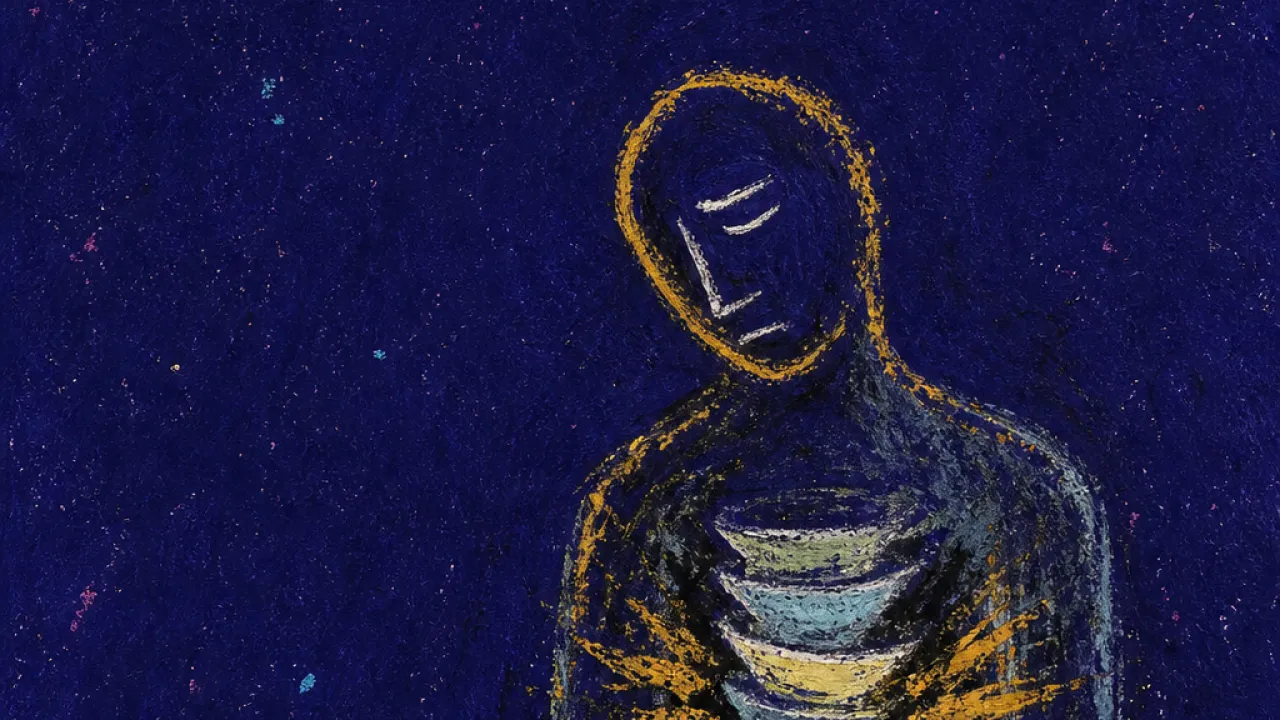
That tight ache under your ribs, the one that feels like a receipt your body keeps rereading, is one way Sunk Cost Grief makes past effort feel physically present. This is a universal emotional experience: mourning what you gave while noticing that investment cannot be the only voice in the room. Tarot gives the feeling a visual language through carefully stacked cups and the weight of what still looks worth honoring. Here are the Tarot Cards that tend to mirror Sunk Cost Grief.
Five of Cups UprightSpilled wine across the ground makes the past materially visible: something valuable has already left the container and cannot be restored by staring harder at it. The figure remains beside that evidence while the river continues, placing spent investment and ongoing movement in the same frame. For a high-stakes choice, this becomes grief over what a path has already cost you. The bridge does not erase what was spent; it clarifies that the emotional weight of past investment and the agency of the next decision are not the same object.
Seven of Cups ReversedThe wreath and skull share a single cup, making achievement and loss occupy the same visual container. Around them, the other cups still glitter, which keeps the abandoned or delayed paths visible rather than letting them disappear. You may grieve an option because leaving it means releasing not only a plan, but the version of yourself that survived inside that plan. Sunk Cost Grief names the sadness that emerges when the investment is real, yet continuing would require you to keep feeding a vision that no longer feels alive.
Eight of Cups UprightThe red figure does not kick the cups over; he leaves them intact. Every cup remains a record of effort, care, and former meaning, which makes the departure heavier than a simple rejection. In personal growth, the image captures the grief of leaving behind a system that genuinely helped you become who you are now. You may be ready for a larger view and still feel the cost of walking away from habits, ambitions, and identities that once gave your life structure.
ReversedThe eight cups are not random objects; they are the visible record of effort, taste, attachment, and time. Their careful stack makes the act of leaving more difficult because the past is not vague. It is arranged right there in the foreground, still capable of holding what once mattered. Sunk Cost Grief appears when the cost of a direction change is measured in years, identities, and versions of yourself that were sincerely invested. The reversed card intensifies the ache by keeping the old structure intact enough to question the departure. It lets you see that the grief is not proof you chose wrong; it is the residue of having built something real before realizing it could not carry you forward.
Page of Cups ReversedThe Page looks closely at the fish in the cup, as if the object of care has become difficult to separate from the act of caring itself. The sea behind him suggests a larger place the fish may belong, while the cup preserves the history of holding it. In a decision, this becomes grief over the time, hope, attention, or identity already invested in a path that may no longer be right to keep. The ache is not only about the future you might lose; it is about the past effort that wants to be honored before it is released. Sunk Cost Grief fits the reversed Page of Cups because the card shows attachment at the moment it becomes a decision variable. It helps distinguish love for what was invested from clarity about what should continue.
Knight of Cups ReversedThe chalice is held like something hard-won, and the armored rider approaches a threshold that may require carrying it into unfamiliar terrain. The cup’s value is visible not through abundance, but through the care, control, and slowed movement organized around it. That is why the card can hold Sunk Cost Grief inside a decision. You are not only choosing between options; you are feeling the weight of what has already been pursued, protected, and imagined, and the card gives that grief a place without letting it become the only decision-maker.
Ace of Pentacles ReversedThe manor, fence, and flowering threshold show a world that has already been claimed and maintained, yet the deeper hill inside the scene looks dry and neglected. The land is not empty; it carries signs of care, ownership, and uneven nourishment. Sunk Cost Grief fits the moment when leaving a choice is not just practical subtraction. You are not only comparing options; you are feeling the weight of what has been planted, protected, and kept alive, even where part of the terrain no longer returns the same vitality.
Two of Pentacles ReversedThe cord keeps both pentacles tied into the same circuit, so neither object can be dropped without changing the whole apparatus. The figure continues handling both weights because the system has already been set in motion. Sunk Cost Grief emerges when a decision is no longer only about what you want next; it is also about what has already been invested. In this card, the returning coins mirror the ache of choices that keep coming back because time, effort, money, or identity has been braided into them. For a decision spread, the grief is not a command to stay or leave. It is the emotional residue of recognizing that one path may need to be released even though part of you already built a life around keeping it in circulation.
Three of Pentacles ReversedThe pentacles are already embedded in stone above an unfinished church, and the architecture continues beyond the frame as if the project has absorbed time before the viewer arrived. Labor has become visible, measurable, and difficult to mentally detach from. Sunk Cost Grief appears when leaving a path feels like grieving the version of yourself that built it. The card does not reduce that ache to bad logic; it shows the emotional weight of effort already set into structure, especially when a decision asks you to stop adding to something that once made sense.
Four of Pentacles UprightThe pentacles in the Four of Pentacles are not lost; they are present, intact, and tightly held. The grief comes from the fact that their presence has become immobilizing, with the seated figure holding the evidence of investment so closely that the wider town stays out of reach. Sunk Cost Grief lives in that exact tension. In a decision, what has already been paid in time, effort, identity, money, or loyalty can feel too emotionally expensive to release, even when holding it keeps the next path inaccessible. This card does not reduce the choice to a spreadsheet. It shows the private mourning underneath the calculation: the ache of admitting that something valuable may still need to be left behind for movement to become possible.
Five of Pentacles UprightThe wrapped foot, the crutch, and the weary forward lean make the journey look already paid for in the body. The figures continue past the lit window because stopping would require acknowledging how much the road has taken. In decisions, Sunk Cost Grief is the heaviness that appears when leaving a path would mean grieving the energy, identity, or years already spent there. The pain is not only about the next option; it is about admitting that endurance has become part of the attachment. The Five of Pentacles holds that grief without turning it into a command to stay or leave. It shows the cost that has been carried so the choice can be audited instead of romanticized.
Seven of Pentacles ReversedThe lush vine implies a long season of cultivation, while the figure studies the harvest as if weighing whether the return matches the work. The single pentacle on the ground makes the result tangible, but not emotionally final. Sunk Cost Grief surfaces when time spent on becoming cannot be casually dismissed and cannot be fully celebrated either. In personal growth, the card names the ache of wondering whether the years invested in a path, method, or identity have returned enough life to keep carrying it forward.
Eight of Pentacles ReversedThe finished pentacles hang behind the craftsman like a visible record of time, attention, and effort already spent. A path and town remain in the background, but the body stays bent toward the bench, still working the next coin. That arrangement gives Sunk Cost Grief its shape. The pain is not simply about choosing badly or changing direction. It is the ache of seeing real labor behind you and realizing that labor cannot, by itself, decide what should come next. In a decision spread, the Eight of Pentacles can expose the emotional weight of prior investment without turning it into a command. It asks the grief to be seen clearly: the past work mattered, and it still may not be a sufficient reason to keep building the same future.
Nine of Pentacles ReversedEvery grape, pentacle, and boundary in the garden looks like the result of patient investment. The snail makes time visible at the woman's feet, turning the scene into a record of slow accumulation rather than instant reward. When a choice asks whether to stay or leave, this becomes Sunk Cost Grief: the ache of admitting that years of effort were real even if they cannot be the only reason to continue. The card gives that grief a shape, so the past can be honored without being allowed to silently make the decision for you.
Ten of Pentacles ReversedThe elder, the crest, the house, the wall, and the completed pentacle pattern all point to value accumulated over time. The scene is not a loose pile of resources; it is a whole structure that has absorbed years, roles, and visible proof of effort. Sunk Cost Grief enters when a decision asks you to loosen your grip on something that once made sense. You are not only weighing future benefits; you are grieving the emotional weight of what has already been built, because leaving or changing direction can make past effort feel painfully exposed.
Page of Pentacles ReversedThe coin held with both hands carries the weight of what has already been tended. Around the Page, the living field remains present, but his attention stores value inside one disc until the wider landscape becomes harder to use. Sunk Cost Grief is the sadness of realizing that past investment has become emotionally louder than future fit. In a decision reading, this card reveals the ache of leaving something not because it was worthless, but because continuing to honor its cost may be quietly taking over the choice.
Knight of Pentacles ReversedThe field stretches outward but shows no visible harvest, and the horse remains still under a rider built for endurance. The pentacle carries the history of effort, yet the scene does not guarantee that effort will become growth. In friendship, Sunk Cost Grief is the ache of realizing that years of loyalty, late-night support, and repeated repair may not produce the mutuality You kept waiting for. The card anchors that sadness in the gap between what has been invested and what the relationship can actually return.
Queen of Pentacles ReversedVines climb around the throne, flowers fill the ground, and the Queen holds the pentacle as something that has already accumulated weight. The scene is not a blank starting point; it is a place shaped by time, care, and material input. That visual density mirrors the grief that can surface when leaving a path means admitting how much has been poured into it. The choice hurts not only because of what comes next, but because the current path has roots in your identity, routines, and history. Sunk Cost Grief names the tender heaviness of realizing that investment is real without making it the final authority. The card gives that heaviness a physical form, so it can be examined instead of silently running the decision.
King of Pentacles ReversedThe castle, wall, vines, and cultivated land make the past visible as something built stone by stone. The King's foot presses down, the coin is braced on the knee, and the whole image gathers weight around what has already been claimed. Sunk Cost Grief appears when leaving a path would mean mourning the time, identity, effort, and imagined future already poured into it. You are not only choosing between options; you are feeling the cost of admitting that something valuable may not be worth more of you.
Three of Swords UprightThe heart hangs in the rain with the swords already inside it, suspended after the moment of impact. Nothing in the image is negotiating, repairing, or reaching backward; the card holds the viewer in the aftermath of what has already entered the emotional center. That suspended quality fits the grief of recognizing how much has already been invested in a path that may need to end. In decision work, the hardest part is often not the next move itself, but the mourning of every hour, hope, identity, and version of the future that made the old path feel too expensive to leave. Sunk Cost Grief is the emotional weather of seeing that continuing would not erase the wound. The card gives that grief a clear shape so the decision can be audited without pretending the loss is small.
Four of Swords ReversedThe coffin-like support holds the knight so closely that the body nearly merges with the stone. The lower sword sits inside that support, making the past investment feel embedded in the very place where the figure is trying to pause. Sunk Cost Grief appears when leaving an option means mourning the time, effort, identity, or hope already placed inside it. The card does not treat that sadness as proof that you must stay; it makes the weight visible so the choice can be separated from the ache of what has already been given.
Five of Swords ReversedTwo swords lie on the ground while the background figures turn away with bowed heads. Nothing in the scene turns the abandoned blades into waste or wisdom; they simply remain there as visible evidence of what has already been spent. In a high-stakes choice, that image captures the ache of leaving an invested path. You may know that walking away is the cleaner move, yet the effort, identity, and hope already placed into the old option still have weight. Sunk Cost Grief names the emotional cost of releasing what cannot repay you. The card does not force the past to justify itself; it keeps the spent material visible so the decision can separate real value from the pain of having paid.
Six of Swords UprightThe six swords are not left behind; they are carried across, adding weight to the small boat and shaping the space around the passengers. The far shore is visible, but the vessel sits low enough to make the cost of the crossing physical. In a career context, this mirrors the ache of realizing that years of effort, loyalty, training, or identity cannot be fully recovered before moving on. You may be choosing a better path while still mourning the version of yourself that invested so much in the old one. Sunk Cost Grief fits because the card refuses the fantasy of a weightless pivot. It shows transition as a passage where the mind can choose forward while the body still carries the ledger of what was spent.
ReversedThe six swords travel with the passengers instead of being left on the bank. Their order makes them manageable, but their weight still sinks the boat lower and turns the crossing into slow work. In friendship, Sunk Cost Grief appears when history, shared secrets, group memories, and years of mutual access make departure feel expensive. You are not grieving only the friend in front of you; you are grieving the amount of yourself already invested in keeping the bond alive. The reversed Six of Swords gives this grief its specific pressure: forward movement keeps being slowed by what you cannot simply drop. The card helps separate care from obligation, so the past can be acknowledged without being allowed to decide the entire route ahead.
Eight of Swords ReversedThe water has traveled from higher ground and pooled around the figure, while the castle sits behind her at a distance. The scene carries the residue of what came before: terrain already crossed, effort already spent, and a body still wrapped inside the consequences. Sunk Cost Grief appears when a decision is not only about what comes next, but what must be mourned if one path is released. You may be evaluating strategy on the surface while quietly grieving time, identity, loyalty, effort, or the version of the future you kept trying to justify. Eight of Swords holds this grief through the contrast between temporary restriction and emotional residue. The card makes visible how past investment can become a binding sensation, especially when leaving would mean admitting that endurance has not guaranteed alignment.
Ten of Swords UprightThe river is calm enough to cross, and that is what makes the fallen body beside it so stark. The image holds an unused threshold, a path that could have carried movement, and a figure who reached the edge too late to take it. For personal growth, this becomes the grief of looking back at all the effort invested in a system that never actually moved you across. Courses, habits, identities, and plans may have accumulated, but the body of the self remained on the same bank. Sunk Cost Grief fits because the card does not only show loss; it shows the pain of proximity. You can see what the work was supposed to open, and that visibility makes the wasted energy feel heavier.
ReversedThe red cloth spread around the fallen man carries the sense of energy already spent. The river remains calm and crossable, and the far mountains still exist, but the body is fixed on the bank where the loss has already taken place. Sunk Cost Grief in friendship is the ache of realizing that loyalty, years, shared memories, and emotional labor cannot guarantee mutual care. The sadness is not only about losing the person; it is about facing how much of yourself was invested in keeping the connection alive. The card makes that recognition stark without making it hopeless. The distant light suggests that clarity can begin after the hardest admission: the amount you gave does not obligate you to keep giving from an empty place.
Queen of Swords ReversedBehind the Queen's high throne, the living signs are distant: a few trees and a narrow trace of water beneath the cloud layer. Her composed face and elevated seat create the image of someone who can see the landscape clearly, yet remains physically separated from what has already grown there. Sunk Cost Grief comes from that separation between clear judgment and accumulated attachment. In a decision spread, this card can reflect the ache of knowing an option may need to be cut away while still feeling the weight of time, effort, loyalty, and identity invested in it. The sword makes the exit thinkable, but the distant water shows why it is not emotionally simple. This grief is the cost of becoming honest about a path that once carried life, even if it no longer carries enough future.
Two of Wands ReversedThe houses, fields, and castle below are not abstract assets; they are the visible proof of a life already built. The fixed wand on the wall makes attachment physical, while the sea beyond keeps opening a different direction. Sunk Cost Grief lives in that split between what has been built and what may need to be left. You are not simply choosing a better option; you are registering the emotional weight of effort, time, and identity that cannot all travel with you.
Three of Wands ReversedThe planted wands mark a foundation that has already been established, not a blank beginning. The figure stands with one hand still attached to a wand while looking toward a sea that would require leaving the known ground behind. Sunk Cost Grief forms where past investment becomes emotionally visible. You may recognize that a route is no longer cleanly aligned, yet the effort, identity, time, and hope already placed into it still have weight. The card holds that grief without turning it into an obligation to stay. In a choice reading, this emotion matters because it separates honoring the past from being trapped by it. The cliff shows the boundary between what has been built and what has not yet been entered, allowing the real cost of departure to be named without letting that cost quietly make the decision for you.
Seven of Wands ReversedThe elevated ground gives the figure an advantage, but the ridge is jagged, narrow, and hard to stand on. He has climbed into a position that now requires constant defense, with six wands below turning achievement into maintenance. Sunk Cost Grief is the ache of realizing that a hard-won position may not be the same as a life-giving one. In a decision spread, this card names the sadness of asking whether the effort it took to get here is the only reason you keep fighting to stay.
Nine of Wands ReversedThe eight wands behind the figure look like effort made visible: upright, planted, and hard to ignore. Beyond them, the green hills suggest continuation, but the body remains in front of the barrier, held in place by the staff it leans on. That is the emotional ache of a choice where leaving would mean mourning the investment itself. The future may still be alive, but the accumulated past keeps asking to be honored, counted, and protected before any exit can feel emotionally clean. Sunk Cost Grief fits the reversed Nine of Wands because the card shows endurance becoming attachment. It reveals the sadness that appears when what once helped you stand now makes movement feel like abandoning proof of everything you already gave.
Ten of Wands UprightThe leafy wands look alive while the carrier appears depleted, as if his vitality has been poured into the bundle he is still moving forward. The destination remains ahead, which makes the scene feel less like a fresh start and more like the late stage of a long investment. In a decision, that visual tension becomes the grief of admitting how much life force has already gone into one path. The pain is not only about whether to continue or leave; it is about recognizing that the option has been kept alive by your effort, time, and identity. Sunk Cost Grief names the ache that appears when walking away would mean mourning the self who carried it this far. The card helps separate the value of your past effort from the question of whether the same load still deserves your future.
No cards available for this filter.