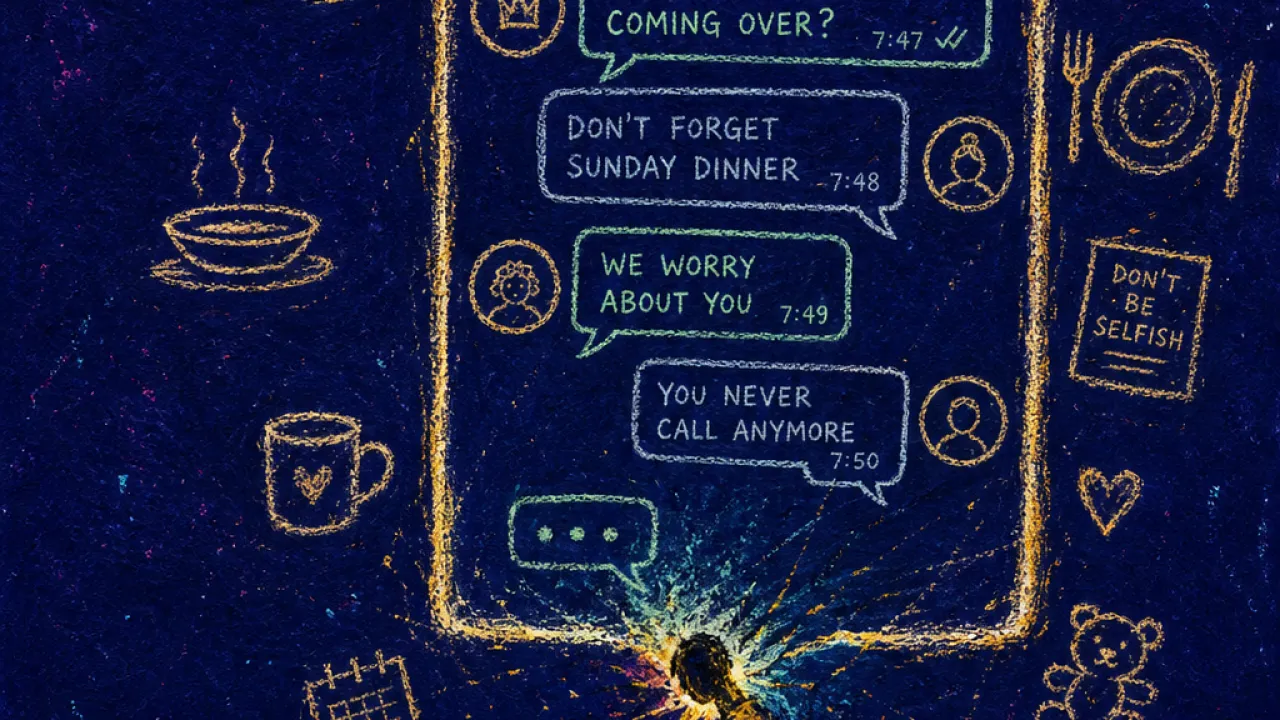
Family System Overidentification lives in the second after a call, when your mood has already calibrated to the family field before you have checked yourself. You feel it in the tight throat, lifted shoulders, and small pause before you say what you want. From an existential perspective, the structural framework is the bind of belonging becoming the map for self-definition. The Tarot Cards below make that outline visible.
The World ReversedThe central figure is not alone in the image; she is surrounded by a wreath, tied red loops, paired wands, and four corner creatures that complete the card's sense of cosmic order. The body becomes the visible point where many systems meet and appear resolved. Inside a family structure, that same arrangement can become a heavy assignment. You may be treated as proof that the family is fine, successful, healed, or respectable, so any move toward a separate truth feels like it would expose cracks in the whole picture. Family System Overidentification names the burden of being turned into a symbol for more than your own life. The World shows why this can feel so hard to untangle: the self is not merely inside the system, but used as evidence that the system is complete.
Three of Cups ReversedThe celebratory ring can become a closed circuit when the raised cups are treated as the only valid rhythm. Distinct figures remain visible, but their timing, posture, and spacing are organized around the circle rather than around their separate centers of gravity. Family System Overidentification begins when that circle becomes your internal measuring device. After a call, visit, or argument, you may find your mood, desire, and sense of rightness calibrated to the family field before you have checked what is actually yours. The reversed structure does not show simple closeness; it shows self-reference being absorbed by group rhythm. The card gives that absorption a boundary, making it possible to see where family contact ends and your own signal needs to begin again.
Four of Cups ReversedThe man sits beneath a rooted tree with three cups grounded before him and a fourth cup arriving from elsewhere, yet his closed eyes make all coordinates collapse inward. The scene contains past experience, present environment, and new possibility, but the body uses only its internal reference point. In family systems, this is the shape of overidentification: the old emotional climate becomes the default map for who you are allowed to be. You may stand in adult life, but the family field still supplies the first translation of your needs, your choices, and your worth, making outside support feel strangely unreal.
Five of Cups ReversedThe black cloak reduces the figure's body into one continuous dark shape, with almost no visible separation between arms, torso, and outline. The scene makes differentiation difficult: the person appears less like a moving body and more like an extension of the loss-field in front of them. Family System Overidentification takes that visual fusion into the family realm. A family story, role, disappointment, or control pattern can become so close to your sense of self that separation feels less like a boundary and more like losing orientation. The bridge and upright cups are still present, but the cloaked posture makes them practically absent. The card shows how a family system can become the default coordinate system inside you, making it hard to know which pain is yours, which duty is assigned, and which future is actually available.
Six of Cups ReversedThe two children remain foregrounded while the older figure and manor recede behind them, turning the whole courtyard into a preserved childhood coordinate system. The cup ritual has no adult-sized exit in view; the scene keeps identity scaled to the role first learned at home. Family System Overidentification takes this preserved scale into your present life. You may arrive as an adult, but the family field recognizes the child-shaped outline first, and the card shows how easily your current self can be pulled back into an inherited version of belonging.
Seven of Cups ReversedThe figure is a dark silhouette facing a wall of symbolic containers, while the most intimate image of self is covered and elevated inside one of the cups. Identity is not shown as a body with clear edges; it is dispersed across objects that look like home, status, fear, desire, and recognition. When family patterns have been internalized, you can start reading yourself through those objects before you feel your own position. The card locates the struggle in that loss of scale: the family system becomes the larger visual field, and your own outline has to be recovered from inside it.
Eight of Cups ReversedThe cup formation stays behind as a system with its own shape, its own gap, and its own emotional gravity. The figure does not take it apart, yet the visible incompleteness of the arrangement can still seem to call his body back. Family System Overidentification appears when the missing cup of the household is experienced as your own missing piece. You may keep reading the family’s tension, disappointment, silence, or unmet need as something you must metabolize before you are allowed to move freely. The card’s reversed pressure sits in that fusion. The path exists, the staff is in hand, and the cups are not yours to carry, but the old system has trained your inner map to feel responsible for its unfinished emotional architecture.
Nine of Cups ReversedThe cups behind the figure rise above his seated body, creating a higher reference line than the person himself. He appears in front of his own display, but the display silently defines the room’s scale. A family system can become that raised backdrop: its achievements, image, wounds, rules, and preferred version of you hover above your own self-reading. The card marks the moment when you stop asking what is true in your body and start measuring yourself by what keeps the family story intact.
Ten of Cups ReversedThe Ten of Cups gathers every element into one field of belonging: parents, children, house, river, garden, and the promise overhead. Reversed, the same completeness can become too total, with each symbol reinforcing the others until the individual self has little unclaimed space. In inner work, this is where family harmony or the memory of an ideal home becomes more than a background influence. It becomes the template your psyche uses to decide which feelings are acceptable, which needs are disruptive, and which private truths threaten the whole field. Family System Overidentification names the compression that happens when belonging becomes the main container for identity. The card shows why separation can feel internally dangerous: stepping outside the harmonious picture can feel like damaging the structure that once promised safety.
Page of Cups ReversedThe Page's role, costume, cup, and gaze all converge on one small emotional object, while the empty sky offers no competing landmark. Reversed, the figure's balance can read as a role posture that has become a reference system: the body knows where to stand because the cup tells it who to be. Family overidentification has that same loss of distance. You may arrive as an adult and quickly become the sensitive child, the peacekeeper, the translator, or the disappointing one, because the family field supplies the reference point before your separate self can come online.
Knight of Cups ReversedThe Knight of Cups can look beautifully self-possessed, but the reversed structure locks the body into a transport role. One hand must keep the family cup presentable while the other keeps the horse controlled, turning movement into continuous emotional regulation. In family life, this is the point where care stops being something you offer and becomes something you are identified with. You may be treated as the sensitive one, the good one, the one who understands, or the one who can absorb the family's unfinished feelings without disturbing the surface. Family System Overidentification names the loss of separation that happens when your inner life is organized around the family's emotional image. The card's graceful surface matters because it shows why the bind can be hard to challenge: the role looks loving, refined, and harmless from the outside while quietly absorbing the space where your own self-definition should be.
Queen of Cups ReversedThe Queen's body is small inside a throne that is visually larger, heavier, and more elaborately defined than she is. Crown, shell, cherubs, cup, water, and wall all gather around her until the person and the emotional realm become difficult to separate. In family life, that image describes the moment when the system becomes the reference point for the self. You may enter a visit, a call, or a family decision as an adult, then feel your scale change as the old role, old mood, and old rules become larger than your present identity. Family System Overidentification is not simple closeness. It is the loss of inner proportion when the family throne becomes the default seat from which you measure your worth, permission, and emotional reality.
King of Cups ReversedThe blue garments echo the sea so closely that the figure can appear made from the same field he is trying to govern. The shell throne still marks a boundary, but water surrounds every edge and becomes the visual baseline. Reversed, the card locates a family bind where inherited moods, expectations, and old reactions start feeling like your own inner weather. You may enter a call or visit as an adult and leave carrying a family state that has overwritten your individual signal.
Ace of Pentacles ReversedThe manor, garden, hedge, pathway, and coin create a complete material world before any separate full body appears. The only body part shown is the hand that carries the family-marked resource, not the person who will live with its consequences. When family structure becomes the baseline for identity, you can feel yourself shrink around parents or relatives even after building an adult life elsewhere. The system does not have to shout; it only has to define the ground, the gate, and the measure of value. The card gives that overidentification a visual boundary. You are not just reacting to relatives; you are navigating a whole inherited landscape that can make your separate self feel secondary to the family field.
Three of Pentacles ReversedThe cathedral is larger than every person in the scene. Its arch, pillars, symbols, and strict geometry turn individual labor into part of a structure that was there before the worker arrived and will remain after the immediate task is done. When that architecture becomes a family system, You can begin to experience your identity as one more support beam inside the larger design. Your choices, moods, boundaries, and future all get measured by whether they preserve the family structure. The card gives form to overidentification as the moment when belonging to the system starts to replace knowing where You end and the system begins.
Four of Pentacles ReversedThe reversed structure turns the coins from held objects into a coordinate system. Head, chest, feet, seat, and posture all organize around the same arrangement until the body no longer appears to have a separate reference point. In family life, that is the texture of overidentification: the system's stability becomes your internal map. You may notice family tension as if it is your own identity shifting, because the old arrangement has been absorbed into how you measure safety, loyalty, and selfhood. Family System Overidentification is not closeness; it is a loss of distinguishable edges. The card frames the struggle as a closed architecture where the family pattern has moved inside the body and begun deciding what counts as normal movement.
Seven of Pentacles ReversedThe single lush vine dominates an otherwise spare field, and the figure's whole posture is organized around watching its condition. In the reversed state, the surrounding space disappears as a reference point, leaving one family crop to define where the body belongs. This is the shape of overidentification with the family system, where its growth, mood, and stability become the scoreboard for your own adulthood. The card gives that fusion a boundary by showing how narrow the field becomes when one inherited plot receives all of your attention.
Eight of Pentacles ReversedThe bench, tools, displayed coins, and loose coins form a tight production cell around the seated body. In the reversed pressure of the image, the workspace no longer looks like a place the craftsman uses; it looks like the coordinate system his body has learned to become. Family roles can work the same way when they are rehearsed for years. The achiever, the calm one, the problem-solver, the difficult one, the responsible one, or the proof that the family is fine can become so familiar that the role feels like identity. The card names the collapse between selfhood and assigned function. It shows why returning home can make an adult self suddenly feel smaller: the old family calibration is still waiting, and the body remembers where it was trained to sit.
Nine of Pentacles ReversedThe estate surrounds the woman so completely that the garden, house, vines, pentacles, bird, robe, and ground all read as extensions of one managed domain. The boundary between person and property becomes hard to locate because the whole scene has been organized around belonging to the same field. Family System Overidentification emerges when the family’s moods, conflicts, assets, reputation, and expectations become the coordinate system for selfhood. You may know you are an individual, but your body still reacts as if family stability, family image, and family problems are yours to absorb. The card gives the fusion a visual boundary: it is not love itself that erases you, but the way every part of the environment has been folded into one inherited map. Seeing the map makes it possible to ask which parts of your identity were cultivated by you and which were planted by the system.
Ten of Pentacles UprightThe elder sits at the front of the scene while the couple, child, dogs, crest, arch, and property line gather around him as parts of one inherited structure. The family is not only present; it is arranged as a system of visibility, status, loyalty, and placement. That arrangement mirrors the pressure of becoming identified with the family system itself. You are not simply relating to relatives; you are being asked to stay recognizable inside a legacy, a household image, and a hierarchy that existed before your current choices. The struggle named here is the loss of separation between belonging and self-definition. The Ten of Pentacles holds the comfort of continuity and the weight of being absorbed by it, making the family system feel like both shelter and identity container.
ReversedThe elder, crest, arch, dogs, child, and couple all sit inside one enclosed household field, and every path through the scene passes a family marker before it reaches open space. The symbols of belonging are so dense that individual direction has to negotiate with the architecture before it can become movement. Here the struggle is not family itself; it is the way an inherited system can become the inner reference point for what you are allowed to become. You may feel blocked because change is being processed as a disturbance to belonging rather than as a legitimate act of self-definition.
Page of Pentacles ReversedThe Page's green and brown clothing almost repeats the colors of the field, while the pentacle becomes the sharpest reference point in the scene. Body, terrain, and material sign start blending into one continuous surface around the object he is trained to notice. Within family life, that image captures what happens when the system's values become so familiar that they feel like your own physical climate. You are not simply influenced by the family story; your sense of self begins to take its shape from the role, resource, or expectation that the system keeps placing in the center.
Knight of Pentacles ReversedThe rider, horse, armor, and pentacle form one sealed system, with the same green growth marker appearing on more than one body. The image no longer reads as simple preparation; it reads as a whole identity organized around staying aligned with the carrier, the equipment, and the guarded object. In family terms, this is where belonging has absorbed too much of the self. You may know you are an adult, but the family system still feels like the ground, the vehicle, and the reference point at once, making separation feel less like a choice and more like losing the coordinates of who you are.
Queen of Pentacles ReversedThe reversed structure makes the Queen's estate feel less like a setting and more like a coordinate system. The throne, cloak, carvings, roses, and pentacle crowd the body until the person inside the role is hard to separate from the role itself. In a family system, this is the point where identity starts borrowing its outline from the household. You know yourself through being the responsible one, the difficult one, the successful one, the fragile one, or the one who keeps contact possible. The card does not frame this as weakness. It names a spatial problem: the family field has occupied so much inner territory that finding your own shape requires first seeing where the inherited frame ends.
Two of Swords ReversedThe shoreline, moon, and tide offer several reference points, but the body remains organized around the crossed blades. Here, that guarded line becomes the internal horizon, and the surrounding world is measured against the defense rather than the other way around. Family overidentification forms when an old system keeps providing the coordinates for adult choices. You may be physically elsewhere, but a parent's reaction, a sibling role, or a family rule still decides what feels possible, making your own authority hard to locate.
Three of Swords ReversedThe card offers no body around the heart, no ribs, hands, or skin to mark where one living system ends and another begins. The organ floats in shared rain and grey weather, pierced by forces from several directions until the whole scene behaves like one exposed nervous system. In a family system, this turns personal feeling into a shared impact zone. You may absorb a parent's mood, a sibling rivalry, or an old household conflict as if it were your own signal, because the structure has trained the heart to register the family's pressure before it can locate its own center.
Four of Swords ReversedThe church, tomb, swords, armor, prayer hands, and stained glass all occupy one compressed symbolic field. No single object fully defines the scene; sanctuary, threat, duty, memory, and surrender are layered until the figure’s own reference point becomes difficult to isolate. That is how family systems can become internal weather. The family’s version of loyalty, peace, pain, obligation, and protection may become so fused with your own inner compass that separating personal truth from inherited atmosphere takes real effort. Family System Overidentification names that fusion without treating family connection itself as the problem. The card shows a self lying inside the family structure’s symbols, and the struggle is the work of locating where the family field ends and your own agency begins.
Five of Swords ReversedThe figures share one scene but cannot meet one another directly: one stands armed in the foreground while the others fold away into distance. The space is open, yet every body remains organized by the same conflict field. That is the physical shape of overidentification with a family system. You may leave the room, win the argument, stop replying, or insist on your own life, but the old family roles still decide what those actions are allowed to mean: loyal or selfish, strong or cruel, grateful or ungrateful. The reversed Five of Swords shows why separation alone may not restore selfhood. The struggle sits in the way the family narrative keeps holding your identity even when your body is already turned toward independence.
Six of Swords ReversedAll three figures face away, and the adult and child are visually absorbed into the same direction of travel. No face interrupts the group orientation with a separate expression; the boat’s angle becomes the dominant line that determines where every body is going. Reversed, that geometry can show how a family system becomes an internal compass before the self has had space to choose. You may read your needs through the family’s danger signals, inherit its silence as wisdom, or mistake its version of safety for your own desire. The problem is not closeness itself; it is the loss of a clear boundary between your perception and the system’s posture. Six of Swords gives overidentification a quiet physical form. The crossing continues, but the question of who is choosing the direction has become obscured by the shared boat, shared gaze, and inherited route.
Eight of Swords ReversedThe red robe stands out, but the white bands segment it, and the distant castle repeats the same red-gray contrast as if the body and the family structure share a color code. The woman is visually separate from the castle and still compositionally tied to it. That is the family-system bind where your own reactions, desires, and timing become hard to distinguish from inherited roles. The card does not erase your agency; it shows the exact place where self-definition has been overlaid by the system that taught you who you were supposed to be.
Nine of Swords ReversedThe bed is not a neutral support in this card. Its carved side holds a conflict scene, while the quilt covers the body without covering the story built into the frame. Reversed, that visual structure becomes Family System Overidentification. The family pattern is no longer just something you remember or react to; it becomes the structure you rest on, the shape you wake inside, and the frame through which you interpret your own safety and worth. The black field around the bed makes the system feel total because there is no wider room visible. The card witnesses the suffocation of confusing the family structure with the whole self, while also showing the first edge of separation: the pattern is on the frame, not identical with the body inside it.
Page of Swords ReversedClouds gather close to the ridge, the ground is uneven, and the distant landscape sits lower than the Page's exposed position. The scene has no neutral room; every reference point is shaped by height, wind, threat, and the need to keep balance. Family System Overidentification takes shape when that kind of terrain becomes the default inner map. You may leave the room, end the call, or build an adult life, yet the family system's weather can still decide what feels safe, selfish, dangerous, or allowed. The card locates the struggle in reference points rather than weakness. It shows how hard it is to hear your own compass when the family climate has trained the whole body to treat its pressure as reality itself.
Ace of Wands ReversedThe wand echoes the trees on the riverbank, making the object in the hand look less like a separate tool and more like a living branch pulled from the same landscape. Cloud, hand, wood, river, and distant power structure form one continuous circuit of origin, growth, and command. Inside a family system, that continuity can erase the line between your own pulse and the system that produced you. The struggle named here is the loss of a clean boundary: your desires, reactions, ambitions, and guilt start to feel like family weather moving through your body rather than signals you can identify as your own.
Two of Wands ReversedThe elevated figure surveys the whole domain as if the land, sea, houses, and future route have to fit inside the globe in his hand. Scale is distorted: a living world becomes a manageable object, while the body stays identified with the castle's point of view. In family work, that distortion names the moment when the family system becomes the measuring instrument for the self. You are not simply caring about them; your own direction starts being processed through their moods, standards, and inherited map before it can register as yours.
Three of Wands ReversedThe upright staff can become more than support; it can become the axis around which the whole body organizes itself. The man faces the horizon, but the planted wand and the markers behind him still define what stability looks like. Family System Overidentification is carried by that overreliance on inherited verticals. You may want a wider life, yet the family role still supplies the posture, legitimacy, and reference points that make You feel real. The reversal concentrates the struggle inside the support itself. What once helped You stand can begin to decide where You are allowed to stand, making individuation feel less like movement and more like the loss of an internal skeleton.
Four of Wands ReversedThe four wands form a temporary structure in front of a much older house, and both claim the visual language of home. One is immediate, ceremonial, and open; the other is distant, rooted, and heavy with continuity. When this structure turns inward, the family system becomes larger than the individual standing inside it. Your moods, choices, and sense of identity start to orbit the condition of the family frame, as if your own stability depends on keeping the whole structure upright. The card’s architecture makes that fusion visible without treating it as personal weakness. The struggle is a loss of inner scale: the family becomes so spatially large inside the self that it becomes difficult to tell where your life begins outside its pillars.
Six of Wands ReversedThe crowd in the Six of Wands is present through its raised staffs more than through distinct faces. The rider appears central, but his centrality is produced by a surrounding field of approval whose individual sources are difficult to separate. In a family system, this describes the moment when your identity becomes overlaid with the family's pride, story, and public image. You may look like the one being celebrated, yet the shape of your life is being held in place by many inherited expectations at once. The struggle is the loss of a separate internal outline. To question the parade can feel like questioning the family itself, even when what you are trying to recover is only the right to know where your own self begins.
Nine of Wands ReversedThe eight wands behind the figure create a family-like architecture of inherited positions: upright, evenly spaced, already there before the current moment begins. The figure does not build the wall from scratch; he enters a structure that has already decided where the vulnerable gap is. Family System Overidentification takes hold when the old defensive line becomes the main coordinate system for identity. You may evaluate your choices by whether they disrupt the family mood, expose a fracture, disappoint a parent, or force someone else to carry tension they usually avoid. In the reversed Nine of Wands, the danger is that the wall stops looking like a temporary defense and starts feeling like home ground. The card witnesses the moment when loyalty, role, and selfhood become so overlaid that stepping into your own life feels like leaving the family structure undefended.
Ten of Wands UprightThe figure and the ten wands form one compressed silhouette, as if the carrier cannot be visually separated from what he carries. The wands are alive with leaves, but his body is bent around them until his own outline becomes secondary to the bundle. In a family system, this is the shape of overidentification: the family's needs, moods, expectations, and crises become so close to the self that they occupy the same internal space. You may experience independence as disloyal not because independence is wrong, but because the old structure has fused your sense of self with the family load. The open road does not feel open when the bundle fills the space in front of the body. This card gives that fusion a visible boundary, showing where family belonging has started to demand your posture, direction, and life force.
Queen of Wands ReversedThe robe, throne, sand, and background share a single heated palette, so the Queen's body almost blends into the seat and the desert around her. The living sunflower in her hand is echoed by carved sunflowers on the throne, making it difficult to separate what is alive from what has been inherited as decoration, status, or script. Family System Overidentification grows from that blur. You may think you are choosing freely while moving inside tones, reactions, ambitions, fears, and power habits that were already arranged before you entered the room. The card does not erase your agency. It marks the first line of separation: the self can begin to tell the difference between inner fire and family weather only after the inherited background stops being mistaken for the whole sky.
King of Wands ReversedThe King's cloak spreads over the whole chair and down to the ground, making it hard to separate the body from the throne's footprint. His personal outline is absorbed into the architecture of rule, while the surrounding desert offers almost no independent growth beyond the wand he holds. In a family system, this becomes the struggle of not knowing where your own state ends and the family's state begins. Their expectations, moods, reputation, conflicts, and unfinished business can spread across your inner space until selfhood feels like part of the furniture. Family System Overidentification is the pressure of being merged with the throne instead of simply sitting on it. The card gives the entanglement a visible border: the place where care, history, and belonging have expanded so far that your separate life has to be rediscovered as its own terrain.
No cards available for this filter.