The 6:40 p.m. Kitchen, and the Burnout Shutdown That Looks Like Laziness
If you keep reading message previews without opening the thread, stepping around the sink, and telling friends 'let me check my week' until the invite dies, this is probably going to hit a little too hard.
When Jordan came onto my screen from her Toronto apartment, she did not give me a dramatic story. She gave me a Tuesday. She was 29, a project coordinator at a hybrid tech company, and she looked like someone who had spent all day being reachable without ever feeling reached.
She told me about 6:40 p.m.: three unread Slack threads still sitting in preview mode, a pan and two mugs in the sink, Uber Eats open, and a group-chat reply typed out — 'sorry, rough week' — but never sent. The fridge hummed. The overhead light buzzed too brightly over the counter. Cold freezer air hit her hand while her shoulders climbed toward her ears, and every little ping came with that small stomach drop that says the night is about to be taken from you.
'You want to answer,' I said. 'You want to clean. You even want to go. And still your whole system backs away.'
She gave me a tired half-laugh. 'I know none of this is that hard, which somehow makes me feel worse.'
I hear that sentence from good, capable people all the time. Her exhaustion was not simple tiredness; it felt more like moving through wet concrete in office clothes — technically possible, but every tiny act of contact suddenly charged double. This isn't laziness. It's backlog plus bracing.
I let that land gently. 'I'm not here to shame the retreat,' I told her. 'I'm here to help us map it. Let's see whether tarot can turn this fog into sequence — not a heroic reset, just clarity about your next human-sized move.'

Choosing the Cross: How the Five-Card Spread Holds What Feels Fused
I asked Jordan to put both feet on the floor and take one unforced breath while I shuffled. I always treat that moment as a threshold, not a performance. It gives the nervous system a clean doorway from spiraling to noticing.
For this session, I chose a Five-Card Cross. When people ask me how tarot works for feeling checked out from life, I explain it plainly: some spreads are for decisions, but some are for patterns. Jordan did not need a pros-and-cons list. She needed the anatomy of a shutdown.
This spread is one of the best compact tools I know for burnout shutdown, fused overload, and paced re-entry. It is small enough to stay honest and strong enough to hold the whole sequence: the visible state at the center, the pressure crossing it, the deeper root underneath it, the regulating shift above it, and the grounded next step to the right. In other words: what is happening, what is overloading it, what fear is hiding underneath, what restores balance, and how movement begins again.
Before I turned the cards, I told her what I was looking for. The center card would show the symptom cluster itself — unread Slack pings, stacked dishes, delayed social replies. The crossing card would show the practical pressure making everything feel bigger than it is. The lower card would reveal the hidden guard beneath the behavior. The upper card would name the antidote. And the final card would translate the insight into one testable action for the week ahead.
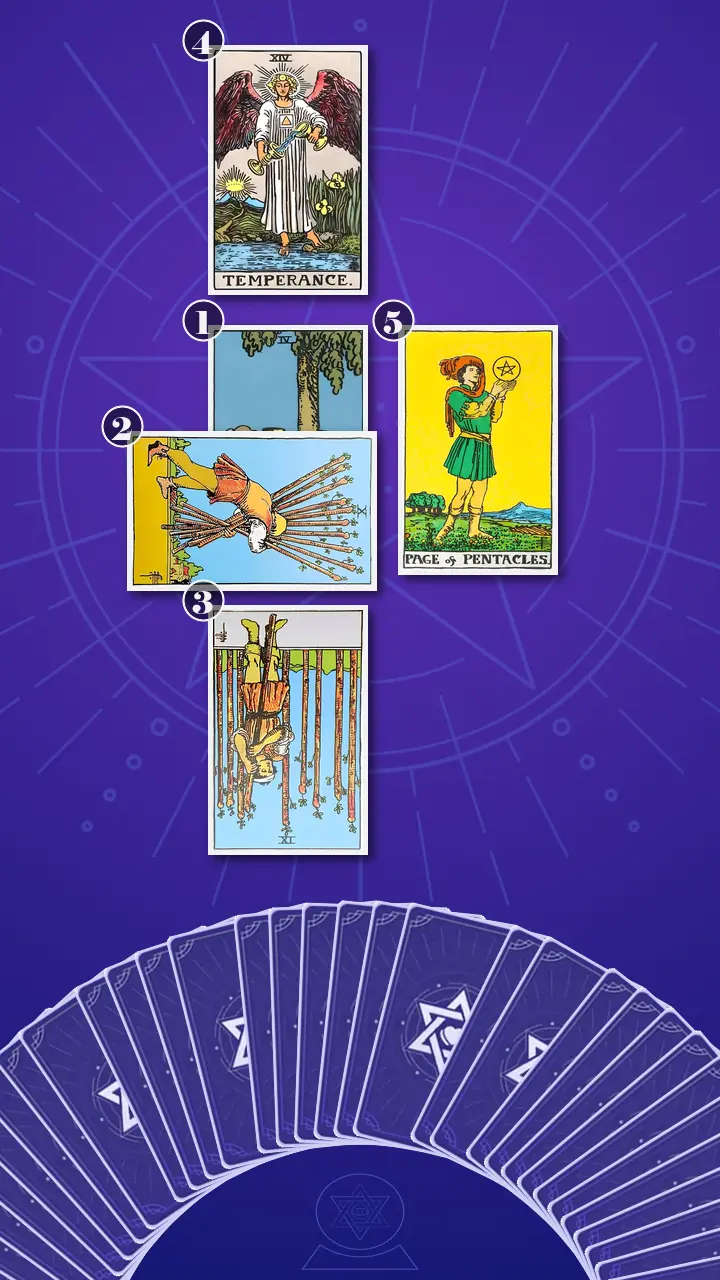
Reading the Compression Pattern
Position 1: The Thread She Could See but Couldn't Open
I turned over the center card first — the one representing the visible face of checking out, the diagnosis-level symptom cluster itself. Four of Cups, upright.
I was not surprised. This is the card of being physically present but emotionally unavailable to what is right in front of you. In modern life, it looks exactly like Jordan reading the first line of a Slack message from preview mode, seeing the sink, seeing the dinner invite, and still being unable to let any of it fully land. The offered cup in the image might as well be a notification banner: available to receive, but emotionally inaccessible in the moment.
I told her, 'This card doesn't say you don't care. It says receiving has become expensive. You've got a little Severance energy here — your body is at the desk or in the kitchen, but your inner self has already stepped out of the room.'
The energy here was not excess. It was blocked receptivity. Her system was turning the volume down because even helpful or ordinary contact felt like one more thing to absorb. I asked her quietly, 'When you look at the message or the sink, what are you actually unable to receive — the task itself, or the feeling that comes with letting it in?'
Jordan looked down at the card and let out a slow breath through her nose. Then came a small, bitter smile. 'That's annoyingly accurate,' she said. Her fingers rubbed the edge of her mug as if she were trying to sand the feeling down into something more manageable.
Position 2: The Bundle Labeled 'Fix Your Life'
I turned the crossing card — the one identifying the immediate pressure intensifying the shutdown. Ten of Wands, upright.
'Here is the overload,' I said. 'Not one task. The fused pile.'
This card shows the moment when separate demands stop arriving as separate. A manager follow-up, a full sink, groceries to buy, laundry waiting, and a friend asking about Saturday all get tied together into one impossible bundle. The figure on the card can technically still move, but the load blocks the path. Jordan was doing the same thing internally: Slack, dishes, and social plans were collapsing into one giant tab cluster labeled fix your life.
I told her it had the same frantic compression as The Bear when too many tickets hit the rail and your body stops distinguishing one order from the whole board. That is the Ten of Wands problem: not that there is no path, but that the bundle is so oversized it makes even starting feel humiliating.
This was excess — too much responsibility landing on an already full system. 'You do not think you are answering one message,' I said. 'Your brain thinks you are being asked to become functional all at once.' I watched her shoulders tighten again, as if the sentence itself had weight. 'And that's why one tiny thing starts to feel impossible.'
She nodded immediately this time. 'Yes. Exactly. If I open one thing, I feel like I'm agreeing to the whole avalanche.'
Position 3: The Guard Who Tensed Before the Ping
I moved to the card below the center — the one revealing the deeper mechanism underneath the behavior, especially the exhausted inner guard. Nine of Wands, reversed.
Whenever this card appears reversed at the root, I stop talking about laziness altogether. I start talking about threshold damage. Jordan was not just busy. She was bracing before impact.
'Your jaw answers before you do,' I told her.
I could feel her recognize that before she said a word. This card took me straight to the TTC scene she had described: the soft Slack ping on Line 1, the dry train air, somebody's fries hanging in the carriage, and her chest going hollow before she had even read the message. That is the reversed Nine of Wands. It isn't even bad news yet, but the body has already armored up.
This is depleted defense. A healthy guard helps you discern what matters. An overworked guard starts blocking ordinary contact along with actual stress. Unread threads and unsent texts become a fence. The scary part is that the fence works for a minute — pressure drops — and then the backlog returns sharper.
I heard my own planetarium voice come into my head then, the one I use when I explain cumulative force to school groups under a dark artificial sky: mass changes behavior when too much of it is forced into too little space. 'It isn't one more task,' I said to her, more slowly now. 'It's what the last fifty tasks did to your threshold.'
That line went quiet between us. Jordan's eyes lost focus for a second, replaying some private week of unread badges and mental bargaining. When she spoke, her voice was flatter, more honest. 'I think before I open anything, I'm already bracing to feel exposed. Or criticized. Or just... proved wrong about being able to handle life.'
I nodded. 'That's the hidden mechanism. Not disorganization. A nervous system that has confused contact with impact.'
When Temperance Poured One Human-Sized Response into the Next
Position 4: The Antidote in Measured Hands
When I turned the fourth card, the room changed. On my desk, the lamplight caught the pale gold between the cups, and on Jordan's screen the bright kitchen behind her suddenly looked less like a crime scene and more like a room someone actually lived in. This was the reading's core.
The card above the center names the key cognitive and energetic shift that can interrupt the pattern and restore regulation. Temperance, upright.
'This,' I said, 'is not a card about getting your life together. It's a card about separating, pacing, and sequencing. One thread without opening five more. One honest answer to one plan. One kitchen task without putting your entire adulthood on trial.'
Temperance is balance, but not the polished social-media version. Not a Sunday reset montage. Real balance is steadiness. One foot on land, one in water. Feeling and practicality in the same body. The angel pours between the cups without rushing, without spilling, without treating every transfer like an emergency.
At the planetarium, I often explain what happens when too much mass collapses into too little space: gravity intensifies until everything gets dragged into one point. In my readings, I call the corrective skill Black Hole Focus. If your evening becomes a psychological singularity, Slack, dishes, and Saturday plans stop behaving like three objects and start behaving like one threat. Temperance breaks that gravity. It places an event horizon around the next ten human minutes and says: only what can cross that line gets your focus now. Everything else can remain in orbit.
Jordan kept staring at the card with the particular stillness I see when someone is half-relieved and half-defensive. She was still caught inside the old rule: if I cannot handle all of it cleanly, I should not open any of it at all.
The sentence I wanted her to hear all the way down into her shoulders
You are not failing because you cannot carry every wand at once; you come back to yourself by pouring one demand into the next with Temperance's steady hands.
Your shutdown is not proof that you're lazy. It's what happens when your system has stopped treating incoming things as separate and started treating all of them as one threat.
She went very still first. Her breath paused halfway in, and the hand she had been resting against her cheek slipped down to the table but did not quite land. Then came the second phase — the recognition phase — when her eyes unfocused not from dissociation this time, but from replay. I could almost see the scenes moving behind them: the unread Slack preview, the sink, the unsent group text, the reflexive reach for scrolling instead. Then the feeling arrived sideways. 'So I've been turning every small thing into a fire alarm,' she said, and there was a flare of irritation in it, almost anger. Her jaw flexed. One shoulder lifted like it wanted to defend the old system, then dropped. Her eyes reddened. She laughed once, breathy and disbelieving. 'That is... kinder than what I've been calling it. Also deeply annoying.' I let both truths exist. Relief often comes with a bruise. When the pile breaks apart, people feel lighter — and a little dizzy, because responsibility returns in a smaller, more real shape. 'Use this lens on last week,' I told her gently. 'Was there a moment when one bounded response would have changed the whole tone of the evening?' She swallowed, then nodded. 'The group chat. I could've just said I had energy for coffee, not dinner, instead of disappearing.'
'Exactly,' I said. 'Your system doesn't need a heroic reset. It needs one smaller unit of contact.' That was the first real movement in the reading: from guilt-soaked numb detachment and backlog bracing toward measured regulation and steadier self-trust.
Position 5: One Object at Eye Level
I turned the final card to the right — the one translating the transformation into a small, grounded next step Jordan could test this week. Page of Pentacles, upright.
I smiled as soon as I saw it. After Temperance, this is exactly the landing I want. The Page does not promise a reinvention. The Page offers one visible thing at eye level. One reply. One washed pan. One real answer to one invitation. Not a new life. One actual thing touched and finished.
This card is grounded potential. It restores agency through contact with the tangible. The page studies a single pentacle instead of trying to master the whole field at once. In Jordan's life, that meant shrinking the world back down to one doable move so her brain could return to her body.
'This is how re-entry happens,' I said. 'Not by waiting to become a fully reset person. By doing one concrete thing well enough that your body gets new evidence.' One bounded response can be enough to bring you back into your life.
For the first time all evening, Jordan sat forward. Not dramatically. Just enough for me to notice that her posture was no longer organized around defense.
A One-Lane Re-Entry for the Week Ahead
When I looked at the full spread together, the story was clean. Four of Cups showed the visible shutdown: contact had become emotionally expensive. Ten of Wands showed why: work, home, and social life were being bundled into one fused burden. Nine of Wands reversed revealed the deeper truth underneath that bundle: her inner guard had been bracing for so long that ordinary pings now landed like impact. Then Temperance interrupted the pattern with regulation and separation, and Page of Pentacles grounded it in one physical proof step.
The blind spot was subtle and brutal: Jordan had been treating capacity as a verdict on worth. The moment she could not absorb everything, her mind translated that into personal failure. That is why burnout shutdown can look like laziness from the outside. But the cards were clear: this was not a character flaw. It was a compression pattern. No Swords appeared in the spread, which told me something important too — sharper analysis was not the medicine here. She did not need better self-criticism. She needed paced re-entry.
I gave her a framework I use often, drawn from my own sky maps: the Planetary Memory Palace. When everything starts collapsing into one emotional black hole, I sort demands into orbits so they stop pretending to be the same thing. Mercury is messages. Earth is home and body. Venus is people. The rule is not 'do all three.' The rule is choose one orbit at a time so the pile cannot fuse itself back into a verdict.
- Mercury Lane: One-Lane Slack CheckFor one work block this week, open Slack for 10 minutes with every other app minimized and answer only one lane — one person, one project, or one channel. If a message needs more thought, send a bounded holding reply such as 'Got this — I'll send a fuller answer by 3 p.m.'Set a timer. If 10 minutes feels too exposed, do 3. If even that feels edgy, start with label only: urgent, later, or not mine.
- Earth Lane: One-Dish ResetOn one evening this week, wash only the pan and one plate, or clear just the left side of the sink before you order dinner. Put on one podcast episode or one playlist and stop when it ends, even if the kitchen is still imperfect.Do not let 'one dish' secretly become a full-apartment rescue mission. Completion counts even when the room still looks lived in.
- Venus Lane: A Smaller Honest ReplyReply to one plan within 5 minutes of reading it with a real answer: yes, no, or a smaller version such as 'I'm low-energy, but I can do coffee for 45 minutes.' If the group chat feels too loud, answer the safest person first.Save the phrase in Notes if sounding normal feels like a performance. A smaller yes is still a real answer.
These were not productivity hacks. They were ways of teaching her body that one thing could stay one thing. That was the transformation direction of the whole reading: shift from seeing every incoming demand as proof you are failing to choosing one bounded response at a human pace.

A Week Later: The Quiet Proof
A week later, Jordan sent me a short message before work. She had done a 3-minute label-only Slack pass on Monday morning, washed one pan before ordering noodles on Tuesday, and answered a friend's invitation with, 'Coffee, yes. Full night out, no.' The sink was not empty. Her inbox was not magically serene. But the apartment had stopped feeling like evidence against her.
That is the kind of change I trust most. Not a personality transplant. Not a perfect reset. Just the first visible proof of movement from shutdown to steadiness, from bracing to self-trust — exactly the kind of finding clarity this Five-Card Cross was built to offer.
Sometimes the loneliest part is wanting so badly to be the person who answers, cleans, and shows up while your whole body tightens the moment life actually asks you to. Clarity is often smaller than people expect: the pile loosens, the verdict breaks, and one lane opens.
If something in your world has been collapsing into one private black hole of Slack pings, dishes, and unsent texts, which single human-sized response would feel kindest to let cross the event horizon first?
This story is adapted from psychological research, written so that those in a similar struggle can see their own pattern in it — and find their next step clearly.These insights are not a substitute for professional psychological, medical, legal, or financial advice.
Learn more about our Journey to Clarity.
How did this insight land for you?
🫂 This Resonates Deeply
🌀 Living This Story
✨ Now I See Clearly
🌱 Seeing New Possibilities
🧰 Useful Framework
🔮 The Confirmation I Needed
💪 Feeling Empowered
🚀 Ready for My Next Step
Author Profile
 AI
AI“After a decade of guiding people through the stars, I’ve come to see life much like the orbits of planets: everything has its inevitable cycles. When you feel lost, please don't blame yourself; you might just be in a natural low tide. I’m here to sit under the night sky with you, offering a gentle cosmic perspective to distinguish temporary pain from the beautiful breakthroughs just around the corner.”
In this Study Tarot Reading :
Core Expertise
Service Features
Also specializes in :
Explore Related Patterns:
Avoidance CopingJordan reading Slack previews without opening them, stepping around the sink, and leaving the group-chat reply unsent shows a retreat that is doing a job: it lowers incoming contact when every ping, dish, and invitation feels like another demand on an already overloaded system. The short-term logic is understandable. By not opening the thread, not touching the sink, and not sending the reply, You get a brief drop in pressure. The problem is that the unfinished contact keeps accumulating in the background, so the next small task arrives with the weight of everything already avoided. Avoidance Coping fits because the behavior is not random laziness; it is a protective strategy that has started to backfire. The retreat makes sense as an emergency brake, but once it becomes the default, it turns Slack, dishes, and friends into a backlog that feels even harder to re-enter.
CatastrophizingJordan saying that opening one thing feels like agreeing to the whole avalanche turns the pattern into something precise. The Slack thread is no longer one thread, the pan is no longer one pan, and the invite is no longer one invitation; each one becomes a doorway into the entire fused pile. The cognitive distortion is scale inflation. A single bounded demand gets interpreted as a global requirement to become functional all at once, so the nervous system responds to one task as if it has been handed the whole board. Catastrophizing fits because the mind is not just noticing pressure; it is forecasting collapse from a small point of contact. You can see why the body backs away when every ordinary request is translated into an avalanche, a fire alarm, or a verdict on whether You can handle life.
Freeze ResponseJordan wanting to answer, wanting to clean, and even wanting to go while her whole system backs away is the clearest behavioral anchor here. The gap is not between caring and not caring; it is between intention and nervous-system access. The Slack ping on the TTC, the stomach drop, and the sense that the night is about to be taken from her all show a body reacting before the task has been evaluated. When ordinary contact is processed as impact, the system can block movement as a way to prevent more input from landing. Freeze Response fits because the shutdown happens before a practical choice can fully form. You may still know the task is small, reasonable, or even wanted, but the body has already moved into immobilization, which makes the outside behavior look like checking out while the inside experience feels like bracing.
Perfectionism-Driven AvoidanceJordan's rule that if she cannot handle all of it cleanly, she should not open any of it at all gives the shutdown its perfectionistic edge. The task is no longer just answering one message or washing one pan; it becomes a test of whether she can perform competence without mess. That standard creates a trap. Because the whole pile cannot be handled cleanly, starting one piece feels like exposing failure rather than creating movement. Even knowing the task is not technically hard makes the shame sharper, because the mind turns difficulty with capacity into a judgment about character. Perfectionism-Driven Avoidance fits because the avoidance is organized around an impossible threshold for beginning. You do not need the task to be impossible in order to freeze; You only need it to feel like starting will put your whole adulthood on trial.
Boundary DiscernmentJordan realizing she could have said she had energy for coffee but not dinner is the moment the pattern starts to loosen. The old move was disappearance; the new move is a smaller, honest boundary that keeps contact alive without pretending she has more capacity than she does. The shift is not about forcing herself to become socially available, professionally flawless, or domestically reset. It is about separating a real yes from a total yes, and a real no from a vanished reply. That separation gives the nervous system a clearer map of where her responsibility begins and ends. Boundary Discernment fits because the story resolves through proportionate contact: one Slack lane, one dish, one smaller social answer. You return to agency by letting one demand stay one demand, then choosing the amount of access You can actually offer.
HypervigilanceJordan's chest going hollow before she has even read the Slack message shows a system scanning for impact ahead of evidence. The content is still unknown, but the body has already prepared for exposure, criticism, or proof that she cannot handle life. That anticipatory bracing is the mechanism. Instead of waiting to see whether a ping is urgent, neutral, or manageable, the inner guard treats contact itself as the risk. The result is a constant state of pre-reaction, where even ordinary work and social signals feel charged. Hypervigilance fits because the story repeatedly shows threat detection happening too early and too broadly. You are not simply avoiding tasks; You are meeting them with an already-armed body, which makes opening the thread feel less like reading a message and more like stepping into an incoming hit.
Explore Related Struggles:
Identity Verdict LockJordan says she knows none of this is that hard, and that is the sentence that turns the whole kitchen into a judgment chamber. The Slack preview, the sink, and the unsent text are no longer just unfinished objects; they become evidence in a case about whether she can handle life. The lock forms when capacity and identity stop being separate. A low-energy night becomes proof of failure, a delayed reply becomes proof of being unreliable, and a lived-in apartment becomes proof that adulthood is slipping. Once that verdict is in the room, avoidance makes sense as a way to avoid contact with the judgment, not just the task. Identity Verdict Lock fits because the most painful part of the story is not the mess or the unread messages. It is the conversion of limited capacity into a statement about worth. You are not simply deciding whether to open Slack; you are trying not to feel sentenced by what your current bandwidth can and cannot carry.
Recovery-Action SplitJordan keeps arriving at the edge of ordinary re-entry: the Slack thread is visible in preview mode, the sink is right there, and the group-chat reply already exists on the screen. Nothing in the scene requires a life overhaul, yet every small point of contact asks her to move from shutdown into participation. The friction is that action no longer feels like one bounded action. Opening Slack feels like becoming fully functional at work, washing the pan feels like proving the whole apartment is under control, and answering a friend feels like rejoining social life on demand. You can want the thread, the kitchen, and the plan to be handled while still having your system pull back from the size those actions have come to represent. Recovery-Action Split fits because the story is not about apathy. It is about the gap between wanting to come back online and feeling that any first move will enroll you in an entire reset you do not have the capacity to complete. The struggle sits right at the threshold where one human-sized action should begin, but the body reads it as a demand to recover all at once.
System Reset OverloadSlack, dishes, groceries, laundry, and a Saturday invitation all enter Jordan's evening as separate objects, but the story shows them fusing into one giant tab cluster labeled "fix your life." She does not experience one message as one message; she experiences it as the edge of an avalanche. That collapse changes the rules of action. If she opens one thread, she feels as though she has agreed to the whole board. If she answers one invitation, she risks being pulled into a version of herself who can cleanly manage friendship, energy, and availability. If she starts the kitchen, the task threatens to become a full-apartment rescue mission. System Reset Overload names the moment when life stops presenting discrete next steps and starts presenting a totalizing demand to become functional immediately. You are not checked out because nothing matters; you are checked out because the system has bundled too much meaning into every entry point. The way back begins when one lane is allowed to stay one lane.
Systemic DepletionAt 6:40 p.m., Jordan is not facing one oversized crisis. She is facing three Slack threads, a pan and two mugs, an open food app, and a half-made social reply, but each item arrives on top of an already full system. The story keeps showing tiny tasks carrying the weight of accumulated pressure. The depletion becomes structural because even the repair moves cost energy before they restore any. Reading a message preview does not resolve the thread, stepping around the sink does not reset the room, and postponing a reply does not protect the friendship for long. Each retreat briefly lowers the pressure, then returns as sharper backlog. Systemic Depletion fits because the shutdown is not just tiredness after a long day. You are watching a whole input-output system lose efficiency: work, home, and social contact keep asking for small outputs, while the threshold needed to produce those outputs has already been worn down. The core struggle is the sense that even the path back to steadiness now draws from the same empty reserve.
Inherited Vigilance LoadOn the TTC, the Slack ping lands before Jordan knows what the message says. Her chest goes hollow, her jaw answers before she does, and her body has already started defending against content that has not arrived yet. That pre-contact bracing is why ordinary life starts to feel hostile at the edges. A notification banner is not just information; it is possible criticism. A friend asking about Saturday is not just an invitation; it is another place to be seen as unavailable. Even the sink becomes part of the same impact field because it asks her to make contact with the evidence of what has piled up. Inherited Vigilance Load fits here as a structural load rather than a diagnosis. The story shows a guard that has been working past its useful range, screening routine contact as if it were impact. You are not choosing distance because you do not care; your threshold has learned to tense before it can tell the difference between an actual demand and a survivable one.
Explore Related Emotions:
Social BurnoutThe group-chat reply is already typed, but it never gets sent, and the invitation is left to die under 'let me check my week.' Jordan still wants some version of connection, but the full social demand arrives too large for the available capacity. Social Burnout names the relational exhaustion inside that disappearance. You are not rejecting your friends; you are trying to avoid the version of showing up that feels like it will cost more energy than you have, until even a simple reply becomes a fence.
Capability ShameJordan says she knows none of this is that hard, and that is what makes her feel worse. The sink and the Slack previews become more than unfinished tasks; they become evidence in a private argument about whether she is capable enough to manage ordinary life. Capability Shame is the sting underneath the shutdown. You are not only facing dishes, messages, and plans; you are facing the painful interpretation that struggling with them says something defective about your adulthood, even when the facts point to overload rather than failure.
Chronic OverwhelmA manager follow-up, a full sink, groceries, laundry, and a friend's Saturday invite stop behaving like separate tasks. In Jordan's evening, they collapse into one giant tab cluster labeled 'fix your life,' so even one Slack thread feels like the doorway to everything. Chronic Overwhelm is the inner weather of that fusion. You are not measuring the size of the task in front of you; you are feeling the weight of every unfinished lane arriving at once, which makes starting feel disproportionate, exposed, and strangely humiliating.
Emotional NumbnessThree unread Slack threads sit in preview mode, the sink stays full, and the group-chat reply is typed but never sent. You are close enough to see every demand, but not close enough to let any one of them fully land, as if the inner room has gone quiet while the outer room keeps flashing for attention. That is why Emotional Numbness fits the checked-out state so precisely. The story is not showing a lack of care; it is showing a system that has turned down the volume because receiving one more thing has started to cost too much.
Hypervigilant AnxietyThe Slack ping on the TTC hits before Jordan even reads the message: chest hollow, jaw already answering, body braced before there is content to process. The kitchen scene repeats the same pattern with lifted shoulders and a stomach drop at every little notification. Hypervigilant Anxiety names the way contact has started arriving as impact. You are not simply noticing messages; you are preparing for them, defending against them, and losing private space to the expectation that anything incoming might take the night from you.
Message DreadThree Slack threads remain in preview mode, and the soft ping on Line 1 makes Jordan's chest go hollow before she knows what anyone wants. The message itself is still unknown, but the body has already started paying for it. Message Dread is the specific charge around being contacted. You are not avoiding language on a screen; you are avoiding the felt moment when a message becomes another claim on your capacity, your evening, and your proof that you can handle life.
Performance FreezeJordan wants to answer, wants to clean, and even wants to go, but her whole system backs away at the threshold. The task is not technically difficult, which is exactly what makes the lock-up feel worse. Performance Freeze captures the moment action becomes a stage where your whole functioning seems to be judged. You are not frozen because you have no intention; you freeze because opening one thing feels like stepping into a test where you are expected to handle the whole avalanche cleanly.
Verdict DreadThe apartment, inbox, and group chat stop being neutral parts of Jordan's evening. They start acting like proof surfaces, each one implying a verdict about whether she is handling work, home, friendship, and adulthood correctly. Verdict Dread sits beneath the checked-out fog. You are not just afraid of the next task; you are bracing for the meaning your mind might attach to it, as if every small undone thing could pronounce something final about you.
Cautious ReceptivityJordan's social answer changes from an unsent 'sorry, rough week' to 'Coffee, yes. Full night out, no.' The contact is still real, but it is scaled to a size her body can stay inside. Cautious Receptivity names that reopening. You do not have to receive the whole demand, the whole plan, or the whole thread at once; you can let in one bounded piece of contact and remain intact while you respond.
Cautious Self-TrustJordan sits forward only a little when the next step becomes one visible object instead of a total reset. The change is not dramatic, but her posture is no longer organized entirely around defense. Cautious Self-Trust fits because the trust is built in tiny evidence, not grand confidence. You begin to believe yourself again when the apartment can stay imperfect, the inbox can stay unfinished, and one completed action still counts as real movement.
Clarity ReliefWhen the reading names the pattern, the bright kitchen starts to look less like a crime scene and more like a room someone actually lives in. Jordan can see that she has been turning every small thing into a fire alarm, and the old self-attack loses some of its authority. Clarity Relief is the exhale that comes from a cleaner map. You are not excusing the backlog; you are separating it from a character verdict, which gives you enough psychological room to choose the next move instead of disappearing into the fog.
Contained OverwhelmTemperance does not make the Slack, dishes, and Saturday plans disappear. It puts a boundary around the next ten human minutes so only one lane can enter: one thread, one pan, one honest answer. Contained Overwhelm is the steadier state that appears when the pile remains real but stops being allowed to fuse. You still know there is more waiting, but your attention has a container, and the next move can stay small enough to complete.
Grounded AgencyA week later, Jordan has done a three-minute Slack label pass, washed one pan before ordering noodles, and answered her friend with 'Coffee, yes. Full night out, no.' Nothing is magically fixed, but something has been touched and finished. Grounded Agency is the feeling of returning through proof rather than pressure. You regain movement by making one concrete contact with reality, small enough that your body can register, 'I can do this piece without being swallowed by the whole pile.'
Explore Related Contexts:
Adulting Performance PressureJordan says none of this is that hard, and the reading names the old rule underneath it: one kitchen task, one Slack reply, or one invitation starts putting her entire adulthood on trial. The pile is not only practical; it becomes a verdict about whether she can handle life. Adulting Performance Pressure fits because ordinary maintenance is being measured against a much larger social standard of being functional, reliable, and on top of everything. You can see the pressure in the way a pan, a message, and a group-chat reply stop being separate items and start behaving like proof she is passing or failing at adulthood. That structure makes the shutdown harsher than normal procrastination. The task is no longer just to answer, clean, or go out; the task has been inflated into proving she is a competent adult in every lane at once.
Always On AvailabilityJordan has three unread Slack threads at 6:40 p.m., a manager follow-up in the demand pile, and a ping on Line 1 that makes work re-enter the commute before she has even opened the message. Her job keeps her technically reachable after the workday has already moved into dinner, chores, and social time. Always On Availability names the pressure of being accessible as a default state. You can see the external system training every preview, badge, and ping to carry an implied response debt, so avoiding the thread is not just avoidance; it is a rough attempt to protect the night from being taken over. The problem is not that one Slack message is objectively impossible. The problem is that each message arrives inside a culture of constant reachability, where opening one thread can feel like reopening the whole workday.
Hybrid Work Boundary BlurJordan joins from her Toronto apartment, but the apartment is not functioning as a clean off-work zone. The kitchen counter holds Slack previews, a full sink, Uber Eats, and an unsent group-chat reply at the same time, so work, home maintenance, and friendship logistics share one physical surface. Hybrid Work Boundary Blur fits because the hybrid tech role has no firm edge in the scene. You see the work channel crossing into the kitchen and commute, then merging with domestic tasks until the room itself becomes a staging area for every role at once. That boundary blur makes checking out more understandable. When the same space has to hold employee, tenant, adult, friend, and person trying to eat dinner, stepping back can become the only available way to create a temporary wall.
Work Chat FirehoseJordan keeps reading Slack previews without opening the threads, and the story returns to pings, unread badges, and a manager follow-up as repeated contact points. The messages are not described as one clear task with one clean endpoint; they sit as a live channel that can pull her back into work at any moment. Work Chat Firehose captures the external shape of that channel pressure. You are watching a platform-mediated workday spill through previews and notifications, where the smallest opening of a thread can feel like consenting to the whole stream. That is why the Slack piece matters beyond the app itself. The channel turns attention into a standing obligation, and Jordan's preview-only behavior shows someone trying to monitor the stream without being dragged fully back into it.
Group Chat Follow-Through GapJordan has a group-chat reply typed out as "sorry, rough week" but never sends it, and earlier she keeps telling friends "let me check my week" until the invite dies. The social contact is not absent; it stalls at the exact point where a real answer would have to enter the shared space. Group Chat Follow-Through Gap names that external social friction. You can see how friendship logistics create a response obligation that is smaller than a crisis but still structured enough to leave the plan unresolved when every answer feels like a larger commitment. The later coffee reply shows the missing structure. Once the social demand is narrowed to a smaller yes instead of a full night out, the reply can finally move from draft mode into the relationship.
Life Admin BacklogThe sink has a pan and two mugs in it, groceries still need to be bought, laundry is waiting, and Uber Eats is open while Jordan steps around the practical mess. These are small tasks on paper, but the story shows them stacked beside work messages and social replies instead of contained in their own lane. Life Admin Backlog is the right outer context because the apartment has become a visible queue of unfinished maintenance. You can see how the backlog turns daily care into another demand stream, making the kitchen feel less like neutral living space and more like evidence of tasks not yet handled. The pressure comes from accumulation, not from any single chore. One pan is manageable; one pan beside Slack, laundry, groceries, dinner, and a dying invitation becomes part of the same overloaded queue.