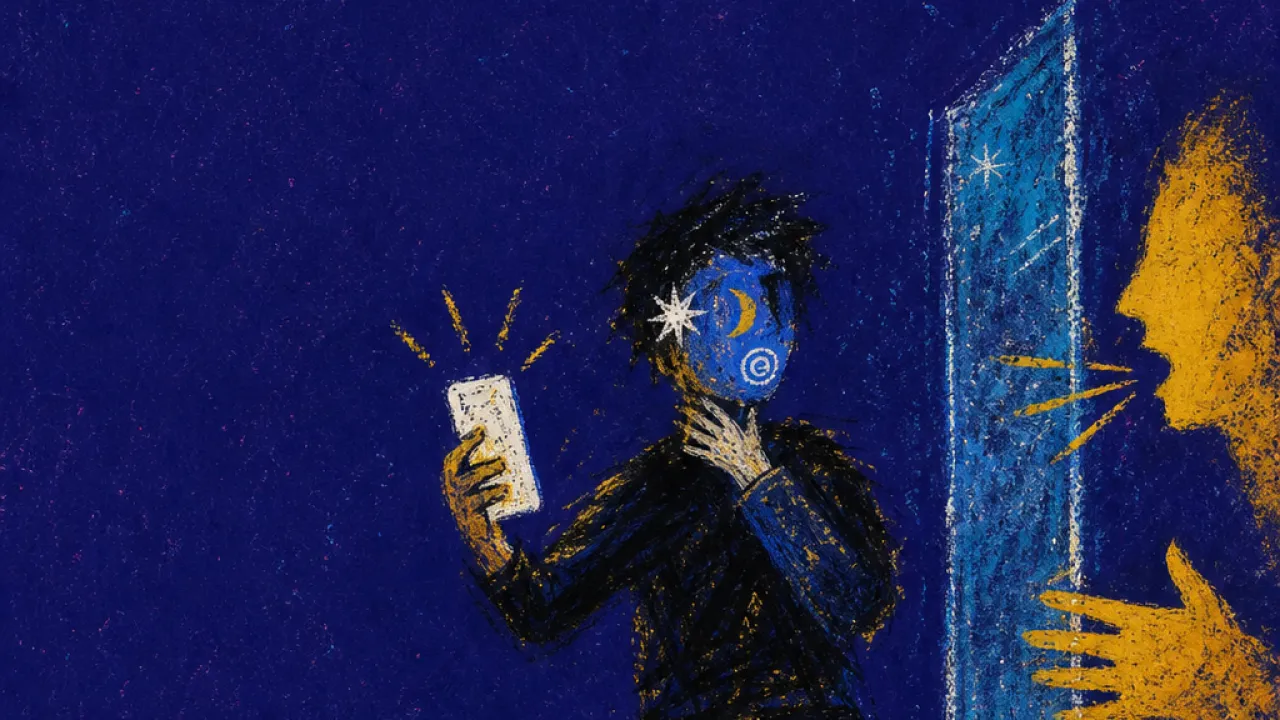
Family Role Regression lives in that slide from present-day adult into the family role they recognize, the moment your throat may narrow before the hello lands. From a Jungian perspective, archetypal theory gives this return a language without turning it into a verdict. The cards below reflect the unconscious dynamics behind that smaller voice, the familiar room, and the role your body reaches for first. Here are the Tarot Cards that map this pattern.
The Moon ReversedThe crayfish rises from the pool at the exact start of the path, small and unarmored against the dog, the wolf, and the distant towers. It has technically reached land, but the scene around it still belongs to the old night field. Family Role Regression works like that threshold. You may arrive as an adult and still feel your body drop into the old child position the moment a parent judges, questions, or withholds warmth. The Moon connects this pattern to a role-state reactivation: the path forward exists, but the nervous system is pulled backward into the family script that first taught it how to survive.
The Sun ReversedThe central body in The Sun is not an adult negotiating from equal height; it is a naked child beneath a vast solar face, carried by a horse without reins. The image is joyful on the surface, but the scale difference is psychologically important: a smaller self is held inside a field of enormous warmth, visibility, and power. In a family system, that same visual arrangement can describe the sudden return of an older role. You may enter a conversation as an adult, then find your voice, posture, timing, and emotional reflexes pulled back behind the wall into the child-position the family recognizes most easily. Family Role Regression is not a failure of adulthood. It is a learned state-shift triggered by familiar cues: parental tone, comparison, approval, silence, or expectation. The card makes that regression visible by showing how quickly openness can become smallness when the old family Sun becomes the source of permission, warmth, and emotional weather.
Judgement ReversedThe bodies in Judgement are upright, exposed, and awake, yet their feet remain inside the coffins. The image holds a contradiction: resurrection has happened, but the old container still organizes the body. Around them, the mirrored family groups make the awakening feel less individual than inherited. That is the exact mechanics of family role regression. You may arrive as an adult with language, insight, and distance, but one family cue can pull the nervous system back into an older role before your reasoning has time to intervene. The body remembers where it used to stand in the system. In family readings, this pattern explains why a short phone call can make you feel smaller, guiltier, angrier, or more responsible than you expected. The card does not reduce that reaction to weakness. It shows an old relational container being reactivated, and the work begins by noticing when you are standing back inside it.
The World ReversedThe dancer's movement can also be read as a loop with no doorway. Inside the wreath, the body keeps moving, the ribbons keep circling, and the whole image can feel less like arrival than like a perfect choreography that must be repeated. That is the reversed psychological pressure of The World: completion becomes enclosure. The family system may appear stable from the outside, but contact with it can reactivate the old role that once kept you safe, approved, or predictable. For you, Family Role Regression names the moment your adult self gets pulled back into a younger family function. The card shows why this can feel so confusing: you are not failing to grow up; you are stepping into a closed symbolic field where the body remembers the role before the mind can choose a new response.
Two of Cups ReversedThe Two of Cups shows a powerful face-to-face field: one person's presence immediately reflects back to the other. In a family context, that mirror can feel older than the present moment, pulling the body into a familiar posture before the adult mind has time to intervene. Family Role Regression names that slide back into an old relational position. The child who appeased, performed, stayed invisible, mediated, or absorbed tension can reappear during a simple phone call or visit, even when the person has built a more autonomous life elsewhere. The card's closeness becomes a container that activates memory through relationship, not logic. The cups matter because they show a ritual of recognition. Reversed, the ritual can recognize the old role instead of the current self. The audit is about catching the moment when the family system stops meeting you as an adult and starts summoning the version of you it knows how to manage.
Three of Cups ReversedThe card shows a dance already in motion, with the three bodies moving as if they know the rhythm without needing instruction. Their cups rise together, their spacing holds the circle, and the shared posture suggests a choreography that the body can enter before the mind has evaluated it. This is the reversed anchor for Family Role Regression. Around family, old roles often live in procedural memory: the peacemaker softens their voice, the responsible one starts organizing, the rebel braces for critique, and the quiet one disappears from the conversation. The role returns because the system recognizes it and rewards its reappearance. You are not reduced to that old position, but the card shows why it can feel automatic. The family circle has a rhythm, and when you step back into it, your nervous system may start dancing the part it learned long before your current adult self had language for boundaries.
Four of Cups ReversedThe three cups on the ground stand like a small archive in front of the seated figure. They are stable, visible, and already known, while the fourth cup enters from the side as something current but untested. The body stays loyal to the old emotional arrangement before the new signal can be evaluated. In family contact, this is how a capable adult can suddenly feel reduced to an old role. A parent's tone, a sibling comparison, or a holiday gathering can activate the archive faster than conscious choice, and the system pulls you back into being the quiet one, the responsible one, the difficult one, or the one who must not need anything. The present moment gets interpreted through the old family map. Four of Cups connects to Family Role Regression because the card shows a figure surrounded by new and old emotional data while physically returning to a fixed internal posture. The pattern is not a failure of maturity; it is a learned state shift that needs to be seen before it can be interrupted.
Five of Cups ReversedThe bowed head, hidden face, and enclosing cloak shrink the figure's presence even though the landscape is wide. The body appears adult, but the posture has become small, still, and waiting in front of the spill. Family Role Regression fits because family contact can pull the body back into an older relational position before the adult mind can choose a response. You may enter a call as a capable adult and suddenly feel like the child who must explain, appease, freeze, or wait for permission. The distant bridge and house show why this pattern feels so disorienting. Adult stability is still in the frame, but the old family role has taken over the foreground, making present-day agency feel temporarily unreachable.
Six of Cups UprightThe children are small within a walled courtyard, while the manor and background figure mark a world of roles, safety, and early belonging. The cup exchange is gentle, but it is also staged inside a protected social order, where each child occupies a clear position in the emotional scene. This is where Family Role Regression enters the card. Under inner pressure, the psyche may return to the role that once kept the self safe: the sweet one, the quiet one, the grateful one, the helper, the protected child, or the one who never disturbed the peace. The cups hold not only memory but a familiar emotional script. In introspection, the pattern becomes visible when self-reflection keeps collapsing into old permissions and old limits. The card's courtyard shows how an early role can feel like safety, while also revealing how that safety may still be organizing adult self-perception from behind the wall.
ReversedThe children stand in front of a home-like structure while an older figure recedes in the background, giving the scene a layered sense of past, protection, and observation. The bodies are small within the architecture, so the environment carries more authority than the figures themselves. Family Role Regression shows up in academic settings when grades, feedback, or professor attention pull you back into an earlier role of being the compliant, impressive, or careful student. You may react to coursework as if evaluation is not just about a paper or exam, but about whether the old version of you is still safe. The Six of Cups anchors this pattern in memory rather than blame. It reveals how a familiar role can quietly take over under pressure, making present academic choices feel governed by a younger self's need to be seen as good enough.
Seven of Cups UprightThe figure is physically adult-sized, yet the posture is startled and small against the oversized display of images. The cups do not simply offer choices; they loom like a family script full of rewards, threats, roles, and hidden tests. This is how regression can work in a family field. The current self remains present, but the old relational system activates an earlier operating mode: scanning, bracing, pleasing, explaining, or waiting to be told which version of yourself is safe. When this pattern appears, you may notice that you are capable and clear elsewhere, then suddenly anxious, defensive, or childlike around parents or relatives. The card's misty suspension shows why: the family atmosphere can pull the psyche backward into roles that were once adaptive, even when the adult self is ready for more autonomy.
Ten of Cups ReversedThe adults and children are locked into a familiar family tableau: parents raised toward the promise overhead, children dancing below, everyone held inside the same domestic image. Reversed, the scene can freeze the body into an old role before conscious choice catches up. That freeze is the logic of Family Role Regression. You can walk into a conversation as an adult and still feel your posture, voice, and confidence shrink back to the old household script, because the family field remembers who you were before it recognizes who you are now.
Page of Cups ReversedThe Page's young body is formally dressed for an emotional duty, yet the fish in the cup pulls his focus into a private exchange that feels older than the moment. The posture can read as composed from the outside while the inner system has shifted into a younger state. Family Role Regression follows that shift. Around parents or older relatives, the adult self can lose access to present-day agency and fall back into the role that once kept connection predictable. The cup becomes the old assignment to watch the mood, hold the feeling, and respond as the family remembers you.
Queen of Cups ReversedThe Queen's body is small inside a large throne, and the throne carries the emotional authority of the whole scene. In reverse, that scale can feel less like sovereignty and more like being seated inside a role that existed before you chose it. This is the visual logic of Family Role Regression. A parent, sibling, or older family script can pull the adult self back into a younger configuration: the compliant one, the mediator, the difficult one, the emotional caretaker, the one who must not make waves. The water and wall make the stage feel contained, which is why the shift can happen so quickly. You may enter the room as an adult, but the family field recognizes the old seat and asks your nervous system to sit there again.
King of Cups ReversedThe crowned figure looks adult and composed, yet he is seated on an impossible shell throne suspended in the emotional sea. In the reversed reading, the authority costume can become rigid, as if the body is holding a role rather than inhabiting the present. Family Role Regression appears when contact with parents or old household dynamics pulls you back into a younger script. You may arrive as an adult and still find your voice, posture, or decision-making shrinking around the same old cues. The card links the pattern to a nervous system caught between present authority and an inherited emotional stage set.
Two of Pentacles ReversedThe dancer's lifted foot, tilted posture, and entertainer-like costume create a body that is moving but not grounded. In the reversed texture, that motion can harden into a familiar performance: the adult body is present, yet the stance is organized around an older role. Family role regression works the same way. A parent's tone, a family room, or a routine comparison can pull you back into the version of yourself that appeases, explains, panics, or proves worth, even when your current life has outgrown that script. The card's unstable dance shows how quickly a practiced role can take over when the family field sets the rhythm. You are not simply reacting to the present moment; the body is replaying an older coordination strategy because it recognizes the stage before it recognizes the choice.
Three of Pentacles ReversedThe worker is physically elevated, but the scene still places him under the gaze of robed figures holding the plan. His body is active, yet the structure around him decides what the work is supposed to become. That tension captures the way family contact can pull an adult body back into an old psychological role. You may arrive with independence, language, and lived experience, then suddenly find yourself explaining, pleasing, defending, shrinking, or performing exactly as you did years ago. Family Role Regression is not a failure of adulthood; it is a learned nervous-system shortcut inside a familiar architecture. The card shows why the regression can feel so automatic: the old blueprint, the old observers, and the old task are all already in position before you speak.
Four of Pentacles ReversedThe crown pentacle can only stay balanced if the figure remains rigidly still, and the body becomes organized around preserving an old arrangement. Movement would not just change his position; it would threaten the identity structure sitting on top of him. Family Role Regression has the same mechanics. Around parents or older relatives, you may find your adult capacities temporarily shrink into an older role because the family field rewards stillness, obedience, caretaking, or silence more than present-time self-definition.
Six of Pentacles ReversedThe shared platform keeps all three figures inside one family-like field, but the posture locks them into unequal positions. One body stands, weighs, and releases; the others remain lower, open-handed, and dependent on the timing of the person above them. In the reversed psychological texture, that fixed hierarchy becomes more than a resource exchange. It becomes a regression trigger: the adult self may still walk into the room, but the body remembers the old role before the mind can update the scene. Family Role Regression is the moment you hear a parent's tone, enter a childhood home, or face a familiar comparison and suddenly lose access to your adult clarity. The card's hierarchy shows how quickly present-day autonomy can collapse into an inherited position when the family system still expects you to play the same part.
Nine of Pentacles ReversedThe falcon is not weak; it is trained, covered, and held in a position that decides what it can see and when it can move. The open garden around it makes the restriction more psychologically precise, because the surrounding space is available but not equally usable. Family contact can create the same mismatch between adult capacity and old positioning. You may arrive with a fully formed life and still feel suddenly smaller, quieter, overexplaining, or waiting for permission because the family role has taken control before the adult self can respond.
Ten of Pentacles ReversedThe child is half-hidden inside the mother's space while the elder occupies the foreground and the household architecture holds every generation in one frame. The scene makes old relational positions visible: who stands forward, who stays partly covered, who is recognized, and who remains inside the inherited arrangement. Family Role Regression occurs when growth pressure pulls You back into an older position before conscious choice can catch up. In personal growth, You may feel evolved in private, then become the old child, achiever, stabilizer, or quiet one around familiar systems, because the architecture remembers the role before You can inhabit the new self.
Page of Pentacles UprightThe Page holds the pentacle with both hands as if the object has to be kept steady, visible, and correctly presented. His gaze does not wander through the field; it stays on the thing he has been given to carry. The body looks composed, but the composition also makes responsibility feel like something already assigned. Family Role Regression grows from that assigned-object feeling. The pentacle is not just a resource; it becomes a role marker, a visible task that organizes posture, attention, and self-presentation. The figure appears young because the card captures the early place where duty becomes identity before it becomes choice. In a family system, You may arrive as an adult and still find your body moving back into the old position: the careful one, the useful one, the steady one, the one who understands what needs to be handled. The pattern is not immaturity; it is a learned role reactivating under familiar family cues before your present-day self has time to speak.
Knight of Pentacles ReversedThe armored knight appears prepared, but the horse remains fixed in place, creating a tension between adult capability and suspended movement. The pentacle sits in front of the body like a duty-marker, while the gaze is controlled and forward-facing rather than emotionally expressive. In the reversed field, that steadiness can harden into Family Role Regression. The body still looks competent, but the inner system has returned to an older family position: the compliant child, the reliable one, the careful one, the one who must not disrupt the arrangement. This pattern becomes visible when You can function everywhere else, yet one call from a parent or one comparison at home collapses your adult agency into a familiar role. The card shows how duty can become a trigger that pulls the nervous system backward, even when the present-day self is ready for more freedom.
King of Pentacles ReversedThe King looks like an adult authority, yet his body is almost fused with the throne, the estate, and the symbols that define his role. The scepter, pentacle, armor, wall, and castle do not simply decorate him; they hold him inside an inherited structure of power and expectation. Reversed, that visual structure becomes Family Role Regression. You may function as an adult everywhere else, then return to family contact and feel your choices shrink back to the old assignment: the obedient one, the useful one, the responsible one, the successful one, the one who must not disrupt the system. The regression is not immaturity; it is a learned nervous-system response to a familiar authority field. The card makes the mechanism visible because the throne is both support and trap. What once gave identity and security can also pull you back into automatic compliance. The pattern becomes clear when you notice how quickly your adult agency changes shape in the presence of family power.
Two of Swords ReversedThe seated woman holds adult tools, but her body is immobilized, blindfolded, and braced in place. The swords suggest agency, yet the posture suggests that agency has been locked into a defensive stillness. Family Role Regression enters when contact with parents or older relatives pulls the nervous system back into an earlier role. You may become the compliant child, the mediator, the achiever, the rebel, or the caretaker before you have time to choose a present-day response. Reversed, the Two of Swords shows the adult self holding the instruments of choice while the body has already returned to an older family script.
Four of Swords ReversedThe adult knight lies passive beneath a bright parent-child image, held still in a church space that resembles both sanctuary and tomb. The body has armor, but the posture is powerless: straight, silent, and unable to negotiate with the figures and blades above it. Around family, that visual collapse becomes an old role taking the wheel before your adult self can respond. You may find yourself shrinking, explaining, apologizing, or freezing, not because you have no maturity, but because the family field has reactivated a younger map of where safety used to be found.
Seven of Swords ReversedThe figure is physically leaving the camp, yet his head turns back toward it. The body has crossed into open ground, but the gaze remains attached to the structure behind him, keeping the camp psychologically present even as he moves away. That divided posture is the visual anatomy of Family Role Regression. You may enter a family setting with adult boundaries, adult language, and adult intentions, then suddenly feel pulled into an older position: the responsible one, the difficult one, the quiet one, the mediator, the child who must not upset anyone. The Seven of Swords makes this regression visible through motion that never fully detaches. The card shows that old family roles are not only memories; they can become active scripts that take over posture, tone, timing, and truthfulness the moment the familiar field reappears.
Eight of Swords ReversedThe figure stands like an adult, but the blindfold and bindings make her agency look abruptly reduced. The surrounding swords and distant castle enlarge the world around her, so the body appears competent and diminished at the same time. That split captures family role regression. You may enter a call, visit, or argument as your current self, then suddenly operate from an older role where approval, punishment, comparison, or parental mood carries more authority than your adult judgment.
Nine of Swords ReversedThe woman is an adult figure in a nightgown, upright in bed with the lower body tucked away and the upper body overwhelmed. The room reduces her available posture to a childlike containment shape, while the carved bed scene leaves an older power dynamic exposed below the cover. Family role regression happens when contact with parents or relatives pulls the adult self back into an older position. You may become the scared one, the good one, the blamed one, or the invisible one before you can choose a present-day response. The card captures that collapse without moralizing it: the body remembers the role faster than the mind can update the map.
Ten of Swords ReversedThe body is caught at the riverbank, close to a crossing but unable to complete it. The figure is not standing at the threshold as an adult decision-maker; he is flattened below the swords, face hidden, with the whole sky pressing down over him. Family Role Regression works through that same collapse of vertical space. Around parents, older relatives, or inherited family scripts, You may suddenly lose the posture, language, and authority You have elsewhere in life. The adult self does not vanish because it is fake; it gets overridden by an older role that the family field still knows how to summon.
Page of Swords ReversedThe Page is not a child, but he is not a fully settled authority either. He stands on a difficult ridge with a serious duty, carrying a sword that seems larger than the emotional age of the figure holding it. That tension gives Family Role Regression its visual anchor. Around family, the present-day self can be pulled back into an older role because the system recognizes the old version more quickly than the current one. You may become the anxious child, the defensive teenager, the silent one, the responsible one, or the one who performs competence to avoid being treated as fragile. The reversed Page of Swords shows this as an identity snapback rather than simple immaturity. The body knows the old terrain, the sword knows the old job, and the family field can recruit you into a familiar script before your adult boundaries have time to come online.
Ace of Wands ReversedThe wand is held as a single charged object between cloud and earth, but the body holding it is absent. In a reversed family reading, that absence matters. The visible hand can start to feel like an old relational script acting through you before the adult self has had time to choose. Family Role Regression names the moment when contact with relatives pulls you back into a familiar position: the obedient one, the difficult one, the fixer, the successful one, the invisible one. The wand becomes a defended piece of identity because the family field does not simply see your action; it tries to assign a role to the life force behind it. The Ace of Wands is especially relevant because it shows identity at the ignition point. Reversed, that ignition can be captured by older family expectations before it becomes conscious. The pattern is not weakness; it is an old body-level map switching on when the family system starts treating your autonomy as something it can name, judge, or redirect.
Two of Wands ReversedThe figure looks outward, but one wand is literally secured to the battlement beside him. The body has perspective, yet the structure still holds part of the scene in place. Reversed, that fixed wand becomes the visual logic of being pulled back into an old family role even after you have developed adult insight. A parent calls, a holiday begins, a comparison lands, and the body remembers the part it was trained to play before your conscious boundary arrives. Family Role Regression is not a failure of maturity; it is the nervous system re-entering a familiar family architecture. The Two of Wands shows the tension between the adult self that can see the wider world and the inherited structure that still knows where to fasten you.
Three of Wands ReversedThe composed back and fixed stance can read as dignity, but under pressure the same stillness becomes a locked posture at the edge. The body is no longer simply observing the horizon; it is bracing itself inside a familiar position. Family Role Regression appears when contact with parents or relatives pulls you back into an older role before you can choose a current response. The adult self may be present in the room, but the nervous system is reacting from the child, fixer, rebel, or compliant one the family learned to expect.
Four of Wands ReversedThe distant children play near the home while the foreground figures perform a formal welcome at the threshold. The image holds adulthood, childhood, ceremony, and home in the same frame, so time feels layered rather than linear. That layering is why Family Role Regression fits the card so closely. You can walk into a family setting as an adult and still feel pulled into an older posture, voice, or compliance reflex. The Four of Wands makes the trigger visible because the home field can reactivate roles before conscious choice has time to arrive.
Five of Wands UprightThe Five of Wands shows young bodies braced on uneven ground, each one marked by different clothing and posture, yet all of them are pulled into the same noisy struggle. Individuality is present, but the shared field absorbs it into role-based conflict. That is why the card maps so closely to Family Role Regression. Around family, the adult self can lose access to its full range and fall back into an old assigned position: the responsible one, the rebellious one, the ignored one, the mediator, the disappointment, or the one who must fight to be seen. The pattern is not a failure of maturity. It is a body-level return to a familiar relational stage where the rules were learned early, and the card’s youthful contest shows how quickly You can be pulled back into the old arena even when Your current life is much larger than that role.
Six of Wands ReversedThe rider moves through a corridor of raised wands, elevated above the group but still fully contained by their gaze. The laurel crown marks a promoted identity, while the parade fixes that identity in public. The body is visible, celebrated, and therefore hard to reposition. In a family system, that visibility can pull you back into the old role the moment contact begins. You may enter as an adult, but a parent's tone, a family gathering, or a familiar expectation can place you back into the achiever, the responsible one, the pride of the family, or the child who must not create friction. The role is not chosen in the moment; it is reactivated by the field. Family Role Regression is the reversed pressure of this card: the parade no longer simply honors the rider, it keeps him legible to the group. The pattern shows how family attention can turn recognition into a script, making autonomy feel like a breach of the role that once kept you safe.
Seven of Wands ReversedThe young man's feet are split across unstable ground, with one side near the edge and the other close to the stream below. Even while he holds the higher position, the terrain underneath him pulls his body back into imbalance. That physical split mirrors the way family contact can pull an adult self into an older role. You may arrive with language, boundaries, and independence, then suddenly feel small, defensive, or over-explaining because the room activates a version of you shaped by the old hierarchy.
Nine of Wands ReversedThe figure is an adult body in a defended position, but the scene is arranged like an old role being resumed. He stands at the gap, holds the wand in a fixed grip, and watches the edge of the frame as though the next move has already been scripted. The wall behind him gives the image a history; this is not a first reaction, but a rehearsed stance. Family Role Regression appears when contact with relatives pulls You back into a younger version of yourself before conscious choice catches up. A phrase, tone, silence, comparison, or demand can activate the old position: the responsible one, the invisible one, the rebel, the peacekeeper, the one who must absorb the tension. The adult self is present, but the family field cues the body to perform an earlier role. The reversed Nine of Wands makes this regression visible through repetition and strain. The figure is not moving forward; he is guarding a familiar breach. In family tarot, the card reveals how old relational architecture can reactivate inside current conversations, making autonomy feel fragile precisely when You most need access to it.
Ten of Wands ReversedThe distant house gives the man somewhere familiar to arrive, but the posture changes before he gets there. His body is already bowed, compressed, and narrowed by the load, as if the destination is pulling an old shape out of him. That is how familiar family systems can reactivate old roles. The adult self may enter the scene with insight and independence, but the field remembers a previous arrangement: the responsible one, the quiet one, the fixer, the child who absorbs tension, the person who must not make things harder. Family Role Regression appears when contact with the system pulls behavior back into a role that no longer matches who you are outside it. The card makes the mechanism visible: the destination is not just a place, but a relational field that can bend posture, voice, and choice before anything has been said.
Page of Wands UprightThe young figure holds the wand like an official instrument, standing sideways in a posture that looks more like proclamation than relaxed exploration. His chin rises above the staff, and his whole body appears organized around the role of announcing something before the surrounding desert shows any lived result. That visual tension mirrors the way an old family role can take over the body before the adult self has time to respond. You may enter a conversation with relatives intending to speak as yourself, then suddenly find your posture, tone, and choices shaped by the familiar role of the promising child, the responsible messenger, or the one who must make everyone believe the future is under control. The pattern is not simple immaturity; it is a role-based defense. The family system has taught the self to become readable through performance, so confidence gets acted out before it is felt, and autonomy gets translated into a script the family already understands.
Knight of Wands ReversedThe knight looks proud and armored, yet the scene still carries the volatility of a young rider proving himself through heat and display. The horse's power rises under him, making the adult costume and the reactive body occupy the same frame. Family Role Regression happens when contact with parents or older relatives pulls You out of your current self-state and into an older survival script. The response can look like defiance, defensiveness, performance, or sudden dependence, even when the adult part of You knows the situation is not new. The card makes that split visible: armor says grown, while the rearing horse shows how quickly the old role can take the reins.
Queen of Wands ReversedThe Queen appears powerful, but the same throne that supports her can also read as a role that has swallowed the body sitting inside it. Her robe, throne, and desert share the same heated palette, making personal presence and inherited position blur into one field. Family Role Regression begins exactly there: the current self gets absorbed back into the old family seat. You may arrive as an adult, but a parent's tone, a familiar room, or one loaded comment can pull your posture, voice, and decision-making into the role the system already knows how to manage. The card does not reduce this to immaturity. It shows how identity can become state-dependent inside a family field. The work is to notice when the throne has become a script, and when your warmth, authority, or defiance is no longer coming from the present version of you.
No cards available for this filter.