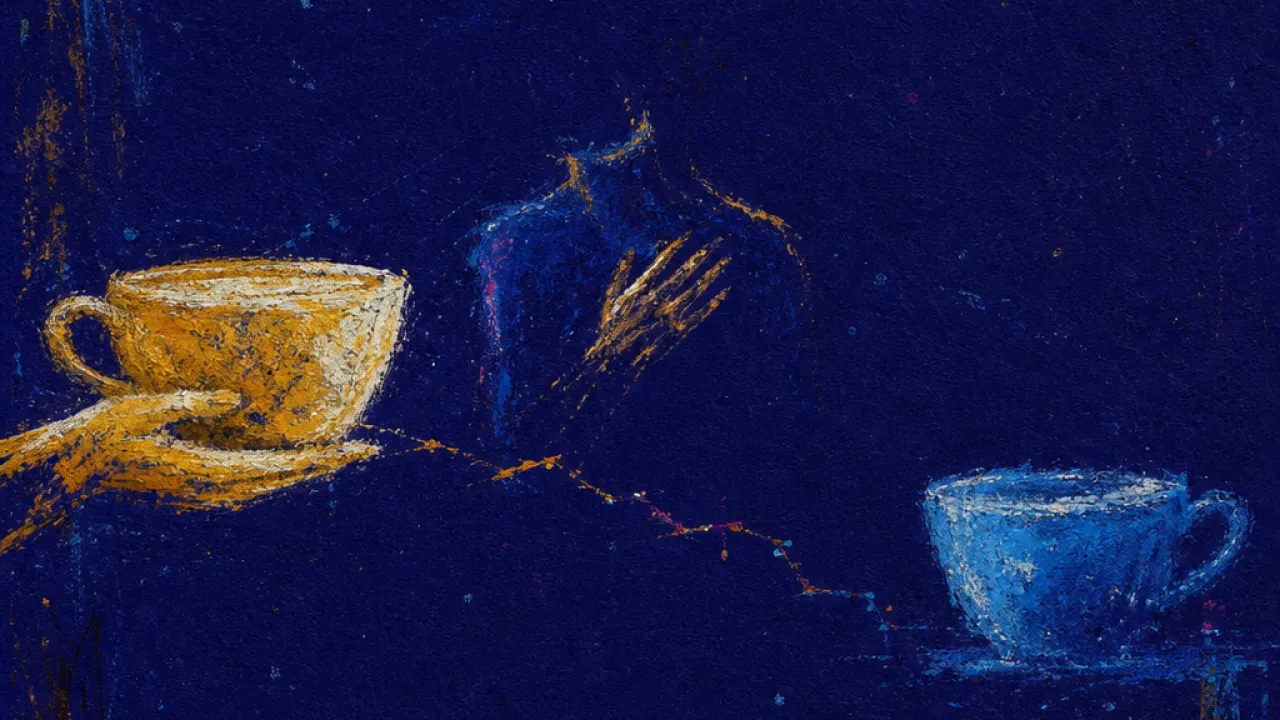
The moment you notice who repairs, who listens, and who lets care return is where Emotional Reciprocity becomes visible. You might feel it as a small tightening in your chest when a warm message lands without any follow-through. From a Jungian archetypal theory lens, this pattern can be understood as the psyche testing whether connection can hold two separate people at once. The Tarot Cards below mirror the unconscious dynamics of giving, receiving, repair, and return.
The Star UprightTwo pitchers pour at the same time, one stream entering the pool and one feeding the land. The image does not hoard water in the figure's hands; it turns inner resource into visible circulation across two different surfaces. That circulation is the visual logic behind Emotional Reciprocity. In a family system, care becomes psychologically healthy when it can move without being converted into debt, guilt, or ownership. You may be auditing whether support still feels like a trap because earlier exchanges taught your body that receiving always came with a hidden invoice.
The Sun UprightThe sun gives light, the sunflowers receive it, the child moves with it, and the horse carries the movement forward without force. No single element in the card appears to hoard the energy field or collapse under it. That visual balance is why Emotional Reciprocity fits The Sun. The card does not show one figure draining another; it shows warmth circulating through a coherent system where receiving and giving are both part of the same living exchange. In friendship, this pattern is the difference between mutual support and being used as an emotional utility. The Sun makes the audit simple: if the connection is real, both people should have room to be bright, needy, honest, celebrated, and held.
Judgement UprightThe figures below the trumpet do not form a single isolated listener; they rise in mirrored groups, each answering the same sound from their own place. The card's geometry creates a field of response rather than a scene where one person absorbs everything for everyone else. That is the psychological core of Emotional Reciprocity in friendship. Support can move in cycles, with each person capable of being heard, challenged, repaired with, and responded to. When this pattern is active in a healthy direction, the bond stops depending on one friend's endless availability and starts revealing whether the connection can actually answer back.
The World UprightThe two wands sit in balanced hands while the four creatures hold the corners of the image, giving the scene a distributed rhythm instead of a single point of strain. The dancer is central, but she is not carrying the whole field alone; the composition keeps energy circulating around her. In friendship, that circulation becomes the audit point: care has to move both ways or it turns into an assignment. Emotional Reciprocity is linked to this card because the visual harmony depends on exchange, proportion, and shared participation rather than one person becoming the permanent container for everyone else's feelings.
Ace of Cups UprightThe dove descends into the cup while water rises and falls in return, so the image is not a closed vessel hoarding feeling. It is a circuit: receiving, overflowing, and returning emotional energy to a wider pool without losing the central container. That circulation anchors Emotional Reciprocity. The defense mechanism here is not self-protection through withdrawal, and it is not self-erasure through endless giving; it is a regulated exchange where care can move both ways. The cup receives the offering, but it also releases what it carries. In family dynamics, this pattern becomes visible when you stop treating love as a ledger and start noticing whether emotional labor is actually mutual. You may still care deeply, but the Ace of Cups asks whether the family system allows you to be nourished too, not only to become the channel through which everyone else is soothed.
Two of Cups UprightThe two cups are held at the same height, and neither figure dominates the exchange. The man's slight movement forward meets the woman's steady stance, creating a visible rhythm of offering and receiving rather than pursuit and surrender. That symmetry turns emotion into a regulated circuit. The card does not show isolated self-control; it shows a psyche learning through contact, where feedback, trust, and recognition move in both directions without one side absorbing the whole field. For personal growth, Emotional Reciprocity names the pattern of letting insight become relationally real without losing self-direction. You are not using connection as a substitute for discipline; the exchange becomes a mirror that helps you calibrate what is true, what is performative, and what is ready to be practiced.
Three of Cups UprightThe raised cups do not point toward one winner; they meet in a shared toast over harvested fruit. The card's emotional architecture is mutual rather than vertical, with recognition moving around the circle instead of being handed down by a single authority. That visual rhythm gives Emotional Reciprocity its psychological basis. In personal growth, a win often needs to be exchanged, named, and received before it becomes internally believable; achievement can stay strangely flat when it has no relational echo. You may notice this pattern when progress feels real only after it has been shared, or when giving support feels easier than letting support come back. The card does not reduce growth to applause; it shows that mature self-recognition often develops through balanced emotional exchange.
Six of Cups UprightThe boy's cup is not empty; it is filled with flowers before it is offered, and the girl stands close enough to receive without being crowded. The scene makes care visible as a vessel that can be held by both people, not as a vague feeling one friend must guess at. In friendship, that image maps onto Emotional Reciprocity because the bond stays clean when support has a path in both directions. You can value the sweetness of an old or intimate friendship while still auditing whether the exchange is mutual, current, and freely given rather than quietly assumed.
Eight of Cups UprightThe eight cups are carefully arranged, but the visible gap in their structure changes how the whole scene is read. Nothing in the foreground looks chaotic; the problem is subtler than collapse. The structure can hold memories, routines, and shared meaning, while still failing to hold the missing emotional element. That is why the card connects so directly to Emotional Reciprocity. In a relationship, You may have signs that the bond is real, yet still feel the absence of mutual emotional movement. The psyche begins to distinguish between a relationship that has been built and a relationship that is actively nourishing both people. The moon over the path strengthens the inner audit. This pattern names the moment when You stop using history as proof of connection and begin asking whether care, vulnerability, repair, and effort are actually flowing both ways now.
Nine of Cups UprightThe nine cups sit in an even row behind the seated man, arranged like a completed emotional inventory rather than a shared table. The scene is balanced, but the cups are not being passed, poured, or offered to anyone else. That stillness gives Emotional Reciprocity its edge in friendship. You can have plenty of warmth, history, and care in the bond, yet still need to ask whether the exchange actually moves both ways. The card frames fulfillment as something that must eventually circulate, not just remain stored behind one person's composure.
Ten of Cups UprightThe raised hands, the children's handholding, the flowing river, and the arc of cups all move the eye through exchange rather than possession. No single figure is carrying the emotional atmosphere; the scene distributes feeling across bodies, water, home, and sky. That circulation mirrors Emotional Reciprocity in a family system. You are not asked to prove love by overgiving; the pattern becomes visible when care can return, repair can move both ways, and the household does not depend on one person to keep everyone emotionally supplied.
Page of Cups UprightThe fish rising from the chalice does not simply appear; it meets the Page's gaze. The image creates a closed emotional circuit: the Page offers attention, the fish returns a signal, and the cup holds the exchange in a small but visible container. That visual loop maps directly onto the mechanics of Emotional Reciprocity. You are not only asking whether you care about people; the deeper audit is whether the social field can receive and return care without making you carry the entire exchange. The Page of Cups shows connection at the moment before it becomes overextension, where tenderness is still contained enough to be measured. In social networks, this pattern becomes especially clear when friendships, group chats, or community spaces leave you doing all the remembering, checking in, and emotional translation. The card's quiet mutual gaze reveals the difference between genuine resonance and a one-sided performance of warmth.
Knight of Cups UprightThe cup is not spilled, hidden, or seized; it is carried upright through an open field. The horse moves at a controlled pace, and the scene gives the emotional vessel enough space to remain intact. That arrangement reflects Emotional Reciprocity because the card shows feeling as something contained, offered, and carried with dignity. The reins prevent the emotional current from becoming one-sided urgency, while the open field suggests a bond that can breathe without constant extraction. In friendship, this pattern is the quiet audit of whether care actually circulates. You may be willing to offer empathy, but the card asks whether the friendship can also return presence, repair, and attention without turning your cup into a permanent supply source.
King of Cups UprightThe king does not hold only a cup; he also holds a scepter shaped by the same emotional language. One hand receives, the other organizes, and the ship in the distance keeps moving through the shared water rather than leaving the king as the only point of emotional motion. This is the visual basis for Emotional Reciprocity in friendship. Care is not shown as endless pouring from one person into another; it is shown as a system where feeling, steadiness, and navigation circulate. When this pattern is active in a healthy way, you notice whether the friendship can hold both people's needs. The card's balance exposes the difference between mutual support and a dynamic where one person has become the permanent emotional infrastructure.
Ace of Pentacles UprightThe pentacle is held in the open hand while the garden below shows cultivated ground, not a sealed vault. Value is not isolated in one place; it moves through a field where receiving, tending, and access all have to stay connected. In friendship, this becomes the difference between mutual support and a one-way emotional drain. Emotional Reciprocity reveals whether care is actually circulating, or whether you have quietly become the stable ground everyone else uses without returning presence, repair, or attention.
Two of Pentacles UprightThe Two of Pentacles places two material symbols in constant exchange, with the figure’s hands keeping them from dropping through repeated motion. The linked loop makes the two sides feel connected, but the balance is never static; it has to be refreshed again and again. In friendship, this becomes Emotional Reciprocity. The card does not show cold accounting; it shows the living question of whether care, time, attention, and support can keep circulating without one side carrying the whole rhythm. When this pattern is active, You may become sharply aware of who reaches out, who listens, who initiates repair, and who disappears when the emotional weather gets rough. The card gives that sensitivity a concrete image: two connected commitments that only stay healthy when movement flows both ways.
Three of Pentacles UprightThe three pentacles are set into the same arch, and the three figures gather around one shared piece of work. No single body fills the whole frame; the composition gives each participant a place in the structure. That visual balance is the core of Emotional Reciprocity. The card shows care as circulation rather than extraction: attention, skill, and perspective move between people instead of being pulled from one person indefinitely. In friendship, this pattern becomes the felt difference between mutual support and being used as an emotional holding area. You can track whether the bond has a living exchange, or whether one person's needs have quietly become the entire project.
Six of Pentacles UprightThe coins fall from the standing figure's hand while the scales remain lifted in the other, and the two kneeling figures hold out their hands from separate positions. Care is shown as movement across a gap, not as a merger of bodies; the card makes support visible as something that must be measured, received, and returned to balance. In friendship, Emotional Reciprocity turns this scene into an audit of whether emotional labor is actually circulating. You may be generous by nature, but the pattern asks whether your support network lets care move both ways or keeps you in the position of the person who gives while everyone else waits.
Seven of Pentacles UprightThe seven pentacles are visible units of harvest: six still held by the vine and one already down at the figure's feet. The figure is not fantasizing about effort; the card places the work, the waiting, and the result in the same field where they can be compared. Emotional Reciprocity uses that comparison without turning it into accusation. In friendship, the pattern asks whether support is circulating or collecting around one person, whether listening, check-ins, repair, and care are returning in some living form. You are not being asked to stop giving; the card reveals whether giving still belongs to a mutual system.
Eight of Pentacles UprightThe pentacles are not scattered randomly around the craftsman. Some are finished and displayed, one is being worked on, and others remain near the bench and ground, making the whole card feel like a visible record of effort, sequence, and contribution. That visual order maps cleanly onto Emotional Reciprocity in friendship. The issue is not cold accounting; it is the need to see whether care moves both ways, whether listening, repair, initiation, and support are actually shared rather than silently assumed from one person. The Eight of Pentacles holds a mature kind of clarity here. You are not asked to stop caring; the pattern reveals whether your care has become a one-sided craft, polished by your effort but unsupported by equal emotional participation.
Ten of Pentacles UprightThe small gestures in the card matter: one dog receives the elder's touch, the child reaches toward another, and the couple faces each other in conversation under the arch. The scene is full of connection, but no single figure is carrying the whole emotional field. That is the visual logic of Emotional Reciprocity. Care moves through the group as repeated, embodied exchange rather than being extracted from one person as a permanent role. The shared space has enough structure for support to circulate instead of pooling around the most available friend. In friendship, this pattern becomes especially important when generosity has started to blur into emotional labor. The card points to a healthier rhythm: closeness is not measured by how much you absorb, but by whether the bond can hold mutual attention, repair, and response.
Page of Pentacles UprightThe Page steadies one pentacle with both hands, giving the object his full attention without grabbing at it. The gesture is careful and mutual inside the body: one hand does not dominate the other, and the coin is held where it can be seen clearly. That visual balance maps cleanly onto Emotional Reciprocity. In friendship, the issue is rarely whether care exists at all; it is whether care has a return path. The card turns emotional exchange into something visible enough for You to examine instead of silently absorbing imbalance. The open field around the Page matters because reciprocity needs room. When support can move both ways, friendship stops feeling like a private endurance test and becomes a shared structure that can actually hold both people.
Knight of Pentacles UprightThe pentacle is held like a tangible unit of value, and the plowed field behind the knight suggests effort that should eventually become harvest. Nothing in the scene is chaotic; the horse, armor, coin, and land all imply that care has weight and must be sustained by real resources. Emotional Reciprocity translates that visual economy into friendship. You are tracking whether care circulates or whether one person quietly becomes the field everyone else harvests from. The card does not reduce friendship to transaction; it shows that even sincere loyalty needs a sustainable exchange of attention, repair, and effort.
Queen of Pentacles UprightThe Queen sits among symbols of care that are both material and alive: carved stone, vines, roses, flowing water, and the pentacle held with attention. Nothing in the scene suggests frantic giving; the environment shows circulation, rootedness, and enough structure for care to return. This is the visual logic behind Emotional Reciprocity. The card does not reduce friendship to a ledger, but it does show that nourishment requires a system where attention, presence, repair, and practical help can move in more than one direction. When this pattern is active in friendship, You can sense whether a bond is mutually sustaining rather than merely familiar. The card makes reciprocity visible as an ecology, not a demand: a friendship stays alive because both people feed the ground it grows from.
Ace of Wands UprightThe wand rises above a landscape that is not dry: a thin river cuts through the fertile ground while the trees echo the living branch in the hand. Fire is shown with an emotional channel beneath it, so the card refuses a one-way model of energy. In friendship, Emotional Reciprocity is the pattern of checking whether initiative, listening, celebration, and repair move in both directions. When You can feel the river under the spark, support stops being a performance of loyalty and becomes a living exchange that either circulates or reveals its blockage.
Four of Wands UprightThe two foreground figures raise garlands together under the same open frame, and neither one is shown holding up the four wands alone. The structure stands before the celebration begins, so the joy is shared rather than extracted from one body. This is the clean visual logic behind Emotional Reciprocity in family life. You can notice whether warmth is being exchanged or whether one person is assigned to regulate the whole room. The card ties belonging to mutual participation, not to silent emotional labor.
Eight of Wands UprightBelow the flying wands, a thin stream divides the ground into two banks while the rods travel through the same open air above it. The image holds two facts at once: movement can cross the field, but the land still has edges. That is the visual logic of emotional reciprocity in friendship. Care moves between people, but it does not erase the difference between your capacity and someone else’s need. The pattern becomes psychologically useful when it keeps attention on the flow itself: who reaches out, who receives, who repairs, who disappears, and whether the exchange is alive on both sides. You may be learning to read friendship less through intensity and more through circulation. The card’s motion asks whether support is actually traveling back and forth, or whether one person has quietly become the route that every emotional demand uses to cross the distance.
Queen of Wands UprightThe wand and sunflower split the Queen's attention between directed will and offered warmth. Neither object is dropped, hidden, or over-gripped; the image holds agency and generosity in the same body. That bilateral structure mirrors emotional reciprocity inside friendship. You are not only the person who gives light, plans the hangout, receives the venting, or keeps the vibe alive; the bond has to move care in both directions to stay clean. The mirrored lions and repeated sunflowers add a relational rhythm to the image. The card's balance suggests that warmth becomes sustainable only when it is exchanged, not silently extracted from the person who seems most radiant.
No cards available for this filter.