The Late Laugh: Inside Jokes at Dinner and Outsider Freeze
If dinners with your partner’s friends are going fine until one ‘remember that weekend?’ turns into ten minutes of callbacks and you suddenly become deeply interested in your water glass, you already know this exact flavor of social anxiety at dinner. When Maya sat across from me, that was the first thing I named. She was 27, a communications coordinator in Toronto, sharp on Slack, warm one-on-one, and absolutely exhausted by the question she kept typing into the internet after nights out: why am I good one on one but bad in groups?
She described 8:47 PM at a narrow wine bar in Ossington: candle flickering, plates still smelling like garlic and butter, someone saying, ‘Oh my god, not the cottage weekend again,’ and the far end of the table folding into laughter. She laughed half a beat late, wrapped both hands around her cold glass, felt her throat tighten, and stared at the condensation ring as if it might hand her a script. She wanted to stay in the conversation. What she feared was the exposure of not already being in on it.
That kind of self-consciousness is brutal because it feels like your own face has become a too-bright phone screen in a dark car—suddenly every pause seems visible, every expression incriminating. Maya said, ‘I am fine until everyone starts speaking in references. By the time I think of something to say, the moment is already gone.’ I told her, gently and very plainly, that being good one-on-one and weird in groups is a real pattern, not a fake personality. Then I said, ‘Let’s make a map of the exact moment the room starts to feel faster than your voice. That’s our journey to clarity today.’

Choosing the Bridge: How Tarot Works in a Fast Room
I asked her to take one full breath and hold the question in the simplest possible language: How do I stop going quiet when dinner turns into inside jokes? Then I shuffled slowly and had her cut the deck—not as theater, but as a way to let her nervous system step out of replay mode and into observation.
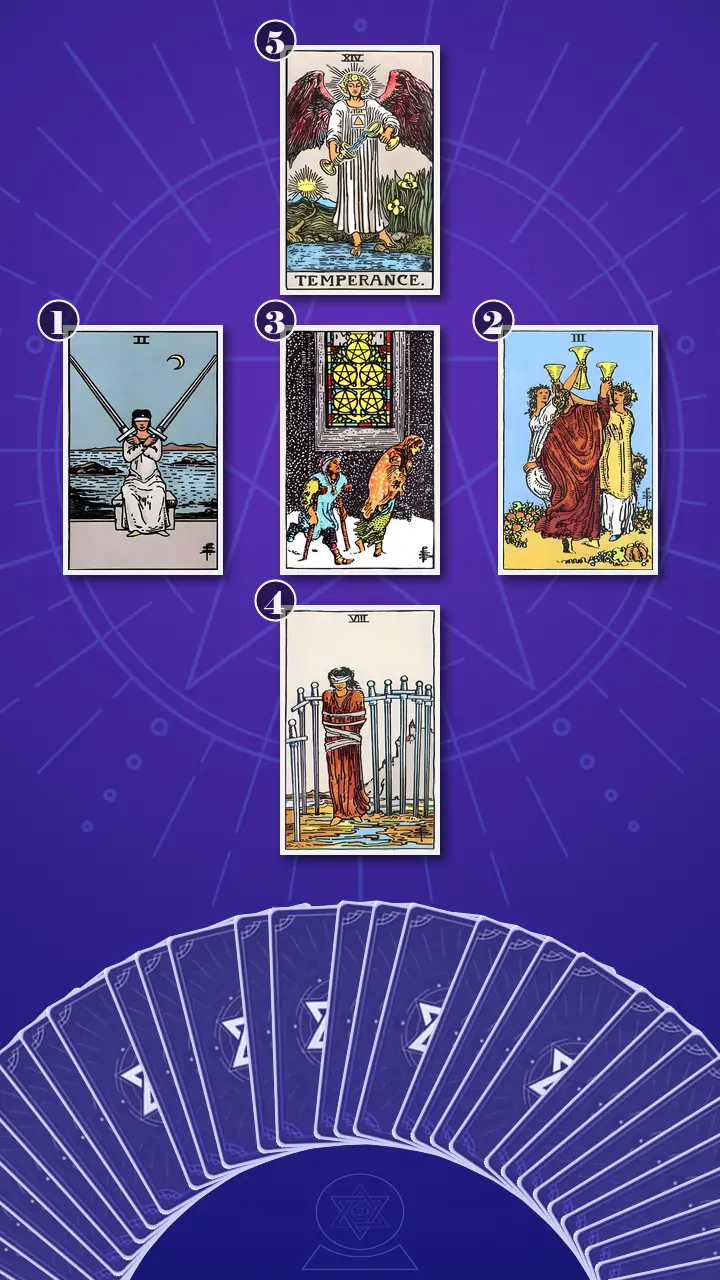
For this session I used the Relationship Spread · Context Edition—the spread I reach for when someone is really asking, how do I join a conversation when I missed the context? I chose it because Maya was not asking me to predict whether she would be accepted. She was asking how to understand and shift her role inside a live group dynamic. This spread keeps the structure minimal but complete: one card for the self-state, one for the actual group energy, one for the deeper wound being activated, one for the internal block that keeps the silence going, and one for the bridge back into reciprocity.
I told Maya—and I’ll tell you, too—that I wanted our eyes to move like the layout itself: first to the freeze on one side, then to the room on the other, then to the emotional heart in the center, down to the pattern that maintains the silence, and finally up to the card that shows how to re-enter without performing for approval. For outsider freeze in group settings, that order matters. It shows where the sting is real, where the meaning gets amplified, and where the next step becomes usable.
Reading the Suspended Bridge
Position 1: The Polite Freeze
Now I turned over the card representing the exact self-state described in her question—the freeze, self-protection, and quiet withdrawal that show up when the table turns into shared lore. It was the Two of Swords, upright.
I pointed to the blindfold and the crossed swords over the chest. In modern life, this is the moment at a long dinner with your partner’s friends when the table speeds into old stories, you stop eating for a second, wrap both hands around your glass, and spend the next few minutes trying to engineer a line that won’t reveal you missed the setup. This card is blocked Air: not absence of thought, but too much protective thinking all at once. It is like hovering over a reply in the group chat and never hitting send, or waiting at a crosswalk for a perfectly empty street in a city where traffic never fully stops.
‘What changed first for you?’ I asked her. ‘Your breathing, your posture, or the sentence you stopped yourself from saying?’ She let out one short laugh with a bitter edge and said, ‘Okay, wow. That’s accurate enough to be annoying.’ I smiled. ‘Yes,’ I told her, ‘and it also means the pattern is visible. Silence can look polite while still costing you contact.’ Her thumb kept tracing the wet seam of her glass while she nodded.
Position 2: The Room Itself
Next I turned over the card showing what the dinner-table energy actually is, beyond fear’s interpretation of it. The Three of Cups, upright.
This mattered immediately. The group energy at the table, I told her, is often genuinely warm, fast, and socially fluent—more like people caught in shared rhythm than a coordinated effort to keep you out. The Three of Cups is communal Water in balance. The room is mid-thread, not necessarily closed. In the same way a group chat can already be moving before you open it, a dinner table can already be laughing without that laughter being a verdict on you. The question here is not only, ‘Do I belong?’ but, ‘Am I reading a moving conversation as a closed door?’
Maya looked up from the cards for the first time in a while. Her jaw softened slightly. ‘So maybe it’s not as personal as it feels,’ she said. ‘Exactly,’ I replied. ‘Sometimes the room is simply enjoying its own rhythm. That’s different from rejecting you.’
Position 3: The Story Under the Story
At the center of the spread—the emotional heart—I turned over the card revealing the deeper belonging narrative activated between Maya and the group in that moment. Five of Pentacles, upright.
This was the card I expected to hurt a little. I showed her the image: figures in the cold, moving past a lit window. In real life, this is what happens when you are physically sitting at the table, but internally it feels like you are standing just outside it, translating one missed callback into, I guess I am not really one of them. The energy here is lack and exposure. A small context gap gets translated into a much bigger story of not belonging.
I kept my voice soft. ‘A missed reference is not a failed belonging test.’ The candlelight caught the water in her glass just then, and for a second it looked like a tiny stained-glass reflection on the table between us. Maya swallowed. Her shoulders lifted, then fell. ‘That,’ she said quietly, ‘is exactly how it feels in my body. Like I’m in the restaurant but emotionally out on the sidewalk.’ I told her that was the real center of the spread: not the joke itself, but how quickly her nervous system turned unfamiliarity into exile.
Position 4: The Perfect-Entry Rule
Then I turned over the card identifying the main internal block and defense pattern that keep the silence going after the trigger hits. The Eight of Swords, upright.
I almost laughed—not at her, but at how cleanly the deck had drawn the architecture. Here was the perfect-entry rule in full view. In modern life it looks like this: you think of a simple question, then reject it. You think of a quick reaction, then reject that too. Not yet. That sounds weird. Wait for a better opening. It is the same move as keeping a Slack message in drafts until the thread is dead, or rewriting a caption until you miss the post window entirely. This card is excessive Air turned inward. The enclosure is real, but it is partial; the stronger prison is the rule in your head that says you are not allowed to speak unless it sounds smooth.
‘I do exactly that,’ Maya said, almost before I finished. Her breath stalled, her fingers hovered above the edge of the table, and then she pressed her palm flat as if steadying herself. That was the deep emotional sync I wanted for her—not shame, but recognition. ‘How many good openings have you missed while waiting for the perfect one?’ I asked. She gave me a hard nod. ‘Too many.’
When Temperance Poured Between Two Cups
Position 5: One Honest Way Back In
When I turned over the final card—the bridge, the guidance, the healing movement that could help Maya re-enter the conversation without performing for approval—the room itself seemed to conspire with it. A server at the next table poured water into a glass, and the small, clear stream cut through the restaurant noise. On the table between us lay Temperance, upright. Whenever Temperance appears, my artist brain goes straight to an edit suite: the best cut is never the loudest one, but the one that lets two truths stay in the same frame. Slightly unsure. Still connected.
I asked her to picture the dinner she had described: fine for the first twenty minutes, then one callback landing, the whole table lifting at once, and her hand tightening around the glass because suddenly it felt like everyone else got the map except her.
The old rule says you must already belong before you speak, but Temperance asks you to blend your voice into the room as it is, like water poured between cups rather than a password you have to guess.
I let the sentence sit between us for a beat. Then I added, ‘This is like mixing your voice into a playlist rather than trying to take over the aux.’
Then I gave her the framework I’m known for. ‘I call this Typecasting Analysis,’ I said. ‘In established groups, there is often a quiet social script that casts one person as the old friend, one as the storyteller, one as the chaos gremlin, and one as the newer person who listens and smiles on cue. The danger isn’t only that the room may box you in a little. It’s that you start over-performing the role you fear you’ve been given.’ I tapped Temperance. ‘This card is Group Dynamic Rewriting in real time. It doesn’t ask you to become louder, cooler, or instantly fluent in the lore. It asks you to stop auditioning for acceptable outsider and re-enter as a real person—slightly unsure, genuinely curious, still in contact. You do not need the password; you need one honest way back in.’
Her reaction came in layers. First, a tiny freeze: breath caught high in her chest, fingertips suspended just above the stem of her glass. Then the cognitive drop: her eyes unfocused and I could practically see last Thursday replaying behind them—the late laugh, the condensation ring, the sentence that died in her throat. Then came the release, but not as instant relief. Her shoulders loosened a fraction, and with that came a strange lightness, the kind that can feel almost like grief when a familiar rule starts breaking. ‘But if that’s true,’ she said, and now there was a flash of irritation under the vulnerability, ‘doesn’t that mean I’ve been making it worse?’
‘Not worse,’ I said. ‘Safer. Or at least safer in the short term. You built a strategy to protect yourself from exposure. It makes complete sense. We’re just noticing the long-term cost now.’ I let that settle. ‘So tell me—using this new lens—was there a moment last week when one small bridge would have changed the whole temperature?’
She looked back at the card. ‘Actually, yes,’ she said. ‘Someone mentioned a trip, and one of the friends literally turned to me a second later and said, “You missed this one, it was chaos.” They were already trying to include me. I had just gone offline.’ I nodded. That was the shift. Not from awkward to effortlessly social, not from fear to zero fear, but from self-conscious outsider freeze to the first real inch of steadier social ease.
The Bridge-Not-Password Method
Once all five cards were on the table, the story was clean. Maya’s first reflex was Two of Swords: freeze, protect, hold. The actual room was Three of Cups: often warm and already in motion. The center wound was Five of Pentacles: a missed reference becoming a private story of exclusion. The maintenance loop was Eight of Swords: the internal rule that she had to sound fully in before she was allowed to join. And the way through was Temperance: blend inner discomfort with one measured outer move. This is how tarot works best for me—not as fate, but as card meanings in context, showing where a human pattern begins, where it hardens, and where it can soften.
The cognitive blind spot was subtle but decisive: Maya was treating a fast room like a verdict. She was also obeying an invisible casting note that said her role was to be pleasant, polished, and undemanding until she earned more. The transformation direction was simpler than her mind wanted: move from trying to earn your place with the perfect comment to making small, real bids for connection even before you feel fully settled. Join the tone before you master the backstory.
- Save three bridge lines before dinner Before your next dinner with your partner’s friends, a work group, or any fast-moving table, put three lines in your Notes app: ‘Wait, I need the backstory,’ ‘Okay, now I’m invested—who are we talking about?’ and ‘I missed chapter one but I’m here for chapter two.’ At the first inside-joke moment, use exactly one line once instead of waiting for a perfect opening. Pick the shortest line. Treat it as a one-line experiment, not a personality overhaul. If your body spikes afterward, you are allowed to stop there.
- Use the glass-down two-breath reset The moment you notice both hands clamping around your glass, set it down for two seconds, let one full exhale happen, and say one simple reaction or follow-up within two breaths. A real example: ‘That is actually hilarious—wait, what happened?’ Direct it to the one person at the table who feels easiest to read. Start with the body before the sentence. If words still stick, the minimum version is one exhale and quiet eye contact with one person before you try again.
- Try my Recasting Exercise once At your next gathering, intentionally break the old social character you have been cast in—the agreeable quiet one who laughs on cue and waits. Make one visible, warm bid for contact early in the night: ask for the lore, respond to the emotion, or say, ‘I need the full story now.’ This is not about stealing the scene; it is about reclaiming authorship in it. One scene change is enough evidence for one night. When you get home, write one sentence in your phone: ‘What actually happened after I spoke?’ Let reality, not fear, answer the question.
I reminded her that none of these were tricks for becoming the most magnetic person at the table. They were simply small ways to re-enter a fast group conversation when you miss the context. That is enough. Actionable advice only works if it is humane.

A Week Later, the Room Stayed Open
A week later I got a message from Maya just after 10 p.m., sent from the back seat of a ride along Queen Street after dinner. ‘I used one,’ she wrote. ‘They started doing the cottage weekend lore again, and I said, “Wait, I need the backstory.” Nobody blinked. Three people started explaining at once. I actually laughed on time after that.’
The message that followed mattered even more. ‘My throat still did the thing for a second,’ she wrote, ‘and the next morning my first thought was still, was that weird? But I kind of laughed at myself and moved on.’ That was the proof I cared about. Not a new personality. Not perfect ease. Just a quieter nervous system, a clearer story, and one real experience strong enough to interrupt the old one.
When I closed my notes on our Relationship Spread · Context Edition, I kept thinking about how clarity usually arrives. Not as a dramatic social transformation, but as a tiny loosening in the exact place that used to lock. A little less performance pressure. A little more contact. A little more trust that belonging does not require flawless timing.
When the table lights up around a reference you missed and your throat closes before you even choose a sentence, it can feel like you were invited to the dinner but not fully into the belonging.
The next time you do not have the full backstory, what kind of small, honest way back in would feel most like you?
This story is adapted from psychological research, written so that those in a similar struggle can see their own pattern in it — and find their next step clearly.These insights are not a substitute for professional psychological, medical, legal, or financial advice.
Learn more about our Journey to Clarity.
How did this insight land for you?
🫂 This Resonates Deeply
🌀 Living This Story
✨ Now I See Clearly
🌱 Seeing New Possibilities
🧰 Useful Framework
🔮 The Confirmation I Needed
💪 Feeling Empowered
🚀 Ready for My Next Step
Author Profile
 AI
AI“I’ve always felt our lives are films currently in production. As an artist, I know that when you feel stuck, it’s often because you’ve bravely stayed in a painful scene for just a little too long. I’m not here to coldly analyze you. I want to sit closely with you, look at those difficult moments with profound empathy, and gently hand you the pen so you have the courage to write your next beautiful act.”
In this Social Tarot Reading :
Core Expertise
- Typecasting Analysis: Identifying how your social circle has boxed you into a specific, restrictive character arc that no longer serves your growth.
- Group Dynamic Rewriting: Analyzing the invisible script that forces you to conform to groupthink out of a fear of isolation.
Service Features
- The Recasting Exercise: A creative behavioral challenge to intentionally break your established 'social character' at the next gathering, reclaiming your narrative freedom.
Also specializes in :
Explore Related Patterns:
Authentic Self-ExpressionMaya's useful turning point is the small sentence, 'Wait, I need the backstory.' It does not perform insider status, and it does not apologize for missing the setup; it simply tells the truth in a way the room can respond to. Authentic Self-Expression fits because the repair is not about becoming louder, cooler, or instantly fluent in the group's shared history. The mechanism is a shift from managing how she appears to making a real bid for contact from exactly where she is. That one line changes the social math. Instead of trying to earn belonging through flawless timing, you let your actual position become part of the conversation, which gives other people something concrete to meet.
Exclusion SpiralMaya is physically at the table, but one missed callback quickly becomes the private story that she is emotionally outside the room. The late laugh, the tightening throat, and the fixation on whether her face looks exposed all turn a small context gap into a larger belonging threat. Exclusion Spiral names the loop that follows: feeling outside makes you go quiet, going quiet makes you miss more context, and missing more context seems to prove that you were outside all along. The mechanism is not simple insecurity; it is a self-reinforcing cognitive and relational loop where silence becomes both the defense and the evidence. This directly answers the dinner-table question because the goal is not to decode every inside joke perfectly. The pattern loosens when you interrupt the spiral early with one honest bid for context before the silence has time to turn into a whole verdict about your place in the room.
Freeze ResponseMaya's hands around the cold glass, the half-beat-late laugh, and the sentence that dies before she can say it show a protective shutdown happening in real time. The table has not necessarily rejected her, but her body treats the inside joke as a sudden exposure risk, so stillness becomes the safest available move. That is the logic of Freeze Response in a social setting: the nervous system pauses visible action while the mind tries to calculate a risk-free entry point. You are not empty-headed in that moment; you are often flooded with too many micro-decisions at once, from facial expression to timing to whether a simple question will make you look out of place. The cost is that silence starts to protect you from embarrassment while also cutting you off from contact. Maya's pattern becomes clear because she wants to join, but the protective pause lasts long enough for the conversation to move on without her.
Perfectionism-Driven AvoidanceMaya thinks of a simple question, rejects it, thinks of a quick reaction, rejects that too, and waits for a cleaner opening until the moment is gone. The problem is not that she has nothing to say; it is that every possible sentence gets tested against a rule that says it must sound smooth before it is allowed to exist. Perfectionism-Driven Avoidance fits because the avoidance is powered by a standard that is too polished for a live, messy group conversation. You may tell yourself you are waiting for the right moment, but the hidden defense is trying to prevent the exposure of being new to the reference, late to the joke, or not fully fluent in the group's history. The pattern keeps Maya quiet because it turns connection into a performance threshold. A good-enough bridge line would work, but the perfect-entry rule makes her miss the social opening she actually needed.
Emotional ReciprocityWhen Maya asks for the backstory, three people start explaining at once. That moment matters because the group is no longer a fast-moving wall of references; it becomes a two-way exchange where her curiosity invites their inclusion. Emotional Reciprocity fits because belonging is treated as something co-created, not something Maya has to privately earn before speaking. She offers a small, honest bid, and the room answers with context, warmth, and shared attention. This pattern is the relational antidote to going quiet. You do not need to dominate the table or decode every callback alone; you need enough visible participation for other people to meet you halfway.
Emotional RegulationMaya's glass-down reset starts with the body before it asks for the perfect sentence. Setting the glass down, taking an exhale, and offering one simple follow-up gives her nervous system a concrete bridge between the spike of self-consciousness and the next social move. Emotional Regulation fits because the pattern is not about suppressing discomfort or pretending the throat-tightening never happens. It is about staying present enough to choose a measured action while the discomfort is still there. The week-later message shows why this matters: her body still reacted for a second, and her mind still wondered the next morning whether it was weird, but the old loop did not take over. You can have the body signal and still build a different ending.
Social MaskingMaya does not simply become silent; she becomes the acceptable silent person, the newer partner at the table who listens, smiles on cue, and tries not to create friction. That polite composure hides the more vulnerable fact that she does not have the backstory and wants a way in. Social Masking fits because the defense is a performed version of ease. You may appear warm, agreeable, and low-maintenance while internally monitoring every expression and suppressing the direct question that would actually restore contact. The pattern matters because the mask protects against looking out of place, but it also confirms the role Maya is trying to escape. The shift comes when she stops auditioning for harmless outsider and lets one real sentence enter the room.
Explore Related Struggles:
Access-Belonging FusionA single missed reference at the wine bar becomes much larger than missing a story. Maya is physically at the table, but the callback makes her feel as if she is outside the lit window, watching belonging happen through glass. Access-Belonging Fusion is the moment information access gets mistaken for relational status. You start treating the backstory as proof of whether you are allowed to be there, so not knowing the reference feels less like a normal gap and more like a verdict. The story shows that the room may already have an opening. One friend even says, "You missed this one, it was chaos," which is an invitation into the lore. The work is learning to receive missing context as a doorway, not as evidence that the door was closed all along.
Outsider Identity LockMaya is invited to dinner, seated at the table, and still feels emotionally out on the sidewalk when the inside jokes start. The role available to her begins to shrink into the newer person who listens, smiles on cue, and does not ask for too much space. Outsider Identity Lock takes hold when that temporary position starts to feel like the whole truth of who you are in the room. You do not just notice that other people have more shared history. You begin acting as if your job is to remain low-impact so nobody has to deal with your lack of context. The lock loosens when Maya stops performing acceptable outsider and asks for the backstory. Nobody blinks. Three people explain at once. That response matters because it gives her evidence that the role was not as fixed as it felt from inside the freeze.
Voice-Safety FusionMaya wants to stay in the conversation, but the moment the table turns into cottage-weekend callbacks, her throat tightens and both hands close around the glass. The sentence she could ask for, something as simple as requesting the backstory, becomes loaded with the risk of proving she was not already inside the group. That is the bind at the center of Voice-Safety Fusion. You are not quiet because you have nothing to say. You go quiet because voice has been tied to exposure, and connection starts to feel like something you must earn without letting anyone see the gap first. The useful clarity here is precise. The danger is not speaking itself, but the rule that says speaking has to be fully smooth before it is allowed to count as belonging. Once that rule is visible, your voice can become a bridge again instead of a test you have to pass.
Welcome-Perfection BindMaya thinks of a simple question, then rejects it. She thinks of a quick reaction, rejects that too, and waits for a cleaner opening until the thread has moved on without her. Welcome-Perfection Bind forms when entry starts to feel conditional on already sounding fully included. You are expected, by your own inner rule, to arrive with the right tone, the right timing, and the right amount of context before you make a bid for contact. That rule protects you from the sting of looking unsure, but it also keeps you auditioning at the edge of the table. The bridge line works because it breaks the perfection requirement. It lets you join as a real person who missed chapter one but is still present for chapter two.
Social Acceleration StrainThe table moves faster than Maya's voice. One callback becomes ten minutes of shared rhythm, and by the time she has formed a sentence, the opening has already moved somewhere else. Social Acceleration Strain names the pressure of trying to enter a live group dynamic after it has already picked up speed. You are not failing the room because you need a beat to orient yourself. The strain comes from treating a fast-moving social current as if it were a timed exam. The shift is not to become louder or instantly fluent in everyone's history. It is to stop waiting until you can match the full pace and use one small bridge while the room is still moving. A real-time conversation does not require perfect synchronization before contact is possible.
Observer-Self SplitMaya's attention leaves the table and lands on her own face. The water glass, the condensation ring, the timing of her laugh, and the expression she is wearing all become more vivid than the conversation she wants to join. Observer-Self Split is what happens when part of you tries to participate while another part starts watching you from the outside. You are no longer only at dinner with other people. You are also managing the image of yourself being at dinner, and that second layer slows every real response. The bridge back is not to force confidence. It is to return attention to one reachable point of contact, one person, one follow-up question, one honest reaction. The goal is to re-enter the shared scene instead of continuing to monitor yourself from the edge of it.
Explore Related Emotions:
Conditional Belonging FearThe old rule says she must already belong before she speaks. At the table, that rule turns a harmless backstory gap into a hidden entrance exam, as if she needs to be fluent in the group's lore before she is allowed to ask for it. Conditional Belonging Fear names the pressure to earn your place before you participate. You start waiting for proof that you are already accepted, but the proof can only arrive through contact. The result is a loop where silence feels safer in the moment while quietly reinforcing the sense that belonging is always one perfect comment away.
Grounded BelongingNobody blinks when Maya asks for the backstory. Three people explain at once, the room keeps moving with her in it, and she actually laughs on time after that. The dinner does not become perfect; it becomes reachable. Grounded Belonging names the steadier feeling that belonging can be entered through contact, not proven through flawless timing. You can miss chapter one and still be present for chapter two. The emotional clarity comes from realizing the table was not sealed; it only needed one honest opening to stay connected.
Grounded CuriosityA week later, Maya uses one line: 'Wait, I need the backstory.' Nobody blinks. Three people start explaining at once, and the conversation opens toward her instead of punishing her for not already knowing. Grounded Curiosity is the emotional bridge because it gives you a way to enter without pretending. It does not demand instant fluency, charm, or perfect timing. It lets the missing context become a shared doorway, and the simple act of asking keeps you connected to the room as it is.
Micro-Performance ShameHer own face starts to feel like a too-bright phone screen in a dark car: every pause visible, every expression incriminating. She laughs a little late, monitors the shape of her reaction, and waits for a sentence polished enough not to reveal that she missed the setup. Micro-Performance Shame captures the tiny stage that opens inside ordinary conversation. You are not trying to deliver a speech; you are trying to survive a facial expression, a laugh delay, a follow-up question, a single line. The shame sits in those micro-moments where being slightly out of sync starts to feel publicly readable.
Performance FreezeAt 8:47 PM in the narrow wine bar, Maya laughs half a beat late, wraps both hands around the cold glass, feels her throat tighten, and stares at the condensation ring as if it might hand her a script. The body moves first: grip, swallow, hold, look down. The silence is not empty; it is packed with protective calculation. Performance Freeze fits because the dinner moment turns social participation into a physical lock. You want to stay in the room, but the body chooses stillness while the mind tries to engineer a line that will not expose the missed setup. The emotional cost is contact delayed until the opening has already passed.
Regulated CourageHer throat still does the thing for a second, and the next morning her first thought is still, was that weird? The difference is that she speaks anyway, uses one small bridge line, laughs on time after that, and moves on instead of letting the old replay take the whole night. Regulated Courage fits because the shift is measured, not dramatic. You do not need a new personality or total ease before you make contact. The courage here is quiet and body-aware: one sentence, one breath, one small move while the nervous system is still catching up.
Social Exclusion DreadMaya says it feels like she is in the restaurant but emotionally out on the sidewalk. She is physically at the table, close enough to see the candlelight and hear the laughter, but one missed callback turns the whole scene into a lit window she is standing outside. Social Exclusion Dread is the feeling that a small context gap has become proof of a much larger separation. You are not reacting only to a joke you missed; you are bracing against the private story that everyone else has a shared map and you have arrived without one. The dread comes from how quickly unfamiliarity starts to feel like exile.
Explore Related Contexts:
Conditional Participation PressureMaya says she is fine until everyone starts speaking in references; by the time she thinks of something to say, the moment is already gone. The table's pace makes participation seem conditional on perfect timing, instant fluency, and a comment that sounds as if she had always been there. That condition locks the conversation into a high-pressure format. You are not simply missing a joke; the situation is asking you to perform belonging before you have enough context to participate naturally. Naming the pressure changes the task. The goal is no longer to pass as fully fluent, but to lower the entry requirement with a direct bridge line that turns hidden context into shared context.
Unspoken Table Rule PressureAt the Ossington wine bar, one 'not the cottage weekend again' turns into ten minutes of callbacks, and Maya starts studying the condensation ring instead of entering the thread. The rule in the room is not printed anywhere, but it behaves like a rule: know the backstory, laugh at the right beat, and do not make the group slow down for you. That is why your silence is not just shyness or poor timing. The external structure is a fast table with private references and no obvious pause for onboarding, so every small entry attempt has to compete with a rhythm already built before you arrived. Naming it as Unspoken Table Rule Pressure gives you a cleaner target. You are not trying to become louder on demand; you are identifying the hidden participation rule and choosing one small bridge line that makes the rule negotiable.
Community Integration TrialA week later, Maya says 'Wait, I need the backstory,' and nobody blinks; three people start explaining at once. That detail matters because the group finally shows its usable side: the room can make space when the entry bid is clear. Community Integration Trial is not a claim that the social field is effortless. It names a transitional stage where you are still newer to the circle, but the path into reciprocity is visible enough to test with one honest request. For you, the evidence is practical and social at the same time. The group does not need you to master every old story before speaking; it can respond to a simple ask, and that turns belonging from a password into a process.