Close, But Not Reached

A clear look at performed closeness, related tarot cards, and reading insights around signals that do not quite land.

Performative Intimacy

What does this feel like?

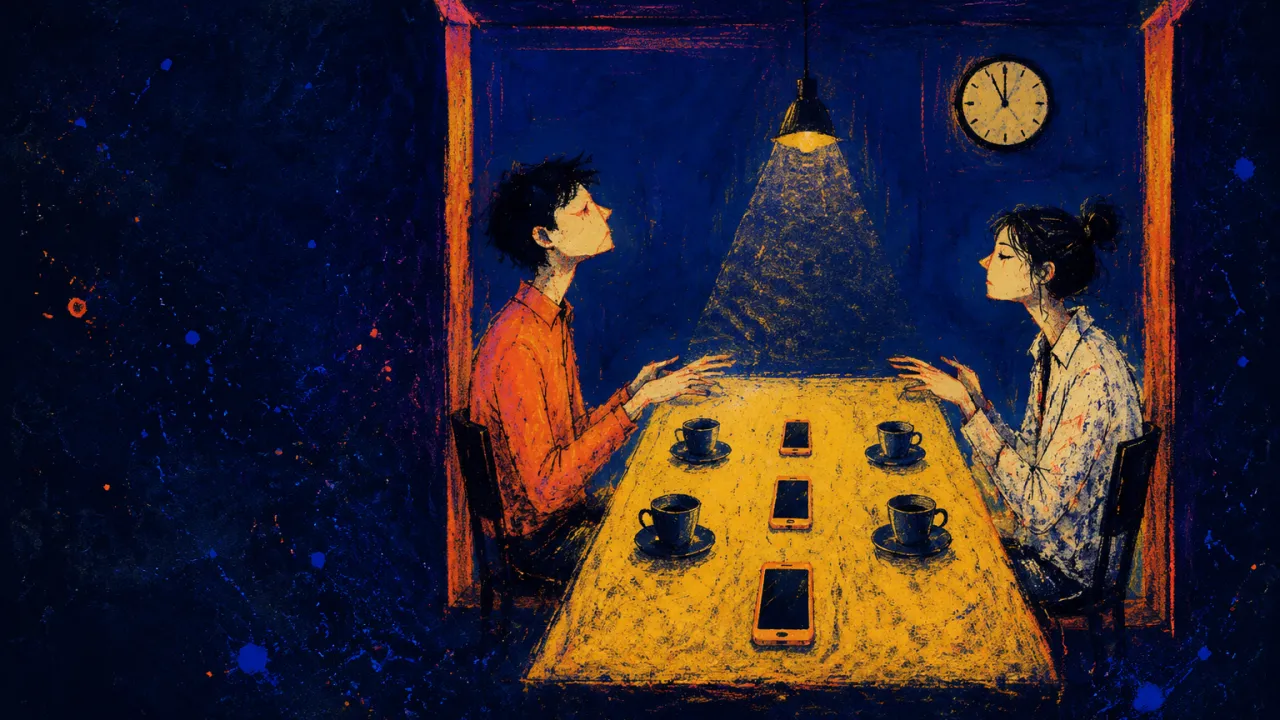
Performative Intimacy — you notice it in the moment someone says the right thing, holds your gaze for the right amount of time, and somehow your body still does not soften. On the surface, everything is there: the late-night confession, the thoughtful text, the photo where you look happy, the public warmth, the private language, the kind of emotional fluency people are supposed to want. You nod, you smile, you answer with the version of yourself that knows how to keep the scene smooth, but somewhere under your ribs there is a quiet delay, like the feeling has not landed yet. You start listening less to what is being said and more to what does not happen after it: the need that gets named but not held, the apology that sounds beautiful but does not change the next day, the vulnerability that arrives like a performance and leaves before it has to become mutual. The confusing part is that you are not dealing with coldness; there may be warmth, chemistry, tenderness, even moments that feel cinematic enough to make you doubt your own unease. So you keep checking the evidence, scrolling through messages, replaying conversations, measuring the shape of the relationship against the hollow place it leaves in your chest. You wonder if you are asking for too much, because the signs of closeness are so visible that naming the absence feels almost unfair. Over time, you become fluent in the difference between being shown intimacy and being met by it, and that fluency costs you something: you stop trusting the signals that used to make you feel safe. The ache is not just that someone may be performing closeness; it is that you may have learned to perform receiving it, much like The Magician with one hand raised, one hand pointing down, and every tool laid out in perfect order, while the table still cannot prove that anything is truly being shared.

What's pulling at you?

You're caught between the part of you that sees all the signs of closeness and the part of you that still feels untouched by them. The bond may know how to look warm, open, and emotionally fluent, while the exchange underneath does not give you enough consistency, risk, or follow-through to rest inside it. That is why it can feel so hard to name: nothing looks obviously missing, yet something essential does not arrive.

How It Shows Up?

  • You open a message from someone you're dating and see the exact sentence you once hoped they would say, but your thumb stays still above the keyboard because the timing feels too neat, too polished, too easy to screenshot. Your throat tightens, your face goes blank, and a small pressure gathers behind your ribs as you try to decide whether the words are arriving from contact or from performance. You can let the pause exist before you answer; a response does not have to be immediate just because the line was well delivered.
  • You're at dinner with friends, and everyone is laughing about how close the group is, how you all know everything about each other, how nothing has changed. You smile on cue, take a sip of your drink, and feel your shoulders lift toward your ears because you know the group chat is full and the private reach is thin, like cups arranged on a table that no one is actually passing. It is acceptable to notice the difference between being included and being met without turning the whole night into a verdict.
  • You sit in a meeting, class, or studio session and deliver the warm version of yourself: interested face, quick laugh, careful follow-up question, just enough honesty to seem accessible. Your jaw starts to ache from holding the expression, your breathing goes shallow, and by the time you close your laptop you feel oddly scraped out, as if you have spent an hour proving you are connectable without letting anything touch you. You can step away from the screen and let your body unclench before deciding what the interaction meant.
  • You're lying in bed next to someone after a conversation that looked intimate from the outside: deep eye contact, long pauses, soft voices, the kind of talk that should have made you feel closer. Instead, your chest feels hollow, your hands are cold under the blanket, and you replay the exchange trying to find the moment where something was actually shared rather than beautifully performed. You do not have to solve the gap tonight; noticing the hollow place is already information.
  • You catch yourself checking photos, comments, old texts, or saved voice notes, looking for evidence that the closeness is there. Your stomach drops when everything looks convincing: the smiles, the jokes, the affectionate words, the public ease, all arranged like The Magician's tools in perfect view. Your body knows the difference between a signal and a landing place, and it is okay to give that knowing a few quiet minutes before you explain it to anyone else.

Performative Intimacy in Tarot Cards

Performative Intimacy lives in the gap between vivid signs of closeness and the harder exchange that would make those signs accountable. You may feel it as a tight throat over a polished text, cold hands after a soft conversation, or a chest that stays hollow even when everything looks warm. From an existential perspective, the structural framework here is about what happens when connection becomes legible before it becomes livable. These Tarot Cards reflect the visible outline of that gap.

The Magician Upright
The Magician faces outward with a precise, readable gesture, his tools laid out like proof of capability. The scene is open to view, but the contact is highly controlled, more like a demonstration than a mutual exchange. In social spaces, that same structure appears when warmth, charm, and availability become a performance of intimacy. You can look present, responsive, and easy to connect with, while the relationship itself remains organized around what you can display rather than what can actually be shared. This card anchors the struggle in the distance between social access and real reciprocity. The performance opens the room, but it can also keep the deepest point of contact out of reach.
Reversed
The reversed Magician can make the raised wand, pointed hand, and ordered tools look less like living exchange and more like a display of capability. The form is convincing, the symbols are all present, and the scene still looks prepared, but the visible arrangement does not prove that anything is being shared. In a romantic context, that is the shape of intimacy that performs fluency without becoming mutual vulnerability. You may receive the right words, intense eye contact, curated openness, or emotionally charged gestures, while the relationship still avoids the grounded exchange that would make those signals accountable. The table matters because it turns contact into presentation. The struggle is not simply being impressed by charm; it is trying to locate what is real when the signs of closeness are vivid, but the structure of care, consistency, and shared risk remains out of reach.
The Empress Reversed
The raised scepter sits beside the face like a ceremonial greeting, while Venus symbols, robe patterns, and the heart shield arrange intimacy as a visible display. In the reversed texture, the signs of closeness remain intact even when the body is not moving toward contact. In a relationship, that can feel like love that photographs well, texts correctly, or performs warmth in public while the private bond stays strangely unfed. The card does not reduce the issue to dishonesty; it shows a structure where symbols of love do the work that direct presence has stopped doing.
The Lovers Reversed
The figures are naked and open, but the openness stops at display. No body moves into touch, and the angelic frame above them can make the scene appear whole even while the actual contact between the two people remains incomplete. In a relationship, that structure can feel like intimacy because the symbols are all present: vulnerability, attraction, meaning, confession, chemistry, even a sense of fate. Yet the bridge of reliable response is missing, so closeness becomes something performed in atmosphere rather than proven through repair, consistency, and mutual reach. The reversed Lovers names this as a functional gap inside the image of connection. It witnesses the exhaustion of being surrounded by signs of intimacy while the relationship itself keeps avoiding the concrete exchange that would make intimacy real.
The Sun Reversed
The red flag is the loudest moving object in the child’s hand, but it does not steer the horse. It announces vitality, celebration, and presence while the actual mechanics of direction are being carried somewhere else. In love, that image locates a relationship where visible closeness can become a substitute for navigational truth. Photos, affection, sexual warmth, public ease, or the performance of being fine may wave brightly while the bond avoids the quieter work of naming pace, needs, resentment, and direction. The reversed Sun does not erase warmth; it shows warmth becoming overused as evidence. You may be surrounded by signs that the relationship looks alive, while the deeper question is whether those signs are actually guiding anything.
The World Reversed
The dancer appears weightless and composed, framed by a wreath that tells the eye everything has come together. Yet there is no visible floor under the body, so the sense of stability comes from the image of completion rather than from grounded contact. In romantic life, that becomes the structure of performed closeness. The relationship can keep showing the correct signals of harmony, mutual growth, or 'we're good,' while the actual felt ground between two people remains thin, delayed, or hard to name. The reversed World fixes the struggle inside the gap between the visible choreography and the missing footing. You are not simply pretending; the bond may have learned to preserve its completed image because touching the unfinished parts would disturb the whole frame.
Two of Cups Reversed
The garlands, matched cups, and winged caduceus create a complete public grammar of closeness. In this state, the symbols can become heavier than the exchange itself: the cups are displayed, the figures face each other, and nothing visibly proves that emotional content has passed between them. That is the shape of performative intimacy in social life. You can be invited, tagged, replied to, and warmly included while the bond remains untested, leaving the surface of connection intact and the felt container strangely empty.
Three of Cups Reversed
The raised cups, wreaths, bright robes, and smiling faces create a complete image of togetherness before any private exchange is visible. The bodies know how to form the celebratory picture, and the circle holds that picture tightly. In the reversed texture, the relationship can become skilled at producing the signs of intimacy while the lived contact underneath thins out. You may have photos, plans, jokes, shared friends, and public ease, yet still sense that the bond is being performed at the surface rather than inhabited from within. Performative Intimacy names the moment when love becomes more legible to observers than to the people inside it. The card's celebration is not dismissed; it is measured against the quieter question of whether the cup ever comes down from display long enough to be received.
Nine of Cups Reversed
The scene presents every signal of ease: bright background, arranged cups, composed body, and a figure positioned as if the feast has already proved its point. Yet the cups are not being lifted, passed, emptied, refilled, or shared; the image of closeness is stronger than the action of closeness. Friendship can become performative in exactly this way when the group chat, the photos, the rituals, or the old jokes keep proving that the bond exists, while the real exchange of honesty and repair has gone still. You can be surrounded by evidence of friendship and still feel the structure refusing deeper contact. The card names the struggle as a gap between social proof and emotional function. It shows a friendship that may look full from the outside while its living channels of need, response, and mutual presence are quietly inactive.
Ten of Cups Reversed
The adults face the rainbow with raised arms while their faces remain hidden, and the children keep the scene alive with visible movement. Harmony is present as a surface arrangement: joined bodies, open gestures, domestic background, and ten cups overhead. In the reversed texture, that arrangement can harden into a display system. The relationship still has the gestures of closeness, but the bodies are not shown meeting each other face to face. The image carries intimacy outward while leaving the private feedback loop unreadable. Performative Intimacy names the strain of keeping love recognizable when contact itself has thinned. The card does not accuse the bond of being fake; it shows how visible togetherness can become the structure that protects a couple from noticing where emotional exchange has stopped moving.
Nine of Pentacles Reversed
The woman's gestures are precise: one hand acknowledges the pentacles, the other carries the falcon through a glove and a hood. In the reversed structure, those gestures keep the relationship scene intact while direct, risky contact is filtered before it can reach the skin. Performative Intimacy emerges when love keeps its rituals but loses its unmediated feedback. You may still show up, text back, plan dates, manage the tone, and preserve the image of closeness, while the parts that would reveal real need or discomfort remain covered. The card's elegance matters because the performance is not crude or fake in a simple sense. It is a refined system of closeness that can keep functioning even when the relationship no longer feels fully contactable.
Queen of Swords Reversed
The open hand remains visible, but the body is still organized around the throne and the sword. Care appears in the scene, yet the active structure is guarded, elevated, and controlled. That is the shape of a friendship that still performs the signs of closeness while real access has quietly narrowed. Messages are answered, check-ins happen, birthdays are remembered, but the living exchange underneath has been reduced to a careful surface. Performative Intimacy becomes painful because nothing looks obviously broken enough to name. The card gives the contradiction a boundary: the gesture of connection is still there, but the system behind it is no longer letting the friendship actually reach you.
Six of Wands Reversed
The scene is full of signs of support: raised wands, a decorated horse, laurels, and a public route lined by people. In the reversed structure, those signs can keep functioning even when the private relationship underneath them is thin, unclear, or emotionally inaccessible. Performative Intimacy takes shape when a friendship can still look close from the outside because the rituals remain intact. The group may still cheer, comment, invite, tag, or show up in public ways, while the actual channel for honest mutual care is harder to locate. This card points to the strain of friendships maintained through visible gestures that no longer match the private bond. You are not imagining the warmth; the structure shows why warmth can exist at the surface while true access remains blocked.

Performative Intimacy in Tarot Card Reading Insights

When Performative Intimacy shows up, people often bring the same question into readings: why does the connection look so close while the felt exchange stays hard to locate? The pieces below move from card patterns into readings where that kind of polished closeness becomes the focus. Tarot Reading Insights on Performative Intimacy.

Psychological struggles related to Performative Intimacy