Fluent Everywhere, Grounded Nowhere
Explore Social Integration Strain through grounded descriptions, related tarot cards, and tarot reading insights from familiar social contexts.

Social Integration Strain
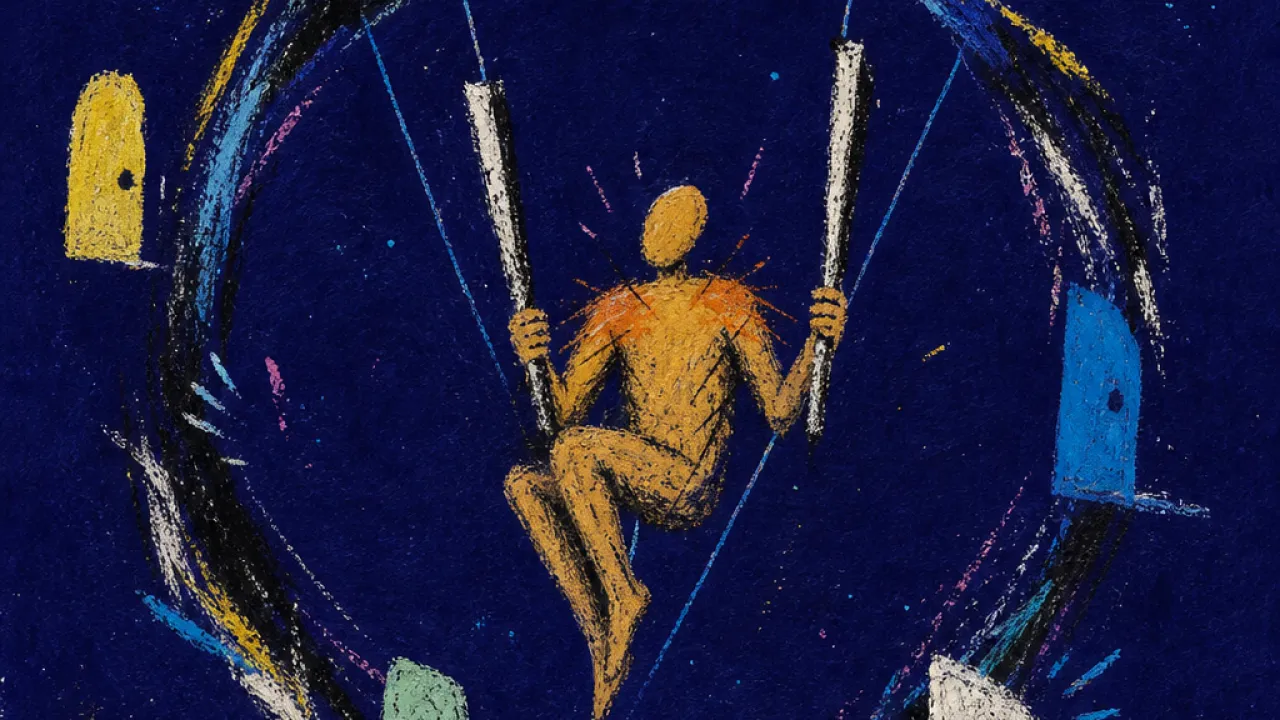
What does this feel like?
Social Integration Strain — you notice it the moment you walk into a room where everyone technically knows you, but no one seems to know the same version of you. Your smile arrives before the rest of your body does; your shoulders lift slightly, your voice chooses its setting, and a tiny part of you starts scanning for the right amount of warmth, irony, ambition, privacy, confidence, and softness to bring into this particular circle. In one group, you are the funny one who keeps things light; in another, you are careful and polished; somewhere else, you are supposed to be open, loyal, relaxed, impressive, low-maintenance, available, not too much, not too quiet. None of these versions feel fake exactly, which is part of what makes it so hard to name. They are all you, but holding them together takes effort that no one sees, like your whole body is translating in real time while everyone else seems to be simply speaking. You might leave a dinner, a work event, a group chat, or a friend hangout replaying tiny moments: Did I talk too much? Did I seem distant? Did I miss the joke? Did I make the new people comfortable and the old people feel remembered? The strain is not that you dislike people; often, you want connection so much that you become hyper-attuned to the rhythm of every room, and by the time you get home, your face feels tired from arranging itself around other people's cues. The cost is subtle but deep: belonging starts to feel like choreography instead of rest, and you begin to wonder whether there is any place where all of you can arrive at once, much like the figure in The World, turning inside the wreath with a wand in each hand, held together in motion while every corner asks the body to stay integrated.
What's pulling at you?
You're not stuck because you lack social skill; you're stuck because different circles ask for different versions of you, and every version is still partly honest. The pull is between wanting to belong without performing and needing to adjust enough to be understood. That middle space can make connection feel available but not fully inhabitable.
How It Shows Up?
- You get home from a group dinner and stand in your kitchen with your coat still on, replaying the night before you've even turned on the light. Your cheeks feel stiff from smiling, your shoulders are still slightly raised, and your stomach keeps tightening around tiny moments that probably looked normal from the outside. You can let the replay run out without turning it into a verdict on the whole evening.
- A friend invites you to a hangout where two of your circles will overlap, and you pause over the message longer than the invite seems to require. Your thumb hovers above the reply box while your chest tightens, because you can already feel yourself becoming the bridge between inside jokes, histories, and social temperatures that do not quite match. It is allowed to notice the effort before deciding how available you are.
- In a work, class, or networking setting, you hear yourself switch into a more polished voice before you have chosen to do it. Your jaw tightens, your breathing gets shallower, and you start tracking who needs competence, who needs warmth, who needs humor, and who needs you to stay carefully neutral. You can take one steady breath without having to solve the whole room.
- In a group chat, messages move faster than your body can settle into them; jokes build, references stack, plans shift, and you keep typing, deleting, and retyping. Your throat feels tight even though no one is in the room, and the little typing bubble starts to feel like a doorway you are standing in but not crossing. It is fine to step back from the screen before choosing your words.
- At a party or shared event, you find yourself physically near the circle but not quite inside its rhythm. Your hands search for something to hold, your neck feels warm, and your attention keeps moving between faces, exits, and the right moment to enter without interrupting. You can stay at the edge for a minute without forcing yourself to perform ease.
Social Integration Strain in Tarot Cards
Social Integration Strain lives in the effort of moving between circles while trying to remain one coherent person. You may feel it as lifted shoulders, a tight face, and the small delay before your voice chooses the version that fits the room. From an existential perspective, the structural framework is about belonging that requires constant translation instead of simple arrival. The Tarot Cards below make that pressure visible through images of circles, thresholds, timing, and bodies trying to hold a shared field.
Social Integration Strain in Tarot Card Reading Insights
Social Integration Strain often enters readings when someone is visible in several circles but still feels held at the edge of stable belonging. These readings shift from the cards themselves into how people bring that in-between social pressure to the table. Tarot Reading Insights on social belonging and group calibration.