Hyperconnected Loneliness on Friday Night—And One Honest Thread

The 8:37 p.m. Scroll
If you keep your Friday night technically open just in case something comes together, then end up on your bed in a going-out top refreshing Instagram stories and calling it being chill, this is for you.
When Alex sat across from me, she did not start with a dramatic story. She started with one small, devastating scene. It was 8:37 p.m. the previous Friday in her downtown Toronto bedroom: jeans on, one boot half-zipped, three group chats open, one unsent text blinking in a direct thread. The blue phone light washed over her room. The air conditioner hummed. Outside, the city sounded sharp and far away at the same time, like plans happening one neighborhood over. She told me the fabric across her shoulders had started to feel too tight. Her chest went heavy. Her stomach dropped every time the phone buzzed and still said nothing personal.
“I am always included,” she said, looking down at the screen she had set face-down on my table, “just never specifically wanted.”
I believed her immediately. A busy phone can still be a lonely room. What she was describing was not a lack of contacts. It was the very modern ache of wanting someone to text on Friday night while having many group chats and no one to actually text. Hyperconnected loneliness has a strange texture: like having twenty tabs open and still not being fully inside any one conversation, or watching a transit map pulse with activity without ever getting on the train you actually need.
I leaned in a little and kept my voice soft. “That does not sound dramatic to me,” I told her. “It sounds exhausting. And it sounds like your body already knows this is not really about how many chats you have. It is about whether anyone is turning toward you directly. Let’s make a map for that tonight. Not to judge you. To find clarity.”

Choosing the Compass for Friday-Night Loneliness
I asked Alex to take one slow breath, then another, and to hold the real question in mind instead of the polished version of it. I shuffled slowly while she rested her palms around a mug of tea. I do not use this moment as theatre. I use it as a threshold. It helps the nervous system step out of the loop long enough to see the pattern.
For her, I chose the Situation-Obstacle-Advice-Outcome · Context Edition, a compact four-card relationship spread. When someone asks me why they have so many group chats but no one to text on Friday night, I do not need a huge predictive layout. I need the fewest cards that can cleanly separate symptom, blockage, key shift, and action. This spread does that beautifully. It keeps the reading self-exploratory rather than fortune-telling: what is happening on the surface, what wound sits underneath it, what relational antidote actually helps, and what grounded next step turns insight into behavior.
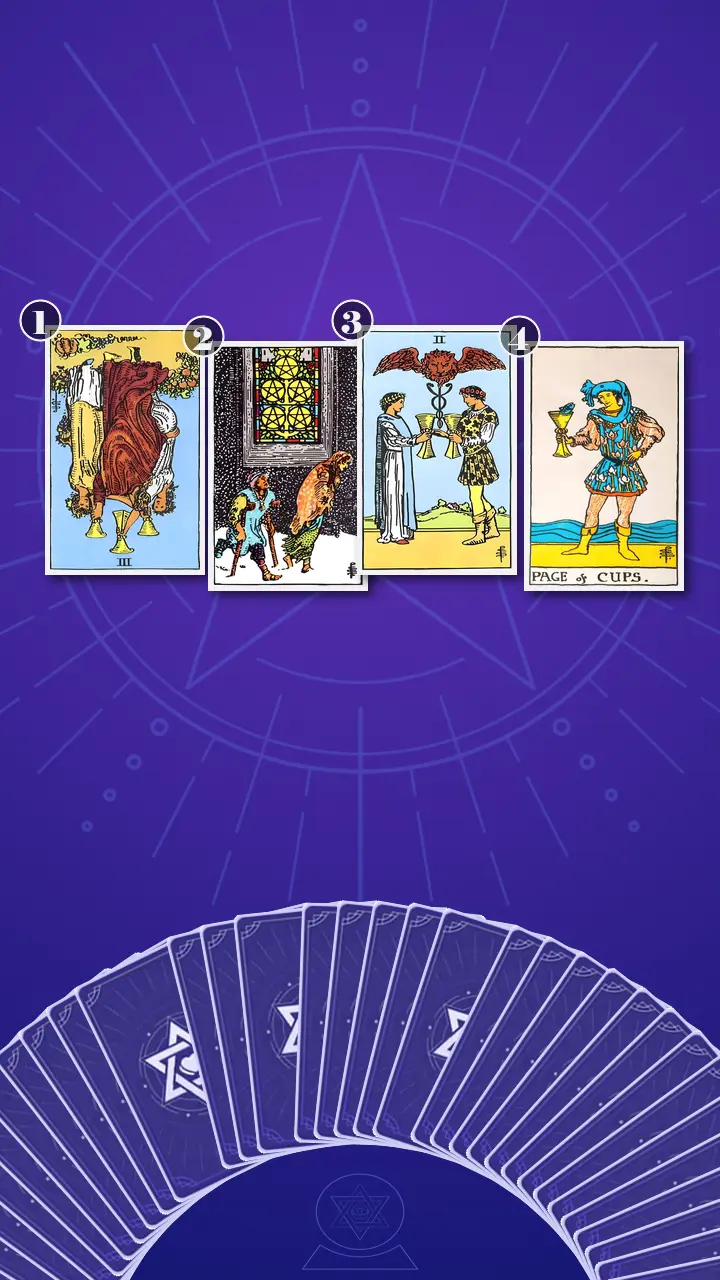
I showed her the line I was building from left to right. The first card would show the visible symptom: lots of social activity, very little emotionally meaningful contact. The second would reveal the deeper belonging wound underneath the habit of staying in the group instead of reaching one-to-one. The third, the heart of the reading, would point to the antidote. The fourth would translate that shift into one lived next step. A short bridge, really—from social noise to one clear gesture of contact.
Reading the Crowd Noise
Position 1: The Loop That Looks Social
I turned over the first card. “Now we’re looking at the card that shows the visible symptom,” I said. “The present situation as it appears on the surface.”
Three of Cups, reversed.
I smiled a little, because sometimes tarot is almost painfully literal. Friday night looks socially full on paper: three group chats are active, somebody is posting a blurry bar photo, somebody else is saying ‘maybe patio later,’ and you keep the energy going with reactions, jokes, and memes. But none of it becomes one direct message with a real plan, so the whole evening stays broad, buzzy, and emotionally underfed.
In energy terms, this card is not empty. It is diffuse. Too much communal water, not enough actual nourishment. The social motion is real, but it is spread so thin that it never lands in the body as closeness. It is the difference between being tagged into the feed of the night and being asked, plainly, ‘Do you want to come?’
“This is exactly the thing,” I told her. “You are participating in the atmosphere. You are not making contact. The card is showing quantity without intimacy, noise without nourishment. You’re technically included, but nothing here is actually for you.”
Alex let out a short laugh that had a little sting in it. “Why is that so specific?” she said. “That actually feels rude.”
I laughed with her, gently. “Because the pattern is specific. And once we can name it, it stops feeling like random bad luck.” I watched her fingers loosen around the mug. Recognition had arrived, which meant we could go deeper.
Position 2: The Cold Outside the Warm Room
I turned the second card. “This position reveals the belonging wound and rejection fear underneath the habit of staying in the group instead of reaching out one-to-one.”
Five of Pentacles, upright.
The image always lands hard when the question is about belonging. Alex sees other people out, sees the chat still moving, and still feels like she is standing outside the warm room. Instead of taking a quiet or vague phone as ordinary adult ambiguity, she experiences it as evidence that closeness is available nearby but maybe not for her. So she stays visible in the group and avoids the one-to-one ask that might clarify reality.
This is blocked earth energy: contracted, braced, scarcity-driven. Not because she is weak, and not because the cards are punishing her. Because somewhere along the line, her system learned to treat ambiguity like proof. A delayed reply becomes a failed background check on her worth. A rooftop Instagram story becomes light through frosted glass. And being included in the vibe is not the same as being held in a connection.
“This is the deeper fear,” I said. “Not ‘What if they’re busy?’ but ‘What if one direct text confirms I was only ever tolerated?’ That is why group-chat banter feels safer. It gives you contact without the risk of a clear answer.”
Her reaction came in three small waves I almost could have storyboarded: first her breath paused, as if her body had hit ice; then her gaze slid past the cards to the window, unfocused, replaying something I could not see; then her jaw softened and she said, very quietly, “I thought it was just me being dramatic.”
“No,” I said. “It’s a wound, not a character flaw. And it makes perfect psychological sense. But it also means the strategy protecting you is the same strategy keeping the need invisible.”
When the Two of Cups Turned Toward Her
Position 3: The Card That Reduced the Field
I always feel the room change a little when the key card appears. The air conditioner clicked off. Street noise softened against the window. I turned the third card and looked up at Alex before I said anything else. “This is the heart of the reading,” I told her. “The card that points to the core relational antidote: moving from ambient access to mutuality, eye contact, and direct reciprocity.”
Two of Cups, upright.
This is the turning point. Not a better group chat. Not a louder social field. This card shows Alex choosing one person who already feels reasonably safe and sending a direct, low-pressure invite. In that moment the whole landscape shrinks from crowd energy to mutual exchange: one person asks, one person answers, and connection becomes specific enough to exist. Energetically, this is balance. Clear water. No overperformance. No crowd management. Just reciprocity.
This was the moment I brought in one of my signature lenses, something I call Typecasting Analysis. “Sometimes,” I said, “a social circle quietly casts you in a role without meaning to. The funny one. The useful one. The chill one. The one who keeps the group thread alive and never asks for too much. It keeps you visible in the ensemble, but it can box you out of a closer character arc. You’ve been getting written as socially easygoing, not emotionally direct. The Two of Cups is not asking you to become someone else. It’s asking you to step out of the crowd scene and allow a close-up.”
At 8:37 p.m., with three chats open and one text unsent, the worst part is not that your phone is quiet. It is that your phone is busy enough to look like connection while your body still feels alone.
You do not need a louder crowd; you need one honest exchange—let the Two of Cups remind you that belonging grows where two hands actually meet.
Alex’s face changed before she spoke. First came the stillness: her thumb stopped against the edge of her phone, and I could see the tiny hold in her breathing. Then came the resistance. Her brows pulled together and a flash of anger crossed her face. “But if that’s true,” she said, “doesn’t that mean I’ve been doing this to myself?”
I shook my head. “No. It means you built a strategy that kept you safe in a city and a social culture that reward being low-maintenance, funny, and vaguely available. That strategy made sense. It just can’t take you where you want to go.”
That landed deeper. Her eyes lost focus for a second, the way they do when someone is replaying an exact memory frame by frame. I could almost see the moment she had described: one friend’s direct thread open, the words are you free for a drink? half typed and then erased. Her throat worked once. Her shoulders, which had been pulled slightly toward her ears since she arrived, lowered by what looked like half an inch. Then she let out a breath that sounded surprised to find itself leaving her body.
“So the answer isn’t to be more socially on,” she said.
“Exactly,” I told her. “Being near connection is not the same as being in connection. The loneliness doesn’t start to thaw when the crowd gets louder. It starts to thaw when one honest message gives somebody real a chance to meet you.”
I asked her, “Now, with this new lens, think back to last Friday. Was there a moment when this insight could have changed how the night felt in your body?”
She nodded almost immediately. “When I opened Emma’s chat,” she said. “I knew she was the person I actually wanted to ask. But I posted a story instead.”
There it was: the first step of the real transformation. Not from lonely to magically fixed, but from socially adjacent, rejection-avoidant scanning toward direct, mutual, steadier trust in reciprocal connection.
Position 4: The Message Before the Inner PR Team Arrives
I turned the final card. “This position translates the shift into a grounded next step,” I said. “A small, sincere message or invitation that builds real intimacy over performative social presence.”
Page of Cups, upright.
I love this card in action positions because it never asks for a speech. It asks for a message. The next step is small and slightly vulnerable: a simple text sent before it gets overmanaged, like, ‘Hey, are you around for a drink tonight?’ or ‘I’ve been missing actual catch-ups—want to grab coffee this weekend?’ It is sincere without being heavy, and that is exactly why it can begin building real intimacy.
This is fresh water starting to move again. Not a flood. Not a performance. Just emotional honesty in human-sized form. In modern terms, it is sending the message before your inner PR team rewrites it into sounding so detached that the warmth disappears. A voice note with one honest sentence instead of a whole strategy deck. Dropping a map pin, not a manifesto.
“Sometimes the bravest Friday-night move is one soft text, not one more meme,” I said.
Alex smiled this time without the bitterness. She picked up her phone, opened Notes, and typed out a draft while I watched the card line hold steady between us.
From Group Glow to One Honest Thread
When I stepped back and looked at the whole spread, the story was strikingly clean. The reading began in a wide shot: the reversed Three of Cups, where the social field looked full but offered little nourishment. Then it moved into the cold exterior of the Five of Pentacles, where ambiguity got translated into exclusion and a quiet phone started feeling like a verdict. Then the camera tightened. The Two of Cups reduced the field from three raised cups to two exchanged ones, from group glow to mutuality. And the Page of Cups gave that insight its first line of dialogue: one message, one preference, one real bid for contact. As an artist, I often think of readings this way. Sometimes people are not stuck because the story is over. They are stuck because they have been brave enough to stay in a painful scene too long, hoping the crowd shot will somehow turn into a close-up.
I told Alex her cognitive blind spot was not that she lacked options. It was that she kept asking scale to do intimacy’s job. She had been treating social motion as evidence of closeness and directness as evidence of danger. The transformation direction was simpler than her nervous system wanted it to be: from waiting to be implicitly included to making one clear, low-pressure bid for one-to-one connection. Waiting to be chosen keeps the need invisible.
- Start One Honest ThreadBefore next Friday, choose one person from an active group chat who already feels basically safe. Put their name in a note called One Honest Thread, so when the spiral starts you are choosing from intention, not from panic.When the old thought says, ‘If they wanted to, they would have asked first,’ treat it as protection strategy, not fact.
- Use the 90-Second Boundary-First InviteWhen you know who you want to ask, type and send a two-line message in under 90 seconds: ‘Hey, random but are you around for a drink or walk tonight around 8:30? No stress if not.’ If same-night plans feel too exposed, use the same structure for coffee on Sunday around 11.Read it once, not five times. After sending, put the phone down for ten minutes or mute the thread so your body can come back out of alert mode.
- Try My Recasting ExerciseThe next time the group chat lights up, break your usual social character on purpose. If your old role is The Funny, Helpful, Chill One, do not post the meme first. Either send one direct DM to the safe person you actually want to see, or open Notes and make two columns—Facts and Story I’m Telling—then choose a solo plan you genuinely want for the next 20 minutes.This is not about forcing vulnerability with everyone. It is about reclaiming authorship in one moment. One message is enough information; do not chase a vague reply.

A Week Later, the Phone Felt Different
A week later, Alex messaged me a screenshot. She had sent: ‘Hey, random but I’ve been missing actual catch-ups. Want to grab coffee Sunday around 11? No stress if not.’ They met at a café near Trinity Bellwoods. Nothing cinematic happened. That was the point. It was ordinary, direct, and real.
She told me afterward that she slept well that night, then woke with the familiar first thought—what if I got it wrong?—and smiled because this time she could hear it as an old line reading, not the truth. Clear, but still a little vulnerable. Human. In progress.
That is what I love about a reading like this. The cards did not create belonging for her, and they did not guarantee who would text back. They helped her separate symptom from wound, antidote from action. They handed the pen back. That is the real Journey to Clarity: not certainty, but ownership.
If tonight you know the very specific ache of sitting fully dressed on your bed with a busy phone in your hand, trying to act casual while your stomach drops at the thought that one direct text might tell you whether you really belong, please know this: the moment you notice that pattern, you are already no longer fully trapped inside it.
If you didn’t need the perfect opening, who feels safe enough for one small, honest text this week—and what would the softest version of that message sound like in your own words?