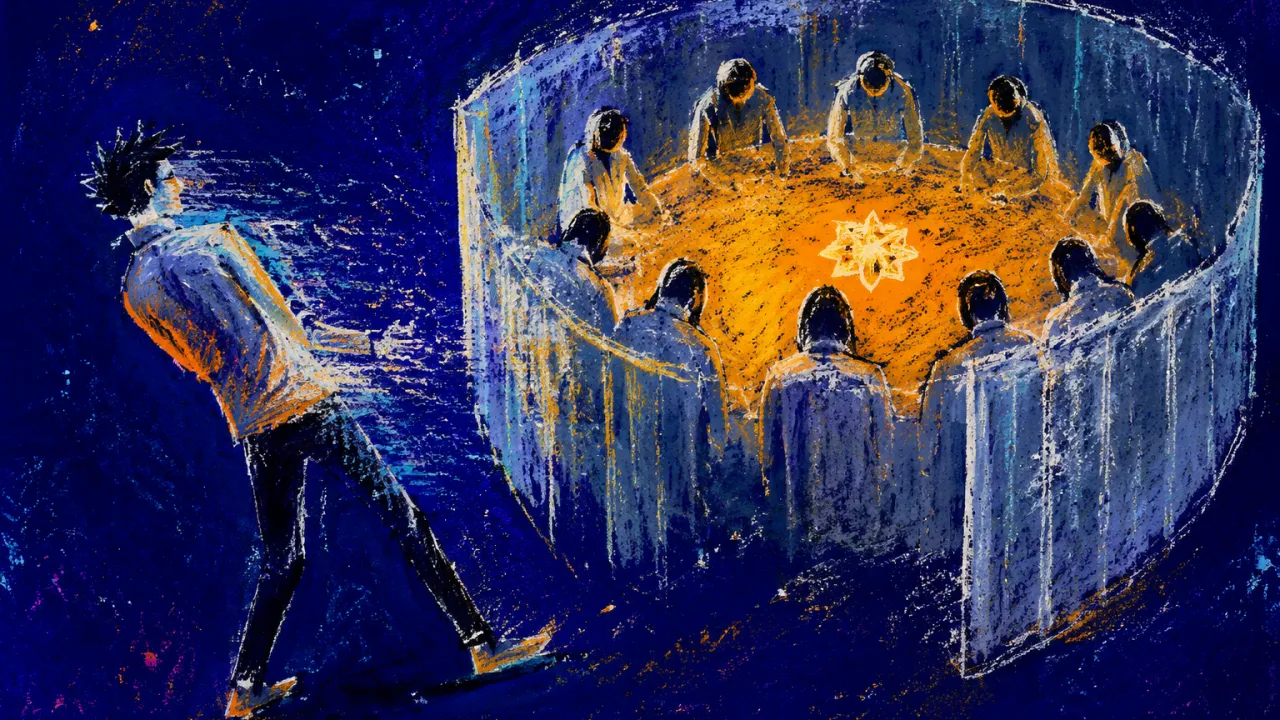
Why Is Entry Conditional?

Explore the social access pattern, related tarot cards, and reading insights for groups where belonging stays quietly conditional.

Social Gatekeeping Circle

What is this situation?

Social Gatekeeping Circle — you step into a friend group, creative scene, hobby community, campus crowd, Discord server, industry mixer, or work-adjacent network that looks open at first, but the longer you stay, the more you notice that entry is being managed through rules nobody says out loud. Someone mentions an afterparty you were not told about, a group chat you are not in, a running joke that everyone understands except you, or a name-drop that quietly sorts who matters and who is still being assessed. The people at the center may be friendly enough in public, but warmth arrives in uneven doses: one person gets tagged, invited, introduced, defended, or filled in, while you are left piecing together context from side comments and delayed replies. You learn to watch who gets eye contact across the table, who is allowed to be messy without losing status, who can disagree and still be held close, and who has to stay polished just to remain near the edge. The power in the circle rarely announces itself as power; it shows up as taste, history, mutuals, seniority, aesthetics, inside language, shared references, or the quiet approval of one host, moderator, popular friend, legacy member, or inner pair. Over time, the ordinary act of showing up becomes a kind of decoding: checking the group chat for what was left out, replaying a comment to see if it landed wrong, standing in the room with your shoulders tight because the door is visible but the terms of passage keep changing. What wears you down is not simply being excluded; it is being close enough to see the table, the laughter, the plans, and the social currency moving around, while the route into full recognition stays conditional, much like the High Priestess seated between two pillars before a veil, marking a threshold that exists but is being quietly regulated.

Why it's not you?

The issue is not that you are failing to fit in; the circle is controlling access through signals it refuses to make clear. Selective invitations, private context, insider jokes, status cues, and uneven warmth create a social structure that keeps people guessing. That uncertainty belongs to the gatekeeping system, not to your worth.

Social Gatekeeping Circle in Tarot Cards

In a Social Gatekeeping Circle, the group can look casual from the outside while access keeps moving through private chats, status cues, and people already near the center. The tightness in your shoulders when you hover near the room but still do not know the rule is part of the visible cost of that arrangement. This is an environmental, structural dynamic: belonging is organized through a social access system before anyone names it. The Tarot Cards below reflect the shape of that gate, who appears to hold it, and how the circle manages entry.

The Magician Reversed
The central figure controls the table, with every tool arranged in a legible line below him. In the reversed frame, that visual order can become a status checkpoint, where access depends on knowing what each object signals and who is allowed to use it. Social Gatekeeping Circle emerges in cliques, creative scenes, hobby communities, and professional-social networks where the rules are rarely spoken directly. You can be near the room, near the table, and still not know which codes decide entry. The pressure comes from asymmetrical access. The Magician's centered position shows a social field where one person or inner circle holds the interpretive power, making belonging depend on performing the correct signals before the group explains them.
The High Priestess Upright
The High Priestess sits at the entrance, not inside the crowd and not outside the structure. Her body, the pillars, and the veil create a gate where passage is possible but socially regulated. That is the visual logic of a gatekeeping circle. The group may look open from the outside, but real participation is filtered through status cues, prior relationships, invitation chains, and the quiet approval of people already near the center. The card gives the situation a precise shape: you are not imagining a wall where there is only a door. The door exists, but it is being managed by a social order that decides who is merely present and who is recognized as belonging.
Reversed
The black and white pillars turn the scene into a guarded doorway, while the veil marks a difference between those who belong inside and those who remain outside. The central figure does not merely sit in a room; she occupies the point where access is decided. In a Social Gatekeeping Circle, friendship becomes managed through insider codes, quiet approval tests, and selective invitations. You may be facing a group that presents itself as close and intuitive, while the real rules of belonging stay hidden enough to keep newcomers or less powerful friends unsure of their place.
The Empress Reversed
The Empress's garden is welcoming in texture but not neutral in structure. The throne, crown, Venus markings, robe, shield, and cultivated landscape create a recognizable code of beauty, status, and belonging. The abundance is inside a social field with a center. In friendship, that becomes gatekeeping when warmth is offered selectively through taste, lifestyle, access, and unspoken group rules. A person may be close enough to see the garden but still feel they are being measured against an aesthetic or social code they were never clearly told. You are not dealing with simple exclusion alone. The card points to a softer mechanism: belonging is managed through invitations, tone, inside jokes, image alignment, and who is allowed to stand near the center without disrupting the group's preferred version of itself.
The Emperor Reversed
The Emperor's throne sits at the mountain peak, with a hard stone boundary between the ruler and the landscape he oversees. The image turns belonging into something granted from a protected center. In a friend group, that visual logic becomes access control: who gets invited, who hears the update, who is treated as inner circle, and who waits outside the frame. The card names the structure behind the awkwardness, showing that the issue is not simply social chemistry but a hierarchy of entry.
The Hierophant Reversed
The two golden keys sit at the Hierophant's feet while the acolytes kneel below him. Access is visible, but it is not distributed; the room shows who can open the threshold and who must wait to be recognized. In a friend group, that becomes the architecture of gatekeeping. Invitations, group-chat information, inside jokes, and social legitimacy can all be held by a few people, leaving you to decode a hierarchy that presents itself as community.
The Chariot Reversed
The moat, city wall, guarded threshold, and enclosed chariot create a world where access is structured before anyone speaks. Movement is not only about desire; it depends on who is allowed through the visible and invisible gates. In a friendship circle, that image becomes the quiet politics of invitations, private chats, inside references, and selective information. You may be close enough to see the social city, yet still held at a distance by rules nobody names directly.
Wheel of Fortune Reversed
The four winged creatures sit in the corners with open books, while the central wheel is packed with letters, symbols, and layered codes. The whole field looks readable only to those who already know how the system is arranged. In a friend circle, that becomes the pressure of insider rules: who gets invited, whose version of events is accepted, what tone is allowed, and which loyalties are silently tested. The image shows a social environment where belonging is controlled through codes more than open conversation.
Justice Reversed
The pillars, curtain, and central seated figure create a controlled doorway into the inner hall. The scales and sword are visible at the front, but the deeper operating space sits behind fabric, status, and architecture. Reversed, this turns the social field into a gatekeeping circle. Access is shaped by selective invitations, coded standards, private approval, and the feeling that one wrong tone or missing cue can keep you outside the room. The card maps the structure instead of blaming your social instincts. It shows where the gate is, who appears to hold it, and which rules are actually about mutual trust versus status control.
Death Reversed
The priest facing the rider with folded hands creates a threshold scene: access is mediated through posture, symbols, and recognized position. Around him, the other figures show that not everyone gets the same standing before the central force. In social life, a gatekeeping circle often operates through subtle status codes rather than explicit rules. The host, legacy member, moderator, or insider language decides who moves closer and who remains outside the real exchange. The distant towers and river sharpen the structure because there is a passage, but it is not openly available. You are not only trying to be liked; you are navigating a social boundary system that decides belonging before the conversation fully begins.
The Devil Reversed
The black cube, single ring, and oversized central figure create a scene with positions but no open doorway. The people in front are close to the center, yet their access is still mediated by the structure above them. Social Gatekeeping Circle shows up when a clique, creative scene, work-adjacent network, or friend group controls entry through unstated codes. You may be invited near the room, but not fully brought into the flow of trust, information, or belonging. The card's value is in separating your worth from the gate. Once the hidden rules are visible, you can decide whether to keep negotiating with that circle or redirect energy toward spaces where access is not designed to stay conditional.
The Tower Reversed
The tower is a hard boundary before it is a ruin. Its height, crown, and sealed stone walls create a visible separation between those inside the elevated structure and those outside on the ground. In social life, that boundary becomes gatekeeping: the circle controls access through taste codes, insider language, private invitations, status markers, and unspoken tests. The problem is not that a group has standards; it is that belonging becomes a moving target managed by people who already hold the room. You are looking at the mechanics of entry, not a verdict on your worth. The card helps separate genuine fit from a hierarchy that keeps people uncertain so the gate remains powerful.
The Moon Reversed
The two towers form a narrow gateway, and the animals occupy the approach before anything can pass through. The route exists, but entry is mediated by figures already positioned inside the terrain. In a friend group, that becomes the structure of controlled belonging. Invitations, inside jokes, loyalty checks, and private approval systems can decide who gets through the gate while pretending the circle is casual and open. The Moon makes the hidden access rules visible. You are not simply trying harder to fit in; you are reading a social architecture where acceptance is being filtered through cues that were never openly explained.
The World Reversed
The laurel wreath can read as a beautiful closed perimeter, with the four corner figures marking who gets recognized at the edges. The frame is orderly and bright, but that order also gives the social field a controlled entry point. This is how gatekeeping often feels in a circle that never openly says no. You can see the group, learn its signals, and stand near the boundary, yet access still depends on subtle approval, status cues, and rules that remain unspoken until you break one.
Two of Cups Reversed
The pair stands like a narrow doorway in front of the distant town, with the central staff marking the point where access has to be recognized. The wider social space exists, but the visible route into it runs through a small exchange. In a friend group, scene, or community, that becomes a gatekeeping structure when one person or inner pair quietly controls who is warmed, invited, named, or ignored. You are not simply trying to be more outgoing; you are dealing with a social access system. The card helps separate belonging from permission. Once the gate is visible, the question becomes whether this circle has an actual path for mutual recognition or whether the entrance is designed to keep power concentrated in the middle.
Three of Cups Reversed
The same inward-facing circle that protects the toast also creates an outside edge. Cups, eye contact, shared symbols, and body orientation all point toward the center, making access a spatial fact before anyone explains the rules. In a social network, that geometry becomes gatekeeping when warmth is reserved for insiders and entry depends on invisible credentials. You are reading the room not for whether the group looks friendly, but for whether its boundary allows genuine arrival or only managed proximity.
Six of Cups Reversed
The guarded manor places warmth inside a defined boundary. When that boundary stiffens, the same protected garden can become a social territory where shared history functions like an entry requirement. Friend groups often gatekeep without open hostility. Inside jokes, childhood stories, old photos, private references, and unspoken rituals can decide who belongs before anyone says it out loud. You may be facing a circle that looks kind from the inside but difficult to enter from the edge. The card makes the mechanism visible: the cups are beautiful, the garden is safe, and the gate is real.
Seven of Cups Reversed
The castle, jewels, and laurel are elevated above the person, arranged as rewards that must be decoded before they can be reached. The figure stands below a hierarchy of signs rather than inside a shared space. That vertical distance becomes social gatekeeping when belonging depends on taste codes, mutuals, aesthetics, income cues, insider language, or being seen by the right people. You are not simply trying to join a group; you are confronting an entry system that converts connection into status compliance.
Nine of Cups Reversed
The tall table creates a soft wall behind the seated figure, and the cups remain visible but not freely reachable. The scene presents abundance while making access pass through a guarded center. In a friendship circle, that becomes a gatekeeping structure: one friend, host, or inner clique controls invitations, group chat energy, social recognition, and proximity to the desirable parts of the network. You may be close enough to see the cups but still dependent on someone else's permission to fully belong. The card clarifies the power dynamic by showing access as spatially managed. It helps separate genuine friendship from a social layout where warmth is curated, withheld, or distributed according to hierarchy.
Three of Pentacles Reversed
The scene happens at the doorway, not inside the building. The craftsperson is close enough to work on the structure, but access is still mediated by figures who hold the plan, occupy the formal roles, and decide how the contribution is read. In social life, that doorway becomes the circle that lets you hover near belonging while keeping the real invitation conditional. You may be useful, visible, and even praised, while still being held just outside the inner layer where trust and information circulate. The card gives the gate a shape. It separates your actual contribution from the group’s control over access, making it easier to see whether the circle is slowly opening or simply using threshold proximity as a substitute for inclusion.
Four of Pentacles Reversed
The figure sits in front of the town like a checkpoint, with blank ground stretching between his locked body and the streets behind him. The social world exists, but the card gives no clear walkway into it; access is controlled by the one positioned at the front. In a friend group, that layout becomes the quiet power of invitations, side chats, inside jokes, and selective inclusion. You are being shown the structure of a circle where entry is not openly denied, but the real doors are managed through proximity to a gatekeeper.
Six of Pentacles Reversed
The scales are held by one person, not set in the middle of the group, and the coins pass through the same elevated hand. The visual hierarchy turns access into something mediated by a central figure who can define fairness while standing above the people waiting for inclusion. When this appears in a social network, You may be dealing with a circle where invitations, information, attention, or credibility move through a small number of gatekeepers. The card exposes the structure behind the friction: the group may look open, but the actual path to belonging runs through someone else's timing, preference, and social approval.
Nine of Pentacles Reversed
The garden is abundant, but it is not public ground. The glove, hooded falcon, ornate clothing, and estate boundary all suggest a world where access is managed through coded signs rather than open invitation. In social life, this becomes a circle where belonging depends on reading the room correctly: the right taste, the right references, the right level of polish, the right relationship to money or status. You may be dealing with a group that never says the rules out loud but still ranks people by them. The Nine of Pentacles makes that gate visible. It shows that the friction may not come from your lack of social skill, but from a field designed to filter people before they ever reach the center.
Ten of Pentacles Reversed
The gateway, wall, crest, and ranked household positions create a private territory with visible rules of entry. The space is not empty social ground; it is a protected circle where acceptance is filtered through symbols, history, and proximity to the people who already belong. In a friend group, that becomes the subtle pressure of being evaluated before being included. You can be near the circle, invited to some moments, and still feel the invisible audit that decides whether you are trusted, useful, familiar, or peripheral.
Knight of Pentacles Reversed
The open field looks passable, but there is no clear road, gate, or marked route through it. The rider’s guarded equipment and the pentacle held forward create the feeling of a checkpoint without a visible rulebook. In social networks, that becomes a circle where access depends on signals nobody explains: who introduced you, how you speak, what status you carry, what history you lack. You are not imagining the friction; the structure shows belonging being controlled through unwritten criteria rather than open invitation.
Queen of Pentacles Reversed
The rose arch and shaded estate create a beautiful threshold, but a threshold is still a boundary. The Queen's seat is not in an open public square; it is placed inside a cultivated social space where access is shaped by proximity, invitation, and recognition. That spatial arrangement mirrors a gatekept circle. The group may look warm from the outside, full of charm, taste, shared rituals, and apparent abundance, while entry depends on reading unspoken codes or staying close to the person who holds social authority. The card gives this context its edge because the garden is genuinely appealing. You are not imagining the value of the circle; the structure simply asks you to see whether belonging is being offered through mutual welcome or rationed through subtle status control.
King of Pentacles Reversed
The castle, crenellated wall, black throne, and centered ruler create a private domain where entry is not automatic. The landscape is visible, but access to it is mediated by the person seated at the center. In a friendship group, that becomes the circle where invitations, updates, secrets, side chats, house parties, and emotional protection are distributed through an informal gate. You may not be officially excluded, but belonging depends on staying close to whoever controls the door. The card makes the power structure visible without romanticizing it. The issue is not simply popularity; it is the architecture of access, where friendship resources are routed through a small center and everyone else learns to manage their proximity.
Ace of Swords Reversed
The crown is held high on the sword, but it is not shared across a living social ground. Recognition sits above the scene, controlled by the same sharp instrument that defines what counts as valid. That image maps cleanly onto gatekeeping in a social circle. You are not only trying to make friends or network; you are moving through a status-coded environment where taste, language, references, and insider approval decide who gets access. The barrier is structural, even when it is delivered through casual jokes or polite distance.
Two of Swords Reversed
The crescent moon hangs between the blades like a rule only partly visible, while the blindfold prevents the seated figure from reading the scene directly. The shore is open, but openness is not the same as access when there is no doorway, host, or shared code. In a gatekeeping circle, the real criteria for belonging are hidden inside tone, timing, references, and who already knows whom. The card shows why trying harder may not solve it: the issue is a social architecture where the rules are visible to insiders and guessed by everyone else.
Five of Swords Reversed
The central figure controls most of the swords, and the others move away without tools in hand. The scene creates a clear access imbalance: one person holds the objects that define the field, while the others are left outside the terms of engagement. A social gatekeeping circle works through the same imbalance. One person or small subgroup controls invitations, introductions, context, status, or the unspoken rules of belonging, so everyone else must navigate a social space they did not help design. The Five of Swords links to this context through its unequal distribution of power after conflict. It shows that exclusion is not always loud; sometimes it is built into who gets to hold the rules, the story, and the access points.
Eight of Swords Reversed
Eight upright swords behave less like weapons than a temporary fence, marking who can move, who must wait, and who has to guess the rules. Around the blindfolded figure, the social field is visible but not freely accessible. That is the structure of a gatekeeping circle: entry is controlled through insider timing, coded references, selective warmth, and unspoken approval tests. You may be close enough to see the community, but the pathway is managed by people who already know where the openings are. The castle in the background shows that there is a social center with resources, status, and safety attached to it. The card's practical value is in exposing the gate itself, so you can stop treating every blocked step as a personal failure and start seeing the architecture of access.
Page of Swords Reversed
The raised sword creates a boundary in a place with no shelter, and the birds overhead suggest information moving through channels the Page cannot fully enter. The terrain is open, but access is still controlled by position, signal, and who gets to define safety. Social Gatekeeping Circle emerges when a group looks casual from the outside but operates through hidden permission systems. You are dealing with invitation politics, insider language, and status cues that decide who gets included before anyone says the rule out loud.
Queen of Swords Reversed
The crown, throne, and upright blade place one figure at the center of admission, refusal, and evaluation. Even the open hand is not fully open; it functions like a controlled signal from someone who can decide who comes closer. In a social gatekeeping circle, the pain is not just being outside. It is having access to invitations, information, and belonging filtered through someone else's standards, while the group presents that filtering as taste, maturity, or discernment. The Queen's elevated seat makes the hierarchy visible so you can separate genuine fit from approval dependency.
King of Swords Reversed
The throne sits above a sparse mound while the surrounding life remains distant and small. Access to the center is visually controlled by height, stone, and a single figure who occupies the recognized point of authority. For you, this mirrors a friend circle where invitations, updates, and social legitimacy pass through a dominant person or inner ring. Social Gatekeeping Circle names the external stage where belonging is not openly discussed but quietly allocated, making every entry point feel conditional.
Ace of Wands Reversed
The castle sits high on the hill, visible but separated from the foreground by river, slope, and distance. The route exists, yet access is not immediate or equal. The wand's authority is symbolic, depending on recognition rather than force. That makes the social structure around it especially sensitive to insider signals, informal approval, and who is allowed to carry the visible spark. In a friend group, creative scene, alumni network, or professional-adjacent circle, this becomes gatekeeping through vibe, status, shared history, or unspoken rules. The card helps name the architecture of access so you can tell the difference between needing time to integrate and being kept at the edge by design.
Two of Wands Reversed
The buckle-secured wand and the rigid battlement turn the social boundary into something engineered, not accidental. The emblem below the wall intensifies the sense of a coded order: entry is possible only if the access rules are recognized and accepted. For you, this maps a circle where inclusion is controlled through invitations, status cues, private norms, or silent approval. The card makes the gate visible, showing that the friction is not simply awkwardness but an access structure that decides who gets to participate in the flow.
Three of Wands Reversed
The upright wands and authoritative clothing turn the cliff into a controlled vantage point, where status is visible before exchange begins. In this position, the markers of access become more important than the actual ships of contact. You may be dealing with a circle that says it is open while quietly sorting people through taste, introductions, rank, or public recognition. The card exposes the gate itself, making it easier to see whether the problem is effort or a social structure designed to keep entry selective.
Four of Wands Reversed
The home in the background is not immediately accessible; the image places a bridge and a ceremonial frame between the viewer and the place of belonging. Reversed, that spatial sequence becomes a system of access rather than a simple welcome. Social Gatekeeping Circle describes the friendship structure where invitations, side chats, private context, and group status are controlled through subtle thresholds. People may not openly say who is in or out, but the architecture keeps making the distinction visible. Four of Wands ties to this because it is a card of shared space with a clear entrance. The reading can help you see whether the group is protecting healthy intimacy or using the language of closeness to manage access, attention, and social rank.
Five of Wands Reversed
The bodies share the field, but their crossed wands interrupt clean movement through it. Access is physical before it is symbolic: the route across the scene is blocked by other people's positions, timing, and claims. That is the social shape of gatekeeping in a circle. Invitations, introductions, inside information, and informal credibility may not be denied openly, but they are controlled through who gets included in the clash, who gets ignored, and who is made to keep proving they belong. Reversed, the Five of Wands shows a hierarchy that moves just enough to avoid being named. The card gives you a way to read the pattern without personalizing every blocked path: the barrier is built into the group's exchange system, not only into one person's mood.
Seven of Wands Reversed
The high ground in the image looks like advantage, but it also functions as a contested threshold. Six wands rise from below, and the people holding them are hidden, so access to the space is controlled through pressure rather than through a clear doorway. Reversed, that threshold turns into Social Gatekeeping Circle. A friend group, scene, or online community may appear open from the outside while its real entry rules are enforced through private status cues, delayed invitations, inside jokes, or tests no one names. You are left responding to the pressure without being told what standard is actually being applied. The image clarifies the difference between a community that has boundaries and a circle that uses boundaries to preserve hierarchy. Once the gatekeeping structure is visible, the question shifts from how to prove yourself harder to whether this is a space designed to let anyone enter with dignity.
Nine of Wands Reversed
The row of upright wands looks organized, but the discontinuous fence and lone guard make the structure feel conditional. There is a visible line between the person at the gap and the protected space behind it. In a social circle, that line becomes coded access: who gets invited, who gets context, who is allowed to be casual, and who must keep proving they belong. You may be near the group without being granted the same ease as the people already inside. The reversed Nine of Wands makes the fence less protective and more policed. It reveals a circle where belonging is managed through subtle tests rather than direct conversation.
Page of Wands Reversed
The Page announces on behalf of a court while the pyramids sit behind him as distant, older structures of power. The image contains a young messenger, a visible decree, and authority that is not fully present in the same space. In friendship, that can become a gatekeeping circle where invitations, information, and status move through a few unofficial announcers. You may not be excluded by a posted rule; the pressure comes from subtle signals about who gets told, who gets included, and who has to wait. The distance between foreground display and background authority shows why the dynamic is hard to challenge. The rules feel real because people act on them, even when no one admits who created them.
Queen of Wands Reversed
A raised throne in a wide desert creates an obvious center, while the distant pyramids make the wider landscape feel impressive but hard to access. The Queen's warmth is visible, yet the seat, steps, lions, and symbols still decide who gets near the center. In a friendship circle, this becomes social gatekeeping when belonging depends on invitations, insider jokes, private plans, and the approval of whoever holds the most attention. You may be near the group but still outside its real access points, which is why the situation can feel confusing even when everyone remains outwardly friendly.
King of Wands Reversed
The throne stands alone in a desert with no buildings, shade, or second center of orientation. All visible symbols of access and legitimacy cluster around the King: the lions, the salamanders, the cloak, and the wand that touches the ground. Translated into a friend group, this is the circle where inclusion runs through a single social checkpoint. Invitations, context, inside jokes, and reputational approval can be distributed unevenly, and the card makes that gatekeeping visible as a spatial structure rather than a vague sense that something is off.

Social Gatekeeping Circle in Tarot Card Reading Insights

Social Gatekeeping Circle is the kind of situation people bring into readings when the group seems open, but invitations, context, and recognition keep passing through a few insiders. These readings shift the focus from cards on the table to what appears when others sit with the same kind of social threshold. Tarot Reading Insights from sessions on this pattern.

Psychological contexts related to Social Gatekeeping Circle