At 9:20 on the Streetcar, Rehearsed Comebacks Became One Boundary

The 9:20 Streetcar and the Fight That Would Not End
If you coordinate deadlines on a hybrid creative team in Toronto and reopen the same Slack thread on the streetcar because you are still polishing a reply to an objection nobody made, you may recognize this as post-conflict rumination rather than simple preparation.
I met Jordan, a 28-year-old project coordinator, on video from their shared Toronto kitchen.
They had just described the 9:20 p.m. TTC ride: reopening the Slack thread, typing a reply to an objection nobody had made, deleting it, and quietly testing a sharper version. The phone felt warm in their palm; fluorescent lights buzzed over wet windows; the stop announcement crackled past unnoticed.
They wanted to feel prepared for the next workplace conflict, but every rehearsal kept the previous one active. “I don’t want another fight,” they said. “But I keep preparing to win one.”
Their coat was still on during our call. I watched one shoulder remain slightly higher than the other, as if part of their body had never left the meeting. Their agitation seemed to move like a phone trapped on vibrate behind the ribs: contained, repetitive, and impossible to ignore.
“I always think of the perfect response three hours too late,” Jordan told me. “If I pause next time, they’ll control the conversation. I’m not planning drama. I’m trying not to be blindsided again.”
“That makes sense as a protection strategy,” I said. “Your mind has taken an unfinished emotional exchange and converted it into a language problem. Language is one of your strengths, so it feels reasonable to keep editing until you feel safe. But the meeting ended; your internal courtroom did not.”
I made the purpose of our reading explicit. I would not predict what the colleague intended, promise that the next meeting would go well, or tell Jordan to suppress a legitimate boundary. I wanted us to identify what the rehearsal was doing, what it was costing, and what kind of preparation could return choice to their hands.
“Let’s give this fog a map,” I said. “Not a verdict. A map.”
Choosing a Compass for the Internal Courtroom
I invited Jordan to put both feet on the kitchen floor and take one unforced breath. I shuffled slowly where the camera could see, using the movement as a transition from replaying the argument to examining it.
I want to be clear about how tarot works in a consultation like this. I use the cards as an externalized cognitive map. Their symbols help us separate behavior, fear, protection, capacity, and action. They do not reveal a fixed fate, read a coworker’s mind, or replace Jordan’s judgment.
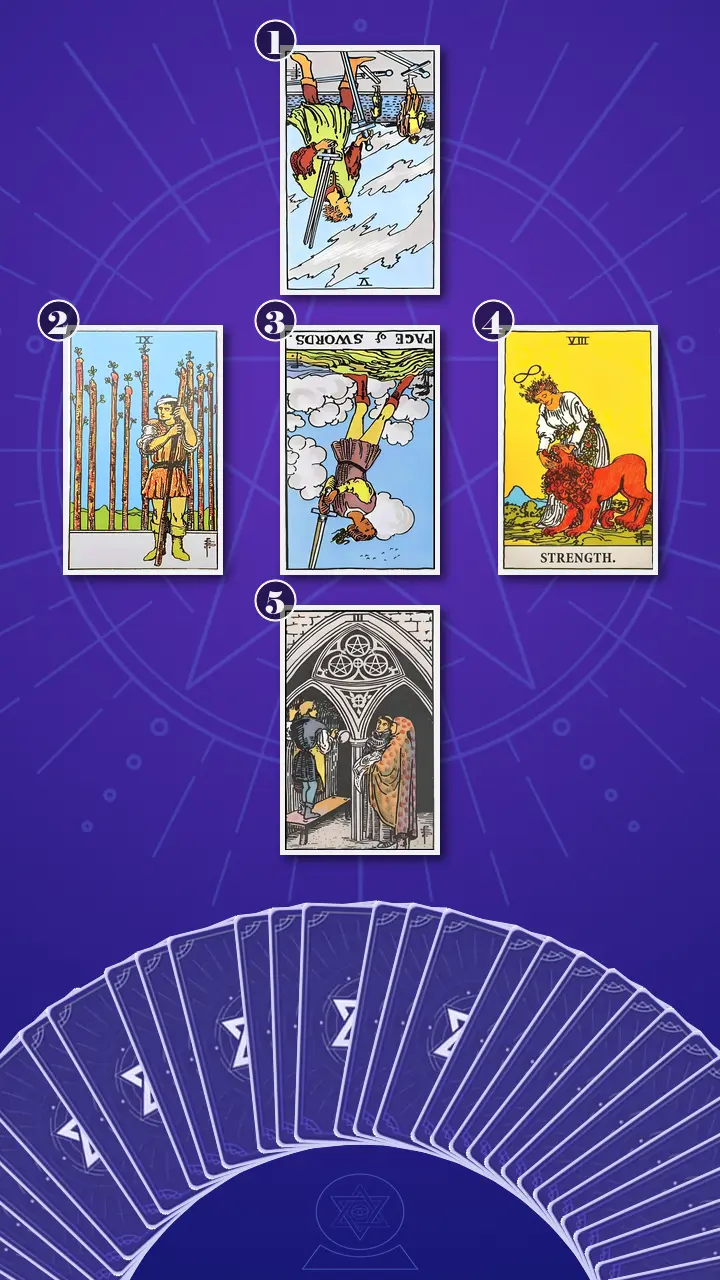
I chose The Shadow Spread · Context Edition, a five-card tarot spread designed to examine the protective psychology behind a repeated pattern. A larger Celtic Cross would have introduced future outcomes and environmental factors we did not need. Jordan’s question was narrower: why did rehearsing comebacks feel necessary even when it kept them unable to leave work conflict at work?
The first position would show where the conflict continued after the meeting. The second would reveal the fear beneath that behavior. The central card would identify the protective job performed by rehearsal. The fourth would offer the quality capable of changing the loop, and the fifth would turn that quality into a bounded workplace practice.
Placed in a cross, the spread resembled a compass whose needle had stopped spinning. I told Jordan that the first three cards would diagnose the loop, while the final two would point toward grounded readiness. The reading would move from symptom to root, from root to defense, and from defense to deliberate action.
Where the Swords Kept Gathering
Position 1: Collecting Replies After Everyone Has Left
The card I turned for the position presenting the visible shadow behavior, where the workplace fight continues through repeated message review, unsent rebuttals, and imagined dialogue, was the Five of Swords, reversed.
I pointed to the foreground figure still gathering swords while two people walked away toward the water. The confrontation in the image was already ending, yet one person remained invested in its weapons. Reversed, the conflict energy had become internalized and blocked. Instead of producing repair or useful accountability, it kept circulating as regret, anger, embarrassment, and the wish for a retroactive victory.
“This is you physically riding home while mentally remaining in the meeting,” I said. “You reopen the transcript, collect sharper sentences, and draft answers to points nobody has raised. One more verbal weapon seems as though it could alter what already happened.”
It was the same fantasy that makes Severance feel so appealing: perhaps work could stay cleanly contained at work. In Jordan’s actual evening, the Slack thread crossed the boundary with them, following the streetcar into the kitchen and turning the commute into a second meeting.
“Which part of the replay is looking for useful accountability,” I asked, “and which part is trying to secure a win after the other person has already left the room?”
Jordan gave one short laugh, but there was no amusement in it. Their thumb pressed into the edge of the phone case. “That’s so accurate it’s almost cruel.”
“I’m not reading this as cruelty in you,” I replied. “I’m locating the moment a protective habit stops protecting. Wanting accountability is valid. Rehearsing every unspoken objection is a different task, and it does not have an ending built into it.”
I suggested a simple distinction: what had actually been said versus what Jordan was preparing to hear. The reversed Five of Swords showed that those two categories had been stored in the same mental file. A perfect comeback could feel like protection while keeping the conflict on Jordan’s calendar.
Position 2: Prepared Is Not Permanently Braced
The next card occupied the position revealing the mechanism beneath the behavior, especially the fear that being unscripted in another conflict would mean losing control. I turned over the Nine of Wands, upright.
The figure wore a bandage, gripped one wand, and looked backward while eight more wands stood like a defensive barrier. This was not a picture of weakness. It was resilience held beyond the moment when it was needed, until endurance had hardened into vigilance.
I connected it to the routine follow-up call Jordan had described. Before anyone said anything difficult, they would place pages of rebuttal notes beside the laptop, open the previous Slack thread, raise their shoulders, and watch the colleague more closely than the shared project document. The last disagreement entered the new meeting through Jordan’s posture.
“You are not only trying to win,” I said. “You are trying to avoid the exposed feeling of being surprised again. The Nine of Wands respects why your guard went up. It also asks whether the guard now treats every check-in as the return of the same battle.”
The card’s Fire was useful as persistence, but in excess it kept Jordan’s nervous energy mobilized without a present opponent. Prepared is not the same as permanently braced. A boundary can stand without requiring the entire body to remain at the meeting-room door.
“If you paused or stumbled in the next conversation, what are you afraid that moment would prove?” I asked.
Jordan looked away from the screen. Their jaw shifted once before they answered. “That I’m not actually as competent as everyone thinks. I’m the person who is supposed to have the words.”
I heard the deeper professional threat beneath the argument. An imperfect response did not merely feel awkward; it seemed capable of overturning Jordan’s identity as prepared and articulate. The rehearsal offered a few minutes of relief because it appeared to restore that identity, even while it made the next conversation feel dangerous before it began.
Position 3: When Slack Becomes a Case Board
The card in the center represented the protective job performed by verbal rehearsal: creating temporary readiness while sustaining workplace hypervigilance and adversarial forecasting. I turned over the Page of Swords, reversed.
The Page held a sword aloft before any opponent was visible. The body twisted one way while the gaze tracked another, and the surrounding trees bent in fast-moving wind. Reversed, useful alertness had become overactive and poorly directed. Attention was plentiful, but reliable information was blocked.
I returned to a Slack message Jordan had shown me: “Can we revisit this?” No emoji. No context. A period at the end. Jordan had read it repeatedly, checked the response time, drafted three answers, and sent a screenshot to friends asking whether the wording sounded deliberately dismissive.
“The Page’s sword is ready before there is a confirmed target,” I said. “You want more reliable information, but the surveillance loop produces more imagined information. Then the quantity of possibilities starts to feel like evidence that a confrontation is coming.”
Jordan’s eyes stayed fixed on the card. Their breathing became shallow enough that I could see the small pause between each rise of their shoulders.
“The sentence underneath this card sounds like: ‘If I can predict the next objection, I will not be caught off guard,’” I continued. “But predicting an objection is not the same as receiving information. It is autocomplete for conflict. The script fills in the next line before the other person has spoken.”
This was the spread’s major blockage. Mental alertness had become a closed surveillance system: imagined objections created material to rehearse, and the existence of all that rehearsal was then mistaken for proof that another fight was imminent. In energy terms, Air was in excess and circulation was blocked. Thought kept generating more thought without contact with current facts.
I also noted that no Cups card had appeared. I did not treat an absent suit as a supernatural warning. I treated it as a useful question. Jordan’s anger, embarrassment, apprehension, and hurt were being translated into arguments before any of those feelings had been named plainly.
“When you say, ‘I don’t want to be blindsided,’ what appears beneath the anger?” I asked.
Jordan’s fingers tightened around the phone, then loosened. Their gaze drifted past the screen as if replaying the original interruption. Finally, they released a breath from low in the chest. “Embarrassment,” they said. “I felt talked over, and then I hated that I couldn’t respond fast enough.”
That answer did not resolve the workplace issue, but it changed the material we were working with. Jordan no longer had only a language puzzle. They had an observable event, an emotional impact, and a need for room to finish a point. Those were elements a real conversation could hold.
When Strength Put Its Hands on the Lion
Position 4: The Skill Beneath the Script
The radiator clicked once in Jordan’s kitchen, and then the call became unusually quiet. I turned the card representing the key transformation from controlling every possible reply to regulating the internal surge and choosing one deliberate response. It was Strength, upright.
The woman in the card met the lion with calm hands at its jaws. She did not attack it, flee from it, or pretend it had no force. The infinity sign above her suggested a capacity that could be practiced repeatedly: remaining in relationship with strong emotion without surrendering authorship of the next action.
In Jordan’s modern workplace scene, Strength appeared in the instant before a cutting reply was typed. Their jaw could still tighten. Anger could still arrive. The balanced energy of this card did not demand silence, submission, or perfect calm. It asked for one pause long enough to name the surge and choose a concise boundary.
Seeing the woman’s steady hands, I remembered the wall of an excavation trench, where a dramatic burn layer once marked a period of upheaval. The layer mattered, but it did not define the whole site. Beneath it, older foundations continued to carry weight.
I used the same principle through one of my central methods, Core Competency Excavation. We dug through the strata of Jordan’s previous roles and difficult meetings to separate durable professional skills from defensive debris. Their foundational competencies were real: documenting accurately, noticing dependencies, synthesizing competing needs, asking precise questions, and setting expectations. Exhaustive rebuttal scripting was not the foundation. It was a temporary fortification built around those skills after conflict.
Jordan had been trapped in the thought that they must make the next conversation go correctly. The more branches they scripted, the more each unscripted possibility felt like a threat. Strength shifted the source of control away from predicting another person and toward retaining access to choice in Jordan’s own body.
Real preparation is not a perfect comeback. It is noticing the surge, choosing one boundary, and speaking without turning the next conversation into another contest.
I allowed the sentence to settle. Then I gave Jordan the message at the center of the reading.
You do not need to win an imaginary fight to protect yourself; choose one grounded response and guide the lion with steady hands instead of meeting force with more force.
For a full beat, Jordan’s breathing stopped. Their fingers remained suspended over the warm phone, and their pupils widened slightly before their gaze lost focus, as if the last week of messages were replaying somewhere behind the screen. Then their fist softened. One shoulder dropped, followed by the other, and their eyes grew pink at the edges.
The release was not clean or simple. After setting down the demand for a perfect script, Jordan looked briefly unmoored, almost dizzy with the responsibility of having a choice. Their mouth tightened again. “But doesn’t that mean I’ve been doing this wrong for years?” they asked, with a flash of anger beneath the tremor in their voice.
“It means a strategy that once gave you a few seconds of control has become too expensive,” I said. “I’m not asking you to condemn the version of yourself that built it. I’m asking whether your current skills can protect you with less collateral damage.”
Jordan inhaled carefully and let the breath out with a quiet, uneven laugh. Their shoulders stayed lower, but their expression held both relief and the vulnerable blankness that can follow a clear insight. The cards had not removed uncertainty. They had made Jordan responsible for a smaller, more workable choice.
“Now, with this new perspective, think back,” I invited. “Was there a moment last week when this insight could have made you feel different?”
“On the streetcar,” Jordan said. “I could have written down that I needed them to stop interrupting me. I didn’t need to invent six ways they might deny doing it.”
That was the first movement from braced agitation and adversarial forecasting toward regulated self-command. We were not moving from anger to passivity. We were moving from an internal courtroom with competing speeches to boundary-first readiness: one observable event, one named impact, and one response Jordan could actually choose.
I reinforced the card with a bounded experiment. Within ten minutes, Jordan could open Notes and record four short lines: what happened, the emotional impact, the unmet need, and one possible request. When the timer ended, they could close the note and decide whether follow-up was needed. If their body became more activated, they could stop or reduce the exercise to one fact and one feeling. The container belonged to Jordan, not the conflict.
Position 5: Returning to the Workbench
The final position translated integration into a daily practice: a timed debrief followed, when needed, by one fact-based request or clarifying question. I turned over the Three of Pentacles, upright.
The card showed a craftsperson standing on a workbench while two collaborators consulted shared plans beneath three pentacles set into the stone. After the distorted Air of the Swords and the defensive Fire of the Nine of Wands, this card brought Earth: structure, observable work, agreed standards, and something concrete enough to discuss.
“This changes the central question,” I said. “Instead of asking, ‘How do I defeat this person’s next argument?’ you can ask, ‘What are we trying to make workable, and what process would help us build it?’”
I translated the imagery into Jordan’s next follow-up. Pages of private rebuttals would become a three-line brief: one observable fact, its impact on the shared work, and one request or open question. Jordan could ask the question before offering a prepared explanation, leaving room to discover what the colleague actually meant.
The card’s upright energy was balanced rather than controlling. It did not guarantee agreement, an apology, or a warm conversation. It gave Jordan a practical structure that remained useful even if the other person responded imperfectly.
“For the last conflict, what could fit on three lines?” I asked.
Jordan opened a fresh note while I waited. I watched them type, delete two defensive clauses, and try again: “I was interrupted twice while giving the timeline. It made ownership of the next steps unclear. Can we agree that each person finishes their update before questions?”
“That is enough to begin,” I said. “Read the facts once; do not turn uncertainty into a second meeting.”
Four Lines to Adjourn the Courtroom
When I read the spread as one story, its logic was direct. The reversed Five of Swords showed the external conflict turning inward. The Nine of Wands revealed the fear underneath: an unscripted moment might expose Jordan as powerless or incompetent. The reversed Page of Swords showed rehearsal performing its protective job by manufacturing readiness, even as it kept attention attached to imagined threats. Strength uncovered the deeper resource, the ability to remain in contact with anger while retaining choice. The Three of Pentacles grounded that self-command in shared facts, work impact, and one discussable request.
Jordan’s cognitive blind spot was the assumption that more mental preparation automatically meant more agency. In practice, the growing script handed more of their evening to the conflict and made the next interaction more defensive. The transformation direction was not toward saying less at any cost. It was from trying to control every possible reply to reviewing the conflict once, naming what mattered, and choosing one boundary or question.
I adapted the logic of my Resume Stratigraphy Review to make that distinction practical. In its usual form, I separate enduring professional assets from job titles that have become obsolete. Here, Jordan and I separated enduring competencies from an obsolete tactic. We kept preparation, documentation, precision, and self-respect. We retired pre-emptive rebuttals, punctuation investigations, and answers to objections nobody had made.
I gave Jordan two next steps. Both were deliberately small, because an experiment should produce information, not become another standard they have to perform perfectly.
- The Ten-Minute Conflict CloseoutAfter the next tense exchange, open Apple Notes or a paper notebook and set a ten-minute timer. Write four headings: what happened, emotional impact, unmet need, and one possible request. When the timer ends, write either “follow-up needed” or “no action tonight,” close the note, and put the phone out of reach for five minutes.Expect the urge to continue editing. That urge is part of the loop, not proof that the debrief is incomplete. Use a two-minute version if ten minutes increases the activation.
- The Fact-Impact-Request BriefBefore the next follow-up, create a three-line Google Doc or notebook entry: one observable fact, its impact on the shared work, and one request or open question. Bring only that note. Ask the question before giving a prepared explanation. If the discussion drifts, return to: “What process would make this easier to handle next time?”Cap drafting at three minutes. One clear question is a complete action even without immediate agreement. For a formal workplace issue, keep appropriate documentation and use the relevant reporting procedure; this exercise is not a substitute.
I reminded Jordan that the goal was not forced calm. Anger could be valid information. The practice was to notice when anger had been assigned the impossible job of predicting and controlling an entire conversation. Strength returned responsibility for the next sentence to Jordan without making them responsible for the colleague’s reaction.

Six Days Later, One Stop at a Time
Six days later, I received a short message from Jordan: “I did the two-minute version because ten felt impossible. One fact, one feeling, one request. Then I closed it.”
In the follow-up meeting, the colleague did not offer a dramatic apology, and the conversation was not magically warm. Jordan asked the open question before explaining their position. The team clarified who would present timeline updates and when questions should be held. That modest process change was enough to make the work more navigable.
On the streetcar home, Jordan delayed reopening Slack until the next stop. The urge remained, but it changed while they watched rain move across the window. For one stop, the commute belonged to them again.
They slept through the night, yet woke with “What if I missed something?” as their first thought. This time, they smiled, put the phone face down, and made coffee before opening Slack.
I did not credit the cards with fixing Jordan’s workplace or choosing their words. The Shadow Spread - Context Edition had made an invisible pattern visible. Jordan supplied the courage, the boundary, the question, and the decision to stop writing when the timer ended. That was the real Journey to Clarity: not certainty about another person, but grounded readiness within oneself.
When a meeting ends but your jaw stays clenched, I know rehearsal can feel like the only barrier between you and being caught without the perfect sentence. Noticing that bargain is already a small release. The internal courtroom no longer gets to call itself your only form of protection.
If one ten-minute debrief could hold the facts, the impact, the unmet need, and one possible request, what might you choose to leave unsaid for tonight?