Calling Others Defensive After Hurt: Learning to Hold Truth and Care

The 11:14 p.m. Case File
'You are the friend people call when they want the unfiltered answer,' I said to Jordan, 'but after someone says your honesty hurt, you open the Notes app and build a line-by-line case for why they are being defensive.'
It was 11:14 p.m. on a Tuesday in their Zone 2 London flat. Jordan sat on the edge of the bed with their phone warm against their palm, the radiator hissing beside them and streetlight leaking through damp blinds. Their jaw ached from holding it tight. They had deleted the softer draft twice and restored the paragraph that proved the original point was accurate.
Jordan worked as a content strategist at a growing technology company, where perceptiveness was part of their professional credibility. Friends often came to them for the direct answer. Yet when a partner, colleague, or friend said, 'That hurt me,' the phrase seemed to set off a fire alarm behind their ribs. They reached for definitions, screenshots, exact wording, and the word defensive before they could ask what had landed badly.
'I keep calling people defensive because saying I hurt them feels harder,' they told me. 'I am not going to lie just to make someone comfortable. But I also do not want to be the person who damages every relationship by calling it honesty.'
I could see the contradiction in their body before they finished speaking: the desire to protect a truthful observation and the fear that acknowledging its impact would make them seem unfair, weak, or untrustworthy. Frustration sat in their jaw like a key turned too far in a lock, while shame and loneliness waited just behind the urge to explain one more time.
I told Jordan that I was not there to decide whether they were a good or bad person, or to make them surrender every fact they believed. I wanted to help them look at the scene closely enough to find a different next act. 'Let us draw a map of this intent-versus-impact conflict,' I said. 'The point is not to hand your life over to the cards. The point is to hand the pen back to you.'

Choosing the Compass: A Five-Card Relationship Spread
I asked Jordan to put both feet on the floor, take one unhurried breath, and hold the question without trying to solve it. I shuffled slowly. The movement was a practical threshold between replaying the argument and observing it, not a supernatural verdict about another person's private mind.
I chose a classic five-card Relationship Spread because it is the smallest structure that can hold both sides of this communication problem and the pattern between them. A decision or timeline spread would move attention away from the feedback loop, while a Celtic Cross would add more layers than this focused question requires. This is how I explain how tarot works in a reading like this: the images give us a disciplined set of questions for examining behaviour, impact, choice, and repair.
The first position would show Jordan's current role and self-presentation, especially the habit of defending factual accuracy and calling the other person defensive. The second would mirror the communicated impact being reported, without claiming certainty about what the other person thinks. The centre would reveal the interaction pattern. Above it, the fourth card would expose the blockage that keeps the cycle under pressure. Below it, the fifth and final card would offer a grounded practice for holding honesty and care together.
I placed the cards in a cross, with the centre as the conversation's table, the upper card as the pressure above it, and the lower card as the way forward. Then I began with the role Jordan knew best: the person who had to prove the point.
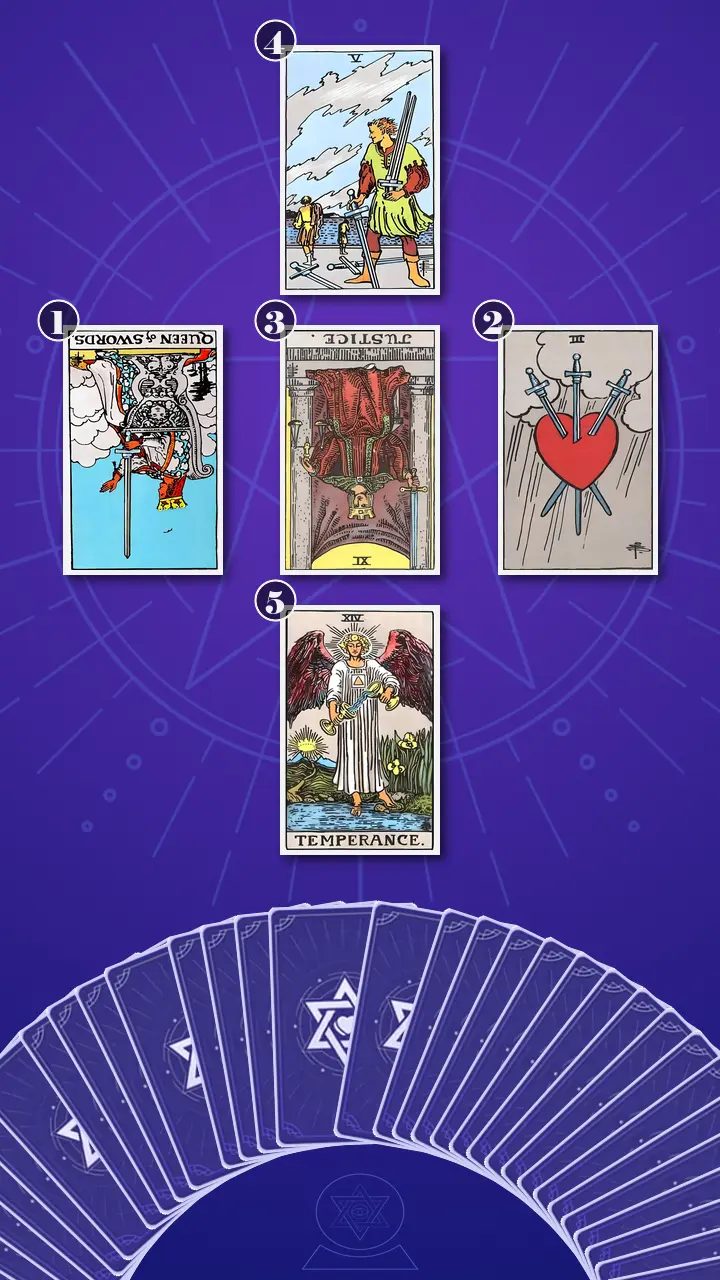
Reading the Map: When Accuracy Becomes Armour
Position 1: The Raised Sword and the Open Hand
Now turned, the first card represented Jordan's current role and self-presentation in the dynamic: the behaviour of defending factual accuracy and calling the other person defensive. The card was the Queen of Swords, in reversed position.
In its clearest form, the Queen of Swords sees sharply and speaks directly. Reversed here, that clarity had become cutting judgment. I connected it to the scene Jordan had just described: after a friend said their comment was hurtful, Jordan opened the Notes app, reconstructed the exchange, highlighted the technically accurate lines, and deleted the draft that began with acknowledgement because it felt too close to surrender. The final message was grammatical, precise, and almost impossible to enter as a conversation.
The raised sword showed an excess of mental control. The extended hand still wanted recognition and connection, but the sword made openness conditional on the other person accepting the verdict first. This was not a sign that directness itself was a character flaw. It showed directness being used as armour, with factual accuracy treated as proof that the delivery must also have been fair.
I thought of the high-pressure exchanges in The Bear, where useful information can arrive with such force and urgency that nobody has enough space to receive it. 'A true point can still arrive as a verdict,' I said. 'Before you add another explanation, ask which part is an observable action, which part is a judgement, and whether the other person has room to hear it.'
Jordan gave a short laugh with no humour in it. Their thumb stopped above the phone, and their mouth tightened before they said, 'That is a little too accurate. I literally deleted the apology because it sounded like I was admitting the whole message was wrong.'
I did not treat the laugh as proof of resistance. I let it be information. The first card was creating recognition without asking Jordan to abandon honesty. It was showing the difference between wanting to be trusted and making trust depend on winning the analysis.
Position 2: The Heart Beneath the Message
Now turned, the second card represented the impact that might be communicated by the other person when Jordan's honesty was experienced as hurtful. It was the Three of Swords, upright.
I was careful with this position. The card could not give me access to another person's unspoken thoughts, and it could not declare that Jordan's underlying observation was false. It made communicated hurt visible as information worth examining. I asked Jordan to read one sentence slowly: 'I am not saying your point was false; I am saying the way you said it hurt.'
The image of the pierced heart made the distinction physical. On a Northern line train, that sentence might remain on a WhatsApp screen while the brakes shrieked, a damp wool coat brushed an arm, and the chest went hollow before the Notes app opened. The swords were the content of the message, but the exposed heart was the lived impact of receiving it in a particular tone, setting, or moment.
'If their hurt is real, does that mean I am wrong?' Jordan asked. Their shoulders rose, and they looked from the card to the dark window as if waiting for the reflection to settle the question.
'Not necessarily,' I said. 'Impact is not a fact-check on intent; it is data about the relationship. You can still disagree about the underlying issue. You do not have to turn their report into a final judgement about your character, and you do not have to turn it into an objection that must be defeated.'
Jordan pressed their palm lightly against their chest. For a moment, the urge to reach for evidence seemed to pause. The Three of Swords was not asking them to accept every interpretation of an exchange. It was asking them to stop treating emotional impact as irrelevant simply because intention had been different.
Position 3: The Tilted Internal Courtroom
Now turned, the third card represented the interaction pattern linking Jordan's honesty, the other person's reported hurt, and the label of defensiveness. It was Justice, in reversed position.
The scales immediately became a practical image. I asked Jordan to picture the private case file they built after conflict: exact quotations, timestamps, screenshots, definitions, and evidence that the original statement had a factual basis. One column was full. Beside it sat a conspicuously blank heading: How it landed.
Justice reversed showed the accuracy-as-fairness filter. Jordan was not necessarily inventing facts. The imbalance came from giving intention and factual correctness full evidentiary weight while leaving out timing, tone, context, public exposure, and the other person's reported experience. The inner courtroom had a rule that sounded reasonable but was quietly one-sided: if the point was true, the delivery must count as fair.
'Calling someone defensive can become your own way of not receiving feedback,' I said. 'It can protect the truth for a few minutes while protecting you from the more vulnerable question: what part of the delivery is mine to address?'
Jordan went quiet. I watched their eyes move as though they were scrolling through a recent argument no one else in the room could see. Their fingers curled around the edge of the chair, then loosened. 'I counted everything that proved I was accurate,' they said, 'but nothing that would make me accountable for delivery.'
I nodded. 'Adding impact to the record does not require agreeing with every interpretation. Responsibility is not total blame. It is identifying the part you can actually change.'
Position 4: The Victory That Ended the Conversation
Now turned, the fourth card represented the central blockage maintaining the cycle: using correctness, argument, or the label of defensiveness to protect belonging and avoid accountability for delivery. It was the Five of Swords, upright.
The card showed a figure gathering swords while two people walked away. I connected it to the Soho pub scene Jordan remembered: a group-chat message saying, 'You did not need to correct me like that in front of everyone.' Jordan had attached a screenshot proving the corrected detail was false, sent a final paragraph that closed every factual loophole, and watched the typing indicator appear and disappear.
'The last word can end more than the argument,' I said. 'The question is not whether you could win the factual exchange. The question is whether your next sentence is meant to clarify or defeat.'
Jordan exhaled through their nose and gave a small, pained smile. They remembered the short burst of relief after sending the final message, followed by the lonely habit of checking the chat again. The card did not demand reconciliation, and it did not say that every relationship had to remain open. It simply showed the cost of making control of the argument the condition for feeling safe.
'I proved the point, so why do I feel more alone?' Jordan said. I let the question stay between us. The two figures walking away mattered more than the swords in the winner's hands. A technically won exchange could still leave the honest relationship Jordan wanted with no shared place to stand.
When Temperance Poured Between Two Cups
Position 5: The Bridge Between Truth and Care
Before I turned the fifth card, the radiator seemed to quiet. The room held the kind of silence that arrives when an explanation is no longer rushing to fill it. This was the card I had marked as the bridge.
Now turned, the fifth card represented the constructive practice that could translate the transformation into a small relational action, allowing honesty, emotional impact, and repair to remain present together. It was Temperance, upright.
The angel poured liquid carefully between two cups, one foot on land and one in water. I read that as a behavioural instruction rather than a demand for softness: regulate the pace, keep one foot grounded in what you observed, and make room for the emotional reality of the exchange without letting either dimension erase the other.
In ordinary life, Temperance looked like putting the phone face down, asking, 'Do you have capacity for direct feedback right now?' naming one visible action without a character verdict, and waiting long enough to hear the response. It looked like saying, 'I still mean the observation, and I can see that my delivery put you on the spot.' Truth and care could occupy the same conversation.
This was where I used my Hero's Journey Alignment. Jordan had not become stuck because they lacked a better argument. They were standing at the classic Refusal of the Call before a character evolution: the call was to stop using the courtroom sword as the only proof of integrity. The next stage did not require silence. It asked them to enter the scene where truth became a shared process.
I also named the limiting narrative through my Vision Actualization lens: the story that insisted Jordan was not ready for the next stage unless every sentence was perfectly defended. I invited them to rewrite it. Their future self was not fake, vague, or endlessly agreeable. Their future self could notice capacity, describe an action, hear impact, repair a delivery, and still hold a difficult observation.
At 11:14 p.m., the Notes app was still open in Jordan's memory, their jaw was tight, and the same explanation was waiting to be edited again: the sentence was accurate, so why did acknowledging its impact feel like surrendering the truth? I let that question rise fully before answering it.
You do not have to choose between blunt accuracy and silence; Temperance asks you to blend truth with care by pouring your words slowly enough for impact to be heard.
Truth does not become less honest when it makes room for timing, delivery, and impact; it becomes something another person can actually meet you inside.
Jordan's breath stopped with their thumb hovering above the phone. Their pupils widened, and their shoulders stayed high as if the body had frozen before the mind could decide what this meant. Then their gaze lost focus. I could see the earlier conversations replaying behind their eyes: the public correction, the partner's pause, the deleted apology, the typing indicator vanishing. Their fingers tightened around the chair. 'But doesn't that mean I was wrong?' they asked, and there was anger in it now, not cruelty but the frightened anger of a rule being removed. A long breath finally moved through their chest. Their grip loosened, their mouth trembled, and their shoulders dropped a fraction. The relief brought a brief lightness, followed by a small, dizzying emptiness. Clarity had given them responsibility as well as room. They looked at the two cups again and whispered, 'I can stay honest without rushing to make my version the only reality in the room.'
'Now use this new view to remember one moment from last week,' I said. 'Where might you have separated observation from judgement, checked readiness, and allowed the reported impact to remain in the room before explaining intent?'
That was the first meaningful movement in the emotional transformation: from courtroom certainty toward curiosity, and from point-winning toward practiced repair. It was not a promise that every conversation would resolve cleanly. It was a choice Jordan could make before the next sentence left their mouth.
Finding Clarity in the Three-Column Audit
When I gathered the spread into one story, I saw a sequence rather than a verdict. The reversed Queen of Swords showed a perceptive communicator turning sharpness into protection. The Three of Swords showed the emotional impact that could no longer be dismissed as a side issue. Justice reversed revealed the hidden rule connecting them: factual accuracy and good intent were being treated as sufficient proof of fairness. The Five of Swords showed the hollow relief of winning while the other person withdrew. Temperance offered the resource already present in Jordan: the ability to notice, distinguish, and communicate carefully when they were willing to slow the pace.
The blind spot was not that Jordan cared too much about truth. It was the assumption that acknowledging impact would cost them truth, credibility, or belonging. The key shift was more precise: before difficult feedback, separate observation from judgement, ask whether the other person has capacity, name the possible impact, and invite their account before defending intent.
I told Jordan that this was the third option between brutal honesty and emotional safety as opposing teams. It was paced relational honesty. A statement could remain factually true and still be delivered in a technically true but relationally damaging way. Repair could address the delivery without retracting the observation. A boundary could end an unsafe or circular conversation without becoming a failure of accountability.
To make the guidance usable, I turned the two cups into a short practice. I also used my Character Bible Directive, a creative visualisation protocol for writing the exact psychological and behavioural specifications of a future self. Jordan did not need to perform a new personality. They needed a few behaviours they could rehearse while the old courtroom reflex was still loud.
- Ask before offering the truthBefore giving one unsolicited opinion to a friend or colleague this week, ask, 'Do you want honesty, support, or a bit of both?' If they have capacity, name one observable action without a character judgement, then ask, 'How is that landing?' and wait through one full breath.Use this for personal, unsolicited, or emotionally loaded feedback. The minimum version is one question before one observation, and the other person can decline.
- Run the Truth-Impact-Responsibility AuditAfter one conflict, open the Notes app for five minutes and write three headings: 'What was true,' 'What impact was reported,' and 'What is mine to address.' Put one observable action under the first heading, use the other person's actual words under the second, and draft a response to the third before explaining your intent.Keep each line to one sentence so the audit does not become another case file. If five minutes feels exposing, write only, 'What part of the delivery was mine?'
- Practise the future self before the next replyWhen your jaw tightens, put both feet on the floor and ask, 'Is my next sentence meant to clarify or defeat?' For the Character Bible Directive, write three behavioural specifications for your future self: asks about capacity, describes actions rather than character, and leaves room for impact. If the answer is defeat, pause the rebuttal for twenty minutes.A pause is not agreement or surrender. You can return, decline, or leave if the exchange becomes insulting, coercive, unsafe, or circular.
These are small steps, not a guarantee of forgiveness or relationship repair. They return choice to the person holding it. Jordan could still disagree with someone's account, protect a boundary, postpone the conversation, or decide that a relationship was not safe to continue. The work was simply to stop making factual victory the only available route to self-respect.

A Week Later: The First Clean Sentence
A week later, Jordan sent me a message before work. They had asked a colleague whether they had capacity for direct feedback, described the three competing claims in the campaign opening, and then listened when the colleague said the previous public wording had felt humiliating. Jordan still believed the brief had a real problem. They also made a repair without drafting a twenty-minute defence.
At 8:06 a.m., Jordan told me they had slept through the night after that conversation. They still woke with, 'What if I handled it wrong?' This time they made tea, left the question open, and did not open Notes to build a case.
I do not call that a solved life. I call it evidence. The tarot reading did not change Jordan's fate, and Temperance did not make the next conversation safe by magic. Jordan noticed the old script, chose a slower rhythm, and wrote the next scene with both cups on the table. That is what the Journey to Clarity looked like: not certainty, but ownership with enough room for curiosity.
If your jaw tightens when someone says your honest words hurt, and you feel the old courtroom assembling behind your eyes, noticing that impact can sit beside truth is already the first place the two cups meet.
If truth and care were allowed to share those two cups instead of competing for the raised sword, what is one observation you might imagine offering more slowly, after checking whether the other person has room for it?