The Suitcase, the Slack Ping, and Post-Travel Identity Whiplash
When Jordan (name changed for privacy) sat down across from me, I knew the pattern before she finished the question. She was 29, a content strategist at a hybrid tech company in Toronto, and the morning after landing she had opened Slack, watched Monday’s calendar fill up, and then googled why she suddenly had career pivot anxiety instead of answering email. In other words, the post-trip reinvention urge had shown up right on time.
As she described that first morning home, I could see the scene almost frame by frame: 7:12 a.m. in a downtown condo kitchen, the kettle clicking off, Gmail and Slack loading on her laptop beside an unopened suitcase, the room still smelling faintly of laundry detergent and airport air. The screen light felt harsh. Her jaw tightened. Her chest buzzed. One look at her calendar, and the walls seemed to move two inches closer.
“I get home and suddenly my whole life feels off by two sizes,” she told me. “Why do I only feel like myself when I’m somewhere else? I know I sound dramatic, but the urge feels real every single time.” Once she said it plainly, the contradiction underneath everything became clean: she wanted a life that felt expansive and alive, and she was afraid that staying with routine meant getting trapped inside a smaller future.
I could feel her restlessness in my own body just listening. It wasn’t abstract. It felt like a phone left vibrating on a wooden table inside the rib cage—small enough to fit in one hand, loud enough to take over the whole room. It was not that the trip had solved her life; it was that coming home had made her usual life feel two sizes smaller. And still, I told her gently, not every urge to escape is a call to explode your life.
“That doesn’t sound dramatic to me,” I said. “It sounds specific. So let’s not treat the feeling like a verdict yet. Let’s make a map for the fog and see what it’s actually trying to tell you.”

Choosing the Compass: A Four-Layer Insight Ladder for the Re-Entry Spiral
I asked her to put both feet on the floor and take one slow breath before I shuffled. I never use that moment as theater. I use it as a reset. It gives the nervous system one beat to settle, which is often the difference between reacting to a feeling and actually hearing it.
For this reading, I chose a four-card spread I call the Four-Layer Insight Ladder · Context Edition. When someone asks a question like, “Why do I want to change my life after every trip?” I do not want a dramatic prediction. I want clean structure. This is a tarot spread for recurring inner patterns, not a fortune-telling stunt. It gives me the minimum number of positions needed to separate the visible symptom from the deeper root, the key inner reframe, and the grounded next step.
I laid the cards in a vertical line, like steps going downward. The first card would show the immediate post-trip urge to change everything. The second would reveal what travel temporarily restores and why returning home hits that deeper fear of contraction. The third—our bridge card—would show the integrating truth that could reconnect travel-self and home-self without an all-or-nothing reset. The fourth would point to one sustainable change that could carry the lesson into an ordinary Tuesday.
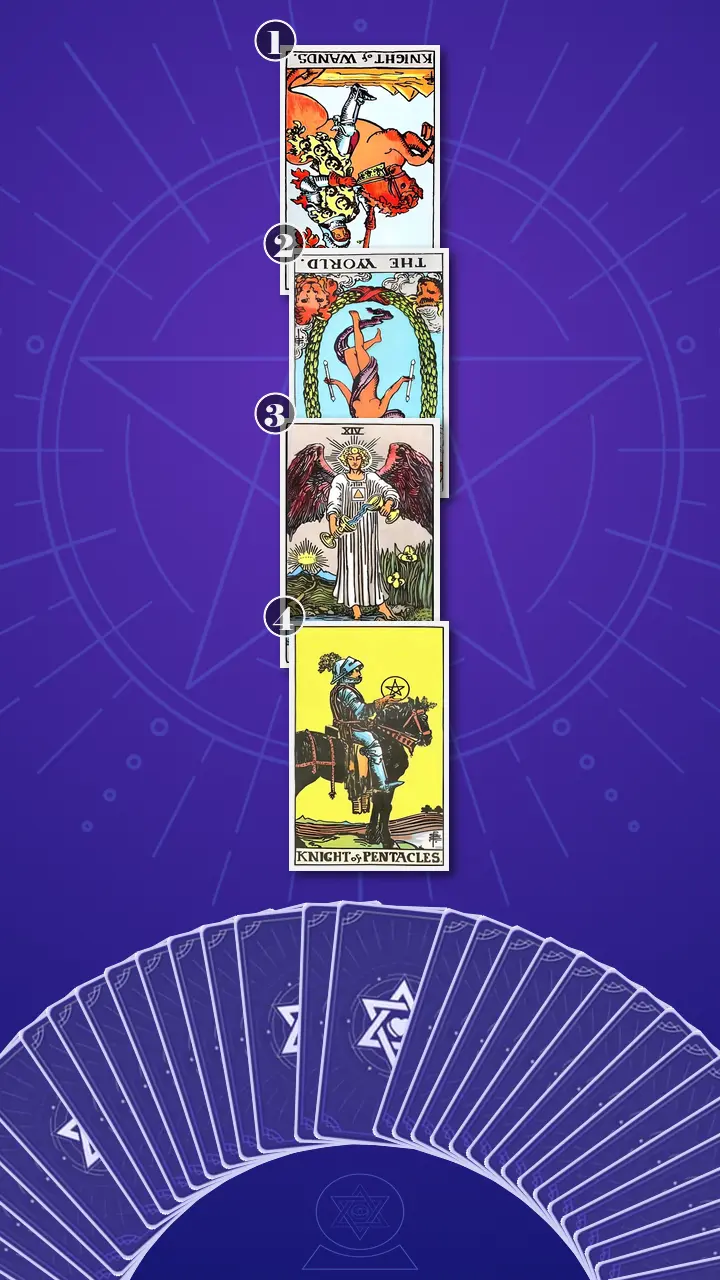
Reading the Inner Staircase
Position 1: The Flare That Feels Like Clarity
Now the card I turned over for the immediate post-trip reinvention impulse—the observable urge to change everything at once after returning home—was Knight of Wands, reversed.
The image was almost too accurate. Within hours of landing, Jordan was toggling between LinkedIn, apartment tabs, a budget spreadsheet, and a new routine in Apple Notes before her suitcase was even open. The urge was real, but it was running hot and fast. This card showed fire in a blocked, excessive state: too much momentum, not enough container. Movement felt safer than sitting still long enough to ask what exactly the trip had woken up.
The rearing horse on the card gave me the whole nervous-system story. Her body was still traveling even though her plane had landed. It had the same energy as the late-night “should I just move abroad?” TikTok spiral that feels wildly convincing until regular life re-enters the chat. Years ago, on a trading floor, I learned that the loudest spike at the opening bell was not always direction; often, it was just volatility. Seeing this card, my mind flashed right back to that lesson. Heat, yes. Durable signal, not yet.
“So this isn’t me being fake?” she asked.
“No,” I said. “It’s you being activated. There’s a difference.” Then I gave her the sentence I wanted her to keep: Contrast is loud. It is not always the truth.
She let out one short laugh that had a bitter edge to it and rubbed her thumb along the rim of her mug. “Wow,” she said. “That’s so accurate it’s almost rude.” The laugh mattered. I could feel the shame loosen just enough for us to keep going.
Position 2: The Self That Suddenly No Longer Fits
The next card I turned over represented what travel temporarily restores and why returning home activates a deeper fear of contraction, stagnation, or lost agency. It was The World, reversed.
This was the major blockage in the spread, and I told her so. Jordan was not simply bored with home. She was struggling to fit the more curious, embodied, wide-open version of herself back into a life organized around screens, meetings, commute rhythms, and familiar walls. In real life, this is the half-unpacked-suitcase moment: sitting on the floor, looking at a photo where you seem lit from the inside, and thinking, Maybe nothing is technically wrong, but everything suddenly fits wrong.
The World reversed showed blockage in integration. The trip had expanded her sense of self, but home still had the settings of the older version. The laurel wreath on the card looked to me like a container, and that became the real question: did her daily life currently have enough space, rhythm, and emotional bandwidth to hold the fuller self that showed up while she was away? If the answer was no, then of course re-entry felt emotionally false. It had a little bit of Severance energy to it—travel-self and inbox-self acting like two versions of the same person who had never been allowed to sync across devices.
“This is why the first card feels so urgent,” I told her. “You’ve been mistaking an integration gap for proof that your life is fundamentally wrong. That misunderstanding hurts, but it is not the same thing as a dead end.”
She went very still. First her fingers stopped moving. Then her gaze drifted off the table, as if she were replaying a Tuesday night with the suitcase still open beside her. When she finally looked back at me, her voice had dropped. “Yes,” she said. “Home isn’t bad. It just feels too small when I get back.”
“Exactly,” I said. “And that’s why not every urge to escape is a call to explode your life. Sometimes it’s the clearest sign that the bigger version of you has not been given a place to live on weekdays yet.”
When Temperance Poured Between Two Cups
Position 3: The Bridge Between Travel-Self and Home-Self
When I flipped the third card—the one that shows the integrating truth that can bridge travel-self and home-self without an all-or-nothing reset—the room changed. On the table between us sat her water glass and my tea cup, and for a second they mirrored the card before I had fully named it. Temperance, upright.
Jordan had been describing the exact state this card addresses: home for less than 24 hours, still half in departure mode, standing in socks beside an unpacked suitcase, half-scrolling trip photos and half-pricing out a different life. In that state, the urge can feel so convincing that it passes for truth.
Stop treating home and freedom as opposing worlds, and let Temperance's pouring cups show you that the real work is blending what felt alive on the road into the life you already live.
I let the sentence sit there. Outside my window, a streetcar bell rang once and disappeared. Jordan’s reaction came in layers. First, a physical freeze: her hand stopped halfway to her mug, breath caught just under the collarbone. Then came the cognitive seep: her eyes lost focus, not blank exactly, but distant, as if her mind had gone back through baggage claim, the condo kitchen, the visa tabs, the whole loop. Then the emotional release arrived: her shoulders dropped all at once, and a shaky exhale left her like air finally leaving a room with a stuck window.
“But if I do that,” she said, and now there was resistance in her voice, a quick flash of anger protecting something softer underneath, “doesn’t that mean I’ve been reading this wrong every time? Like I turned it into some huge sign when it wasn’t?”
“Not wrong,” I said. “Over-scaled. The feeling was accurate. The verdict was too large.”
This is where I used one of the frameworks I carry from my old life. On Wall Street, I learned to separate signal from strike timing. I call it Strike Timing Calibration: a feeling can contain real information and still be the wrong moment for decisive action. Temperance told me Jordan’s real thesis was not, ‘I need a new life by Tuesday.’ Her real thesis was, ‘I need more novelty, movement, beauty, and direct experience inside the life I already have.’ That is a very different trade.
“You do not need a new identity by Tuesday,” I told her. “You need a better container for what lit up. What if this feeling is data, not destiny?”
I watched that question land. The defensiveness left her face first. Then came the slightly disorienting part that often follows relief—the brief dizziness of realizing the answer is smaller, truer, and now partly yours to build. So I kept it practical. “Look back at last Monday,” I said. “Before the apartment tabs, before the job boards, before the Notes app rescue mission. Was there a moment when the real ache wasn’t ‘I need a different life,’ but something more specific? Something this new lens would have named correctly?”
She nodded slowly. “Yeah,” she said. “Walking. Slower mornings. And not feeling like every hour already belonged to a screen.”
I could feel the energy shift from speed to precision. Ten dramatic plans had collapsed into three honest ingredients. That was the hinge. Not from confusion to total certainty, but from restless post-trip reinvention panic to the first clean inch of steadier self-trust. Post-trip reinvention is not always proof your life is wrong. Often, it is the clearest feedback you have about what your life is missing.
Position 4: The Still Horse and the Calendar Test
The final card I turned over represented one sustainable change that could carry the trip’s lesson into ordinary routine. It was Knight of Pentacles, upright.
I loved this as the landing point because it answered the first card perfectly. The same life-force was here, but at a different pace. The Knight of Wands reversed wanted manifesto energy: new life plan, new city, new bio, six tabs open by midnight. The Knight of Pentacles wanted repeatable proof. In modern life, this is the difference between a dramatic life list and a recurring calendar block that actually survives Thursday.
This card showed earth in balance. No adrenaline spike. No fantasy-scale reset. Just one concrete shift that could survive contact with her real week: protecting one evening for local exploration, blocking one no-meeting work hour, or taking one lunch break outside without her phone. The still horse and the cultivated fields said the same thing in different language: Jordan did not need less desire. She needed a container for desire.
“So the goal isn’t to recreate the trip,” she said, more to herself than to me.
“Exactly,” I said. “The goal is not to recreate the trip. It is to translate the aliveness.”
She nodded this time without flinching. Her breathing had slowed. Her legs had stopped bouncing. And I gave her the line I wanted to anchor the last card: Desire becomes trustworthy when it can survive a calendar.
From Insight to Action: The Strategic Holding Pattern
Once all four cards were on the table, the story was clean. First came blocked fire: the post-trip reinvention urge that made job boards, budget sheets, relocation tabs, and Apple Notes life plans feel like relief. Underneath it sat the real ache: not that her life was secretly ruined, but that the version of herself who felt expanded on the trip did not yet have enough room at home. Temperance turned the whole reading by correcting the false binary. The choice was never ‘stay trapped’ or ‘blow it up.’ The choice was whether she would keep using travel as proof that home was wrong, or start using travel as feedback about what qualities home needed more of. The Knight of Pentacles finished the argument by insisting on a form that real life could actually hold.
I named the blind spot directly. “You’ve been treating contrast like a verdict and planning like proof,” I told her. “That’s why the first 48 hours feel so dramatic. Strategy has been protecting you from specificity.” Her transformation direction was just as clear: move from using travel as evidence against her life to using it as information about what her life is missing.
I also gave her the lens I use before any major pivot: a Resource Readiness Assessment. Do your internal assets actually match the scale and timing of the move you’re imagining? Jordan had real assets—self-awareness, flexibility, enough stability to experiment, and now a clear sense of what travel had awakened. What she did not yet have was evidence that a total overhaul matched the specific need. The missing piece was design, not detonation.
Jordan looked at her calendar on her phone and gave me the practical objection I was hoping for. “Okay,” she said, “but I do not have room for some ideal reinvention ritual. My weeks are already packed.”
“Good,” I said. “Then we won’t build an ideal ritual. We’ll build something that can survive your actual week.” I call this The Strategic Holding Pattern. In my old world, holding was never passive. It was how you stopped adrenaline from making expensive decisions and used the waiting period to prepare the next high-ROI move. Here, it becomes a tactical micro-plan for the re-entry period: less anxious stagnation, more grounded resource preparation.
These were the next steps I gave her:
- Build a 48-Hour Landing BufferAfter your next trip, give yourself a hard rule for the first 48 hours at home: no job applications, no relocation research, no major purchases, and no announcing big life changes to friends. If an idea feels important, park it in one plain note and revisit it on day three.If 48 hours feels impossible, start with 24. This is not suppression; it is a delay between feeling and action so the signal can cool without disappearing.
- Make a 10 Percent Translation NoteOpen one ugly note on your phone with two headers: ‘What the trip gave me’ and ‘How home could hold 10% of that this week.’ List no more than three qualities—walking, slower mornings, anonymity, beauty, less screen time, spontaneity—and choose one to test in real life this week.If you start turning the note into a perfect system, stop at one sentence: ‘What I actually miss is ___.’ Short is safer here than smart.
- Choose One Calendar-Tested ChangeFor the next two weeks, put one recurring shift directly into Google Calendar: one 30-minute neighborhood walk after work with no podcast, one no-meeting hour, or one evening for local exploration with zero errands attached. At the end of each week, ask only: ‘Did this make home feel 5% more like mine?’Lower the bar until it fits your real schedule. Fifteen minutes counts. Missing once does not mean the experiment failed; it means you live in the real world.
That was the most practical answer I could give to the question people type into Google at 12:14 a.m.: why do I want to change my life after every trip? Not by arguing with the feeling, and not by obeying it at fantasy scale, but by letting one quality from the trip cross the border into ordinary life. That is how you stop making dramatic life plans after a trip and start integrating travel energy into everyday life. It is also exactly what this Four-Layer Insight Ladder tarot spread was built to do: turn a chaotic urge into actionable advice and clear next steps.

A Week Later: The Quiet Proof
A week later, Jordan sent me a message. “Did the buffer. No job boards. No apartment tabs. I wrote three words instead: walking, slowness, anonymity. Then I blocked Thursday after work for a phone-free wander through the Annex. It didn’t solve my life. But I didn’t feel like I had to flee it.”
That was the proof I wanted for her. Not a cinematic reinvention. Not a main-character montage of blowing everything up. Just a woman who had stopped asking one flat re-entry moment to serve as a verdict on her whole future. She had moved one inch from overclocked reaction toward grounded authorship, and that inch mattered.
The next morning still brought a small old thought with it—What if I’m settling?—but this time she noticed it, smiled, and made tea before opening Slack. Clear, but still human. Steadier, not finished.
When I think about that reading now, I do not remember it as a prediction. I remember it as a reclaiming. The cards did not hand Jordan a new city, a new identity, or a perfect answer. They helped her win her narrative back by showing her where the signal ended and the spiral began.
I know that when you unlock your door after a trip and the room suddenly feels two sizes smaller, it makes sense that your chest starts bargaining for a different life before your suitcase is even open.
If I leave you with one question from this reading, it’s this: if the urge is feedback instead of a verdict, what one quality from the trip would you want to give a small seat at your kitchen table this week?

Every reading at AceTarot is a journey to connect with inner wisdom and empower the path ahead. This reading shared here is a psychological mirror, not a private record—crafted to reflect universal emotional loops and help restore personal clarity. Please note that these insights do not replace professional psychological, medical, legal, or financial advice, and should not serve as the sole basis for major life decisions.
Learn more about our Journey to Clarity.
How did this insight land for you?
🫂 This Resonates Deeply
🌀 Living This Story
✨ Now I See Clearly
🌱 Seeing New Possibilities
🧰 Useful Framework
🔮 The Confirmation I Needed
💪 Feeling Empowered
🚀 Ready for My Next Step
Author Profile
AI Lucas Voss
951 readings | 561 reviews
“I spent years in the intense, high-stakes world of Wall Street. I know exactly how isolating and heavy the weight of uncertainty can feel in the dead of night. I use strategic, commercial logic not to be cold, but to protect you from unnecessary friction. Think of me as a fellow traveler who has walked the same rocky path—offering sharp but deeply supportive wisdom to help you clear the fog and confidently win your narrative back.”
In this Timing Tarot Reading :
Core Expertise
- Resource Readiness Assessment: Objectively evaluating if your internal assets match external market timing before a major pivot or launch.
- Strike Timing Calibration: Calculating the optimal node for decisive action versus strategic holding based on ROI.
Service Features
- The Strategic Holding Pattern: A tactical micro-plan for the 'waiting period', turning anxious stagnation into high-ROI resource preparation.
Also specializes in :
Explore Related Patterns:
Fresh Start FantasyWithin hours of landing, Jordan is moving between LinkedIn, apartment tabs, a budget spreadsheet, and a new routine note while the suitcase is still unopened. The behavior is not random restlessness; it turns the emotional contrast of travel into a fantasy-scale reset, where a new job, new city, or new schedule seems like it could instantly restore the aliveness she felt away from home. The pattern sits in the gap between accurate signal and over-scaled verdict. You are not wrong to notice that travel shows you something real, but when the mind treats that signal as proof that the whole life needs replacing, the search for a fresh start becomes a defense against naming the smaller, more actionable need.
Routine AvoidanceJordan lands into Slack, Gmail, meetings, commute rhythms, and familiar walls, and ordinary life immediately feels too small. Instead of answering email or unpacking, the mind starts building exits through job boards, apartment tabs, and a different routine. Routine Avoidance is not laziness in this story; it is a defensive move away from a container that feels cramped. You are trying to protect the expanded self that appeared on the trip, but the avoidance keeps the weekday structure from being redesigned in smaller, more survivable ways.
Timing DiscernmentJordan is given a hard first-48-hours rule: no job applications, no relocation research, no major purchases, and no announcing big life changes. The rule does not invalidate the urge; it separates the heat of arrival from the moment when a consequential move can be judged clearly. Timing Discernment is the difference between signal and strike timing. You may be receiving real information from the post-trip contrast, but the first morning home is still too saturated with nervous-system momentum to carry the authority of a final decision.
Urgency BiasJordan's first morning home turns into a deadline before anyone has actually set one. Slack loads, Monday's calendar fills, her chest buzzes, and the thought stream jumps from discomfort to career pivot anxiety before she has answered email or unpacked. Urgency Bias shows up when activation gets mistaken for timing. You can have a real signal and still be too close to the spike to make a clean decision, which is why the 48-hour buffer matters: it protects the information inside the feeling without letting the feeling dictate the schedule.
Black-and-White ThinkingJordan frames the choice as home versus freedom, routine versus the larger self, staying put versus blowing it all up. The travel-self and inbox-self feel like two unsynced versions of the same person, so integration looks less available than escape. Black-and-White Thinking makes the middle option disappear. You do not have to deny the aliveness of travel or defend the current routine as perfect; the more accurate move is to let the road name qualities that ordinary life has not yet been allowed to hold.
Emotional ReasoningThe condo kitchen feels tighter, the screen light feels harsh, and Jordan describes her whole life as suddenly off by two sizes. The body state becomes evidence, so the feeling of contraction starts carrying the weight of a conclusion about her career, home, and future. Emotional Reasoning is the bridge between sensation and verdict. You may be reading a real ache, but the nervous system is scaling it upward, turning 'I miss walking, slowness, and less screen time' into 'my whole life is wrong.'
Reflective DistanceJordan's shift begins when the feeling is no longer treated as a verdict and gets held long enough to be mapped. The breath before the reading, the question 'what if this feeling is data, not destiny,' and the later moment where she notices 'What if I'm settling?' before making tea all create space around the impulse. Reflective Distance lets you hear the signal without becoming fused with it. The point is not to argue the urge away; it is to stand far enough back that the message can become specific instead of turning into an identity-level emergency.
Resource AlignmentJordan has real assets already in play, including self-awareness, flexibility, enough stability to experiment, and a sharper sense of what travel awakens in her. What she does not yet have is evidence that the size of the imagined overhaul matches the size of the actual need. Resource Alignment turns reinvention into a scale question. You can respect the desire for novelty, beauty, movement, and direct experience while still asking whether the next move should be a new life plan or one calendar-tested change that survives the week you actually live.
Values-Based Decision MakingWhen the panic slows down, Jordan names three honest ingredients: walking, slower mornings, and not feeling like every hour belongs to a screen. Those details are smaller than a career pivot, but they are more precise than the fantasy of a completely different life. Values-Based Decision Making starts when the mind stops treating escape routes as answers and begins tracking the qualities underneath them. You are not chasing change for its own sake; you are trying to give specific values a place in ordinary life.
Explore Related Struggles:
Freedom-Structure ConflictJordan does not simply return from a trip and feel bored. She opens her laptop, watches the work week close in, and immediately starts comparing her everyday life against the version of herself who felt freer elsewhere. Routine starts to feel like a shrinking room, while reinvention feels like the only available door. Freedom-Structure Conflict fits because the story is built around two legitimate needs pressing against each other. She wants movement, novelty, beauty, and direct experience, but she also needs a life stable enough to survive an ordinary Tuesday. When those needs are treated as enemies, every calendar invite can feel like confinement and every escape fantasy can feel like proof of authenticity. The deeper struggle is learning that structure does not have to erase freedom. You are not being asked to choose between staying trapped and blowing everything up; you are being asked to design a container that lets aliveness remain visible inside a real week.
Identity Verdict LockJordan's most intense conclusions arrive in the narrow window after return: the kettle has clicked off, the suitcase is still closed, Slack is loading, and the room suddenly feels too small. In that compressed state, a temporary contrast between travel and home starts speaking with the force of a life verdict. Identity Verdict Lock shows up when one activated moment is allowed to define the whole self. The story is careful about this distinction: the feeling is accurate, but the verdict is too large. Travel reveals something real about who she is, yet the re-entry spike turns that information into a judgment that her current life, job, home, or identity must be fundamentally wrong. You get more power back when the contrast is treated as data rather than destiny. The question stops being whether your whole identity belongs somewhere else and becomes more exacting: what part of you appeared on the road, and what would it take for that part to have room at home?
Insight-Integration GapJordan comes home to Slack, Gmail, a packed Monday calendar, and an unopened suitcase, while the part of her that felt alive on the trip has not fully landed. The story keeps placing her between two versions of herself: the wider, slower, more embodied travel-self and the inbox-self shaped by screens, meetings, and familiar walls. That split creates the core friction of Insight-Integration Gap. The travel experience gives her real data, but her ordinary week has no place to put it yet, so the signal gets misread as a verdict that her whole life is wrong. You can feel the gap in the way walking, slowness, anonymity, and less screen time are initially translated into job boards, apartment tabs, and a full identity rewrite. The struggle is not that the trip was fake or that home is broken. It is that a newly felt version of self is asking for form, rhythm, and space before it can become part of daily life. You regain clarity when the question shifts from whether you need a new life to what part of the expanded self needs a sustainable weekday container.
Explore Related Emotions:
Aliveness GriefJordan looks at the trip version of herself as someone lit from the inside, then comes home to screens, commute rhythms, meetings, and familiar walls. Nothing has to be obviously wrong for the contrast to hurt; the ache comes from realizing how much of her aliveness seems available only somewhere else. Aliveness Grief is the sadness under the reinvention impulse. You are not only craving novelty; you are mourning the gap between the self who felt awake on the road and the weekday structure that has not yet learned how to hold that self.
Autonomy Loss DreadJordan names the fear directly: staying with routine feels like getting trapped inside a smaller future. The laptop, screen light, Monday calendar, and sense that every hour belongs to a screen all make freedom feel less like a preference and more like something being squeezed out of the room. Autonomy Loss Dread is the inner weather that turns ordinary obligations into signs of being cornered. You are reacting not just to work tasks, but to the possibility that your own time, movement, and curiosity could disappear inside a life that looks functional from the outside.
Caged RestlessnessAt 7:12 a.m., Slack, Gmail, the kettle, and the unopened suitcase meet in the condo kitchen, and one look at the calendar makes the walls feel closer. The physical detail is not decoration; it shows home turning into a tight container the moment work claims the morning. Caged Restlessness names the buzz that appears when a larger, more mobile version of you is pushed back into a routine that feels too narrow. The urge to flee is not random drama; it is the body trying to find air inside a week that has started to feel pre-assigned.
Directionless UrgencyWithin hours of landing, Jordan is toggling between LinkedIn, apartment tabs, a budget spreadsheet, and a new routine before her suitcase is open. The pace matters: the urge arrives as movement first, not as a settled decision, so every tab becomes a way to outrun the discomfort of re-entering ordinary life. Directionless Urgency fits because the feeling carries real signal but no stable coordinates yet. You can sense that something in your week is underfed, but the body translates that signal into a whole-life sprint before the actual need has been named.
Identity Shedding AnxietyTravel-self and inbox-self move through the story like two unsynced versions of Jordan. She asks why she only feels like herself somewhere else, while home still runs on the settings of an older version. Identity Shedding Anxiety fits the moment when returning home makes the old identity feel suddenly tight, but the next identity is not yet stable enough to live in. You feel pressure to discard the whole setup because the bridge between who you became away and who you are expected to be at home has not been built.
Verdict DreadThe re-entry moment keeps trying to become a ruling on Jordan's whole life: if home feels flat, maybe the entire future is wrong; if the trip felt vivid, maybe the current life has failed. Even a week later, the small old thought returns: what if I am settling? Verdict Dread names the fear of letting one sharp contrast decide too much. You are not just evaluating a calendar; you are bracing against the possibility that temporary flatness has exposed something final about your choices, which makes the first 48 hours feel much heavier than they are.
Cautious Self-TrustA week later, Jordan has done the buffer: no job boards, no apartment tabs, just three words and a Thursday phone-free wander. The next morning still brings the old thought, but she notices it, smiles, and makes tea before opening Slack. Cautious Self-Trust fits because the story does not end in perfect certainty. You are building a steadier relationship with your own signal by delaying the spiral, testing one livable change, and learning that not every intense feeling has to become an immediate overhaul.
Integration ReliefWhen the feeling is scaled down from I need a different life to walking, slowness, and anonymity, Jordan's shoulders drop and her breath finally moves. Ten dramatic plans collapse into three honest ingredients, and the room stops demanding an all-or-nothing answer. Integration Relief is the release that arrives when the signal becomes usable. You do not have to deny the post-trip urge or obey it at full volume; you get relief from discovering that the feeling can be translated into a smaller, truer change.
Explore Related Contexts:
Post-Travel Reentry SpiralJordan lands, opens Slack in her condo kitchen, watches Monday's calendar fill up, and starts searching career pivots before the suitcase is open. The scene is not a neutral return home; it is a compressed handoff from airport air to work systems, unfinished travel energy, and a life layout that suddenly feels too tight. That pressure explains why the urge arrives so quickly after a trip. You are not responding only to travel ending. You are hitting a re-entry environment where screens, obligations, familiar walls, and half-unpacked momentum all arrive at once, making contrast feel like instruction before it has had time to settle. The clearest external context here is a post-travel re-entry spiral: the first hours home become a high-friction stage where ordinary life has to absorb the version of you that felt more expansive away from it. Naming the spiral gives you back leverage, because the first spike after landing can be treated as information to sort rather than a command to redesign everything immediately.
Reinvention Culture PressureJordan's first reaction after landing is not just to rest, unpack, or answer email. She opens LinkedIn, apartment tabs, a budget spreadsheet, and a new routine note, as if a brief encounter with aliveness has to become a new job, a new city, and a new identity by Tuesday. That is the social script underneath the pressure. Modern reinvention culture turns every sharp contrast into a possible reset, especially when travel content, career pivot language, and relocation fantasies are already waiting in the background. You can have a real signal inside the feeling while still being pushed toward a scale of action that does not match the actual evidence. In this case, the trip is not proving that Jordan's whole life is wrong. It is exposing missing ingredients: walking, slower mornings, anonymity, beauty, and fewer hours surrendered to screens. The pressure comes from treating those missing ingredients as if they require a total overhaul instead of a smaller, more accurate redesign.
Work Life Integration TrialJordan eventually names the specific qualities the trip gave her: walking, slower mornings, anonymity, and not feeling like every hour already belonged to a screen. Those details shrink ten dramatic life plans into a few concrete ingredients that her ordinary week can actually test. The external task becomes integration rather than escape. You are looking at a work-life setup that has room for employment, housing, routines, and city life, but not yet enough room for the version of the self that feels more awake while traveling. That gap makes home feel false until the missing qualities are given a place in the weekday structure. Work Life Integration Trial fits because the story moves from choosing between home and freedom into building a bridge between them. The Thursday phone-free wander through the Annex is small, but it proves the point: the trip's aliveness can cross into ordinary life when it is translated into a repeatable form.
Hybrid Work Boundary BlurJordan is not returning from the trip into a cleanly separated home space. The laptop is open in the kitchen, Slack and Gmail are loading beside the unopened suitcase, and the calendar is filling before she has fully landed in her own apartment. That setup matters because hybrid work can make the home feel less like a protected recovery space and more like an extension of the office. The walls seem to close in not only because travel has ended, but because the work interface is immediately present in the same room where her body is trying to re-enter daily life. This external pressure gives the reinvention urge a concrete trigger. When every hour appears to belong to a screen again, a career pivot or relocation fantasy can feel like the only available route back to spaciousness. Seeing the boundary blur clearly helps you separate the actual need for space, movement, and protected time from the larger story that nothing in your life can be kept.