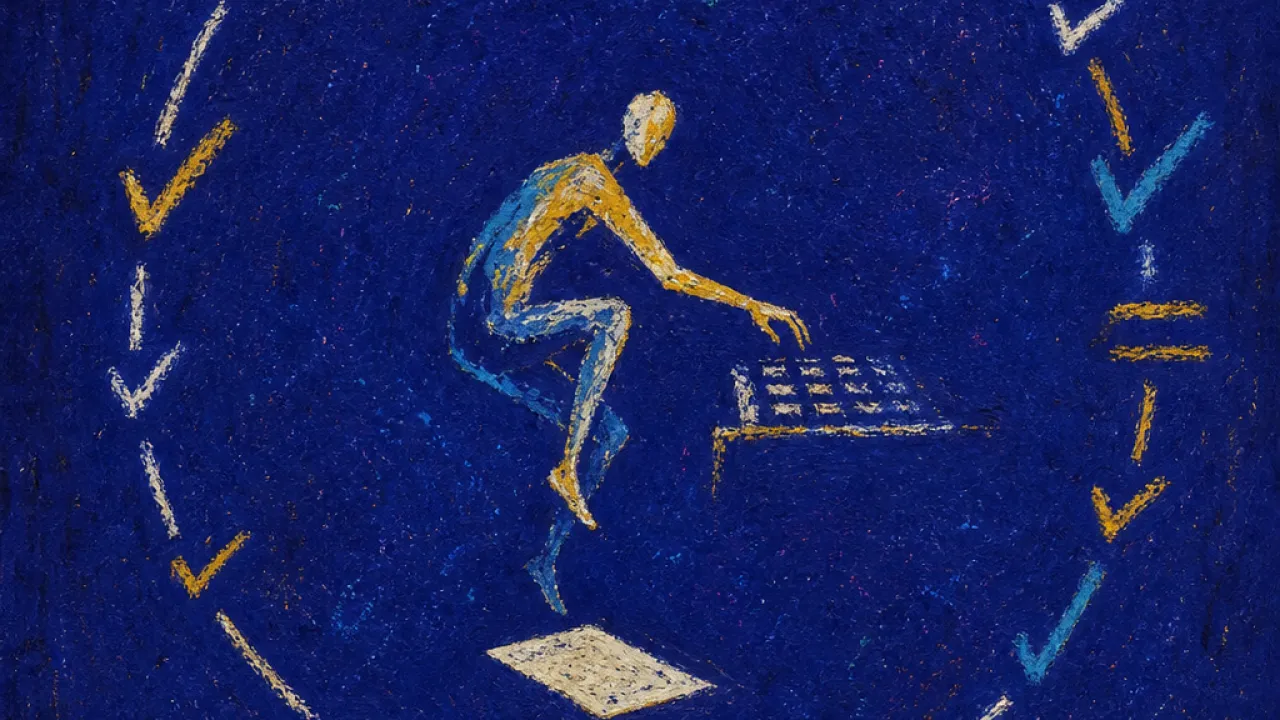
That moment when the document is open, the application is formatted, and your hand still hovers over the first mark is where Perfect Readiness Trap lives. You feel it in tight shoulders, a locked jaw, and shallow breathing while the page stays untouched. From an existential angle, the structural framework is the cost of keeping potential polished so it never has to meet ordinary friction. The Tarot Cards below mirror that held threshold: readiness arranged so carefully that movement keeps waiting.
The World ReversedThe dancer is framed by a perfect wreath, crowned by another wreath, and held in a pose that appears complete before it touches any ordinary ground. In a reversed state, the image becomes a perfected container that keeps demanding one more condition before movement can count as real. That is the academic trap of waiting to feel fully ready before submitting, speaking, applying, choosing a topic, or letting unfinished work be seen. You may keep gathering sources, refining notes, rereading instructions, or polishing the plan because the inner state must feel complete before the outer action is allowed to happen. The card locates the blockage inside the demand for total readiness. It shows how the fantasy of a complete self can become the frame that delays actual academic progress.
Ace of Cups ReversedThe dove, the disc, the cup, and the water column all converge on one precise center. In reversal, that precision hardens into a bottleneck: the moment has to look pure, aligned, confirmed, and emotionally unquestionable before movement feels allowed. You may be waiting for a version of readiness that no real season can provide. The card's symbols do show alignment, but they also show motion, overflow, and exchange; the living process is not frozen into one flawless checkpoint. Perfect Readiness Trap names the timing paralysis that forms when confirmation becomes stricter than the cycle itself. The Ace of Cups places the struggle inside a sacred-looking opening, where the search for total alignment can quietly block the actual passage from receiving to acting.
Seven of Cups ReversedThe cups are prepared as if they contain every necessary future, but none descends into the figure's hands. The raised arm remains in a suspended pre-action state, keeping preparation visually active while contact with real work never begins. You may keep building the perfect reading list, revision setup, or essay plan because the first imperfect sentence would collapse the fantasy of total readiness. The card frames Perfect Readiness Trap as a study field where preparation becomes a safer container than execution.
Nine of Cups ReversedNine cups line up like a completed checklist behind a figure whose crossed arms do not touch any of them. The visual order is impressive, but it also turns readiness into something staged, elevated, and separate from the body's actual capacity to move. In timing work, that arrangement exposes the trap of waiting for every condition to look complete before acting. You may keep scanning for one more sign, one more resource, one more proof that the season is safe enough, while the live window requires a less polished kind of readiness. The cups are full, yet their fullness does not create motion. The card gives shape to the strain of treating perfect preparation as the entry requirement for life, rather than recognizing the moment when enough has already become enough.
Knight of Cups ReversedThe horse is already at the edge of movement, but the rider's grip keeps the cup steady and the pace carefully contained. The river is close enough to demand a decision, yet the whole posture is organized around preserving the vessel before entering the crossing. You can feel this in personal growth when readiness becomes more important than contact with the real threshold. The plan keeps being refined, the mindset keeps being adjusted, and the identity of someone preparing to change becomes safer than the destabilizing act of changing. The reversed structure turns care into delay. The cup stays protected, but the crossing does not happen, and the self begins to mistake controlled approach for transformation.
Queen of Cups UprightThe ornate cup is complete, closed, and treated like something too sacred to use. The Queen's crossed feet and protected island keep the scene calm, but they also keep the body from testing the shore beyond the throne. In personal growth, that visual structure names the point where preparation becomes a protected enclosure. You are not simply waiting because you are lazy; the system is trying to keep your self-image intact until the inner state feels refined enough to survive contact with reality. The trap forms when readiness becomes the condition for movement rather than something built through movement.
ReversedThe chalice is ornate, lidded, and held like a sacred object, with both hands preserving its shape instead of putting it into use. Nothing spills, nothing is tested, and the queen's attention stays on the protected vessel rather than the open water around it. In academic work, that image becomes the pressure to keep an idea pristine until it feels worthy of exposure. The draft must feel clean before it exists, the argument must feel complete before it is written, and the first attempt starts to feel like a threat to the imagined final version. The card ties the trap to reverence. You are not simply delaying; you are guarding the work so carefully that the protective ritual blocks the imperfect contact through which academic work actually becomes real.
Ace of Pentacles UprightThe garden is immaculate, the sky is clear, and the pentacle is held with careful precision before anything has been planted, crossed, or disturbed. The scene carries the seductive pressure of a perfect beginning, where the opportunity looks safest while it is still untouched. Academic work often turns painful at exactly that threshold. A blank document, fresh semester, new notebook, or untouched study plan can feel pure until the first imperfect mark appears. The card witnesses the trap as a clean frame that protects potential by delaying contact with the real material of learning.
ReversedThe thumb can keep pressing the pentacle until stability becomes its own closed system. The grip protects the coin from falling, but the same pressure also prevents the object from being released, planted, or carried through the gate. In its reversed tension, the card shows readiness becoming a substitute for entry. The hand is competent at holding the symbol, yet the garden path below remains untouched because the whole system is organized around preventing the first destabilizing movement. You may keep preparing your growth until preparation feels morally safer than beginning. The struggle is not that you have no discipline; it is that discipline has been redirected into guarding the threshold instead of crossing it.
Three of Pentacles ReversedThe hammer is raised at the edge of impact, and the plan is already present. The scene holds preparation, permission, and a visible destination, but the decisive contact with stone has not yet happened. Perfect Readiness Trap forms when personal growth keeps circling the moment before action. The plan can always become more refined, the identity more coherent, the method more optimized, but the first imperfect strike would expose the work to reality. The card names the trap as a threshold condition. You are not outside the process; you are caught in the part of the process where preparation feels safer than leaving a mark that can be seen, judged, and revised.
Four of Pentacles UprightThe pentacle balanced on the crown makes stillness a condition of safety: one wrong movement and the top piece falls first. The arms and feet reinforce the same instruction, locking the body into a position where keeping everything stable matters more than doing anything with it. In academic pressure, that becomes the threshold where preparation has to feel flawless before a draft, revision, application, or exam attempt can begin. You may call it being responsible, but the structure shows a readiness standard so tight that action itself is treated as the threat.
ReversedThe crown pentacle makes even a small head movement risky, while the feet and hands are already assigned to keeping the other coins in place. The figure's stability depends on a condition that action would immediately disturb. In personal growth, this is the trap of waiting for readiness to feel consequence-free. You are not lacking potential; the card locates the blockage in a readiness standard so delicate that any real test feels like it could make the whole self-image fall.
Seven of Pentacles UprightThe hoe is ready for use, the crop is heavy with pentacles, and the figure still watches rather than completing the next move. Maturity and unfinished growth occupy the same plant, so the scene never gives a perfectly clean signal that action is safe. Perfect Readiness Trap appears in that suspended edge. You keep studying, researching, planning, or revising because every bit of progress reveals another part that could be stronger before you submit, write, speak, or sit the exam. The card's pressure is not laziness or lack of ability. It is the academic bind of treating readiness as something the field must guarantee before you let the work become visible.
Eight of Pentacles UprightThe craftsman bends over one pentacle with hammer and chisel while a clean row of finished coins already hangs beside him. The scene holds completion and incompletion in the same frame: proof of competence is visible, yet the body stays locked around the next small refinement. At a choice point, that posture captures the moment when readiness becomes a moving threshold. You are not simply gathering information; the decision keeps being pushed into one more rehearsal, one more condition, one more proof that choosing will be safe enough.
ReversedThe in-progress pentacle sits under close inspection, small enough to invite endless correction. In the reversed state, the open space around the craftsman collapses into the coin’s surface, and precision begins to consume proportion. Perfect Readiness Trap is the academic struggle where preparation becomes a shelter from evaluation. Notes, outlines, citations, drafts, and revisions keep expanding because submission would move the work from private control into public judgment. The card places that trap in the body’s frozen scale: the hands still work, but the larger academic movement stalls. It witnesses the point where refinement stops serving mastery and starts delaying the moment your work has to leave the bench.
Nine of Pentacles UprightThe right hand rests on the pentacles as if checking the proof of readiness, while the vineyard already shows a cultivated result. The falcon is powerful but hooded, and the elegant stillness of the figure turns preparation into a controlled display rather than an active threshold. You may be reading readiness as a condition that must become visually complete before movement is allowed. Perfect Readiness Trap names the point where timing stops being sensed through the cycle and starts being audited through endless signs that everything is finally safe enough.
Ten of Pentacles ReversedThe archway gives the scene a clear point of passage, yet the figures do not rush through it. They remain inside a complete environment of home, wealth, crest, elder, child, and social recognition, as if movement must wait until every marker of legitimacy is in place. Reversed, that completeness becomes a holding pattern. The staff steadies the standing figure, the crest stabilizes the public image, and the pentacles keep presenting a finished standard that real timing can never fully match. Perfect Readiness Trap appears when preparation stops serving the move and starts replacing it. The card shows the cost of waiting for the entire field to feel complete before taking the next step: the threshold remains visible, but the body keeps rehearsing readiness instead of crossing.
Page of Pentacles UprightThe boots stand on fertile ground, and the mountains wait in the distance, but the Page's body stays arranged around the raised pentacle. His right foot carries the hint of movement while his gaze and hands keep the whole system paused around one object of preparation. This is not empty delay; it is preparation with real devotion, real care, and real intelligence. The problem is that the field is already available while the body keeps asking the coin for one more proof of readiness. Perfect Readiness Trap appears when inner work becomes the condition that must be completed before life can be entered. You keep refining the self that will someday move, while the part of you that could move now is kept waiting in a polished state of almost.
ReversedThe raised pentacle asks for exact focus, and the Page's narrow stance keeps him balanced by holding still. Reversed, that balance becomes a locked preparation posture, with the back foot hovering behind the body while the open ground waits without a chosen route. This is the shape of personal growth that keeps postponing the first imperfect step until the inner signal feels clean enough. The card does not frame readiness as laziness; it shows readiness becoming the condition that prevents contact with the path.
Knight of Pentacles UprightThe Knight sits fully armored on a horse built to travel, yet the horse is planted and the pentacle is held out like a checkpoint before the road begins. The field is open, but the body system has chosen inspection over motion. In academic work, that image locates your freeze at the point where preparation is asked to become exposure. The struggle is not a lack of seriousness; it is a readiness gate that keeps moving farther away every time the essay, exam, or application demands contact with the page.
ReversedThe armored rider, the bridled black horse, and the careful grip around the pentacle form a complete readiness system, but the scene contains no stride. Protection, planning, and capacity are all present, compressed into a posture that keeps checking the terrain instead of entering it. For personal growth, this is the point where preparation stops being support and becomes the enclosure around change. You may be waiting for a cleaner signal, a better system, or a more certain self, while the card shows the body of readiness hardening into the very structure that prevents initiation.
Queen of Pentacles UprightThe pentacle rests fully in the Queen's lap, held by both hands with careful attention, while the fertile ground around her remains untouched by the object she is studying. The garden is already alive, but the resource stays suspended in the space of inspection. Perfect Readiness Trap forms when preparation becomes a beautifully defended threshold. You may keep waiting for the timing to prove itself beyond doubt, but the card shows the cost of holding the seed so perfectly that it never reaches the season that could receive it.
ReversedThe throne's careful carvings, shaded arch, lush ground, and composed body form a complete enclosure around the pentacle. In its reversed state, the preparation system hardens into a seat that keeps the work ceremonially held rather than started. For academic output, that enclosure is the trap of needing the notes, desk, sources, outline, mood, and confidence to feel complete before the first imperfect page can exist. You are not simply delaying; the card shows readiness becoming a structure that absorbs motion before it reaches the draft.
King of Pentacles ReversedThe king already has the castle, armor, throne, crown, scepter, and coin, yet his body remains seated and curved around what has been secured. Preparation is visible everywhere, but none of the symbols has crossed into motion. In a timing question, that density names the moment when readiness becomes its own holding pattern. You are not lacking materials; the struggle is that every extra condition makes the launch point feel more distant, until preparation starts protecting you from the very threshold it was meant to carry you across.
Ace of Swords ReversedThe reversed crown no longer reads as a light end point above the blade. It becomes something the sword must keep carrying, with the branches hanging as extra weight on a tool that was built for movement. Perfect Readiness Trap appears when timing cannot be trusted until every sign looks complete, crowned, and clean. You may wait for certainty, confirmation, and full internal alignment, while the waiting itself consumes the capacity needed to act when the window arrives. The card gives the trap a physical boundary. Readiness has stopped being a launch condition and has become a load suspended on the blade.
Two of Swords ReversedThe woman can keep the swords raised only by turning stillness into strain. In the reversed texture of the card, the posture no longer reads as a temporary pause; it becomes a locked system that protects the appearance of calm while the body pays the cost. Personal growth can take the same shape when preparation becomes the safest identity. You keep waiting for cleaner certainty, better timing, more emotional neutrality, or a more complete plan, but the waiting itself becomes the structure that prevents contact with the next stage. The blindfold matters because the trap can look disciplined from the inside. The card names the moment where readiness stops being a doorway and becomes a closed room built from reasonable conditions.
Four of Swords ReversedThe knight's hands make a complete, careful gesture, but the figure remains sealed inside a posture that cannot begin a task. The sword beneath the slab suggests that reason is present, yet it has been built into the base of the scene instead of drawn into use. In study and research, this is the preparation chamber that starts to feel like proof of readiness. One more reading, one more outline, one more cleaner desk, one more better mental state can become a ritual that protects you from the exposure of producing work. Perfect Readiness Trap names the point where preparation stops serving output and starts replacing it. The card gives that trap a physical shape: a disciplined stillness that looks focused from the outside, while the actual movement into academic visibility remains untouched.
Eight of Swords UprightThe path out of the sword enclosure exists, but it is narrow, muddy, and not fully visible from behind the blindfold. The body stands upright in a temporary restraint, close enough to move yet arranged as if movement must wait for a completely safe opening. In personal growth, that is the trap of treating readiness as a condition that has to arrive before the first step. The card gives shape to the point where preparation becomes another binding, and the wish to avoid a messy beginning keeps the upgrade suspended.
Page of Swords ReversedThe same prepared stance can harden into a brace. The Page's hands stay fixed around the sword while the ground remains uneven, so readiness becomes a way to stay upright rather than a bridge into movement. Perfect Readiness Trap appears when preparation keeps absorbing the energy meant for the crossing. In timing work, the card shows the cost of trying to make the launch point risk-free before letting the moment touch reality. The reversed quality is not simple hesitation. It is a locked pre-action structure where each extra check, rehearsal, and protective adjustment makes the body more prepared in form but less available to the actual window.
Queen of Swords ReversedThe Queen has the sword, the crown, the throne, the clear upper sky, and the boundary hand already in place. The apparatus of decision is complete, yet the body stays seated above the clouds rather than entering the field below. You may be waiting for readiness to become flawless enough to remove risk. The card shows the trap in that demand: preparation becomes a contained structure that protects clarity while quietly preventing the moment of release.
King of Swords UprightThe King has the blade, the crown, the vantage point, and a clear field of sight, but the action remains held at the top of the gesture. The throne offers authority without a visible path down from the mound. This is the shape of readiness becoming a checkpoint that never fully clears. You keep waiting for the moment to certify itself beyond doubt, and the waiting begins to feel more rational than the move itself.
Ace of Wands ReversedThe field is open, green, and visible, yet the wand stays in the hand above it. The image holds readiness as a symbol before it becomes contact with ground, route, or consequence. You meet Perfect Readiness Trap when preparation becomes a suspended state that keeps asking for one more alignment signal. The card shows why the right moment can become a container that never opens: the spark is present, but the body keeps waiting for the terrain to become perfectly certain.
Two of Wands ReversedThe wand is present, the globe is present, the view is present, and the figure still remains on the wall. Every symbol of readiness is assembled, yet the card's physical scene keeps the actual crossing outside the body's motion. Perfect Readiness Trap forms when preparation becomes the safest substitute for contact with the threshold. In personal growth, the next framework, plan, course, or mental rehearsal can feel like progress because it keeps the self organized while delaying the part of growth that would be irreversible. The reversed structure turns readiness into a holding pattern. It does not show a lack of tools; it shows too much authority being given to the moment before action, until the preparation stage becomes a protected identity of its own.
Three of Wands ReversedThe hand on the forward wand can become a brace instead of a launch point, turning the planted staff into a device for staying composed at the edge. The distant ships keep moving, but the figure's authority gathers around posture, planning, and surveillance rather than crossing. For personal growth, the reversed structure names readiness as a closed circuit: preparation keeps proving that you are serious while quietly delaying the moment that would test you. You are not simply waiting for better timing; the card shows timing being used as the last stable ground before exposure.
Four of Wands UprightThe four unheld wands stand in a neat square, stable enough to carry garlands yet still temporary compared with the castle behind them. The image is almost too well arranged: every post is upright, every ribbon has a place, and the visible sign of readiness can become more compelling than the road beyond it. This struggle forms when timing is judged by the fantasy of total setup. You keep waiting for the whole structure to look finished before acting, even though the card's own geography shows that a workable doorway and a completed destination are not the same thing.
Page of Wands ReversedThe Page appears dressed for the role before the journey has visibly begun: feather lifted, garment bright with fire symbols, wand held upright, feet still fixed in the sand. The scene shows readiness as a visible costume and posture, not yet as contact with the road. In a choice reading, that image names the trap of preparing until the decision feels perfectly safe to cross. You may keep gathering signals, refining the plan, and rehearsing the future because each layer of readiness briefly reduces the exposure of choosing. The clear sky and empty desert remove obvious obstacles, which makes the delay harder to explain. The card marks the threshold where preparation has stopped building capacity and started protecting you from the first irreversible step.
No cards available for this filter.