Leaving the Acceptance Email Unsent: From Urgency to One Useful Fact

Finding Clarity in the 8:47 p.m. Jubilee Line Spiral
If you are an early-career project coordinator in London who can build a colour-coded spreadsheet for a new job, then hit Accept before checking the notice period because the offer expires at 5 p.m., you may know career decision fatigue in its most practical form.
Jordan joined my evening video call from the shared kitchen of their Hackney flat. The boiler clicked behind them, and the overhead light turned the tired skin beneath their eyes almost silver. They held their phone face down on the table as though even the dark screen might ask for an answer.
They began with the Jubilee line. At 8:47 p.m., while the automated voice echoed through the carriage and the brakes shrieked against the rails, Jordan had scrolled past former colleagues announcing promotions on LinkedIn. The phone had felt hot in their palm. Their jaw had locked, their breath had climbed into the top of their chest, and every “excited to share” post had seemed to move somebody else one station ahead.
“I started searching for jobs before I even got home,” Jordan told me. “The weird thing is, I don't know whether I want a new role. I just want to feel like I've made progress.”
That admission opened the wider pattern. Jordan had accepted work responsibilities in Slack before checking the project timeline, drafted lease replies before comparing the rent with their Monzo balance, and agreed to relationship steps during emotionally charged conversations before asking what those commitments would mean on an ordinary Tuesday. Their private rule was painfully concise: “I would rather regret a decision than sit inside an unanswered question.”
I watched their thumb rub the edge of the phone. What they called anxiety looked less like simple indecision and more like being trapped in a train that accelerated whenever they reached for the emergency brake: fizzing pressure beneath the ribs, teeth held together too firmly, and an almost physical need to turn an open possibility into a finished fact.
“You want a major commitment that genuinely fits,” I said, “but the moment uncertainty begins to feel like stagnation, almost any final answer feels safer than remaining in the hallway. You are not necessarily confused; you may be using a final answer to make the uncertainty stop.”
Jordan looked down and gave a small, tired nod.
“I won't ask the cards to choose for you,” I continued. “Tarot is most useful here as a mirror, not an authority. Let us give this rush a shape, find what it is protecting, and build a route towards clarity that leaves the decision in your hands.”

Choosing the Four Rungs of the Ladder
I invited Jordan to put both feet on the floor and take three breaths at a pace that did not need to prove anything. I shuffled slowly while they held one question in mind: “Why do I rush major commitments before I feel clear?” The breathing and shuffling were not mystical requirements. They marked a transition from reacting to observing.
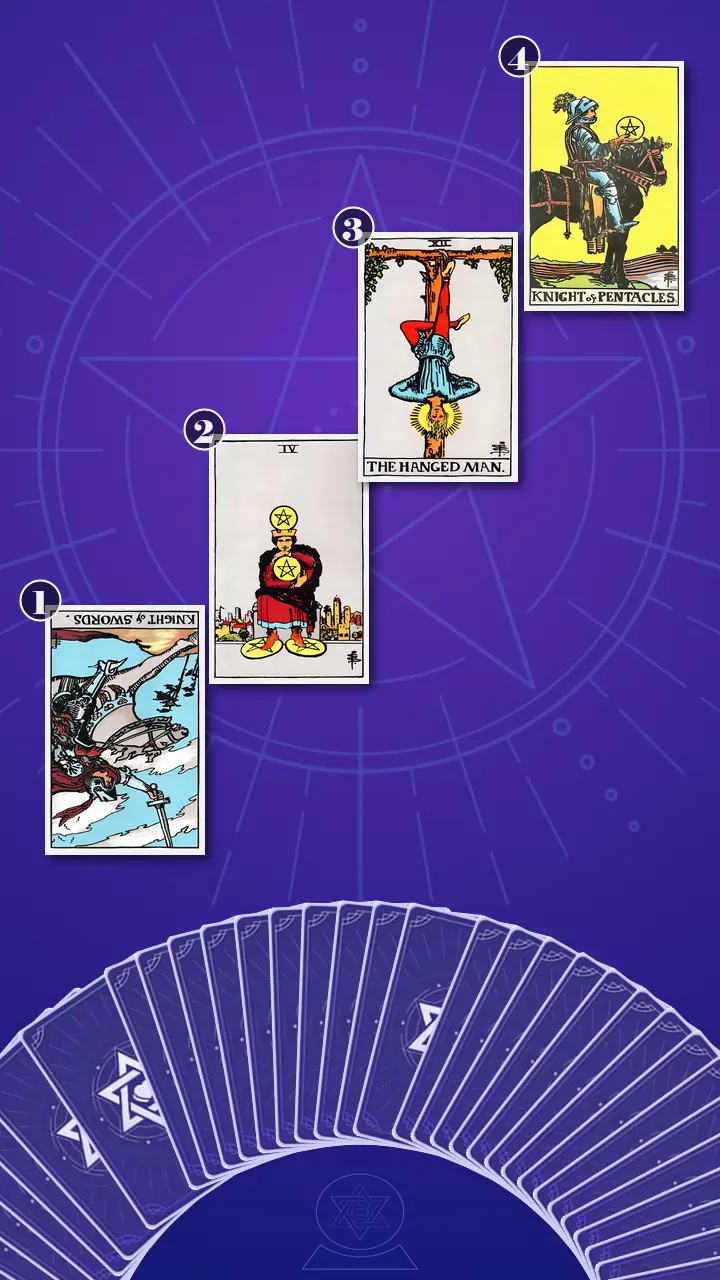
I chose the Four-Layer Insight Ladder · Context Edition. I placed its four cards in a stepped diagonal, beginning at the lower left and rising towards the upper right. This is how tarot works in my practice: the spread provides a structure for examining a pattern, while the card meanings become useful only when tested against lived context, practical facts, consent, and personal limits.
I should explain why this particular reflective tarot spread suited the question. A Past-Present-Future reading would have made the issue too chronological, while a Celtic Cross would have introduced more variables than we needed. Jordan's question required the smallest structure capable of following the complete chain: visible behaviour, hidden protection, transformational perspective, and grounded integration. It was not designed to predict whether Jordan should accept a job, sign a lease, or deepen a relationship. It was designed to show what happened inside them before any of those choices became final.
The first rung would reveal the observable rush towards commitment. The second would uncover the fear and control strategy beneath it. The third, the hinge of the entire reading, would show what belief had to loosen. The final rung would translate insight into one paced, observable next step.
Seen together, the cards would form a climb from frantic forward motion to deliberate movement. I asked Jordan to notice that the ladder did not require them to leap directly to its highest rung.
The Accept Button Beneath the Raised Sword
Position One: The Rush That Masquerades as Confidence
The first card I turned represented Jordan's presenting pattern: the visible way they agreed, signed, announced, or emotionally locked into a major commitment before their reasons and limits were clear. It was the Knight of Swords, in the reversed position.
I pointed to the horse charging through the wind and the sword already raised. In Jordan's modern life, that sword was the acceptance email drafted before the practical questions had been finished. The horse was a warm phone, a short response window, and a finger hovering over Accept while the body was already moving at fight-or-flight speed. The decision became a train: answer now, look confident, and stop the mental noise.
I brought Jordan back to 4:58 p.m. at their office desk. A job-offer notification had arrived while Slack messages stacked up beside a half-finished project plan. The fluorescent lights buzzed, the keyboard was warm beneath their fingers, and the browser tab seemed to demand action simply because it was open. Their inner sentence had been, “If I keep thinking, I will never move anywhere.”
I read the reversal as Excess Air becoming a Blockage. Thought was moving so quickly that it could no longer perform its proper task of distinguishing one fact from another. Speed was not creating clarity; it was carrying action beyond the point where Jordan could still hear their own questions.
“So I want to separate two things,” I said. “What is genuinely time-sensitive, and what is only asking for relief? A short response window may be real. The internal command to make the whole future certain before five o'clock is something else.”
Jordan gave one sharp laugh, then pressed their lips together. “That is so accurate it's almost cruel. I sent the last acceptance email before opening the attachment with the probation terms.”
I let the bitter humour have room without turning it into shame. “The card isn't accusing you of recklessness. It is showing a protection strategy that worked for ten minutes. The calm after a yes can be real without being proof that the yes is right for your life.”
Their hand stopped moving against the phone. For the first time that evening, they left it untouched.
Position Two: The Commitment Asked to Hold Everything
The next card represented the root mechanism: the hidden fear and control strategy that made waiting feel more threatening than committing. I turned the Four of Pentacles, upright.
The figure gripped one pentacle against the chest, pinned two beneath the feet, and balanced another above the head. I saw a full-body attempt to secure emotion, practical life, and identity through one decision. In Jordan's world, the image became a hand tightening around a phone while Monzo, Rightmove, Citymapper, and several friends' opinions competed across the screen.
Jordan was not merely trying to choose a job or a flat. They were asking one commitment to contain every loose part of life. A job offer had to prove they possessed direction. A lease had to provide financial and emotional security. A relationship step had to demonstrate that they were not falling behind. Once the option was locked down, competing possibilities could no longer keep changing the story.
Here, Earth had moved into Excess. The healthy wish for stability had tightened into control. The card did not criticise Jordan for needing security in a city of rising rents and precarious work. It showed that no single signed document could carry the entire weight of safety, identity, progress, and self-worth without distorting the decision.
“If you delayed one of these commitments by a day,” I asked, “what would you fear that delay said about you?”
Jordan's fingers closed around the phone, their eyes shifted towards the dark kitchen window, and then their grip slowly released. “That I don't know how to run my own life,” they said. “Everyone else seems able to choose and move on.”
I recognised the social clock at work. In what I call Social Clock Decoupling, I separate the actual decision from the artificial timetable supplied by colleagues' promotions, friends' engagements, moving-day posts, and every polished announcement that hides the uncertainty preceding it.
“Somebody else's milestone can provide information about their life,” I said. “It cannot create an emergency in yours. A short deadline is not the same thing as an emergency inside your body.”
Jordan drew a breath that reached lower than the earlier ones. Their expression carried recognition, but also grief for how often they had treated another person's timeline as evidence against their own.
When the Hanged Man Stopped the Clock
Position Three: The Answer Held Open on Purpose
The room seemed to quiet as I reached the central hinge of the spread. Even the boiler behind Jordan had stopped clicking. The card representing the transformational perspective, the belief that had to loosen and the new relationship to uncertainty capable of interrupting the cycle, was The Hanged Man, upright.
The figure was suspended by one foot from a living tree, not falling and not fighting the pause. The crossed legs inverted the usual angle, while the calm face and halo suggested awareness rather than defeat. In modern terms, this was the deliberate night when Jordan did not answer, sign, or announce. The phone went face down. Notifications fell quiet. The decision moved into a dated Notion note containing three useful questions instead of expanding into twenty-seven anxious tabs.
I read the card as the restoration of an energy that had been in Deficiency: receptive attention. The Hanged Man did not ask Jordan to abandon action. It asked them to suspend the automatic answer long enough to discover whether they wanted the commitment itself, wanted the relief of closure, or had practical limits that speed was hiding.
Before I explained further, I brought Jordan back to the Jubilee line: the warm phone, the locked jaw, and promotions passing beneath their thumb. They had not only been trying to choose a career direction. They had been trying to make the feeling of being behind disappear before the next stop.
At sixty-seven, I have lived through enough winters to know how easily stillness is mistaken for failure. My family's Highland language for this is Seasonal Energy Diagnostics: sometimes exhaustion and forced decisions come from demanding a spring harvest during a winter dormancy phase. Winter is not an empty season, and the Hanged Man is not an empty card. Both hold life in a form that does not yet need to be publicly visible.
Do not turn urgency into a commitment just to escape uncertainty; suspend the automatic answer and look from a new angle, as The Hanged Man shows that a changed perspective can be more useful than a faster decision.
I left the sentence alone for a few seconds. Then I made it plainer: “You do not need to finalise a major commitment to prove that you are moving forward. Let the pause hold the question, then let one smaller, reversible step show you what is actually true. A slower answer is still an answer in progress. A pause is not proof that you are stuck; sometimes it is the first evidence that the choice belongs to you.”
Jordan's breathing stopped first. Their fingers remained suspended above the phone, as though the message they had been about to send existed between hand and screen. Then their gaze lost focus; I could see them silently replaying earlier offers, announcements, and conversations. Their pupils widened, the muscles along their jaw shifted, and a faint redness gathered around their eyes.
“But doesn't that mean I got all those decisions wrong?” they asked. The words came out with more anger than relief. Their shoulders were still raised, but their hands had opened. Beneath the resistance, I heard the new and uncomfortable responsibility of realising that they could pause without waiting for permission.
“No,” I said. “It means those decisions taught you how strongly your body seeks closure. We don't need to put your past on trial to make your next process more honest. Some of those choices may still fit. Some may need boundaries. The insight is about how you choose, not a verdict on everything you have chosen.”
Jordan exhaled with a slight tremor. Their shoulders lowered, then they blinked at the blank space beside the cards as if the release had left them briefly unsteady. Clarity had removed one burden but revealed another: if urgency was no longer in charge, they would have to listen to their own preference. The vulnerability of that responsibility was visible in the way their open hand rested uncertainly on the table.
“Now, using this new perspective, think back to last week,” I invited. “Was there a moment when this insight could have made you feel different?”
“The job offer,” Jordan said after a pause. “I asked four friends, but I never asked the manager what the first ninety days would actually look like. I could have left the announcement in drafts and asked the one question that mattered.”
We spent ten minutes testing that changed angle. Jordan chose one non-emergency decision, wrote three questions that could genuinely change their answer, switched the phone to Do Not Disturb, and selected one fact to check the following morning. I reminded them that they could stop after two minutes if the exercise became overwhelming. The right to pause included the right to choose how long the pause lasted.
This was the reading's key movement: from urgency-driven closure and fear of stagnation towards paced discernment, grounded self-trust, and conscious commitment. It was not certainty. It was the first experience of uncertainty without immediate surrender to it.
The Still Horse and the One Useful Fact
Position Four: Progress That Can Be Observed
The final card represented grounded integration: one paced, observable action Jordan could test that week so clarity would develop through practice rather than be forced through premature closure. I turned the Knight of Pentacles, upright.
The contrast with the opening Knight was immediate. This horse stood still. The rider held the pentacle level and examined it carefully, while the cultivated field stretched behind them. The stillness did not mean stagnation. It meant the rider was steady enough to notice the ground, the available facts, and the actual cost of the route.
In Jordan's daily life, this was the difference between a dramatic final yes and a grounded test: asking a prospective manager about the first ninety days, walking the commute once, reviewing the lease terms, or scheduling one practical conversation about space, money, and timing. The level pentacle became one piece of evidence examined carefully. Trust could grow from observable follow-through rather than a public promise.
I read this Knight as balanced Earth. Movement remained present, but it had a workable pace. The spread contained no Wands, so I saw no lack of ambition to correct. Jordan did not need more motivational pressure. Their motivation had been recruited by fear; it now needed to serve genuine intention.
“What is one grounded action that would move your current career crossroads forward without pretending every answer is already known?” I asked.
Jordan looked at the three questions they had written. “I can ask what the weekly hours look like in practice, especially during probation. That answer could actually change my decision.”
Their jaw was not completely loose, and I did not expect it to be. But their hand moved towards the notebook instead of the Accept button. The shift was small enough to trust.
From Immediate Relief to Evidence That Fits
The four cards formed one coherent account of why Jordan rushed major commitments. Months of being rewarded at work for speed and visible decisiveness had helped teach their mind that an open question was a performance failure. The reversed Knight of Swords showed that lesson becoming premature action. The Four of Pentacles revealed the deeper attempt to make a commitment secure direction, safety, identity, and control all at once. The Hanged Man interrupted the sprint through the hallway, and the Knight of Pentacles offered a different form of progress: one fact, one boundary, and one reversible movement at a time.
Jordan's cognitive blind spot was not a lack of intelligence or ambition. It was the assumption that immediate relief was evidence of genuine fit, while the discomfort of waiting was evidence of failure. That equation made speed look trustworthy and their own slower judgment look suspect.
The transformation direction was precise: replace the reflex to finalise with a deliberate pause that names the decision, identifies the minimum information needed, and chooses one smaller reversible step. Clarity would no longer need to arrive as a perfect feeling before action. It could be built through paced action, practical evidence, and limits that remained intact.
I considered the full Winter Dormancy Ritual I sometimes use for a blocked goal: one week of consciously doing nothing to force it, with no guilt and no stealth research. Jordan's offer had a genuine response window, so a full week would have ignored reality. I scaled the principle rather than forcing the ritual: one protected night, three questions, and one useful fact. Good guidance must remain accountable to the actual deadline.
- The Three-Question Commitment CheckChoose one non-emergency decision with at least twenty-four hours available. Spend ten minutes in Apple Notes or a Google Doc writing the decision at the top and listing only three questions that could genuinely change your answer. Put the phone on Do Not Disturb, leave any announcement in drafts, and review the page the next morning. Tell one trusted person, “I am gathering the facts, not asking you to decide for me.”Expect the pause to feel like lost momentum at first. That sensation is part of the experiment, not proof that the choice is wrong. If the real deadline is shorter, ask for an extension or request the missing information plainly.
- The Reversible Step TestFor the same decision, open a simple Google Sheet with three columns: What I know, What I need to know, and What I can test without committing. Choose one test that takes less than an hour: ask the manager one direct question, review one contract term, walk the commute once, attend one viewing, or schedule one practical relationship conversation. Set a review point, such as Sunday at 6 p.m.Let one useful fact do more work than twenty anxious tabs. If the test starts growing into another research project, return to the single issue most likely to affect daily life: money, time, capacity, boundaries, or practical fit.
I made one boundary explicit: these practices were not instructions to delay every choice or distrust every quick instinct. Jordan remained free to decide quickly when the facts were sufficient. The experiment simply removed public announcements, artificial deadlines, and other devices that made a choice feel irreversible before it had been consciously made.
“You do not need a permanent answer to take one honest step,” I told them. “The goal is not perfect certainty. The goal is to know that the next movement is yours.”

A Week Later, the Quiet Proof
A week later, Jordan messaged me. They had asked the manager about the first ninety days and sent the question instead of the acceptance. They slept through the night. In the morning, “What if I'm wrong?” still arrived, but it no longer gave the orders.
I did not regard that message as proof that tarot had made the decision. The Four-Layer Insight Ladder had offered a map; Jordan had supplied the honesty, gathered the evidence, and kept their hand on the compass. Their journey to clarity had moved from urgency-driven closure towards grounded self-trust, one unannounced choice at a time.
When an unanswered commitment leaves your chest buzzing and your jaw locked, I know it can feel safer to sign away the question than to risk discovering that moving slowly does not look like control. Yet clarity is sometimes no more dramatic than the moment the noise thins and you can finally hear which question is genuinely yours.
If you gave one unresolved decision the Hanged Man's single unannounced night, what small, reversible Knight of Pentacles fact might you be curious to notice in the morning?