Closing the 'Own the Strategy' Tab—Then Scoring It 5 Out of 6

The 9:40 p.m. Tab That Closed Itself
If you’re a late-twenties operations coordinator in Toronto who can rescue a messy project but closes the tab when a job description says “own the strategy,” you may know the safe-role trap better than you think.
At 9:40 p.m. on a Tuesday, Maya (name changed for privacy) joined my video call from the small kitchen table in her rental. She angled her phone so I could see two glowing job descriptions beside a colour-coded comparison sheet; the laptop fan whirred, the radiator clicked, and her fingers hovered over the trackpad as she highlighted “lead cross-functional strategy.” Then I watched her close that tab and add another familiar coordinator role to her queue.
“I know I can do more, but I keep applying for what I already know,” she said. “I call it being realistic, but it feels like hiding.” She wanted meaningful ownership, not a hustle-culture title for its own sake, yet the moment ownership became visible, predictable competence felt safer than fit.
She told me that the cost usually arrived on Sunday. At 6:18 p.m., standing in the cold wash of a Loblaws produce aisle while scanners beeped ahead of her, she had checked a calendar full of scheduling, documentation, and follow-ups. Her shoulders sank because she knew she would complete everything well—and almost none of it would ask for the judgment she wanted to be hired for.
I could hear frustration in her voice, but it had a physical shape too: it was like pressing an accelerator while the parking brake stayed on, heat gathering beneath her ribs while the same professional scenery remained outside the window. Underneath it sat envy, self-doubt, and the quieter fear that visible struggle might damage the dependable identity she knew how to protect.
“Nothing about this tells me you’re short on ability or discipline,” I told her. “It tells me that effort, security, and fit may have become tangled together. We’re not going to ask the cards to choose a career for you. I’m going to use them as an objective reflection tool, so we can draw a map through the fog and return the decision to the person who actually lives with it: you.”

Choosing the Ladder at a Career Crossroads
I asked Maya to close LinkedIn, place both feet on the floor, and take one slower breath while holding the question, “Why do I keep choosing roles that waste my strengths?” I shuffled at an unhurried pace, using the small ritual as a transition out of comparison mode rather than as a performance of mystery.
I chose the Four-Layer Insight Ladder, a linear four-position RWS career spread. I laid the cards vertically like rungs: the observable pattern at the bottom, the protective root above it, the transformational resource next, and the action horizon at the top.
For anyone wondering how tarot works in a career reading, I chose this spread because Maya was not deciding between two concrete offers. Her question called for inner excavation. A larger Celtic Cross would have introduced more future and environmental positions than we needed, while a conventional decision spread could have implied that one current listing held the answer. The Four-Layer Insight Ladder lets me examine the causal chain without pretending to predict an outcome.
I explained that the first card would show the familiar-role loop as it appeared during an ordinary workweek. The second would reveal what that loop protected. The third—the pivotal card—would identify a different way to evaluate fit. The fourth would turn the insight into one bounded experiment. This is where card meanings in context matter: no symbol would stand apart from Maya’s actual work, finances, body responses, or right to decide.
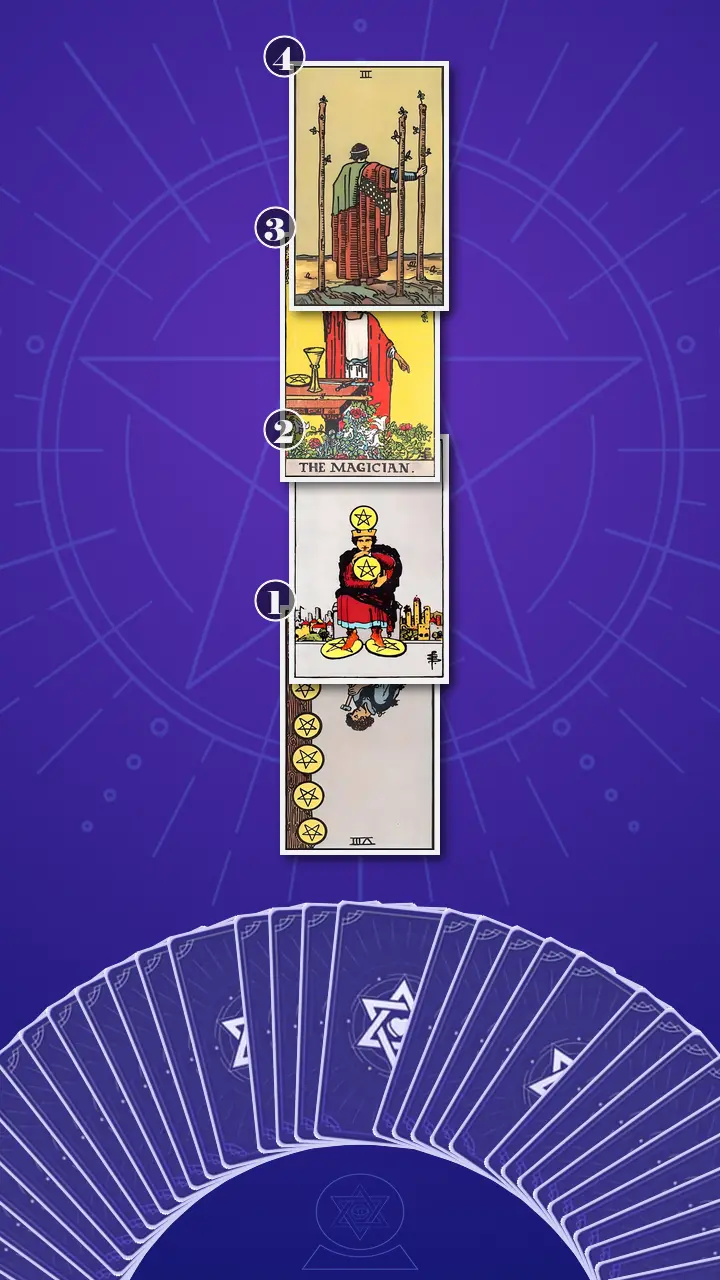
The Hands That Kept Proving the Same Thing
Position One: Eight of Pentacles Reversed and the Respectable Hiding Place
“The card I’m turning now represents the present layer,” I said, “the observable career pattern of applying for familiar execution roles, working hard inside them, and experiencing your wider strengths as underused.”
I revealed the Eight of Pentacles, in reversed position. In the familiar RWS image, the craftsperson bends over one pentacle while a neat row of completed work accumulates nearby. Reversed, the card did not question Maya’s work ethic. It questioned the direction in which that work ethic had been aimed.
I reflected the modern version back to her. I saw the Wednesday she had described near Union Station: after identifying the hidden dependency that rescued a delayed project, she spent the end of the day correcting formulas, labels, handoffs, and formatting in a tracker someone else would present. By 5:30, ten tasks were complete, her coffee was cold, her shoulders felt weighted, and the strategic example she wanted for her portfolio remained untouched.
“This is not a deficiency of effort,” I said. “It’s a blockage in development. Earth energy—work, competence, proof, practical output—has become overconcentrated in repetition. You keep demonstrating that you can execute, but the repetition no longer gives you much new evidence about how you frame problems, exercise judgment, or create direction.”
I wrote one sentence on the page between us: You are not short on effort; your effort has been pointed at work that keeps proving the same thing.
“So the internal script becomes, ‘I am busy proving I can execute while producing no new proof that I can direct,’” I added. “It’s a little like the workplace split in Severance: highly functional inside the assigned role, increasingly disconnected from the part of you that wants authorship.”
Maya gave a short, bitter laugh instead of nodding. “That’s so accurate it’s almost cruel.” Her hand closed around her mug, her eyes dropped to the row of pentacles, and then her grip eased as though she had noticed it happening.
I did not rush to turn the discomfort into motivation. “I’m not calling your coordination work meaningless,” I said. “Repetition can build craft, and dependable execution has real value. The card is asking whether this particular repetition is still developing the strengths you care about—or whether competence has become a professionally acceptable place to avoid being seen learning.”
I asked her to think about the last ten tasks she had completed. “Which ones used a strength you want to be known for? Which developed it? Which simply kept the day moving?” Maya looked toward her comparison sheet and named six tasks that had occupied her resourcefulness, two that had used her systems thinking, and none that had formally developed strategic ownership.
Position Two: The Four of Pentacles and the Safety Contract
“The next card represents the root layer,” I said, “the protective belief and underlying fear that make predictable competence feel safer than testing your strengths under visible responsibility.”
I turned over the Four of Pentacles, upright. The figure held one coin against the chest and pinned two beneath the feet, with the wider city at a distance. I saw the body language before I spoke about the symbolism: a tight grip protecting what was already possessed, and the same grip limiting movement.
I asked Maya to reopen the ambitious listing. Interest returned when she read “own the strategy,” and then I watched her chest rise shallowly. She checked the salary band, scanned every responsibility she could not already prove, and moved the cursor toward the close button. The familiar coordinator posting beside it offered immediate relief because it protected both predictable income and her identity as the person who rarely gets caught unprepared.
“The upright energy here is preservation,” I explained. “Preservation is useful. But in excess, it becomes control so concentrated that nothing new can circulate. The safe role is not a random mistake. It is a protection plan with a growing opportunity cost.”
I reflected the bargain in the words I heard beneath her job-search behaviour: “If I choose familiar work, I may stay underused. If I choose visible ownership, I may lose the proof that I’m competent.”
Maya’s jaw tightened. “Toronto rent is not imaginary,” she said. “I can’t turn my career into a motivational experiment and hope the bills work themselves out.”
“You’re right,” I said. “I would never ask you to treat financial stability as a character flaw. Compensation, benefits, commute, health, privacy, and any other material boundary can remain firm. The question is whether familiarity has quietly been allowed to stand in for all of them.”
I pointed to the tab she had nearly closed. “What certainty would this familiar role buy, and what opportunity would it cost?”
Her breathing paused. Her gaze drifted away from the screen as if she were replaying every shortlist she had made, then she let out a long breath from low in her chest. “It buys protection from being seen learning,” she said. “It costs me the chance to create evidence that I can own something.”
That was the first loosening. I told her the protection was real, but it was not free. I also told her that naming the cost did not obligate her to apply, resign, disclose anything at work, or abandon caution. It simply made the bargain visible enough to negotiate.
When The Magician Put the Real Tools on the Table
Position Three: The Antidote to Proof Before Action
The radiator clicked once and then fell quiet. Beyond Maya’s window, a streetcar bell carried faintly through the night, clean and singular against the traffic. I placed my fingers on the third card, and the room seemed to narrow around the space between us.
“This position represents the transformation layer,” I said. “It shows the resource capable of changing your relationship to that protective root.” I turned over The Magician, upright.
The cup, pentacle, sword, and wand were all visible on the table. One hand reached upward while the other directed energy toward the ground. I explained that The Magician does not begin by auditing what is missing. The card begins with an inventory of available tools and asks how deliberately they are being combined and directed.
For Maya, the modern translation was concrete: a one-page strengths map naming systems thinking, risk judgment, communication, and resourcefulness; one observable example beside each; and a job score based on whether those strengths would be used, developed, and entrusted with meaningful ownership. The role did not have to certify her potential. It had to give real work to tools she could already place on the table.
Energetically, The Magician restored balance. The opening cards had compressed Earth around labour, proof, and security. Here, practical evidence remained present, but it sat beside the Sword’s discernment, the Cup’s values, and the Wand’s initiative. I was not asking Maya to replace evidence with blind confidence. I was inviting her to use a fuller evidence set.
Looking at the four tools, I thought of the sky charts I have worked with for more than a decade. A planet’s path is not defined by one night of cloud, and a life decision should not be handed over to one exhausted hour after work. That professional association led me to one of my most reliable diagnostic lenses: Decision Timing Calibration.
I explained that 9:40 p.m.—after a packed workday, a LinkedIn comparison spiral, and a fresh reminder of Toronto living costs—was not a structurally optimal environment for making a high-stakes career verdict. That did not make the bodily reaction false. It meant the reaction needed context before it was promoted into a conclusion.
Then I used Cyclical Variable Filtering to separate temporary friction from the variables that could affect Maya’s longer professional orbit. The temporary weather included late-night depletion, a former colleague’s promotion post, an intense week, and the reflexive sting of an unfamiliar requirement. The durable variables included her compensation floor, benefits, commute, strengths use, strengths development, decision scope, and appetite for visible learning. The Magician’s table became a filter: keep the facts that govern fit, and stop letting passing weather impersonate destiny.
At 9:40 p.m., the ambitious role was still open beside Maya’s colour-coded sheet. Interest lifted at “own the strategy,” her chest tightened, and the familiar coordinator tab offered relief. I pointed out that this relief had been choosing which evidence her career was allowed to collect.
I gave her the card’s hinge in one line:
Familiarity is not proof of fit; place your real tools on the table and direct them deliberately, as The Magician turns available potential into chosen action.
I let the words sit between us for a few seconds. Then I made their practical consequence even plainer:
Familiarity is not proof of fit. Your strengths stop being wasted when you name the tools already on the table and require your next role to put them to meaningful use.
Maya’s breath stopped for a beat. Her right index finger, which had been tracing the edge of the spreadsheet, froze above the trackpad; her pupils widened, and then her gaze slipped past me as if the previous year were replaying on the dark edge of the screen. Her jaw tightened before her eyes began to shine. “But doesn’t that mean I was wrong every time?” she asked, sharper than before. The anger arrived first, protecting the grief underneath: all those careful applications, all that effort. Then her fist loosened. Her shoulders dropped a centimetre, and she released a shaky breath that sounded almost like a laugh. Relief did not make her instantly certain. It left her briefly unsteady—the small dizziness of setting down a weight and realising her own hand had been holding it. She looked back at the card and said more quietly, “So I don’t need proof of the whole role. I need evidence of my tools.”
“I wouldn’t call your earlier choices wrong,” I replied. “They performed a rational protective function with the information and capacity you had. We’re not putting your past self on trial. We’re noticing that her strategy now produces a cost she no longer wants to pay automatically.”
I invited her to test the insight against real memory. “Now, using this new perspective, think back to last week. Was there a moment when this insight could have made you feel different?”
She returned to the delayed project call. In six minutes, she had identified the dependency problem, reframed the sequence, and given the team a workable decision path. “I treated the updated tracker as the evidence,” she said. “But the judgment that made the tracker useful was the evidence.”
“Exactly,” I said. “Your strengths become career evidence when you name them, direct them, and let the role require them.” I asked her to set a ten-minute timer after our session and write two strengths, one real example of each, and one responsibility she wanted each strength to own next. Six lines, no polished assessment language, no courtroom-level proof. If the exercise felt exposing, she could keep it private, pause, or write only one strength and one example.
I named the change carefully: this was not sudden confidence, and it was not a promise that every ambitious role would fit. It was the first move from proof-driven career avoidance and protective certainty toward grounded agency—an ability to gather evidence with curiosity instead of demanding a verdict on worth before exploration could begin.
The Horizon That Asked for One Small Experiment
Position Four: Three of Wands Upright and the Bounded Field Test
“The last card represents the action layer,” I said, “the grounded next step through which you can test this new way of choosing without making one application carry the weight of a final identity decision.”
I revealed the Three of Wands, upright. The figure stood on firm ground beside three planted wands while ships moved across open water. I read the planted wands as Maya’s legitimate boundaries—salary, benefits, commute, privacy—and the ships as small questions sent outward to return with information.
The modern scenario was not a dramatic resignation. I pictured a Thursday lunch break in which Maya kept her current job and compensation floor intact while sending one fifteen-minute informational interview request to someone whose role included the kind of ownership she wanted to understand. I also saw the option of one bounded stretch assignment or one carefully selected application that scored well for strengths use, development, and ownership.
The energy here was balanced Fire: enough initiative to move beyond private analysis, but supported by Earth rather than severed from it. The card did not ask her to throw away her PRESTO card and leap toward an unknown shore. It asked her to look beyond the TTC stop she always used and collect information about where another route might go.
“The internal frame is, ‘I am collecting information, not announcing a new identity,’” I said. “One stretch application is a field test, not a final verdict on your worth.”
Maya looked at her saved contacts. Her shoulders loosened, and the corner of her mouth lifted with equal parts possibility and nerves. She named a former colleague now working in program operations and said she could ask, “What did you have to learn after you started that you couldn’t prove beforehand?”
I reminded her that the experiment could return any useful answer. She might discover that the role fit, that it did not fit, that the compensation was wrong, or that a different form of ownership suited her better. None of those findings would invalidate her strengths. The point was to widen the evidence available before she chose.
Rewriting the Job-Search Algorithm
I drew the four cards into one coherent line. The reversed Eight of Pentacles showed effort repeating inside work that kept proving dependable execution. The Four of Pentacles revealed why that repetition persisted: familiar scope protected income and a hard-won identity as competent. The Magician changed the selection criterion by naming and directing tools already in use. The Three of Wands moved those tools into limited contact with a wider professional field.
The body language across the cards told the same story: hands bent over repetitive work, arms closing around security, hands consciously directing resources, and finally a figure facing an open horizon from stable ground. I did not see missing talent. I saw a changing relationship between talent, protection, and action.
I described Maya’s old job-search process as a recommendation algorithm trained almost entirely on roles she had already performed. Each familiar application became another click telling the system, “Show me more of this.” When the resulting feed contained only predictable support work, she mistook that narrow dataset for an objective map of her capability. More tabs and more research increased decision fatigue because the same hidden filter remained in charge.
Her cognitive blind spot was painfully logical: she treated a thin portfolio of strategic ownership as proof that she lacked strategic ability, even though repeatedly choosing roles without ownership had helped produce that thin portfolio. The transformation was therefore not “be more ambitious” or “take bigger risks.” It was to move from selecting by immediate familiarity to evaluating opportunities against written evidence of strengths use, strengths development, meaningful ownership, and practical fit.
The Strengths-Use Scorecard and the Orbital Pause
I turned the reading into two pieces of actionable advice. I kept them deliberately small because Maya did not need another beautiful Notion system to maintain. She needed a process simple enough to encounter reality and return information.
- Run the ten-minute Strengths-Use Scorecard.On Tuesday evening at the kitchen table, set a ten-minute phone timer and list the last ten tasks completed at work. Mark each one “uses,” “develops,” or “occupies” a strength. Then name two strengths the next role must use every week—such as systems thinking and risk judgment—and add one recent, observable example beside each. Before judging another job by familiarity, add three columns to the existing comparison sheet: “strengths used,” “strengths developed,” and “meaningful ownership.” Score each from 0 to 2.Stop at one page. If ten tasks feel exhausting, review three. One credible example is enough; this is an information sheet, not a legal defence of your ability.
- Use the 72-hour Orbital Pause, then run one field test.When a promising role triggers either sudden panic or suspiciously quick relief, save it instead of permanently rejecting it for 72 hours. During my Orbital Pause Strategy, separate temporary macro-friction—late-night exhaustion, a LinkedIn comparison spike, a difficult workday—from durable variables such as salary floor, benefits, commute, strengths use, learning, and ownership. By Thursday, if the role respects the practical boundaries and scores at least 4 out of 6, spend no more than 45 minutes on one application, or send one 15-minute informational interview request to a person doing similar work.The pause delays the internal verdict, not a real deadline. If timing is tight, use the available window rather than miss it. The minimum version is drafting a two-sentence message without sending it; no experiment obligates you to accept an offer or leave your job.
I told Maya that staying could also become an intentional choice. If the scorecard showed that her current role fit her priorities, or if a stretch role violated a necessary boundary, “no” could be clarity rather than avoidance. The cards were helping her improve the selection process, not imposing a preferred title, timeline, or definition of success.

A Week Later, the Quiet Proof
Seven days later, I received a message from Maya with a photo of a plain sheet of paper—not a redesigned dashboard. She had written “systems thinking” beside the delayed-launch example and “risk judgment” beside three issues she had caught before they escalated. Beneath them, she had named the responsibility she wanted next: drafting the first recommendation, not merely documenting someone else’s decision.
She had scored the senior operations posting 5 out of 6 while keeping her compensation floor intact. After the Orbital Pause, she spent thirty-eight minutes on the application and sent the former colleague a short informational interview request. The colleague replied yes. Maya had not solved her career, secured a new title, or become immune to self-doubt. She had simply created one new piece of evidence that her old algorithm would never have allowed to exist.
Maya added, “I slept through the night. My first thought in the morning was, ‘What if I’m wrong?’ This time I smiled, made coffee, and left the question unanswered.”
I thought of the four cards as a Journey to Clarity in miniature: repetition noticed, protection understood, tools named, and one ship sent outward. Tarot had not changed Maya’s fate for her. It had made a pattern visible enough for her to change how she gathered evidence—and she remained the only person with the authority to decide what that evidence meant.
If your chest tightens at the words “own the strategy,” it may still feel safer to return to work you know you can ace, even while your shoulders carry the ache of wondering whether the strengths you protected will ever get to count. But the moment you distinguish temporary weather from the variables that shape your longer orbit, you are no longer making the choice entirely inside the fog.
If your next opportunity could be one small field test rather than a verdict on your ability, which real tool from your own Magician’s table would you be curious to let it use?