The Sunday-Night Spiral When Friends Start Leaving the City
If you're 28, paying NYC rent, and one friend's moving announcement can turn your Sunday night into a StreetEasy and LinkedIn spiral before Monday's all-hands, I usually know I'm not looking at a simple moving question. I'm looking at Borrowed Timing.
When Jordan sat down across from me, she already had that look I know well: the look of someone who has done a full hour of research and somehow feels less informed than when she began. She told me about the previous Sunday, 10:16 p.m., cross-legged on her bed in Brooklyn with the streetlight leaking through the blinds, cold takeout still open beside her. The room smelled faintly of soy sauce and old paper napkins. Her phone was warm in her palm as she toggled between StreetEasy, Zillow in Chicago, LinkedIn remote roles, and a camera-roll album from 2021.
"Every time somebody leaves," she said, "I start acting like I need to decide my entire life that night. I can't tell whether I actually want out or I just don't want to be the last one standing."
That was the core contradiction right there: wanting to know if it was truly her time to leave the city, while fearing she was confusing her friends' exits with her own direction. The feeling in her body was even clearer than the words. Disorientation sat in her like a draft on a subway platform inside a hollow chest—cold, echoing, impossible to settle—while her stomach kept fluttering as if a train were arriving and she still didn't know whether it was hers.
I nodded and kept my voice soft. "That makes sense to me. When pressure hits, people often mistake social movement for personal truth. Let's not force an answer tonight. Let's make a map for the fog and see what is actually yours in it."

Choosing the Compass: A Decision Cross Tarot Spread for Stay-or-Go Questions
I asked Jordan to take one slow breath and hold the real question in mind, not the dramatic version of it. Then I shuffled slowly. For me, that moment is never about theater. It's a transition point, a way of getting the nervous system out of the group chat and back into the room.
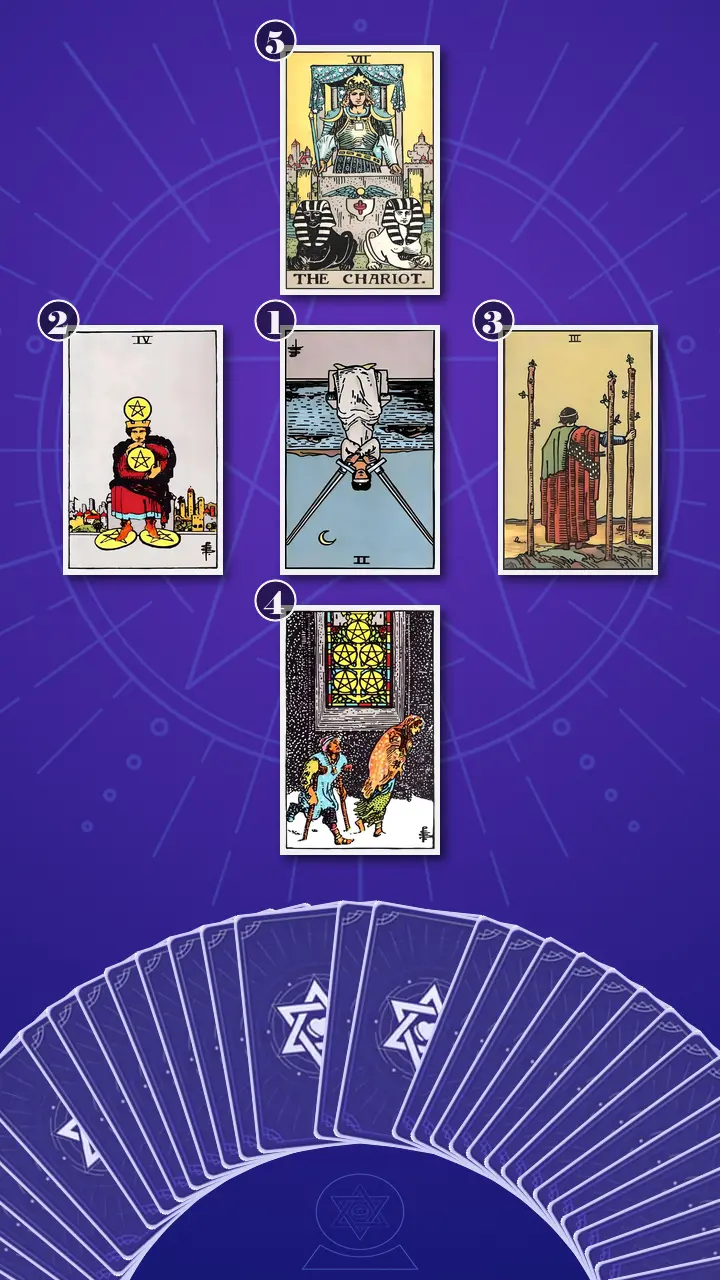
I told her I was using a Decision Cross, a five-card tarot spread for moving decisions that I reach for when someone is stuck between staying and leaving. Tarot works best, in my practice, as a pattern-recognition tool. It doesn't hand down a verdict. It helps me separate symptom from signal, fear from desire, and card meanings only become useful when they are read in context.
This spread fits a stay-or-move crossroads because it is small enough to stay clear but structured enough to hold the real trade-offs. The center card shows the live symptom of the dilemma. The card below uncovers the hidden driver that is making the choice feel heavier than logistics alone. The left and right cards show what staying protects and what leaving opens. The top card becomes the integrating compass—the principle that can help someone choose from self-trust instead of social timing.
So I gave Jordan the roadmap before I turned anything over: first we would look at the visible pattern that keeps sending her into research mode; then we would go underneath it to the belonging wound; then we would compare what the city still genuinely gives her with what another chapter might honestly offer; and finally we would look for the decision test that could return the steering wheel to her hands.
Reading the Map Beneath Borrowed Timing
Position 1: The Tabs That Feel Like a Plan
Now I turned the card representing the concrete symptom: using friends' departures as a cue and getting stuck in comparison-driven indecision.
The card was Two of Swords, reversed.
I felt immediate recognition. This card, in this position, was almost painfully literal. I told Jordan that I could already see the scene: a friend says they're moving, and within minutes she is opening StreetEasy, Zillow in another city, LinkedIn remote jobs, texting two friends, "Would you ever leave?" and then closing everything without choosing one concrete next step. The whole night looks active, but it is really stalled motion—too many tabs, low battery, no route.
In energy terms, this is blocked Air spilling into excess. Thought is overworking because feeling has been benched. The blindfold in the card becomes trying to decide from tabs and opinions instead of direct feeling; the crossed swords over the chest become analysis protecting a heart that has already been hit by grief. I said it to her plainly: "Research can feel practical and still be panic in a blazer."
I asked her, "When was the last time someone else's move sent you into research mode, and what actual next step did you avoid while you were busy thinking about it?"
Jordan let out one short laugh, the kind with a little sting in it. "Okay," she said, rubbing her thumb against the edge of her phone. "That is so accurate it's almost rude." Then she looked back at the card and went quiet. The recognition had landed.
Position 2: What Staying Still Holds
Next I turned the card that reveals what staying in the city is genuinely protecting, beyond habit or fear.
The card was Four of Pentacles, upright.
I told Jordan this was important, because a lot of people moralize their own need for steadiness. They assume that if staying offers relief, it must mean cowardice. But this card didn't read that way to me at all. It showed the known commute, the coffee shop where no explanation is needed, the running route she can do half-asleep, the few close friends still nearby, the budget she understands, and the identity scaffold of knowing how to live here. Staying is not automatically stagnation. Sometimes it is honest regulation.
In energy terms, this is Earth in balance beginning to harden toward excess. There is real stability here, but there is also the risk of gripping so tightly that nothing new can reach her. I pointed to the image in my explanation: the pentacle held at the chest, the feet planted, the city in the background. "This is the tension," I told her. "Being held by a place is different from being trapped by it. The question is whether the routine is supporting you, or whether you're clutching it because low power mode feels safer than uncertainty."
I asked, "If you renewed your lease for another year, what would you honestly be preserving besides fear?"
Her shoulders softened for the first time. "My mornings," she said almost immediately. "My coffee shop. My run. The fact that I know how to do my life here." She looked faintly embarrassed after saying it, and I shook my head. There was nothing embarrassing about good data.
Position 3: The Horizon That Isn't Just Escape
Then I turned the card that reveals what leaving is truly calling toward, apart from borrowed urgency.
The card was Three of Wands, upright.
This shifted the room. I could feel it before I even started speaking. The card did not show a panicked exit. It showed a figure facing the horizon, not bolting from what is behind but surveying what might be ahead. I translated it into Jordan's real life: not midnight apartment doom-research, but those quieter moments at her favorite coffee shop or on a bridge walk when she imagines a life with more room, a different pace, lower rent pressure, more creative bandwidth, a version of adulthood that feels designed rather than auto-renewed.
In energy terms, this is Fire becoming available in a balanced way. It is not frantic. It is directional. I told her, "This matters because not every urge to leave is fake just because some of it is comparison. Part of you really does want expansion. The question is whether you are reacting, or whether you are seeing."
I asked, "If nobody in your circle were moving right now, what about leaving would still feel quietly exciting or relieving to you?"
Jordan stared past me for a second, toward the window where late afternoon light was flattening into gold against the glass. "More space," she said. "A little less intensity. I think I want a life that doesn't feel like I'm negotiating with the city before I've even started the day." Her voice had changed. Less buzzy. More honest.
Position 4: The Lit Window and the Fear of Being Outside
Then I turned the card that reveals the core fear around belonging and being left behind—the part of the question that keeps it emotionally charged.
The card was Five of Pentacles, upright.
This one made the whole spread click into place. I told Jordan that underneath the moving question, I could see the deeper fear: that if everyone else leaves and she stays, the city will stop feeling like a choice and start feeling like proof. Proof that she was less brave, less chosen, less clear, maybe simply easier to leave behind. This is what it looks like when a thinner social season gets misread as a verdict on who you are.
I described the card as I saw it in her life. The lit window was the warmth that still exists—support, community, meaning, even joy—but feels emotionally out of reach when comparison has taken over. The figures in the cold were that Tuesday-evening feeling after a farewell dinner, when the block looks the same but somehow the whole neighborhood feels thinner. The deli lights are too bright. The group chat is full of sublets and jokes and "you have to visit." And suddenly you are outside the venue without a ticket.
In energy terms, this is Earth in deficiency: not a lack of worth, but a scarcity story running too loudly. I said the sentence I wanted her to keep: "A thinner season is not proof you chose wrong." Then I added, "You may not be asking for a new zip code as much as relief from the feeling of being outside the window while everyone else seems to be inside the next chapter."
Jordan went very still. Her breath caught first. Then her eyes shifted away from me as if she were replaying a walk home through her block after one more goodbye dinner. Finally, she exhaled from deep in her chest and pressed her lips together hard. "Yes," she said quietly. "That's the actual fear."
Outside, a siren moved down the avenue and thinned into the distance. Inside, the room felt warmer and sadder at the same time. That is often the moment I know we have left logistics and reached truth.
When The Chariot Spoke Over the Noise
Position 5: The Direction Test
When I reached the final card—the one showing the self-trust and decision criterion needed to choose from personal direction rather than social timing—the atmosphere changed again. Even the radiator's tiny clicks seemed to space themselves out. I have spent ten years listening for where a person's inner rhythm falls out of sync under pressure, and in that pause I could feel Jordan's whole reading gathering toward one clean beat.
The card was The Chariot, upright.
I told her this was the card of self-command, chosen momentum, and directed movement. In modern life, it works like Google Maps: until you enter a destination, every train pulling out of the station can look like yours. The Chariot does not ask whether moving is good or bad. It asks what the movement is for.
This is where I brought in what I call a Tempo Misalignment Audit. I explained that when someone else's goodbye post spikes your psychological BPM, your whole decision process starts running on borrowed rhythm. Your body says, move now, but the message is often coming from comparison, not conviction. With Jordan, I could hear two competing tracks at once: one rhythm wanted stability, one wanted expansion, and every time a friend left, both got louder at the exact same time. The issue was never that she lacked motion. It was that her inner tempo kept syncing to other people's exits instead of her own values.
Jordan had been stuck in the loop I hear so often in late-20s city decisions: if I stay, maybe I failed; if I leave for the wrong reason, maybe I prove I don't know myself. She was trying to make one perfect move that would erase uncertainty altogether.
You do not need to chase the dust from other people's wheels; take the Chariot's reins and move only toward a destination your own values can name.
Other people's exits are not your deadline.
At first, she froze. Her fingers stopped halfway around her paper cup. Then her gaze went unfocused, not in some mystical way, but like someone scrubbing backward through memory: a packed-box Instagram Story, an unanswered lease email, a Sunday night with five tabs open and no actual desire in sight. A flush climbed her neck. "But then what have I been doing?" she asked, and for a second there was a crack of anger in it—not at me, at herself. "Have I just been reacting the whole time?"
I answered her gently, because this is where people can start punishing themselves for coping. "You've been trying to protect belonging with strategy," I said. "That's not stupidity. That's a nervous system using research as relief." I thought of mixing two tracks in a studio: when the beats are misaligned, you do not shame the song. You adjust the timing. That is all. Her jaw unclenched. One shoulder dropped, then the other. And then came the more delicate part of insight—the wobble after release, the almost-dizzy feeling that comes when the pressure lifts and responsibility quietly takes its place.
I asked her, "Using this new lens, can you think of a moment last week when this would have changed how you felt?"
She nodded slowly. "Nina's goodbye post," she said. "I opened Zillow in Chicago. But I didn't actually want Chicago. I wanted relief. I wanted to feel like I wasn't the only one staying."
That was the crossing. Not certainty yet, but something more useful: the first step from borrowed timing and belonging panic into grounded clarity and self-authored direction. I told her, "Clarity gets louder when comparison gets quieter. And this card is asking you to choose from your own ordinary aliveness, not your group chat's momentum."
Choose the Life, Then Test the City
By the time I laid the spread back out for Jordan as one complete story, the architecture was clean. Two of Swords reversed showed the visible symptom: comparison-triggered indecision, the late-night research spiral that looks practical on the surface but keeps her suspended. Four of Pentacles showed that staying protects real things—routine, money predictability, nervous-system steadiness, an identity she can still inhabit. Three of Wands showed that leaving is not only panic; there is genuine desire for expansion and a wider horizon. Five of Pentacles revealed the hidden weight underneath both options: the fear that staying will mean being the one left outside the warmth of everybody else's next chapter. And The Chariot resolved it by shifting the whole question onto a better axis. Not: which city looks like growth? But: which environment supports the life she is actually trying to build?
The blind spot, I told her, was simple and brutal: she had been asking geography to answer a belonging wound. The transformation direction was equally simple: use daily aliveness, real needs, and actual values as the decision test. Choose the life, then test the city.
Because Jordan's rhythm kept getting hijacked by every external departure, I didn't want to hand her a dramatic reinvention plan. I moved into my Execution Rhythm Calibration and gave her my signature Syncopation Reset: a three-day tempo adjustment experiment with small, deliberate beats instead of one big pressure spike.
- Day 1: Build Your “My Decision Test” NoteOn your phone, at your kitchen table or on the train home, set an 8-minute timer and create one note titled “My Decision Test.” Add only three headings: “What gives me energy in a normal week,” “What drains me in a normal week,” and “What I need more of in the next 6 months.” No city names yet, no apartment tabs, no pros-and-cons novel.If your brain starts turning Chicago, Philly, or LA into personality tests, stop at three bullets. The note is a compass, not a verdict.
- Day 2: Interrupt the Trigger-to-Tab ReflexThe next time a goodbye post, lease-ending text, or packed-box Story hits, open Notes before any listing site. Write down the trigger, set a 20-minute timer called “Not choosing yet,” and do one grounding action first: make tea, shower, walk the block, or sit by the window. If you still want to research after that, cap it at 15 minutes and end by writing, “What am I actually looking for right now—relief, belonging, possibility, or information?”If 20 minutes feels absurd, make it 5. The goal is not to ban research. It is to stop urgency from impersonating clarity.
- Day 3: Run a Belonging Before Geography CheckText one nearby person with a low-pressure plan like “Coffee and a 30-minute walk this week?” or go to one current-city ritual you truly love—a coffee shop, bookstore stop, or running route. Right after, write one sentence: “This place supports me by…” Let yourself gather evidence from lived experience instead of from comparison.One text is enough. One local plan is enough. You are not trying to solve your whole social life in a week; you are testing the difference between disconnection and total non-belonging.

A Week Later: The Quiet Proof
Four days later, Jordan messaged me a screenshot of her note. Under “What gives me energy in a normal week,” she had written: morning runs, writing without rushing, nearby friends who don't need a whole production. Under “What drains me,” she wrote: rent dread, social performance, too much transit. Under “What I need more of in the next 6 months,” she wrote: more quiet, lower pressure, more room to think. Then she added, "I still don't know if I'm leaving. But I didn't open Zillow after Mia's post. I made tea, set the timer, and texted a friend to walk instead."
That night, she told me later, she slept all the way through. In the morning the old thought still showed up—What if I get this wrong?—but this time she smiled at it, made coffee, and let the question stay a question. Clear, but still a little tender. That is often the first real proof.
When I think back on her reading, what stays with me is not whether she will stay in NYC forever or book a one-way ticket next season. It is that the cards returned authorship to her. Tarot did not choose the city. It helped her hear her own timing again.
Sometimes the hardest part is not choosing a city. It is feeling your chest drop every time someone else starts packing and wondering whether staying would make you the one who got left behind. If that is where you are tonight, I want you to know that noticing the difference between grief and direction already means you are no longer at the beginning.
If you stopped using other people's exits as your timer for a moment, what small clue from your own daily life—the ritual that steadies you, the pressure that drains you, the ordinary Tuesday that feels more alive—would you want to trust first?
This story is adapted from psychological research, written so that those in a similar struggle can see their own pattern in it — and find their next step clearly.These insights are not a substitute for professional psychological, medical, legal, or financial advice.
Learn more about our Journey to Clarity.
How did this insight land for you?
🫂 This Resonates Deeply
🌀 Living This Story
✨ Now I See Clearly
🌱 Seeing New Possibilities
🧰 Useful Framework
🔮 The Confirmation I Needed
💪 Feeling Empowered
🚀 Ready for My Next Step
Author Profile
 AI
AI“Through ten years of sound energy research, I’ve found that when we struggle, it's usually just our internal rhythm falling out of sync under pressure. I know firsthand the frustrating helplessness of wanting to move forward but feeling paralyzed. Without overwhelming theories, I want to be the soothing background track that helps you recalibrate, turning your heavy burdens back into a light, effortless, and harmonious melody.”
In this Timing Tarot Reading :
Core Expertise
- Tempo Misalignment Audit: Decoding the feeling of 'pushing against a wall' as a fundamental disruption in your psychological and executive BPM.
- Execution Rhythm Calibration: Identifying the specific friction points where your ambition is out of sync with your daily capacity.
Service Features
- The Syncopation Reset: A 3-day tempo adjustment experiment, breaking a forced routine into smaller, harmonious beats to restore effortless momentum.
Also specializes in :
Explore Related Patterns:
Comparison TrapJordan's question is built around comparison before it is built around logistics. She is not only asking whether New York still fits; she is asking whether her friends' exits reveal something she should already know about her own life. Comparison Trap fits because the external reference point keeps becoming louder than her internal signal. When other people leave, their movement activates both tracks inside her: the part that wants stability and the part that wants expansion. Instead of letting those parts speak in her own timing, she starts measuring herself against the apparent momentum of the group. The useful nuance is that comparison is not treated as meaningless. Her friends leaving does reveal a real shift in her social environment, and it helps surface desires she may have been ignoring. The trap begins when their choices become the main evidence, and her own ordinary aliveness becomes secondary.
Exclusion SpiralJordan's fear becomes most visible after the farewell dinners and goodbye posts, when the same neighborhood suddenly feels thinner. The city has not objectively rejected her, but the emotional scene changes: the lit window of other people's next chapters feels warm, and she feels outside it. Exclusion Spiral fits because the mind starts converting a social transition into a self-worth verdict. Friends leaving becomes evidence that she might be less brave, less chosen, less clear, or easier to leave behind. That is a cognitive distortion with a relational charge: the fact of separation gets pulled into a story about personal inadequacy. The pattern matters because it explains why the moving question feels heavier than logistics. You are not just comparing rents or cities when this spiral is active; You are trying to escape the feeling of being outside the room where everyone else's life is happening. Naming that mechanism returns the problem to its real scale: a belonging wound needs belonging data, not only a new zip code.
Outsourced Self-SoothingJordan reaches for external systems the moment the belonging fear spikes: apartment listings, remote job searches, other cities, old photos, and other people's opinions. These tools look practical, but the story shows they are also being used to regulate a surge of uncertainty. Outsourced Self-Soothing fits because the relief is being delegated to the outside world before she has checked in with her own body and values. The line “I wanted relief. I wanted to feel like I wasn't the only one staying” makes the mechanism explicit. Chicago was not the desire in that moment; Chicago was a container for the wish to stop feeling left behind. This is not a character flaw. It is a coping strategy that has become imprecise. For You, the audit is whether the next search, poll, or fantasy city is helping You gather information, or whether it is being asked to soothe a wound that needs direct contact, community, and self-authored direction.
Social Clock ComplianceJordan's first cue is not an internal desire but somebody else's moving announcement: one friend's exit is enough to send her into listings, job searches, old photos, and social checking. That sequence shows how quickly another person's life update becomes a timer inside her own nervous system. Social Clock Compliance fits because the pressure is not only about geography. It is about the hidden belief that other people's departures might define the correct pace for her own adulthood. You can see the mechanism in her sentence, “I can't tell whether I actually want out or I just don't want to be the last one standing.” The decision starts to organize around not falling behind rather than around what kind of life she is trying to build. The pattern becomes clearest when the reading separates social timing from self-trust. Other people's exits are real data about change in her environment, but they are not proof that her deadline has arrived. The psychological work is learning to notice the difference between a borrowed countdown and a value-based signal from inside her own life.
Urgency BiasJordan's body reacts to a friend's departure as if the decision has to be made that night. The story gives the timing with almost forensic precision: Sunday, 10:16 p.m., cold takeout open, phone warm in her palm, multiple tabs pulling her into a false emergency before Monday has even started. Urgency Bias fits because the pressure of the moment starts impersonating evidence. A goodbye post, lease-ending text, or packed-box Story becomes a cue to act now, even though the real question requires slower data from routine, energy, values, and lived experience. Her nervous system reads social movement as a deadline, then treats immediate research as the only way to get safe again. The deeper mechanism is that urgency narrows the field. It makes staying feel like failure and leaving feel like the only way to avoid being left behind, even when neither conclusion has been tested. For You, the pattern to watch is the split second when speed starts feeling like truth, because that is often where borrowed timing enters the decision.
Analysis ParalysisJordan's Sunday night looks busy from the outside: StreetEasy, Zillow in Chicago, LinkedIn remote roles, old camera-roll photos, and texts to friends all open in the same emotional weather system. But the story keeps emphasizing that the motion does not produce a concrete next step. She closes the tabs with more stimulation, not more direction. Analysis Paralysis fits because thinking is being used as a defense against feeling. The research gives her a temporary sense of control, but it also protects her from the grief, uncertainty, and belonging fear underneath the move-or-stay question. The more tabs she opens, the less contact she has with the simpler question: what do I actually want when nobody else's timeline is pressuring me? This pattern does not mean information is useless. It means information has started doing emotional labor it cannot perform. For You, the key audit point is whether research is clarifying a next action or keeping You suspended in a loop that feels responsible while quietly avoiding a decision test.
Comfort Zone AttachmentJordan's reasons for staying are concrete and embodied: her mornings, her coffee shop, her run, the fact that she knows how to do her life here. The story refuses to flatten those attachments into cowardice, because they are real nervous-system supports. Comfort Zone Attachment fits because the familiar city is doing psychological work. It provides predictability, identity scaffolding, and regulation in a life stage where the social map is changing fast. The pattern is not automatically unhealthy; in its more adaptive form, it helps You recognize which routines genuinely hold You together. The tension appears when support begins to harden into gripping. Jordan has to ask whether the routine is preserving a life that still feels alive or whether it is protecting her from uncertainty. That distinction is the heart of the pattern: comfort can be a base for clear choice, or it can become a substitute for choosing.
Values-Based Decision MakingJordan's clarity starts to return when the question moves away from city names and toward lived criteria: what gives her energy, what drains her, and what she needs more of in the next six months. That shift matters because it replaces social comparison with observable data from her own life. Values-Based Decision Making fits because the story's turning point is not a verdict about staying or leaving. It is a change in decision architecture. Instead of asking whether New York, Chicago, Philly, or LA proves something about her identity, she begins asking which environment supports writing without rushing, lower pressure, more quiet, real connection, and room to think. This pattern is the constructive counterweight to borrowed timing. For You, it means a move becomes psychologically clean only when it points toward a life Your values can name. The city is no longer asked to solve belonging by itself; it becomes one variable inside a decision led by needs, energy, and self-trust.
Explore Related Struggles:
Social Clock EntrapmentWhen a friend's moving announcement sends you into StreetEasy and LinkedIn before Monday's all-hands, the night stops being about one person leaving and starts feeling like a deadline on your whole life. You are reacting to other people's movement before you have a chance to hear your own pace. The story keeps returning to that pressure point: every departure makes you ask whether you are late, left behind, or finally supposed to go. That is why the question carries so much weight. The clock is borrowed from the social field around you, not generated by a clear internal yes.
Comparison EntrapmentStreetEasy, Zillow in Chicago, LinkedIn remote roles, and the 2021 camera-roll album all work like comparison machines in the story. You keep reaching for more reference points, but the extra input does not move you toward a decision; it just makes your present look more unstable. That is the trap here. Research looks practical, but it is being used to measure your life against other people's exits and against an older snapshot of yourself, so the search keeps widening instead of clarifying.
Explore Related Emotions:
Conditional Belonging FearWhen staying starts to look like proof that you are less brave, less chosen, less clear, or easier to leave behind, the moving question becomes loaded with identity. The city is no longer just a place; it becomes a test you are afraid of failing in public. Conditional Belonging Fear names the feeling that your place in the group is only secure if your timeline keeps matching theirs. You are trying to decide from self-trust, but part of you is still checking whether belonging will be revoked if you choose a slower or quieter path.
Social Exclusion DreadAfter the farewell dinner, the block still looks like your block, but the neighborhood feels thinner, the deli lights too bright, and the group chat is full of sublets, jokes, and invitations to visit. The city starts to feel like a venue where everyone else has found the door to the next room. Social Exclusion Dread is not about disliking the city. It is the cold drop that arrives when staying begins to feel like being outside the lit window, watching other people move toward warmth while you wonder whether you are the one being left behind.
Timing Dependence AnxietyA friend's moving announcement turns 10:16 p.m. into StreetEasy, Zillow, LinkedIn remote roles, and an old camera-roll album. You are not simply asking where to live; your internal clock has been pulled into someone else's departure, so another person's move starts to feel like evidence that your own answer is overdue. That is why the pressure arrives before the desire is clear. The body says move now, but the signal is coming through comparison, not a named destination, and the question becomes whether you can hear your own timing after the group chat gets loud.
Directionless UrgencyThe whole night looks active: tabs open, cities compared, jobs scanned, friends texted, everything moving at once. Underneath that motion, there is no route yet, only the sensation that standing still for one evening might mean falling behind. You are caught in a rush that has not been given a destination. Directionless Urgency names the inner weather of sprinting through options while the real need, relief, belonging, space, or information, has not been separated out yet.
Grounded Self-TrustAfter Nina's post, you can name the difference: you opened Zillow in Chicago, but you did not actually want Chicago; you wanted relief and the feeling that you were not the only one staying. That recognition returns the steering wheel from the trigger to the person holding the phone. Grounded Self-Trust is the quieter proof that arrives when you make tea, set the timer, text a friend to walk, and let the question stay a question. The answer is not forced, but the decision process starts belonging to you again.
Horizon HungerOn the bridge walk and in the quieter coffee shop moments, leaving is not framed as a midnight escape. It appears as more room, less intensity, lower rent pressure, creative bandwidth, and a version of adulthood that feels designed instead of auto-renewed. Horizon Hunger names the pull toward expansion that remains even after comparison quiets down. You are not only reacting to other people leaving; there is also a real appetite for a wider life, and that appetite deserves to be tested without being rushed.
Security HungerThe known commute, the coffee shop where no explanation is needed, the half-asleep running route, the budget you understand, and the few close friends still nearby all matter. Staying protects more than habit; it protects a daily structure your body already knows how to inhabit. Security Hunger is the part of you that wants a base before it wants a breakthrough. It does not make the city automatically right forever, but it does explain why steadiness feels valuable when every external departure is trying to speed up the room.
Wrong Choice PanicThe loop is sharp: if you stay, maybe you failed; if you leave for the wrong reason, maybe you prove you do not know yourself. That double bind turns a lease decision into a referendum on your judgment. Wrong Choice Panic appears when uncertainty is treated like something one perfect move should erase. You are not just weighing cities; you are trying to avoid the future moment where you look back and accuse yourself of missing the correct signal.
Friendship Drift GriefOne goodbye post, one packed-box Story, one more farewell dinner, and the same familiar streets start carrying a thinner sound. You can still name the coffee shop, the route, the block, but the people who made the city feel inhabited are beginning to scatter. Friendship Drift Grief is the ache underneath the logistics. It is not only that friends are moving; it is that a shared version of adulthood is ending in pieces, and your body keeps trying to convert that loss into a relocation plan.
Choice Paralysis OverwhelmStreetEasy, Zillow in Chicago, LinkedIn remote roles, and 2021 photos sit in the same hand, each one pretending to be a possible answer. The more inputs you gather, the less informed you feel, because every tab adds another version of life without giving your body one grounded next step. Choice Paralysis Overwhelm shows up when research becomes a holding pattern. You are trying to protect yourself from choosing wrong by keeping every option alive, but the result is suspended motion, a full screen and no clean signal.
Explore Related Contexts:
Conditional Belonging PressureJordan says the sharp part out loud: she cannot tell whether she wants out or whether she just does not want to be the last one standing. That line turns the relocation question into a social belonging problem, because staying starts to carry the risk of looking left behind rather than simply remaining in a place that still contains parts of her life. Conditional Belonging Pressure appears when connection feels dependent on moving at the same pace as the group. In the story, other people's exits become proof-like signals, and a thinner social season gets misread as a public verdict on whether Jordan is brave, chosen, clear, or current enough. For You, the useful audit is to ask where the choice has become performative. If staying feels invalid unless other people stay too, the city has become a social scoreboard. Naming that pressure helps You reclaim the difference between choosing a place and trying to preserve membership in a disappearing group rhythm.
Friendship DriftJordan is not losing the city in one dramatic event; she is watching the social texture of it change through goodbye dinners, packed-box posts, sublet jokes, and promises to visit. The block can look physically the same after a friend leaves, but the practical map of who is nearby, who shares the week, and who makes the city feel inhabited has shifted. Friendship Drift names that external social change. The friendships are not presented as broken, but relocation changes their everyday form: local rituals become digital updates, casual proximity becomes planned visits, and the group chat starts carrying more departures than shared plans. This matters because You may be trying to solve a belonging change with a geography decision. The question is not only whether the city still works on paper, but whether the friendship ecosystem that made it feel workable is still present enough to support the life You are living now.
Lease Renewal Decision ParalysisJordan's Sunday-night spiral has the shape of action: housing tabs, remote-job searches, messages to friends, and city comparisons all open at once. Yet the night ends without a concrete next step, because the practical question of where to live has absorbed a much larger question about stability, belonging, money pressure, and future identity. Lease Renewal Decision Paralysis fits because the decision is anchored in real urban constraints rather than abstract indecision. NYC rent, a known budget, familiar routines, remaining nearby friends, and the possibility of lower pressure elsewhere all create a high-stakes holding pattern around whether to renew the life she knows or test a different one. For You, this context points to the moment when logistics become overloaded with symbolic meaning. A lease stops being only a housing document and starts acting like a referendum on whether You are staying from clarity, staying from fear, leaving from desire, or leaving because the social room has emptied out.
Social Clock PressureA friend's moving announcement does not stay contained as a piece of news for Jordan; it turns Sunday night into StreetEasy, Zillow, LinkedIn, old photos, and urgent life math before the workweek has even started. The pressure is not coming from one lease document or one job offer. It comes from watching other people's exits start to function like public timestamps for adulthood. That is the structure of Social Clock Pressure: the outside world begins presenting other people's timing as evidence that your own timing is late, unclear, or underperforming. In Jordan's case, every packed-box post and goodbye dinner makes staying feel less like a neutral option and more like a position she has to defend. The real decision is not whether movement is good or whether NYC is bad. The pressure point is that You are being asked, by the social atmosphere around You, to treat peer momentum as a deadline. Naming that structure gives You room to separate a valid relocation question from the false urgency created by everyone else's calendar.
Cost-of-Living PressureJordan's question is emotionally charged, but the story keeps returning to material conditions: NYC rent, a budget she understands, too much transit, rent dread, and the appeal of more space and lower pressure. The city is not only a symbol; it is a real economic environment with daily costs attached. Cost-of-Living Pressure belongs here because the stay-or-go dilemma is partly shaped by what urban intensity takes from her ordinary week. Leaving is not framed only as escape from comparison. It also carries a concrete possibility of more room, less financial pressure, and more creative bandwidth. For You, this context keeps the reading grounded. Belonging matters, but so does the external cost structure of the life You are funding. The useful question becomes whether the current city still offers enough support, opportunity, and aliveness to justify the pressure it demands from your money, time, and attention.
Values Alignment CrossroadsJordan's clearest shift comes when the question changes from whether she should follow the city's outbound current to what her ordinary life is actually asking for. Her note does not begin with Chicago, Philly, LA, or a dramatic reinvention plan. It begins with morning runs, writing without rushing, nearby friends, rent dread, social performance, transit strain, and the need for more quiet and room to think. Values Alignment Crossroads fits because the decision becomes grounded in observable life data rather than social timing. The external choice is still real, but it is now being tested against energy, pressure, support, and the environment that would help her build the next six months. For You, this is the constructive edge of the story. The goal is not to force certainty before You have evidence. It is to choose the life conditions that matter, then test which city can realistically hold them.