Four Approved PRs: From a Mandatory Final Pass to a Peer-Owned Merge

The 4:47 P.M. Pull-Request Bottleneck
If your team has already approved a routine pull request but you still interrupt a planning document at 4:47 p.m. to perform the final pass, you may be living the indispensable expert trap rather than a simple workload problem.
Jordan appeared in my video window from their Toronto home office at exactly that kind of hour. They had just closed an architecture document and opened GitHub for what was meant to be a quick check. Cold blue light washed across their face and a half-finished mug beside the keyboard. I could hear the laptop fan humming through the call. Four pull requests were waiting, and all four already had green checks from qualified teammates.
Jordan shared the queue with me. Their shoulders climbed almost to their ears as they scanned the first change. Slack flashed in the corner. The architecture document sat untouched in another tab.
“It is faster for me to review it,” they said, rubbing the hinge of their jaw, “until suddenly I have reviewed everything.”
They paused over a routine test change. “I keep saying I want ownership, but I am still the merge button. Why must every pull request wait for me before my team can own it?”
The contradiction was painfully precise: Jordan wanted a team capable of owning routine pull requests, yet the thought of a change moving without their review made their whole body behave as if an unseen incident had already started. Their frustration felt like a laptop fan trapped at maximum speed, constantly working, never cooling the machine, and turning every quiet moment into another reminder that something might be overheating.
“I cannot tell where quality control ends and control begins,” Jordan said. “If something preventable gets through, I will know I should have looked.”
I did not tell them to simply trust the team. That advice would have ignored the real security, reliability, architectural, and production risks an engineering manager remains accountable for. It would also have treated a workflow problem as a character flaw.
“You are not carrying every review because you do not care about ownership,” I told them. “You are carrying every review because quality still feels personally attached to your hands. We are not going to shame that instinct or pretend risk is imaginary. We are going to find out which part of the burden belongs to your role, which part belongs to the system, and which part can be made portable.”
I asked Jordan to close the GitHub tab for the length of our session. Their cursor hovered for a second before they clicked the small x.
“Our Journey to Clarity is not about predicting whether a future pull request will fail,” I said. “It is about drawing a map of the loop you are already living inside, then giving you enough structure to choose a different next scene.”
Choosing the Switchback Map
I invited Jordan to place both feet on the floor, release their hands from the keyboard, and take one unforced breath while holding the question in mind. I shuffled slowly, not to create mystery, but to give their attention a clean transition from clearing the queue to observing the system behind it.
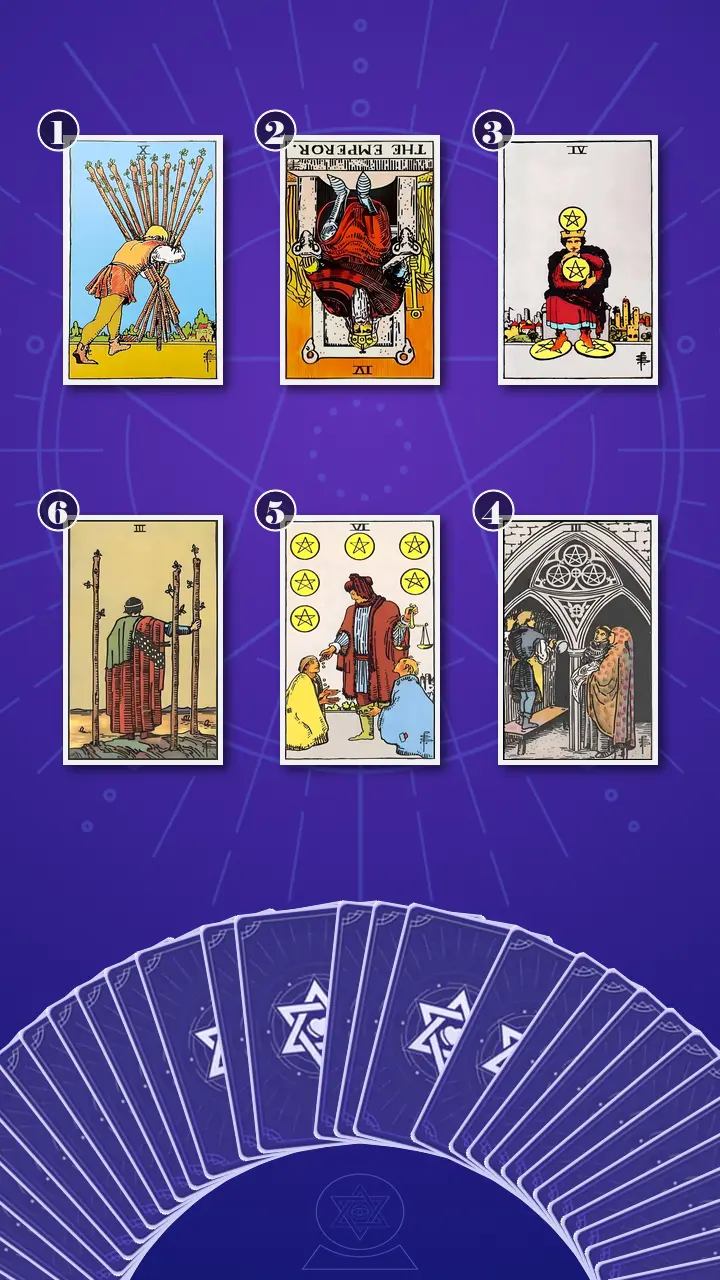
I chose the Transformation Path Grid · Context Edition, a six-card tarot spread arranged like a switchback. The top row moves from visible behaviour to structural blockage to psychological root. The path then drops to a catalyst and returns across the lower row through a bounded experiment and an integrated leadership posture.
For anyone wondering how tarot works in a practical career reading, this spread is not a verdict generator. I use its positions as distinct analytical lenses. Each card meaning changes in context because each position asks a different question: What is happening? What keeps it happening? What fear protects the pattern? What could interrupt it? What can be tested? What would sustainable integration look like?
A simpler decision spread might have framed Jordan's situation as control versus delegation, as if they had to choose between reviewing everything and abandoning quality. That binary would have flattened the real feedback loop. Jordan's mandatory approval reduced the team's opportunities to practise complete judgment; the resulting dependence then appeared to prove that Jordan's approval was still necessary. Six positions were the smallest map that could show the whole mechanism without burying it under unrelated detail.
I placed positions one, two, and three from left to right. Position one would show the diagnostic behaviour: Jordan carrying nearly every pull request across the final threshold. Position two would identify the structural blockage: reviewer authority concentrated in one person. Position three would reveal the fear beneath that structure. Below them, the fourth card would supply the catalyst, the fifth would define an experiment, and the sixth would show how accountability might remain intact without constant personal presence.
The vertical pairs mattered. The first and sixth cards would contrast overloaded execution with strategic oversight. The second and fifth would compare a single approval gate with calibrated distribution. The third and fourth would show whether the quality bar had to remain privately guarded or could become collaborative craft.
“The cards will not decide who gets merge rights,” I told Jordan. “They can help us separate a meaningful risk from a familiar discomfort. You will decide what changes, how narrow the experiment should be, and when to stop it.”
Reading the Queue That Blocked the Horizon
Position One: The Load That Hid the Road
The first card I turned over represented the present diagnostic behaviour: Jordan personally carrying nearly every pull request across the final approval threshold, creating a visible queue and repeated interruptions.
It was the Ten of Wands, upright.
I pointed to the figure carrying all ten wands alone. The town was close, but the bundle blocked the figure's forward view. The problem was not only the weight. The carrier could no longer see beyond what they had agreed to hold.
“This is your 4:47 p.m. loop,” I said. “You finish a day of planning and coaching, see several pull requests already approved by teammates, and personally carry each one across the merge line. You tell yourself, ‘I will clear this quickly, then I can focus.’ The work moves, but the hour disappears. Architecture, coaching, and uninterrupted thinking stay hidden behind the next approval.”
I read the upright Fire here as Excess: too much responsibility converted into immediate execution. Jordan's technical capability was not in question. The excess appeared because every visible request triggered the same response, regardless of whether the change involved production architecture or an isolated test fixture. Tight jaw, raised shoulders, screen fatigue, click, inspect, correct, approve, brief relief. Then the next notification.
Jordan gave a short laugh with no amusement in it. Their hand lifted toward the cold mug and stopped before touching it.
“That is so accurate it is almost rude,” they said. “I literally say, ‘I will clear these and then do the real work.’”
“And what does the calendar say the real work has become?” I asked.
Jordan looked away from the cards toward the architecture tab they had closed. “Whatever is left after GitHub.”
I let that answer sit without turning it into an accusation. The Ten of Wands did not say Jordan was weak or incapable. It showed that the workload had become a leadership-visibility problem. Being the human version of a required GitHub Actions check meant every routine change waited for one green light, while the person supplying it lost sight of the wider system.
Position Two: The Throne Inside CODEOWNERS
The next card I turned over represented the structural blockage: reviewer authority was concentrated in Jordan, so quality assurance and personal availability had become inseparable.
It was The Emperor, reversed.
I traced the card's stone throne, armour, and fixed sceptre. Upright, the Emperor can describe durable structure and accountable authority. Reversed in this position, that stability had become a Blockage. The system looked orderly, but its ability to move depended on one occupied seat.
“In your workflow, this card is a required-reviewer setting, a CODEOWNERS rule, and an informal expectation all pointing to the same name,” I said. “A qualified teammate can review a routine dependency update and approve it, but the approval still feels provisional until you arrive. The process looks stable because an expert controls the gate. The process stops when the expert is in a coaching session, protecting focus time, or taking a day off.”
I placed two sentences beside the card on my notepad: The process looks orderly.The process stops when I am unavailable.
Jordan's fingers curled once against their palm. Their eyes moved from the card to those two sentences, then unfocused as though they were replaying several meeting-heavy days at once.
“The team asks for permission because the system keeps teaching them to ask,” I said.
Jordan exhaled through their nose. “I tell them to own it in one-on-ones, but GitHub tells them I am the real decision-maker.”
“Exactly. If every pull request waits for you, the workflow is measuring your availability, not their judgment.”
I also named the reversal's overcorrection risk. Removing every guardrail overnight would not be liberation; it could create inconsistent decisions and avoidable rework, especially around security, compliance, architecture, or production impact. That result could frighten Jordan back into even tighter control.
“The alternative to a throne is not an empty room,” I said. “It is a structure in which authority can move through defined roles. Accountability can stay with you without every routine decision having to pass through you.”
Position Three: The Quality Bar in a Private Vault
The third card I turned over represented the psychological root: Jordan's fear that a change moving without personal review could mean losing control of quality and failing their leadership accountability.
It was the Four of Pentacles, upright.
The crowned figure held one pentacle against the chest, balanced another above the head, and pinned two beneath the feet. Everything valuable appeared secure, but nothing could circulate. The distant city remained separate from the person protecting the coins.
“This is you holding the quality standard close,” I said, “checking a correct implementation because it looks unfamiliar, and treating personal review as the container that keeps reliability safe. Your green check brings immediate relief, but the team remains outside the reasoning that would help them carry the same standard.”
I read this Earth energy as Excess and contraction. Preservation had become a grip. The card did not criticize Jordan for caring about consistency. It asked whether consistency was functioning as evidence of safety because the actual risk criteria had not yet been made explicit.
I asked Jordan to remember the last pull request they had reopened after another engineer approved it.
“It was correct,” they said. “I did not like how the service boundary was named. I kept thinking the naming difference might turn into a bigger design problem later.”
“What was the specific consequence you were protecting against?”
Their breathing paused. Their thumb pressed into the side of one finger. Their gaze drifted toward the lower corner of the screen as the memory seemed to replay. Then their hand opened.
“I do not know,” they said more quietly. “I can explain why my version is cleaner. I cannot honestly say the other version created a current reliability risk.”
I wrote two prompts where they could see them: The risk I am protecting against is... and The preference I may be protecting is...
“You do not have to force every comment into one category,” I said. “The point is to notice when a style difference triggers the same body alarm as a production hazard. Real risk deserves scrutiny. Personal preference can still be discussed, but it does not automatically need veto power.”
Jordan nodded once, then gave me a thin, bittersweet smile. “I think I have been using my discomfort with unfamiliar code as a smoke detector.”
“And a smoke detector is useful,” I said. “It just cannot distinguish toast from a building fire unless the system gives it better signals.”
When the Workshop Plan Became Visible
Position Four: The Card That Changed the Leadership Script
By the time I reached the fourth position, the laptop fan had gone quiet. Outside Jordan's window, the winter light had thinned to silver, and the blue reflection on the cold coffee looked less like an alert and more like an empty screen waiting for new text.
The card I turned over represented the catalyst: converting Jordan's private quality judgment into shared criteria, collaborative review practice, and observable team competence.
It was the Three of Pentacles, upright, the key card of the reading.
I showed Jordan the craftsperson standing on the bench while two collaborators consulted a visible architectural plan. No one in the image occupied every role. Expertise remained differentiated and respected, but the standard did not live inside one person's head. The work could be discussed against something everyone could see.
In modern engineering life, this was Jordan sitting with two engineers over one recent pull request and a short review rubric. Each person would explain the risk they saw. The team would not be asked to reproduce Jordan's exact comments or preferred implementation. They would use a shared plan, make their reasoning observable, and improve the criteria together.
The Earth energy had shifted into Balance. The Four of Pentacles protected quality by holding it still. The Three of Pentacles protected quality by making it teachable. The standard did not disappear when more people could read it; it became easier to practise.
Jordan had been trying to solve a structural problem as a private test of vigilance: if they found every edge case, they were responsible; if they missed a review, they were negligent. The card placed a third option on the table. Responsibility could mean designing a system in which judgment became visible.
At that moment, I thought of an editing room from my earlier life as an artist. A brilliant continuity editor can rescue a scene by spotting every mismatch, but if the whole production depends on one person remembering every detail, the film does not have a standard. It has a human single point of failure.
I call the lens I used next Workplace Typecasting Analysis. I look for the role an office ecosystem keeps rewarding long after someone's formal position has changed. Jordan's title said engineering manager, but the workflow still cast them as the indispensable senior engineer who appeared at the end of every scene to catch the detail everyone else missed. Each successful rescue made that supporting role harder to leave.
Through Leadership Narrative Construction, I offered a different professional identity: not the person who proves their value by supplying the last green check, but the systems designer who makes good judgment repeatable. Jordan did not need to become the star of every technical scene. They needed to reclaim authorship of the conditions under which the whole team could act.
Ownership is not created by gripping every approval; it grows when shared standards become a plan the whole workshop can read and use.
I let the sentence remain between us before I added, “Your quality bar becomes scalable only when the team can apply, discuss, and improve it without waiting for your hands. The shift is not from accountability to indifference. It is from private approval to shared, visible judgment.”
I watched Jordan go completely still. Their breath stopped first, and two fingers remained suspended above the desk as if they had forgotten what they were reaching for. Then their pupils widened slightly and their focus moved past the screen. I could see them mentally replaying old reviews, one-on-ones, and every “Can you take one last look?” that they had answered by opening the code again. Their mouth tightened before their shoulders finally dropped. The release was not clean. Their eyes shone, and the first words arrived with a flash of anger rather than relief.
“But does that mean I have been doing leadership wrong this whole time?” they asked. Their voice caught on “wrong.” They looked down, opened one hand, and then closed it again. A second later, they released a breath that sounded almost like a laugh, except the new clarity had left them briefly unsteady. If personal intervention was no longer the clearest evidence of competence, they would need a new way to recognize themselves at work.
“No,” I said. “It means the behaviour that earned trust when you were the most relied-upon senior engineer has stayed in the scene beyond the point where it can carry your new role. You protected real risks. You also built habits around the relief of seeing everything personally. We can respect why that happened without making it your permanent leadership model.”
I leaned closer to the camera. “Now, using this new perspective, think back to last week. Was there one moment when shared criteria could have made you feel different?”
Jordan named the routine dependency update. Another qualified engineer had approved it. Jordan had reopened the review because of a naming preference and spent twenty minutes composing comments.
“If the reviewer had written, ‘No schema change, tests pass, rollback is understood, no security impact,’ I would have had evidence of their judgment,” they said. “I still might have disliked the name, but I would not have needed to treat that dislike as a stop sign.”
That answer marked the real emotional crossing: from frustrated hyper-vigilance and control-based apprehension toward observable trust and steadier strategic confidence. It was only a first step. Jordan still felt the pull to inspect. The difference was that trust no longer had to mean closing their eyes. It could mean looking at someone else's reasoning instead of reproducing the entire review.
I gave them a ten-minute design exercise. I asked them to open a blank repository note and write one low-risk pull-request category, three observable checks that would make it approvable, two people who could own that decision, and one reason to escalate. I explicitly asked them not to change branch protection or merge anything during the exercise.
“This is only a small design test,” I said. “If your body or attention says stop, stop. Continuing is your choice. We are collecting information, not trying to win an argument against your fear.”
Jordan wrote: isolated test-only changes. Under it came tests passing, no production-path change, and rollback understood. They named two peer reviewers. For escalation, they wrote: unexpected service-boundary or data-handling impact.
For the first time in the session, Jordan's jaw was no longer locked.
Position Five: Scales for the Reviewer Ladder
The fifth card I turned over represented the practical action: tiering pull requests by risk, assigning peer approval rights, and defining limited escalation conditions.
It was the Six of Pentacles, upright.
I pointed to the scales in one hand and the coins moving from the other. This was not authority tossed into the air. It was calibrated distribution. I read the Earth energy as Balance through circulation: more scrutiny where the potential consequence was higher, clear decision rights where the risk was routine and understood.
In Jordan's workflow, the card became a visible reviewer ladder with three levels: routine, elevated, and exceptional. Two qualified peers could approve routine changes. Architectural, security-sensitive, compliance-related, production-impacting, or unusually consequential work would follow a defined escalation route. Every change would no longer receive the same mandatory checkpoint simply because GitHub made that checkpoint easy to encode.
“But what if a routine pull request contains an unusual edge case that the category misses?” Jordan asked. Their shoulders rose a little again.
“Then the ladder needs an exception rule,” I said. “A bounded delegation pilot should be reversible. Start with a category narrow enough that you can describe the known risks. Keep automated checks and normal peer review. If a genuine new risk appears, pause that category, examine the specific miss, and revise the criteria. Shrinking the experiment is not failure. It is how system design learns.”
I asked which category felt small enough to inspire curiosity rather than obligation. Jordan kept isolated test-only changes and added documentation updates with no generated production artifacts.
“That is less dramatic than removing myself from CODEOWNERS everywhere,” they said.
“It is also more informative. You do not need a leap of faith. You need one complete judgment cycle that belongs to someone else and remains observable to you.”
Position Six: Fire With an Open Horizon
The final card I turned over represented cognitive integration: Jordan remaining accountable through guardrails, coaching, and system-level monitoring while the team owned routine review decisions.
It was the Three of Wands, upright.
The contrast with the first card was immediate. The Ten of Wands figure could barely see past the burden in their arms. Here, the figure stood beside three firmly planted wands and faced an unobstructed horizon. The standards had not vanished. They were planted. What changed was where attention could travel.
I read the Fire as Balance: initiative transformed from constant execution into foresight. In modern terms, Jordan would look at weekly patterns in review wait time, rework, exceptions, and team learning while routine pull requests moved without a final personal pass. They could still coach difficult decisions and enter reviews by risk or exception. They would no longer need to stand at the merge gate for every individual change.
“Stepping back from routine reviews is not leaving the work,” I said. “It is making room to see the system that the queue has been hiding.”
I asked Jordan which three signals could show whether distributed ownership was working without tempting them to reopen every pull request. They chose review wait time, the number and type of escalations, and rework caused by missed review risks. They deliberately left stylistic difference off the list.
“I am still accountable,” Jordan said, testing the sentence aloud.
“Yes.”
“I do not have to be present in every decision.”
“Also yes.”
I noticed another detail in the spread: there were no Swords. The cards offered workload, structure, material practice, and strategic Fire, but the language of discernment had to be supplied consciously. Jordan's next step required explicit words for risk, preference, authority, and escalation. The limited emotional imagery mattered too. The workflow could not carry trust through configuration alone; Jordan would need an honest conversation about discomfort, learning, and what would happen after a mistake.
That was the reading's final safeguard against false certainty. Tarot had not promised that every delegated review would be perfect. It had shown Jordan where to place the next experiment so that mistakes, disagreements, and competence could all become visible without one person silently absorbing every decision.
The One-Week Shared Quality Bar
I gathered the six cards into one causal story. Jordan's earlier success as the engineer who caught difficult problems had trained both their nervous system and their office ecosystem to equate personal intervention with safety. In the present, the Ten of Wands showed that habit consuming the attention their management role required. The Emperor reversed showed how the habit had hardened into branch rules and team expectations. The Four of Pentacles revealed the protective fear underneath: if quality moved beyond Jordan's sight, accountability might move beyond their control.
The lower row offered a different sequence. The Three of Pentacles made private judgment visible. The Six of Pentacles distributed decision rights according to risk. The Three of Wands restored Jordan's attention to architecture, coaching, and system patterns. The Transformation Path Grid did not tell Jordan to care less. It showed how caring could become infrastructure instead of interruption.
In the language of film, Jordan had bravely stayed in one painful scene for a little too long: the indispensable expert enters at the last moment, catches the flaw, and saves the release. That scene had once demonstrated genuine skill. Repeating it in every episode now prevented the rest of the cast from completing a decision and kept Jordan's next leadership act off-camera.
I named the cognitive blind spot directly: Jordan had been treating shared judgment as if it required identical judgment, and treating accountability as if it required personal presence. Neither equation was structurally necessary. A teammate could prefer a different implementation and still evaluate the agreed risks competently. Jordan could remain accountable by defining guardrails, coaching reasoning, reviewing exceptions, and monitoring outcomes.
The transformation direction was therefore specific: move from mandatory personal approval on every pull request to a one-week pilot with documented review criteria and two designated peer reviewers for one low-risk category. No heroic withdrawal. No demand for instant trust. Just a bounded test that would turn assumptions into evidence.
Before we wrote the actions, Jordan raised the most practical obstacle.
“I know myself,” they said. “I will see the notification between meetings and think I am only checking for thirty seconds.”
“Then your plan needs to govern your attention as well as GitHub,” I said. “We will make the experiment visible to your team, put the exception path in writing, and give your urge to check somewhere smaller to go.”
I also introduced The Protagonist Reframe Directive, my micro-behavioural script for disrupting an old workplace role in the moment it tries to reclaim someone. In this framework, becoming the protagonist does not mean making colleagues into supporting characters. It means taking authorship of the role the system expects you to perform.
Jordan's old script was, “Tag me and I will take one last look.” The new script would publicly locate authority where Jordan wanted it to live: “For routine changes in this category, the designated peer reviewers own approval under the shared criteria. Bring me the defined exceptions. You do not need a ceremonial final pass from me.”
- Draft the shared quality bar on Tuesday. Schedule 30 minutes with two qualified engineers. Open a shared Notion page or repository document titled “Low-Risk Pull Request Review Criteria.” Write three to five observable checks together, including tests passing, no security or schema impact, rollback understood, and clear service ownership. Apply the draft to one recently merged routine pull request and record disagreements as questions. Timebox the first version to 30 minutes and label it “one-week working draft.” Do not perfect every edge case before anyone can use it.
- Publish the risk-tier reviewer ladder by Wednesday. Define routine, elevated, and exceptional pull requests. Name two peers who can approve the routine category without Jordan's final pass. List the exact architectural, security, compliance, data, or production conditions that require escalation. In the next cross-departmental meeting or Slack thread, use the Protagonist Reframe Directive to state who owns routine approval and when Jordan should be involved. Begin with isolated tests, documentation, or another narrow category. If the boundary feels vague, shrink the category instead of abandoning the ladder.
- Run the guardrails-first pilot for one working week. Remove Jordan's mandatory final review from the chosen category while keeping automated checks and standard peer-review requirements. Ask the two designated reviewers to approve or escalate from the written criteria and leave one sentence naming the risk they evaluated. At the end of each day, Jordan records only three facts for five minutes: how many routine pull requests moved, which exceptions appeared, and which criterion was unclear. Put “Routine PRs follow the reviewer ladder; exceptions are escalated” in the calendar or Slack status. If a genuine risk appears, pause the category, inspect that specific failure, and revise the rule. Do not silently reopen every successful review.
“This is not a test of whether your anxiety is irrational,” I told Jordan. “It is a test of whether visible standards and peer reasoning can protect a narrow class of changes without your hands on every approval. The evidence can tell you what to expand, revise, or stop.”
Jordan looked at the three actions and changed one word in the pilot note. They replaced delegate with distribute.
“Delegate still sounds like I own every decision and lend it out temporarily,” they said. “Distribute sounds like the decision rights are part of the system.”
I left the edit in place. It was small, but it showed that Jordan had begun writing the next act themselves.
The Green Check Jordan Did Not Give
Six days later, Jordan sent me a short message. The team had drafted four low-risk criteria in 27 minutes. Two engineers had used them on an isolated test change, compared their reasoning in the pull request, and merged it without Jordan's final approval. No one had asked, “Can you take one last look?”
At 4:47 p.m. that Friday, the peer-owned pull request merged while Jordan kept the architecture document open. Their jaw tightened, and their cursor hovered over GitHub. Then they closed the notification. For three seconds, they stared at the empty corner where the red badge had been.
The moment was lighter, but not triumphant. Jordan told me their first thought the next morning was still, “What if they missed something?” This time, they checked the agreed system signals instead of reopening the code. One rubric phrase needed clarification. There had been no unplanned escalation and no rework.
“I did not magically trust everything,” Jordan wrote. “But I could see what judgment they used. That felt different.”
That difference was the quiet proof. Jordan had moved one step from checking for unseen failures toward observing shared judgment. The cards had not changed GitHub, transferred authority, or made the team capable by magic. They had helped Jordan see the script, the feedback loop, and the available leverage. Jordan changed the workflow.
I think of clarity this way: it is not always a final answer or a perfectly relaxed body. Sometimes it is the first green check that can appear without becoming a personal summons, because the standard beneath it is finally visible to more than one pair of eyes.
If a green pull request is waiting for you tonight and your jaw tightens before you have identified a specific risk, remember that the tension does not make you a bad leader. It may mean you want the team to own quality while part of you is still afraid that stepping away will expose a failure you were supposed to prevent. Noticing that conflict means you are already looking at the system, not only the queue.
If your quality bar became a shared workshop plan rather than a private checkpoint, what is one routine pull request you would feel curious, not obligated, to let someone else own this week?