Approval-Based Career Choice Paralysis: Letting Personal Criteria Lead

The 11:40 p.m. Family-Chat Review Board
I recognized approval-based career choice paralysis before Maya (name changed for privacy) finished setting down her phone. She was twenty-seven, lived alone in Toronto, paid the kind of rent that makes a stable salary feel less like a preference than a weather system, and had built a credible career as an operations analyst. Yet every promising role seemed to become impossible the instant she pictured explaining its title on the next family call.
She described a Thursday at 11:40 p.m. in her condo kitchen: an unfamiliar product-operations job description open on one side of her laptop, the family WhatsApp chat on the other. The fridge hummed beneath the apartment's nighttime quiet. Blue screen light caught the rim of an unfinished mug. Maya typed two sentences about the company, deleted them, opened Glassdoor, searched for layoffs, and closed the tab without saving the role.
"I know they want me to be secure," she told me, turning the phone face-down. "But I cannot tell where their definition of security ends and mine begins."
I watched her shoulders pull upward as though she were bracing for a question that had not yet been asked. Her apprehension was not an abstract cloud; it was a held breath trapped behind her ribs, like she was trying to draft a courtroom defence while standing waist-deep in cold water. Each closed application brought a few minutes of relief, then left a heavier, duller weight behind.
"That makes sense," I said. "Stability matters when living costs are real, and family concern can be a form of care. But the job is being reviewed before you have written down what you need from it. Let us make a map for that distinction. Today is not about asking tarot to decide your career. It is a Journey to Clarity about what gets lost when approval becomes the first filter."

A Compass for Family Approval and Career Trade-Offs
I asked Maya to take one slow breath and hold her question in ordinary language: what did she lose by choosing only the role her family would support? I shuffled slowly, not as a performance of mystery, but as a pause from the browser tabs, salary comparisons, and rehearsed explanations that had been doing all the talking.
I chose the Decision Cross, a tarot spread for family approval and career trade-offs. This is how tarot works best in a career crossroads: not as a prediction machine, but as a structured way to separate evidence, inherited rules, felt values, and trade-offs that have been blurred together. Card meanings in context matter more than generic promises.
The center card would show the present bind: where Maya was removing alternatives before evaluating them. The card to the left would acknowledge the real support offered by the family-approved role. The card to the right would name the opportunity cost of relying on approval alone. Beneath the center, I would look for the learned authority shaping the decision; above it, for the principle that could return authorship to Maya.
The layout formed a compass rose on the table. Its horizontal line would measure two truths at once: belonging and exploration. Its vertical line would ask a harder question: who was holding the compass?
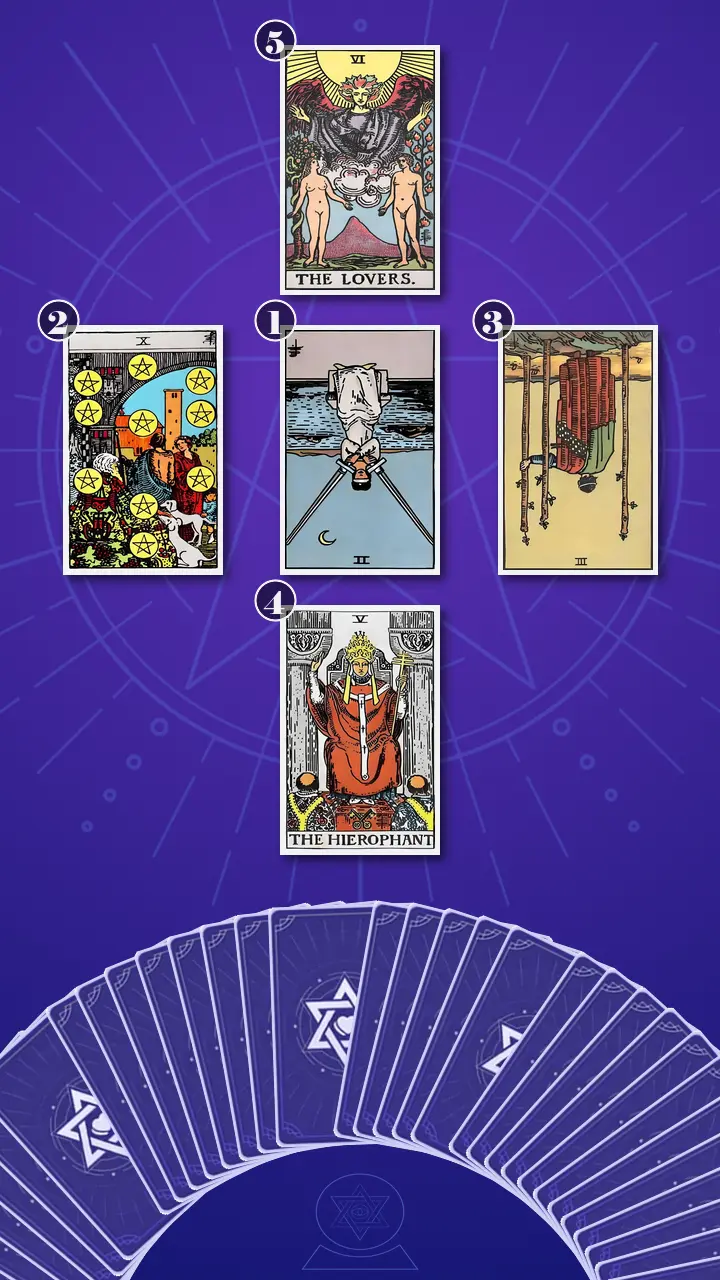
Reading the Map of a Career Crossroads
The Blindfolded Browser Tabs
"Now I am turning the card that represents the current symptom," I said. "The pattern in which alternatives disappear before you have had the chance to evaluate them."
Two of Swords, reversed.
In the image, a figure sits blindfolded with two swords crossed over her chest. Reversed, it did not suggest that Maya lacked intelligence or discipline. It showed thought becoming overworked and defensive: Air blocked by the need to pre-argue every option. The blindfold was the missing personal scorecard. The crossed swords were the explanation she prepared before allowing herself a preference.
I described what I saw in her daily life: Maya at her laptop after work, toggling between the familiar analyst role and a more interesting listing she had already half-rejected. Rather than putting salary, day-to-day tasks, learning, and commute on one page, she rehearsed how each title might be challenged on a family call. The alternatives did not lose a fair comparison. They vanished before her priorities had been asked to vote.
"You are not indecisive," I told her. "Your criteria keep getting replaced mid-decision."
Her mouth made a small, bitter curve. First, her fingers stopped tapping the edge of her phone. Then her gaze went past the cards, as if she were replaying a familiar midnight sequence. Finally, she gave a breathy laugh without much humour. "That is brutally accurate. Before I ask whether the role fits, I need to know whether I can defend it."
"And those are different questions," I said. "One asks for direct evidence. The other relies on predicted objections. Closing the tab tightens your chest, then returning to the approved role lets your shoulders drop for a minute. That relief is real, but it is not necessarily clarity."
The Secure Archway
"Now I am turning the card that represents what Maya genuinely receives from the family-supported role: continuity, practical reassurance, and belonging."
Ten of Pentacles, upright.
The elder sits beneath a stone archway while family gathers in a settled courtyard. I did not treat this as an obstacle. The approved path offered a reliable income for Toronto living costs, benefits, a title that would make immediate sense at family dinners, a familiar ladder, and the calm of knowing loved ones would understand why it was sensible. That support was not imaginary, trivial, or shameful to want.
Its Earth energy was steady and useful. The trouble came only when its weight became absolute, when the recognisable career option was asked to certify the entire future rather than serve as one factor inside a broader comparison.
"Family support can be a resource without becoming the admission ticket," I said. "When you picture taking that role, what becomes easier? Rent? Explaining your plan? Feeling connected? A clear progression path? Naming the benefit precisely means you do not have to either dismiss it or worship it."
Maya nodded once. "The calm at home," she said. "And not feeling like I have to prove I am being responsible."
"That is an honest benefit," I replied. "It deserves a place in the decision. It does not have to become the whole decision."
The Ships Maya Never Boards
"Now I am turning the card that represents the hidden cost of treating family approval as the only filter: the exploration, wider horizon, and evidence about fit that become unavailable."
Three of Wands, reversed.
A figure faces an open horizon where ships move across the water, but in reversal the expansion is delayed or narrowed. Its Fire was not absent in Maya. It was constrained at the edge of the search, visible in the small lift she felt when an unfamiliar role appeared, then pressed down by the imagined conversation that followed.
I saw her on the Line 1 train at 8:47 p.m., heading north from downtown. The carriage jolted. An ad panel flickered white above her. Her phone warmed in her hand as she scrolled past a role outside her usual category. It was a distant ship on a screen: a saved listing, an alumni contact, a possible twenty-minute conversation. Instead of approaching it, she searched its worst reviews from shore and remained planted inside the category that required the least explanation.
"The loss is not one perfect job," I said. "It is the evidence you never let yourself collect."
I let the sentence settle before I added, "This card is not asking you to make a dramatic escape, hide applications, or declare a new identity. It is asking for low-risk data. An informational interview is not a binding contract. It is twenty minutes in which imagined risk can become usable information."
Maya's grip loosened around her phone. Her eyes moved back to the card, then to the window behind me, where the late-afternoon streetcar bell sounded thinly through the glass. "I do not have to leave shore today," she said slowly. "I can learn what is on the other side."
"Exactly," I said. "Curiosity is not betrayal, and exploration is not secrecy."
The Inherited Stamp of Approval
"Now I am turning the card that represents the psychological root beneath the decision: the learned belief that a legitimate path must be endorsed by a trusted authority."
The Hierophant, upright.
The Hierophant's raised hand offers formal blessing. Two acolytes sit before him. Crossed keys rest at the base of his throne. In Maya's life, this was the invisible family stamp: a familiar title, conventional progression, and reassurance that no one would call her irresponsible.
Its energy was not malicious. Tradition can transmit financial caution, planning, and hard-won knowledge. But I could see how a useful standard had become an unexamined gatekeeper. Maya was not only receiving advice; she had been placing every possible future before an internal tribunal and waiting to be told that it counted.
For a moment, I thought of an archaeological trench I had worked on years ago. In a single layer of soil, a wall may look final until careful excavation reveals an older road beneath it, and another older settlement below that. The visible structure is real. It is simply not the only structure that has ever existed there.
"This is closer to Billy Elliot than to a simple story of tradition versus freedom," I said. "The question is not whether your family's standards are worthless. It is whether a respectable future can make room for a personally chosen one. Which principles do you genuinely share, and which rules are mainly there to prevent anyone from questioning you?"
Maya looked down at the card. "Financial resilience, I share," she said. "Needing a title everybody immediately understands... I think that is more about avoiding the conversation."
"That distinction is a serious piece of clarity," I said. "It gives you something more precise than rebellion or compliance."
When The Lovers Asked Who Held the Compass
The Open Gaze of a Responsible Choice
The room seemed to quiet when I reached for the final card. Rain had begun to trace the window behind Maya, softening the city lights into vertical lines. "Now I am turning the card that represents the integrating principle: how to define your values, acknowledge real trade-offs, and communicate without outsourcing authorship of the choice."
The Lovers, upright.
The two figures stand uncovered beneath the angel's open presence, with a mountain visible between them. This was not a promise that every priority could be preserved. It was a card of conscious choice: relationship, vulnerability, values, and responsibility held in the same field of vision. It answered the blindfolded Two of Swords with openness.
At 11:40 p.m., the unfamiliar role was still open, the family chat was still waiting, and the cursor was still blinking in the draft explanation. Maya had been carrying the pressure of making the possibility acceptable before she had let herself evaluate it. She wanted a choice nobody could challenge, because an unchallengeable choice seemed safer than admitting that she had a preference which might invite disagreement.
You do not need unanimous approval to make a responsible choice; name your values, choose in full view, and meet The Lovers' open gaze.
I held the quiet for a beat, then said, "A responsible choice does not need to be pre-approved. It needs values, evidence, and an honest account of what it asks you to trade."
Maya went very still. Her breath paused high in her chest; even the hand resting beside the phone seemed to forget what it had been about to do. Then her eyes lost focus for a moment, as though she were replaying every deleted application and every family call at once. Her pupils widened. A flush rose at the edge of her cheeks. "But does that mean I was wrong before?" she asked, and there was a brief flash of anger beneath the question. "Like I have been letting them run my life?"
I kept my voice level. "No. It means you found a strategy that protected belonging when you needed it, and it has become too narrow for the decision in front of you. A strategy can be understandable and still need updating."
Her jaw worked once. Her fingers slowly uncurling on the tabletop were the first sign that the thought had reached somewhere deeper than agreement. Her shoulders lowered, but with that release came a slight unsteadiness, the small dizziness of setting down a burden and realising the next direction was hers to choose. Her eyes shone without spilling over. "I want their support without needing their permission," she said, quieter now.
"Now, with this new perspective, think back to last week," I invited. "Was there a moment when this could have helped you feel differently?"
She remembered the Notes app she had opened during lunch in the PATH food court. She had typed only one word, security, while her phone vibrated with a family message. "I could have separated it," she said. "Income. Growth. What the work feels like. Family reassurance. I made them all one word because that was easier."
I call this part of my work an Enduring Value Assessment. A career title can look impressive in the present and still fail to hold what matters over time; an unfamiliar role can look unsettling now and still build a capability that remains useful across several future chapters. The question is not which option wins a universal argument. It is which values Maya can recognise as still hers after the noise of this particular family conversation has faded.
This was the move from apprehensive approval-seeking and narrowed exploration toward grounded ownership of a values-based career trade-off. Family approval could remain meaningful input. It could no longer be the pass-or-fail filter that decided whether Maya was allowed to gather evidence.
The Three Columns That Return the Pen
The spread told a coherent story. The reversed Two of Swords showed analysis being used as armour: Maya prepared for imagined cross-examination rather than comparing roles. The Ten of Pentacles showed why the approved path carried such force: it offered genuine stability, recognition, and a sense of belonging. The reversed Three of Wands showed the cost: not a guaranteed better job left behind, but the wider horizon and direct evidence she never allowed herself to collect. The Hierophant revealed the inherited rule beneath the pattern, while The Lovers offered a way to retain relationship without giving away authorship.
The cognitive blind spot was treating bodily discomfort as proof that an unfamiliar role was irresponsible. Sometimes the heaviness in Maya's shoulders might signal poor fit. Sometimes it might signal that disagreement feels expensive. Both could be present. The transformation direction was to compare roles using personal values, practical evidence, and explicit trade-offs before asking for family input.
I gave Maya three pieces of actionable advice. I framed the last one through my Time Stratigraphy Exercise: a mental shift in which the noisy surface layer of tonight's group chat is set beside the deeper ground of the next ten years. The exercise does not predict the future. It simply asks what a ten-years-older Maya might recognise as a meaningful trade-off, rather than a momentary discomfort to avoid.
- The Three-Column Trade-Off NoteTonight, in Notes, create three headers: "Income floor," "Skills I want to build," and "Day-to-day energy." Rate one family-supported role and one less familiar role from 1 to 5, using only the job descriptions, compensation information, and Maya's own work preferences. Under each, add one factual line: "What I would knowingly trade for this." Do this for ten minutes before opening a family chat.If the ratings feel too small for a large life decision, rate only two roles. The aim is a first comparison, not a verdict.
- The Horizon Data CheckThis week, Maya would send one five-sentence LinkedIn message to a person doing work outside the approved path and request a twenty-minute informational conversation. She would ask what a normal week looks like, what surprised them after joining, and what trade-off they would want to know before applying. Afterwards, she would write three bullets: "actual benefit," "actual cost," and "still unknown."An informational conversation does not commit Maya to applying, changing careers, or explaining the exploration before she has facts.
- The Family Input WindowBefore the next family call, Maya would read one prepared sentence from her phone: "I am taking stability seriously, and I am also comparing what I will learn, what the work is like, and what supports my life." She would ask what "secure" means to the relative speaking, set a twenty-minute endpoint, and then spend two quiet minutes imagining what her ten-years-older self would thank her for learning before choosing.Listening is not the same as handing over authorship. A worried reaction is information about someone else's concern, not proof that Maya's preference is irresponsible.
These were not commands to abandon the stable role. That role might score well. The point was to give it a fair comparison and to make its trade-offs visible, alongside the trade-offs of every other serious option.

A Week Later: The Quiet Proof
Six days later, Maya sent me a screenshot of a Notes page. Two roles had been scored under her three headings. Beneath the unfamiliar one, she had written: "More product exposure, less title certainty." She had also sent a message asking for a twenty-minute informational chat.
Her next line was less triumphant and more useful: "I still woke up thinking, what if they think I am being reckless? But I did not close the tab."
I read that as the first real proof of her Journey to Clarity. Nothing had been magically solved. Her family had not been converted into a unanimous committee, and the unfamiliar role had not become a guaranteed destination. But she had moved from making every future defensible to giving her own evidence, values, and curiosity a place at the table.
When a promising job tab is open beside the family chat and the chest tightens before the person has even asked what they want, belonging and authorship can feel as though they demand opposite things. Yet clarity can begin when the role is allowed to be explored before it must be defended.
When the next unfamiliar role appears on the horizon, what small piece of real-world information would you be curious to gather before the invisible review board begins its meeting?