When "I Need a Better System" Is Fear: Learning to Sort, Not Store

Finding Clarity in the 11:40 p.m. Split-Screen
I know this loop the second I hear it described: the laptop split between lecture slides and a flashcard app, three more tabs open for better study systems, and that thin electric feeling in the forehead that shows up when a study session looks productive on screen but still leaves you unable to explain the idea out loud. It is study perfectionism disguised as productivity, and it is one of the most common reasons someone ends up asking me, very quietly, why they keep making flashcards for everything and none of it sticks.
When Maya (name changed for privacy) sat down with me, she told me about 11:40 p.m. on a Tuesday at Robarts Library in Toronto: slides glowing on the left side of her laptop, Anki on the right, the HVAC humming overhead, fluorescent light turning the page a tired gray. Her phone was warm from constant tab-switching. She kept turning bullet points into cards while her shoulders climbed toward her ears and her eyes went dry. “If I don’t make a card for it,” she said, “I’ll forget it.” But the deck kept getting bigger while her own explanation got thinner.
The frustration in her body felt to me like a violin string wound one turn too tight: useful tension pushed past its pitch until every note turned sharp. She was torn between making flashcards for everything and feeling like none of it stuck, and I could feel the deeper fear under it too: not just forgetting, but blanking under pressure and having that moment mean something terrible about her. I looked at her and said, “You’re not failing. Studying can look organized and still be avoiding recall. Let’s make a map of the loop, and then let’s find where your clarity actually lives.”

Choosing the Compass: How This Spread Works
I asked Maya to put both feet on the floor, take one full breath that reached all the way down into her ribs, and hold the question in plain language while I shuffled. I never treat that moment as theatre. It is just a clean transition from spiraling inside the problem to observing the pattern with a little more space around it.
For her reading, I used a Situation-Obstacle-Advice-Outcome tarot spread for study anxiety, flashcard overuse, and retention problems, specifically a context-focused version of that classic four-card structure. This is how tarot works at its most useful for me: not as a verdict about your grades, but as a way of showing card meanings in context so the visible habit, the hidden fear, the needed shift, and the next practical boundary can all be seen in one line.
I chose this spread because Maya’s question was never really about flashcards alone. It was about a whole chain. The first position would show the visible study knot: the overmaking, rewriting, and polishing. The second would reveal the real blockage underneath it: the grip for safety and control. The third would show the medicine: the shift that helps learning become processing instead of storage. And the fourth would ground that shift in an actual next step, not a fantasy of perfect studying.
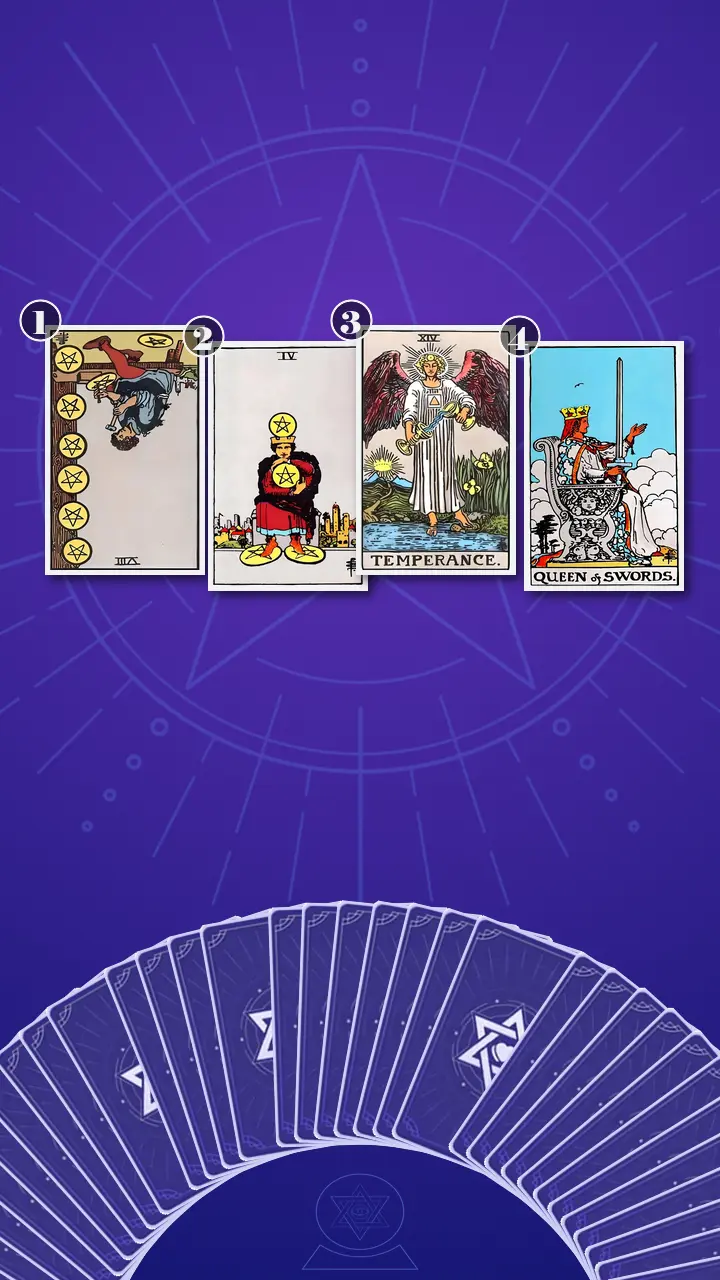
The Loop That Looked Like Discipline
The Worker Who Never Gets to Test Herself
I turned over the card that represents the visible study knot from the diagnosis: the specific behavior of making flashcards for almost everything and still not retaining it.
Eight of Pentacles, reversed.
I felt the accuracy of it immediately. This is the card of effort that has lost its translation into mastery. In Maya’s life, it looked exactly like what she had described: after one lecture, spending nearly two hours turning slide bullets into dozens of flashcards, tweaking wording, tags, and phrasing so the deck looked rigorous, while never once checking whether she could explain the concept with the notes closed. In the Rider-Waite image, the worker is bent over the bench, making one pentacle after another. In her world, those pentacles had become near-duplicate cards in a lonely study booth. It had the same deadened loop energy as Severance: plenty of repetitive task completion, very little felt understanding.
“This is blocked earth,” I told her. “The effort is real. The discipline is real. But the energy is getting trapped in production instead of turning into usable memory.” Then I said the line I knew she needed to hear: A bigger deck is not the same as a stronger memory. The card was not accusing her of laziness. It was showing me that her hands stayed busy so she would not have to face the vulnerable question underneath: what can I actually retrieve without prompts?
Maya gave one short laugh, the kind with a little bruise in it, and looked down at the table. “That’s so accurate it’s rude,” she said. Her fingers started tracing the edge of her sleeve, but her shoulders dropped half an inch. Recognition had landed.
The Grip Beneath the Grind
I turned over the card that represents the real blockage beneath the behavior, especially the psychological mechanics of gripping every detail for safety and control.
Four of Pentacles, upright.
This was the engine under the loop. Maya did not have a motivation problem. She had a safety problem. The image says it clearly: a coin clutched at the chest, two pinned under the feet, the whole body rigid with holding. In real life, it looked like hovering over the delete button on duplicate cards and keeping all of them anyway because deleting even one felt more dangerous than drowning under three hundred. Her flashcard app had stopped being a tool and started becoming a vault for anxiety.
I ran what I call a quick Focus Disruption Audit with her. I asked, “What usually happens in the five minutes before the thought I need a better system?” She answered almost immediately: a Canvas notification on the TTC ride home, a professor saying, “You need to know this,” a classmate texting that they finally got the big picture, a practice question she couldn’t answer cleanly. Those were the dissonant chords. Each one shattered her flow state and pushed her back into capture-everything mode.
“If your system gets tighter while your understanding gets thinner,” I said, “that is not discipline. It is fear in a planner font.” This card showed excess holding. Knowledge was being gripped so tightly it could not move, combine, or breathe. The question underneath it was simple and brutal: Are you studying to build understanding, or studying to prevent loss?
Her jaw worked once before releasing. First her breath went shallow. Then her eyes fixed on the card as if she had found a screenshot of her own nervous system. Then came the long exhale, low from the chest. “Yes,” she said. “Deleting feels like gambling.”
When Temperance Poured Between Two Cups
The Antidote Was Rhythm, Not More Storage
The room changed when I reached for the third card. Even the small sounds became clearer: the faint click of the radiator, the soft shift of Maya’s bracelet against the table. I turned over the card that represents the key transformation needed, directly addressing the limiting pattern and introducing the cognitive shift that supports learning rather than hoarding.
Temperance, upright.
I asked her to picture the late-night study block I already knew so well: the deck getting bigger, the room getting quieter, the forehead starting to buzz because she still could not explain the concept without looking at the screen. This was the exact moment where her brain kept asking for more cards, when what it actually needed was something else entirely.
You do not need to imprison every fact in a deck; you need to let ideas mix, rest, and become yours, like Temperance pouring one cup into another.
Your brain is not asking for more storage. It is asking for more contact with the idea.
She went completely still. First her inhale caught halfway, like her body had missed a stair. Then her hand froze around the paper cup beside her. Then her gaze slipped past me and unfocused, and I knew she was back in that fluorescent library silence, replaying some midnight session where the cards multiplied and the understanding didn’t. When she finally spoke, there was a flash of resistance in it. “But if that’s true,” she said, “doesn’t that mean I’ve been doing it wrong this whole time?”
“Not wrong,” I said. “Protective. There’s a difference. And protection makes sense when blanking feels dangerous.”
This is where I brought in the lens I call Cognitive Tempo Calibration. “Right now,” I told her, “your whole study system is locked to one tempo: capture, capture, capture. But this material doesn’t want one tempo. It wants a rhythm. A plain-English explanation. A tiny recall check. A few practice reps. Sleep. A return visit tomorrow. Temperance is not telling you to care less. It is telling you to stop blasting one track at max volume and start crossfading between modes so the idea can actually become yours.” As I said it, I had the same internal flash of memory I used to get when I was editing muddy audio: layering the same sound again and again never created clarity; it just made the mix denser. Space and timing were what let the real melody emerge.
I pointed to the image: one foot in water, one on land. “That’s structure plus live thinking,” I said. “One part system, one part contact.” Then I gave her the smallest possible experiment, because insight matters most when it becomes breathable: “Pick one concept from today’s material. Set a seven-minute timer. Close your notes and explain it out loud in plain English. Then write only the two or three missing links as cards. If your body starts spiraling, stop after one concept and call that enough for tonight.”
Something softened in her face then, but not in a movie way. More like the quiet unclenching after a hard jaw has been held too long. Her shoulders lowered. Her eyes brightened with that strange mix of relief and vertigo that comes right after a real insight, when the burden eases but the responsibility becomes yours again. “Okay,” she said slowly. “So the goal isn’t to cover everything. It’s to make contact.”
“Exactly,” I said. “That’s the shift. Not from hard work to easy work. From fear-driven overcapture and mechanical review to selective learning, clearer recall, and steadier self-trust.” Then I asked her, “Now, with that new lens, think about last week. Was there a moment when ninety seconds of saying the idea out loud would have taught you more than twenty more cards?” She nodded before I had even finished the question.
The Editor at the End of the Line
I turned over the card that represents the grounded next step: how to study with clearer boundaries, prioritization, and self-trust.
Queen of Swords, upright.
After Temperance restored movement, this card gave it a rule. In Maya’s real life, it looked like cutting a 120-card deck down to 25 sharp prompts and trusting cleaner questions over exhaustive coverage. The upright sword in the image is discernment. The open hand is honest feedback. The clear sky is what the mind feels like when noise stops impersonating importance.
“Not every fact deserves rent in your head,” I said. “This Queen is the part of you that asks a clean question before adding anything: Do I need to retrieve this, do I only need to recognize it, or can I look it up?” That is the outcome this reading points toward. Not more force. Better selection. In learning terms, it is the difference between a suitcase packed for every possible emergency and a carry-on packed for the trip you are actually taking.
Maya sat straighter at that. I watched her pick up her pen almost automatically. There was no grand epiphany in the gesture, just a visible return of agency. “A smaller, sharper deck,” she murmured, almost to herself. “That actually sounds less scary than reviewing everything badly.”
From Capture Mission to Sorting Pass
When I laid the whole spread out for her, the story was clean. The Eight of Pentacles reversed showed the visible loop: studying that becomes endless production. The Four of Pentacles showed the hidden bargain underneath it: if every detail is held tightly enough, maybe nothing important can be lost. Temperance broke that closed system open by reintroducing pace, mixing, and trust in gradual consolidation. Then the Queen of Swords finished the arc by giving Maya permission to select. The apprentice became the alchemist, and then the editor. That was the real reason she felt so stuck: she had been trying to hold water by squeezing harder. The tighter her grip became, the less learning she could actually keep.
I told her the blind spot plainly. She had been confusing feeling covered with being prepared, and confusing comprehensive storage with actual understanding. There is nothing wrong with Anki, Quizlet, or any other tool. The problem starts when the tool becomes a safety ritual. Her transformation direction was clear now: shift from treating every fact as something to capture to treating learning as something to sort, explain, and revisit. Retention starts when you stop storing everything and start sorting what matters.
Your Smaller, Sharper Plan
I didn’t want to leave her with inspiration only, so I gave her a practical rhythm she could test without rebuilding her whole life.
- The Syncopated Study SessionAfter your next lecture, before you open Anki, Quizlet, or any flashcard app, set a 7-minute timer. Use the first 60 to 90 seconds to record a Voice Memo explaining the topic as if you were texting a friend who missed class. Then write one plain-English summary sentence in Notes or Google Docs. Only after that, make up to three flashcards for the exact ideas you genuinely need to retrieve from memory.If your first thought is “This is too little,” treat that as the old loop loosening. Do it for one lecture only this week. If you get flooded, stop after one concept.
- The Retrieve-or-Store FilterPut a sticky note on your laptop that says, “Retrieve, recognize, or look up?” Before making any new card for this unit, label the idea in the margin of your notes as Must Know, Nice to Recognize, or Can Look Up. Then take one existing deck and cut it down to a 25-card must-know version.If deleting feels too activating, move extra cards into a Parking Lot deck instead of erasing them. Set a 15-minute cap for editing and stop when the timer ends.
- Proof Before ProductionFor one chapter this week, do three closed-notes practice questions before making a single flashcard. Turn each miss into a one-line error note: what I missed, what mattered, what cue would have helped. If you still want cards after that, make them only from repeated misses.If anxiety spikes, do one question and stop. Evidence still counts when it is small.

A Week Later, the Quiet Proof
Five days later, Maya sent me a voice note while I was making tea. I could hear the TTC doors in the background and the soft station chime behind her. “I did the seven-minute thing after physiology,” she said. “One voice memo, one summary sentence, three cards. It still felt weirdly wrong for like two minutes. But in tutorial today, I answered a question without looking down once.” She paused, then laughed. “My first thought this morning was still, ‘What if I missed something?’ But I tested myself anyway.”
That, to me, was the real journey to clarity. Not a magically fixed semester. Not a perfect streak, a prettier dashboard, or a cleaner deck. Just the first real proof that her mind worked better when she stopped treating learning like a capture mission and started letting it become a living rhythm. That is why I trust a Situation-Obstacle-Advice-Outcome tarot spread for study anxiety, flashcard overuse, and retention problems: it returns the power to the person holding the cards, not the cards themselves.
When every slide feels too risky to leave behind, your shoulders lock, your deck swells, and the relief you were trying to build still does not arrive. Clarity can begin much smaller than certainty; sometimes it is just the first quiet bar between tracks when your own understanding becomes audible again.
If your next study block felt less like a capture mission and more like a sorting pass, what is one idea you would be willing to say in your own words before you store it?