Finding Clarity in the 11:47 p.m. Tab Spiral
If closing a random tab about a course, article, or side project feels weirdly emotional, like you're deleting proof you could still become that person, I know exactly the kind of session we're in. That was the energy in the room when Alex sat across from me: 28, a content strategist at a Toronto startup, bright enough to hold a dozen ideas at once and tired enough to look haunted by Chrome.
They told me about 11:47 p.m. at the kitchen table under the stove light: a half-drunk coffee gone cold, Slack still open, a Google Doc called 'life plan' glaring from one tab, a work deck in another, three saved courses, two admin pages, and the fridge humming like an accusation. Their wrists were warm from the laptop fan, their shoulders were practically earrings, and their cursor kept hovering over the X on a course page they had not opened in months. They said, 'I swear I'm just checking one more thing,' but the tightness in their jaw was already telling the truth. This wasn't about information.
It was about the contradiction underneath: wanting to keep every option alive and still appear endlessly capable, while fearing that choosing one thing and closing the rest would expose an ordinary human limit. Shame sat on them like wet wool. Not loud. Just clingy, heavy, and impossible to peel off.
I leaned in and said what I often need people to hear first: your browser is not messy because you don't care. It's messy because too many choices have become a test of worth. 'We're not here to shame your habits,' I told them. 'We're here to make a map of the fog, and then find the scene where your power returns.'
Choosing the Compass: A Four-Card Spread for Too Many Tabs Open Anxiety
I asked Alex to place both feet on the floor, take one slower breath, and hold the question in mind while I shuffled. I don't treat this part as theater. It helps the nervous system cross the little bridge from spinning to noticing.
When people ask me how tarot works for something as modern as browser chaos, my answer is simple: it gives the pattern a visible shape so we can talk to it honestly. For a question like too many tabs open anxiety, I chose a Situation-Obstacle-Advice-Outcome · Context Edition spread. I like this four-card layout because it does not try to predict a fixed future. It shows me the visible symptom, the deeper mechanism, the inner medicine, and the grounded way that medicine can become practice.
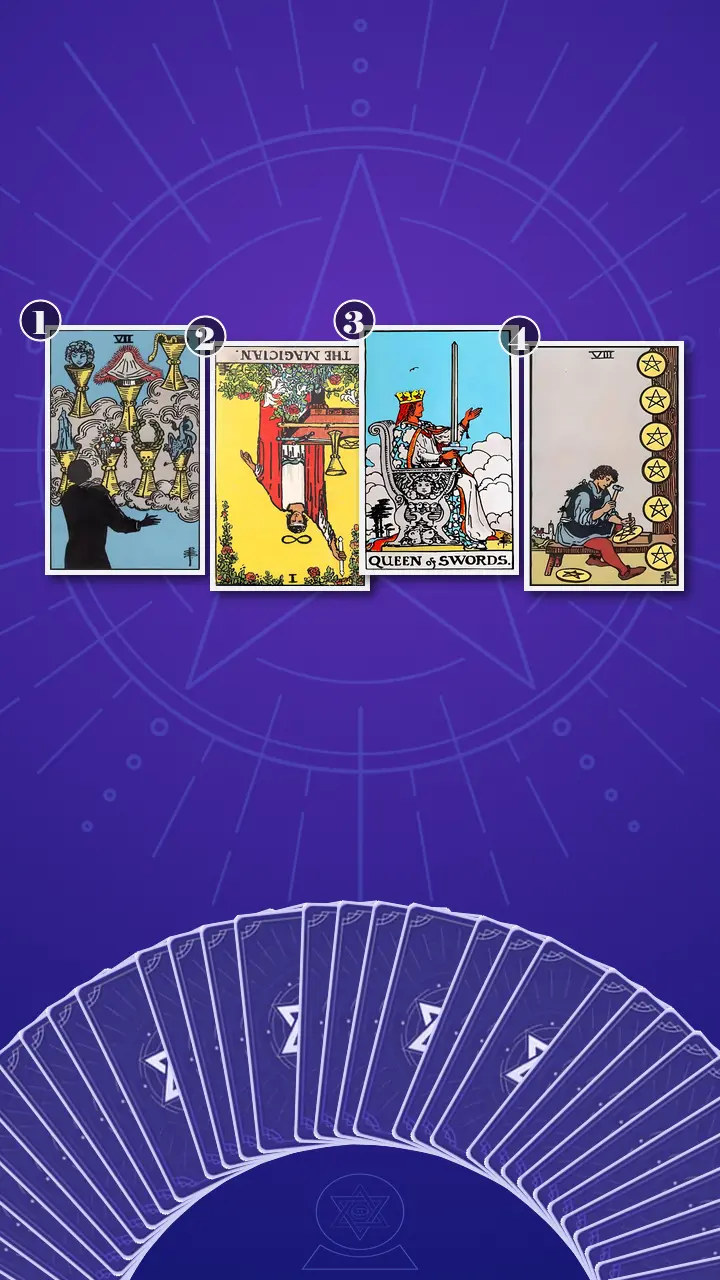
I laid the cards in a straight line from left to right, like a messy desktop gradually becoming one workable screen. The first card would show the surface pattern. The second would reveal the fear or resistance underneath. The third, our pivot card, would name the cleanest corrective. The fourth would answer the most practical question of all: what does this look like in a real calendar, a real browser, and a real body?
The Tabs, the Tools, and the Tension Underneath
The Browser as a Cloud of Futures
'Now I'm turning over the card that represents the visible pattern of keeping too many options, tasks, and future selves open at once,' I said. The card was the Seven of Cups, upright.
It was almost too on the nose. I told Alex this card looked exactly like opening a laptop to start one client deliverable and getting pulled into a glittering field of emotionally loaded tabs: courses, articles, admin, side-project prompts, trend reports, future-life ideas. Nothing is fully urgent, but every tab flashes with the promise that it might matter to who you become. It is the browser version of the streaming home page where every thumbnail looks perfect and that exact abundance keeps you from pressing play.
In this spread, the Seven of Cups showed excess water: too much possibility, too little containment. The issue was not curiosity. It was that preserved possibility had started masquerading as progress. I asked, 'When you open your laptop and see everything still waiting, what is actually for today, and what are you keeping open because closing it feels emotionally risky?'
Alex went still first; their breath paused, fingertips hovering over the edge of the table. Then their eyes drifted away as if replaying a Monday-morning screen. Then came a small laugh with a bruise in it. 'Wow,' they said. 'That's accurate enough to be rude.' I smiled. 'Good. That means we're looking at the real thing.'
The Private Audition of Competence
I turned over the second card. 'This one shows the obstacle: the worth-and-control fear that makes letting go feel like failure.' The Magician appeared reversed.
Reversed, the Magician is not a lack of talent. It is talent turned into pressure. I told Alex it felt like having the brief, the notes, the template, the draft, the apps, the whole beautiful Notion second brain, and still opening two more tabs because starting with limits feels less flattering than looking infinitely capable. Like owning every kitchen tool and still not making dinner because the setup itself has become a performance.
This is where I used one of my own lenses: Internal Monologue Auditing. I listen for the genre of the self-talk underneath the behavior. Alex's mind was not narrating in the genre of work. It was narrating in the genre of private audition. I already have enough to begin, so why am I still gathering? Because prepared and safe are not the same thing. Resourceful and performing capability are not the same thing either. Sometimes being thorough is just fear in a nicer outfit.
The reversed energy here was blockage. All the tools were on the table, but will was kinked by shame. Their jaw tightened just hearing it; one shoulder climbed. They gave a quiet wince and nodded. I asked, 'The last time you almost closed a tab and backed out, what flashed through your mind?' Alex answered without looking up: 'If I let this go, maybe I'm admitting I'm not the person who can do all of it.'
When the Queen Lifted Her Sword
The Clean Cut Between Capacity and Worth
By the time I reached for the third card, the room had gone oddly quiet. Even the traffic outside my window seemed to fall back. A ribbon of pale light slid across the table and caught the blade first. This was the card representing the inner medicine, the key shift that could interrupt the perfectionism loop. I turned it over: Queen of Swords, upright.
I felt my whole attention sharpen. As an artist, I have spent enough hours in edit bays to know that good cuts are not acts of cruelty. They are how a story becomes watchable. I told Alex that this card looked like the moment they stop asking which tabs preserve the most potential and start asking which one actually serves the task in front of them. The upright sword was a clean cursor decision. The open hand was just as important: firmness without self-punishment. A closed tab is not a failed self.
This is where Internal Monologue Auditing became a lever instead of a label. Up to now, Alex's subconscious had been scoring every small choice like prestige tragedy: every X button a funeral, every archived idea a failure montage. The Queen changes the genre. She moves the scene into the editing room. A paragraph gets cut because the piece needs shape, not because the writer is a fraud. Capacity and worth are not the same thing. Clarity and cruelty are not the same thing either.
You know that moment late at night when your cursor pauses over the X, the coffee has gone cold, and somehow closing one random tab feels bigger than it should? That moment usually isn't about the tab at all.
You do not need to cradle every cup to prove you matter; lift the Queen's sword, make one clear cut, and let clarity rather than excess show your strength.
Closing what you cannot carry is not weakness. It is one of the most ordinary, adult ways attention starts feeling like self-respect again.
Alex's body reacted before their face did. First their inhale snagged halfway, and their fingers froze against the table edge. Then their gaze went soft and unfocused, like they were replaying a dozen late-night browser scenes in fast succession. Then the resistance came, sharp and honest: 'But if I do that, doesn't that mean I've been wrong this whole time?' I shook my head. 'No. It means you've been treating attention like a talent show. This card is asking you to treat it like care.' Their jaw loosened first. Then their shoulders dropped a fraction. Then came that strange, slightly dizzy exhale that arrives when relief shows up holding responsibility by the hand. I asked, 'Now, with this new view, was there a moment last week when this would have changed how you felt?' They looked at the Queen and said, almost embarrassed, 'Thursday night. I would've just bookmarked the course and gone to bed.' That was the first real move from shame-fueled mental scatter toward steadier self-respect.
I didn't let the insight stay abstract. I told Alex that within the next ten minutes, I wanted one experiment only: pick the tab tied to the real next step, make a folder called Not Now, Not Never, move three nonessential tabs into it, and stay with the main tab for five minutes. If three felt too sharp, we would make it one. The point was gentler clarity, not a performance of control.
From Seven Possibilities to Eight Reps
The fourth card represented integration, the path that turns insight into lived practice instead of another attractive idea. It was the Eight of Pentacles, upright.
I loved the honesty of it. After the cloud of the Seven and the distorted pressure of the reversed Magician, this card brings earth. One brief. One block. One repetition. One visible thing made real. I told Alex it looked like choosing one deliverable, full-screening it, putting Slack on Do Not Disturb for twenty minutes if their role allowed, and letting confidence come from reps instead of from keeping infinite options alive. Seven possibilities is a fantasy. Eight reps is a life.
This was balanced energy: steady, absorbed, unglamorous in the best way. The Eight of Pentacles does not care whether the work makes you feel globally impressive. It cares whether you stayed with one task long enough for competence to become believable in your own body. Fewer fantasies, more reps. Alex nodded more slowly at this card. The first two cards had made them feel seen. This one made change feel livable.
From Browser Chaos to One Workable Screen
When I stepped back, the full story of the spread was clean. First came the Seven of Cups: too many glowing futures, too many tabs made emotionally sacred. Then the reversed Magician: the hidden fear that if Alex stopped performing limitless capability, something ordinary and shame-inducing would be exposed. Then the Queen of Swords: the correction, the editor, the clean cut that separates capacity from worth. Finally the Eight of Pentacles: the rebuild, where self-respect stops being a theory and becomes one completed work block at a time.
The blind spot was not disorganization. It was the belief that keeping something open was the same as honoring it, and that closing something meant failing it. In other words, preserved possibility had been posing as forward movement. The transformation direction was simpler and braver: stop proving capacity, start stewarding attention. Not every door has to stay open for your life to be real.
I gave Alex three very concrete next steps. Not a dramatic reset. Just boundary-first focus.
- Build the Not Now, Not Never folder Before your first work block on one weekday morning, create one bookmark folder with that exact name and move any tab that does not support today's actual deliverable into it. Keep only the main task tab and one support tab open for the first 25 minutes. If your chest tightens, start with one tab instead of five. You are creating a boundary for this hour, not forcing a permanent loss.
- Run a one-tab work block Choose one thing you can finish in 30 minutes this week: one slide, one email draft, one admin form, or one section of a brief. Define done before you start, use full-screen mode, and if you can, put Slack on Do Not Disturb for 20 minutes. Completion is the metric, not intensity. Feeling under-stimulated or exposed does not mean you picked wrong; it usually means the scatter-buffer is turning down.
- Use the Director's Cut of Self-Compassion When you feel the urge to reopen an old tab, ask, 'Info or avoidance?' If the answer is avoidance, take three slower breaths, unclench your jaw, and rewrite the line in your head as if you were an honest editor, not a punitive judge: 'Closing this clarifies my choice.' Then return to the current tab for two more minutes before deciding again. This works best in the exact moment shame spikes. Don't wait until the spiral is huge. Catch it at cursor-hover size.
'Not now is not never,' I reminded them. 'You're not deleting your potential. You're deciding what belongs to this scene.'
A Week Later: The Quiet Proof
A week later, Alex sent me a screenshot instead of a speech. Three tabs. One finished deck. A folder in the bookmarks bar called Not Now, Not Never. Then came the message: 'I still wanted to open twelve things. But I did the one-tab block first, and the urge got smaller.'
They sent the deck, then sat alone in a coffee shop with the laptop closed, feeling oddly exposed. The work was done; the room was quieter. The old what if I chose wrong still arrived, just softer.
That is what I love about tarot when it is used well. The cards did not magically clean Alex's browser. They named the pattern, revealed the shame under it, and handed the choice back to the person living the life. The Situation-Obstacle-Advice-Outcome · Context Edition spread gave us exactly what clarity often is: not a perfect system, but one clean opening in the static.
There is a very specific kind of exhaustion that comes from trying to keep every door open while your body is already bracing for the moment it proves you cannot walk through all of them. If that is where you are tonight, remember this: clarity is not cruelty, and a closed tab is not a failed self. It may be the first clean frame in a life that finally knows what belongs in this scene. When the background noise rises again, what would you want the attention you reclaim with one clean cut to touch first?
This story is adapted from psychological research, written so that those in a similar struggle can see their own pattern in it — and find their next step clearly.These insights are not a substitute for professional psychological, medical, legal, or financial advice.
Learn more about our Journey to Clarity.
How did this insight land for you?
🫂 This Resonates Deeply
🌀 Living This Story
✨ Now I See Clearly
🌱 Seeing New Possibilities
🧰 Useful Framework
🔮 The Confirmation I Needed
💪 Feeling Empowered
🚀 Ready for My Next Step
Author Profile
 AI
AI“I’ve always felt our lives are films currently in production. As an artist, I know that when you feel stuck, it’s often because you’ve bravely stayed in a painful scene for just a little too long. I’m not here to coldly analyze you. I want to sit closely with you, look at those difficult moments with profound empathy, and gently hand you the pen so you have the courage to write your next beautiful act.”
In this Introspection Tarot Reading :
Core Expertise
- Internal Monologue Auditing: Identifying the destructive 'genre' (e.g., tragedy, horror) of your subconscious thoughts that constantly induces anxiety.
- Persona Fatigue Diagnosis: Assessing the heavy psychological toll of maintaining an artificial 'social character' that conflicts with your authentic self.
Service Features
- The Director's Cut of Self-Compassion: A mental editing technique to pause a spiral of self-hatred, reframing the internal narrative from a punitive judge to an objective, supportive observer.
Also specializes in :
Explore Related Patterns:
Boundary DiscernmentAlex's practical experiment is precise: create a Not Now, Not Never folder, move nonessential tabs into it, keep only the main task tab and one support tab open, and stay with the main tab for five minutes. The action does not erase the future. It creates a boundary around the present. Boundary Discernment is the capacity to tell the difference between what belongs to this hour and what belongs somewhere else. In the story, that discernment becomes psychological because the old pattern treats every boundary as a loss of potential. The new frame lets You set a limit without turning it into abandonment, failure, or self-punishment. This is why the week-later screenshot matters: three tabs, one finished deck, and a smaller urge to open twelve things. The boundary did not make Alex smaller. It made the work visible, the nervous system less scattered, and the next choice less fused with shame.
Competence TheaterAlex already has the brief, notes, template, draft, apps, and a whole Notion second brain, yet the impulse is still to open two more tabs before beginning. The setup has stopped being only functional. It has become a visible performance of readiness, as if the surrounding tools can prove competence before the work has to face a real limit. Competence Theater names that defensive performance. Instead of using preparation to support action, the mind uses preparation to keep the image of being endlessly capable intact. The internal monologue is not simply about work; it is a private audition where every small choice has to protect the role of the resourceful, high-potential person. The pressure breaks when Alex moves from staging capacity to doing one finite work block. You can still be capable without keeping every tool, idea, and future self on display. The shift is subtle but important: competence becomes something Your body can believe through completion, not something Your browser has to perform through excess.
Conditional Self-WorthAlex's sentence, "If I let this go, maybe I'm admitting I'm not the person who can do all of it," makes the emotional charge of the X button explicit. A closed tab is being treated as evidence in a private trial about capability, ambition, and worth, so an ordinary act of prioritization starts to feel like a personal confession. Conditional Self-Worth appears when value gets tied to meeting a private standard of endless capacity. In this story, the standard is not just doing good work; it is remaining the kind of person who could theoretically do every course, every project, every work task, and every future-life idea. That creates cognitive dissonance: You know one body and one evening have limits, but the self-image demands limitless availability. The Queen of Swords intervention works because it separates capacity from worth. When Alex learns that a closed tab is not a failed self, the nervous system gets a different rule to practice: You can choose what belongs to this hour without making Your limits mean something damning about Your value.
Option HoardingAlex's 11:47 p.m. browser scene is built around too many choices being kept alive at once: a work deck, a life plan, courses, admin pages, side-project prompts, and articles all sitting open as if each one might still become essential. The behavior is not simple digital clutter. The open tabs function as preserved access to possible futures, so closing one feels emotionally risky because it appears to shrink who You could still become. That is the mechanism of Option Hoarding: holding onto optional paths to avoid the exposure of choosing one real path with ordinary limits. The mind treats abundance as safety, but the body tells a different story through the tight jaw, raised shoulders, cold coffee, and cursor frozen over the X. The browser stays expansive while attention becomes trapped. The turning point comes when Alex moves three nonessential tabs into the Not Now, Not Never folder and completes a one-tab work block. That small action shows why the pattern matters: You do not reclaim clarity by deleting potential; You reclaim it by separating live commitments from symbolic possibilities, so choice becomes stewardship rather than self-erasure.
Explore Related Struggles:
Capacity-Identity FusionAlex keeps the work deck, the life-plan document, the saved courses, the admin pages, and Slack open at 11:47 p.m., then stalls over the X on a course tab they have not touched in months. The tab is no longer just a page. It has become proof that they could still be the kind of person who can hold every future at once. The pressure forms where capacity gets mistaken for identity. When you close one option, the action can feel like shrinking who you are rather than choosing what this hour can carry. That is why a browser command starts to feel like a verdict: an ordinary limit of attention has been loaded with the weight of self-definition. The cleanest shift in the story comes when capacity and worth are separated. A closed tab does not erase the person you could become; it only names what your real body, real calendar, and real attention can work with right now.
Clarity-Exposure SplitAlex's cursor hovers over the X, but the body reacts as if the click would reveal something bigger than a cluttered browser. The course page has not been opened in months, yet closing it feels emotionally risky because the choice would make a limit visible. The split is between clarity and exposure. You may know that one clean cut would help, but the moment of choosing can feel like standing under a harsh light: if this is what stays, then everything else has to move out of the active frame. The fear is not that the tab disappears; it is that your finiteness becomes harder to deny. Clarity becomes workable when it stops acting like punishment. The Queen of Swords moment in the story turns the X button into an edit rather than a confession, giving you a way to choose without treating the cut as cruelty.
Future-Proofing ParalysisAlex's browser becomes a cloud of futures: courses, articles, admin pages, work material, side-project prompts, and life-plan fragments all kept visible at once. Each open door seems to protect against choosing wrong, so the safest move appears to be keeping every door in view. The paralysis comes from using possibility as insurance. You may feel protected by not closing anything, but the protection costs you the present. The more futures stay active, the harder it becomes to give one task enough attention to become real. The screenshot a week later matters because it shows a different kind of proof: three tabs, one finished deck, and the urge to open twelve things getting smaller after the one-tab block. Future-proofing loosens when progress stops depending on keeping every possible life open at the same time.
Performance-Worth FusionAlex's browser is described as a private audition of competence. The open tabs, the templates, the saved courses, and the Notion system are not only work materials; they become stage props for the feeling of being resourceful enough, impressive enough, and prepared enough. That is where performance starts carrying worth. You may keep proving that you could do everything because the alternative feels like being ordinary, limited, or exposed. Even a small browser decision becomes charged because it is no longer about workflow; it is about whether you can still appear endlessly capable to yourself. The story's repair comes from treating attention like care instead of a talent show. When you close what does not belong to the current task, you are not failing the performance. You are stepping out of it long enough to make one real thing.
Potential OveridentificationEvery course, article, side-project prompt, trend report, and future-life idea in Alex's browser glows with the promise that it might matter to who they become. Nothing is fully urgent, but every tab has become emotionally charged enough to protect. This is the bind of identifying with potential before it has been chosen, practiced, or made real. You are not only saving information; you are saving versions of yourself, and that makes release feel strangely personal. The X button feels severe because it seems to cut off a future identity rather than close a page. The story does not ask you to stop caring about your possibilities. It asks you to stop making every possibility prove that your life is still open. Not now can mean not now, without becoming never.
Explore Related Emotions:
Capability ShameYou are sitting at the kitchen table at 11:47 p.m. with Slack still open, a life-plan doc glaring from one tab, and the cursor parked over the X on a course page you have not touched in months. The tab has stopped being just a tab; it is carrying the weight of a version of you that still looks unlimited. That is why the click lands as more than housekeeping. The scene ties closure to worth, so shutting one window feels like shrinking the size of your own claim on the future. The feeling underneath is the sense that a simple cut might expose the limit you have been trying not to name.
Self-Audit AnxietyThe browser is being used like a private scorecard. 'Too many choices have become a test of worth' and 'I swear I'm just checking one more thing' show a mind that is not only working through tabs, but grading its own competence while it works. That turns each close button into a tiny verdict. The tension is in the constant checking, the way every open page seems to ask whether you are still capable enough to trust yourself.
Identity Shedding AnxietyWhen a course page starts to feel like proof that you could still become that person, closing it does more than tidy the screen. It asks you to let go of an imagined version of yourself that has been living inside the tab. That is why the click can feel like a quiet loss of identity rather than a simple edit. You are not just choosing what stays visible; you are deciding which future self gets less oxygen.
Quiet Self-RespectThe Queen of Swords changes the scene from hoarding every option to making one clean cut. The Not Now, Not Never folder and the one-tab block give the browser a boundary that can actually hold the hour. After that, the room gets quieter, the urge gets smaller, and closing a tab stops reading as self-erasure. What returns is a steadier sense that attention can be cared for instead of defended at all costs.
Explore Related Contexts:
Choice OverloadAlex is sitting at the kitchen table at 11:47 p.m. with a work deck, a life plan doc, saved courses, admin pages, and months-old tabs all competing for space on the same screen. The cursor hovers over the X because each tab has stopped being just information and has become a small claim on a possible future self. The pressure comes from an overbuilt option environment, not from a simple lack of organization. Courses, articles, side project prompts, and work materials all look like responsible things to keep available, but together they make prioritizing feel like abandoning a version of yourself before it has had a fair chance. That is why Choice Overload fits the story so tightly. You are not just choosing between tabs; you are trying to choose under a pile of open doors, each one carrying a different promise about who you could become. The useful move is not to shame the abundance, but to separate the option that serves today's task from the options that need a holding place outside the active screen.
Hustle Culture TrapAlex is a content strategist at a Toronto startup, sitting under the stove light with Slack, a work deck, saved courses, side project prompts, admin pages, and a life plan doc all open at once. The browser is carrying paid work, self-improvement, future planning, and identity maintenance in a single late-night frame. Hustle Culture Trap names the outside pressure that makes every possible upgrade feel like evidence of seriousness. The courses, side projects, and productivity systems are not random clutter; they belong to a culture where staying in motion can start to feel like the price of remaining valuable. In that context, closing a tab feels less like tidying and more like stepping off a treadmill that keeps promising a better version of you. The cleaner question is whether the open item supports a real next step, or whether it is just keeping you enrolled in an endless audition for future potential.
Productivity TheaterAlex already has the brief, the notes, the template, the draft, the apps, and the whole polished setup, yet the laptop keeps pulling in two more tabs before the real work begins. The visible scene looks equipped and ambitious, but the story shows how the setup itself has started performing competence in place of letting one deliverable become real. Productivity Theater is the external stage where tools, tabs, systems, courses, and planning documents become proof that you are still capable of doing everything. The problem is not that the tools are useless; it is that their display value has begun to outrank their practical value. The X button feels loaded because closing a tab would interrupt the performance of limitless readiness. You get your agency back by asking which resource serves the next concrete action and which resource is only helping the screen look like potential.
Protected Boring RepThe final card translates the insight into one brief, one block, one repetition, and one visible thing made real. Alex is invited to full-screen one deliverable, put Slack on Do Not Disturb for twenty minutes if the role allows, and let confidence come from reps instead of open possibilities. Protected Boring Rep fits because the repair is practical, contained, and repeatable. It gives competence a place to form through ordinary work rather than through the more glamorous feeling of keeping every path available. For this question, the most stabilizing external structure is not a bigger system. It is a protected pocket of repetition where one slide, one email draft, one admin form, or one section of a brief can reach completion. You do not have to prove you can do everything before you are allowed to do one thing well.
Ready Enough BoundaryAlex does not delete every course, article, or future idea; they build a folder called Not Now, Not Never and move nonessential tabs out of the active workspace. That detail matters because the story is not asking for a harsh purge. It is asking for a boundary that preserves access without letting every resource occupy the present moment. Ready Enough Boundary names the point where preparation becomes sufficient for action. The folder gives the open tabs a legitimate place to wait, so the current task no longer has to share the screen with every possible upgrade, plan, and alternate self. The X button becomes less dramatic when the boundary is temporary, explicit, and practical. You are not proving that the other path has no value; you are deciding that it does not belong to this scene. That distinction is what lets clarity feel like agency instead of self-erasure.
Work Life Boundary CreepThe kitchen table holds cold coffee, Slack, a work deck, a life plan doc, saved courses, admin pages, and side project tabs in the same late-night browser session. Work, planning, learning, and private recovery are not happening in separate containers; they are stacked on top of each other under the same stove light. Work Life Boundary Creep fits because the story's pressure is spatial and temporal as much as digital. The workplace has entered the kitchen table, self-improvement has entered rest time, and the browser has become the place where every role asks for attention at once. When those edges blur, closing a tab can feel like failing a responsibility because every open page has been allowed to look equally legitimate. Reclaiming agency starts with rebuilding smaller borders: what belongs to this work block, what belongs in a holding folder, and what does not need to stay visible tonight.
Self-Help Content SpiralAlex keeps three saved courses, articles, trend reports, and side project prompts open even when some have not been touched in months. These tabs are framed as evidence of what could still be learned, built, or become possible later. Self-Help Content Spiral names the point where learning resources stop functioning as support and start multiplying the number of selves you feel obligated to keep alive. The content is not harmful by itself; the spiral appears when every course or article becomes another open claim on your identity. That is why the story's real move is not deleting curiosity. It is moving nonessential resources into Not Now, Not Never so learning can become available without taking over the current screen. You can preserve access without letting every improvement pathway demand immediate proof of commitment.