Tuesday's Row of Empty Bins, Then the Rule That Left Amazon Closed

The Tuesday-Night Row of Empty Bins
When a late-20s hybrid worker in a Toronto one-bedroom tells me her version of a Sunday reset is comparing clear bins while the same pile of mail keeps changing rooms, I already know I’m hearing productive procrastination disguised as organization.
Maya didn’t start with a theory. She started with a timestamp. “Tuesday, 8:47 p.m.,” she said, “I cut open a delivery box of clear bins on my kitchen counter and lined them up like this was finally going to be the thing.” I could almost see it with her: the sharp tape smell still hanging in the air, the dry fluorescent buzz overhead, her phone screen warm from checking the tracking page again. Then her eyes moved to the chair still stacked with tote bags, unopened mail, and returns, and her shoulders locked so fast it was like somebody had hit mute on the tiny burst of hope.
“Why do I keep buying storage bins for clutter I still won’t sort?” she asked me. “I know the problem isn’t the bins, but buying them feels like I’m at least doing something.”
As she spoke, I could hear the rhythm of it: a quick hopeful downbeat when the package arrives, then the crash of decision overload around clutter the second one loose cable or old receipt has to be touched. Her overwhelm wasn’t abstract. It sounded like fluorescent static trapped under the skin — shoulders rising toward her ears, jaw set hard, then arms going sandbag-heavy the moment the first real choice appeared.
I nodded. “You’re not behind on storage. You’re stuck at decisions.” I let that land before I added, more softly, “And that makes sense. If every object has started acting like evidence in a trial about whether you’re competent, no wonder the shopping cart feels easier than the pile. Let’s make a map of the loop, and then let’s find the point where it loosens.”

Choosing the Compass: A Tarot Spread for Decluttering Overwhelm
I asked Maya to take one slow breath and keep her actual question in mind — not how to become a different person overnight, just why buying organizers instead of decluttering kept feeling easier than sorting. Then I shuffled until the cards made that soft paper sound I always love: not mystical thunder, just a clear little change of tempo, like a room deciding to pay attention.
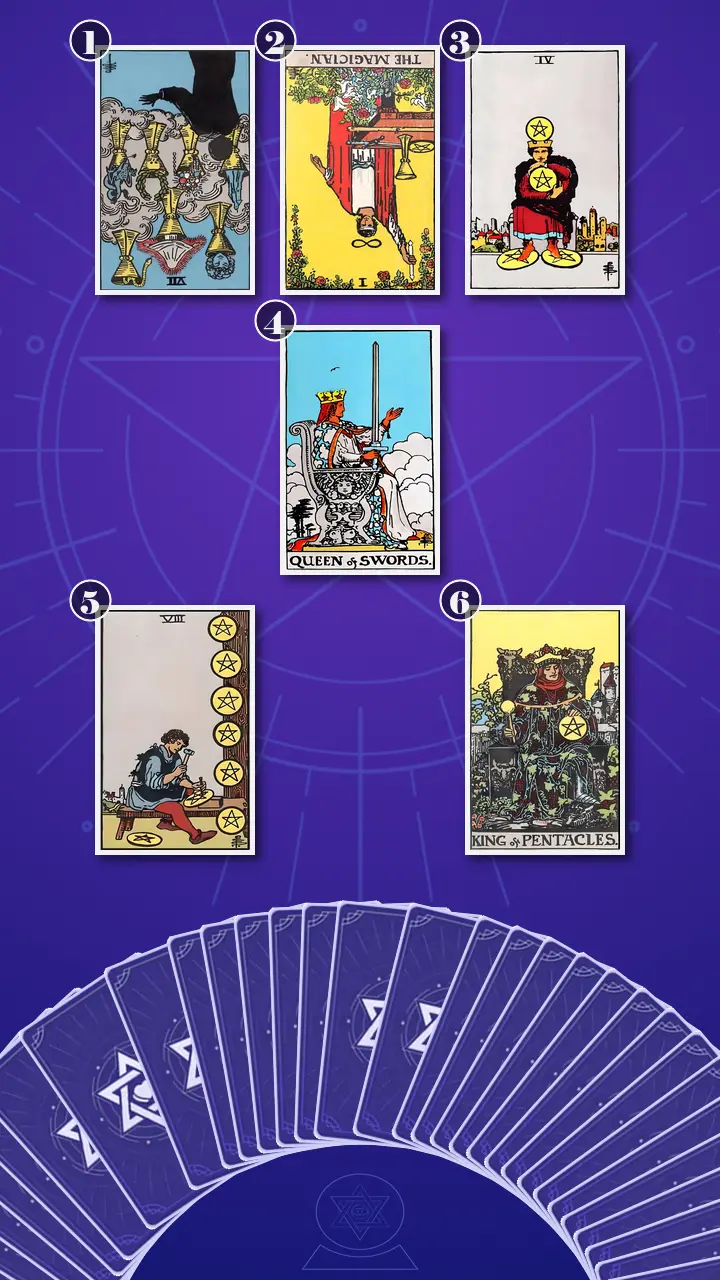
For this reading, I used my six-card Transformation Path Grid · Context Edition. It’s the spread I reach for when the issue isn’t a single messy room or a lack of discipline, but a self-reinforcing clutter loop: overwhelm leads to shopping, shopping creates relief, and that relief delays the real choices. A simple past-present-future spread can describe the mood, but it often misses the false solution in the middle — the part where preparation starts impersonating action. That’s why this particular decluttering tarot spread works so well for decision fatigue around possessions.
I told Maya, and any reader who has ever wondered how tarot works in a situation like this, that this spread is really a precision tool for card meanings in context. The first card would show the visible symptom. The second would reveal the loop-maintainer — the “helpful” behavior that keeps the pattern alive. The third would uncover the deeper fear under it. The fourth, at the center, would name the cognitive pivot. Then the last two cards would show the repeatable practice and the steadier result that could follow.
Fog on the Counter, Shopping in the Browser
Position 1: When One Pile Turns Into Twenty Decisions
Now I turned over the card representing the concrete clutter behavior and decision overload that appear the moment she tries to start sorting. It was the Seven of Cups, reversed.
I pointed first to the image before I translated it. Seven cups, too many possibilities, all suspended in cloud rather than resting on solid ground. In Maya’s life, that looked exactly like one messy surface turning into a branching decision tree the second she touched it. A charger wasn’t just a charger; maybe it belonged to an old hard drive, maybe it might matter for taxes, maybe it could help in a move, maybe throwing it out would be careless. One pile became twenty futures in under a minute.
Reversed here, the energy felt like blocked water — not imagination serving choice, but imagination flooding it. Clutter gets louder when every object is auditioning for a future version of you. So the real stall didn’t begin when the room looked bad; it began at the first keep-or-release decision, when possibility multiplied faster than action could keep up.
Maya gave a short laugh that had a wince inside it. “That is... weirdly rude,” she said, rubbing the side of her thumb against the edge of her sleeve. “Every pile does feel manageable until I actually touch it.”
“Exactly,” I said. “This isn’t laziness. It’s overload at item one.”
Position 2: When Preparation Starts Impersonating Action
The next card was the one representing the false solution that keeps the cycle repeating: buying organizing tools to feel temporarily in control instead of making keep-or-release choices. It was The Magician, reversed.
Of all cards, this one was painfully precise. The Magician upright knows how to use tools with intention. Reversed, the tools are still there, but the intention scatters. In real life, that looked like Maya after a hard hybrid-work day, laptop warm on her knees, measuring an entryway shelf, comparing drawer dividers, reading Amazon reviews, building a cart full of clear stackable bins and label refills while the unopened mail stack sat beside her ankle untouched. It had the exact energy of believing one perfect Home Edit-style haul could create the before-and-after without the boring middle where she actually had to choose what stayed. The apartment gained more equipment; the pile stayed exactly where it was.
I know this pattern well enough that I almost smiled — not at her, but at the card’s accuracy. In my own mind, The Magician reversed always flashes like a studio session where someone keeps adjusting plugins, renaming tracks, and perfecting the setup without ever pressing record. Motion everywhere. Movement nowhere.
“A prettier container can delay a choice, but it can’t make it for you,” I told her. “This is misdirected fire. The energy isn’t absent. It’s being spent on the performance of readiness. How many empty bins have been asked to do a decision’s job?”
Her shoulders rose on a breath and fell on the exhale. It wasn’t full relief yet; it was that tight, caught feeling of being seen kindly but accurately. “At least I’m doing something,” she said, then immediately made a face. “Which I know is the lie.”
“Not a lie,” I said. “More like a coping strategy with great branding.”
Position 3: The Grip Beneath the Shopping
The third card represented the deeper fear around waste, regret, and losing control that makes holding on feel safer than deciding. I turned over the Four of Pentacles, upright.
This card always shows me the body before it shows me the mind: the tight chest, the fixed jaw, the instinct to brace. In Maya’s world, it lived in the drawer of duplicate chargers, old notebooks, product packaging, spare stationery, half-used beauty supplies — the things kept not because they supported her current life, but because releasing them felt like inviting future regret. The second she considered tossing them, her chest tightened because what if she needed the wrong one later? What if letting it go proved she’d wasted money, dropped the ball, or wasn’t very good at adult life after all?
This was excess earth — structure used defensively, not supportively. Like a budget where every old purchase keeps demanding emotional interest long after the money is gone. The home gets crowded, but the deeper crowding is internal: present usefulness versus future what-if, space versus self-protection.
I asked her quietly, “If you threw out the wrong thing this week and regretted it later, what would it feel like that said about you?”
Her eyes dropped to the table. First came the little freeze in her breath. Then the faraway look, as if she were replaying some drawer she had already opened and closed three times. Then the answer arrived in a smaller voice. “That I can’t even manage basic stuff properly.”
That was the real root. Not mess. Not bins. Shame with a storage label on it.
When the Queen’s Sword Cut Through the Cart
Position 4: The Current-Life Rule
When I turned over the center card — the pivotal shift that interrupts the loop — the room changed in that tiny way rooms do when a sentence is about to matter. Outside my window, a streetcar scraped past and then the sound fell away. On the table, the spread had already shown me the top-row architecture clearly: fog, misdirection, contraction. Now we were at the hinge. The card was the Queen of Swords, upright.
Before I said anything else, I named the moment I knew she was living inside: the empty bins lined up on the counter, the chair pile still there, her whole body waiting for the magic feeling of being finally on top of it to arrive. She wasn’t only stuck in clutter. She was stuck in the belief that the right system had to appear before she could trust herself to choose.
I looked at the Queen’s raised blade, then back at Maya. “The breakthrough is not a better container,” I said. “It’s the moment you trust one honest rule more than another shopping cart.”
Stop outsourcing clarity to prettier containers, and start using the Queen’s sword to choose what genuinely deserves space.
She went still in three visible stages. First, a full pause — breath suspended, fingers hovering above the cuff of her sweater. Then her eyes lost focus for a second, not vacant but replaying: the kitchen counter, the row of empty bins, the cable put back down, the browser tab reopened. Then came the reaction neither of us could fake. Her mouth tightened first, almost irritated. “But then what was all that money on organizers for?” she asked. There was a flash of anger in it, and underneath that, grief. “Was I just avoiding it the whole time?”
“Sometimes,” I said gently, “we buy ourselves a waiting room because the real room feels too loaded. That doesn’t make you foolish. It means you were trying to lower the pressure with the tool that was available. But the Queen is asking for a different kind of authority now.”
This is where my own work always comes in. Through Somatic Rhythm Mapping, I had already watched her body tell the truth: shoulders racing upward the moment she looked at the pile, then heavy limbs the moment she tried to begin. That’s arrhythmia under pressure, not lack of care. And through my Execution Block Dismantling lens, I could hear the real dissonant chord: the task entry point was overloaded. She wasn’t failing at decluttering a room; she was hitting a five-part identity spiral at the first object. The Queen of Swords reduces the chord count. She takes “What if I need it, what if this proves waste, what if future me wants it, what if I’m careless, what if I should keep it just in case?” and replaces it with one cleaner beat: Does this earn room in my current life? It works like an email filter — once the rule exists, not every item gets a personal hearing.
Her eyes glassed a little, not with collapse but with release. Her shoulders dropped, and then — the part people don’t talk about enough — she looked slightly dizzy, the way people sometimes do when a burden leaves quickly and the body has to figure out what to do with the extra space. I asked her, “If you’d had that question last Tuesday, what would have changed?”
She let out a breath that was almost a laugh. “I probably would’ve left Amazon closed and just dealt with the cables.”
“That’s the shift,” I said. “Not from messy to perfect. From shame-driven visual overwhelm and pseudo-progress to the first real inch of grounded calm and self-trust.”
From One Rep to Stewardship
Position 5: Reps, Not Reinvention
The fifth card showed the small, repeatable behavior that converts insight into movement. It was the Eight of Pentacles, upright.
I loved seeing this after the Queen. Eight of Pentacles is gloriously unglamorous. One drawer. One shelf. One category. One timer. In Maya’s life, it meant real progress would look almost boring: a 15-minute three-option sort, one neutral category at a time, repeated often enough that self-trust starts to build. Not “fix my whole apartment this weekend.” More like, “I’m not fixing my whole life tonight; I’m finishing one rep.”
This was balanced earth — not gripping, but working. The difference between dramatic reset fantasy and repeatable practice. Her face softened as soon as the scale got smaller. I saw the pressure drop in real time.
“That actually sounds possible,” she said. “A whole reset makes me shut down. One category doesn’t.”
Position 6: The Home That Stops Feeling Like a Verdict
The last card depicted the grounded relationship to space, money, and possessions that replaces panic-buying and visual chaos. It was the King of Pentacles, upright.
Here, the earth energy had matured. The King doesn’t clutch. He manages. In modern terms, Maya knows what she owns, buys containers only after a category has been sorted and kept, and treats her apartment like something she stewards steadily rather than rescues in a panic. The room stops feeling like a verdict on her adulthood and starts feeling like a working home — one that can be office, landing zone, and living space without every corner carrying accusation.
She looked at that card for a long moment. “I want that,” she said. “I want to not need twenty minutes’ warning before someone comes over.”
“That’s not a fantasy,” I told her. “That’s a practice made visible.”
Sort First. Store What’s Left.
By the time I reached the end of the spread, the story was clean. The visible problem wasn’t a lack of bins. It was a small-apartment clutter cycle powered by decision overload. Seven of Cups reversed showed the fog: every object multiplying into five possible futures. The Magician reversed showed the false solution: shopping, measuring, planning, and researching until the setup felt like the task. Four of Pentacles named the root fear: if the wrong item left, it might feel like proof of waste, poor follow-through, or lost control. Then the Queen of Swords cut the pattern open. She turned sorting from a moral drama into criteria. Eight of Pentacles made the criteria repeatable. King of Pentacles showed what happens when calm replaces emergency management.
I told Maya the cognitive blind spot was simple and brutal: she had been treating clutter as a logistics problem when, underneath, it was an identity problem. No organizer can solve a referendum on competence. The transformation direction was just as simple: shift from “I need the perfect setup before I begin” to “I sort first and only buy storage for what I truly keep.” Real calm starts when your rules are clearer than your shopping cart.
Because her body had been flipping from buzzy urgency to heavy shutdown, I didn’t give her a makeover plan. I gave her my Frictionless Tempo Calibration — a three-day micro-habit sequencing experiment designed to rebuild momentum without triggering burnout.
She immediately raised a practical objection. “But after work I’m fried,” she said. “Sometimes I genuinely don’t have fifteen clean minutes.”
“Then we don’t demand fifteen,” I said. “We demand one completed beat. Five items counts. Five minutes counts. The point is not intensity. It’s a rhythm your nervous system will actually repeat.”
- Day 1 — Write the Current-Life RuleOpen your Notes app tonight and write one line you can use for the next ten items: “I keep it only if it serves my current life, I know what it is, and I would notice if it were gone.” Then put a sticky note on any unopened organizer box that says, “Sort first, store later.”If the rule sounds harsh, shrink the stakes. Test it on five items only. You are not deciding your worth; you are deciding whether one object earns space right now.
- Day 2 — One 15-Minute Sorting RepBook one short session right after work — Wednesday or Thursday at 7:15 p.m. works well for most people in this loop — and sort one tiny category only: chargers, unopened mail, reusable bags, or beauty samples. Use one trash bag, one donation bag, and one keep zone. No mixed piles. No shopping apps.When the timer ends, stop even if the area isn’t finished. Take one quick photo so your brain has proof that repetition counts. Minimum version: sort five items only.
- Day 3 — Start the No-Buy Container PauseFor the next seven days, if you think you need a new bin, add it to a list called “Real storage needs after sorting” instead of buying it. Move unopened bins, dividers, or labels into one visible holding spot. Only buy storage after a category has already been sorted, kept, measured, and still has no workable home.The pause is data, not deprivation. A shoebox, paper bag, or empty drawer is allowed to be your temporary container. You are separating a real need from a stress purchase.
When I finished, Maya looked back at the Queen of Swords and smiled in that wary, real way people do when advice finally sounds survivable. “Okay,” she said. “That I can actually hear.”

A Week Later, the Chair Was Still a Chair
A week later, Maya messaged me a photo instead of a long update. It was her entryway chair. Not perfectly styled. Not magazine-clean. But it was functioning as a chair again. One tote bag hung on the hook where it belonged. The unopened organizer boxes had been moved into a single holding spot. On the floor beside them sat one small donation bag and one dead charger coiled like a retired snake.
Her text said, “Did the Wednesday 7:15 rep. Cables only. I wanted to shop halfway through, but I used the rule instead. Also returned two unopened bins.” Then, after a gap, another message: “Still had the ‘what if I threw out the wrong thing?’ thought this morning. I laughed and checked my Notes instead.”
That was the proof I cared about. Not instant perfection. Not a life transformed by acrylic. Just the first visible evidence of a new internal rhythm: from panic cleaning to steady stewardship, from guilt-driven shopping to self-trust, from visual overwhelm to grounded calm. In this Transformation Path Grid · Context Edition reading, the cards didn’t rescue her apartment. They helped her hear where her authority had gone quiet — and then reclaim it.
When every object feels like it might expose money wasted, plans abandoned, or adulthood done badly, even opening one drawer can make your shoulders tense before you’ve made a single choice. If that’s where you are tonight, I hope you know that tension is not proof that you’re failing; it’s often just the sound of too many meanings crowding one small decision.
If you trusted one simple rule a little more than the fantasy of a perfect reset, what tiny category would feel safe enough to sort first?