Three Podcast Tabs and an Unopened Journal Became Three Quiet Rows

The 10:45 p.m. Self-Help Consumption Loop
If you are a 27-year-old junior content strategist in London who keeps a journal exercise open while three podcasts explain the same idea, this is the self-help consumption loop: the moment practice feels uncertain, you search for a safer version of it.
When Maya (name changed for privacy) joined my video call at 10:45 on a Tuesday night, an unopened notebook lay beside her on a small kitchen table. Three podcast tabs glowed at different timestamps behind our call. I heard the radiator click through her laptop speakers and watched blue screen light flatten the colour from her face as she shifted a warm phone from palm to palm, created a folder called Start Here, and saved five more episodes.
Then she stopped moving. “I already know what the advice will say,” she told me. “But I still want another version of it. Research feels productive until I notice I haven't actually done anything.”
She described what happened whenever Atomic Habits, a podcast, or a saved Instagram Reel reached the practical part. Her jaw tightened. Her fingers opened another tab. The quick lift of discovering a new framework dropped through her body like an escalator changing direction beneath her feet. She wanted to use what she knew, but real practice could produce an imperfect result. More research kept that result safely hypothetical.
“That doesn't sound like laziness to me,” I said. “It sounds like a protective loop that has become expensive. We are not going to predict your future or shame you into discipline tonight. We are going to make the loop visible, find what it protects, and draw a route through the fog that still leaves the choices with you.”

Choosing the Four-Layer Insight Ladder
I asked Maya to place her phone face down, feel both feet on the floor, and take one ordinary breath while holding the question: Why do I keep consuming self-help instead of using what I know? I shuffled slowly, using the pause as a transition from reacting to observing rather than as a mystical performance.
I chose the Four-Layer Insight Ladder tarot spread. This is how tarot works best in my practice: not as a predictive authority, but as a structured cognitive mirror. The issue was a compact, self-reinforcing system. Searching postponed action; the lack of action prevented usable evidence; the missing evidence seemed to prove that more searching was necessary. A larger spread would have added noise to a loop that needed clean diagnosis.
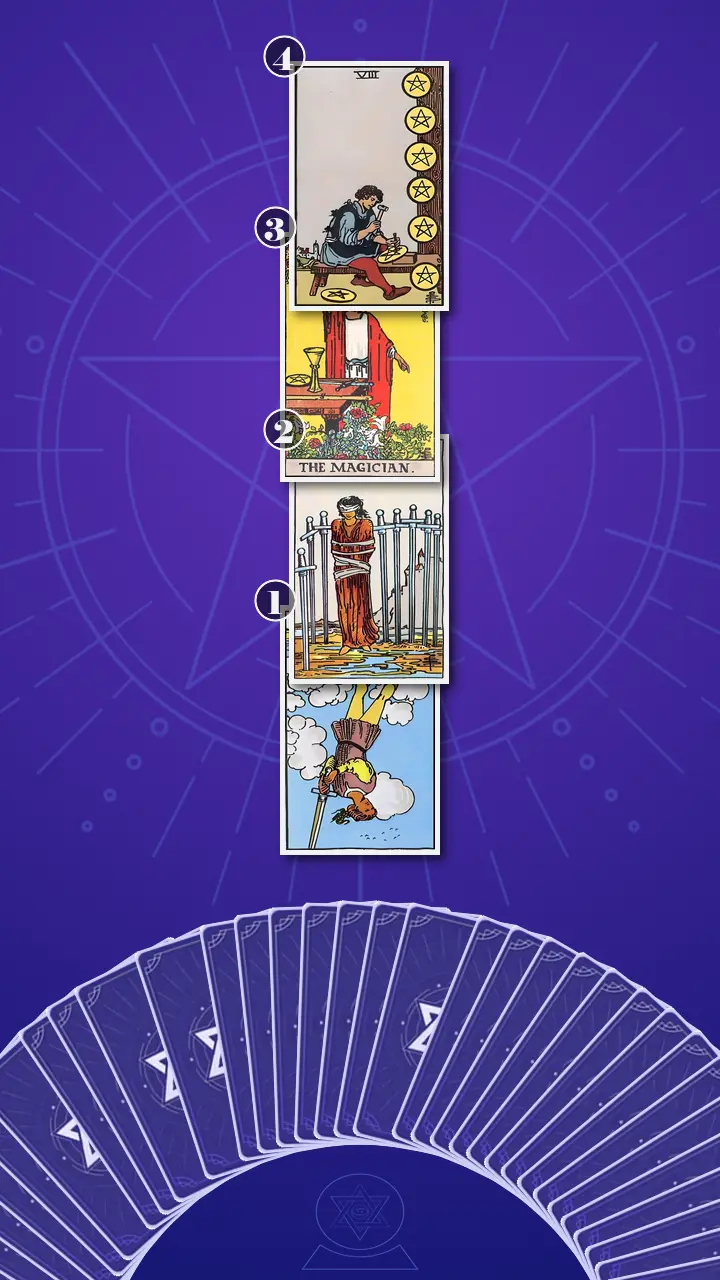
I arranged four cards in a vertical line like a short ladder. The bottom position would reveal the Present Pattern, the observable behaviour replacing practice. Above it, the Root Mechanism would show why preparation felt safer. The third position, the Transformative Principle, would identify the lever capable of interrupting the loop. The final card would translate that shift into Practical Integration. I wanted Maya, and anyone reading this, to see card meanings in context: behaviour, belief, intervention, practice.
Reading the Loop Behind the Open Tabs
Position 1: Present Pattern, The Restless Student
Now I turned over the card representing Maya's Present Pattern: the visible searching, saving, note-taking, and method comparison that replaced the exercise. It was the Page of Swords, reversed.
In the Rider-Waite-Smith image, the Page braces against strong wind with a sword held high. The mind is alert, but the body has not committed to a direction. Reversed, I read that active air as an excess: curiosity had become scattered intake, while directed attention was blocked.
“This is you with six advice tabs open, a podcast paused at 42:17, and a journal prompt still untouched,” I said. “The moment the prompt asks you to choose a behaviour, you rewrite its takeaway in Notion or look for someone more credible to explain it. You get a quick rush of competence, then your hands stay restless and your motivation falls flat.”
I pointed to the sword. “Curiosity is not the enemy. But here, the phone is functioning like that raised blade: ready, intelligent, vigilant, and never brought into contact with one chosen task. It is also like an algorithm that has learnt uncertainty keeps you scrolling. Just as the exercise asks you to stop consuming, it serves another productivity clip that promises a calmer morning or a total reset.”
Maya gave a brief laugh with no lightness in it. “That is painfully accurate. Slightly brutal, actually.” Her thumb rubbed the corner of the face-down phone while her gaze stayed on the reversed Page.
“Accurate does not have to mean condemning,” I replied. “The Page is showing us where the switch happens. When you reach an exercise and your hand moves towards a new tab, what does your body seem to expect will happen if you begin?”
She pressed her tongue against the inside of her cheek before answering. “My jaw locks. Then there's this drop in my stomach, like the exercise is about to catch me out.”
Position 2: Root Mechanism, The Rule That Feels Like a Locked Door
Next I turned over the card representing the Root Mechanism: the belief and underlying fear that made continued preparation feel safer than imperfect evidence. It was the Eight of Swords, upright.
The blindfolded figure appears surrounded, but the bindings are loose and the enclosure of swords is incomplete. I read this as a blockage created by a rule that feels absolute: I cannot begin until I know which framework is best. The available agency has not disappeared; recognition of it has become deficient.
“This card is not telling you that the restriction is imaginary,” I said. “Your jaw, stomach, and urge to escape are real. It is showing that the conclusion you draw from those sensations may be too final. You could close the extra tabs, try two minutes of the exercise, and stop. Nothing about that reversible choice requires a permanent commitment.”
I traced the visual movement between the first two cards. The Page gripped a sword in turbulent air; the bound figure could not use her hands. I named the internal defence as I had heard it in Maya's story: “I am not avoiding this. I am preparing properly.” The search activity was visible, intelligent, and busy. The experiment remained absent.
“The swords around you are competing standards,” I continued. “One creator says wake at five. Another says protect sleep. One app says never break the streak. Another says identity matters more than tracking. If you require every standard to agree before you move, it is like waiting for every traffic light in London to turn green before walking one block.”
I asked, “Think about the last time you delayed a small action because you needed the right method. What did you believe an imperfect result would prove about you?”
Her fingers stopped rubbing the phone. Her eyes drifted towards the dark kitchen window, and I watched her replay something before she spoke. “That I am the problem. That other people can follow through and I can't.” A longer breath left her chest. “So another method lets me postpone finding out.”
“Yes,” I said. “And that is the blindfold. You have been treating uncertainty as evidence that no safe movement is available. An imperfect result can describe an experiment without defining a person.”
When The Magician Put One Tool on the Table
Position 3: Transformative Principle, Focused Agency
The room seemed to become quieter as I reached the third position, the turning point of the ladder. Even the radiator paused. I turned over the card representing the Transformative Principle: the precise shift from complete certainty to one bounded real-world experiment. It was The Magician, upright.
The four suit tools were already arranged on the table. One hand raised the wand; the other pointed towards the material world. I read this as balanced, directed energy: thought, intention, feeling, and physical behaviour coordinated around one task. The Magician did not need another resource to arrive before beginning.
In Maya's life, the scene was practical rather than grand. One saved exercise. One calendar block. One timer. One notebook. The result would be information about an attempt, not a performance review of her character. This was the point where collecting maps could become one reversible step down an actual road.
I pictured her at 10:45 p.m., journal open and three podcast tabs glowing, reaching for another explanation just as the exercise asked for contact with experience. The room offered one route forward, but her mind kept generating exits. She was trying to make action feel certain before allowing action to teach her anything.
You do not need one more perfect map; choose one tool already on the table and use The Magician's gesture to bring a single intention into concrete action.
For one beat, Maya did not move. Her breath stopped, and her fingers hovered above the edge of the notebook. Her eyes went slightly unfocused, as though she were replaying every evening she had renamed a folder instead of touching the exercise inside it. Then her pupils widened and her mouth tightened. Relief appeared first, followed almost immediately by irritation. “But doesn't that mean I've been doing this wrong for years?” she asked, her voice sharper than before. Her shoulders rose towards her ears again, and I let the silence hold without trying to rush her towards a prettier feeling. “No,” I said. “It means learning protected you when exposure felt too costly. The knowledge is not worthless, and you were not foolish for seeking it. We are only questioning whether the next explanation still earns the time it takes.” Her fist loosened against the table. She looked at the Magician, exhaled with a slight tremor, and said, “So the result can be bad without me being bad.” The release left her briefly unsteady, as if clarity had removed a railing she was used to gripping.
I asked, “Now, using this new perspective, think back to last week. Was there a moment when this insight could have made you feel different?”
“Thursday,” she said. “A senior strategist edited my campaign brief. I opened a tab about confidence instead of revising it. I thought another imperfect draft would prove I wasn't good enough for the job.” She looked down at the Magician's tools. “I could have changed one paragraph and learnt something from the next round of feedback.”
The card brought back a restrained memory from my Wall Street years: a desk covered in sophisticated research while the actual decision remained untouched. I used the diagnostic lens I call Time-Asset Valuation. I asked Maya to audit the hidden return on the hour after an exercise made her uncomfortable. The first explanation might have produced genuine insight. The fourth comparison usually produced temporary relief, declining informational value, and the opportunity cost of no lived evidence.
“This is not about monetising every minute,” I told her. “Sleep, a walk, dinner with your flatmate, or doing absolutely nothing can be high-value uses of time because they restore you. The hidden sunk cost is not the books you already read. It is continuing to pay tonight's protected time into the promise that certainty will arrive tomorrow.”
I placed my finger beside the four tools. “You are not missing another explanation; you are missing a small container where one existing idea can be tested safely. You do not need to feel certain. You need a container small enough to let uncertainty exist.”
This was the emotional crossing at the centre of the reading: not from doubt to total confidence, but from certainty-seeking self-doubt towards the first grounded act of self-trust. Maya did not have to become a different person. She had to let one ordinary action produce information without converting that information into identity.
The Quiet Evidence of One Repeated Practice
Position 4: Practical Integration, The Working Apprentice
Finally, I turned over the card representing Practical Integration: the repeatable behaviour that could produce observable feedback without tying the result to personal worth. It was the Eight of Pentacles, upright.
The craftsperson works on one pentacle while completed pieces hang in an orderly row. I read the earth energy here as balanced and available. The Magician initiates; the Eight of Pentacles stays long enough to learn. Knowledge becomes useful through attentive repetition rather than through a dramatic burst of motivation.
“This is you using the same short exercise on Tuesday, Thursday, and Sunday,” I said. “You record the date, what you did, and one thing you noticed. The first attempt can feel awkward. The second can be interrupted by a work message. The third can become slightly easier to start. All three are evidence.”
I showed her the two eights in the spread. The Eight of Swords organised repetition into a restrictive mental enclosure: search, compare, delay, restart. The Eight of Pentacles redirected the same capacity for repetition towards craft. Maya did not need to invent consistency from nothing. She was already repeating something. The question was whether repetition would keep reinforcing restriction or begin building skill.
“Let repetition answer the question that comparison keeps reopening,” I said. “The craftsperson's workbench is away from the distant town. Nobody needs to applaud this. You do not need a streak screenshot, a new identity, or a LinkedIn post about your life-changing system. You need three ordinary encounters with the same practice.”
Maya frowned at her calendar. “But agency work eats my evenings. Sometimes I honestly don't have fifteen minutes.”
“Then fifteen minutes is too large on those days,” I said. “Make it two. Success is completing the agreed container, not proving that you can override exhaustion. If the most truthful choice is rest, choose rest consciously. A useful experiment protects your agency; it does not become another rigid routine that punishes you.”
Turning Insight Into an Evidence-Not-Verdict Plan
I read the whole ladder back to Maya as one connected story. The reversed Page showed the surface behaviour: a mind moving quickly between tabs while the hands avoided one direction. The Eight of Swords revealed the learned equation beneath it: uncertainty meant danger, and an imperfect result might become a verdict on worth. The Magician interrupted that equation by coordinating tools she already owned. The Eight of Pentacles grounded the intervention in repetition, review, and observable evidence.
The spread did not contain a separate past position, but its history was visible in the pattern Maya described. Work feedback, polished creator routines, missed habits, and Sunday-night comparison had trained an internal recommendation engine: discomfort triggered new input, new input delivered relief, and relief rewarded the next search. The personal algorithm was not malicious. It was optimised for avoiding exposure, not for gathering real-world data.
Her cognitive blind spot was the assumption that not feeling certain meant no safe action existed. That assumption kept her restarting before repetition had enough time to teach her anything. The transformation direction was therefore precise: when discomfort appeared, she would pause the next search and run one small, reversible test before consuming more advice on that topic.
“We are not building another elaborate system,” I said. “We are designing the smallest structure that can survive an ordinary London week. Do not ban learning; pause the next search long enough to meet the idea you already chose.”
The 48-Hour One-Tool Test
I combined The Magician's focused agency with a practical intervention I call Energy Portfolio Restructuring. The goal was subtraction before addition: remove one high-friction habit for 48 hours, return part of the recovered bandwidth to genuine rest, and give one existing idea a small calendar container.
- Choose one tool already on the table. Before bed tonight, select one exercise already saved in Notion, Apple Notes, or a book. Put its smallest action into one calendar block for a specific day. Set the container at fifteen minutes, or two minutes if fifteen feels too exposed. Tip: Put the phone in another room and leave the exact exercise visible. Define success as staying with the agreed time, not feeling inspired or finishing perfectly.
- Restructure the next 48 hours by subtraction. Remove one predictable high-friction habit, such as the twenty-minute advice scroll after dinner or the Sunday-night productivity-app redesign. Reinvest that exact block exclusively in a high-yield recovery choice: a shower, a short walk, music without advice, or an earlier lights-out time. Tip: Recovery does not have to produce output. This subtraction prevents the experiment from becoming one more demand added to an already overdrawn evening.
- Build a three-attempt Evidence-Not-Verdict Log. Repeat the same exercise three times before replacing it. Use one existing note with four columns: date, action, completed, observation. At the end of each attempt, record what you did, what you noticed in your body or mood, and what you might test next time. Review the three entries on Sunday at 6 p.m. Tip: Make no mid-experiment redesign unless the practice is unsafe or clearly incompatible with your circumstances. Boredom, awkwardness, and the urge to compare are observations, not automatic instructions.
I reminded Maya that the review date was a decision aid, not a contract to endure a bad fit. She remained free to stop, adapt, seek appropriate support, or choose a different exercise. Tarot had helped us externalise the pattern and examine it from several angles; it had not taken ownership of the decision.

A Week Later: Three Quiet Rows
A week later, Maya sent me a photo of three handwritten rows. The exercise had felt ordinary, not transformative. Her first thought that morning was still, “Maybe another method would be better.” She smiled at the thought, made coffee, and kept her Sunday review date.
She had noticed that the first attempt brought a tight jaw, the second brought impatience, and the third began without a search. None of that solved her life. It did give her something the full Start Here folder could not: direct evidence that discomfort could be present without controlling the next move.
I thought again of the hands across the spread: the Page gripping an idea defensively, the bound figure unable to act, the Magician directing intention, and the craftsperson using one tool. The cards did not make those hands move. Maya did. Her Journey to Clarity was not a journey towards perfect certainty; it was a shift from restless information gathering to grounded self-trust through bounded experiments and repeated practice.
When the exercise is open and your jaw tightens, it can feel safer to keep learning than to let one imperfect attempt say something about your worth. Simply noticing that old internal algorithm already creates a gap between the urge to search and the choice that follows.
If one idea you already saved could become a low-stakes fifteen-minute experiment rather than a verdict, which tool is already waiting on your Magician's table, and what would you be curious to notice this week?