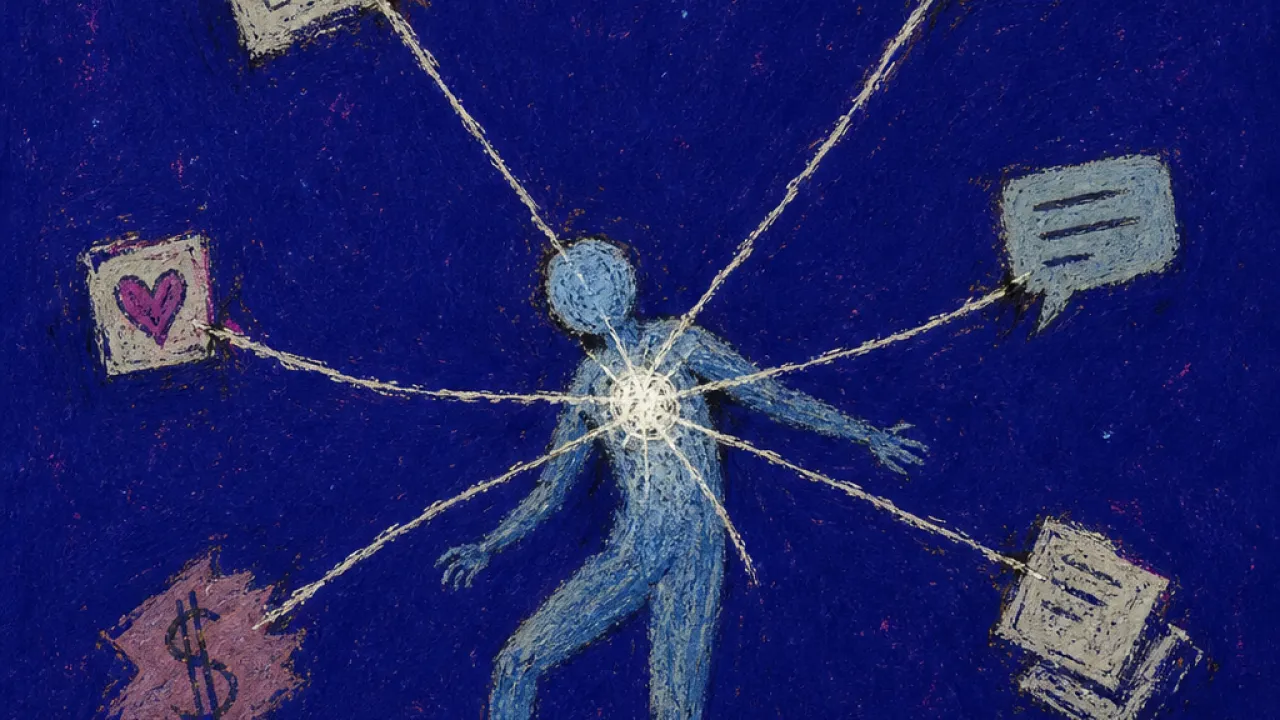
In an Insight Integration Window, the pressure comes from the gap between the pattern becoming visible and the surrounding schedule still moving like nothing has changed. The held breath in your chest, the late-night notes, and the pause before the next message all point to the same thing: this is not just a private thought. It is an environmental, structural dynamic where insight has to compete with deadlines, apps, routines, and other people's timing before it can become usable. The Tarot Cards below reflect the shape of that window without telling you to rush it or freeze inside it.
Wheel of Fortune UprightThe wheel is packed with letters, alchemical marks, spokes, and book-bearing figures, yet the image binds them into one coherent mechanism. Knowledge is not scattered across the sky; it is arranged around a center that can turn. That visual structure fits the moment when personal growth material stops being content and starts becoming an operating model. You may have collected frameworks, journaled through patterns, watched enough explanations, and gathered enough language, but the real opening is the chance to connect those pieces into lived behavior. The card grounds this context through its layered architecture. Insight becomes useful only when the symbols stop competing for attention and begin working as one system that can guide timing, choice, and repetition in the real world.
The Hanged Man UprightThe bright halo sits above a body that cannot yet reach for anything, making insight physically separate from action. The living tree keeps the figure connected to the world, while the suspended posture shows that understanding has not yet returned to ordinary movement. For personal growth, this points to the narrow window after a realization, course, conversation, or journal breakthrough, when the insight has to survive contact with daily habits. You are seeing a gap between knowing and embodying, and the card gives that gap a visible structure instead of treating it as a personal flaw.
Temperance UprightThe liquid moving cleanly between the two cups gives Temperance its most concrete image of integration: separate contents are not erased, but blended through steady handling. One foot on land and one in water keeps the process tied to both lived reality and the deeper material that usually stays below the surface. In personal growth, that image points to the moment after insight arrives but before it becomes a life structure. You may understand the pattern, name the belief, or see the limiting loop, yet the card holds attention on the transfer itself: the fragile passage from inner recognition into repeatable action. The road rising behind the angel matters because the work is not complete at the level of awareness. The path asks whether the new clarity can travel into your habits, choices, timing, and boundaries without spilling into another round of abstract self-analysis.
The Tower UprightThe lightning in The Tower is violent, but it is also the brightest line in the image. It cuts through the dark sky and reveals the tower's instability at the exact moment when the windows show fire already moving inside. That creates a narrow window for integration. In introspection, You may suddenly see a pattern with uncomfortable precision: the mask, the avoidance, the self-criticism loop, the relationship to control, or the private bargain that kept the old structure standing. Insight Integration Window fits because the card does not end at revelation. It shows that seeing clearly has a cost and a timing: the exposed truth must be brought into the rebuilt structure, or the mind will try to seal the tower again once the smoke clears.
The Star UprightThe woman kneels with one knee on land and one foot touching water while two vessels pour in different directions. One stream returns to the pool, and the other breaks into channels across the ground, turning inner clarity into something that must reach a real surface. That is the structure of an integration window. You are not short on insight; the pressure is whether the insight can survive contact with routines, choices, and friction. The stars overhead give orientation, but the card keeps the work at ground level, where a new understanding has to become a repeatable practice before it evaporates.
The Moon UprightThe small creature breaking the surface at the exact beginning of the path is a concrete image of something previously submerged becoming available for movement. Above it, the yellow drops fall from the moon toward the land, turning the scene into a vertical exchange between hidden material and practical ground. In personal growth, this is the fragile stage after an insight has surfaced but before it has changed the architecture of daily life. You may have named a pattern, recognized a belief, or seen the cost of an old script, yet the card shows that recognition is only the shoreline, not the journey itself. Insight Integration Window belongs to the Moon because the card is built around partial illumination becoming embodied action. It asks for a grounded container where what has been seen can become a repeatable behavior rather than another passing realization.
The Sun UprightThe child on the white horse has already crossed the wall, and the sunlight leaves very little hidden. The image is not just bright; it is organized brightness, with rays, flowers, wall, horse, and flag all forming a field where something newly understood can become visible and usable. In personal growth, this points to the rare window after an insight lands but before it becomes another abandoned idea. You are not looking for more explanation here; the structure shows that the real test is whether clarity can be placed into rhythm, environment, and action while the light is still strong enough to guide it.
Judgement UprightRadiating lines from the trumpet create a visible path of sound, and every raised body turns toward it. The call is not abstract; it has direction, timing, and a physical audience. In a personal growth reading, this becomes an insight integration window. You have received enough signal to see the pattern, but the open coffins show that recognition is only the threshold; the real leverage is whether the insight becomes a routine, boundary, or decision that can hold weight outside the moment of realization.
The World UprightInside the laurel oval, the dancer holds two wands while the scarf traces one continuous route through the body. The image is not a search for another tool; it is a completed circuit where movement, symbol, and boundary are already coordinated. In personal growth work, that maps to the moment when insight has enough structure to leave the intake phase. You are not facing a lack of information; the external pressure is the window where learning either becomes an embodied routine or stays suspended inside a beautiful closed loop.
Ace of Cups UprightThe hand holding the chalice at the center of the Ace of Cups creates a precise receiving posture: something arrives, the vessel opens, and the water begins to move into a larger pool. The card does not show a finished transformation. It shows the first usable moment when raw insight has somewhere to land. In personal growth, that visual structure maps to the window after a breakthrough but before integration. You may have just read the sentence, had the conversation, joined the practice, or noticed the pattern that finally makes things click, yet the real test is whether the insight can enter your ordinary routines without evaporating into a beautiful idea. The five streams matter because the card shows flow becoming distributed. This context asks whether your new clarity can travel into behavior, attention, relationships, creative work, and self-trust, instead of staying sealed inside a private emotional high.
Two of Cups UprightThe two full cups are already raised, and the caduceus stands between them as if the moment has become organized enough to hold meaning. The figures are not searching for the vessel; they are already in the exchange, with stable ground beneath them and ordinary life visible beyond the encounter. In introspection, this points to the brief window after something becomes clear but before it is fully lived. The insight has surfaced, the relational mirror has done its work, and the structure now has to move from recognition into integration rather than remaining a beautiful moment of awareness. The card’s calmness is important because integration rarely looks dramatic from the outside. It looks like keeping the cup level after the conversation ends: carrying the named pattern back into choices, boundaries, routines, and the way you meet yourself when no one is watching.
Three of Cups UprightPumpkins, grapes, vines, wreaths, and filled cups gather around the dancers as proof that effort has reached a visible result. The card is set at a completed seasonal threshold, where the work has produced something real enough to be shared. In personal growth, this points to the delicate window after a breakthrough, completed challenge, therapy-adjacent insight, course, habit streak, or major realization. The external structure has given you evidence of progress, but the next stage depends on whether that evidence becomes part of your daily operating system. The scene holds celebration and consolidation at the same time. You are not being pushed to chase another milestone immediately; the card reveals the practical need to metabolize the win before the harvest becomes only a memory of progress.
Four of Cups UprightThe three cups on the ground sit like completed containers, close enough to be counted but not being used. Above them, the fourth cup is offered from another level, creating a visible gap between what has already been received and what is trying to enter next. That gap is the exact pressure point of an insight integration window. In personal growth, You may have gathered frameworks, feedback, books, and breakthroughs, yet the image shows that collected material does not become development until it can cross into ordinary behavior. The Four of Cups does not treat the next cup as automatically better than the first three. It reveals a structure where the growth task is conversion: turning what is already present into lived contact before another polished insight becomes more unused inventory.
Five of Cups UprightThe three overturned cups, the two upright cups behind the cloaked figure, and the bridge to the distant house create an inventory rather than a closed ending. The picture holds loss in the foreground while quietly preserving resources and a route, which is exactly the structure of an insight that has not yet been turned into a life system. In personal growth, this maps to the period after a setback when you have enough evidence to learn from what failed, but the lesson still needs a container. The card points to integration as the real threshold: not pretending the spill did not happen, but identifying what remains strong enough to carry across the bridge.
Seven of Cups UprightThe figure stands still before a full inventory of symbols, not yet grabbing, rejecting, or escaping. The cups are suspended in a way that allows the whole field to be seen at once, which makes the card less about immediate action and more about organizing what has already surfaced. In personal growth, this is the narrow window after insight appears but before it becomes structure. You may have gathered enough observations about your habits, desires, strengths, and avoidance patterns, yet the material is still floating above the ground. The card supports this context because it shows insight as raw material that still needs integration. The next leverage point is not more input; it is the translation of scattered self-knowledge into a stable practice, priority, or decision.
Eight of Cups UprightThe river still moves beside the stacked cups, and the staff gives the walking body a way to translate intention into traction. The higher ground ahead suggests that perspective only arrives after the stored material is carried into motion. In personal growth, this is the moment when insight has accumulated but has not yet become a lived system. You are not short on meaning; the card reveals the narrow window where reflection, courses, and realization have to cross into repeatable practice.
Nine of Cups UprightThe nine cups arranged behind the seated figure create a shelf of completed wants, while his crossed arms keep the center of the body protected. The scene is not empty or lacking; it is full, ordered, and paused. For personal growth, that pause matters. You may have gathered insight, proof, confidence, or a meaningful win, but the card shows a threshold where the next task is not more acquisition. The structure asks whether the achievement has become part of your lived system yet. The raised cups suggest that progress is visible, but visibility is not the same as embodiment. This context names the moment when growth needs time to settle into routine, language, boundaries, and choices before it can become the next chapter.
Ten of Cups UprightThe ten cups do not scatter across the sky; they sit in a clear arc above an ordinary home, a river, and moving bodies. The image gives emotional fulfillment a structure, suggesting that what has been learned internally can finally be placed into daily life. In personal growth, this is the moment when insight stops being content to consume and starts becoming a lived arrangement. The river matters because it keeps the scene moving, while the house and garden prevent that movement from becoming abstract or ungrounded. You can use this context to locate the narrow window between understanding something and building around it. The card does not reward endless reflection; it shows the conditions under which reflection becomes a repeatable way of living.
Page of Cups UprightThe young Page studies the cup as the fish rises from it, turning a private emotional signal into something visible enough to inspect. The image is not only about receiving a feeling; it shows a small, time-sensitive exchange between a contained vessel and a living message that has surfaced from deeper water. In personal growth work, that same structure appears when an insight finally becomes concrete enough to handle. You may have a prompt, reflection, creative idea, or moment of self-recognition that is no longer vague, but it still needs a container before it can become practice. The platform beside the sea matters because the Page is close to emotional movement without being swallowed by it. This card maps the window where clarity can be converted into a repeatable structure, before the signal dissolves back into content, mood, or abstraction.
Knight of Cups UprightThe knight already holds the cup, but the horse is only just approaching the river. The image is not about needing more inspiration; it is about carrying a fragile insight across a real threshold without spilling it through speed, distraction, or overcontrol. In personal growth, this matches the moment after a breakthrough when the old terrain no longer explains you, but the new system is not yet lived. You have something valid in hand, and the work is to build a crossing structure that lets it become behavior rather than another beautiful realization.
Queen of Cups UprightThe chalice is supported from below and steadied from the side, making the Queen's hands look less like grasping and more like careful maintenance. The shoreline around the throne creates a threshold: inner material is close to the outside world, but it has not yet become motion. In personal growth, that is the brief window after an insight lands and before ordinary life absorbs it. You are in a setting where the structure can be translated into routines, choices, or small experiments if the container stays stable long enough.
King of Cups UprightThe distant sailboat, the leaping dolphin, and the king's foot near the waterline all show movement around a composed center. The insight is not trapped inside the cup; the wider scene contains vessels, signals, and a route through moving water. That visual structure fits a growth window where awareness is ready to leave the private container. You may already understand the pattern, but the next pressure point is whether that understanding can travel into choices, boundaries, routines, and creative output. The card does not rush the crossing. It shows integration as a navigational problem: the cup holds the recognition, the sea holds the complexity, and the boat marks the place where inner clarity starts becoming external motion.
Ace of Pentacles UprightThe pentacle is not buried in the garden yet; it is held above the place where it could become real. The arch and road below show a passage from idea to embodied practice, with the mountain in the distance marking the longer climb after the first opening. In personal growth work, this describes the brief window after an insight, coaching session, book, or hard realization when the pattern is visible enough to be converted into a routine. You can treat the insight as a trophy, or you can let the structure reveal where it needs to enter your actual day.
Two of Pentacles UprightThe loop between the pentacles is readable, rhythmic, and contained by the figure's coordinated hands. Even with waves behind the scene, the image holds a temporary window where movement can be organized instead of scattered. For personal growth, this points to the moment after insight but before it hardens into a stable practice. You may have enough information to see the pattern, but the card emphasizes translation: the idea has to become a repeatable rhythm inside real constraints. The value of this context is timing. The card marks a usable integration window, where the next layer of growth depends less on consuming more insight and more on giving the insight a structure that can move through ordinary life.
Three of Pentacles UprightThe blueprint in the bishop's hand and the hammer in the craftsperson's hand occupy the same worksite. The plan is not floating above the scene; it is positioned beside stone, tools, and a pillar waiting for contact. That visual chain is the logic of insight integration. Ideas become useful only when they travel from design into repeated contact with material reality: a habit, a practice session, a boundary rehearsal, a visible piece of work. Insight Integration Window fits because the card captures the moment when learning has enough structure to become embodied. You are not being asked to collect another framework; the workshop shows where the existing framework wants to meet the tool already in your hand.
Seven of Pentacles UprightThe grounded pentacle beside the hoe is the one piece of growth that has left the vine and entered the worker's immediate space. It sits at the handoff point between harvesting, using, and planting again, while the rest of the crop remains in formation. For personal growth, this is the window after an insight becomes tangible but before it has been integrated into daily behavior. The card makes the conversion problem visible: information has become available, but its value depends on whether the system can carry it into practice rather than back into more collecting.
Eight of Pentacles UprightThe hammer meeting the coin at the bench shows knowledge in the act of becoming form. Five pentacles are already finished, but the current piece still requires pressure, rhythm, and attention before it can join the visible line. For personal growth, the scene points to the threshold where insight has to stop being a private concept and become observable behavior. You are in the zone where clarity must pass through repetition, feedback, and material proof before it can change the wider pattern of life.
Page of Pentacles UprightThe Page holding the pentacle at eye level turns a material symbol into a focused object of study. His body is still, his hands are careful, and the open field around him gives the scene the quality of a practice ground rather than a finished achievement. That visual structure fits the point in personal growth where insight has to become something usable. The coin is not abstract wisdom; it is a concrete unit of value being examined, tested, and learned through attention. You are not looking at instant transformation here. The card frames a window where one clear realization, one habit, one course, one tool, or one grounded experiment can become the bridge between self-awareness and actual behavioral change.
Knight of Pentacles UprightThe pentacle is held carefully, but the Knight's gaze moves past it toward the field. The image turns the coin into something more than an idea; it has to be carried into terrain, timing, and repeated labor before it becomes useful. In a personal growth reading, this describes the fragile window after an insight but before embodiment. You can see the principle, but the card keeps attention on the gap between understanding something and building the routine that lets it change your actual life.
Queen of Pentacles UprightThe pentacle is held low and studied carefully, with the fertile ground and water beyond it showing a system ready to turn attention into form. The Queen's stillness is not empty; it is a contained moment before value becomes routine, schedule, or visible work. For personal growth, this describes the narrow window after insight but before implementation hardens. You are not lacking more input; the structure is asking for translation from mental clarity into repeatable material practice.
Ace of Swords UprightThe cloud-born hand holds the sword firmly at the center of the image, and the blade reaches into the crown rather than drifting through the sky. The visual structure begins with a clean mental instrument, but it is still suspended above barren hills, so clarity has arrived before it has become terrain. In personal growth, that is the pressure of an integration window. You may have named the belief, seen the pattern, or found the principle that cuts through the noise, but the image keeps the insight in the air until it is carried into a repeatable practice. The leverage is not more information; it is the point where the bright idea gets connected to the ground.
Three of Swords UprightThe swords are painful, but their geometry is ordered. Their clean angles and shared center create a map of impact, while the rain around the heart gives the scene a visible channel for release rather than a sealed, static wound. In personal growth, this is the narrow window after a painful event when the facts are finally arranged clearly enough to study. The card does not romanticize the hit; it shows how a sharp experience can become usable only when the pattern, source, and cost are all held in the same frame.
Four of Swords UprightThe three swords fixed above the knight and the single sword hidden below create a mental architecture around a body that is not yet moving. The stained glass glows from the side, suggesting that meaning is present, but it has to pass through stillness before it becomes usable. For personal growth, this is the stage after insight but before embodiment. You may already have the language, the framework, or the realization; the unresolved task is letting it settle into a repeatable way of living instead of treating every new idea as the next breakthrough.
Six of Swords UprightThe swords are not scattered; they are evenly spaced and held upright while the boat follows a quiet current toward a far bank. The ferryman's oar touches only a small field of ripples, suggesting measured movement rather than dramatic reinvention. In personal growth, the structure points to a moment when insight is ready to become lived architecture. The scene is not organized around more input; it is about arranging what is already onboard so the crossing has order, direction, and a workable pace.
Eight of Swords UprightOne foot rests in pooled water while the other remains on muddy ground, placing the body between submerged material and practical footing. The distant castle and higher terrain show that a reference point exists, but the foreground still has to carry the weight of transition. For introspection, this is the space after recognition and before embodiment. You may understand the pattern, name the trigger, and still need time for the insight to find a stable route through ordinary life.
Page of Swords UprightThe Page stands on uneven high ground with the sword lifted cleanly while wind moves through his hair and clouds gather close. The blade gives a clear line of thought, but the terrain insists that clarity still has to be carried through unstable conditions. For personal growth, this matches the window after a real insight but before that insight has become a repeatable structure. You may have named the pattern, understood the lesson, or seen the next version of yourself, while the practical ground underneath still needs pacing, feedback, and disciplined rehearsal.
Queen of Swords UprightClouds cover the Queen's cloak, butterflies are carved into the throne, and a lone bird crosses the clear space above her. The image gathers thought, transformation, and distance into one controlled scene, with the sword acting as the instrument that can cut an idea into usable form. This fits the narrow window after an insight has arrived but before it has changed the day-to-day system. The growth work is no longer about collecting another realization; it is about translating the clean view above the clouds into routines, decisions, and boundaries that can survive on the ground.
King of Swords UprightThe butterfly carved into the throne sits beneath a ruler who does not move until thought has taken form. Above him, birds and clouds keep the air active, while the upright sword gives that movement a single edge. For personal growth, this is the window where insight has to leave the feed, the journal, or the coaching session and become a smaller set of repeatable decisions. The card frames integration as a translation problem: ideas are abundant, but they only become growth when they can survive contact with your daily system.
Ace of Wands UprightThe falling leaves around the sprouting wand are not waste; they show energy returning to the ground where it can feed the next cycle. The river beneath the hand keeps the landscape connected, turning a single spark into something that can move through the wider system. This matches the personal-growth moment when an insight is fresh enough to matter but not yet integrated enough to change behavior. You are being shown the difference between collecting a realization and letting that realization alter the route, the rhythm, and the conditions around your life.
Two of Wands UprightThe ordered flowers beneath the battlement, the globe in hand, and the balanced height of the viewpoint create a scene where insight has form but has not yet become movement. The figure can see the pattern from above, but he is still standing at the threshold between recognition and embodiment. That is exactly the fragile phase of introspective work where a realization can feel clear in the mind yet remain untested in daily behavior. You may have named something true about your inner system, but the surrounding routines, boundaries, and choices have not fully reorganized around it. The Two of Wands gives this stage a concrete image: a map held before the journey begins. It supports the window where clarity must be integrated carefully, before it hardens into another idea you admire but do not live.
Three of Wands UprightThe ships are visible on the water, but they have not yet reached the shore. The figure can see evidence of movement in the distance while his own body remains planted on land, held between recognition and arrival. In inner work, this becomes the interval after a realization but before it reorganizes behavior, boundaries, or self-understanding. You are not dealing with empty reflection; the image shows returns in motion, but the insight still needs time to dock inside the life that must carry it.
Four of Wands UprightFruit and flowers hang across the four wands while the castle remains set back in the distance. The image shows a moment of visible fruition, but it also keeps a more durable structure in view, suggesting that the celebration is only useful if it can connect to something lived after the ceremony ends. In personal growth, that places you inside the window between insight and integration. The breakthrough has enough substance to be honored, but the card keeps pointing toward the practical architecture that must hold it once the emotional high, group praise, or first wave of clarity fades.
Eight of Wands UprightThe wands are still airborne, but their angle is unmistakably downward. They are not abstract sparks floating in the sky; they are moving toward green land, a stream, layered ground, and a small house that gives the scene a practical endpoint. That visual bridge is the core of an insight integration window. A realization, framework, or self-understanding has enough force to travel, but it has not yet become a schedule, boundary, habit, conversation, or repeated behavior. This card makes the pressure specific: the insight is close enough to land, but it can still remain untouched if it never meets the terrain of ordinary life. You regain agency by tracking where the idea is supposed to make contact with reality, not by collecting another idea above it.
Nine of Wands UprightOne wand is active in the figure's hands while eight stand behind him like stored attempts, lessons, and previous rounds of effort. The image does not show a lack of material; it shows too much accumulated material needing to be organized into one present stance. For personal growth, this points to the window where knowing more is no longer the main lever. You have gathered enough frameworks, feedback, and evidence to stop scanning the horizon and test what can actually hold weight in daily practice. The distant hills remain visible, but the body is still on the flat foreground. That distance makes integration the immediate task before the next phase can become movement instead of more preparation.
Page of Wands UprightBoth hands meet around one wand, creating a narrow channel for raw fire to become handled action. The salamander pattern on the Page’s clothing turns transformation into a visible motif, while the empty desert gives that motif a real testing ground. In personal growth, this points to the narrow window after an insight arrives and before it dissolves into more content, more journaling, or another framework. You have enough clarity to work with, but the insight still has to pass through behavior, schedule, friction, and repetition. The card links growth to integration rather than inspiration alone. It reveals a moment where one clear idea can become embodied if it is given a practical container before the next idea pulls attention away.
Queen of Wands UprightThe living wand and sunflower are the only clearly green growth in a dry landscape, and both are held within reach of the body. The scene concentrates vitality into specific objects rather than scattering it across the desert. That is the personal-growth window where insight stops being an aesthetic and has to become an operating system. You have enough signal to work with; the task is not more inspiration, but turning the visible resource already in hand into a rhythm that can survive ordinary days.
King of Wands UprightThe long wand touches the ground, giving the King's fire a point of contact with the actual terrain. His gaze moves outward across the open field, while the salamander and fire emblems keep the energy active rather than abstract. This is the personal growth window where insight has enough charge to become practice. You may already have the idea, the framework, or the language for the change, but the real test is whether it can enter a calendar, a body, a room, or a repeated behavior. The card's authority comes from grounded direction. It turns self-knowledge into something that has to touch the ground before it can be trusted as growth.
No cards available for this filter.