When “You’ve Got It Figured Out” Makes You Freeze
I knew the pattern as soon as Alex sat down across from me and said, “Why do compliments about my future make me panic?” She was a 24-year-old final-year grad student in Toronto, the kind people describe as driven, clear-headed, and ahead of the curve. And yet she was freezing on next steps because praise about having a figured-out future had made every choice feel permanent. Being seen as promising can feel a lot like being watched.
She described Wednesday at 11:40 p.m. in her apartment near campus: one application portal open, three alternate-path tabs kept half-alive, a Notes app packed with pros and cons, the radiator clicking in the background, her phone warm in her hand. The screen light made the room look colder than it was. Every time her cursor drifted toward Submit, her shoulders locked, her chest tightened, and her stomach dropped as if one click would sign a forever contract.
What I felt from her wasn’t simple indecision. It was future anxiety that looks like ambition. In public, she could sound polished and strategic; in private, she was caught in a late-night loop of editing, comparing, and calling it research. The feeling sat on her like a blazer tailored out of compliments—sharp from the outside, impossible to breathe in once the buttons were done up.
I told her, “You’re not lazy, and you’re not broken. You’re reacting to a future that has started sounding less like possibility and more like terms and conditions. This is exactly the kind of inner knot I use tarot to map—not to tell you who you are, but to help you hear yourself again. Let’s make a map of the fog together and find where your own clarity has been getting crowded out.”

Choosing the Map: A Situation-Challenge-Advice-Outcome Spread for Future Anxiety
I asked her to place a hand lightly over the center of her chest, take one breath slower than the one her body wanted to take, and hold the question in plain language: Why do I feel stuck when people say I’ve got my future figured out? Then I shuffled. Nothing mystical for show. For me, this part is a threshold more than a ritual—a small psychological handoff from performance mode into honest attention.
I told her I was using the Situation-Challenge-Advice-Outcome · Context Edition spread. When people wonder how tarot works in a moment like this, my answer is simple: I use it as a symbolic map for pattern recognition, not a fixed prediction. This spread is especially useful for future pressure, approval anxiety, and post-grad decision paralysis because the issue isn’t a lack of options. It’s a self-reinforcing loop. Four cards are enough to track the whole arc without making it messier than it already feels: visible freeze, hidden pressure, transformational reframe, grounded embodiment.
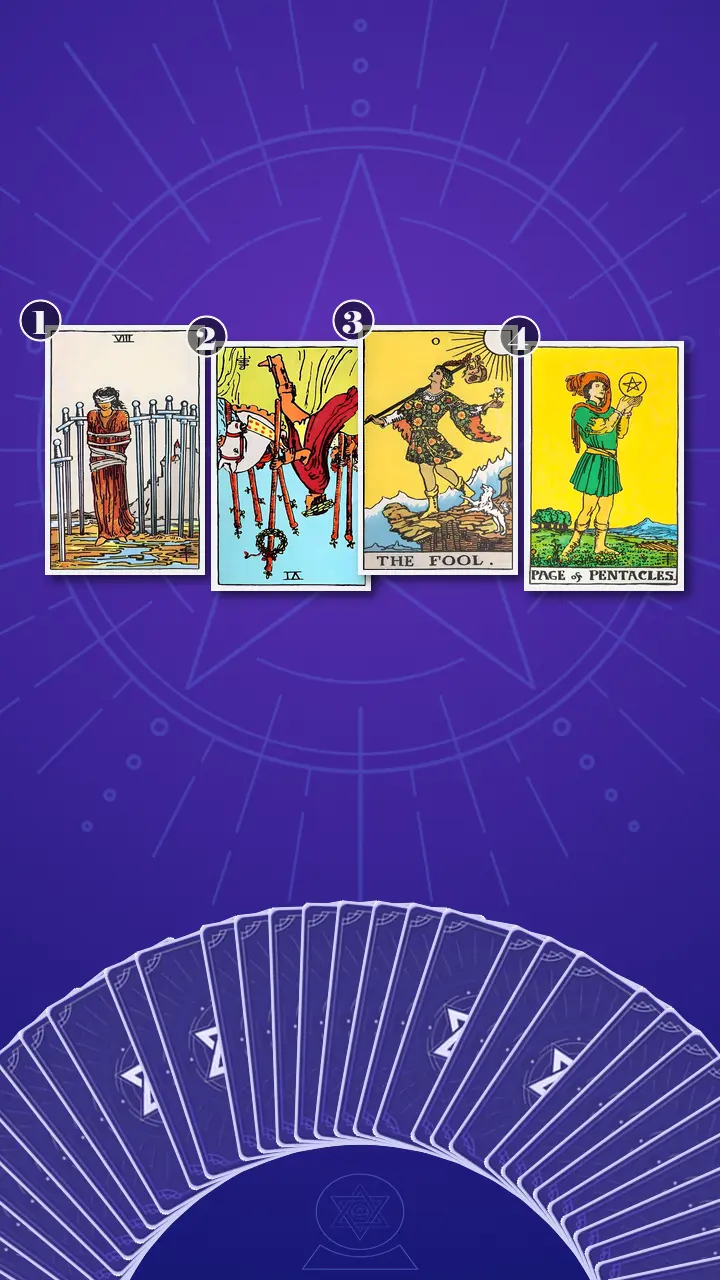
I laid the cards in a straight horizontal line. The first position would show the observable freeze behavior she already knew too well. The second would narrow in on the approval-based fear beneath it. The third—the key card—would show the shift needed to restore agency. The fourth would not predict a fixed outcome; it would show what integration looks like when a future stops being a costume and becomes livable again.
Reading the Runway Back from the Cage
Position 1: The Late-Night Draft Loop
I turned over the card representing the observable freeze behavior from her diagnosis. The Eight of Swords, upright.
This is the late-night draft loop in perfect form: an application portal, a job posting, a course choice, and the sudden feeling that choosing one next step would close off every other version of your life. Nothing is fully blocked, but the mind starts behaving as if one click would permanently define you. It feels like having twenty-seven browser tabs open and acting like closing one will crash the whole system. The blindfold is pressure-shaped perception. The loose ropes are the options she still actually has. The ring of swords is the mental story turning expectation into a cage.
Energetically, this is blockage. Not a lack of intelligence. Not a lack of ambition. A constriction of attention so intense that a reversible move starts looking irreversible. I asked her, “Think of the last time someone said you seemed clear on your future. What exact task did you avoid in the next twenty-four hours—submitting, replying, choosing, or naming what you really wanted?”
Her mouth twitched before she answered. “Submitting,” she said. Then, quieter: “I can handle uncertainty until it starts sounding like a promise.” She rubbed at the cuff of her sleeve with two fingers, small and repetitive, the way people do when their body is already telling the truth before the rest of them has caught up.
Position 2: The Compliment That Became Terms and Conditions
I turned to the card representing the underlying fear and validation pressure beneath the stuckness. The Six of Wands, reversed.
When this card lands here, I don’t read it as success gone wrong. I read it as praise turning into a performance contract. This is the fluorescent hallway after class, the professor saying, “You always seem so clear on your direction,” while you smile automatically and feel your chest go tight under the compliment. The wreath is the praise you can’t seem to take off. The raised wand is the visible path other people now associate with you. The crowd is mentors, family, peers, LinkedIn, milestone-heavy group chats, all silently reinforcing the same image. It’s LinkedIn main-character energy turning into PR pressure.
Energetically, the Fire here is distorted—confidence turned inward until it becomes self-monitoring. In Jungian language, the persona is the social face that helps us move through the world; it only becomes a problem when we confuse it with the whole self. Seeing this card, I had one of those quick private flashes I sometimes get from years of reading across cities and cultures: Toronto, London, Melbourne—different train lines, different accents, same look in the eyes when competence hardens into costume. Through my Shadow Path Analysis, the fear-based logic became very clear: someone praises you, an inner rule switches on—great, now I have to keep being that version of me—and then you stall so you won’t have to publicly revise it. It had the split feel of Severance: the polished career self doing the talking while the private self got locked in the basement with the panic.
Alex let out one short laugh that had no humor in it. “That’s almost rude how accurate that is,” she said. Then came the reaction in sequence: first the sharp stillness in her shoulders, then the far-off look as if she were replaying a professor’s compliment and a family FaceTime in the same loop, then a hard exhale through her nose. I asked her, “Are you choosing a future, or managing the audience around your future?” She looked back at me and whispered, “Honestly? The audience.”
Position 3: When The Fool Opened the Door
The room changed when I turned the third card. Even the radiator seemed to pause between clicks. This was the position that identifies the key cognitive and behavioral shift needed to restore self-directed movement, and it gave us The Fool, upright.
I asked Alex to picture the exact 11:40 p.m. screen glow: one portal open, three backup tabs, a Notes app full of pros and cons, and her chest tightening not because she had no options, but because every option had started to feel like a public identity test. That was the setup her nervous system knew by heart.
I said, “The trap is not that you need a perfect future. The trap is treating other people’s confidence in you like a script you are no longer allowed to revise.”
The sentence that changed the room
Your future is not a trophy case you have to keep dust-free; like The Fool stepping toward the cliff with a white rose, you can trade performance of certainty for one honest step into the unknown.
I let the sentence sit in the air for a moment.
This is where my Authentic Desire Decoding lens becomes indispensable. I told her, “The Fool does not ask you to become reckless. He asks you to strip away the pseudo-expectations that have been masquerading as desire. The respectable choice. The choice that keeps everyone reassured. The choice that looks clean in a caption. When I separate those from what actually comes alive in you, I don’t see someone who wants chaos. I see someone who wants room—room to test, room to revise, room to stay intelligent without turning every move into a final identity claim.” In a city where rent already makes experimentation feel emotionally expensive, that distinction matters. She didn’t want to blow up her future. She wanted permission to stop treating it like museum glass. Less season finale, more pilot episode. Less mapping the whole decade, more tapping onto the TTC for one honest stop.
Her first reaction wasn’t relief. It was resistance. Her breathing stalled; her fingers froze halfway around the mug. Then her eyes lost focus, as if Wednesday night and every hallway compliment were suddenly layered over each other. Then her jaw tightened and she said, with a flash of anger mostly aimed inward, “But doesn’t that mean I’ve been protecting an image more than an actual life?”
I answered softly, “It means your persona has been doing its job too well. That isn’t fraud. That’s adaptation. In Jungian work, we don’t shame the persona—we stop letting it drive the whole car. You’re allowed to outgrow a role that once helped you survive.” Outside, a car hissed through wet pavement, and at that exact moment something in her shoulders dropped a full inch, as if the weather itself had agreed to exhale with her.
What happened next was subtle and enormous. The color in her face shifted. Her grip loosened. She took one deeper breath, then another, and with the second there was that faintly disoriented look people get when the wall they were leaning against turns out to be a door. I could see both the release and the new vulnerability beneath it—the slight dizziness of realizing the path is open and therefore truly yours to walk.
I asked, “If you had held this frame last week, would Wednesday at 11:40 have felt different in your body?”
She nodded slowly. “I think I still would’ve been scared,” she said, “but I wouldn’t have treated submitting like marrying the path.”
Exactly. That was the emotional transformation in real time: from praise-shaped paralysis and claustrophobic anxiety to self-directed curiosity and steadier self-trust. Not perfect certainty. Not a fully solved decade. Just the return of breathable space. Your future is a working draft, not a fixed identity.
Position 4: The Ground Under the Next Step
I turned to the card representing the integrated next state—the embodied direction that follows when the guidance is practiced. The Page of Pentacles, upright.
I love this card after The Fool because it keeps freedom from floating off into theory. This is not “figure out your whole life.” This is one concrete path sample: one course, one email, one application, one placement conversation, one trial commitment. The Page holds one pentacle long enough to learn from it. In modern life, it’s like keeping a lab notebook instead of writing a life manifesto.
Energetically, this is balance returning through Earth. The overworked mind gets replaced by real-world contact. I asked her, “What one real-world data point could teach you more this week than another comparison table?” She didn’t answer immediately, but the silence had changed. It wasn’t jammed anymore. It was thoughtful.
Then she said, “I could email the alum I’ve been hovering over for two weeks. I keep acting like that’s too small to matter.” I smiled. “That,” I said, “is exactly Page of Pentacles medicine. One honest experiment beats ten polished maybes.”
From Performance to Contact
When I stepped back and looked at the whole spread, the story was clean. First came the Eight of Swords: the visible freeze, where a reversible decision had been mistaken for a permanent identity sentence. Underneath sat the reversed Six of Wands: not simple ambition, but approval pressure, the burden of being the promising one, the fear that changing direction might make her seem less capable. The Fool interrupted that contract by returning permission. The Page of Pentacles translated that permission into evidence.
The blind spot was not that Alex lacked direction. It was that she had been confusing sounding intentional with being internally aligned, and mistaking other people’s confidence in her for terms and conditions. She had been trying to think her way into certainty before allowing reality to teach her anything. The transformation direction was simpler and braver: move from protecting a polished future-image to testing what genuinely fits through one reversible, concrete step at a time. A next step is not the same thing as a forever self. Don’t manage the audience around your future more than the future itself.
I gave her three pieces of actionable advice, all deliberately small enough to be real:
- Run the Persona Detox Protocol For the next three evenings, spend five minutes with one note on your phone. Day 1: list what professors, family, peers, social feeds, and your program seem to say you should want. Day 2: under each option, write what feels lighter and what feels heavier in your body. Day 3: finish the sentence, “If nobody needed me to stay impressive, I’d be curious enough to…” Keep it private and messy. Fragments count. This is not journaling for grades; it is a filter for separating pseudo-expectations from authentic desire.
- Take One Reversible 15-Minute Step by Thursday Pick the option you’ve been circling and give it one reality-contact point: submit the application, send the inquiry email, or book the info session. Before you do it, rename the note in your phone from “big decision” to “experiment #1.” If comparison spikes your chest, create an Audience-Off Decision Window first: mute LinkedIn and milestone-heavy group chats for 48 hours. No public announcement required.
- Use the One Honest Sentence Script Save this line in Notes and use it once this week with a friend, classmate, sibling, or mentor: “I have a direction I’m exploring, but I’m still learning what fits.” Afterward, write only two lines: “What felt lighter?” and “What felt heavier?” If saying it live feels too exposed, send it in text first. The goal is not a big vulnerable speech. It is one honest sentence that leaves room for your real life.
I reminded her that none of these were tests of worth. They were ways of collecting lived evidence so her body could stop treating the future like a courtroom and start meeting it like a conversation.

A Week Later, the Quiet Proof
A week later, Alex sent me a message just after sunset: “I emailed the alum, renamed the note experiment #1, and used the sentence with a classmate.” She had muted one offer-season group chat, booked one information session, and then sat alone in a campus café for forty minutes—not triumphant, just noticeably less clenched.
The next line was my favorite: “I still don’t know the whole future. I just don’t feel held hostage by it.” That is what a real Journey to Clarity usually looks like. Not fireworks. Not an instant life answer. Just the return of movement, breath, and authorship.
When I think about what this Situation-Challenge-Advice-Outcome tarot spread revealed, that is the value I trust most: the cards did not decide for her. They made the subconscious pattern visible enough that she could stop obeying it automatically. The power stayed where it belongs—with the person living the life.
There is a special kind of panic in being praised for a future that looks right on paper while your body is quietly telling you it may not fit the way people think it does. If tonight you recognize yourself in that split, I want you to know that noticing the split is already the beginning of being gently unhooked.
If your next move only had to be one stop on the TTC, not the whole decade’s route map—reversible and honest, not impressive—what would you be curious enough to test?
This story is adapted from psychological research, written so that those in a similar struggle can see their own pattern in it — and find their next step clearly.These insights are not a substitute for professional psychological, medical, legal, or financial advice.
Learn more about our Journey to Clarity.
How did this insight land for you?
🫂 This Resonates Deeply
🌀 Living This Story
✨ Now I See Clearly
🌱 Seeing New Possibilities
🧰 Useful Framework
🔮 The Confirmation I Needed
💪 Feeling Empowered
🚀 Ready for My Next Step
Author Profile
 AI
AI“Having traveled across cultures... I've learned that what we often lack isn't a simple answer, but a moment of being truly understood. I use a Jungian psychological lens to help you deconstruct your subconscious patterns—not to prove anything, but to be the gentle companion who helps you unravel your knots, free of judgment, so you can reconnect with your inner wisdom.”
In this Direction Tarot Reading :
Core Expertise
- Authentic Desire Decoding: Stripping away inherited societal or parental 'pseudo-expectations' to reveal the true motives behind your macro confusion.
- Shadow Path Analysis: Identifying the fear-based subconscious logic that paralyzes you from stepping into a new, authentic trajectory.
Service Features
- The Persona Detox Protocol: A 3-day journaling experiment to objectively separate 'what I should want' from 'what I actually desire', recalibrating your inner compass.
Also specializes in :
Explore Related Patterns:
Approval SeekingThe professor's hallway compliment, the family FaceTime, and the milestone-heavy group chats all become part of the same internal crowd. You hear praise, but your nervous system translates it into a new rule: now I have to keep being that impressive version of me. Approval Seeking is not just wanting people to think well of you. In this case, it becomes a monitoring system where the audience around your future starts feeling more real than your own curiosity, and each possible pivot feels like it might disappoint people who already believe they know where you are going. That is why compliments can make you freeze. The praise does not land as support; it lands as surveillance. The work is not to reject encouragement, but to stop letting other people's confidence become the contract your life has to obey.
Competence TheaterIn public, the polished and strategic version of Alex can answer questions about the future cleanly, while the private version is up late with tabs open and her body braced against the Submit button. You can function well enough for people to admire the performance and still feel trapped inside it. Competence Theater forms when capability becomes a social costume you keep wearing because it reassures everyone else. The persona has a useful job, but when it starts speaking for the whole self, uncertainty becomes embarrassing and revision starts feeling like exposure. That split explains why being seen as promising can feel like being watched. You are not freezing because you lack direction; you are freezing because the performance of already having direction has left too little space for the real, unfinished process of choosing.
Analysis ParalysisThe 11:40 p.m. portal, the half-alive backup tabs, and the pros-and-cons Notes app show a mind trying to make the future safe by overprocessing it. You are not short on intelligence in this pattern; the problem is that thinking starts substituting for contact with reality, so the cursor hovering over Submit carries the weight of an entire identity verdict. Analysis Paralysis shows up when research, editing, and comparing still look responsible from the outside while quietly delaying the one move that would create real information. The more your future is praised as already figured out, the more every option has to be mentally neutralized before it can be touched. The stuckness comes from treating a reversible next step as if it has to resolve every possible future self in advance. Once the move becomes an experiment rather than a final contract, analysis can return to its proper job: helping you choose a test, not trapping you in the pre-choice loop.
Certainty SeekingEvery time the cursor nears Submit, the choice stops feeling like one practical move and starts feeling like a legal agreement with the rest of your life. The future becomes terms and conditions, and your mind tries to read every clause before allowing your body to act. Certainty Seeking is the attempt to remove risk before movement. It can look mature because it uses planning, comparison, and strategic language, but underneath it is a control strategy: if you can think far enough ahead, maybe you will never have to feel exposed by choosing. The trap is that real clarity often arrives after contact, not before it. When you demand certainty as the price of action, even a small reversible step starts looking unsafe; when you let action become data, the future becomes learnable again.
Identity ForeclosureThe moment one application click starts feeling like a forever contract, the decision is no longer just about an application. You are being asked, internally, to choose not only a next step but a whole public self that may not be allowed to change later. Identity Foreclosure appears when a future-image becomes fixed before exploration has had enough room to happen. Other people's confidence in your direction can harden into a script, and suddenly revising your path feels less like learning and more like losing the identity that made you legible. The pressure lifts when a next step stops being treated as a permanent self-definition. You can have a direction without turning it into a locked identity, and you can test a path without agreeing to become the same version of yourself forever.
Reality TestingThe week-later message about emailing the alum, renaming the note experiment #1, and booking one information session shows the pattern beginning to change. You stop asking one private thought-loop to solve the whole decade and start letting the real world give you usable feedback. Reality Testing works by moving the future out of pure mental simulation and into small, reversible contact. Instead of treating a choice as proof of who you must become, you treat it as a data point about what feels lighter, heavier, more alive, or less true once it meets reality. This is the grounded counter-move to the freeze. You do not need a flawless identity before you act; you need enough honest evidence to take the next step without pretending it has to answer every question at once.
Explore Related Struggles:
Compliment Debt LoopYou hear driven and clear-headed as admiration, but the praise quickly turns into a bill you are expected to keep paying with consistency. Once other people have invested confidence in your future, the image can start demanding maintenance instead of offering support. The professor, the family call, the group chat, and the polished public self all feed the same loop: approval becomes a contract, and the cost of breaking that contract feels like losing the right to revise.
Future-Proofing ParalysisYou sit in front of an application portal with three alternate paths still alive, and the moment your cursor moves toward Submit, the decision stops feeling temporary. What should be a small next step starts to read like a forever contract, so choosing turns into the risk of locking one version of life in place. That is why praise about having your future figured out can freeze you. The compliment stops being support and starts sounding like a public claim on who you are supposed to remain, which is why even a reversible move feels like a permanent identity claim.
Clarity-Exposure SplitYou are described as promising and clear-headed, but the moment that clarity becomes visible, it stops feeling private and starts feeling watched. The more legible your future looks from the outside, the less room you have to move through it without being measured. Outwardly you can sound polished and strategic; inwardly, your body tightens before the choice is even made, because exposure has turned ordinary ambition into something that feels hard to inhabit.
Explore Related Emotions:
Approval AnxietyAlex hears 'you always seem so clear on your direction' and her body does not receive it as warmth; she smiles automatically while her chest tightens, then later avoids Submit. The praise has become a social contract: if people approve of the impressive version, any revision can feel like disappointing an audience. Approval Anxiety fits because the stuckness is not created by having no options. It comes from approval turning into surveillance, where every next step has to protect the image other people already believe in. You are not just choosing a path; you are carrying the weight of being seen as someone who should already know.
Identity PR FatigueAlex eventually answers that she is managing the audience around her future. The polished career self keeps speaking in public while the private self is stuck with the screen glow, the backup tabs, and the exhausting job of keeping the story presentable. Identity PR Fatigue names the drain of maintaining a clean narrative when your actual life is still in draft form. You are not tired because you lack ambition; you are tired because every option has to pass through an internal press office before it can be allowed to feel real.
Visibility PressureBeing described as promising makes Alex feel watched, not held. The professor, family FaceTime, LinkedIn, peers, and milestone-heavy group chats form a silent crowd around a decision that should have had some private air. Visibility Pressure fits because the painful part is not visibility itself; it is visibility without room to change shape. You become aware of yourself as a public version before you can hear what the private version actually wants, and that makes movement feel exposed.
Commitment ClaustrophobiaThe story keeps returning to tight containers: the blazer made of compliments, the museum glass around the future, the sense that Submit is almost like marrying the path. The more respectable the option looks, the less air there is around it. Commitment Claustrophobia fits because commitment is being experienced as enclosure rather than contact. You may want movement, learning, and direction, but when a next step is framed as a whole identity, the body reads commitment as a room with no exit.
Finality DreadAlex says she can handle uncertainty until it starts sounding like a promise, and the application click begins to feel like signing a forever contract. A reversible step gets inflated into a permanent identity sentence, so the future stops feeling like a route and starts feeling like a locked door. Finality Dread is the inner weather of treating every choice as if it will close every other version of your life. You are not simply worried about picking wrong; you are bracing against the feeling that one ordinary move could define you too completely.
Performance FreezeAt 11:40 p.m., Alex has the portal open, backup tabs alive, and a Notes app full of pros and cons, but when the cursor moves toward Submit her shoulders lock and her stomach drops. The task is technically small, yet her body treats it like a public point of no return. Performance Freeze names the moment competence turns into immobilization. You can still sound strategic, still understand the options, and still be unable to move because the action has become a test of the polished self everyone expects to see.
Grounded AgencyA week later, Alex has emailed the alum, renamed the note experiment #1, used the honest sentence with a classmate, muted the group chat, and sat alone in a cafe noticeably less clenched. None of those moves solves her entire future, but each one returns a piece of authorship to her hands. Grounded Agency is the feeling of movement becoming real without becoming dramatic. You regain power not by forcing certainty, but by making one reversible contact with reality and letting your own data matter more than the audience around your potential.
Liberating UncertaintyAfter the reframe, Alex still does not know the whole future, but she no longer treats submitting like marrying the path. The future becomes a working draft: one email, one information session, one stop on the route rather than the whole decade mapped in advance. Liberating Uncertainty fits because the unknown is no longer proof that you are failing. It becomes space to test, revise, and collect lived evidence, which lets your next move be honest without pretending to be final.
False Alignment UneaseAlex can sound intentional in public while her body tightens in private, especially when a future looks right on paper but does not feel fully livable inside. The respectable choice, the caption-clean choice, and the reassuring choice start crowding out the question of what actually feels lighter or heavier. False Alignment Unease names the quiet mismatch between looking clear and being internally aligned. You can be praised for having a plan and still sense that the plan is partly arranged around other people's comfort, which leaves a low-grade wrongness under the polish.
Explore Related Contexts:
Academic Performance PersonaAlex can sound polished and strategic in public while privately looping through drafts, tabs, and comparisons late at night. The story names the split directly: the visible career self keeps talking while the private self is left with the pressure of not being able to revise the image. Academic performance persona fits because the external academic world is rewarding a highly legible version of her: competent, intentional, ahead of the curve, and easy to praise. That role has social value, but it also narrows the range of moves that feel acceptable when she needs to experiment, ask basic questions, or choose something less impressive on paper. You are dealing with a public-facing student identity that has become too well maintained. The stuckness grows when the role that helped Alex succeed in academic spaces starts controlling what she is allowed to want, test, or admit before the next stage of life begins.
Academic Planning ParalysisThe 11:40 p.m. scene gives the structure clearly: one application portal open, three alternate-path tabs half-alive, and a Notes app packed with pros and cons while the cursor hovers near Submit. The tools of planning are present, but they have stopped functioning as supports and have become a holding pattern. This is academic planning paralysis because Alex is still inside a graduate-school transition system where applications, course choices, alum outreach, and placement conversations carry institutional weight. The problem is not that she has no options; it is that every option is being processed as if it will lock her into a permanent identity before reality has had a chance to teach her anything. You are looking at a stage where planning becomes a socially acceptable way to avoid irreversible-feeling movement. The pressure comes from a real academic threshold, and the paralysis forms when research, comparison, and strategy keep circulating without turning into one concrete test.
Post-Graduation LimboAlex is a 24-year-old final-year grad student in Toronto, and the story keeps returning to applications, course choices, placement conversations, alum outreach, and the question of what comes next. That places her in the unstable passage between student structure and adult-path visibility. Post-graduation limbo shows up here because the next stage is close enough to demand action but not solid enough to feel inhabited. The academic identity that once gave her a clear coordinate is starting to expire, while the future role everyone assumes she has chosen has not yet become real. You are not simply watching a person hesitate over one application. You are seeing the pressure of a life-stage threshold where the old map still evaluates her, the new map is not built yet, and other people’s confidence makes the unfinished transition harder to admit.
Praise as Performance ContractAlex is repeatedly described as driven, clear-headed, and ahead of the curve, but that recognition does not land as ordinary support. A professor’s hallway compliment, family FaceTime, peer expectations, LinkedIn, and milestone-heavy group chats all gather into an audience around her future, turning praise into something she has to keep proving. The pressure is external because the story shows a social role being reinforced from the outside: the promising grad student who already knows where she is going. Once that role hardens, submitting an application stops feeling like a practical step and starts feeling like a public promise to remain the version of herself everyone has already approved. You get stuck because the compliment has become a contract. The real issue is not a lack of ability or ambition; it is the cost of revising a public image once other people have started treating that image as settled.
Rigid Life Script Lock-InThe story says Alex is reacting to a future that has started sounding less like possibility and more like terms and conditions. The respectable choice, the caption-clean choice, and the path that reassures everyone else begin to function like a script she is expected to keep following. Rigid life script lock-in is visible because the pressure does not come from one person’s opinion alone. It comes from an entire field of academic and social signals telling her what a promising future is supposed to look like, making deviation feel like a reputational revision rather than normal growth. You feel stuck when the script has become more powerful than the experiment. The path may look coherent from the outside, but inside the story it has become too rigid to let Alex test what genuinely fits without first defending the right to change shape.
Decision Cliff EdgeAlex’s cursor drifting toward Submit is described as if one click would sign a forever contract. The application itself is a practical action, but the surrounding pressure makes it feel like the edge of a cliff rather than one reversible step. Decision cliff edge is the right external context because the story shows a choice being inflated by academic timing, public expectation, and the cost of experimentation in a city where rent already makes testing a path feel expensive. A single application, email, or course choice carries more symbolic weight than the action itself can reasonably hold. You freeze because the environment has turned a next step into a point of no return. The useful reframe in the story is not to solve the entire future, but to reduce the decision back down to a reality-contact point that can produce information without defining the whole life.