Three Tabs at 11:48 p.m.: A 30-Day Test Instead of a Rebrand

The 11:48 p.m. LinkedIn Spiral
If every dull middle phase sends you back to “maybe I need a total rebrand,” the problem may not be that you lack direction. It may be that ordinary progress feels too personal to risk.
At 11:48 p.m. on a Tuesday, Jordan appeared in my video window from their shared Toronto apartment. Three tabs glowed across the screen they showed me: an unfinished content-design case study, a part-time course application, and a draft LinkedIn headline for an entirely new specialism. The radiator clicked behind them. Blue laptop light caught the skin of cold tea in a mug, and their thumb kept rubbing the trackpad as if friction might produce an answer.
Their fixed-term contract covered rent, but it did not feel like a whole identity. Earlier that evening, a former coworker had announced a promotion. Jordan had intended to finish one portfolio section; instead, they had spent ninety minutes refining a new headline. The wording gave them a bright, brief lift. The draft stayed untouched.
“I am great at starting over and terrible at staying long enough to learn anything,” they said. “I keep thinking I can commit once I know it fits. Maybe one more framework, course, or rebrand will make the uncertainty disappear.”
I heard the central contradiction immediately: Jordan wanted a path that genuinely fit, but they kept replacing the person walking it before any path received enough practice, feedback, or ordinary Tuesdays to reveal its shape. Their restless dissatisfaction was not an abstract cloud. It was more like changing trains at every station while their chest tightened against the fear that staying seated might carry them somewhere disappointingly ordinary.
“A new label can feel like movement before the work has moved at all,” I told them. “I am not here to choose your career or predict a fixed future. I want us to place the pattern where we can both see it. Let us make a map of the fog, then look for one direction you can test without turning it into a verdict on who you are.”

Choosing a Compass for the Identity-Pivot Loop
I asked Jordan to put both feet on the floor, take one unforced breath, and hold the question in plain language: “Why do I keep reinventing myself without finding a path that fits?” I shuffled slowly. The pause was not a mystical performance; it was a transition from reacting to observing.
I chose The Shadow Spread, a classic five-card tarot layout. For anyone wondering how tarot works in a reading like this, I use it as a structured cognitive tool rather than a machine for issuing fate. The images externalise a pattern. Once that pattern is on the table, card meanings in context can help separate a trigger, a protective behaviour, a deeper fear, an available resource, and a practical next step.
This question called for inner excavation, not a simple choice between jobs. A three-card line could have blurred the hidden payoff together with the root fear. A Celtic Cross would have added more material than Jordan needed. The five positions of The Shadow Spread gave us the smallest complete map: the visible reinvention loop at the centre, its concealed benefit to the left, the recognition-based root below, the integrating gift to the right, and the daily practice above.
I explained that the first three cards would diagnose why the compass kept spinning. The fourth would reveal the resource capable of establishing direction. The fifth would show how to convert that resource into lived evidence. No card would tell Jordan which identity they were required to adopt. The reading would clarify the forces acting on the decision; Jordan would remain the person making it.
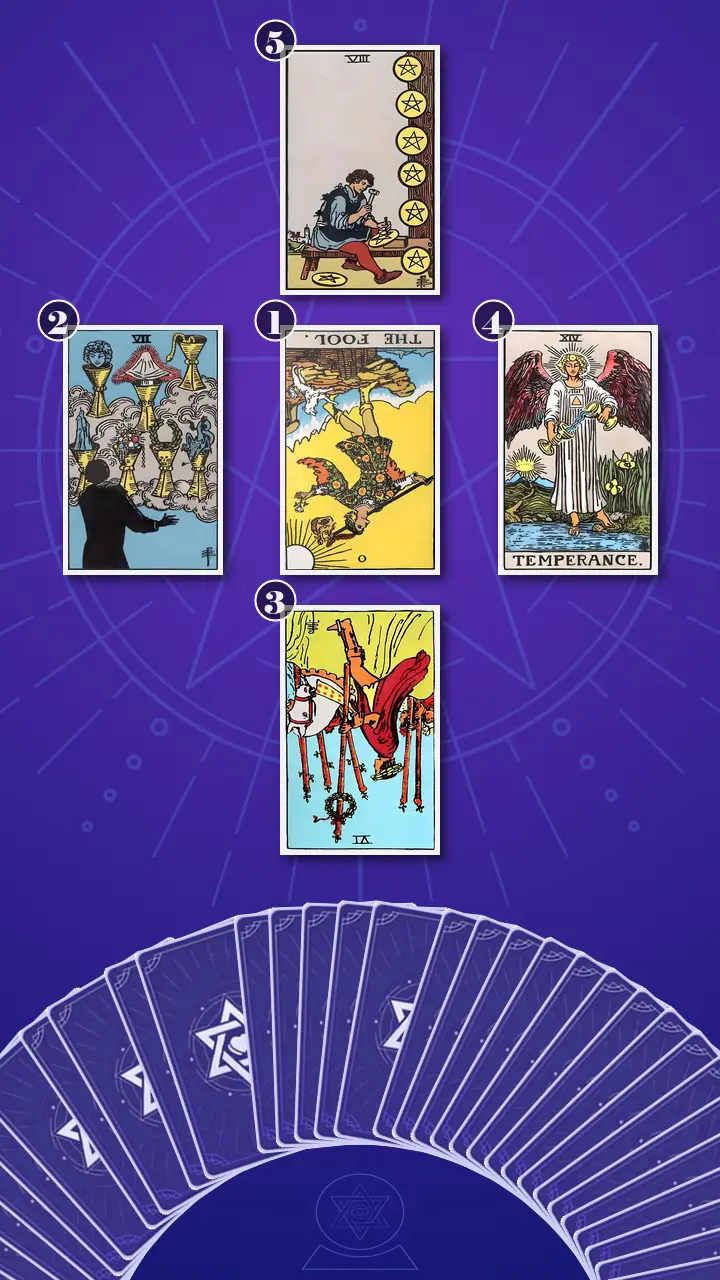
Reading the Map Before Another Reset
Position 1: The Cliff Behind the New Headline
The first card I turned represented the conscious reinvention loop: the observable pattern of changing goals, labels, and plans before sustained testing can occur. It was The Fool, reversed.
I pointed to the traveller suspended near the cliff edge, the light bundle over one shoulder, and the small white dog rising in warning. Upright, The Fool can carry openness, trust, and a willingness to enter experience. Reversed here, I read that energy as a mixture of excess and blockage: too much initiating energy, paired with too little willingness to remain present for the consequences and information that follow a beginning.
I brought the image directly back to the three tabs. Jordan had opened the laptop intending to revise the unfinished case study. A former coworker’s update had triggered the familiar surge. Within an hour, they had changed their headline, bookmarked a certificate, and drafted the outline of a fresh direction. Editing the label felt controlled and finishable. Submitting a messy draft would have created real feedback.
“The cliff edge is not the new career,” I said. “It is the moment between rewriting the bio and letting someone see the work. If I put words to the loop, it sounds like this: ‘If I change the frame, I will not have to face the draft.’”
I asked what concrete task had become slow, visible, or likely to receive feedback immediately before their last three pivots.
Jordan did not nod politely. Their mouth pulled into a quick smile, but there was no amusement in it. Their thumb stopped moving; their gaze shifted toward the unfinished tab; then a breath left their chest in a flat little burst.
“That is so accurate it feels kind of brutal,” they said. “I call it research, but yes. The rebrand is the thing I know how to complete.”
“Then we do not need to shame the research,” I replied. “It has been giving you short-term relief from exposure. We only need to stop confusing that relief with evidence that a new path fits.”
Position 2: Every Tab Is Perfect Until It Has Homework
The next card represented the hidden payoff: how preserving multiple imagined selves protects Jordan from limits, exclusion, and concrete evaluation. I turned over the Seven of Cups, upright.
Seven vessels floated in clouds before a dark, watchful figure. Each held a different promise: beauty, status, danger, achievement, mystery. In another context, the card can describe imagination and possibility. In this shadow position, its energy had become excessively diffuse. Jordan did not have too few options. Possibility was so abundant that it prevented contact with the cost, repetition, and beginner mistakes inside any one option.
I pictured the Notion board Jordan had described: UX writer, visual storyteller, strategist, graduate student, freelancer, creator. Each card looked coherent because it was still a concept. It had not yet met a dull Wednesday, a tuition payment, a revision request, or a month when motivation did not photograph well.
“It has the energy of an endless streaming queue,” I said. “Every unwatched option remains perfect. Choosing one means losing the fantasy of all the moods the others might have delivered.”
The modern algorithm made the pattern even stickier. Each time Jordan clicked on “career change at 28,” “how to find your niche,” or a beautifully packaged studio launch, their feeds supplied more evidence that a new self was available for download. The algorithm responded to clicks, not values. It could keep serving “new you” content forever without learning whether Jordan enjoyed the work behind any of it.
I asked, “If you remove the title, the aesthetic, and the imagined announcement, which option still contains a task you would be willing to do on an ordinary Wednesday?”
Jordan’s lips parted, but no answer came immediately. Their eyes lost focus as though they were scrolling through old project folders in memory. Then their shoulders lowered by a fraction.
“Making complicated things clearer,” they said. “That keeps showing up. Writing, diagrams, systems. The labels change, but that part does not.”
I placed that sentence beside the card. The hidden payoff was now visible: keeping every door open protected Jordan from discovering the limitations of one room. It also kept them from noticing which furniture followed them everywhere.
Position 3: When LinkedIn Becomes an Awards Ceremony
The third card represented the root fear: conditional self-worth and dependence on recognition, which made ordinary progress feel personally threatening. It was the Six of Wands, reversed.
The upright card usually carries recognition, confidence, and public achievement. Reversed, the wreath and watching crowd turned the energy inward. I read it as a blockage in self-generated confidence and an overreliance on external response. The work could feel worthwhile while applause was imaginable. A quiet or mixed reaction could make the entire identity collapse.
I asked Jordan about the content-design teardown they had posted the previous Thursday. They told me how they had checked it between Slack messages in the office kitchen. The espresso machine hissed. Fluorescent light flattened the room. A peer’s promotion post collected hundreds of reactions while Jordan’s piece remained modestly seen. By 5:00 p.m., a search for a new specialty was open.
“The factual event was ‘this post received a quiet response,’” I said. “The conclusion became ‘maybe I picked the wrong future again.’ Those are not the same sentence. A quiet response is information about a moment, not a verdict on your worth.”
This was where I used what I call Gravity Well Identification. I look for an old habit, rule, or environment whose pull has become stronger than its usefulness. Jordan’s gravity well was not LinkedIn by itself, and I did not tell them to disappear from professional life. It was the combination of instant metrics, comparison timing, and one obsolete internal rule: if a path fits me, people should recognise it quickly; if they do not, I may be ordinary in a way I cannot tolerate.
That rule bent every small piece of feedback toward the same conclusion. It made a revision request feel like exposure. It made a friend’s measured response to a new pivot feel like rejection. It turned LinkedIn into a low-grade awards ceremony where every update seemed to announce who was moving forward and who was not.
I asked, “Before deciding the post meant anything about your future, what did making it teach you?”
Jordan’s shoulders rose and held. Their fingers curled against the mug; their gaze moved away from me as if replaying the office kitchen; then their grip loosened.
“I learned that I am good at finding the structure in messy information,” they said quietly. “I did not write that down. I just checked the numbers.”
I showed them the interruption point: after a comparison trigger and before opening a new search tab, they could create a twenty-four-hour gap and record private progress first. I was not asking them to stop caring whether work connected with people. I was asking them to prevent one metric from becoming a live performance review of their entire self.
When Temperance Reduced Seven Futures to Two Cups
Position 4: The Workable Blend
The fourth card represented the transformative gift: Jordan’s capacity to integrate recurring parts of the self instead of replacing the whole identity. As I reached for it, the radiator clicked once and fell silent. The room seemed to gather around the small rectangle of card stock.
I turned over Temperance, upright, the key card and antidote in the reading.
An angel passed water carefully between two cups, with one foot on land and one in water. I read the energy as balance in motion, not a frozen state of perfect certainty. Temperance does not erase difference. It adjusts proportions. It keeps feeling connected to practical reality and allows experience to refine the mixture.
In Jordan’s life, this did not mean choosing between being strategic and being creative. It could mean a thirty-day project combining both: three small visual explainers about a subject they already understood. They could leave their public job title unchanged, notice what sustained attention and what drained it, and adjust the blend using real experience. The direction would become coherent through use, not through finding a more impressive noun.
I drew a loop on a sheet of paper: comparison trigger, new label, rush of relief, delayed work, missing evidence, self-doubt, another comparison trigger. This was my Cognitive Spiral Mapping. In a decade of working with cards and celestial cycles, I have learned not to confuse recurrence with failure. An orbit can revisit familiar ground while still gathering the momentum required for a slingshot. The turn happens when the traveller records what keeps returning and uses it to change trajectory.
My mind went briefly to an ephemeris, where a planet’s repeated passage over one degree is not treated as a character defect. It becomes meaningful because its position is observed. Jordan’s abandoned projects were not proof of a defective self. They were unreviewed data. Across the changes, clear communication, visual systems, and making complexity usable had kept returning.
I brought us back to Tuesday night: the quiet apartment, the clicking radiator, three futures open beside the work Jordan could not quite finish. Rewriting the headline offered a clean rush. Returning to the draft asked them to tolerate being a beginner where somebody might eventually see them.
You are not failing to find one perfect self. You are leaving before your recurring pieces have enough time to become a workable blend.
I let the sentence sit between us.
You do not need another total reset; combine what keeps returning, test it at a human pace, and let Temperance's two cups turn fragments into a workable blend.
Jordan’s breath stopped first. Their fingers remained suspended above the trackpad, perfectly still. Then their eyes drifted from the card to the two recurring interests I had written on the page, as though old projects were being replayed under a new caption. Their brow tightened, and a flash of anger sharpened their voice.
“But does that not mean I have been doing it wrong for years?” they asked.
“No,” I said. “It means starting over protected you from a kind of feedback that once felt inseparable from your worth. The protection worked quickly, and then it became expensive. Seeing that does not condemn the earlier versions of you. It gives the current version of you a choice.”
The anger left their face unevenly. Their jaw released; their fist opened against the desk; moisture gathered at the lower edge of their eyes without becoming tears. A long breath followed, but relief was not the only thing in it. I saw the slight blankness that can arrive when a familiar burden drops and leaves responsibility in its place. Clarity had not trapped them, but it had removed one excuse to keep running.
I asked, “Now, with this new perspective, think back to last week. Was there a moment when this insight could have made the experience feel different?”
Jordan looked down. “My manager asked me to simplify the opening of the case study,” they said. “I heard, ‘You are not naturally good at this.’ I could have heard, ‘This is the next proportion to adjust.’”
I gave them ten quiet minutes to open a private note. They wrote two phrases that appeared in more than one abandoned project: making complex things clearer and building useful visual systems. Then they chose one twenty-minute action that combined them: sketching the structure of a visual explainer from the unfinished case study. They scheduled it once for that week.
This was the first movement in the emotional transformation the spread described: from restless identity resets and comparison-driven self-doubt toward patient integration, sustained practice, and earned self-trust. It was not a promise that the project would become a career. It was permission to let evidence arrive before judgment. Fit is built from evidence, not discovered in a flawless bio.
Position 5: Three Ordinary Sessions
The final card represented the integration practice: a repeatable, evidence-producing action that would allow Jordan to evaluate a direction without another total rebrand. I turned over the Eight of Pentacles, upright.
A craftsperson sat at a bench, shaping one pentacle while completed pieces accumulated nearby. The town stood in the distance, but attention remained with the unit of work in hand. I read this as grounded and available earth energy: repetition, apprenticeship, and enough material evidence to distinguish temporary boredom from genuine misalignment.
For Jordan, the image became one modest project, three recurring calendar blocks each week, one physical task per session, and every completed version stored in the same folder. After thirty days, they would have actual material to review: what they made, which skill improved, what felt meaningfully difficult, and what felt consistently deadening. They would no longer have to assess the direction using excitement alone.
I also noticed that no Swords card had appeared anywhere in the spread. I did not interpret that absence as a ban on thinking. I interpreted it as a practical correction: another identity framework, personality test, or comparison table was not the missing ingredient. Jordan already had abundant analysis. What they lacked was a body of lived work large enough to answer the question analysis kept circling.
“The dull middle is not always a mismatch,” I said. “Sometimes it is the first honest data point.”
Jordan glanced at the proposed three forty-five-minute blocks and gave a strained laugh. “I cannot promise that. My contract gets chaotic, and sometimes I barely have ten minutes after the commute.”
I adjusted the plan immediately. “Then ten minutes counts. Eight of Pentacles is about repeatability, not punishment. A smaller session you can actually enter gives us better evidence than an ideal schedule that becomes another standard you use against yourself.”
Their hand moved to the calendar. This time, instead of naming a new future, they entered one small task: Sketch three layout options.
Make It a Month, Not a New Personality
I read the spread back as one connected story. Jordan’s repeated career reinvention began with The Fool reversed: fresh motion appeared whenever unfinished work approached feedback. Seven of Cups revealed the protective benefit of keeping several impressive futures untested. Six of Wands reversed exposed the root: quiet recognition could become a global judgment about worth. Temperance offered the missing capacity, which was not a more perfect choice but the integration of recurring ingredients. Eight of Pentacles gave that blend somewhere to become observable.
The history influencing the pattern was not a secret past event I claimed the cards could prove. It was the repeated sequence Jordan had already described: a mixed response led to a reset; the reset prevented skill from accumulating; the missing progress then seemed to confirm that another identity had been wrong. The core metaphor was an orbit around the same recognition trigger. Each rebrand changed the scenery without changing the gravitational centre.
I named the cognitive blind spot directly: Jordan had been treating certainty as a prerequisite for practice, when practice was the process most capable of creating useful clarity. They had also been interpreting discomfort, repetition, and delayed applause as interchangeable evidence of mismatch. Those signals needed separating. Depletion might justify stopping. A values conflict might justify leaving. Fear of feedback might ask for a smaller exposure. An ordinary middle might simply ask for another session.
The transformation direction was equally direct: replace a total rebrand with one bounded, private, thirty-day evidence experiment. Identity could be assembled through experience rather than discovered as a permanent label. At the end, Jordan would still be free to continue, revise, pause, or leave. The point was not to force commitment. It was to make the next decision with information the current loop had never allowed to accumulate.
The Orbit Expansion Strategy
I turned that insight into three small actions. I called the overall framework my Orbit Expansion Strategy: identify the gravity well, choose the recurring elements worth carrying forward, and create only enough momentum to enter a wider field of evidence. The goal was not escape at any cost. It was a deliberate change in trajectory.
- Freeze the public label for seven days. Tonight, Jordan would leave their LinkedIn headline unchanged and set a twenty-minute timer for the unfinished case study. The only task was to sketch three layout options; they could stop when the timer ended, even if the result looked messy. Tip: When the urge to research a shinier identity appears, write down what happened in the previous ten minutes. Treat the urge as a signal, not a command.
- Build a Two-Thread 30-Day Fit Trial. By Sunday evening at the dining table, Jordan would combine “making complex things clearer” with “building useful visual systems” in one modest project: three visual explainers in thirty days. They would schedule three sessions each week, with a ten-minute minimum on contract-heavy days. Tip: Keep the experiment private unless sharing genuinely supports the work. Make it a month, not a new personality. No launch announcement is required.
- Keep a Private Evidence Ledger. After every session, Jordan would add four short lines to one note: what I did, what I learned, what felt alive, and what felt heavy. After publishing, they would wait twenty-four hours before checking likes, views, replies, or profile visits. Tip: Before looking at metrics, record one choice made, one skill practised, and one question now answerable. If the boundary slips, restart at the next session without turning it into a verdict.
I reminded Jordan that the review on Day 30 belonged to them. The evidence might support continuing. It might suggest changing the project’s proportions. It might reveal a genuine mismatch. Tarot had not removed those possibilities. It had given Jordan a cleaner way to meet them.

A Week Later, the Quiet Proof
Six days later, I received a message from Jordan. It began with a sentence that would have looked unimpressive in a career announcement: “I did not change my headline.”
They had completed the first twenty-minute session and returned for two shorter ones. The first visual explainer was unfinished, but it existed outside a Notion dashboard. Their evidence note said that structuring the information held their attention, choosing colours became a distraction, and receiving one practical comment from a coworker felt uncomfortable without feeling catastrophic. They had revised the opening instead of opening a course page.
They also told me they had slept through one full night. Their first thought the next morning was still, “What if this is wrong?” The difference was small: they smiled at the thought, made coffee, and checked the next calendar block instead of rewriting their future.
I did not read that message as proof that Jordan had found a final career identity. I read it as the first quiet evidence of earned self-trust. The cards had supplied an objective surface on which to recognise the identity-pivot loop, but they had not performed the change. Jordan had paused, chosen two recurring threads, and returned to the work. The agency was theirs.
I have come to see clarity less as a dramatic answer and more as the moment fog thins enough for a person to recognise their own outline. When the tabs multiply and the chest tightens at the thought of choosing, it can feel safer to become someone new than to let one ordinary, unfinished version of the self be seen. Noticing that impulse already creates a small space around it.
If you let your next month become a bounded experiment rather than a verdict on who you are, which recurring thread would you place in Temperance’s two cups and practise long enough to meet?