Downplaying Real Goals With 'lol'—And How to Let One Sentence Stand

The Warm Phone on the TTC Home
Jordan came to me with a question that sounded small enough to hide in internet punctuation and large enough to shape a life: why do I add ‘lol’ after saying something sincere?
If I hear that question from someone in their mid-20s, working a junior city job, writing polished copy for other people all day and still texting ‘I kind of want to apply for that fellowship lol’ before staring at the group chat on the TTC home, I know I’m looking at protective irony around ambition. Jordan was twenty-six, non-binary, and working as a junior marketing coordinator in Toronto. When they described 8:47 p.m. on Line 1, I could feel the carriage jerk under my own feet: fluorescent lights buzzing overhead, the phone screen warm in their palm, the brakes screaming into Bloor–Yonge, and those three typing dots feeling louder than the train itself.
They had sent the message, then reread it twice before anyone even answered. Their throat tightened. Their breath stalled halfway in their chest. They wanted someone to say, ‘Do it,’ and they wanted nobody to notice how badly they wanted that. “I don’t want to sound like I think I’m special,” they told me. “If I say it too seriously and it doesn’t happen, that’s going to be embarrassing.”
I heard the contradiction immediately: Jordan wanted to share a goal honestly and be taken seriously, but they were bracing against the shame of anyone seeing how much it mattered. The embarrassment wasn’t abstract. It felt like watching someone press a hand over the speaker of their own voice one second after turning it on. Sometimes ‘lol’ is just fear in friendly formatting.
I leaned in and said what I needed them to hear before I touched the deck. They were not unserious. They were pre-bracing. My job was not to tell them whether the fellowship would happen. My job was to help them see why honesty kept leaving the room through a side door. “Let’s draw a map for the moment right after the truth comes out,” I said, “and see if we can make that moment more breathable.”

Choosing the Compass: A Five-Card Cross for Finding Clarity
I asked Jordan to take one slow breath with both feet on the floor and hold only one question in mind: what happens in the two seconds after I say what I really want? Then I shuffled until the room went quiet in the useful way, not the mystical one—the way a film set goes still right before a difficult scene finally gets its close-up.
I told them I was using the Five-Card Cross · Context Edition. This is how tarot works best for a communication pattern like this: not by predicting an external outcome, but by laying out five clean layers of an inner loop—the symptom, the crossing challenge, the hidden root, the healing reframe, and the next grounded step. It is the smallest spread I trust for a habit this compact and this emotionally loaded.
I pointed to the shape the cards would make between us. The center card would show the visible habit itself: the reflex to soften a real goal with humor, qualifiers, or ‘lol.’ The card crossing it would reveal the protective strategy keeping emotional investment under lock. The root below would name the deeper fear under all that tone management. Above it, one guiding card would show the honest stance that could interrupt the cycle. And the card to the right would not promise fate. It would show a practical integration move: how to treat the goal as real without performing indifference or hiding behind it.
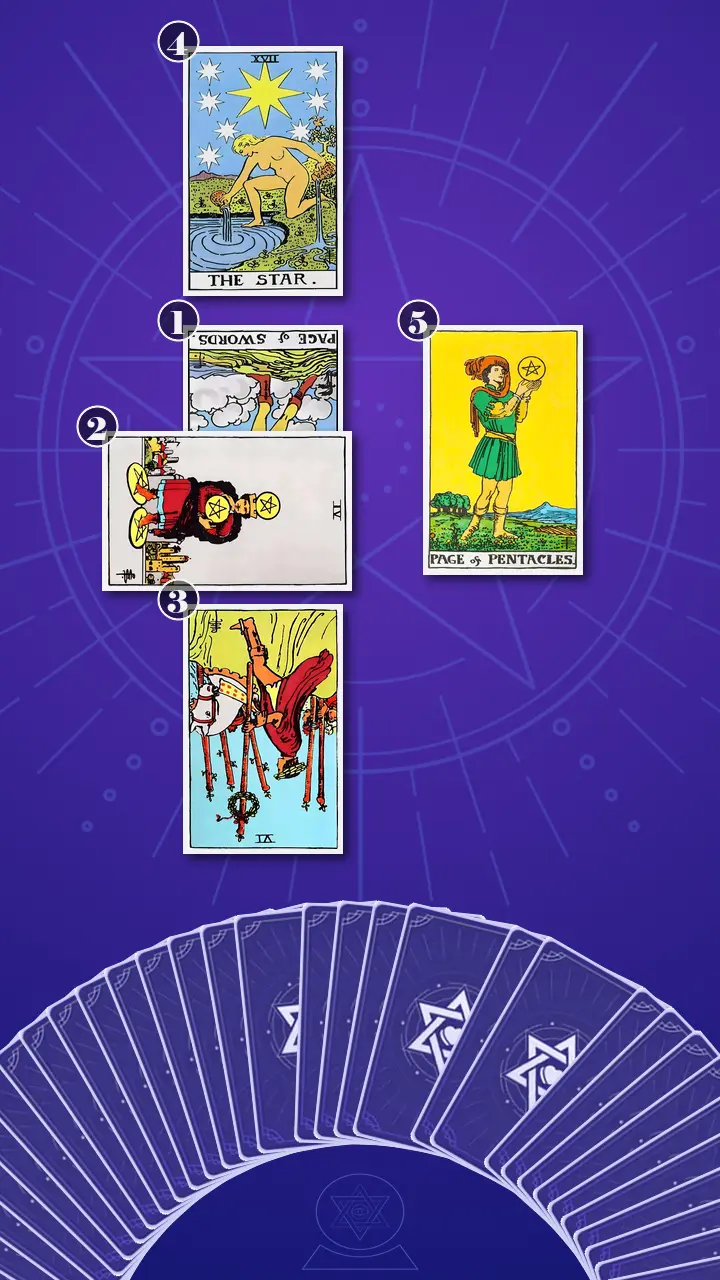
The Watchful Messenger and the Locked Chest
Position 1: The Habit That Fires Before Anyone Replies
I turned over the first card. “Now we’re looking at the position that shows the surface symptom,” I said. “The reflex to soften a real goal with humor, qualifiers, or ‘lol’ the moment it’s spoken.” The card was the Page of Swords, reversed.
I always pay attention to posture in this card. Upright, the Page is alert. Reversed, the alertness starts eating itself. Jordan did not need me to explain that for long. The scene was already sitting in front of us: a Wednesday lunch break in a downtown Toronto office, a draft that began as ‘I want to apply for that fellowship,’ then within seconds became ‘I kind of want to apply lol.’ The energy here was blocked Air—too much monitoring, too much internal editing, too much Slack tone-policing of a sentence before the world had even touched it.
I told Jordan, “This is editing a text like it’s a PR crisis. One finger hovering over backspace while your real voice is still loading. Make it sound chill. Make it sound unserious. Make it impossible to use against me later.” That, to me, was the exact split second where self-trust started negotiating with fear.
Jordan’s body answered before their mouth did. First their breathing caught. Then their thumb froze against the rim of their tea mug as if the whole TTC scene had replayed in real time. Then came a short laugh with a bitter edge. “Okay,” they said, looking at the card and then away from it. “That’s… almost rude. But true. I didn’t realize I was doing damage control that fast.”
I nodded. “You say the real thing. Then you rush to make it unserious before anyone else can. That isn’t personality. It’s protection.”
Position 2: The Protective Strategy Crossing the Message
I turned the second card across the first. “This crossing position shows the active protective strategy complicating the symptom,” I said. “The need to keep your emotional investment guarded and controlled.” The card was the Four of Pentacles, upright.
In modern life, this card looks exactly like after-work drinks where you reveal just enough of the goal to test the room while keeping the real level of care tightly hidden. One hand stays around the cold glass. The joke arrives early. The follow-up lands fast: ‘I mean, no pressure, it’s probably nothing.’ The energy here was excess Earth—containment turned rigid. Instead of letting the goal circulate, Jordan was holding it like rent money, or like a Close Friends post that never quite makes it to the main feed.
I pointed to the crossed pair between us. “Page of Swords reversed makes the sentence nervous. Four of Pentacles puts a lock on the feeling behind it. Together, they create bubble wrap around your ambition. There’s a little Fleabag move in it—say the devastatingly honest thing, then crack the joke before anyone can touch the bruise underneath.”
Jordan looked down, shoulders pulled slightly toward their chest. I watched one of those tiny shifts I’ve learned to trust in readings: the defensive smile arrived, then faded on its own. “So I’m not actually being casual,” they said. “I’m trying to control the exposure.”
“Exactly,” I said. “You want support, but you also want zero evidence that it matters. Those two goals keep canceling each other out.”
The Crowd That Appears Before Anyone Responds
Position 3: When Visibility Starts to Feel Like a Verdict
I placed the next card below the center. “This root position reveals the deeper psychological driver,” I said. “The fear that visible ambition could turn into visible inadequacy.” The card was the Six of Wands, reversed.
Whenever this card turns up in a reading about ambition, I think of the modern crowd first. Not a medieval parade. A feed. A LinkedIn post that begins ‘Thrilled to share.’ A Sunday night kitchen lit by fridge light and phone glare. Jordan had already given me the scene: meal-prep containers clicking shut, a podcast murmuring in the background, and suddenly someone else’s polished announcement making their own private desire feel embarrassing just for existing.
“This is the part underneath the joke,” I said. “It’s not that the goal feels fake; it feels public.” Reversed, the Six of Wands is Fire turned inward. Recognition becomes exposure. Neutral reactions become blank screens that shame rushes to subtitle. If the goal is spoken before success is guaranteed, the mind starts acting like there will be a crowd keeping score.
I asked the question that belonged to that position. “If you said the goal plainly and it didn’t happen, what do you worry people would secretly conclude about you?”
Jordan swallowed hard. Their gaze went slightly unfocused, the way it does when someone is no longer looking at a card but at an old private rule. “That I was naive,” they said finally. “Or full of myself. Or that I thought I was more talented than I am.”
I let that land. “So the joke is not protecting the goal from failure,” I said. “It’s protecting you from being witnessed in the middle of trying.”
When The Star Let the Sentence Breathe
Position 4: The Antidote Above the Cross
By the time I reached the fourth card, the room had changed. Even over a screen, I could feel it. The air had that held, listening quality I know from painting studios right before someone makes the brushstroke they’ve been avoiding. I turned the card over. “This position offers the key healing perspective,” I said. “The kind of honesty and self-trust that can interrupt the cycle.” It was The Star, upright.
I love how merciful this card is. Nothing in it is armoured. The figure is uncovered, calm, pouring water onto land and into the pool with open hands. When I looked at it, I thought immediately of the Four of Pentacles pressing value hard against the chest, and I felt the contrast like a door opening: clenched chest versus open hands, locked value versus flowing value. As an artist, I’ve always felt our lives are films currently in production, and The Star is that scene change after too much fluorescent tension—the camera finally stepping outside, the breath finally becoming audible again.
In my Hero’s Journey Alignment lens, this was the clearest possible Refusal of the Call. Jordan’s call was not to become instantly fearless or publicly impressive. Their call was simpler and harder: to let a real wish be visible before applause, proof, or certainty arrived. The ‘lol’ was the refusal. The old script said, I can only sound sincere once I already have evidence. The Star asked for a rewrite. That is where my Vision Actualization instinct always comes in: a limiting narrative is not truth just because it has good defensive timing.
I asked Jordan to picture that exact post-send second on the TTC: the phone still warm in their hand, the train screeching into the next station, the throat tight because they already wanted to edit a message that had only been alive for three seconds. In that moment, they were trapped in the old equation that embarrassment meant danger.
Stop wrapping your real wish in a laugh, and let it stand in open air; The Star heals by pouring water where you used to build armor.
I let the sentence stay between us without rescuing it with extra explanation. Then I said the quieter line beneath it. “The embarrassment is not proof that your goal is cringe; it is the feeling of being visible before the outcome is guaranteed.”
Jordan’s reaction came in layers. First there was a full stillness—breath paused, jaw set, fingers hovering above the table as if they had forgotten their next move. Then their eyes drifted past me, not dissociated, just deep in replay, like they were watching the message thread from last week with different subtitles. Then the emotion arrived all at once in a long exhale that seemed to leave from the center of their chest rather than their lungs. Their shoulders dropped. Their face softened. And then, because real clarity is rarely neat, a flash of resistance came with it. “But if I stop doing that,” they said, voice low and a little raw, “doesn’t that mean I’ve been making myself small on purpose?”
“Not on purpose,” I said. “On instinct. There’s a difference. You built a smart defense for a moment that felt socially dangerous. We’re not here to shame the armor. We’re here to notice that you’ve outgrown needing it every time.”
I returned to the image on the card. “The Star doesn’t demand a performance. It asks for five honest seconds. Nothing dramatic happened; the sentence just stayed alive in the room. That’s the threshold. Like letting an app load without frantic refreshing. Control says fix the tone. The Star says tolerate the silence long enough to learn that sincerity can survive it.”
I asked them, “Now, using that lens, think back to last week. Was there a moment when this could have changed how you felt?”
Jordan nodded slowly. “Yeah,” they said. “If I had just left the message alone for even a minute, I think I still would’ve felt exposed. But maybe not ashamed. Maybe just… visible.”
That was the real crossing point of the reading for me: not from fear to fearlessness, but from pre-bracing through irony to grounded sincerity and steadier self-trust. A goal can be real before it’s proven.
Let the Sentence Stand, Then Let the Work Begin
Position 5: The Grounded Apprentice
I turned the final card to the right of the center. “This forward position is about the next embodied move,” I said. “How to treat the goal as real without over-performing it or hiding it.” The card was the Page of Pentacles, upright.
This card answered the first Page beautifully. The spread had opened with a Page of Swords reversed—nervous, watchful, trying to manage audience sentiment like a brand manager staring at comments. It closed with a Page of Pentacles, absorbed in the work itself. The next-morning version of this card is very unglamorous in the best way: a folder named with the actual program, the application link saved where you can find it, a twenty-five-minute block on the calendar, one rough draft started before the inner critic can build a whole launch strategy around it.
“This is balanced Earth,” I told Jordan. “Not clutching. Cultivating. The confidence here does not come from sounding cool about the goal. It comes from touching the goal. Less ‘How did that sound?’ More ‘What is the next concrete step?’”
Jordan gave me the first full nod of the session. It was small, but it had weight in it. “That actually feels better,” they said. “Like if I’m doing something with it, I don’t have to keep managing the vibe of it.”
“Exactly,” I said. “Let the sentence stand. Then let the work begin.”
The Character Bible for Breathable Sincerity
By then the whole story of the spread was clear to me. Jordan was not dealing with a lack of ambition. They were dealing with protective irony around ambition. The present habit was nervous language. The crossing challenge was guarded self-worth. The root fear was that visible ambition would become visible inadequacy in a city where everything already feels half networking event, half live audition. The blind spot was subtle but costly: Jordan had been treating embarrassment as evidence that honesty was unsafe, when embarrassment was often just the body registering honest visibility.
I said it plainly. “You have been soft-launching your ambition to reduce the blast radius. It gives you short-term relief, but it also keeps you unseen. Friends respond to the joke layer, not the real layer. Then you get less support and more proof that nobody gets it. That’s the loop.”
The direction of change was just as plain. Jordan did not need to become dazzlingly confident. They needed breathable sincerity: one clean sentence, a few extra seconds of tolerance, and one grounded action that treated the goal as real. Before I gave the steps, I summed the new rule up in a line I use often: ask for witness, not evaluation.
I gave them three small practices, and I deliberately kept them small. I never trust advice that sounds good and cannot survive a Tuesday.
- Plain Sentence PracticeText one trusted person this week with one clean line: ‘I want to apply for the fellowship this month.’ No emoji, no joke, no hedge. If you want support without feedback, add: ‘I want listening, not evaluation.’Choose someone who has earned access to your vulnerable information. If the first internal response is ‘This is cringe,’ treat that as expected friction, not a stop sign.
- The Five-Minute StandAfter you send it, put your phone face down for five minutes so the moment does not immediately become reaction-scanning. If five minutes is too sharp, do ninety seconds.I framed this as learning to let the app load without frantic refreshing. Silence is data-poor, not automatically hostile.
- The Character Bible DirectiveOpen a document titled with the real goal, not ‘ideas’ or ‘maybe later.’ Then write the exact psychological and behavioral specs of your future self in three bullets: how they state this goal out loud, what twenty-five-minute block they schedule this week, and which first link, draft, or application page they save.Do not build a whole new identity around it. One named doc, one calendar block, and one saved link is enough to move from performance to practice.
Jordan made a face at the second one. “The text I can do,” they said. “The phone face-down part is the worst bit.”
I smiled. “Then that’s the exact muscle. Start with ninety seconds. This is not about forcing yourself into exposure therapy by accident. It’s about teaching your nervous system that the sentence can exist without you babysitting every possible reaction.”
They wrote that down. So did I, mentally. That was the real antidote of the reading: not perfect confidence, but a new contract with sincerity.

A Week Later, The Quiet Proof
A week later, I got a message from Jordan. It was wonderfully ordinary. They had texted one trusted friend, ‘I want to apply for the fellowship this month.’ No lol. No shrug. They put their phone face down for two minutes, not five. The friend replied, ‘That makes sense. I’m glad you said it out loud.’ The next morning, Jordan made the folder, saved the link, and blocked twenty-five minutes on their calendar before work.
The bittersweet part was there too, exactly where real change usually lives. They told me they slept better that night, but woke up with the first thought, ‘What if I still don’t get it?’ This time, though, they caught the thought, laughed softly, and kept the calendar block anyway.
I loved that update because it was small and therefore true. The cards had not handed Jordan a destiny. They had handed back authorship. We had moved from a half-open door to open air, from tone management to honest visibility, from pre-rejecting the self to letting a goal exist long enough to be lived.
When your chest flutters after naming a real goal and you rush to laugh it off, you are often not hiding the dream so much as the fear that if it fails, people will read the failure as you.
If this week you let one goal stand in open air for just a few extra seconds before reaching for the cushioning lol, what sentence would you want to try first?