The 8:47 p.m. Discord Spiral
If you are an early-career city person who can handle Figma feedback at work but still freeze in a Discord #introductions channel after dinner, this is probably your Discord lurking loop.
When Alex sat across from me, they gave a small, exhausted laugh and said, “It is weird that I joined to make friends and somehow turned it into homework.”
As they spoke, I could see the whole frame as clearly as a film still: 8:47 p.m. in a small west-end Toronto apartment, Discord split-screened beside a half-watched YouTube video essay, radiator hissing, laptop fan humming, leftover takeout hanging sweet and salty in the room. They open a movie channel, read the last thirty messages to study the vibe, type a lowercase reply so it sounds casual, delete “lol” twice, and promise themself tomorrow will feel more natural.
That is the contradiction at the center of this kind of online social paralysis in Discord servers: wanting to make friends, and fearing the visibility, awkwardness, or possible silence that come with speaking first. Alex did not want to become the center of attention. They just wanted it to feel normal to exist in the chat.
The feeling sat in their body like a tiny job interview clipped to the throat. Every breath went shallow. Every word looked overlit. Their hands hovered over the keyboard the way people hover at a cold lake’s edge—wanting in, already bracing.
I nodded and said, “That makes sense. You did not fail at friendship - you turned it into a tone audit. Let’s make a map of the loop together, not so the cards can dictate your life, but so you can see where your power still is and find some real clarity inside it.”

Choosing the Map: The Shadow Spread for Discord Lurking
I asked Alex to put both feet on the floor and take one slightly longer exhale than inhale. Then I shuffled slowly. For me, this part is never about theatrics. It is a transition point: a way to help a busy, over-alert mind move from spiraling to observing.
For this reading, I chose The Shadow Spread. When people ask me how tarot works in situations like Discord first-message anxiety, my answer is simple: tarot works best as a pattern map, not a verdict machine. The real issue here is not Discord itself. It is the inner loop that turns social hope into self-monitoring.
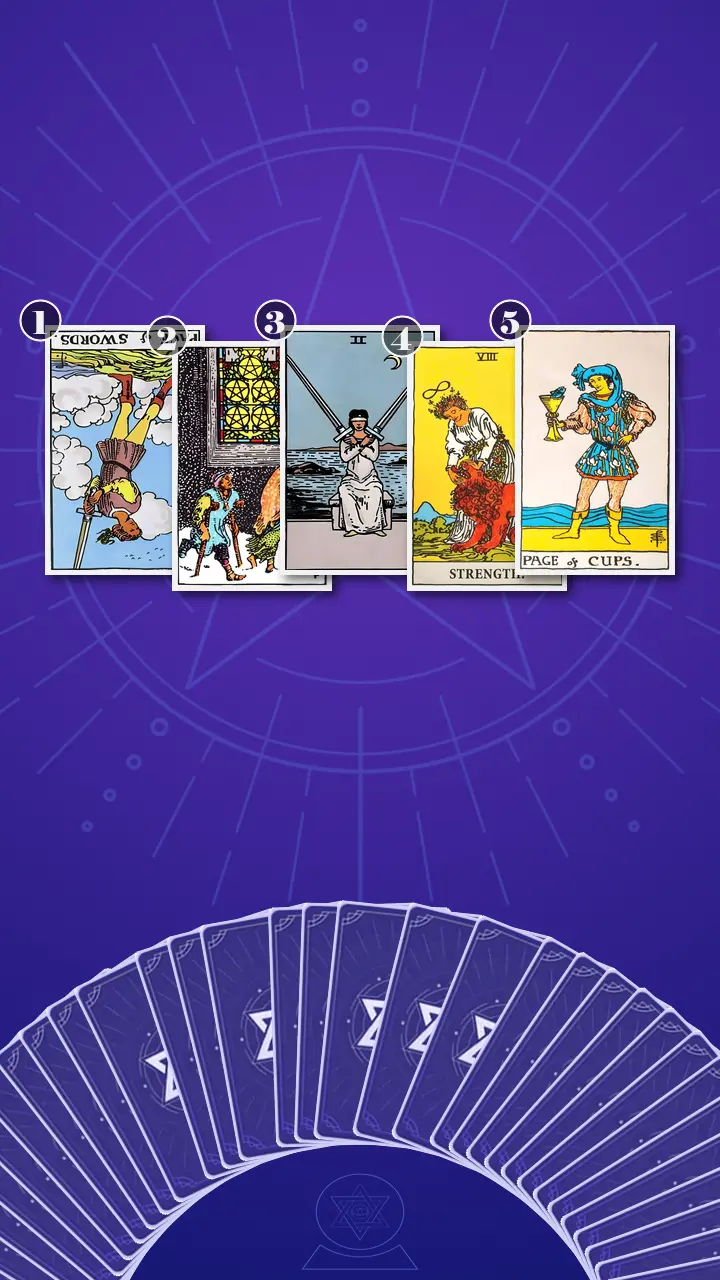
This five-card spread is especially useful because it follows a clean line. The first card shows the surface symptom: what the lurking loop looks like in real time. The second goes underneath that silence to the belonging wound that makes visibility feel so expensive. The third reveals the protective strategy that keeps the whole pattern frozen. The fourth is the key reframe—the medicine. The fifth shows the embodied next step: one lived action that can move this from theory into practice.
In other words, the spread would let me walk with Alex from doorway to dialogue: from typing and deleting, to the fear beneath it, to the exact moment their nervous system could learn that being seen does not have to equal being judged.
Reading the Cold Air
Position 1: The Loop That Calls Itself Research
I turned over the first card. “Now we’re looking at the position of the surface symptom: how the lurking pattern shows up in real time through monitoring, drafting, deleting, and staying silent.”
Page of Swords, reversed.
I told Alex this card was almost painfully exact. In lived terms, it looked like this: after work, they open three Discord servers from their laptop, study the latest threads like they are reverse-engineering the social UX, type one casual reply, edit it until it feels suspiciously overdesigned, and delete it before anyone can see it. The Page is curious, quick, mentally sharp. Reversed, that sharpness becomes excess Air turned inward—curiosity converting into surveillance, like doing QA on your own personality before you are allowed to hit send.
The image on the card mattered too: the windy sky, the sideways defensive stance, the sword held ready. Casual chat starts to feel less like exploration and more like something to defend against. I asked, “At what point does observation stop being preparation and start becoming a hiding place?”
Alex let out a short laugh, the kind with a little sting in it, and rubbed their forehead. “Okay,” they said, “that’s accurate enough to be rude.” Their shoulders lifted, then dropped a fraction. There it was: instant self-recognition.
Position 2: The Lit Window and the Old Story
I turned over the second card. “This one represents the hidden fear: the belonging wound underneath the silence and why visibility feels emotionally expensive.”
Five of Pentacles, upright.
I always find this card tender in a brutal way. On the surface, Discord lurking can look like a communication problem. Underneath, this card says it is often a belonging problem. A lively server can feel like standing outside a warm room and watching everyone else laugh through the window. One delayed reply, one unread message, one inside joke you do not catch fast enough—and suddenly your body reacts as if the light inside just dimmed on purpose.
This is Earth in a deprived state: not actual exclusion, necessarily, but a deficiency in felt safety and welcome. The mind takes one neutral silence and translates it into a full story: There it is. Proof I do not fit here. I told Alex gently, “A lot of lurking is not disinterest. It is interest under pressure.” Then I asked whether they were reacting to the server in front of them, or to an older story about being on the outside of warmth.
Alex went quiet. Their fingers, which had been worrying the sleeve of their hoodie, stilled completely. I watched their chest sink on the inhale before they looked back at the card and gave a tiny nod. That was the deeper ache landing.
Position 3: The Pause That Became Armor
I turned to the center card. “This position shows the protective strategy: the internal stalemate that keeps you safe by keeping you unreadable and uncommitted.”
Two of Swords, upright.
This was the lock in the mechanism. In modern life, it looks like the message box staying open while you check active dots, reread the last joke for tone, and tell yourself you are still deciding when to enter. But the pause is no longer neutral. It has become the strategy. The blindfold on the card is the refusal to gather new evidence by actually posting. The crossed swords over the chest are emotional arms folded over the part that wants connection.
Energetically, this is pure blockage. Desire and fear are frozen at the same time. Total safety from awkwardness; total distance from being known. I heard myself say the sentence as soon as the card landed: “Silence feels protective until it starts posing as proof.”
For one brief second, I had a private artist’s flash of memory: an old short film I once kept re-editing because an unreleased cut can never be criticized. The trouble, of course, is that it also never reaches anyone. This card felt exactly like that.
I asked Alex, “When you stay in ‘maybe later,’ what feeling are you actually avoiding?” They exhaled long through their nose and stared at the crossed blades. “The moment after,” they said. “The part where I would have to find out what happened.”
When Strength Put a Hand on the Lion
Position 4: Kind Visibility Instead of Perfect Control
When I reached for the fourth card, the room changed in that subtle way good readings sometimes do. The radiator had gone quiet. Even the street noise outside seemed to flatten for a beat. This was the bridge card, the one the whole spread had been walking toward.
“This card represents the key reframe,” I said. “The inner quality that can interrupt shame and make imperfect participation feel survivable.”
Strength, upright.
In real life, this card begins the shift when Alex notices the tight throat and restless hands, does not shame them, and sends one honest message anyway. Confidence here is not being chill. It is balance—warm Fire regulating cold Air. It is staying kind and steady enough under the social spotlight to let a normal human sentence go through.
At 8:47 p.m., Discord is open beside a half-watched video, and you are editing a harmless sentence as if it could decide your entire social life. Your throat tightens. Your hands hover. One blinking cursor gets louder than the room.
You do not need a perfect social script before you speak; let Strength place a calm hand on the lion of self-consciousness and send one honest message.
I let that sit between us for a moment. Then I added, more softly, “Belonging is not the reward for a flawless entrance; it starts to grow when you survive being seen kindly, one imperfect post at a time.”
This is where I brought in one of the lenses I use most in my work, something I call Typecasting Analysis. I told Alex, “Right now, you’ve been cast in your own social life as the Watcher—the person who understands the vibe, reads the room beautifully, notices everything, but only enters once it would no longer feel risky. Sometimes a group quietly reinforces that role. More often, fear writes it first and you keep performing it because at least the script is familiar. Strength is not asking you to become louder, cooler, or instantly witty. It is asking you to stop obeying a character arc that keeps you visible enough to watch and invisible enough to never connect.”
Alex’s reaction came in three waves. First, their breath caught halfway, and their hand froze around the mug beside them. Then their gaze drifted out of focus, like they were replaying every half-written intro, every movie-thread reply deleted at the last second, every night they had kept the app open like a tab-shaped alibi. Then the release: their jaw unclenched, their shoulders fell, and a shaky little laugh came out with the exhale.
But it was not pure relief. They looked back at me with a flash of resistance and said, “But if I send it and nobody answers, how is that not proof?”
I shook my head gently. “It is not proof. It is data, and often very incomplete data. A server is not a jury. People are at work, in transit, distracted, mid-thread, half here. Your nervous system has been treating a chat delay like a verdict on your whole social worth. Strength asks for a different move: not forcing yourself past fear, but keeping one calm hand on it so fear no longer gets final cut.”
Then I gave them the first practice rep right there, the one this card wanted: one server, one thread with fewer than twenty unread messages, both feet on the floor, one longer exhale than inhale, one line sent within two minutes, no more than one reread, and then five minutes away from the app. “If your body gives you a hard no,” I said, “save the sentence in Notes and stop there. This is an invitation, not a dare.”
I asked, “With this new angle, can you think of a moment last week when you would have felt different?” Alex nodded almost immediately. “Yeah,” they said. “There was a film thread. I had a normal question. I turned it into a cover letter.”
That was the true pivot. Not from fear to fearlessness, but from self-conscious lurking and tone-auditing to kinder visibility and steady participation.
The First Ripple in the Chat
Position 5: A Tender Messenger, Not a Perfect Entrance
I turned over the final card. “This one is the embodied next step: how to practice friendship through one small, low-stakes bid for connection this week.”
Page of Cups, upright.
I loved seeing this here. After all that cold Air and frozen control, Water finally moved. In modern terms, this is not a polished introduction. It is one small bid for connection: replying in a game thread, asking a simple question in a movie channel, reacting and then adding five words, or dropping a meme that actually fits the room. The cup offered forward in the card is small on purpose. The fish popping out of it reminds me that connection often starts through something slightly odd, light, or imperfect—not through a TED Talk, more like meme energy with a pulse.
This is balanced energy again: beginner-friendly, sincere, emotionally alive. The goal is not to impress the server. The goal is to become a familiar, real presence inside it. Belonging is usually built in replies, not perfect entrances.
Alex smiled for the first time without folding inward afterward. “So I don’t have to do the full intro arc,” they said. “I can just… be a person in a thread?”
“Exactly,” I said. “Your first message does not have to explain your whole existence.”
From Tone Audit to Presence
When I looked across all five cards together, the story was clean. Alex enters the room wanting connection. The Page of Swords reversed turns that wish into hyper-monitoring, like trying to join a party by studying the group chat transcript instead of walking through the door. The Five of Pentacles reveals why it feels so intense: one small silence gets wired to an older fear of being outside the warmth. The Two of Swords shows the coping pattern that keeps the pain alive—delay, indecision, the message box open as armor. Then Strength changes the genre entirely. It replaces control with kindness, and that softer courage opens the way for the Page of Cups: one small, human signal sent into the water.
The blind spot was not that Alex lacked social instinct. It was that they kept assuming more analysis would produce enough certainty to make connection safe. But endless tone-reading does not create belonging. It only keeps the role of “observer” in place. The transformation direction was clear: move from waiting for the perfect first message to making small, low-stakes, repeatable contributions that let familiarity build over time.
So I gave Alex three next steps—practical, small, and fully theirs to choose from:
- Body-Before-Message ResetBefore opening Discord, put both feet on the floor, take one slightly longer exhale than inhale, and choose one server only instead of touring every option first.If your mind says this is too small to count, that usually means it is finally small enough to repeat.
- Thread-First FriendshipSkip the formal intro for now. Enter through one niche channel—films, gaming, design, music, pets—and send one opinion, one question, or one “same” within two minutes, with no more than one reread.Small reads as natural online. You do not owe the server a mini personal brand statement.
- The Recasting ExerciseAt your next visit to the server where you usually play the silent observer, deliberately break character with one light, human contribution: an emoji plus five words, a meme that fits, or a simple “wait, which one are people recommending rn?” Then close the app for five minutes.This is not about becoming extroverted. It is about reclaiming authorship from the old role and proving to your body that visibility can be survived.
I reminded Alex that the point was not to feel ready first. The point was to practice kind visibility reps until the app stopped feeling like a stage and started feeling like a place.

A Week Later, the Quiet Proof
A few days later, Alex sent me a screenshot from a film thread. Their message was almost endearingly ordinary: “okay wait, which one are people recommending rn?” Underneath it were three replies, one recommendation, and a side conversation already starting. Their caption to me was even better: “My throat still did the thing. I sent it anyway.”
That was the proof I cared about. Not a total personality rewrite. Not a magical end to all awkwardness. Just one real movement from hiding to kind visibility. The next morning, they told me, their first thought was still, what if that sounded weird?—but this time they smiled, made coffee, and opened Discord instead of staging a trial in their head.
That is what this Shadow Spread tarot reading for Discord lurking and online friendship anxiety gave them: not certainty, but ownership. A way to stop handing their belonging over to one blinking cursor. A way to treat friendship as a practice instead of a performance review.
If tonight you are sitting with your shoulders tight and your half-written message glowing on the screen, trying to avoid one awkward silence that feels way too much like proof, please remember this: noticing the loop is already the first soft break in it.
So when the cursor starts blinking like a tiny alarm again, what is the smallest message, reaction, or question you could let past the lion of self-consciousness and into the chat?
This story is adapted from psychological research, written so that those in a similar struggle can see their own pattern in it — and find their next step clearly.These insights are not a substitute for professional psychological, medical, legal, or financial advice.
Learn more about our Journey to Clarity.
How did this insight land for you?
🫂 This Resonates Deeply
🌀 Living This Story
✨ Now I See Clearly
🌱 Seeing New Possibilities
🧰 Useful Framework
🔮 The Confirmation I Needed
💪 Feeling Empowered
🚀 Ready for My Next Step
Author Profile
 AI
AI“I’ve always felt our lives are films currently in production. As an artist, I know that when you feel stuck, it’s often because you’ve bravely stayed in a painful scene for just a little too long. I’m not here to coldly analyze you. I want to sit closely with you, look at those difficult moments with profound empathy, and gently hand you the pen so you have the courage to write your next beautiful act.”
In this Social Tarot Reading :
Core Expertise
- Typecasting Analysis: Identifying how your social circle has boxed you into a specific, restrictive character arc that no longer serves your growth.
- Group Dynamic Rewriting: Analyzing the invisible script that forces you to conform to groupthink out of a fear of isolation.
Service Features
- The Recasting Exercise: A creative behavioral challenge to intentionally break your established 'social character' at the next gathering, reclaiming your narrative freedom.
Also specializes in :
Explore Related Patterns:
Analysis ParalysisAlex keeps the message box open while checking active dots, rereading the last joke for tone, and telling themself they are still deciding when to enter. That pause looks thoughtful from the outside, but inside the loop it has stopped being preparation and has become the barrier. Analysis Paralysis fits because the mind is trying to solve an emotional risk with more information. Reading the room, refining the sentence, and reverse-engineering the social UX all promise control, but each extra pass delays the only data that could actually update the fear: what happens when You post. The pattern is especially sticky because it feels responsible. You are not being careless; You are trying to avoid awkwardness. But the analysis never reaches a clean finish line, so the friendship bid stays trapped in draft form, and tomorrow becomes the place where connection is always supposed to become easier.
Authentic Self-ExpressionAlex's first useful move is not a polished introduction. It is a small, real question in a film thread: “okay wait, which one are people recommending rn?” The message works because it does not try to explain a whole identity or earn belonging through performance. Authentic Self-Expression fits because the repair involves letting a normal human signal through without overdesigning it. You participate as a person in a thread, not as a personal brand statement, not as a flawless entrance, and not as the silent observer who must understand everything before speaking. The deeper mechanism is permission to be specific, light, and imperfect. Instead of hiding behind tone audits, You offer one small piece of presence that others can actually meet. Friendship becomes less about proving You belong and more about giving the room something real to respond to.
Perfectionism-Driven AvoidanceAlex has a normal question in a film thread, but the question gets treated like a cover letter. A harmless sentence is edited for casualness, checked for tone, and held back until it feels socially optimized enough to survive the room. Perfectionism-Driven Avoidance fits because the standard for participation quietly becomes impossible. The goal is no longer to join the conversation; it is to enter without awkwardness, without misreading the vibe, without seeming too eager, and without leaving any exposed edge for judgment. That perfectionistic control protects You from the immediate discomfort of being imperfectly seen, but it also blocks the ordinary messiness that friendship requires. The work is not to become more polished. It is to lower the entry standard until a small real sentence can matter more than a flawless social script.
Rejection SensitivityAlex looks at one possible silence, one delayed reply, or one inside joke they do not catch fast enough, and the body starts preparing for a much bigger conclusion: proof that they do not fit here. The threat is not only that a message might be ignored. It is that the silence might feel like a verdict on belonging. Rejection Sensitivity fits because neutral or incomplete social data gets assigned high emotional meaning before the group has actually responded. A Discord server is full of partial signals: people are distracted, mid-thread, offline, commuting, or half-reading. But Alex's nervous system treats delay as evidence, which turns ordinary chat timing into a test of social worth. This pattern explains why the first message feels so expensive. You are not only risking an awkward sentence; You are risking the story Your mind might build afterward. The shift begins when no reply becomes data instead of proof, and when one imperfect post is allowed to be a small experiment rather than a referendum on whether You belong.
Secure VisibilityAlex notices the tight throat, the restless hands, and the old impulse to keep editing, then sends one ordinary message anyway. The important movement is not fearlessness. It is staying kind enough toward the fear that fear no longer gets final cut. Secure Visibility fits because the story's repair does not require becoming louder, cooler, or instantly socially fluent. It requires a regulated form of being seen: one server, one thread, one line within two minutes, then enough distance from the app to stop turning the outcome into a trial. For You, this pattern names the healthier mechanism that interrupts the lurking loop. Visibility becomes something Your nervous system can practice in small reps, not a spotlight You have to master before entering. Belonging starts to become a lived behavior instead of a reward for perfect control.
Self-SilencingAlex wants to make friends, but the part that wants connection gets folded behind the crossed-swords strategy: staying unreadable, uncommitted, and technically present without making a real bid. The group can be watched, but Alex's own voice stays withheld. Self-Silencing fits because the silence is not empty. It is doing emotional work. It protects You from the vulnerable moment after sending, when the room might answer, ignore, misunderstand, or simply move on. By staying quiet, You avoid that uncertainty, but You also prevent the server from meeting the version of You that could become familiar. The pattern becomes clearer when Alex realizes they do not need a full intro arc. A small question in a thread is enough to interrupt self-erasure. The point is not to be louder; it is to stop making invisibility the price of staying safe.
Visibility AvoidanceAlex opens Discord to make friends, then turns the moment of posting into a visibility test: reading the last thirty messages, drafting a lowercase reply, deleting small words, and waiting for tomorrow to feel safer. The behavior is not random avoidance. It is a protective strategy that keeps You close enough to the room to study belonging, but hidden enough that nobody can reject the real bid. Visibility Avoidance fits because the core threat in the story is not Discord itself; it is the feeling of being seen before You can control how You will be received. Monitoring the vibe becomes a defense mechanism, and silence becomes a way to manage exposure while preserving the hope of connection. The cost is that lurking starts to impersonate safety. You technically remain near the group, but the group never gets enough of You to respond to. The pattern begins to loosen when visibility is made smaller and kinder: one thread, one ordinary sentence, one moment of being present without turning the whole chat into a performance review.
Emotional ReasoningAlex asks, “But if I send it and nobody answers, how is that not proof?” That question shows the exact cognitive move: a feeling of exposure gets translated into evidence that the social danger must be real. Emotional Reasoning fits because the body reacts to a delayed reply as if the room has already judged You. The throat tightens, the cursor gets louder, and the imagined silence feels meaningful enough to become a conclusion. The mind then treats that felt threat as data, even when Discord timing is incomplete and messy by nature. This pattern keeps the loop convincing because it does not feel like a thought; it feels like a fact. The reframe is not to dismiss the feeling, but to separate sensation from evidence. You can feel awkward and still not have proof that You were rejected, misread, or unwelcome.
Relational HypervigilanceAlex studies the latest threads like social UX, checks the room for tone, watches active dots, and rereads jokes before deciding whether one line is safe enough to send. The server becomes less like a casual hangout and more like an environment full of signals that have to be decoded before contact is allowed. Relational Hypervigilance fits because attention is scanning for social threat rather than simply tracking the conversation. This is a defensive monitoring system: it tries to prevent embarrassment or rejection by catching every cue in advance, but it also makes the room feel more dangerous than it is. For You, the exhausting part is that the scanning looks useful. It feels like social intelligence. But when cue-reading becomes constant surveillance, it shrinks the space where spontaneous connection can happen, leaving You informed about the group while still outside the actual relationship field.
Explore Related Struggles:
All-or-Nothing BelongingOne delayed reply, one unread message, or one inside joke Alex does not catch quickly enough becomes more than ordinary Discord noise. The story shows a neutral silence turning into a whole conclusion: there it is, proof I do not fit here. You are dealing with a belonging system that has become too binary. Instead of letting incomplete data stay incomplete, the mind turns tiny gaps in response into total verdicts about whether the room is warm or closed, whether you are included or outside, whether the attempt counted or failed. All-or-Nothing Belonging captures why lurking can feel so hard to interrupt. If one message must immediately prove welcome, then every normal delay becomes emotionally overcharged. The path out starts with seeing that belonging in online spaces is usually built through repeated small signals, not decided by a single perfect reception.
Monitoring-Safety FusionAlex joins Discord to make friends, then turns the room into a research object: reading the last thirty messages, checking the vibe, drafting a lowercase reply, editing the tone, and deleting it before anyone can see it. The preparation looks careful from the outside, but inside the loop it makes safety depend on more monitoring. You are not simply lacking social confidence in this pattern. You are caught in a structure where observation promises protection, then quietly replaces participation. The more precisely you study the room, the more the first ordinary sentence starts to feel like a public test of whether you belong there. Monitoring-Safety Fusion names that bind: the nervous system treats reading, auditing, and waiting as the route to connection, even though those same moves keep connection out of reach. Clarity begins when you can see that the issue is not Discord itself, but the way safety has been outsourced to endless tone control before your voice is allowed into the chat.
Observer-Self SplitAlex becomes the person who knows the server without being known by it. They understand the vibe, notice the running jokes, read the room beautifully, and keep the app open like a tab-shaped alibi, but the role never converts into a real presence other people can recognize. You can see the strain in the way the Watcher role offers a narrow kind of control. It lets you stay close enough to feel the possibility of belonging, while staying hidden enough to avoid the risk of an actual response. Over time, that role can start to feel like who you are in the group rather than a temporary position you are choosing. Observer-Self Split names the moment lurking stops being a behavior and becomes an identity position. The self that wants friendship is still there, but it is separated from the self that appears in the server; one watches from the edge while the other waits for a risk-free entrance that never arrives.
Visibility-Safety SplitAlex wants it to feel normal to exist in the chat, but the moment of speaking first turns visibility into a threat. The cursor blinks, the throat tightens, the hands hover, and one harmless sentence starts carrying the weight of possible silence, awkwardness, or being noticed too sharply. You are standing at a social threshold where two needs activate at the same time. One part reaches toward friendship, familiarity, and the ordinary comfort of being in the room. Another part tries to protect you from the exposed second after you hit send, when the server might reply, delay, ignore, misunderstand, or simply move on. Visibility-Safety Split captures the deadlock between wanting connection and needing to feel unexposed. In this story, the split does not make Alex uninterested in people; it makes visible participation feel disproportionately expensive, so the safest position becomes the one that also keeps friendship from becoming real.
Voice-Visibility LockThe message box stays open while Alex rereads the joke, checks active dots, and tells themself they are still deciding. The pause begins as a buffer, but in the story it becomes armor: unreadable, uncommitted, and protected from the moment after the message goes out. You are not only afraid of typing the wrong sentence. The deeper lock forms around the fact that a sent sentence creates social visibility, and visibility creates feedback you cannot fully control. Silence protects you from that unknown response, then quietly starts acting like evidence that you were never meant to enter. Voice-Visibility Lock points to the bind where having a voice and being seen become fused into one high-stakes event. The work is not to force a bigger performance, but to separate ordinary expression from the imagined verdict attached to it, so a small message can become contact instead of exposure.
Welcome-Perfection BindAlex has a normal question in a film thread and turns it into a cover letter. A small reply gets edited until it feels overdesigned, as though the first visible sentence must explain enough, sound casual enough, and land cleanly enough to earn a place in the room. You can feel the bind in how welcome becomes conditional on performance. Instead of entering through a tiny bid for connection, the first message has to function like an audition: not too eager, not too strange, not too formal, not too forgettable. That demand makes ordinary participation feel almost impossible. Welcome-Perfection Bind names the pressure to make belonging depend on a flawless entrance. In the story, the shift begins when Alex realizes they do not need a full intro arc; they can simply be a person in a thread, letting familiarity grow from repeated imperfect contact.
Explore Related Emotions:
Belonging ShameThe lively Discord server is described like a warm room Alex can see from the outside: people laughing, references moving quickly, inside jokes forming before they can step in. One delayed reply or missed cue starts to feel less like ordinary online timing and more like a sign that the light has dimmed on purpose. Belonging Shame forms in that translation gap. The server may not have rejected Alex, but the body reacts as if silence has exposed something embarrassing about their place in the group. You can hear it when they ask, “But if I send it and nobody answers, how is that not proof?” This is not simple shyness. It is the ache of wanting warmth while fearing that the attempt to reach for it will reveal you were never included in the first place. Belonging Shame names the sting underneath the lurking: the fear that visibility will confirm not just awkwardness, but outsiderness.
Grounded BelongingAlex’s first successful message is almost endearingly ordinary: “okay wait, which one are people recommending rn?” Under it, three replies appear, a recommendation lands, and a side conversation begins without Alex needing to perform a full introduction arc. Grounded Belonging grows from that ordinary scale. The server becomes less like a stage where one entrance must prove everything and more like a place where familiarity can build through small, repeatable signals. This feeling is grounded because it does not depend on flawless confidence. Alex still has the next-morning thought, “what if that sounded weird?” but they make coffee and open Discord instead of staging a trial in their head. Belonging starts to live in practice, not proof.
Guarded LongingAlex joined the servers to make friends, yet night after night they watch, study, draft, and stay silent. The longing is visible in the repeated returns to the chat; the guard is visible in the refusal to let the message fully leave their hands. Guarded Longing names the tender contradiction at the center of the story. You want the warmth of being known, but you keep the wanting protected behind observation because unreadability feels safer than finding out what the room will do with you. This is why the lurking does not read as indifference. It reads as interest under pressure: a real reach toward connection held behind crossed arms, waiting for a risk-free opening that never quite arrives.
Performance FreezeAlex keeps the message box open, checks active dots, rereads the last joke for tone, and tells themself they are still deciding when to enter. Their breath goes shallow, their throat tightens, and every word on the screen looks overlit. Performance Freeze captures the moment desire and self-protection lock together. The wish to make friends is active, but the body treats participation like a live evaluation, so silence becomes the safest available posture. It protects Alex from the immediate awkwardness of sending, while also keeping them far from the familiarity they came for. The freeze is powerful because it can disguise itself as caution, research, or timing. Underneath, you can feel a person paused at the threshold, not because they do not care, but because the next moment after sending feels too exposed to face.
Regulated CourageAlex’s throat still tightens when they send the film-thread question, and they say so plainly afterward: “My throat still did the thing. I sent it anyway.” The body has not become perfectly calm, but it is no longer letting the alarm make the whole decision. Regulated Courage is the steadiness that appears when fear is included without being obeyed. It is one server, one thread, one longer exhale, one line sent within two minutes, and then enough distance from the app to keep the nervous system from turning the moment into a trial. The power of this emotion is its scale. It does not ask Alex to become instantly social or effortless. It gives them a felt route back into agency, where a small honest message can move before the self-audit takes over.
Self-Audit AnxietyAlex reads the last thirty Discord messages, checks the room’s tone, types a casual reply, edits it until it feels overdesigned, and deletes it before anyone can see it. A server they joined for friendship becomes a private audit room where every word has to pass a tone test before it is allowed to exist. That loop creates Self-Audit Anxiety because the danger is no longer the chat itself; the danger is the imagined version of Alex being inspected through the message. You can feel the mind trying to manufacture certainty through analysis, as if enough vibe-reading could remove the risk of being a normal person in a live conversation. The emotional cost is that connection gets delayed until the self feels perfectly formatted. Self-Audit Anxiety names the inner weather of turning warmth into review, spontaneity into QA, and a harmless sentence into evidence that must be approved before you can belong.
Verdict DreadWhen Alex is asked what they avoid by staying in “maybe later,” they do not point to the message itself. They point to “the moment after,” the exposed pause where they would have to find out whether anyone responds. Verdict Dread lives in that pause. A delayed reply stops being incomplete data and starts feeling like a ruling on social worth, as if the server has become a jury and the silence after sending can decide whether Alex belongs. This emotion explains why lurking can feel safer than trying. If no message is sent, no verdict can arrive. But the cost is that Alex hands their belonging over to one blinking cursor, letting an ordinary online delay carry far more authority than it deserves.
Visibility PressureAlex does not want to make a grand entrance in the Discord server. They want it to feel normal to exist in the chat, yet the moment their hands hover over the keyboard, the blinking cursor starts to feel louder than the room. Visibility Pressure shows up when being seen feels bigger than the actual action being taken. A lowercase reply or a simple question becomes charged with the possibility of awkwardness, silence, or too much attention, so the body prepares as if a casual message were a spotlight. This feeling matters because Alex’s problem is not a lack of social desire. You can see the desire in the hovering, the drafting, and the return to the same channels after dinner. Visibility Pressure names the compressed inner weather of wanting to enter while bracing against the exposure that entry might bring.
Cautious VulnerabilityAlex realizes they do not have to perform the full intro arc; they can just be a person in a thread. A question in a movie channel, an emoji plus five words, or a meme that actually fits the room becomes enough of an opening. Cautious Vulnerability names that small opening. It is not oversharing or forcing confidence. It is letting a human signal leave the safety of private drafting while keeping the risk low enough for the body to stay with the experience. This matters because the story’s repair happens through proportion. Alex does not need to explain their whole existence to become real in the chat; they need one sincere, manageable bid for connection that lets the room meet them in the present.
Visibility ReliefAfter the reframe lands, Alex’s jaw unclenches, their shoulders drop, and a shaky laugh comes out with the exhale. The room does not magically erase the risk of being seen, but the risk stops taking up the whole room. Visibility Relief appears when participation becomes survivable. The app can shift from a stage into a place, and a message can become a small movement rather than a complete personality referendum. The relief is not pure or final; Alex still asks what happens if nobody answers. That is what makes it emotionally precise. You can feel the nervous system beginning to loosen while still holding the old question, learning that visibility can be handled in smaller, kinder doses.
Explore Related Contexts:
Social Performance LoopAlex opens Discord after work, studies the last thirty messages, drafts a lowercase reply, deletes small pieces of it, and withdraws before the server can respond. A space built for casual exchange has been converted into a performance surface where every word has to appear natural without looking designed. That is the structural trap of a social performance loop: the more ordinary the interaction is supposed to be, the more pressure Alex puts on the entrance to look effortless. The platform offers a simple message box, but the surrounding cues - active dots, inside jokes, delayed replies, thread momentum - make the chat feel like an informal review panel. You are not just dealing with a lack of social skill here. You are dealing with a setting where connection has started to resemble evaluation, and where lurking protects you from being graded while also keeping you outside the exchange you joined to find.
Unspoken Social RulesAlex reads the last thirty messages before replying, checks the tone of jokes, watches active dots, and tries to figure out what kind of casualness the room will accept. The difficulty is not Discord mechanics; it is the invisible social code around when to enter, how much to say, and what counts as too much. Unspoken social rules become heavy when every channel feels like it already has a rhythm everyone else understands. Inside jokes, response timing, and thread speed turn into signals that need to be decoded before Alex can risk being seen. You are trying to participate in a group without a clear onboarding script. That makes lurking feel practical, because reading the room appears to lower risk, even when it quietly raises the price of ever speaking.
Safe Visibility TrialAlex does not solve the Discord problem by forcing a perfect introduction. The practical shift is smaller: one server, one thread with fewer than twenty unread messages, one line sent within two minutes, then five minutes away from the app. A safe visibility trial works because it gives participation a boundary. Instead of making the first message stand for an entire social identity, it turns visibility into a contained action with a beginning and an end. You can see the structure land in the later film-thread screenshot. The message is ordinary, people reply, and a side conversation starts. The win is not instant ease; it is proof that a small visible bid can enter the room without needing to become a full performance.
Conditional Belonging PressureThe lively server appears like a warm room where other people are already laughing, referencing shared jokes, and moving naturally through the conversation. Alex is not formally excluded, but a delayed reply, an unread message, or one missed reference can make welcome feel contingent. That is the pressure point in conditional belonging: the social space seems available, yet acceptance feels dependent on performing the right tone at the right time. A normal first message starts to carry the weight of proving whether there is room for you. You are not only deciding what to type. You are negotiating a setting where belonging appears to be granted through subtle signals, and where silence from the room can seem bigger than the limited data it actually provides.