The All-Hands Invite That Hits Like a Verdict
You’re a 20-something PM in NYC who can ship real work all week—then a single all-hands invite hits your inbox and suddenly it’s imposter syndrome + Sunday Scaries on repeat.
Jordan said that to me the minute she sat down, like she’d been holding it in all day. We were on a video call—her camera angled slightly too high, the familiar Manhattan daylight flattening everything into “work mode.” Behind her, a tiny kitchen corner and a dish rack. In front of her, Google Slides open, speaker notes visible like a confession.
“I keep rewriting,” she said. “Not even big rewrites—like… swapping might to will, then back. I’m not even sure I’m being humble or just hiding.”
I watched her swallow, the kind that’s half reflex, half bracing. Even imagining the spotlight made her throat tighten. Her breathing stayed up in her chest—short, careful inhales, like she was trying not to take up oxygen.
Self-doubt doesn’t always feel like a thought. Sometimes it feels like trying to speak through a hoodie string pulled too tight—words available, but the channel narrowed.
“Okay,” I told her, keeping my voice steady and plain. “We’re not here to hype you up. We’re here to get you clear. Let’s treat this like a map-making session—so you can walk into that all-hands with a next move you can actually use.”
Choosing the Compass: The Celtic Cross · Context Edition
I asked Jordan to take one slow breath—not to ‘calm down,’ just to mark the transition between spiraling alone and looking at the problem with support. While she exhaled, I shuffled. Not as a mystical performance. More like how I used to brush dust off a fragment at a dig site: the point is attention. Focus. A clean surface for what’s already there.
“Today we’ll use the Celtic Cross · Context Edition,” I said.
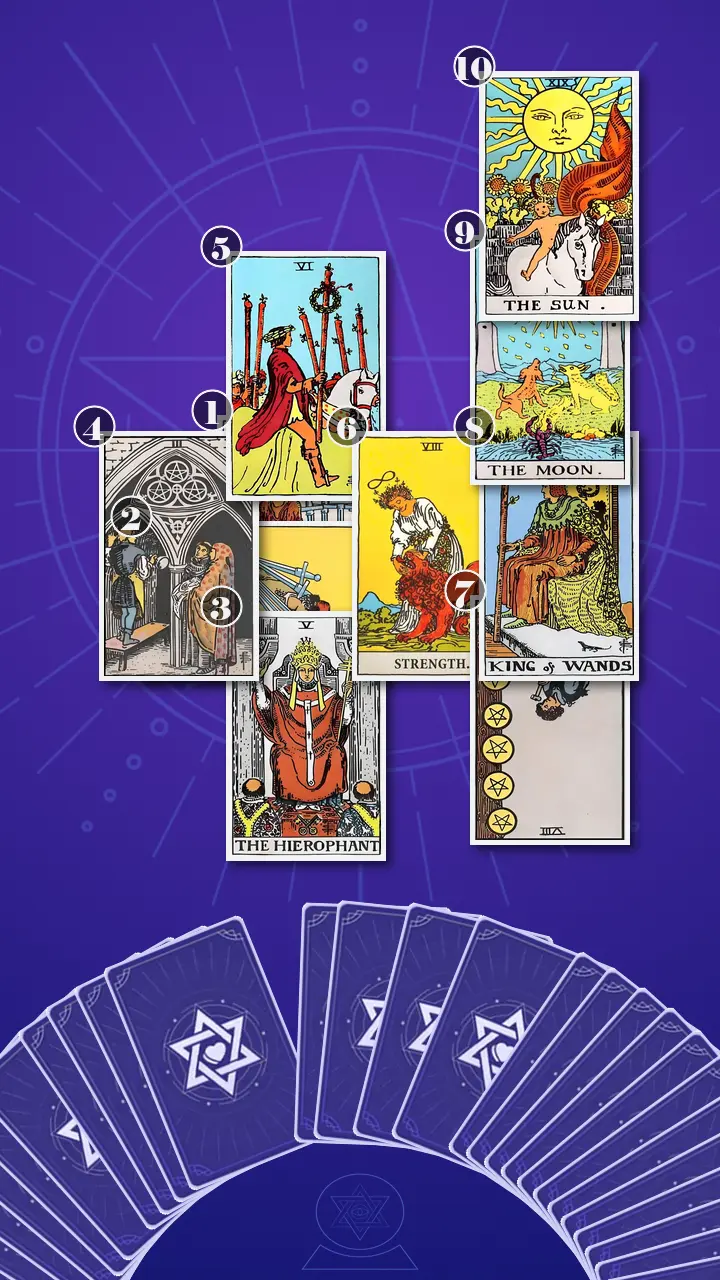
For anyone reading who’s curious about how tarot works in a practical sense: the Celtic Cross is useful because it doesn’t just label a feeling. It shows a system—what’s happening now, what blocks you, what’s underneath, what shaped it, and what the turning point looks like. This version keeps the classic diagnostic depth, but it tweaks two positions so the reading stays anchored to imposter syndrome in high-visibility performance: position 5 becomes “what you think you must prove at the all-hands,” and position 6 becomes “your next move in the moment.”
“We’ll start in the center,” I told her. “The first card shows what your imposter syndrome looks like in real behavior right before the spotlight. The crossing card shows the main strategy that trips you up when you try to be visible. And the card to the right—your next move—that one is often the pivot.”
Reading the Map: From Mental Cages to Clean Daylight
Position 1 — The current presenting moment
“Now we turn over the card that represents the current presenting moment: what your imposter syndrome looks like in real behavior before the all-hands.”
Eight of Swords, upright.
“It’s 11:30 PM and you’re trapped in Presenter View,” I said, letting the modern scene land exactly where her life lives. “Convinced there’s exactly one ‘safe’ way to say your update. You keep rehearsing because you feel like any deviation will expose you—even though your actual competence is sitting right there in your project decisions and shipped work.”
This card is a clarity problem disguised as a competence problem. The energy here isn’t that you lack skill—it’s that your mind is in blockage mode: blindfold on, options narrowed, treating communication like a single-lane bridge with a cliff on both sides.
Jordan gave a small laugh that sounded like it had scraped her throat on the way out. “That’s… painfully accurate,” she said. “Like, almost rude.”
“That reaction makes sense,” I said gently. “The Eight of Swords is ‘rude’ because it shows the bindings are loose. The trap is real—but it’s maintained by interpretation more than facts.”
Position 2 — The main block in the spotlight
“Now we turn over the card that represents the main block in the spotlight: the thought/strategy that trips you up when you try to be visible.”
Seven of Swords, upright.
“During the presentation, you’re half-speaking and half scanning,” I said. “Watching leadership reactions, choosing the least attackable phrasing, trying to avoid live scrutiny. It’s like you’re presenting to not get caught—which steals the grounded energy that would actually make you sound confident.”
I paused and gave her the split-screen that the card demands.
On one side: your hands, clicking between Edit mode and Presenter View, rewriting a bullet like it’s a legal contract. On the other side: your eyes, flicking to the VP’s face in Zoom gallery view like it’s a live reaction feed. Two inner voices running at once:
Be flawless.
Don’t get caught.
Seven of Swords is excess strategy. Too much armor. You’re trying to be “screenshot-proof” instead of clarity-proof. And split attention does something sneaky: it makes you sound less present, which then becomes more evidence (in your own mind) that you’re not safe.
Jordan nodded once—tight, controlled. “Yeah,” she said quietly. “I watch their faces more than my own slide.”
“Right,” I told her. “And here’s the reframe I want you to borrow for the whole reading: This isn’t a trial. It’s an update. The more you treat it like a stealth mission, the more your nervous system believes there’s danger.”
Position 3 — The hidden driver underneath imposter syndrome
“Now we turn over the card that represents the hidden driver underneath imposter syndrome: the deeper standard shaping the fear of being seen.”
The Hierophant, upright.
“Underneath the nerves is an internal corporate rulebook,” I said. “The belief that credibility only counts if it matches a specific ‘executive’ tone. So leadership attention feels like a ceremony where you either get blessed as legitimate—or silently judged as an imposter.”
This is the institutional gatekeeper archetype. The Hierophant’s energy is overweight authority: not authority in the room, but authority in your head. It’s very Succession—the sense there are invisible rules and status tells, even when nobody says them out loud.
“I need to ask you something,” I said. “Whose definition of ‘credible’ are you still trying to satisfy when you speak?”
Jordan stared slightly past the camera, like she was scrolling an internal feed. “Honestly? Some… composite CEO voice. Like every r/ProductManagement thread about ‘executive presence’ turned into one person.”
“That’s exactly The Hierophant,” I said. “A composite. A rulebook without a signature.”
Position 4 — What led up to this
“Now we turn over the card that represents what led up to this: the recent work dynamic that made the all-hands feel higher-stakes.”
Three of Pentacles, upright.
“Your recent work has been reviewed by multiple stakeholders—lots of feedback, lots of visibility,” I said. “Your brain learned: being seen equals being graded. So now an all-hands feels like the next round of evaluation instead of a simple update about what’s true.”
Three of Pentacles is balanced craft: competence demonstrated through contribution, not charisma. In archaeology, we rarely judge a site by a single impressive artifact—we judge it by the layers, the pattern, the workmanship over time. This card says your work has structure. People are looking because you’ve built something real.
Jordan’s shoulders dropped by a millimeter. Not relaxed—just less braced.
Position 5 — What you believe you must prove
“Now we turn over the card that represents what you believe you must prove at the all-hands to feel safe and legitimate.”
Six of Wands, upright.
“You’re secretly hoping the all-hands lands as a clean win,” I said. “The nods, the ‘great job,’ the absence of tough questions. Not because you’re vain—because applause feels like proof you’re real, and silence feels like danger.”
Six of Wands is excess external validation. The laurel wreath becomes a safety blanket. The crowd becomes a scoreboard. And when recognition is your anesthesia, you start performing for relief instead of communicating for impact.
“I want to be seen as someone with leadership potential,” Jordan admitted. The words came out fast, then she looked like she regretted them.
“That desire is human,” I said. “But here’s the trap: if you need the room to confirm you belong, you’ve handed the room your nervous system.”
When Strength Took the Mic
Position 6 — Your next move before and during the all-hands
I slowed my hands before turning the next card. The air in my office felt suddenly quieter, the way it does right before you uncover something intact in the ground—like time itself is holding still so you don’t crack it.
“Now we turn over the card that represents your next move before and during the all-hands—how to meet the moment differently.”
Strength, upright.
“Your next move is to lead your nervous system like a steady PM leads a meeting,” I said. “One breath, one sentence at a time, one pace slower than your panic wants. You don’t try to erase nerves—you keep them in the room without letting them drive.”
Strength is not hype. It’s regulated Fire. It’s the difference between trying to wrestle fear into silence (tight, fast, clenched) and leading fear (steady, warm, paced). In the card, the hand on the lion isn’t a fist. It’s contact.
In that moment when the all-hands reminder hits and your body reacts before your mind can argue—tight throat, shallow breathing, and suddenly you’re rewriting slides like it’s life or death—you’re usually trying to outthink the feeling. You’re trying to win an argument with your own nervous system.
Stop trying to outsmart the fear with perfect scripting; practice gentle control like Strength—hand on the lion, voice steady, presence leading.
Jordan’s reaction came in a chain—three small movements that told me more than her words could.
First, she froze. Her inhale stopped halfway, like the sentence had put a hand up. Her fingers hovered above her trackpad and didn’t click.
Then, her eyes unfocused slightly—not zoning out, but replaying. I could almost see the internal footage: the Midtown glass-walled conference room, the AC hum, the leadership row on Zoom like a scoreboard.
Finally, she exhaled—longer than the breaths she’d been taking all call. Her shoulders loosened, and she looked briefly… annoyed.
“But if I do that,” she said, voice sharper, “doesn’t it mean I’ve been doing it wrong? Like all this prep was pointless?”
I let that land without correcting her too quickly. “That’s a fair reaction,” I said. “And no—your prep wasn’t pointless. Over-prepping isn’t a personality flaw—it’s a nervous system strategy.”
Then I brought in my own lens—my Skill Archaeology tool, the way I’ve learned to read people the way I read a site: not by what’s loudest, but by what’s buried and consistent.
“Here’s what I’m excavating beneath your perfectionism,” I told her. “There’s a skill layer you’re overlooking because it isn’t flashy: you can steer a room. You do it in 1:1s. You do it in planning. You do it when a project wobbles and you make a call. Strength is asking you to bring that same quiet leadership into the all-hands. Not by having zero nerves—but by keeping your hands on the wheel.”
“So what does that look like in under ten minutes?” she asked.
“Exactly this,” I said, and I made it concrete on purpose. “Set a timer for four minutes. Write your ONE sentence message. Then do a 60-second out-loud read with one slow breath before the first word. If it feels too intense, stop—no forcing. The goal is practice, not perfection.”
Her face softened in a way that wasn’t exactly relief—it was more like she’d finally been given a handle. Something to hold.
“Don’t crush the nerves—lead them,” I added, and watched her mouth the phrase silently, as if testing whether it fit.
“Now,” I said, “use this new lens and tell me: last week, was there a moment where this would’ve changed your experience?”
Jordan blinked a few times. “Yesterday,” she said. “I was rewriting my Slack update, thinking about how it could be screenshot. I could’ve just… sent the update.” She let out a small, incredulous laugh. “Like a person.”
“That’s the pivot,” I told her. “This is you moving from tight self-monitoring toward steadier presence—one clear message, and trust that you can respond.”
Position 7 — Your internal posture right now
“Now we turn over the card that represents your internal posture: how you’re showing up to preparation and performance right now.”
Eight of Pentacles, reversed.
“You’re grinding for certainty: polishing slides and wording until clarity starts to blur,” I said. “The work ethic is real, but it’s getting hijacked into perfectionism—like you’re trying to earn the right to speak by doing one more pass.”
This is misdirected Earth: effort that soothes in the short term but costs you in the long term. I named the shadow plainly because Jordan needed the truth without shame.
“One risk,” I said, “is that you over-script every line and end up sounding less present—more rehearsed than necessary. The reframe is simple: do one timed run-through, allow exactly one edit pass afterward, and then stop.”
Jordan’s eyes flicked down to her notes. “That’s so hard,” she murmured. “Stopping.”
“Of course,” I said. “Because stopping removes the illusion of control.”
Position 8 — The room around you
“Now we turn over the card that represents the room around you: how leadership and workplace culture are likely being perceived by you.”
King of Wands, upright.
“The room feels led by people who speak decisively and move fast,” I said. “You interpret that fire as judgment, but it’s often just a culture that rewards clear direction. The ask is clarity—not perfection.”
King of Wands is strong Fire. It can be intimidating when you’re stuck in Swords—when your mind is building cages and escape routes. But this king’s gaze is forward. That’s the lesson: stop looking back mid-sentence to check if you’re safe.
“Translation,” I told her: “fast questions can mean engagement, not indictment.”
Position 9 — Your hope and fear
“Now we turn over the card that represents your hope and fear: what you secretly want from visibility and what you fear it could cost you.”
The Moon, upright.
“After—and during—the talk, ambiguity becomes a projection screen,” I said. “Neutral faces read as disappointment. Short questions feel like traps. Any pause becomes ‘they know.’ You’re not irrational—you’re trying to solve uncertainty by mind-reading.”
The Moon is excess imagination under stress. Instinct howls at what it can’t name. And in a corporate room, there’s always incomplete information—people multitask, cameras freeze, Slack pings, someone’s facial expression means nothing at all.
I shifted into my professor voice for a beat, because history is full of this mistake: taking shadows for facts. “In a trench, moonlight is beautiful,” I said. “But you don’t make measurements by moonlight. You wait for day.”
Position 10 — Integration outcome
“Now we turn over the card that represents the integration outcome: the most empowering trajectory if you practice the key shift after this all-hands.”
The Sun, upright.
“When you practice Strength consistently,” I said, “you come out of the all-hands with clearer memory and less self-monitoring. You can name what went well in objective terms, recover faster from normal imperfections, and feel more at home in visibility.”
The Sun is balanced visibility. Not ‘everyone loved it.’ Not ‘no one challenged you.’ It’s: you were present enough to remember your own words. You spoke in daylight instead of inside a mental maze.
“Clarity is built in daylight—by what you actually do, not what you imagine might happen,” I told her, and that sentence seemed to settle somewhere practical in her posture—like a file finally saved in the right folder.
The One-Page Plan for Finding Clarity Before the Spotlight
I leaned back and stitched the spread into one clean story, the way I teach students to do with a scattered set of artifacts: not as a pile, but as a timeline.
“Here’s the system,” I said. “You start in the Eight of Swords—your mind treats the all-hands like a trap with one safe route. Then the Seven of Swords crosses it—so you try to survive by stealth: approval-checking, hedging, rushing, avoiding questions. Underneath, The Hierophant is enforcing an internal rulebook about what ‘real professionals’ sound like, especially under institutional gaze. Three of Pentacles shows why it’s loud right now: you’ve been evaluated and reviewed, so visibility got paired with grading. Six of Wands crowns it—your brain wants a clean win to finally feel legitimate. But the pivot is Strength: regulated presence, not more proof. From there, you meet The Moon—ambiguity—without mind-reading, and The Sun becomes possible: evidence-based confidence built from what you actually did.”
“Your cognitive blind spot,” I continued, “is believing the only way to be safe is to be flawless. That keeps you stuck in ‘proof mode.’ The transformation direction is the key shift: from ‘I must prove I deserve to be here’ to ‘I will communicate one clear message and let my work speak for itself.’”
Then I gave Jordan what she’d asked for from the start: actionable advice—small, real next steps. I framed it with my own strategy metaphor—Megalith Transport: if you’ve ever seen how ancient builders moved stones that should’ve been impossible to move, it wasn’t by one heroic lift. It was rollers, ropes, teams, and repeatable increments. Your confidence works the same way.
- Write your “Home Base” sentenceOpen your speaker notes and type one sentence at the very top: “This quarter, we shipped X, learned Y, and the next decision is Z.” Keep it literal and specific to your update.If you start adding commas and caveats, treat it as a cue—not a command. Keep it to one breath.
- Do the “Locked Deck” run-throughSet a phone timer. Do one timed run-through in Presenter View. Allow exactly one edit pass afterward (max 25 minutes). When the timer ends, close the deck and rename the file: “LOCKED — [date].”If a full run-through spikes you, do the 20-second version: first two lines + one breath, then stop.
- Relic Authentication: Facts vs Stories (tiny version)Make a two-column note titled FACTS vs STORIES. Write 1–3 objective facts (“My manager approved this plan,” “We shipped X,” “I have data from Y”). Then write the loudest fear sentence under STORIES (“They’ll realize I’m not qualified”).Don’t debate the story—just label it. Like authenticating a relic: you check evidence, not vibes.
“And if you want one line to carry into the room,” I said, “it’s this: One message. One breath. One pace slower than your panic wants.”

A Week Later: The Quiet Proof
Six days later, Jordan messaged me: “I did the LOCKED thing. Renamed the file. Felt insane for five minutes. Then… I slept. Like, a normal amount.”
She told me the all-hands wasn’t flawless. She spoke a little too fast in the first ten seconds. Someone asked a question she hadn’t pre-written an answer for. And she used the uncertainty line anyway: “Great question—what I know right now is ___. The piece we’re validating next is ___.”
After, she didn’t spiral in the Zoom tile reflection. She wrote three Sun facts within fifteen minutes. And then she went to grab a coffee alone—steady but slightly dazed, like someone who’s been holding tension so long that letting it go feels unfamiliar for a second.
That’s a Journey to Clarity I trust: not a personality transplant. Just a cleaner relationship to visibility—proof replaced by presence, fear included but no longer driving.
When the spotlight gets close, it can feel like your throat tightens around a single fear: one imperfect moment, and the room rewrites your worth.
If you didn’t need this all-hands to prove you belong, what’s the one clear message you’d let yourself say—slowly, like you trust you can handle the next moment?
This story is adapted from psychological research, written so that those in a similar struggle can see their own pattern in it — and find their next step clearly.These insights are not a substitute for professional psychological, medical, legal, or financial advice.
Learn more about our Journey to Clarity.
How did this insight land for you?
🫂 This Resonates Deeply
🌀 Living This Story
✨ Now I See Clearly
🌱 Seeing New Possibilities
🧰 Useful Framework
🔮 The Confirmation I Needed
💪 Feeling Empowered
🚀 Ready for My Next Step
Author Profile
 AI
AI“Having spent a lifetime at Cambridge and on archaeological digs, I’ve witnessed the rise and fall of countless civilizations. Please know that your current struggles are not a permanent fate, but merely a necessary fracture before rebuilding. I won't lecture you; instead, I invite you to sit with me in the ruins, using a patient, historical perspective to gently dust off the true, enduring value hidden beneath your temporary doubts.”
In this Career Tarot Reading :
Core Expertise
- Core Competency Excavation: Digging through the 'strata' of your past roles to uncover undervalued, highly transferable foundational skills.
- Career Epoch Analogies: Contextualizing your career plateau as the end of one professional era and the necessary foundation for the next.
Service Features
- The Resume Stratigraphy Review: A structured framework to rewrite your professional narrative, highlighting immutable assets over obsolete job titles.
Also specializes in :
Explore Related Patterns:
Imposter SyndromeJordan can ship real work all week, but the all-hands invite turns one presentation into a verdict on whether she belongs. The story keeps showing a split between objective competence and internal legitimacy: shipped work, stakeholder review, and real PM decisions are present, yet her nervous system treats visibility as exposure. That is the core mechanism of Imposter Syndrome here. You are not simply nervous about public speaking; you are translating a normal workplace performance into a test of identity. Every phrase starts to carry too much weight because the hidden question is not only “Will this update land?” but “Will they find out I am not really legitimate?” The useful move is not artificial confidence. It is evidence-based re-anchoring: one clear message, one breath, and a return to the work that already exists outside the fear loop. When you stop asking the room to certify your worth, you can use the presentation for what it actually is: a communication moment, not a trial.
Mind ReadingJordan watches leadership faces more than her own slide, and the story keeps returning to what she does with incomplete signals. A neutral expression, a short question, a pause, or a silent Zoom tile becomes data her fear tries to decode in real time. Mind Reading is the cognitive shortcut underneath that scanning. You are trying to solve ambiguity by assigning motives to the room before the room has actually given you evidence. That makes the presentation harder because part of your attention is speaking while another part is running a live threat analysis. The cleaner move is to treat ambiguity as ambiguity. A fast question can mean engagement; a blank face can mean multitasking; a pause can mean nothing at all. When you stop making measurements by emotional moonlight, your attention comes back to the message you came to deliver.
Certainty SeekingJordan’s prep keeps circling the same problem: if she can make the wording exact enough, maybe the all-hands will stop feeling dangerous. The late-night rehearsal, the over-scripting, and the search for the least attackable phrasing all point to the same attempt to turn an uncertain social moment into a fully controlled one. Certainty Seeking is the mind’s bargain with anxiety: if you can predict every question, perfect every phrase, and remove every ambiguity, then visibility might finally feel safe. But the story shows the trap clearly. Each edit lowers tension for a moment, then reopens the fear that there is still something else to fix. The practical pivot is to stop treating certainty as the entry fee. You can prepare a clear message and still leave room for live response. That shift matters because the all-hands does not require total prediction; it requires enough grounding to meet the next moment without outsourcing your safety to the script.
Emotional RegulationJordan’s turning point comes when the goal changes from crushing the nerves to leading them. The story names the body response directly: tight throat, shallow breathing, and a reflex to rewrite slides like the stakes are life or death. The next move is not more self-criticism; it is one breath, one sentence, and one pace slower than panic wants. Emotional Regulation fits because the intervention works at the level of nervous system leadership. You are not pretending fear is gone, and you are not letting fear run the meeting. You are keeping the feeling in the room while choosing a clear behavior anyway. That is why the concrete plan matters: a home-base sentence, a timed run-through, one edit pass, and a facts-versus-stories note. These small constraints turn emotional intensity into something navigable, so your visibility is no longer driven by panic, proof, or perfect scripting.
PerfectionismJordan keeps rewriting tiny wording choices, not because the deck has no structure, but because the edit loop gives her a brief hit of safety. Swapping “might” to “will” and back again becomes less about clarity and more about trying to remove every possible opening for criticism. Perfectionism shows up here as a defensive strategy, not a personality flaw. You use polish to manage uncertainty: one more pass, one more rehearsal, one more phrase that might finally make the moment feel controllable. The cost is that the work starts to blur, and preparation turns into a ritual for earning permission to speak. The next move is a boundary around effort. A timed run-through, one edit pass, and a locked deck interrupt the belief that safety comes from endless refinement. You are not lowering your standards; you are separating useful craft from fear-driven over-control.
External ValidationJordan admits she wants to be seen as someone with leadership potential, and the all-hands becomes charged with that wish. Nods, praise, smooth delivery, and the absence of tough questions start to feel like proof that she is real, while silence feels like danger. External Validation is the mechanism that hands the room too much power over your nervous system. Recognition becomes a safety blanket, so you start performing for relief instead of communicating for impact. The more you need the room to confirm you belong, the more every reaction becomes emotionally expensive. The shift is not to stop caring how your work lands. It is to stop using applause as the only evidence that you are legitimate. You can want recognition and still anchor your confidence in objective facts: what shipped, what you learned, and what decision the room needs next.
Explore Related Struggles:
Performance-Worth FusionThe all-hands invite stops being a simple update once nods, silence, questions, and facial expressions start carrying the job of proving whether you belong. Jordan has shipped real work, made project decisions, and already demonstrated competence, but the room's reaction is still treated like the final receipt for whether she is legitimate. That is where the struggle tightens: performance is no longer just performance. A clean win promises relief, a tough question feels like exposure, and one imperfect moment seems capable of letting the room rewrite your worth. You are not only trying to communicate impact; you are trying to get the room to return your nervous system to you. Performance-Worth Fusion names the bind where visible execution becomes fused with personal legitimacy. The way out begins when the presentation is allowed to be evidence of work, not a verdict on the self who did the work.
Vigilance-Execution SplitDuring the presentation, Jordan is not fully inside the update. She is half-speaking and half-scanning, watching leadership reactions, tracking the VP's face in Zoom, and trying to choose phrasing that cannot be attacked. That split attention creates the very instability it is trying to prevent. Part of you is delivering the message, while another part is checking whether the room has become unsafe. The more attention goes into monitoring, the less grounded the delivery feels, and that reduced presence can become new evidence that visibility is dangerous. Vigilance-Execution Split names the bind where performance is interrupted by real-time threat scanning. The next move is not to become fearless; it is to stop asking your attention to serve two incompatible jobs at once.
Clarity-Exposure SplitJordan has a clear update to give, but the all-hands turns that clarity into exposure. The story keeps returning to the same compression: words are available, speaker notes are open, the work exists, yet every phrase starts to feel like it could reveal too much or land wrong. That is why the language becomes defensive. Least attackable phrasing, perfect scripting, and tiny wording swaps are used to make visibility survivable, even though leadership is asking for direction, not flawless self-protection. The message narrows because the room feels wider than the voice can safely occupy. Clarity-Exposure Split names the conflict between saying the thing plainly and fearing what plainness might expose. The work is not to invent more content; it is to let a clear message survive contact with being seen.
Inner Tribunal LockUnder Jordan's nerves sits an internal corporate rulebook about what a credible PM is supposed to sound like. The story gives that rulebook a clear shape: a composite CEO voice, invisible rules about executive presence, and the feeling that leadership attention is a ceremony where legitimacy gets granted or withheld. Because that authority has no single author, it is almost impossible to satisfy. Every sentence can be checked against the imagined standard, but the standard keeps moving: too humble, too assertive, too casual, too rehearsed. The actual project update gets filtered through an internal hearing before it ever reaches the room. Inner Tribunal Lock captures the way an imagined authority can sit inside the preparation process and turn communication into self-prosecution. You are not just asking whether the slide is clear; you are asking whether an invisible panel would approve of the person speaking it.
Perfect Readiness TrapAt 11:30 PM, Jordan is still trapped in Presenter View, swapping 'might' to 'will' and back like the right word could make the spotlight safe. The prep is real, but it has started to blur the very clarity it was meant to create. The deck becomes a holding pattern. One more edit pass offers a momentary sense of control, then creates the need for another check, another rehearsal, another attempt to earn the right to speak. Stopping feels hard because stopping removes the illusion that perfect preparation can eliminate uncertainty. Perfect Readiness Trap captures the point where preparation stops supporting action and starts postponing exposure. You can still respect craft, but the work no longer has to become a toll booth you pass through before you are allowed to have a voice.
Explore Related Emotions:
Ambiguity DreadAfter and during the talk, ambiguity becomes a projection screen: neutral faces read as disappointment, short questions feel like traps, and any pause turns into 'they know.' Ordinary workplace signals lose their plain meaning once the room goes quiet or hard to read. Ambiguity Dread fits because the most charged moments are not the ones with clear criticism. They are the gaps where your mind tries to solve uncertainty by filling it with the harshest possible interpretation, even when the evidence is incomplete.
Approval AnxietyJordan secretly hopes for the clean win, the nods, the 'great job,' and the absence of tough questions. Applause becomes a safety blanket, while silence becomes a threat because the room is being asked to confirm that she belongs. Approval Anxiety fits because her nervous system is handed to the audience for regulation. You are not just wanting a presentation to go well; you are waiting for other people's reactions to tell you whether you are real, credible, and allowed to take up space.
Grounded PresenceStrength enters as a concrete next move: one breath, one sentence, one pace slower than panic wants. Jordan later uses the unscripted question line, names what she knows, names what is still being validated, and keeps herself in the room without needing every nerve to vanish. Grounded Presence fits because the pivot is not a personality makeover or forced confidence. You remain connected to the work, the body, and the room at the same time, letting clarity lead while the charged feelings are present but no longer driving.
Hypervigilant AnxietyJordan says she watches leadership faces more than her own slide, and the reading keeps returning to the VP's face, Zoom gallery view, neutral expressions, short questions, and pauses. Her attention is split between delivering the update and auditing the room for proof that she is safe. Hypervigilant Anxiety fits because the emotional load comes from constant signal-scanning. You are no longer only presenting; you are running a second, exhausting dashboard of micro-reactions, and every ambiguous cue starts to feel like data about your worth.
Imposter Exposure FearThe all-hands invite lands like a verdict, with Google Slides open, speaker notes visible like a confession, and Jordan swapping 'might' to 'will' because one wrong phrase feels like it could expose her. The room is not just an audience in her body; it becomes a test where deviation, silence, or a tough question could rewrite her right to be there. Imposter Exposure Fear fits because the pressure is not simple nerves before a meeting. You can ship real work, yet visibility makes the evidence of competence feel strangely unavailable. The inner weather is the fear of being found out in public even when the actual work is already sitting in the record.
Rulebook ShameUnder the all-hands nerves, Jordan names a composite CEO voice, like every thread about executive presence turned into one invisible judge. Credibility feels tied to a specific executive tone, and the presentation starts to resemble a ceremony where she either gets recognized as legitimate or quietly fails the ritual. Rulebook Shame fits because the sting comes from measuring yourself against a faceless standard you never fully agreed to. You are not only worried about the slide deck; you are trying to speak while carrying an internal corporate rulebook that keeps asking whether your natural voice is professional enough.
Visibility ReliefThe all-hands is not flawless: Jordan speaks too fast at first, gets a question she did not script, and still does not spiral afterward. She grabs coffee alone, steady but slightly dazed, like someone learning that visibility can include imperfection without collapsing the whole self. Visibility Relief fits because the emotional release arrives through surviving being seen without needing the room to crown the performance as perfect. You get a cleaner relationship to visibility, where proof is replaced by presence and your worth is not rewritten by one imperfect moment.
Certainty HungerJordan keeps rewriting tiny words, polishing bullets like legal contracts, and grinding for one more pass because stopping removes the illusion of control. Even when the work is real, the deck becomes a place where she tries to buy safety through another edit. Certainty Hunger fits because the craving is for a version of preparation that finally makes ambiguity disappear. You are not simply being diligent; you are reaching for a guarantee that no live question, neutral face, or imperfect sentence can shake you.
Hard-Won ComposureJordan freezes when the reframe lands, then exhales longer than she has all call, her shoulders loosening only after the body registers a new handle. The plan stays small and strict: one timed run-through, one edit pass, close the deck, and let the file be locked. Hard-Won Composure fits because the steadiness is earned under pressure, not performed as a polished mood. You are building enough internal contact to stop wrestling the nerves into silence and start leading them through the moment.
Performance FreezeHer throat tightens before she even speaks, her breathing stays high in her chest, and later her inhale stops halfway while her fingers hover above the trackpad. The body reaches the spotlight before the mind does, locking around the moment when a sentence has to leave the safety of rehearsal. Performance Freeze fits because the block shows up as a physical narrowing, not a lack of preparation. You still have words, slides, and work behind you, but the channel for speaking gets tight enough that presence has to be rebuilt one breath at a time.
Clarity ReliefThe Home Base sentence, the Facts vs Stories note, and the three Sun facts give Jordan evidence she can hold after the talk. Six days later, the locked deck lets her sleep, and after the all-hands she remembers what happened instead of spiraling inside the Zoom reflection. Clarity Relief fits because the relief does not come from hype or universal approval. It comes from separating what happened from what the mind predicted, so the experience becomes legible enough for your system to stop treating every unknown as a verdict.
Explore Related Contexts:
Corporate Conformity PressureJordan describes a composite CEO voice, built from product-management discourse and vague ideas of executive presence, that seems to decide what counts as credible speech. No one hands her a written rulebook, but the story shows her preparing as if one exists and as if she must match it exactly to be taken seriously. That is a corporate pressure structure, not just a private insecurity. The workplace stage rewards certain signals: decisiveness, polished language, controlled pacing, and the ability to answer leadership without visible hesitation. Those signals become a gatekeeping language around who sounds legitimate in the room. Corporate Conformity Pressure fits because the all-hands is filtered through an unspoken professional code. You are seeing the strain of trying to make real work fit a narrow image of how a credible PM is supposed to sound, especially when the audience carries institutional power.
Executive Presence TestJordan is not anxious about a random slide deck; she is a PM walking into an all-hands where leadership attention makes ordinary communication feel like a credibility test. Her shipped work is real, but the setting asks her to translate that work into a public, status-coded format where tone, pace, and confidence are read as professional signals. The pressure sharpens because the story keeps tying visibility to leadership potential. She wants to be seen as someone who can lead, while the room appears to reward decisive speech, fast answers, and a polished executive style. That turns the all-hands into an external workplace stage where competence has to be performed, not merely possessed. Executive Presence Test fits because the central challenge is not whether Jordan can do the work. The challenge is whether she can occupy a high-visibility professional role without letting the room’s status cues define the whole event. You are watching a moment where career mobility, public communication, and institutional recognition all converge into one presentation.
Performance Defense ModeJordan keeps rewriting tiny wording choices in her speaker notes, then imagines herself presenting while scanning leadership faces in Zoom gallery view. The deck becomes less like a communication tool and more like a shield, with every phrase tested for how hard it would be to criticize. That behavior is shaped by an external performance environment where fast questions, neutral faces, and executive attention can feel like live scrutiny. The story repeatedly shows her preparing as if the room is waiting to catch a mistake, so her energy goes toward being least attackable instead of being clear. Performance Defense Mode names the workplace script that forms around this kind of high-visibility pressure. You are not simply dealing with nerves before speaking; you are operating inside a setting where visibility has started to feel adversarial, and the next move is to stop building the presentation around imagined prosecution.
Silent Evaluation PeriodJordan’s recent work has already passed through multiple stakeholders, lots of feedback, and lots of visibility. By the time the all-hands invite lands, being seen has been paired with being reviewed so often that the next public moment carries the residue of a grading cycle. The evaluation is mostly silent. Neutral faces, short questions, Zoom tiles, and leadership attention become signals she tries to decode in real time, even when the story gives no evidence that anyone is formally judging her. That makes the all-hands feel less like a status update and more like an assessment room without posted criteria. Silent Evaluation Period captures the external atmosphere around the presentation: the sense of being watched, measured, and potentially ranked without a clear scorecard. You are dealing with a workplace visibility moment where the absence of explicit feedback becomes part of the pressure.