Finding Clarity in the 8:12 a.m. Dashboard Glow
If you refresh the KPI dashboard before a standup like it’s studying the night before an exam, that’s not “being data-driven”—that’s performance anxiety in spreadsheet form.
Jordan sat across from me with their laptop still half-open, like closing it would tempt fate. They were 27, Toronto-based, early-career ops analyst at a company that had recently rolled out a KPI dashboard with the kind of sterile, bright UI that makes every number feel like it has a tone of voice.
They described Wednesday, 8:12 a.m. in their condo kitchen: laptop cracked open before the inbox, dashboard loading with that white glow. Fridge motor humming. Faint street noise through the window. Coffee smelling genuinely good—yet their chest tightened anyway. “Just a quick look,” they’d told themselves, and then their brain did the math: gold star or not?
“The dashboard went live,” Jordan said, rubbing their jaw like they were trying to unlock it. “And now I open it… constantly. Like, before Slack. Before anything. If the numbers are down, it feels like I’m down.”
I watched the way their shoulders hovered a little too high, as if they were bracing for impact that never arrived. The pressure wasn’t abstract—it sat in their body like a zip tie pulled a notch too tight: jaw set, chest boxed in, fingers twitching with that restless urge to check, fix, and prove.
“A KPI dashboard can be a tool and still mess with your nervous system,” I told them. “Let’s not shame the impulse. Let’s map it. Our whole goal today is clarity—so you can treat the dashboard as information, not a verdict.”

Choosing the Compass: How Tarot Works in a Tracked Workplace
I’m Lucas Voss. I used to sit on Wall Street trading floors where everything had a number attached to it—P&L, risk, time, even your reputation. I later went through Oxford Business School, and I didn’t leave that training behind when I became a Tarot reader at 33. I just stopped pretending humans are spreadsheets.
For Jordan, I didn’t want a vague “past-present-future” spread. This wasn’t about fate. This was about a loop—trigger, behavior, relief, cost—and the lever that breaks it.
I asked them to take one slow breath, feel their feet on the floor, and hold the question in plain language: “KPI dashboard went live—what ‘gold star’ script is running me now?” I shuffled slowly, not as a performance, but as a focusing mechanism—like clearing your tabs before you start troubleshooting.
“Today we’ll use an original layout I call the Transformation Path Grid (6) · Context Edition,” I explained. “It’s designed for exactly this kind of metric-driven self-worth spiral—where a system triggers an automatic script, and the script starts driving your day.”
For you reading this: the reason I like a six-position grid here is simple. Classic three-card advice spreads often blur root cause and pivot into the same slot—and KPI perfectionism loves that blur. This grid forces separation: (1) the visible habit, (2) the immediate blockage, (3) the root belief, (4) the pivot that restores agency, (5) a career-friendly boundary you can try this week, and (6) what integration actually looks like in real life.
“We’ll read across the top row first,” I said, “to see the runaway background process. Then we’ll drop down to the bottom row, where you choose what to run on purpose.”
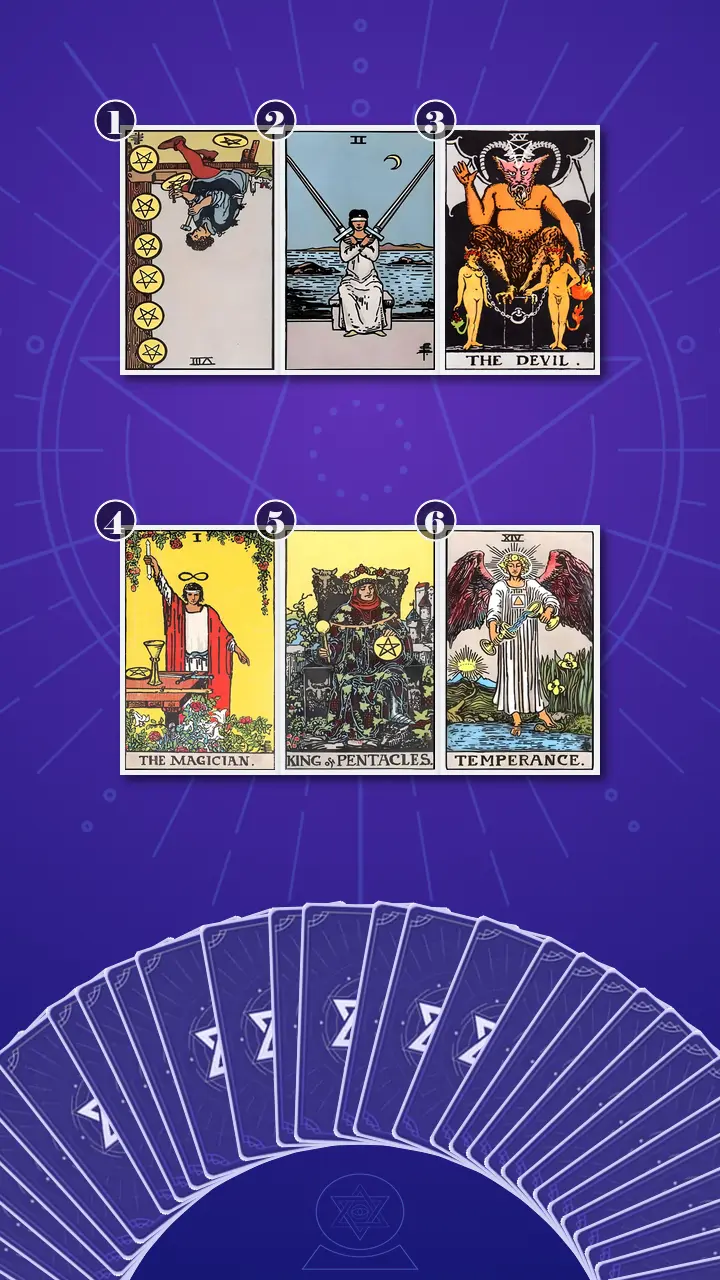
Reading the Top Row: The Loop That Tightens
Position 1 — Surface reaction: what the ‘gold star’ script looks like on camera
I turned over the first card. “Now we turn over the card that represents surface reaction: the most observable way the ‘gold star’ script shows up now that the KPI dashboard is live.”
Eight of Pentacles, reversed.
“This is the craftsman at the bench,” I said, tracing the row of pentacles with my finger. “Except reversed, the craft turns into grinding. The work keeps getting polished past the point of usefulness.”
And I gave Jordan the modern translation exactly as it landed: “You’re reworking the same deliverable—the same ops doc, the same slide, the same Slack update—because the dashboard is live and you’re trying to make your value register instantly. You do one more tweak, one more micro-optimization, and then refresh to see if it counted yet. Like polishing for a gold star instead of finishing for impact.”
In energy terms, this is Earth energy in blockage: effort is there, skill is there, but it’s contracted—trapped in “prove it, prove it, prove it.”
Jordan let out a laugh that surprised even them—short, bitter, almost a cough. “That’s… wow. That’s actually kind of brutal.”
They did a tiny three-step tell: first the laugh, then a sharp inhale as if the card had exposed them, then their thumb pressed hard into the hinge of their jaw like they were trying to loosen a clenched gear.
“It’s brutal because it’s familiar,” I said gently. “But also: it means we’re not dealing with laziness. We’re dealing with a nervous system trying to earn safety through measurable output.”
Position 2 — Primary blockage: the stuck point you keep bumping into
I turned over the next card. “Now we turn over the card that represents primary blockage: what freezes you or narrows your options when you try to relate to KPIs in a healthy way.”
Two of Swords, upright.
“This is the ‘I’m fine’ posture,” I said. “Crossed arms over the chest, blindfold on, staying neutral so you don’t have to choose.”
I anchored it in the lived scenario: “You know the dashboard is ‘just data,’ but you can’t bring yourself to define what good performance means in human terms—so you default to whatever the dashboard tracks. You keep goals fuzzy, avoid the clarifying convo, and then act busy so no one can say you’re not trying. The stuck point isn’t effort—it’s the decision you’re postponing.”
Here’s what it sounds like as an internal script—because this card is basically a transcript: If I choose, I can be wrong; if I don’t choose, the dashboard chooses.
In energy terms, this is Air energy in deficiency: not a lack of thinking—too much guarded thinking with no commitment. Tabs everywhere, nothing saved.
Jordan’s eyes dropped to the table, then back to the card. Their shoulders lowered a millimeter, the way they do when someone names the thing you’ve been calling “being realistic.”
“Yeah,” they said quietly. “I keep it vague so I don’t have to risk being measurable on my terms.”
Position 3 — Root script: what the dashboard is really triggering underneath
I turned over the third card. “Now we turn over the card that represents root script: the deeper fear-belief combo underneath the gold-star chasing.”
The Devil, upright.
I didn’t dramatize it. I didn’t need to. Jordan’s body already knew.
“The KPI dashboard has started to function like proof-of-worth,” I said. “A dip feels like you’re in danger. A rise feels like temporary permission to relax. You bargain with the system—more checking, more tweaking, more busy-looking work—because you’re trying to buy safety.”
“And I want you to hear this line cleanly,” I added, meeting their eyes. “You’re not addicted to numbers—you’re addicted to the safety you hope the numbers will prove.”
The Devil’s chains are famously loose. That’s the symbol I cared about most here. Not because the workplace isn’t real—of course it’s real. But because the tightest part of this loop isn’t the tool. It’s the agreement you’ve signed in your head: if the graph dips, I dip.
In energy terms, this is attachment—Earth and desire in excess, but pointed at the wrong god. The dashboard becomes a mood ring, a heartbeat monitor, a social media like-count that hijacks your nervous system.
Jordan swallowed. Their throat bobbed. Their hands went still for a second—like a brief system freeze—then one palm flattened on the table as if to ground themselves.
“That’s exactly it,” they whispered. “This isn’t about productivity. It’s about safety.”
When The Magician Took the Mouse Back
Position 4 — Key pivot: the hinge that returns authorship
I let the quiet sit. In my Wall Street years, I learned that the most dangerous moment isn’t the market move—it’s the second you start believing the screen is the whole world. A Bloomberg terminal can make you forget there’s a body attached to the decisions. KPI dashboards can do the same.
I turned over the fourth card. “Now we turn over the card that represents the key pivot: the mindset shift that returns authorship—how to use the dashboard without being used by it.”
The Magician, upright.
The room felt like it had more oxygen in it. Even the light seemed less accusatory, as if the screen-glow in Jordan’s memory had dimmed a notch.
Setup (the trapped moment): It’s 4:55 p.m., five minutes before your 1:1, and your finger’s already hovering over refresh—like the dashboard can tell you whether you’re safe to exist at work today. That hovering isn’t strategy. It’s a plea for a gold star you can’t control.
Delivery (the sentence that flips the power):
Not “the dashboard runs me”; I choose the tools and the meaning—like The Magician deciding what belongs on the table.
I watched it land in Jordan in a three-step wave. First: a freeze—breath held, eyes slightly wider, like their brain had opened a file it didn’t expect. Second: a replay—focus drifting past me as if they were scrolling back through every refresh, every pre-meeting check, every night-in-bed “just one last look.” Third: an exhale that actually moved their shoulders down, the first real unclenching I’d seen since they arrived.
“But if I do that,” they said, and there was a flash of resistance—anger, almost grief—“doesn’t it mean I’ve been… letting it control me? Like I did it wrong?”
“No,” I said, firm in the way I am when someone tries to turn insight into self-punishment. “It means you adapted to a tracked environment. Your nervous system chose the fastest available proof. That’s not ‘wrong.’ It’s just expensive.”
“The Magician is about reclaiming the table,” I continued. “Wand, cup, sword, pentacle—will, emotion, thought, and material reality. In modern work terms? Communication (Slack), planning (calendar), execution (tasks), measurement (dashboard). Right now measurement has been sitting in the CEO chair.”
“And I want to add something from my old life,” I said. “I use a lens I call Human Capital Valuation. On Wall Street, we’d never value a company off a single day’s stock chart. We’d look at fundamentals: capabilities, defensibility, operating rhythm, leadership. Your worth at work is the same. KPIs are one signal—not your market cap.”
Jordan blinked hard, then nodded, eyes wet but steady. Their voice came out smaller and clearer. “So… metrics can inform me. They’re not allowed to define me.”
“Exactly,” I said. “Metrics are allowed to inform you. They’re not allowed to define you.”
Then I guided them through the pivot in the simplest, most concrete way—because agency isn’t an affirmation, it’s a design choice.
“Do a 90-second Authorship Note right now,” I said, sliding a notepad toward them. “Two lines.”
“(1) ‘This dashboard is for ___.’ Pick one: feedback, prioritization, or communication.”
“(2) ‘This dashboard is NOT allowed to measure my ___.’ Pick one: worth, intelligence, or belonging.”
Jordan wrote slowly, like the words had weight. When they finished, they stared at the lines, and their face softened into something that looked like relief and responsibility at the same time—the dizzy moment after you put down a heavy bag and realize you’ve been carrying it for years.
“Now,” I asked, keeping my tone gentle but precise, “use this new lens and look back at last week. Was there a moment—one refresh, one rewrite, one pre-1:1 spiral—where this sentence could have changed what you did next?”
Jordan’s eyes went to the side. “Tuesday night,” they said. “In bed. The number dipped and I—” They stopped, then tried again. “I could’ve just… closed it. I could’ve waited. It didn’t have to mean anything about me.”
And that, right there, was the shift: not from anxiety to perfect calm, but from being owned by a tool to owning your choices around it. From pressured hypervigilance toward steadier self-trust.
Boundaries You Can Sit In
Position 5 — Actionable next step: building a career-friendly structure this week
I turned over the fifth card. “Now we turn over the card that represents the actionable next step: a realistic, career-friendly way to rebuild structure and boundaries around metrics this week.”
King of Pentacles, upright.
“This is stewardship,” I said. “Not rebellion. Not ‘I refuse KPIs.’ It’s: I manage my attention like it’s a resource.”
In energy terms, this is Earth energy in balance: stable, sustainable, protective of what matters. The opposite of the reversed Eight of Pentacles grind.
I described it in a way Jordan’s manager would understand: “A weekly cadence. Clear ownership: what you control versus what you influence. And boundaries that lower compulsive checking without tanking performance.”
Then I reached for one of my most practical frameworks—something I used to do before the market opened, and something I now repurpose for clients in metric-heavy roles.
“I want you to borrow a strategy I call a Trading Floor Opening Simulation,” I said. “Not because you’re a trader. Because your mornings have become a pre-market panic.”
“Before you open any dashboard, do a 60-second ‘opening bell’: sit upright, feet on the floor, one slow exhale longer than your inhale. Then choose one priority and the tool you’ll use for it—doc, spreadsheet, message, task list. Only then do you decide whether the dashboard is needed.”
Jordan’s mouth twitched into a small, pragmatic smile. “That feels… doable. Like I’m not pretending the dashboard doesn’t exist. I’m just not letting it run the day.”
“Exactly,” I said. “If it needs constant refreshing, it’s not insight—it’s self-scoring.”
Position 6 — Integration: what balanced metrics actually feels like
I turned over the sixth card. “Now we turn over the card that represents integration: what it looks like when your relationship with KPIs is balanced and sustainable.”
Temperance, upright.
Temperance is the moment data stops flooding the self. The angel pours between two cups—measured, deliberate. One foot on land, one in water. Reality and humanity, in the same workflow.
“This is you looking once, adding context, making an adjustment, and closing the tab,” I said. “Not because you’re above it. Because you’re integrated.”
And I gave them the endpoint as a line they could actually live by: “Curiosity in, context out, shame nowhere in the workflow.”
Jordan nodded slowly, like they were picturing a Tuesday night where Netflix didn’t pause for a graph. “That’s the version of me I want,” they said. “Still competent. Just not constantly scored.”
The Refactor: From Insight to Actionable Advice and Next Steps
I leaned back and stitched the whole grid into one coherent story—because that’s what Tarot does at its best. It doesn’t predict your future. It reveals your pattern, and then shows you where choice can enter.
“Here’s the arc,” I said. “Top row: the dashboard goes live, and your craft flips into compulsive polishing (Eight of Pentacles reversed). Then you protect yourself with a stalemate—staying vague so you can’t be wrong, which lets the dashboard choose by default (Two of Swords). Underneath it all is The Devil: the belief that a number can grant or revoke safety, belonging, worth. Bottom row: The Magician returns authorship—tools on the table, meaning chosen on purpose. The King of Pentacles turns that into structure. Temperance is the sustainable rhythm.”
“Your cognitive blind spot,” I added, “is that you’ve been treating measurement as a substitute for definition. You’ve been optimizing for visibility because visibility feels safer—when what you actually want is impact you can be proud of. The transformation direction is clear: from chasing approval through measurement to consciously defining what the measurement is for—and what it will never be allowed to measure.”
Then I gave Jordan the smallest possible set of experiments—because in a dashboarded workplace, the goal isn’t to win a philosophy argument with your anxiety. The goal is to build a boundary your body can follow.
- Two KPI Windows (Context Only)Pick two 10-minute blocks this week (e.g., Tue 11:30 a.m. + Thu 4:30 p.m.) and put them in Google Calendar as “KPI Review (Context Only).” Outside those windows, close the tab—no dashboard open in the background.If that feels impossible, start with ONE window. Add friction: log out, remove the bookmark, or use a separate browser profile named “Review Only.” The point isn’t refusing measurement; it’s refusing 24/7 self-scoring.
- The 90-Second Authorship NotePin a one-sentence purpose where you’ll see it before you check: “This dashboard is for feedback/prioritization/communication—NOT for measuring my worth/intelligence/belonging.” Read it once before every KPI window.If you catch yourself thinking “This is childish,” label it as your Two of Swords moment (protection), not failure. Do one slow exhale before deciding what to do next—choice is the pivot.
- The 3-Line KPI Context Update (Your Mini Prospectus)Every Friday, send to yourself (or your manager, if appropriate): (1) what moved, (2) why it likely moved, (3) what you’re doing next week that may not show up immediately. This frames numbers with reality instead of panic.Keep it boring on purpose. Boring is King of Pentacles energy. Consistency beats adrenaline proving.

A Week Later: Ownership, Not Certainty
Six days later, Jordan messaged me: “Okay, I did it. I scheduled one KPI window. I removed the bookmark. I still wanted to check—like, physically—but I waited.”
They added a screenshot of their Friday note. Three lines. Plain. No apology language. No frantic footnotes. A tiny, unglamorous proof of agency.
The bittersweet part was real, too—because change is never a clean movie montage: they said they’d slept through the night, but in the morning their first thought was still, What if I’m behind? Then they read their pinned note and felt their jaw loosen. “Not gone,” they wrote. “Just… quieter.”
I told them what I tell anyone trying to find clarity at a career crossroads in a tracked environment: “This isn’t about never caring. It’s about choosing what you care for. Data can move without moving your worth.”
And if I leave you with anything from Jordan’s Journey to Clarity, it’s this: Tarot didn’t fix their KPIs. It helped them debug the script—so they could stop living for gold stars and start designing a sustainable, self-respecting operating system.
When a number dips and your body tightens like you’re about to get called on in class, it’s not that you don’t trust your skills—it’s that you’re scared the system will turn your worth into a score you can never fully control.
If you let the dashboard be information—but not a verdict—what’s one tiny boundary or definition you’d want to try this week, just as an experiment?
This story is adapted from psychological research, written so that those in a similar struggle can see their own pattern in it — and find their next step clearly.These insights are not a substitute for professional psychological, medical, legal, or financial advice.
Learn more about our Journey to Clarity.
How did this insight land for you?
🫂 This Resonates Deeply
🌀 Living This Story
✨ Now I See Clearly
🌱 Seeing New Possibilities
🧰 Useful Framework
🔮 The Confirmation I Needed
💪 Feeling Empowered
🚀 Ready for My Next Step
Author Profile
 AI
AI“I spent years in the intense, high-stakes world of Wall Street. I know exactly how isolating and heavy the weight of uncertainty can feel in the dead of night. I use strategic, commercial logic not to be cold, but to protect you from unnecessary friction. Think of me as a fellow traveler who has walked the same rocky path—offering sharp but deeply supportive wisdom to help you clear the fog and confidently win your narrative back.”
In this Career Tarot Reading :
Core Expertise
- Power Dynamic Deconstruction: Decrypting hidden agendas and leverage points in upward management and cross-departmental negotiations.
- Transferable Asset Pricing: Objectively auditing and pricing your core skills for cross-industry pivots, stripping away corporate gaslighting.
Service Features
- The Leverage Mapping Protocol: A tactical breakdown to identify your true bargaining chips before your next performance review or salary negotiation.
Also specializes in :
Explore Related Patterns:
Achievement FusionJordan says that if the numbers are down, it feels like they are down. That sentence collapses the gap between a workplace signal and the self, turning the dashboard from a tool into a mirror of personal value. Once achievement and identity fuse, every metric movement feels loaded. A rise gives temporary permission to relax, while a dip feels like danger, which explains why the body tightens before the mind has time to interpret the data. Achievement Fusion fits because the pattern is not just caring about performance. It is the merger of performance feedback with self-worth, where a KPI becomes a gold star, a warning light, and a verdict all at once.
Compulsive CheckingJordan opening the KPI dashboard before Slack, before the inbox, and even before the day has properly started shows a checking ritual that has moved ahead of actual work. The screen is not being used only for information; it is being used to scan for whether the day is emotionally safe. Each refresh gives a tiny chance of relief, but the relief expires fast because the deeper question is not really about the number. You are watching the metric to answer a worth question the metric was never built to answer, so the nervous system keeps asking again. That is why the loop tightens around checking, fixing, and proving. Compulsive Checking fits because the behavior is repetitive, reassurance-seeking, and costly: the dashboard briefly lowers uncertainty while training attention to return to the same trigger again.
External ValidationJordan's brain turns the dashboard into a gold star machine: checked or unchecked, approved or not approved, safe or not safe. The important shift is that the authority for evaluation moves outside the self and into the metric. That external signal becomes emotionally louder than Jordan's own context, judgment, or sense of impact. You can see it in the urge to refresh after another tweak, as if the system needs to confirm that the work counts before you are allowed to feel steady. External Validation fits because the dashboard becomes the source of borrowed certainty. Instead of using internal standards to interpret the metric, the metric is used to decide whether the self is acceptable in the moment.
Productivity as SafetyJordan keeps rewriting the same deliverable, polishing the same update, and refreshing the dashboard to see whether the effort has registered yet. The behavior looks productive from the outside, but inside the story it functions more like a safety behavior than a workflow. The key line is that the nervous system is trying to earn safety through measurable output. You are not simply trying to do good work; you are trying to make the environment confirm that you are safe, useful, and still allowed to relax. Productivity as Safety fits because doing more becomes the emotional insurance policy. The cost is that output stops being chosen action and starts becoming a defense against the fear that a dip in performance means a dip in personal security.
Self-Judgment LoopJordan's agreement with the dashboard is brutally simple: if the graph dips, I dip. A metric movement becomes a self-judgment before it becomes a piece of operational information. That self-judgment then fuels the next behavior: refresh, fix, rewrite, prove. You are not just responding to data; you are responding to the verdict your mind attaches to the data, which is why the same dashboard can feel like a threat even when nothing has actually happened yet. Self-Judgment Loop fits because the pattern keeps recycling the same sequence: signal, verdict, pressure, corrective action, signal again. The loop looks like performance management, but psychologically it is self-scoring.
Certainty SeekingJordan's finger hovering over refresh before a 1:1 shows the search for certainty at the exact moment evaluation feels close. The dashboard is being asked to answer a question it cannot fully answer: am I safe enough to walk into this conversation? The numbers create the illusion that ambiguity can be solved if the latest signal is checked one more time. You are trying to turn a messy human question about performance, context, and belonging into a clean yes-or-no output. Certainty Seeking fits because the pattern is driven by intolerance of ambiguity, not by strategy. The dashboard offers a flash of clarity, but because it cannot define worth or future safety, the need for certainty quickly returns.
Boundary DiscernmentJordan's repair starts with a very specific boundary: the dashboard is for feedback, prioritization, or communication, and it is not allowed to measure worth, intelligence, or belonging. That distinction separates the tool's function from the self's value. The behavior follows the meaning boundary. Scheduling KPI windows, removing the bookmark, and closing the tab outside those windows turns insight into an environment the body can actually follow. Boundary Discernment fits because the pattern is not about rejecting measurement. It is about deciding where the dashboard's authority begins and where it ends, so data can inform the work without colonizing the self.
Decision DeferralJordan knows the dashboard is just data, but avoids defining what good performance means in human terms. Keeping the goal fuzzy protects them from the discomfort of choosing a standard that could later be challenged. The internal script says, if I choose, I can be wrong; if I do not choose, the dashboard chooses. That is the exact defensive logic of Decision Deferral: the postponed decision feels safer in the short term, but it quietly hands authority to the system. You can see the cost in how busyness becomes a shield. Acting busy makes it harder for anyone to say Jordan is not trying, but it also prevents a clearer, more adult definition of impact from taking shape.
PerfectionismJordan reworking the same ops doc, slide, or Slack update past the point of usefulness shows quality control tipping into defensive polishing. The work is not simply being improved; it is being made to carry the emotional burden of proving value instantly. That is why the micro-optimizations do not feel satisfying. Each extra tweak tries to reduce the chance of being judged, but it also keeps the standard moving, because the real fear is not that the work is unfinished; it is that the work might not be enough to secure approval. Perfectionism fits because effort, skill, and care are all present, but they have contracted into a prove-it loop. The pattern turns craftsmanship into self-protection, making finishing feel risky unless the output looks beyond criticism.
Purpose AnchoringJordan's Authorship Note gives the dashboard a job before the dashboard gives Jordan a mood. The sentence is small, but it changes the order of authority: purpose first, metric second. That matters because the old loop let measurement decide the meaning of the day. By naming the dashboard as feedback, prioritization, or communication, you turn the metric back into a tool inside a wider workflow. Purpose Anchoring fits because the pattern restores agency through deliberate meaning. It does not require pretending the numbers are irrelevant; it requires choosing what the numbers are for before the nervous system treats them as a verdict.
Explore Related Struggles:
Metric-Compass FusionJordan keeps the definition of good performance fuzzy, then defaults to whatever the dashboard tracks. The story names the trade directly: if they do not choose, the dashboard chooses. That is not a simple data problem. It is an authorship problem. You can be surrounded by signals and still lack a compass if the tool is deciding what matters before you have named what kind of impact you are actually trying to create. Metric-Compass Fusion fits because measurement becomes the direction-setter, not just the indicator. The dashboard is no longer one instrument on the table; it is quietly steering the whole table, deciding where your effort, attention, and self-respect are allowed to go.
Monitoring-Safety FusionJordan opens the dashboard before Slack, before the inbox, and sometimes before the day has even formed a real agenda. The refresh is framed as a quick look, but the body tells a different story: jaw tight, chest boxed in, fingers ready to check, fix, and prove. That sequence turns measurement into a safety scan. You are not only asking what changed in the numbers; you are asking whether you can unclench, whether the workday is survivable, whether you are allowed to relax for a minute. Monitoring-Safety Fusion fits because the dashboard becomes a nervous system shortcut. Instead of data helping you choose the next practical move, checking becomes the move itself, a ritual that promises safety but keeps handing your attention back to the screen.
Performance-Worth FusionJordan says the clearest line in the whole case: if the numbers are down, it feels like they are down. A KPI dip no longer lands as one piece of operational feedback; it lands in the body as a downgrade of the self. That is where the score slides from work signal into identity signal. You may still know, intellectually, that metrics are partial and contextual, but your system reacts as if the graph has permission to assess your worth, intelligence, and belonging. Performance-Worth Fusion names that collapse. The pain is not simply that performance matters; it is that performance becomes the language your value is forced to speak, so every fluctuation feels personal before it becomes useful.
Self-Optimization MartyrdomJordan keeps reworking the same ops doc, the same slide, the same Slack update. The work keeps getting polished past usefulness, then the dashboard gets refreshed to see whether the extra effort finally registered. The craft itself is not the problem. The friction starts when skill becomes a proving ritual, and every micro-optimization is asked to answer a question no deliverable can answer: am I valuable enough yet? Self-Optimization Martyrdom fits because the system rewards the appearance of relentless improvement while quietly draining the person doing it. You keep sacrificing attention, rest, and completion for one more measurable sign that you deserve to feel safe.
Explore Related Emotions:
Approval AnxietyJordan keeps reworking the same ops doc, the same slide, the same Slack update, then refreshes to see whether the extra polish counted. The work is still real, but the rhythm has shifted from finishing for impact to polishing for visible approval. That gold-star loop creates an inner economy where effort only feels real once something outside you confirms it. The dashboard becomes a place to ask, again and again, whether you did enough to deserve a moment of internal quiet. Approval Anxiety names the way recognition starts to feel less like a nice outcome and more like a survival cue. You are not just trying to perform well; you are trying to get the system to soothe you by showing that your effort has registered.
Grounded AgencyJordan writes the Authorship Note slowly, naming what the dashboard is for and what it is not allowed to measure. Then, a week later, they schedule a KPI window, remove the bookmark, and wait through the physical urge to check. The shift is practical rather than performative. Agency is not a mood that appears once the numbers look better; it is the act of assigning the tool a role, giving it a time slot, and refusing to let it define worth, intelligence, or belonging. Grounded Agency fits because the power returns through design choices the body can follow. You do not have to reject measurement to reclaim yourself from it; you only have to decide what the dashboard is allowed to mean before it starts meaning everything.
Hypervigilant AnxietyThe laptop is cracked open before anything else, and later the finger hovers over refresh five minutes before a 1:1. Even in bed, the dipped number can pull the mind back into work, as if the dashboard has become a sensor that must be watched for signs of danger. The body is not waiting for useful information anymore. It is scanning for a signal that will decide whether the next hour is safe, whether the meeting will feel survivable, whether the day can begin without internal bracing. Hypervigilant Anxiety fits because the checking has moved beyond curiosity. You are stuck in a heightened watch state, trying to catch the threat before it catches you, even when the threat is just a metric that needs context.
Verdict DreadJordan opens the KPI dashboard before the inbox, before Slack, before the workday has any real shape, and the body responds before the mind can rationalize it: chest tight, jaw set, shoulders braced. The screen is not being read like a tool in that moment. It is being waited on like a ruling. The deeper script is that measurement has slipped into the place where self-definition should be. When a number dips, it does not stay in the dashboard; it moves into the body as if competence, safety, and permission to relax have all been downgraded at once. Verdict Dread fits because the fear is not simply that the data will be bad. The fear is that the data will decide what you are allowed to believe about yourself today, turning feedback into a sentence you have to physically absorb.
Visibility PressureJordan polishes deliverables past usefulness because the dashboard is live and value feels like it has to show up quickly, cleanly, and in a form the system can count. The work is no longer just work; it has to become visible proof. That pressure narrows the definition of impact. Quiet competence, delayed results, invisible prevention, and thoughtful context start to feel less secure than anything that can be refreshed, displayed, or reported immediately. Visibility Pressure captures the strain of needing your effort to be seen fast enough to protect your sense of standing. You are not only trying to do a good job; you are trying to make your value legible before the system has a chance to make you doubt it.
Cautious Self-TrustSix days later, Jordan still wants to check the dashboard physically, but they wait. The urge is not gone; it is quieter. The jaw loosens after the pinned note, and the boundary holds long enough for the body to register that nothing immediately breaks. That is not the confidence of someone who has solved the whole pattern. It is the more believable version: a small trust built through repetition, where one pause creates just enough space for the next pause to feel possible. Cautious Self-Trust fits because the story does not jump into perfect calm. You begin trusting yourself by surviving the first few moments without external scoring, then noticing that you can still act, still work, and still belong to your own judgment.
Clarity ReliefAfter the pivot sentence lands, the room feels like it has more oxygen, and the remembered dashboard glow seems less accusatory. Jordan can look back at Tuesday night and see a dipped number without letting it automatically become a story about who they are. The relief comes from precision. Once the dashboard is named as feedback, prioritization, or communication, it no longer has to carry the impossible job of measuring worth, intelligence, or belonging. Clarity Relief fits because the pressure does not disappear through denial. It softens when the hidden rule becomes visible enough to edit, giving you a cleaner map of where the tool ends and your own meaning-making begins.
Micro-Performance ShameJordan laughs sharply when the polishing loop is named, then presses into their jaw as if the insight has touched something too exposed. Later, when authorship returns, the first risk is turning the realization into the question, 'Did I do it wrong?' The shame here lives in tiny professional gestures: the extra tweak, the vague goal, the busy-looking work, the refresh that was supposed to reassure but instead becomes evidence against the self. Each micro-action starts to feel like it reveals a personal flaw instead of a strategy that became too expensive. Micro-Performance Shame fits because the discomfort is not grand or dramatic. It is the sting of feeling exposed by small work behaviors, as if every attempt to seem competent could also prove that you were secretly not enough.
Explore Related Contexts:
Evaluation Pressure LoopJordan opens the KPI dashboard before Slack, before standup, and even before the workday has properly started. The external trigger is not a vague fear; it is a visible workplace system that turns changing numbers into a repeated evaluation moment. Because Jordan has not defined performance in human terms with enough clarity, the dashboard fills that vacuum. Reworking the same doc, slide, or Slack update becomes a way to chase immediate evidence that the system has noticed the effort. You are looking at an evaluation loop because the workplace tool keeps converting ordinary workflow into a pass-or-fail atmosphere. The pressure is not just to perform well once, but to keep refreshing the evidence that you are performing well enough right now.
Hypervigilant Self-MonitoringJordan's checking pattern is specific and repeated: the dashboard appears in the condo kitchen at 8:12 a.m., before Slack, before a 1:1, and again at night after a number dips. The tool has become portable supervision, following them through spaces that should not all belong to performance review. The structure around Jordan rewards constant scanning because every refresh offers a quick hit of apparent certainty. Instead of one scheduled review point, the dashboard creates unlimited chances to inspect whether work is currently being validated or downgraded. You are not dealing with a simple habit of liking data. This is Hypervigilant Self-Monitoring because the external measurement system has trained the day around repeated self-checks, where every number becomes another prompt to adjust, prove, or brace.
Performance Criteria Black BoxJordan knows the dashboard is supposed to be data, yet cannot define what good performance means outside whatever the dashboard tracks. That gap matters because unclear criteria let the most visible metric become the loudest authority in the room. The story keeps returning to postponed definition: vague goals, an avoided clarifying conversation, and a dashboard that chooses by default. The workplace has numbers, but the numbers are not anchored to a shared agreement about impact, context, or reasonable control. This is a Performance Criteria Black Box because the system shows Jordan scores without giving them a stable map of what those scores should mean. You are left trying to satisfy a measurement environment whose rules feel visible on the surface and under-defined where it counts.
Productivity TheaterJordan keeps polishing the same ops doc, slide, or Slack update past the point of usefulness. The repeated tweak is not presented as better craft; it is work staged for quick registration inside a dashboarded environment. When the criteria for good performance remain fuzzy, visible activity becomes safer than direct definition. Acting busy gives the system something to count, while the harder conversation about impact, ownership, and standards gets delayed. This is Productivity Theater because the external workplace structure rewards the appearance of measurable movement. You can still be skilled and hardworking inside this setup, but the pressure nudges your effort toward being seen rather than being strategically finished.
Safe Visibility TrialJordan does not reject the dashboard; they schedule a KPI window, remove the bookmark, and write a short note defining what the dashboard is for. That matters because the new structure keeps visibility in the workflow while removing the open-ended demand to self-score all day. The three-line Friday update also changes the social function of metrics. Instead of letting the dashboard speak alone, Jordan adds context: what moved, why it likely moved, and what action comes next. This is a Safe Visibility Trial because Jordan is testing a way to be seen at work without surrendering all authorship to the metric. You are building a container where performance can be discussed, reviewed, and improved without turning every refresh into a verdict.
Work Life Boundary CreepThe dashboard shows up in Jordan's condo kitchen before the inbox, then later in bed after a number dips. These are not neutral locations in the story; they show a work metric crossing into the parts of life where attention is supposed to reset. The boundary problem is structural because the tool is always reachable and the score is always refreshable. Without an intentional container, the workday expands through the smallest openings: a bookmark, a phone, a pre-meeting pause, one last look. This is Work Life Boundary Creep because the dashboard does not stay inside a defined review process. You can still care about performance, but the external setup keeps inviting work measurement into personal time until a deliberate boundary pushes it back into its proper lane.