Finding Clarity in the 12:14 a.m. iPhone Memories Scroll
“If your iPhone Memories notification hits at 12:03 a.m. and suddenly you’re rewriting your entire dating life around a 9-second clip—welcome to the chemistry vs safety spiral.”
Jordan said that line back to me like she’d been caught on camera. She was 29, a product designer in Toronto, and she had the particular tiredness of someone whose day was all pixels—Figma, Slack, tabs inside tabs—until night turned her phone into both comfort and trap.
She described Wednesday, 12:14 a.m., condo-bedroom quiet so complete you can hear the streetcar hiss three blocks away. No lamp. Just screen glow and streetlight stripes on the wall. A Memories notification pops up: her ex smiling, warm-toned like a movie. She replays a seven-second clip twice. Her thumb hovers over the old chat thread. The phone feels hot in her hand, and her chest tightens while her other hand picks at her cuticle like it’s trying to sand down a feeling.
“I don’t even want him back,” she told me. “But those photos make it look like we were perfect, and I hate that I still believe it.”
Underneath the words was the real tug-of-war: wanting undeniable chemistry that makes you feel instantly alive, versus the fear that choosing safety will feel like settling—and prove you can’t sustain real love without chaos.
I watched her hands do what she’d just described: reach, stop, reach again—like her nervous system was voting faster than she was. “We’re not here to shame the longing,” I said. “We’re here to get specific. To turn the fog into a map. Let’s find clarity without needing a midnight spike to decide your whole story.”

Choosing the Compass: The Decision Cross Spread
I asked her to take one slow breath—not as a mystic ritual, just a nervous-system handbrake—then to hold the exact question in mind: “When iPhone Memories pulls me into my ex’s highlight reel, am I choosing chemistry over safety again?”
As I shuffled, I kept the tone practical. Tarot works best, in my experience, when we treat it like a structured reflection tool: it makes the invisible visible—patterns, biases, and what we’re actually optimizing for when we think we’re “just following our gut.”
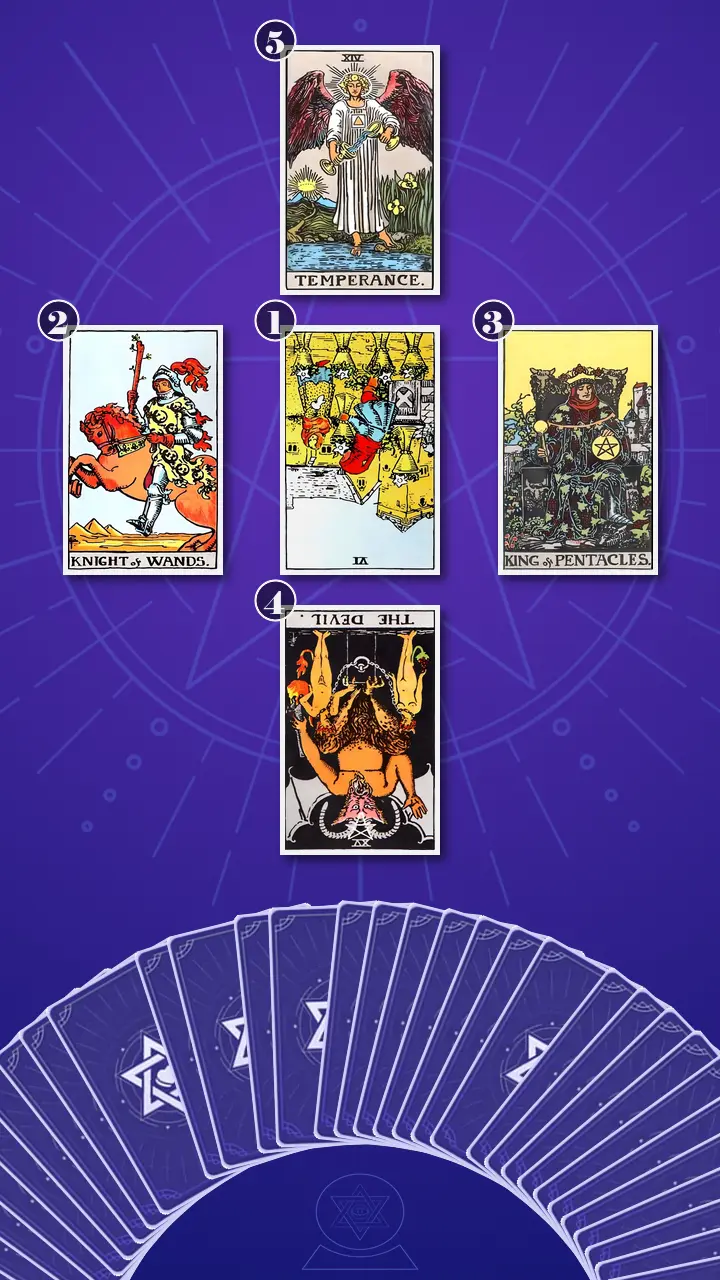
“Today we’ll use the Decision Cross,” I told her, laying the cards in a clean cross. “It’s built for two-pole dilemmas like chemistry versus safety, but it also includes the hidden driver—what keeps the loop repeating—so we don’t end up with a superficial pros-and-cons list.”
For you reading this: that’s the point of the spread’s shape. Card 1 names the present trigger and stuck behavior. Cards 2 and 3 make the tug-of-war visible—chemistry pull versus safety pull. Card 4 goes underneath like a root: the pattern you keep feeding. Card 5 sits above as guidance—how to integrate, in real life, right now.
The Highlight Reel and the Match That Burns Too Fast
Position 1: The present trigger and the specific stuck behavior pattern
“Now we’re turning over the card that represents the present trigger and the specific stuck behavior pattern—how the iPhone Memories loop is shaping your choices.”
Six of Cups, reversed.
I nodded at the picture like it was a familiar app icon. “It’s not that you’re delusional—it’s that your phone is serving you a curated edit. A Memories pop-up lands when you’re most alone, and suddenly you’re measuring today’s dating life against the most photogenic parts of a relationship that also included uncertainty, inconsistency, and waiting. The problem isn’t missing them; it’s treating the highlight reel as evidence that the whole thing was safe.”
Reversed, the energy here is distortion—not a lack of love, but a warped lens. The Six of Cups is memory as a gift; upside down, it becomes memory as a filter that crops out whatever didn’t photograph well.
I used a split-screen in my voice, because that’s how it lives in the body. “On one side: warm lighting, the dim bar, the laugh, the arm around your shoulder—your brain’s ‘best-of trailer.’ On the other side: the nights you waited for a reply, the stomach drop when you saw ‘Seen,’ the quiet dread you’d never post on Instagram. This feels like proof… but proof of what, exactly?”
Jordan let out a small, bitter laugh—too quick to be humor, too honest to be a defense. “That’s… brutal. Like, yes. I watch the cute clip and forget the whole week I cried in my bathroom because he disappeared.” Her shoulders rose, then dropped in a tiny exhale, like she’d finally named what was missing from the frame.
“A highlight reel can’t tell you whether something was safe—only that it photographed well,” I said, gently, and watched her eyes flick down to the card like she was re-learning what counts as evidence.
Position 2: What ‘chemistry’ is actually doing for you
“Now we’re turning over the card that represents what ‘chemistry’ is actually doing for you—the pull, payoff, and the kind of attraction you’re chasing.”
Knight of Wands, upright.
“Chemistry shows up like a rush that makes everything feel immediate: the fast banter, the flirty texts, the vibe that turns your brain into a yes. You want to chase it because it feels like being chosen. But it can also be attraction moving faster than consistency—like falling for the first draft of someone, before you’ve seen whether they follow through when it’s not exciting.”
The energy here is excess—fire with no container. I tapped the Knight’s forward lean. “Momentum starts to feel like meaning. The nervous system goes, ‘This is alive, this is real,’ and your brain tries to crown it as The Answer.”
Jordan’s fingers made a small flicking motion, like swiping on a dating app. “It’s like… the second someone matches my pace, my brain’s like, ‘Finally. There it is.’”
“And that makes sense,” I said. “But here’s the skill we’re building: chemistry isn’t compatibility—sometimes it’s just speed with good lighting.”
Position 3: What ‘safety’ is actually asking of you
“Now we’re turning over the card that represents what ‘safety’ is actually asking of you—the benefits, fears, and the kind of stability you’re learning to trust.”
King of Pentacles, upright.
“Safety looks like someone who texts when they say they will, makes a plan, respects your time, and doesn’t make you guess. It can feel almost ‘too quiet’ at first—because your body isn’t bracing. This card asks you to notice that exhale as data: calm isn’t a lack of chemistry; it might be the first sign you’re not being emotionally auditioned.”
The energy is balance—earth doing what earth does: steady, repeatable, boring in the way reliable Wi‑Fi is boring. Not thrilling, but your whole life works better with it.
I leaned in slightly. “Knight energy is last-minute plans, fast compliments, big vibe. King energy is a reservation, a clear time, and a follow-up text that matches the promise.”
Jordan’s expression shifted—skeptical at first, then curious. “I’ve definitely had that text,” she admitted. “And I remember thinking… why am I irritated? Nothing is wrong.”
“Because your nervous system is used to alarms,” I said. “Calm isn’t ‘nothing.’ Calm is your system not bracing for impact.”
Position 4: The underlying pattern that keeps the cycle repeating
“Now we’re turning over the card that represents the underlying pattern or fear—the thing underneath the chemistry-versus-safety debate.”
The Devil, reversed.
“This isn’t about your ex being your soulmate,” I said, keeping my voice steady. “It’s about a hook: the way longing plus uncertainty can feel like love because it’s familiar. You feel pulled to replay, check, swipe, or reach out—not because it’s aligned, but because the loop promises quick relief from ambiguity. Reversed, The Devil is the split-second you catch yourself and think, ‘Oh. This is a pattern I’m feeding.’”
The energy here is blockage loosening. Not free yet—but not helpless. The chains aren’t gone; they’re slack.
I described the chain moment exactly the way she’d lived it: turning the brightness down, rewatching the same clip twice, thumb hovering over the chat thread, telling yourself it’s “just curiosity.” Then the contrast: “I miss them” versus “I miss the feeling of being pulled.”
Jordan went still in a three-beat sequence I’ve learned to respect: first the tiny breath-hold, then the faraway eyes like a memory replay, then the swallow that brings her back to the room. “It’s not romance,” she said quietly. “It’s compulsion wearing romance’s outfit.”
“Exactly,” I answered. “The urge isn’t a prophecy. It’s a pattern asking to be fed—or not.”
When Temperance Poured Between Two Cups
Position 5: How to integrate chemistry and safety into an actionable next step
I touched the last card before turning it. “This is the one that represents how to integrate chemistry and safety into an actionable next step you can practice now.”
The room felt quieter—not mystical, just focused, like the moment before a decision in a meeting when everyone finally stops pretending they don’t care.
Temperance, upright.
“Your next step isn’t choosing chemistry or safety like you’re picking one permanent flavor,” I said. “It’s choosing a pace. Temperance is you letting attraction develop inside consistency: fewer late-night spirals, more daytime clarity; fewer spike-based decisions, more observation of follow-through. You’re still allowed to want heat—you’re just not letting heat be the only thing driving the car.”
Setup: Jordan was still stuck in that midnight logic: a Memory hits, her body spikes, and her mind tries to force an immediate verdict—text him, delete everything, ghost the calm guy, download Hinge again—anything but sit in the quiet middle where nothing “proves” itself instantly.
Stop letting the highlight reel dictate the verdict; start mixing desire with discernment like Temperance pouring cup to cup.
Reinforcement: The sentence landed the way a clean truth does—first as a sting, then as relief. Jordan froze for half a second, her fingers hovering mid-air like they were about to tap a notification. Then her gaze softened and unfocused, as if she were watching herself in bed with that warm-toned clip and realizing she’d been letting a nine-second video run the whole investment committee. Finally, her shoulders sank—one notch, then another—and she exhaled through her nose like her body had been waiting for permission to stop sprinting.
She blinked fast, like she was annoyed at her own eyes. “But if I pace it,” she said, a flash of resistance sharpening her voice, “what if I end up with someone steady and I still feel… nothing? Doesn’t that mean I chose wrong again?”
I didn’t rush to soothe it. “That fear is real,” I said. “But pacing isn’t a trap—it’s data. It’s you refusing to let volatility decide the whole story.”
This is where my old life always flashes in. On the trading floor, we didn’t make big calls in the most volatile minute of the day. We pre-committed. We used scenario forecasts because feelings spike hardest right before the expensive mistakes. Temperance is that same move, translated into love.
“Let’s do a 10-minute ‘Temperance Pour’ check—once, then stop,” I told her. “Two minutes, feet on the floor, notice your chest, jaw, hands. Then in Notes: two columns—Spike and Steady. Two bullets in each about the last ex-memory or the last date. Then circle one observable behavior you can ask for or watch for this week—like ‘set a date by Wednesday.’ If you start spiraling, you close Notes early. This is information-gathering, not self-punishment.”
I held her gaze. “Now—using this new lens—think back to last week. Was there a moment when the Memory hit and your hand moved before your choice did? If you’d remembered ‘pace is the integration,’ how would you have moved differently in the next ten minutes?”
Jordan’s eyes dropped, then she nodded once. “I would’ve turned the phone face down,” she said. “And I probably would’ve gone to sleep instead of… trying to feel alive on demand.”
That was the shift right there: from memory-triggered longing and spike-chasing to paced, body-based clarity grounded in consistency and calm.
The Temperance Pacing Protocol: Next Steps You Can Actually Do
I laid the whole story back to her in one line, the way I would in a boardroom when a team is drowning in noise: the highlight reel (Six of Cups reversed) triggers a craving for speed (Knight of Wands), which makes steadiness feel suspicious (King of Pentacles). Underneath, it isn’t a soulmate signal—it’s a compulsion loop (Devil reversed). And the way out isn’t choosing an extreme; it’s integration through pacing (Temperance).
Her cognitive blind spot wasn’t “you want chemistry.” It was this: she treated intensity as proof, and calm as a verdict. The transformation direction was equally simple, and not easy: shift from using the spike as the benchmark to using consistency, respect, and your felt sense of calm as compatibility data.
Then I gave her what she’d actually come for: actionable advice that would still work at 12:14 a.m.
- No Highlight Reel After 9 (7 days)Tonight, set a Focus mode for 9 p.m.–morning that hides Photos, Instagram, and your ex’s chat thread (or turn off iPhone Memories notifications). You’re not deleting anything forever—you’re creating one week where midnight doesn’t get to run your dating decisions.Expect the thought “this is dramatic, it’s just photos.” That’s the point: small trigger, big loop. If you slip, don’t restart with shame—just resume tomorrow.
- Two-Sentence Reality Check (miss + not-safe)If a Memory hits earlier in the day, open Notes and write exactly two sentences: (1) one genuinely good thing you miss, (2) one concrete way the relationship wasn’t safe or consistent. Then close the app.Keep it concrete—“went silent for 48 hours” beats “was toxic.” Two sentences is the container; don’t turn it into a memoir.
- Slow Burn Standard + 2-hour post-date checkFor your next two dates: keep it 90–120 minutes, no late-night emotional deep dives, and aim for clear plans plus consistent contact. Set a reminder for two hours after you get home and write: “Body: tight/soft. Mind: spinning/quiet. Urge: chase/avoid/neutral.”Don’t label it “no spark” until after you’ve eaten and slept. You’re collecting real data, not chasing a verdict.
Because I can’t help being who I am, I also offered her my simplest “boardroom-style decision ledger”: if she found herself comparing someone new to the ex, she could score one thing only—follow-through. Not charm. Not butterflies. Follow-through. Weighted heavily. The King of Pentacles doesn’t win by being exciting; he wins by showing up.

A Week Later: The Quiet Proof
Eight days later, Jordan messaged me: “I did the Focus mode. Night one was awful. Night three was… weirdly easier. Also, I went on a second date with the ‘calm’ guy. I didn’t feel fireworks. But two hours after, my body felt soft. Like—no alarm.”
Then she added something smaller, and to me, more important: “I drafted the text to my ex in Notes. I didn’t send it. I went to bed.”
That’s what a Journey to Clarity usually looks like in real life—not a cinematic breakthrough, but a quiet reclaiming of choice. You don’t stop wanting chemistry. You stop outsourcing your decisions to the loudest feeling in the room.
And if tonight you also know that vulnerable hour—when the highlight reel hits and it feels like you have to choose between being wildly alive or safely loved, like calm is a verdict on you and not just a different nervous-system tempo—please hear me: noticing the pattern is already movement.
If you gave connection one notch more time than your craving wants—what would you be curious to notice in your body when it’s not performing for a spike?
This story is adapted from psychological research, written so that those in a similar struggle can see their own pattern in it — and find their next step clearly.These insights are not a substitute for professional psychological, medical, legal, or financial advice.
Learn more about our Journey to Clarity.
How did this insight land for you?
🫂 This Resonates Deeply
🌀 Living This Story
✨ Now I See Clearly
🌱 Seeing New Possibilities
🧰 Useful Framework
🔮 The Confirmation I Needed
💪 Feeling Empowered
🚀 Ready for My Next Step
Author Profile
 AI
AI“I spent years in the intense, high-stakes world of Wall Street. I know exactly how isolating and heavy the weight of uncertainty can feel in the dead of night. I use strategic, commercial logic not to be cold, but to protect you from unnecessary friction. Think of me as a fellow traveler who has walked the same rocky path—offering sharp but deeply supportive wisdom to help you clear the fog and confidently win your narrative back.”
In this Choice Tarot Reading :
Core Expertise
- Sunk Cost Neutralization: Objectively decoupling past investments (time, money, emotion) from future opportunity costs in your decision matrix.
- Asymmetric Risk-Benefit Analysis: Evaluating high-stakes choices for structural advantages and long-term scalability.
Service Features
- The 3rd-Option Leverage Test: A rigorous 72-hour strategic exercise to map out a hidden 'third path' when Option A and Option B both appear to be zero-sum dead ends.
Also specializes in :
Explore Related Patterns:
Chemistry ChasingJordan describes chemistry as fast banter, flirty texts, and the moment someone matches her pace so well that her brain goes straight into yes. The rush feels like being chosen, which makes steadiness seem flat before it has a chance to show its actual value. Chemistry Chasing turns aliveness into a shortcut for compatibility. You are still allowed to want heat, but the pattern becomes costly when speed is crowned as meaning before there is evidence of follow-through, respect, or emotional consistency. The deeper conflict is not chemistry versus safety; it is spike versus trust. When your system is used to alarms, calm can feel like nothing, even when it may be the first sign that you are not being emotionally auditioned.
Emotional ReasoningJordan's chest tightens, her hand picks at her cuticle, and her mind tries to force an immediate verdict from the spike: text him, delete everything, ghost the calm guy, or start over on the apps. The body state arrives first, and the mind rushes to build a relationship theory around it. Emotional Reasoning is the moment a feeling is treated as proof. You feel activated, so the ex must matter more; you feel calm with someone steady, so there must be no spark; you feel irritation when nothing is wrong, so the quiet must be a warning. The story's blind spot is exact: intensity becomes evidence, and calm becomes a verdict. The correction is not to ignore the body, but to stop letting the loudest sensation become the whole court record.
Intermittent ReinforcementJordan does not describe a stable relationship she simply misses; she describes uncertainty, inconsistency, waiting, being left on Seen, and the week she cried after he disappeared. Then the Memory hits, her thumb hovers over the old chat, and the urge promises quick relief from the ambiguity it helped reactivate. Intermittent Reinforcement works because unpredictable contact can train the body to confuse relief with love. You are not being pulled only by the person; you are being pulled by the cycle of activation, hope, waiting, and temporary soothing. That is why the line I miss them has to be separated from I miss the feeling of being pulled. The first can be grief for something real; the second is the loop asking to be fed again.
Nostalgia BiasJordan replaying the seven-second clip at 12:14 a.m. gives the warmest slice of the relationship the status of evidence. The smile, bar light, and arm around the shoulder become easier to trust than the unphotographed record of waiting, being left on Seen, inconsistency, and crying after he disappeared. That is Nostalgia Bias: memory is not lying, but it is editing. You are not wrong for missing a real good moment; the pattern starts when the edited moment is allowed to overrule the full dataset and make volatility feel safer than it was.
Timing DiscernmentJordan's practical shift is small but psychologically precise: Focus mode after 9 p.m., a drafted text that stays in Notes, and a two-hour post-date check before labeling calm as no spark. She stops letting the most volatile minute of the day run the decision. Timing Discernment is the decision to make pace part of the truth. You are not suppressing chemistry; you are refusing to let a spike demand an instant verdict before consistency has had time to show itself. That is why the calm second date matters. No fireworks is not automatically failure, and no alarm is not automatically boredom; with enough time, the body can start giving data that is quieter but more reliable.
Reality TestingJordan naming both the cute clip and the week she cried in the bathroom changes the evidence standard. The relationship is no longer judged by the most beautiful frame or the most painful frame alone; it has to be evaluated by the full pattern, including consistency, repair, and follow-through. Reality Testing restores the difference between what feels true at midnight and what is supported by the wider record. You can miss one genuinely good thing and still name one concrete way the relationship was not safe or consistent. The power of the two-sentence check is containment. It lets desire stay in the room without letting desire run the whole investigation.
Explore Related Struggles:
Ambiguity DependenceThe hook is named directly in the reading: longing plus uncertainty can feel like love because it is familiar. Jordan is not simply missing an ex; she is being pulled toward the old charge of waiting, wondering, replaying, and trying to make the next move reduce the ache of not knowing. That loop offers relief without resolution. You check because checking feels like movement, replay because replaying feels like contact, and hover over the thread because the possibility of response can feel more alive than the quiet facts already available. Ambiguity becomes a substitute for connection because it keeps the system activated. Ambiguity Dependence fits here because the story separates the person from the pull. When Jordan says it is not romance but the feeling of being pulled, the struggle becomes visible: the uncertain bond has started supplying the charge that safer connection is being asked to replace.
Idealization-Reality SplitThe seven-second clip gives Jordan the warm bar, the laugh, and the arm around her shoulder, while the week she cried in the bathroom after he disappeared sits outside the frame. You can see the split in the way the phone offers visual tenderness at the exact hour when her body is easiest to recruit into a verdict. The struggle is not that the good moments were fake. It is that the cleanest, most cinematic evidence starts outranking the less photogenic data: waiting for a reply, the stomach drop after Seen, and the uncertainty she would never post. When memory becomes a filter instead of a record, you end up negotiating with a version of the relationship that never had to prove it could keep you safe. Idealization-Reality Split fits because the story keeps placing beauty and inconsistency in the same frame. The work is not to delete the tenderness; it is to stop letting tenderness erase the rest of the ledger.
Security-Connection SplitSafety shows up in the reading as ordinary behavior: texts that match promises, a plan, respect for time, and a second date that leaves Jordan's body soft instead of braced. Her first reflex is not full trust; it is the suspicion that quiet might mean nothing is there. You can hear the split when she asks whether pacing could leave her with someone steady and still empty. The fear is not just about choosing the wrong person. It is about whether connection can be real if it does not arrive with urgency, friction, or the sense of being chosen under pressure. Security-Connection Split names the visible tug-of-war between calm care and felt aliveness. The story does not ask Jordan to accept boringness as love; it asks her to stop disqualifying safety before it has had time to become felt connection.
Urgency-Compass FusionAt 12:14 a.m., the Memory hits and Jordan's body moves before the decision has language: replay, hover, reach, stop. The spike wants a verdict now, and the options arrive in a rush, from texting the ex to deleting everything to abandoning the calm person before the connection has had time to show its shape. You can feel the pressure point in the way intensity gets promoted into authority. A loud sensation starts acting like a compass, even though it is mostly measuring immediacy, not alignment. The problem is not desire itself; it is the moment desire becomes the only data source allowed to speak. Urgency-Compass Fusion names that collapse between signal and command. The story's clearest movement is Jordan learning that the strongest feeling in the room does not have to become the steering wheel.
Relational Pacing CollapseThe crisis keeps shrinking into a volatile minute: a Memory lands, the phone glows, and Jordan's mind tries to force a move before the relationship question has enough evidence. Text him, delete everything, ghost the calm guy, download Hinge again; the pace itself becomes part of the trap. You can see how attraction outruns observation. Chemistry feels like compatibility before follow-through has been tested, while steadiness is judged before the body has had time to adjust to not bracing. The dating system loses its middle tempo, the place where desire and discernment can actually meet. Relational Pacing Collapse fits because the story's repair is not a grand declaration; it is a slowing practice. Turning the phone face down, writing the text in Notes instead of sending it, and sleeping before deciding are all ways of giving connection enough time to become legible.
Explore Related Emotions:
Ambiguity DreadJordan remembers the nights of waiting, the stomach drop of seeing “Seen,” and the old uncertainty that never made it into the warm Memory clip. When the notification hits, her mind tries to escape the unresolved middle by forcing a verdict: text him, delete everything, ghost the calm guy, or start over somewhere else. Ambiguity Dread fits because the most painful part is not only missing someone. It is the suspended state where the past looks meaningful, the present feels undecided, and every option seems to demand instant proof before you can breathe. The story keeps showing how ambiguity asks to be soothed by action. Replaying, checking, swiping, or reaching out all promise temporary relief, but the deeper work is learning that uncertainty does not have to control your next move.
Clarity ReliefJordan’s shoulders drop when she names what the Memory cropped out. The moment does not erase the pull, but it gives the pull a frame: the clip can be beautiful without becoming the whole record. Clarity Relief fits because the story keeps converting spikes into usable information. The two-sentence reality check, the Spike and Steady columns, and the focus on observable follow-through all reduce the fog without demanding that she shame herself for feeling it. The relief becomes visible eight days later when she drafts the text to her ex in Notes, does not send it, and goes to bed. Nothing cinematic has to happen; the emotional shift is the quiet return of choice.
Hollow FantasyThe Memory gives Jordan a warm-toned version of her ex: the dim bar, the laugh, the arm around her shoulder, the part that photographs well. For a few seconds, the image has enough beauty to make the relationship feel more complete than it was. Hollow Fantasy fits because the image is emotionally vivid but structurally thin. It offers the feeling of a whole love story while leaving out the waiting, the inconsistency, and the bathroom crying that would complicate the frame. This matters because the consultation question is about whether chemistry is being mistaken for safety again. The fantasy becomes hollow when Jordan starts asking what the clip can actually prove, and what it cannot.
Hypervigilant AnxietyJordan’s body reacts before the story becomes intellectual: chest tight, phone hot, fingers picking at a cuticle while the same clip plays again. Later, even a steady text can irritate her because nothing is wrong, and that absence of alarm feels unfamiliar. Hypervigilant Anxiety fits because her relational system has learned to scan for shifts, delays, and missing proof. The old pattern of waiting and being left on “Seen” makes quiet feel less like peace and more like a space where something could still go wrong. This label does not reduce her to the reaction. It names the braced inner weather she is learning to audit, so she can notice the difference between real inconsistency and a calm moment her body has not yet learned to trust.
Limerent RushJordan’s hands reach, stop, and reach again before her conscious choice has caught up. The story describes chemistry as fast banter, flirty texts, and a vibe that turns her brain into a yes, so intensity starts to feel like evidence before consistency has had time to appear. Limerent Rush names the high-speed pull that makes being wanted feel immediate and undeniable. In this state, momentum can feel like meaning, and the body may treat a spike of aliveness as proof that the connection is more real than a steadier one. The label belongs here because Jordan is not just deciding whether she misses an ex. She is auditing the part of her that equates speed with depth, heat with certainty, and relational chaos with proof that love is alive.
Pattern Recognition CalmJordan names the loop in plain language: it is not romance, it is compulsion wearing romance’s outfit. That recognition gives her a small but crucial pause between the trigger and the action. Pattern Recognition Calm fits because calm does not arrive as certainty or emotional numbness. It arrives as the ability to see the mechanism clearly enough to stop outsourcing the decision to the loudest feeling in the room. Eight days later, she drafts the text and does not send it. The calm is quiet, practical, and grounded in agency: the Memory can still hit, but it no longer gets to run the whole investment committee.
Security HungerJordan is shown a different kind of evidence: someone who texts when they say they will, makes a plan, respects her time, and does not make her guess. At first, that steadiness can feel almost too quiet because her body is used to scanning for alarms. Security Hunger names the desire underneath the chemistry-versus-safety question. She is not asking for a flat or lifeless connection; she is looking for a form of love that lets her body soften instead of constantly bracing for the next disappearance. The strongest proof arrives after the calm second date, when she does not feel fireworks but her body feels soft, like there is no alarm. That detail makes security feel less like settling and more like a form of relational nourishment she is still learning to trust.
Wrong Choice PanicJordan’s sharpest fear appears when she asks what happens if she paces attraction, chooses someone steady, and still feels nothing. The question turns dating into a verdict on her whole capacity for love, not just a moment of uncertainty about one person. Wrong Choice Panic fits because the pressure is bigger than deciding whether to text an ex. Chemistry feels risky because it may repeat the loop, while safety feels risky because it may expose a quieter fear that calm will never be enough. That panic is why the midnight Memory creates such urgency. It pushes her away from the quiet middle, where nothing proves itself instantly, and toward a fast decision that can temporarily end the discomfort of not knowing.
Guarded LongingJordan’s thumb hovers over the old chat thread, and the reach is real. The warm-toned Memory still has a pull, but the story also shows her learning to place the feeling inside a container instead of letting it make the next decision. Guarded Longing names that protected form of wanting. She can miss the glow of the old connection and still remember that the relationship included inconsistency, waiting, and a kind of contact that did not always feel steady. By the end, the longing has not vanished; it has been given edges. Turning the phone face down, using Focus mode, or drafting the text in Notes allows the feeling to exist without handing it the steering wheel.
Explore Related Contexts:
Algorithmic Memory ExposureA seven-second iPhone Memory lands in Jordan's bedroom at 12:14 a.m., and the device immediately turns a past relationship into a curated present-tense stimulus. The clip is not neutral storage; it arrives through an algorithmic feature that selects what looks warm, cinematic, and emotionally charged while leaving out the waiting, the unanswered messages, and the week she cried because he disappeared. That matters because the external trigger is doing more than reminding her of an ex. It is reorganizing the evidence environment around her dating choices, making a polished fragment compete with the messier record of what the relationship was actually like. The phone becomes a stage where nostalgia, image selection, and late-night vulnerability all compress into one decision point. You are dealing with a digital context that can make old chemistry feel newly authoritative. Naming it as Algorithmic Memory Exposure gives you a cleaner read: the spike is not proof that the relationship was safe, and the notification is not a reliable judge of what deserves your next action.
Charm Without Follow-ThroughThe ex remains vivid through the warm clip and the feeling of being pulled, but the relationship record includes uncertainty, inconsistency, waiting for replies, and disappearing. Jordan remembers the cute footage and also names the week she cried in her bathroom because he vanished. Charm Without Follow-Through captures the external relationship pattern underneath the chemistry question. The problem is not simply that someone was exciting; it is that excitement arrived without enough reliable behavior to make the connection structurally safe. In that setup, the most memorable parts can keep outranking the most important parts. You can use this label to audit what the chemistry actually delivered. If the connection created a rush but did not create dependable contact, clear plans, or basic consistency, then the relationship was running on heat without enough relational infrastructure.
Chemistry to Commitment TestJordan describes chemistry as the thing that makes her brain say, 'Finally. There it is,' especially when someone matches her pace quickly. The reading then places that rush beside a different kind of evidence: someone who texts when they say they will, makes a plan, respects her time, and does not make her guess. This is a Chemistry to Commitment Test because the story is not asking whether attraction is bad. It is asking whether speed, banter, and intensity can survive contact with repeatable behavior. The real dating task is to stop treating momentum as meaning before follow-through has had time to show itself. You are not being asked to choose a lifeless version of safety. You are being asked to let chemistry earn credibility inside consistency, so desire becomes one data point rather than the entire decision system.
Ex Comparison LoopAfter the Memory appears, Jordan's present dating life is suddenly being measured against a nine-second version of the past. The story names the reactive options that rush in after the spike: text him, delete everything, ghost the calm guy, download Hinge again, anything but stay in the quiet middle long enough to collect better evidence. That is an Ex Comparison Loop because the old relationship becomes the benchmark for new choices even though the benchmark itself is distorted. The calm date is not only being evaluated on his own behavior; he is being compared with a cinematic archive that has removed the instability from the frame. You regain leverage when the comparison is made visible. The question stops being whether someone new can outperform a highlight reel and becomes whether the current connection can show consistency, respect, and follow-through in real life.
Past Relationship IdealizationJordan says she does not even want him back, but the photos make it look like they were perfect, and part of her still believes that version. The story repeatedly contrasts the warm-toned clip, the dim bar, the laugh, and the arm around her shoulder with the nights of waiting, the 'Seen' receipt, and the relationship record that would never make it into a highlight reel. That gap is the structure of Past Relationship Idealization. The problem is not that the past contained good moments; it is that the most visually persuasive moments start functioning as the whole case file. Once the archive becomes selective evidence, current dating options are forced to compete against an edited relationship that never had to prove safety in real time. You can use this label to separate memory quality from relationship quality. The clip may preserve chemistry accurately, but it cannot verify consistency, respect, or emotional safety on its own.