Job Offer Decision Paralysis in the 8:47 PM Condo Kitchen
If you’re in your late 20s, paying Toronto rent, and staring at two offer letters while a recruiter wants an answer by EOD, it can look like due diligence on the outside and job offer decision paralysis on the inside.
When Maya joined my session, the blue-white light of her laptop was washing out the warm tones of her kitchen. It was 8:47 PM in a small Toronto condo: the fridge hummed, a streetcar rattled outside, and beside her keyboard sat a mug of tea gone lukewarm enough to look forgotten. She had both offer letters open, a Notion table color-coded for salary, manager, benefits, and title path, and shoulders so high they looked like they were trying to protect her ears.
She exhaled halfway and stopped. ‘I keep thinking there has to be one obviously right answer,’ she said, rubbing her thumb against the edge of the trackpad. ‘And there isn’t. The calmer offer makes me suspicious. The other one feels more alive, but I can’t tell if that’s growth or just... home in the worst way.’
I knew the shape of it immediately: wanting a job that supports growth while fearing the more compelling offer is only a repeat of the chaos she grew up in. Her apprehension was not abstract. It sat in her body like a phone left on vibrate against bone—tight stomach, buzzing shoulders, breath stopping an inch before it could become a full exhale. She was not only overthinking a career choice. She was dealing with job offer decision paralysis caused by confusing nervous-system activation with career alignment, and her whole system was acting like this was a threat scan instead of a career crossroads.
I leaned a little closer to the screen and softened my voice. ‘That makes sense to me. You’re not being dramatic, and you’re not failing some adult test. We’re going to slow this down and draw a map through the fog, so you can tell the difference between real stretch and familiar chaos.’

Choosing the Compass: The Transformation Path Grid
I asked her to put both feet on the floor, take one unforced breath, and hold the question without trying to solve it for ten seconds. Then I shuffled slowly. For me, that opening moment is never about performance or mystique. It is simply a clean psychological transition from panic to attention.
For this reading, I used my Transformation Path Grid · Context Edition, a tarot spread for choosing between two job offers when the real issue is bigger than salary, title, or prestige. It is the spread I reach for when someone asks me whether tarot can help them choose between two job offers without turning the whole thing into prediction. I chose it because a standard compare-the-offers spread would only rank features. Maya did not need a fortune-told answer. She needed the pattern itself traced clearly: symptom, blockage, root, turning key, action, integration.
I explained the map to her as plainly as I would explain it to any reader who wants to know how tarot works in real life. The first card would show the surface knot: what this decision looks like in her inbox, her notes app, and her body. The next two would show the emotional fog and the older template beneath it. The fourth card would be the hinge—the inner shift that turns survival scanning into discernment. Then we would land on one practical tool and one grounded picture of the self she is actually trying to build.
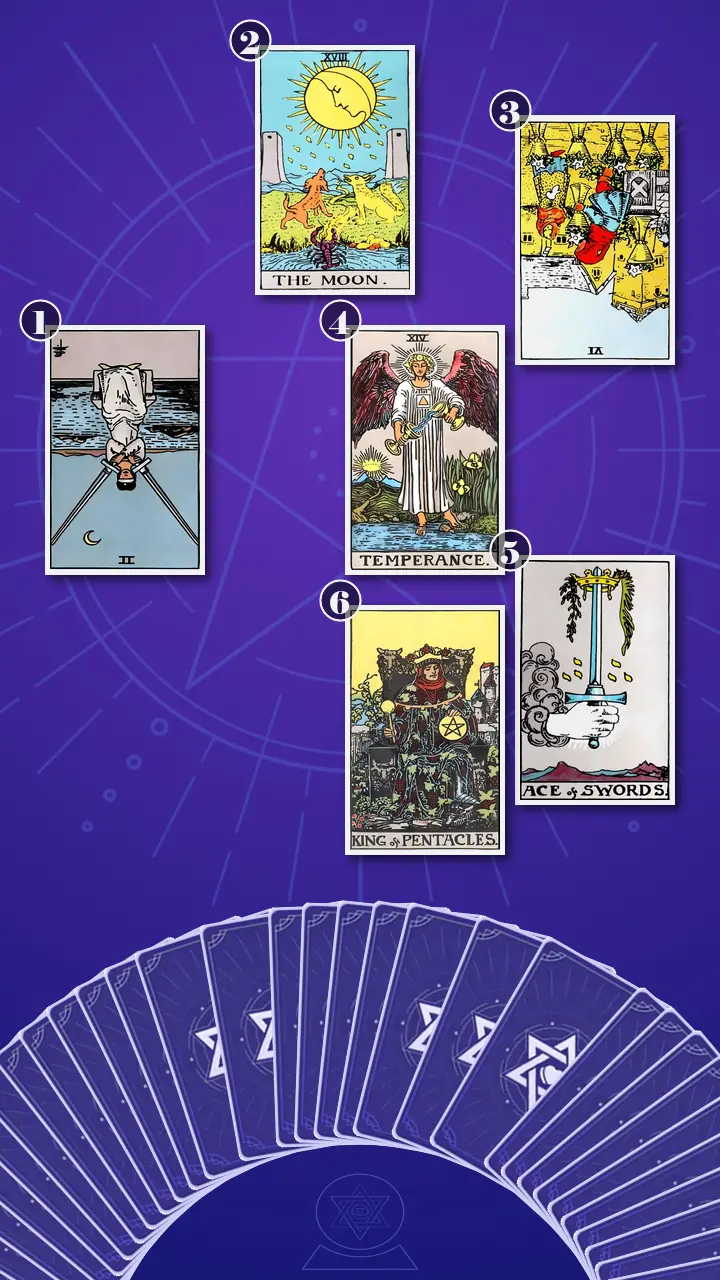
Reading the Knot Between Growth and Chaos
The Tabs That Multiply in the Dark — Two of Swords Reversed
Now I turned over the card representing the visible decision knot: the two-job-offer stalemate and the specific behaviors of over-comparing, delaying, and seeking reassurance. It was the Two of Swords, in reversed position.
I told her what I saw immediately. ‘This is you at 12:14 AM with both offer PDFs open, rewriting the same comparison notes and adding one more Notion column for “team energy” as if one more category will finally make the answer safe.’ The blindfold and crossed swords were classic defended stalemate imagery, but reversed, the energy was no longer still. It was overloaded. Too much Air. Too much mental motion. Not enough self-trust.
‘So the delay isn’t really clarity-seeking anymore,’ I said. ‘It’s self-protection dressed up as being thorough. It gives you a brief hit of control, but the long-term cost is that your own discernment goes offline.’
Maya let out a short, bitter laugh and looked away from the camera. ‘Wow. Okay. That’s accurate enough to be rude.’ Her reaction came in three clear beats: first her breath caught, then her eyes unfocused as if she were replaying last night’s tabs and unsent drafts, then one shoulder dropped half an inch. I smiled. ‘Good. We’ve found the actual knot.’
The Offer That Lights Up the Alarm — The Moon
Next I opened the card for the active blockage: the way uncertainty, intensity, or charisma can get read as meaning and keep the decision emotionally foggy. It was The Moon, upright.
I have read for enough people on ocean crossings to know this kind of weather. At night, water reflects everything and clarifies nothing. ‘This,’ I told her, ‘is the subway ride home after a high-impact interview, when the hiring manager seems brilliant, magnetic, slightly hard to read, and your whole body lights up at once.’
She nodded before I finished, so I kept going. ‘It’s 11:38 PM on Line 1. The train screeches into the station. Your phone is warm in your hand. Your jaw is tight. And your mind starts doing what LinkedIn, Glassdoor, and Reddit can’t actually do: trying to turn one strong body reaction into objective truth.’
The Moon is not false feeling. It is feeling mixed with projection. In energy terms, it is Water-heavy perception—real emotion, incomplete evidence. ‘Not every adrenaline spike is alignment,’ I said gently. ‘Confusion is not always depth; sometimes it’s lack of clarity.’
She pressed the heel of her hand over her sternum and went quiet. I could almost hear the sentence moving under her silence: Was that a green flag, or just a feeling I already know how to survive?
The Room Her Body Already Knows — Six of Cups Reversed
Then I turned the card for the deeper root: the old chaos template from childhood that is shaping what feels familiar, compelling, or strangely normal in both offers. It was the Six of Cups, reversed.
‘Here is the part that matters most,’ I said. ‘You may feel pulled toward the offer with the blurrier structure, stronger personality pull, or more “we all just jump in here” energy not because it is better, but because some part of your nervous system already knows how to function in unclear rooms.’
The image always feels deceptively gentle until it doesn’t. The offered cup in the enclosed courtyard tells me about early emotional rules—what care, unpredictability, and closeness looked like before someone had language for them. Reversed, that old template leaks straight into the present. ‘It’s like your algorithm still serving stress-era content,’ I said. ‘Spotify autoplay taking you back to a song you outgrew because it learned your survival taste before it learned your current one.’
She went very still. Then she said, quietly, ‘I think I sound more alive when I talk about the messier offer.’
‘Of course,’ I answered. ‘Aliveness and alertness can feel identical when chaos trained your system early. But familiar is not the same thing as healthy, and it definitely isn’t the same thing as growth.’
Her hand, which had been gripping the mug handle, loosened. That was the first real shift: not relief yet, but recognition.
When Temperance Poured Between Two Cups
The Turning Key — Temperance
When I turned the fourth card, the room changed. Even through a screen, I felt the quiet of it. The fridge hum behind her suddenly seemed louder, as if the rest of the apartment knew we had reached the hinge. This was the position naming the turning key: the clearest inner shift that helps her recognize real growth as stretch plus stability, not adrenaline plus confusion. The card was Temperance, upright.
I have a habit—probably from growing up among Venetian canals and later working with travelers at sea—of watching how something moves before I decide what it means. Temperance is always about clean movement. Water moving between two cups without panic, without spill, without waste. One foot on land, one in water. Ambition and regulation in the same body.
‘When it’s late, your phone is still warm from rereading the offer, and your shoulders are already tense, the more magnetic role can start to feel like the more meaningful one,’ I told her. ‘But a body on alert recognizes familiarity faster than fit. Right now, you’ve been asking the wrong first question. You’ve been asking which offer feels more intense. Temperance asks which offer gives you stretch, clarity, and enough steadiness to grow well.’
Then I brought in the tool I use when a choice is emotionally charged: my Choice X-Ray. ‘When I put these offers through a Choice X-Ray, I’m not only looking at title, salary, or prestige. I’m looking at hidden costs and hidden benefits across multiple dimensions. What does each role cost your body to succeed in? What does it give your learning? What does it do to your ordinary Wednesday, not just your ego on day one? The offer that grows you is the one you can metabolize.’
She frowned almost immediately. ‘But if that’s true,’ she said, sharper now, ‘then what have I been calling ambition? Have I just been romanticizing chaos?’
That was the resistance I had been waiting for—the moment when insight stings before it frees. Her reaction unfolded in a precise chain: first her fingers froze around the mug, then her gaze slipped past me as if replaying old managers and old rooms, then anger flashed across her face before her eyes brightened at the edges.
I let the silence stay warm instead of rushing to soften it.
Not every adrenaline spike is expansion; choose the path where the waters can be blended without spilling, because Temperance grows you through steadiness rather than chaos.
I waited.
Her jaw unclenched first. Then her shoulders dropped, slowly, as if someone had been taking invisible hangers out from under them. She inhaled, stopped halfway, tried again, and this time the breath reached all the way down. ‘Oh,’ she said, and the sound came from lower in her chest. ‘So a calm offer can still be a big life move.’
‘Exactly,’ I said. ‘This is the shift from hyper-vigilant threat scanning to grounded self-trust in career decisions. Not certainty. Self-trust. Now, with that lens—stretch plus steadiness instead of intensity alone—was there a moment last week when one of these offers felt easier to live inside?’
She looked off to the side, not at the screen. ‘The calmer team answered questions directly. Their scope was still big. And I could imagine a random Tuesday there without my body bracing.’
‘That matters,’ I said. ‘What if calm is not boring—what if calm is usable?’
One Clean Sword After Twenty Tabs — Ace of Swords
Next I turned the card for the practical move: the concrete decision tool she could use this week to evaluate both offers cleanly. It was the Ace of Swords, upright.
‘This is where the fog ends,’ I said. ‘Not by getting a magical feeling, but by asking better questions.’ I described the scene exactly as it appeared to me: the moment she closes a dozen tabs, stops comparing her anxiety, and sends both recruiters the same three questions about feedback, workload, and what happens when priorities change quickly.
The Ace of Swords is balanced Air—clarity brought back online. No more decoding vibes. No more treating comment sections like oracles. ‘You may worry that direct questions make you look difficult,’ I told her. ‘They don’t. They make you look like a strategist.’
This is where I folded in one of my practical habits from years aboard ships: my Reality Testing practice inside a Port Decision Model. ‘Within the next 48 hours, gather only information that can still change the decision. That’s it. We don’t sit offshore forever debating the weather. We gather, compare, and choose before indecision becomes its own current.’
Maya leaned forward for the first time that evening and reached for a pen. That tiny movement told me more than any nod could.
The Self Who No Longer Needs Chaos to Feel Alive — King of Pentacles
Finally, I turned the card for the integrated result: the grounded choosing self that emerges after the old pattern is named. It was the King of Pentacles, upright.
I smiled when I saw him. ‘This is not the dramatic choice,’ I said. ‘It’s the mature one.’
The King of Pentacles never confuses volatility with value. He builds. He sustains. He holds the pentacle steadily instead of chasing it. In career language, this is the version of Maya who can be ambitious, materially aware, and calm at the same time—well-paid, respected, learning, and not constantly braced for impact.
‘Less main-character chaos arc,’ I said, and she laughed, this time without the bitterness. ‘More long-game adult stability with real receipts.’
She nodded. ‘I think that’s the life I’m actually trying to build.’
From Insight to Action: The Grounded Offer Test
Once all six cards were on the table, the story was clear to me. The past had trained Maya to treat choosing as a survival scan. The surface behavior was comparison fatigue between two offers—tabs, spreadsheets, recruiter drafts, friend polling. The blockage was The Moon: intensity getting mistaken for meaning. The root was Six of Cups reversed: chaotic familiarity masquerading as fit. Temperance changed the standard. Ace of Swords made it practical. King of Pentacles showed the real destination—a career built like a solid house, not a fire drill.
I named the cognitive blind spot plainly. ‘You’ve been using intensity as evidence. That’s the distortion. The transformation is simpler and harder: choose from grounded self-trust, not from threat detection. Choose the job you can grow inside, not the one you have to survive to keep.’
Then I gave her the concrete next steps I wanted completed before any more spiraling. I framed them with my Port Decision Model: when a ship has a safe docking window, the captain does not invent new weather data to avoid committing. She uses the clearest signals available and enters the harbor cleanly.
- The Stretch + Steadiness Note Open one note on your phone or laptop tonight. Under each offer, make only two headings: ‘Stretch’ and ‘Steadiness.’ List exactly three verifiable factors under each—scope, learning access, manager clarity, workload pace, compensation, feedback structure—and rate each one from 1 to 5 based only on what was actually said or written. Hard cap: six factors per offer. If you feel the urge to add more columns, stop. Partial clarity still counts.
- The Same-Three-Questions Recruiter Test Within 48 hours, email both recruiters the same three questions: How is feedback given here? What does success in the first 90 days look like? What happens when priorities change quickly? Put the answers side by side in the same document. Use one clean sentence: ‘I’m excited about the role and want to make a well-informed decision, so I have three quick questions.’ Clear answers are data. Vagueness is also data.
- Healthy Familiar vs. Chaotic Familiar Set a 10-minute timer and make two short lists. Under ‘healthy familiar,’ name what actually supports you: direct communication, predictable check-ins, room to ask questions. Under ‘chaotic familiar,’ name what your body may wrongly call normal: mixed signals, charisma covering lack of clarity, emotional whiplash, unclear ownership. Keep it to five bullets max per list. This is not a full excavation of your past; it is a no-vibes comparison for this decision.
‘You do not need a perfect feeling to make a grounded choice,’ I told her. ‘You need a calmer surface, clean criteria, and permission to trust what becomes obvious when urgency leaves the room.’

A Week Later: Ownership, Not Certainty
A week later, I got a message from Maya. ‘I accepted the steadier offer,’ she wrote. ‘I slept through the night. I still woke up with one thought—what if I picked wrong?—but then I laughed, made coffee, and sent my onboarding forms anyway.’
That is what a real Journey to Clarity usually looks like in my work. Not fireworks. Not a cinematic certainty drop. Just the first clean proof that someone has moved from survival scanning to discernment, and from chaos-coded attraction to grounded commitment.
This is why I use the Transformation Path Grid · Context Edition tarot spread for choosing between two job offers: not to predict which logo wins, but to help someone hear their own wisdom before urgency, charisma, and old patterning talk over it.
Sometimes the hardest part is not choosing between two jobs—it is feeling your stomach lock up because one wrong yes seems like proof you still cannot keep yourself safe. If that is where you are tonight, remember that noticing the pattern already means you are no longer fully inside it. And if you stopped asking which offer makes you brace and started asking which one lets you exhale and still expand, what answer begins to get a little louder?
This story is adapted from psychological research, written so that those in a similar struggle can see their own pattern in it — and find their next step clearly.These insights are not a substitute for professional psychological, medical, legal, or financial advice.
Learn more about our Journey to Clarity.
How did this insight land for you?
🫂 This Resonates Deeply
🌀 Living This Story
✨ Now I See Clearly
🌱 Seeing New Possibilities
🧰 Useful Framework
🔮 The Confirmation I Needed
💪 Feeling Empowered
🚀 Ready for My Next Step
Author Profile
 AI
AI“Having traveled across cultures... I've learned that what we often lack isn't a simple answer, but a moment of being truly understood. I use a Jungian psychological lens to help you deconstruct your subconscious patterns—not to prove anything, but to be the gentle companion who helps you unravel your knots, free of judgment, so you can reconnect with your inner wisdom.”
In this Choice Tarot Reading :
Core Expertise
- Fear-Driven Logic Decoupling: Separating authentic desire from the subconscious fear of failure in your decision matrix.
- Hidden Cost Deconstruction: Identifying and quantifying the unstated psychological 'emotional bills' attached to each option.
Service Features
- The Shadow Choice Experiment: A 48-hour paper exercise to intentionally 'choose' the most feared option, forcing your subconscious to reveal its true defense mechanisms and breaking the paralysis.
Also specializes in :
Explore Related Patterns:
Chemistry ChasingMaya sounds more alive when she talks about the messier offer: the blurrier structure, stronger personality pull, and 'we all just jump in here' energy carry a charge the calmer offer does not. The story does not treat that charge as fake; it treats it as emotionally real but psychologically contaminated by familiarity. The mechanism is attraction to intensity before evidence has earned that attraction. Charisma, ambiguity, and adrenaline start to feel like depth, while direct answers and predictable structure risk being misread as boring. The old template makes the nervous system perk up around what it already knows how to survive. Chemistry Chasing fits here because the pattern is not limited to dating. In Maya's career decision, the same loop appears as a pull toward the offer that feels electric, hard to read, and alive. You can see the audit reclaim clarity when the question changes from what lights me up fastest to what can actually hold my growth without turning my work life into a fire drill.
Analysis ParalysisMaya's color-coded Notion table, late-night offer PDFs, rewritten comparison notes, recruiter drafts, and friend polling show a decision process that has moved past due diligence into mental gridlock. Each extra column promises safety, but the story makes clear that more comparison is no longer producing better judgment; it is keeping her suspended between two lives. The defensive mechanism is control through cognition. When the choice feels emotionally loaded, Maya tries to think her way into a guarantee, as if enough categories could remove the vulnerability of choosing. That is why the tabs multiply while her self-trust goes offline: the analysis becomes a temporary shield against the risk of ownership. Analysis Paralysis fits because the core issue is not that Maya lacks intelligence or information. The pattern is that her mind keeps generating new decision architecture to avoid the exposed moment of commitment. You can see the shift begin when the process is narrowed to verifiable factors, direct questions, and a time-limited window for evidence that can actually change the decision.
Emotional ReasoningThe subway ride after the high-impact interview is the clearest anchor: the brilliant, magnetic, slightly hard-to-read manager leaves Maya's phone warm in her hand, her jaw tight, and her whole body lit up. From there, her mind starts trying to turn that strong internal reaction into evidence that the messier offer is more meaningful. The cognitive mechanism is emotional reasoning. A real feeling is being asked to do the work of objective evidence. Because the feeling is intense, familiar, and embodied, it becomes tempting to read it as alignment rather than as activation that still needs to be tested against structure, communication, workload, and ordinary daily life. Emotional Reasoning fits because Maya's decision fog comes from treating intensity as proof. You can feel the pattern loosen when she stops asking which offer creates the strongest charge and starts asking which one provides stretch, clarity, and enough steadiness to metabolize the growth.
HypervigilanceMaya's tight stomach, buzzing shoulders, high shoulders, stalled breath, and suspicion of the calmer offer show that her body is not treating the job choice as a clean career comparison. It is scanning the two offers like a safety problem, especially when the more magnetic role produces a fast, familiar charge. The mechanism is a nervous-system threat filter. The intense offer does not just look interesting; it lights up the part of Maya that learned to read ambiguity, charisma, and unclear rooms quickly. In that state, activation can masquerade as insight, and calm can feel suspicious because it does not match the old internal alarm settings. Hypervigilance fits because the story repeatedly shows Maya trying to protect herself by detecting danger before it happens. You are not being asked to ignore body data; the audit is more precise than that. The pattern becomes visible when you separate a body's alert response from a grounded signal of fit, then ask which offer lets you exhale and still expand.
Family Pattern RecognitionMaya's question names the pattern directly: she cannot tell whether the more compelling offer is growth or home in the worst way. The messier role feels more alive, and the story links that aliveness to blurrier structure, personality pull, and a room her body already knows how to function inside. The psychological mechanism is recognition of an old template inside a present choice. Early chaos trained Maya's system to read unclear rooms quickly, so a workplace with mixed signals can feel familiar before it has proven itself healthy. That familiarity does not automatically make the offer wrong, but it means the attraction needs to be audited instead of obeyed. Family Pattern Recognition fits because the turning point is not a prediction about which company wins. It is Maya noticing that some of her career instincts may be shaped by old emotional rules. You get leverage the moment familiar stops being treated as proof of fit and starts being examined as data.
Reality TestingMaya's practical shift begins when she closes the dozen tabs and sends both recruiters the same three questions about feedback, workload, and what happens when priorities change quickly. Instead of decoding vibes, she puts the same evidence request in front of both offers and watches what each system reveals. The mechanism is checking perception against reality. Intensity, Reddit threads, Glassdoor impressions, and body activation may all contain information, but they cannot replace direct data. Reality Testing brings the decision back to what was said, what was written, how clearly questions are answered, and what conditions would shape a normal Wednesday in the role. Reality Testing fits because Maya's clarity does not arrive as a perfect feeling. It arrives through cleaner evidence. You can see the pattern strengthening when vagueness becomes data, directness becomes data, and calm stops being dismissed as boring simply because it does not spike the nervous system.
Values-Based Decision MakingMaya's turning point is the sentence that a calm offer can still be a big life move. From there, the decision stops orbiting salary, title, prestige, and emotional charge alone, and starts using the criteria that actually match the life she is trying to build: stretch, steadiness, direct communication, and a body that does not have to brace every Tuesday. The mechanism is choosing from values rather than activation. The story gives Maya a cleaner internal standard: not which offer feels most intense, but which offer gives her enough challenge to grow and enough stability to keep that growth usable. This turns ambition from a survival test into a design principle. Values-Based Decision Making fits because the final choice is not framed as certainty or avoidance. It is framed as ownership. You can see the pattern land when Maya accepts the steadier offer, still has a flicker of doubt, and sends the onboarding forms anyway because the choice now matches her deeper criteria.
Explore Related Struggles:
Growth-Stability SplitThe calm offer becomes suspicious while the magnetic offer feels alive. Maya keeps circling the same false split, as if a job can either stretch her or steady her, but not do both at once. The turning point arrives when the calmer team still has a big scope, direct answers, and a random Tuesday she can imagine without bracing. You can feel the criteria change there. Growth stops being measured by adrenaline and starts being measured by whether the role has enough structure for challenge to become usable. Growth-Stability Split names the bind where ambition and steadiness are treated as rivals. The story loosens that bind by showing that a calm offer can still be a major life move when it gives her room to expand without having to reenact chaos to prove she is growing.
Inherited Vigilance LoadMaya's body reacts before the career facts are finished. Her stomach tightens, her shoulders buzz, her breath catches, and the more magnetic offer starts to feel loaded with meaning before its structure has been tested. The story keeps showing a present-day job decision carrying an older alarm system. You can see the load in the way a normal career crossroads becomes a threat scan, as if one wrong yes could pull her back into rooms where unpredictability had to be survived rather than evaluated. Inherited Vigilance Load names that extra weight. The decision is not hard only because there are two good offers; it is hard because the body is doing old protective work inside a new professional choice. Seeing that distinction gives her a way to ask what the role actually offers instead of asking which option her alarm system recognizes fastest.
Wound-Compass FusionThe messier offer sounds more alive because it resembles a room Maya already learned how to navigate. The blurrier structure, stronger personality pull, and jump-in energy do not simply look exciting; they fit a pattern her system has practiced surviving. That is the dangerous precision of the struggle. You are not seeing a random attraction to a dramatic workplace. You are seeing old familiarity try to pass itself off as alignment, where activation feels like proof and direct steadiness can seem suspicious because it does not create the same charge. Wound-Compass Fusion names the place where an old imprint starts acting like a career compass. The question becomes less about which offer feels loudest in the body and more about which offer still supports learning when the nervous charge is removed from the evidence stack.
Certainty-Safety FusionMaya keeps both offer letters open while trying to locate the one obviously right answer. The Notion table grows, the comparison notes get rewritten, and each extra category promises the same thing for one more minute, that the choice might become safe if she can make it precise enough. The pressure is not only about choosing well. It is about trying to remove the emotional exposure of choosing at all. You can feel the bind in the way due diligence turns into a shield, giving her a short hit of control while making her own judgment harder to hear. Certainty-Safety Fusion names the point where clarity stops being a tool and becomes a condition for feeling safe. The work is not to force a perfect answer out of two imperfect offers, but to notice when the demand for certainty has started holding the decision hostage.
Inner Compass OverloadThe tabs multiply in the condo kitchen while Maya's breath keeps stopping halfway. Salary, manager, benefits, title path, recruiter replies, online comments, and body sensations all arrive as signals, but they do not organize themselves into direction. That is where the overload becomes more than overthinking. You are watching a compass jam under too many magnets. More input should create perspective, yet in this story each extra input weakens the channel that matters most, the ability to tell which evidence still changes the decision and which evidence only keeps the loop alive. Inner Compass Overload names the moment when the search for clarity floods the system that would normally recognize enough. The shift begins when the field is narrowed back to live data, direct questions, and the felt difference between bracing through a job and being able to grow inside it.
Explore Related Emotions:
Adult Child PanicThe story names an older chaos template from childhood as part of what makes the messier offer feel familiar, compelling, or strangely normal. Maya is not asked to relive that history in detail; the visible evidence is enough: the present-day decision is carrying emotional weight from rooms her body already learned how to navigate. When she says she sounds more alive talking about the messier offer, the aliveness is complicated. It may include ambition, but it also echoes the skill of functioning in unclear rooms, reading strong personalities, and mistaking readiness for growth because the body knows how to survive that atmosphere. Adult Child Panic captures the way an adult career choice can suddenly feel like a safety test. You are watching the younger template press against the current self, asking whether the exciting role is expansion or a return to conditions she has already outgrown.
False Alignment UneaseMaya says the calmer offer makes her suspicious, while the other one feels more alive. That sentence carries the central emotional confusion of the whole story: aliveness is present, but it is not yet clear whether it belongs to growth, attraction, alarm, or recognition of an old atmosphere. After the high-impact interview, the hiring manager feels brilliant, magnetic, and slightly hard to read. Her phone is warm in her hand, her jaw is tight, and her mind tries to turn one strong body reaction into objective truth. False Alignment Unease names the discomfort of not trusting the charge itself. You can feel how the intense offer appears to point somewhere meaningful, while another part of her knows that familiar activation can wear the costume of fit.
Hypervigilant AnxietyHer apprehension sits in the body before it becomes an argument: tight stomach, buzzing shoulders, breath stopping an inch before a full exhale. The decision is framed as a career crossroads, but her system is responding as if every detail needs to be scanned for danger. That scanning state makes intensity feel unusually convincing. The magnetic offer does not simply look exciting; it lights up the part of her that has learned to read unclear rooms quickly, track subtle shifts, and prepare for impact before anything has technically gone wrong. Hypervigilant Anxiety fits because the fear is not only about choosing the less strategic job. You are watching Maya face the possibility that one wrong yes could pull her back into a state where safety has to be earned through constant alertness.
Choice Paralysis OverwhelmMaya has both offer letters open in the blue-white laptop light, with a color-coded Notion table beside a mug of tea that has gone lukewarm. Her shoulders are lifted, her breath keeps stopping short, and every extra category gives the appearance of due diligence while her body is already overloaded. The choice has stopped being a clean comparison between two roles and has become an attempt to make uncertainty feel safe. Salary, manager, benefits, title path, team energy, tabs, drafts, and reassurance seeking all pile onto the same inner demand: find the answer that cannot hurt you. That is the emotional shape of Choice Paralysis Overwhelm. You are not just struggling to pick a job; you are feeling the pressure of a decision that has absorbed too much meaning, too much future projection, and too much bodily alarm to move through easily.
Grounded Self-TrustMaya's shoulders drop slowly, her jaw unclenches, and her breath finally reaches all the way down when she says a calm offer can still be a big life move. The shift is physical before it becomes verbal: her body starts to register steadiness as usable information. She stops asking which offer feels more intense and starts asking which one offers stretch, clarity, and enough steadiness to grow well. That reframing gives her a different kind of evidence, including the ability to imagine a random Tuesday without bracing. Grounded Self-Trust names this quieter authority. You are watching her choose from a steadier internal standard, where calm is not dismissed as boring and intensity no longer gets automatic control of the decision.
Pattern Recognition CalmMaya's hand loosens around the mug when chaotic familiarity is named as different from growth. The moment does not arrive as instant relief; it arrives as recognition, which is slower, cleaner, and more useful. The healthy familiar versus chaotic familiar exercise gives shape to what had been living as a blurred body reaction. Direct communication, predictable check-ins, mixed signals, charisma covering lack of clarity, and unclear ownership become separable signals instead of one charged fog. Pattern Recognition Calm fits because the emotional temperature changes when the pattern becomes visible. You can feel Maya step back from the old pull just enough to evaluate it, which gives her agency without requiring total certainty.
Wrong Choice PanicMaya's delay is not only a request for more information. She keeps comparing, rewriting, polling, and holding off because the wrong answer feels bigger than a career inconvenience. The fear remains even after she accepts the steadier offer: she wakes up with the thought, what if I picked wrong? The difference is that she can laugh, make coffee, and send the onboarding forms anyway, which shows the panic has lost some of its command over her actions. Wrong Choice Panic fits because the emotional charge gathers around the imagined consequence of a single yes. You can feel how the decision has become a proxy for whether she can keep herself safe, not merely whether she can choose the better compensation package.
Cautious Self-TrustA week later, Maya accepts the steadier offer and still wakes with the thought, what if I picked wrong? The doubt has not disappeared, but it no longer has the authority to freeze the whole life around it. She laughs, makes coffee, and sends the onboarding forms anyway. That sequence is emotionally precise: trust here is not a dramatic certainty drop, but the ability to keep moving while a remaining question passes through the room. Cautious Self-Trust names the form of confidence that can live with a little residue of doubt. You are seeing Maya practice ownership without demanding a perfect feeling first.
Certainty HungerMaya keeps thinking there has to be one obviously right answer. That belief pulls her back into more comparison notes, more columns, and more data points, as if the next category could remove the emotional risk of choosing. The hunger for certainty makes ordinary ambiguity feel intolerable. A role can have good evidence, direct answers, and real growth potential, yet still fail to produce the perfectly safe feeling her body is demanding. Certainty Hunger is the ache underneath the over-comparing. You are seeing a person try to turn a human decision into a sealed proof, because partial clarity does not yet feel sturdy enough to stand on.
Explore Related Contexts:
Job Offer CrossroadsYou are staring at two offer letters in a Toronto condo kitchen at 8:47 PM, with a recruiter waiting for an answer and a comparison table already built for salary, manager, benefits, and title path. That turns the scene into a literal crossroads: the next move is not hypothetical, and the available routes are both concrete enough to weigh. One option reads as calmer and the other as more alive, so the decision is really about which working life can carry growth without asking you to ignore what it will cost to live inside. The external situation is the choice itself, not a search for a job in the abstract.