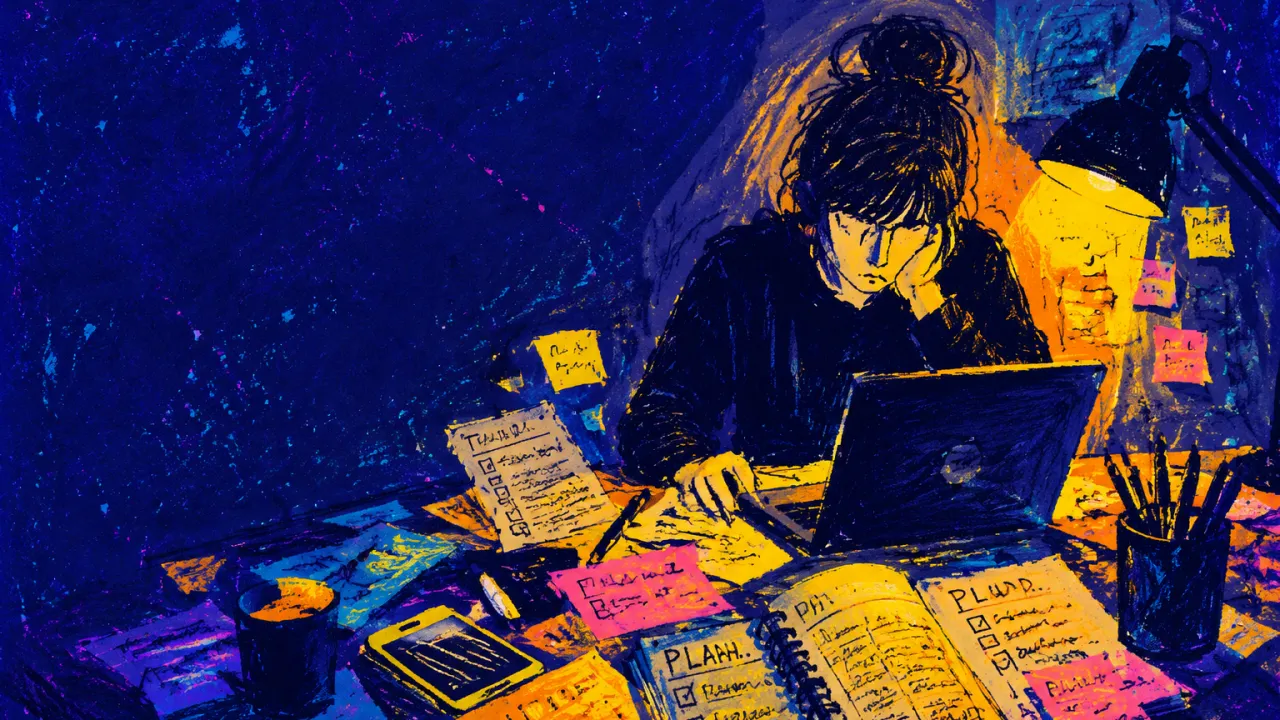
Resource Integration Strain lives in the moment when every useful tool, tab, routine, and offer is present, but your attention has nowhere to stand. You can feel it in the tight neck, dry mouth, and tabs multiplying while one notebook turns into several unrelated lists. From an existential perspective, the structural framework of this struggle is about abundance pressing against one body, one day, and one narrow channel of attention. The Tarot Cards below make that pressure visible as a set of images.
The Magician UprightThe four elemental tools sit side by side on a compact table while one body tries to hold the whole operation through a single raised-and-lowered axis. Each implement has a different weight, function, and demand; none is missing, but none is yet integrated into one usable sequence. In personal growth, the friction comes from having too many valid parts of yourself and no stable way to make them cooperate. You can feel the strain of trying to turn mindset, emotion, skill, discipline, and desire into one coherent practice without letting one tool cancel out the others.
The High Priestess UprightThe High Priestess sits as a vertical axis between black and white pillars, with the crescent moon below, the crown above, the scroll across her lap, and water concealed behind the veil. Nothing is missing from the image; the pressure comes from how many symbolic systems have to coexist without collapsing into one another. That is the body of Resource Integration Strain. In a lifestyle reading, You are not facing one isolated task but a whole ecology of needs: sleep, work, health, space, money, recovery, and meaning all pressing for placement inside the same limited day. The card holds these forces in a ceremonial stillness, which makes the strain visible without turning it into chaos. It shows the cost of trying to become the central organizing point for too many life modules before the system has a structure strong enough to distribute the load.
The Empress UprightThe river, wheat, pomegranates, crown, Venus shield, and throne all carry generative force, but they sit in separate layers of the scene. The water flows behind, the grain stands in front, the symbolic shield rests beside the throne, and the body becomes the fixed point between systems that do not visibly connect. For study, this gives shape to the strain of having lectures, readings, feedback, and ideas without one coherent framework that can hold them together. You are not lacking material; the friction lies in the missing channel that would let separate sources become one usable line of thought.
The Hierophant UprightTwo acolytes, two pillars, crossed keys, black and white bands, rose and lily patterns, and repeated triple symbols all sit inside one formal arrangement. The card gathers many systems into a single ceremonial order, but each element keeps its own direction, level, and function. Your lifestyle strain appears when work, sleep, health, home, and recovery are forced to answer to one central rule. The problem is not that one area matters too much; it is that multiple life modules are being integrated through a structure too rigid to honor their different rhythms.
The Lovers UprightTwo trees stand behind two separate bodies, each carrying a different resource system. One side holds flame and life-force, the other holds fruit, knowledge, and the serpent, while the center of the card remains open but unbridged. A modern life can become organized in the same separated way. Work, sleep, health, home care, social energy, and desire may all exist, but they fail to feed one another because no shared architecture connects their demands. The strain is not caused by having too little. The card shows the heavier problem of having real resources distributed across disconnected zones, forcing you to keep translating between life parts that should be able to support one another.
Strength UprightThe lion's raw force does not disappear under the woman's hands; it is routed through contact, garland, posture, and the silent curve above her head. The card holds multiple channels at once: grounded claws, bent human body, lifted symbol, and distant mountain all showing force that needs direction before it becomes useful. Resource Integration Strain appears when the timing question is not whether you have enough drive, but whether the available channel can carry it without distortion. You may feel ready in one part of yourself and unready in another, and the card gives that split a visible structure: power is present, but it still has to be gathered into a form the moment can actually hold.
The Hermit UprightThe lantern gives warmth and direction, but it is tiny against the scale of the frozen night. The staff, cloak, snow, height, and darkness all ask for different kinds of support, while one small light is made to hold orientation, safety, meaning, and movement at once. That is the structure of a life system where every module is legitimate but not all of them can be fed through the same bandwidth. Work needs focus, the body needs recovery, the home needs maintenance, the mind needs quiet, and the day still asks for forward motion. The Hermit's summit makes the strain visible without turning it into failure. You are not simply bad at balance; the card shows multiple survival needs competing inside one narrow container, where integration itself becomes the hard part.
Wheel of Fortune UprightThe wheel is packed with letters, spokes, signs, books, and mythic figures, each carrying a different kind of order. The elements are not random, but their closeness creates a dense system where every symbol asks to be integrated into the same turning structure. Resource Integration Strain in study has the same geometry. Readings, lecture notes, supervisor comments, methods, case studies, and citation trails can all be valid while still refusing to settle into one clear argument. The card does not frame the overload as a failure of discipline. It shows a system with too many legitimate inputs pressing toward one output, where the real work is not collecting more material but seeing which symbolic layer is actually carrying the argument.
Temperance UprightThe angel holds two cups at different heights while one foot rests on earth and the other touches water. The liquid does not simply sit in either vessel; it has to move through a narrow, exposed passage while the whole body maintains a split contact with two different terrains. That image makes growth look less like a breakthrough and more like a live transfer between systems. You are not only adding more knowledge, discipline, intuition, or ambition; you are trying to make them pass through the same channel without flooding one part of life and starving another. Resource Integration Strain appears when personal evolution depends on holding multiple forms of energy at once. The card names the pressure of becoming someone more whole while still needing enough containment, pacing, and grounded practice for that wholeness to survive outside the moment of insight.
The Star UprightTwo vessels pour at once, but they do not feed the same receiver. One stream returns to the pool, while the other divides across the land, making the image less about abundance alone and more about the difficulty of distributing life force across different layers of the self. In personal growth, this is the strain of having enough insight, emotion, spiritual language, and motivation, while still lacking a unified system that can hold them together. You may be feeding reflection, healing, habits, and ambition separately, then wondering why the whole self still does not feel organized. The Star gives this struggle a precise shape: the source is not empty, but the channels are split. Growth stalls when every part of you is receiving something, yet no single inner architecture is integrating it into a stable direction.
The World UprightThe four creatures hold the corners of the image while the dancer occupies the center, and the two wands divide power evenly across the body. The card does not show one force winning; it shows several distinct forces being held in a single field. That field is beautiful, but it is also demanding. Fire, earth, air, and water remain separate in position, while the dancer’s body and wreath must supply the living center that makes them feel like one world rather than four disconnected claims. For personal growth, this names the strain of integrating every capacity at once: discipline with intuition, ambition with rest, softness with standards, identity with action. The struggle is not that you lack resources; it is that your resources have not yet become one usable operating rhythm.
Ace of Cups UprightFive streams leave the chalice at once, separating into distinct channels before feeding the pool below. The card frames your career tension as a problem of integration, not absence. You may have skills, ideas, allies, and motivation in motion, but the pathway that would gather them into a coherent next role, title, or direction is not yet holding together.
ReversedThe pool beneath the chalice receives the overflow, but the card does not show a system for sorting the water once it lands. Lilies bloom on the surface, streams arrive from above, and the whole field is nourished, yet the return path into a usable container remains invisible. Resource Integration Strain in academic work carries that same pattern. Books, notes, lectures, advisor comments, peer advice, and online explanations may all be present, but availability does not equal integration into memory, argument, method, or performance. The reversed card names the hidden labor between receiving help and making it yours. You are not short on material; the strain is that every resource must pass through a structure capable of selecting, digesting, and reconnecting it to the actual academic task.
Two of Cups UprightThe caduceus rises between the two cups as a single vertical spine for two separate vessels. The paired snakes do not erase their difference; they wrap around one axis so opposing currents can be held without scattering. In lifestyle terms, this is the difference between having many good routines and having one life structure that can actually coordinate them. You may have a sleep intention, a work rhythm, a food plan, a cleaning system, and a recovery need, yet each cup still operates as if it belongs to a separate body. The card anchors Resource Integration Strain in the central staff: the missing piece is not more effort inside each module, but a shared channel that lets the modules recognize one another without collapsing into chaos.
Three of Cups ReversedThe harvest is visible, but the card does not show anyone sorting, storing, cooking, clearing, or making a system from it. The cups mark a moment of recognition while the material results remain spread across the ground. Reversed, that scene becomes Resource Integration Strain. Your life may contain progress, tools, insights, purchases, routines, and intentions, yet the pieces do not settle into a structure that actually supports your day. The struggle is not that nothing is working. The struggle is that what works in fragments has not been integrated into a livable architecture, so each gain risks becoming another object on the floor of your attention.
Four of Cups UprightThree cups sit in front of the figure while a fourth arrives from a clouded hand, yet none of them becomes a usable channel of nourishment. The image is not empty; it is crowded with available inputs that remain outside the body's receiving circuit. That is the exact pressure of Resource Integration Strain in a lifestyle system. You may have the planner, the wellness advice, the open weekend, the sleep goal, and the new habit idea, but they sit like separate cups rather than becoming one rhythm that can actually hold you. The crossed body gives the struggle its boundary. The issue is not that life offers nothing; it is that too many pieces of support are arriving in formats your current daily architecture cannot absorb, so the system stays full and underfed at the same time.
Five of Cups UprightThe cloaked figure stands between two sets of containers: three cups have already emptied into the ground, while two remain upright behind the body. The card does not remove the remaining resources; it places them outside the line of sight, making the problem one of integration rather than total absence. In lifestyle terms, this is the exact shape of a day or routine that has started organizing itself around what leaked away. A missed morning, a broken sleep cycle, an abandoned habit, or a messy room becomes the visible center, while remaining capacity is present but not yet routed into the next useful action. You are not being shown a lack of resources. You are being shown a system where attention, posture, and route selection have stopped feeding the usable cups back into the daily architecture.
Seven of Cups ReversedThe cups share one suspended plane, but their contents do not belong to one simple category. Shelter, status, wealth, desire, hidden identity, recognition, and creative charge sit side by side without a mechanism that can integrate them into one livable pattern. Reversed, this becomes the lifestyle strain of trying to make every valid need fit inside the same day without redesigning the whole system. Health may compete with work, minimalism with comfort, social life with recovery, ambition with sleep, and creative desire with maintenance. The card's value is that it does not treat these conflicts as random inconsistency. It shows a set of real needs occupying the same mental surface without a shared architecture, so the friction can be seen as an integration problem rather than a character flaw.
Nine of Cups UprightThe cups are present, polished, and close, yet none is in the man's hands. The vessels sit behind the body, so the scene contains plenty of supply without showing the transfer that would let it enter the body. Resource Integration Strain names the gap between having supportive elements in your lifestyle and actually receiving them as restoration. You may own the planner, the gym membership, the calming setup, or the self-care ritual, but the life system still keeps those resources on a shelf instead of building them into lived recovery.
Ace of Pentacles UprightThe hand does not simply display the pentacle; it has to stabilize a broad flat object that could tilt, slip, or roll if the grip loosens. Below that careful hold, the garden is fertile but untouched by the resource being held above it. You can feel this as the strain of having access to practices, support, insight, or a healthier way of being, while still not being able to take it in cleanly. The resource is present, but integration asks for more than possession; it asks the inner system to let the offering become ground.
Three of Pentacles UprightThe card gathers tools, a plan, three roles, carved stone, and embedded pentacles into one architectural task. None of these elements works in isolation; each has to reach the same surface at the right scale and at the right moment. Academic pressure often takes this exact form when readings, lecture notes, office hours, feedback, study guides, and peer advice all exist but do not become one usable learning system. You may have access to resources, yet the strain appears where they fail to meet inside a stable rhythm of comprehension, retention, and output. The worker's narrow platform makes the integration problem physical. There is only a limited point where all inputs can be converted into progress, so the overload does not come from having nothing; it comes from having too many disconnected supports competing for the same working surface.
Five of Pentacles UprightThe five pentacles glow inside the church window, close enough to dominate the scene yet separated from the figures by wall and glass. Value is visible, but it does not enter the cold path where the body needs it. You may have resources around your lifestyle system, saved advice, wellness tools, routines, subscriptions, supportive people, or plans, while still feeling no real relief inside the day. The card marks the exact strain between resource visibility and resource integration. The absence of an open door matters. This is not a lack of information; it is a missing interface between what could help and the daily architecture that actually has to carry you.
Six of Pentacles UprightCoins visibly move from the benefactor's hand, yet the figures remain fixed in the same arrangement: one standing, two kneeling, one transfer in progress, one hand still waiting. The card shows resource movement without a visible change in posture. That is the precise friction inside Resource Integration Strain. In personal growth, advice, courses, readings, feedback, and insights may keep arriving, but they can remain like coins in the air: counted, received, even valued, without becoming stance, muscle memory, or self-led action. The struggle becomes clearest when you are not empty of information. You are carrying inputs that have not crossed the harder threshold into embodied change, so progress feels active from the outside while your lived position stays almost unchanged.
Eight of Pentacles UprightThe craftsman’s success depends on more than wanting the coin finished. His posture, bench, tool angle, metal surface, and working space all have to cooperate before the strike can leave a clean mark. Resource Integration Strain appears in timing questions when action readiness is distributed across several conditions at once. You may have energy, but not the right opening; skill, but not enough support; desire, but not the material conditions that allow the next phase to hold. The card’s discipline is grounded rather than dramatic. It shows that timing is not only a date or a feeling; it is the moment when inner capacity, available tools, environmental permission, and external direction become integrated enough for action to land.
Ten of Pentacles UprightThe family in the Ten of Pentacles is connected, but the connection is distributed across different lines of attention. The couple converse under the arch, the elder engages the dogs, the child looks from behind the mother, and the symbols of property and lineage sit around them like separate operating systems. Nothing in the image is isolated, yet nothing fully integrates into one clean flow. That is the lifestyle tension of having all the right modules present while the handoff between them keeps failing: work drains sleep, home upkeep eats recovery, social plans crowd health routines, and the week becomes a set of linked parts without a usable interface. The card gives this struggle a visible boundary. You are not simply disorganized; the system is asking one body to coordinate too many partially connected demands without a central rhythm that can hold them all.
Page of Pentacles UprightThe Page has the coin, the boots, the fertile land, and a visible distance ahead, yet the resource stays suspended in the hands. Nothing in the image shows the pentacle being planted, traded, carried, or worked into the ground beneath it. Resource Integration Strain is the timing struggle of having pieces that are real but not yet joined into a usable sequence. You may have the savings, skill, idea, support, or opening, but the card shows those elements held apart from the living system where they would need to function. The pressure is not simple scarcity. The pentacle is present; the field is present; the body is present. The missing link is the timed conversion between them, where preparation stops being an object to protect and becomes something that can circulate through action.
Queen of Pentacles UprightThe pentacle, throne, stream, roses, vines, and hare all carry different kinds of resource, but they do not move through one visible channel. The Queen holds one concentrated unit of value while the wider landscape produces abundance in many directions. For personal growth, the struggle is not whether you have enough raw material; it is whether your strengths, body, time, care, and ambition can be organized into one sustainable system. You are not being asked to collect more resources, but to see where the existing ones fail to connect.
King of Pentacles UprightThe King is surrounded by more symbols of resource than one body can actively use at once: the pentacle in his lap, the scepter in his hand, vines across the robe, carved bulls in the throne, walls and estate behind him. The scene is abundant, but every element has to be held in relation to every other element to remain ordered. For academic work, that visual density becomes the pressure of too many readings, notes, feedback comments, citation trails, apps, and deadlines competing for integration. You are not empty of resources; the strain comes from needing to convert a crowded domain into one coherent learning system. The throne's heaviness matters because the resources are not floating freely. They gather around a fixed seat, showing how study can become immobilized when every tool asks to be managed before any one idea can be deeply absorbed.
No cards available for this filter.