Finding Clarity in the 10:12 a.m. Mute Button Moment
You’re a high-performing, likable coworker—until one person’s sharp tone hits and you suddenly go quiet like your mic got muted (freeze response at work).
Taylor said it like she was confessing something embarrassing, not naming something real. “I know it’s not a big deal,” she told me, then swallowed like the words were stuck halfway down. “But my body acts like it is.”
She painted the scene without even trying: 10:12 AM on Zoom, camera on, that flat fluorescent buzz above her desk, Google Doc open with neat bullet points. Then a coworker cuts in—slightly sarcastic, slightly impatient—and her throat tightens so fast it’s like someone yanked a drawstring inside her neck. Her jaw clamps. Her shoulders inch up toward her ears. Her eyes drop to the agenda like it’s a life raft.
“I had a point,” she said. “A good one. And I just… let it die.”
When she described the aftermath, I could hear the rhythm of it: silence now, control later. Slack open at 4:38 PM, typing indicator blinking like a countdown, five versions of the same message drafted and deleted until it’s so polite it stops being true. Competent adult on paper, invisible in the room.
The feeling underneath wasn’t vague “anxiety.” It was alarm—like a fire door slamming shut inside her chest the second a familiar tone appears. Like her mind switches into read-only mode mid-meeting: no edits, no comments, just silent observing.
“We can work with this,” I said gently. “Not by forcing you to ‘be confident,’ but by figuring out what exact switch is flipping—and what one small step helps you stay you in the room. Let’s use tarot the way I use radio: as a tool to find the signal inside the noise, and get you to clarity.”

Choosing the Compass: The Four-Layer Insight Ladder Spread
I asked Taylor to take one slow breath—not as a ritual, not as magic, just as a clean transition from spiraling into observing. I shuffled while she held the question in mind: “Coworker sounds like my bully—why do I shut down, and what’s one step I can take?”
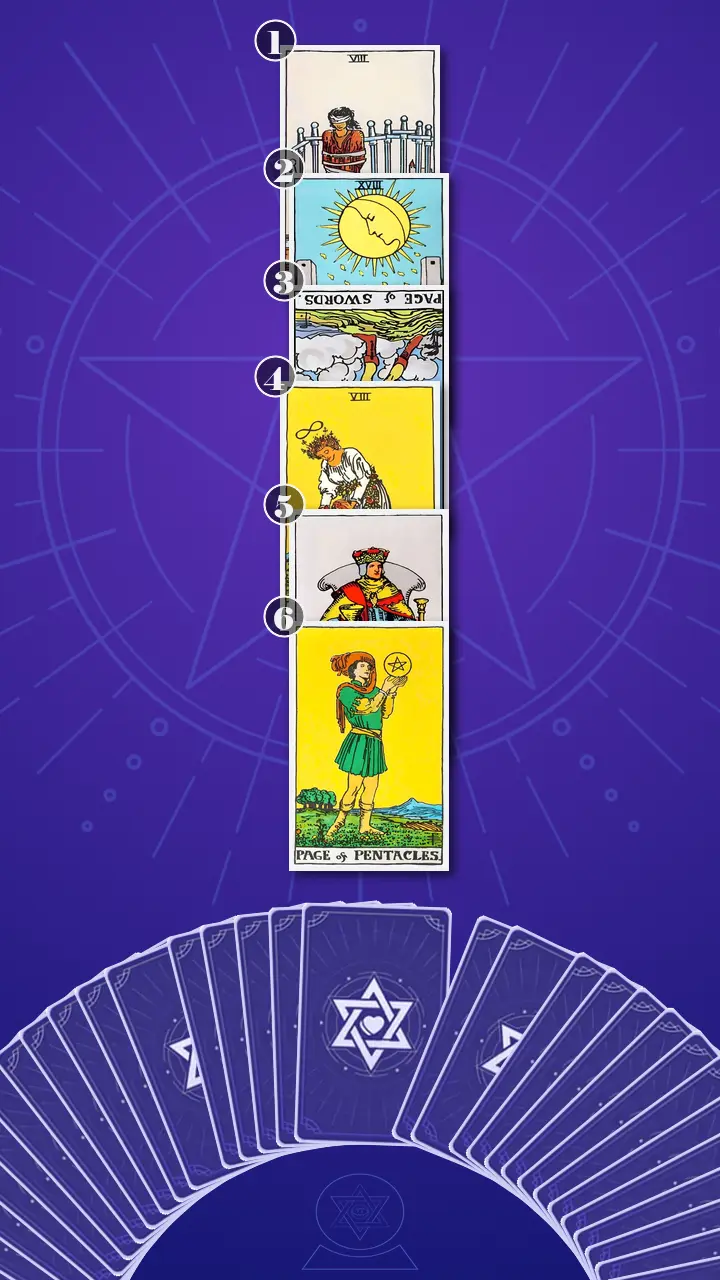
For this, I used a spread I love for workplace trigger responses: Four-Layer Insight Ladder · Context Edition. It’s built to move from the visible moment (what happens in your body), down into the root trigger (why it’s bigger than the present), then name the shadow loop that keeps you stuck, and finally climb back up through a turning point, support, and one practical next step.
For anyone wondering how tarot works in a situation like this: I’m not using the cards to predict what the coworker will do next. I’m using them to map a pattern—symptom → root → block → pivot → support → action—so we can stop treating your freeze response at work like a personality flaw and start treating it like a system that can be led.
I told her what to expect: the first card would show the shutdown moment as it actually happens. The second would reveal what’s being activated underneath. The fourth card—right in the middle—would be our hinge, the turning point that restores choice. And the last card would answer the question she kept coming back to: “Okay, but what do I do—one step?”
Reading the Ladder: From Tone to Truth
Position 1: The Observable Shutdown Moment
“Now flipping over is the card that represents the observable shutdown moment: what your body and behavior do when the coworker’s tone hits.”
Eight of Swords, upright.
And immediately, the card did what it always does when someone is describing “I go blank in meetings”: it made the invisible visible.
I grounded it in her real life, exactly as it shows up: It’s 10:12 AM in a cross-functional meeting. You’ve got your bullet points open and your cursor blinking in the doc. Then that coworker speaks—same sharp cadence, same “are you serious?” edge—and your body does the thing: jaw clamps, throat tightens, shoulders creep up. You stare at your notes like they’re a life raft… You let the moment pass… and quietly watch other people decide the direction you actually had a solid point about.
In energy terms, Eight of Swords is blockage—not a lack of intelligence or preparation, but a narrowing of options in the nervous system. The blindfold matters: you can’t “see” the present clearly when your body is bracing for an old script. And the bindings being loose matters too: the “can’t” feels locked, but in the current room, it isn’t.
I used a split-screen the way I do when I’m producing a show and two audio tracks are competing. “On the left,” I said, “is the meeting: camera on, notes open, your voice disappearing. On the right is the Slack draft graveyard: version one through five. And in your head it’s like rapid-fire browser tabs: Don’t get targeted. Say it perfectly. Better say nothing.”
Taylor gave a small laugh that sounded like it had a bruise under it. “That’s… brutal,” she said. “But yeah. That’s exactly it.”
Her eyes didn’t leave the card. Her fingers pinched the edge of her notebook, then loosened, like her hands were rehearsing what her throat couldn’t.
Position 2: The Deeper Trigger Beneath the Surface
“Now flipping over is the card that represents the deeper trigger: what past-linked fear is being activated beneath the surface.”
The Moon, upright.
I felt the room go quieter in that specific way it does when someone realizes they’re not “overreacting”—they’re remembering.
I translated it into the modern scene the card was already holding: You’re walking back from the kitchen with your coffee and you hear their voice from two desks away—before you even catch the words, your brain writes the plot. ‘They’re annoyed. They’re about to call me out. Everyone will see I don’t belong here.’ Nothing concrete has happened yet, but you’re already in a hallway-from-years-ago version of yourself, bracing for a public takedown.
This is The Moon’s signature move: ambiguity becomes threat. It’s not that you’re “too sensitive.” It’s that your system learned to treat tone as an early warning siren.
“Nothing happened yet,” I said, keeping my voice steady, “and your body is responding like it already did.”
Then I gave her the line I wanted her to borrow this week: “A trigger can be real even when the current room isn’t dangerous.”
Her shoulders lifted on an inhale—almost a flinch—then dropped a millimeter when she exhaled. That tiny drop was important. That was her system learning there’s a difference between a forecast and a fact.
Because I’m me, and because sound is my language, I asked one more question. “What have you been listening to after these meetings? Like… what’s on your ‘recently played’?”
Taylor blinked. “Uh. Mostly angry girl pop? And then… weirdly, a lot of brown noise at night.”
That’s my Music Pulse Diagnosis in action: the songs you reach for when you’re activated are often a diary your nervous system kept when your brain was too busy editing. Anger music after a meeting isn’t “dramatic.” It’s your body trying to complete a response it wasn’t allowed to have in the room.
Position 3: The Shadow Loop That Keeps You Stuck
“Now flipping over is the card that represents the shadow loop: the thought/communication pattern that keeps you stuck in silence.”
Page of Swords, reversed.
“This,” I told her, “is the Slack/Teams tone-anxiety card.”
I brought in her exact life pattern: After the meeting, you open Slack and draft a reply to a simple question. You rewrite it five times: too direct, too soft, too many emojis, too formal, too defensive. You read their last message for ‘tone’ like it’s a forensic document… Eventually you send a watered-down version that doesn’t include the ask you actually needed—or you don’t send it at all until hours later.
Reversed, Page of Swords is excess Air—too much scanning, not enough landing. It’s vigilance turned inward until it becomes self-silencing. In the body, it looks like that jittery internal weather: shoulders up, breath high, eyes tracking for danger instead of tracking the actual conversation.
I watched Taylor’s gaze sharpen when I said the part her brain thought was “just being careful.” “You’re doing sentiment analysis on punctuation marks,” I said. “Not reading the message.”
Then I gave her the interruption phrase, clean and simple: “Tone isn’t a verdict. It’s just data—ask for the rest.”
The energy shift I want here is from interpretation to inquiry. One neutral question can puncture this whole loop because it drags the conversation back into facts.
Taylor’s mouth pressed into a line, then she nodded once—small, but decisive. Her foot, which had been tapping under the table, finally stilled.
Position 4: The Turning Point That Restores Choice (Key Card)
“Now flipping over is the card that represents the turning point: the inner capacity that interrupts the freeze and restores choice.”
When I turned it, the air in the room felt like it held still for half a beat—like the second before a song drops into a chorus.
Strength, upright.
Strength isn’t “clap back.” It’s not winning. It’s keeping your nervous system online long enough to choose.
The trigger hits mid-sentence. You feel the freeze rise. Instead of pushing through or disappearing, you take one slow breath you can actually feel in your ribs, keep your shoulders down, and buy yourself two seconds. Then you say one clean line—calm, not apologetic… ‘Can we slow down for a second? I want to make sure I’m tracking what you’re asking for.’
Setup: Taylor was right back in it for a second—cursor blinking in her notes, that familiar sharp tone landing, throat tightening, mind going white, like she was back in a hallway where silence used to keep her safe.
Stop trying to outthink the trigger; practice gentle courage that holds the lion long enough for your voice to return.
Reinforcement: The reaction came in layers—the way truth does when it hits a body before it hits a story. First, she went still. Not calm-still. Freeze-still. Her breath paused halfway in, like her ribs forgot their job. Second, her eyes unfocused, not on me, not on the card—somewhere behind it, where an old memory was replaying at high speed. Third, she exhaled, long and shaky, and her shoulders dropped in a way that looked almost unfamiliar, like she didn’t realize she’d been holding them up all day.
“But that means I have to… do something in the moment,” she said, and there was a flash of anger in it—at the coworker, at her own body, at the whole unfairness of it. “What if I can’t? What if I just go blank again?”
“Then we don’t try to be fearless,” I said. “We try to be present for two seconds.”
This is where I brought in my most practical signature tool: a Breath Soundtrack. “Your nervous system responds to rhythm faster than it responds to logic,” I told her. “So we’re going to give it a beat it can follow.” I tapped a slow, steady tempo on the table—about 60 BPM, resting heart pace. “Inhale for four counts. Hold for one. Exhale for six. That long exhale is the ‘lion leash.’ It tells your body: we’re not being chased.”
Then I asked her, exactly as I always do at this hinge: “Now, with this new lens—regulation first—can you think of one moment last week when a two-second pause would have changed how you felt?”
Taylor’s fingers moved to her throat, just lightly. “Wednesday,” she said. “They said, ‘So… are we doing this or not?’ and I felt like… I was about to get mocked.”
“That,” I said, “is the difference between starting in alarm-driven disappearance and moving toward calm courage—gentle firmness under pressure. Regulate first, then speak—presence breaks the old bully script.”
Position 5: The Support Resource You Can Borrow
“Now flipping over is the card that represents your support resource: what emotional capacity you can borrow to stay steady in the moment.”
King of Cups, upright.
I love this card for career crossroads moments where you’re not sure if you’re being “too sensitive” or if it’s disrespect—because it doesn’t force you to pick a narrative. It teaches containment.
You notice the internal surge—shame, anger, that stomach drop—without having to perform it or obey it. You anchor to something physical (hand around a warm mug, feet flat inside your sneakers under the desk) and respond like someone who’s allowed to take up space: respectful, clear, not over-explaining.
Energetically, King of Cups is balance: calm on the surface, choppy underneath, and still—steady. “You don’t have to match their energy,” I told her. “You can let them be choppy. You stay you.”
Taylor’s posture shifted as if she was trying on that “adult energy.” She sat back a little. Her chin lifted a fraction. It wasn’t dramatic—just enough that I could see her remembering she had a spine.
Position 6: One Step You Can Try This Week
“Now flipping over is the card that represents one step: a small, practical action you can try this week to rebuild voice and self-trust.”
Page of Pentacles, upright.
This is Notion/Google Docs energy: one reusable template beats a perfect one-off performance.
You pick one sentence you can actually remember when you’re activated, and you treat it like practice—not proof of your confidence… You use it once this week in real time, even if your voice shakes. The win is not that you felt fearless; it’s that you stayed present long enough to act on the ground.
Page of Pentacles is grounding. It takes everything we found—Moon fear, Sword scanning, Strength pause—and turns it into one repeatable micro-action. Not a personality makeover. A rep.
“One sentence is enough to give you your choice back,” I said.
She blinked hard, like she was holding back a rush of emotion that didn’t quite fit into “work.” Then she nodded. This time the nod looked like consent—not to the coworker, but to herself.
The One-Sentence Dignity Script (and the Soundtrack to Use It)
Here’s the story the spread told, cleanly: when the sharp tone hits, your body snaps into the Eight of Swords corridor—options narrow, voice disappears. The Moon explains why it feels disproportionate: old bullying material is getting activated, and ambiguity becomes a humiliation forecast. Page of Swords reversed keeps the loop running by making you do mind-reading and perfection editing instead of real communication. Strength is the hinge: regulation restores choice. King of Cups is your stabilizer: calm-but-not-small. And Page of Pentacles is the install: one doable rep this week.
Your cognitive blind spot isn’t “I’m weak.” It’s this: you’ve been trying to solve a body alarm with better wording. That’s why you keep rewriting Slack messages. You’re negotiating with the lion instead of holding it.
The transformation direction is simple and specific: shift from trying to prevent all discomfort by disappearing to practicing a single, repeatable pause-and-name step that re-establishes choice.
And because I’m Alison Melody, I’m going to make it even more doable by giving you an audio cue. Your nervous system loves a consistent signal.
- The 2-Second HingeBefore your next meeting, write at the top of your notes: “Give me a sec—I want to answer clearly.” When the tone hits and you feel your throat tighten, exhale slowly, drop your shoulders once, and say that line out loud.If it feels awkward, make it even smaller: “Let me think for a moment.” You’re not performing confidence—you’re buying time.
- Tone-to-Fact Reality CheckPick ONE default clarifying question for the week: “Can you clarify what you mean by that?” Use it the first time you notice you’re mind-reading tone. Say it once, then stop talking.If it’s async (Slack/Teams), send it as a single line—no preamble, no apology—then close the laptop for 2 minutes so you don’t spiral-edit.
- Send the V1 (Clean, Calm, Short)Create a “v1 reply” note with two templates: (1) “Here’s what I can do by EOD.” (2) “I can do A or B—what’s the priority?” The next time you rewrite a message for the third time, paste the template and hit send.Tell yourself: “Send the v1. Your nervous system doesn’t need perfect—it needs proof.” Then do a 60-second reset—refill water, look out a window, or take a short walk.
To support all of this, I gave her a BGM Prescription—not as spiritual fluff, but as a way to condition the “pause” into her body before she needs it:
Track 1 (meeting prep, 3 minutes): a 60 BPM instrumental (anything steady, low lyric load) so her breath can lock into that 4–1–6 rhythm without effort.
Track 2 (after a triggering interaction, 5 minutes): low-frequency brown noise or a soft fan sound—my White Noise First Aid—to stop her brain from replaying tone like courtroom evidence.
Track 3 (end of day, 10 minutes): a gentle “frequency cleansing” style track in the 396–528 Hz range if she likes it, or simply a warm ambient pad—something that helps her body complete the stress wave without needing to draft five more messages in bed.

A Week Later: Ownership, Not Certainty
Six days later, I got a voice note from Taylor while I was setting up mics for my radio segment. The background sounded like streetcar rails and a lobby echo—Toronto in motion.
“Okay,” she said, and I could hear the disbelief and pride tangled together. “It happened. Same tone. I felt the throat thing start. And I did the exhale. I literally said, ‘Give me a sec—I want to answer clearly.’ And then I asked, ‘Can you clarify what you mean by that?’”
She paused. “No one got mad. No one ‘pounced.’ They just… clarified. And I stayed in the room.”
Her micro-win wasn’t that she felt fearless. It was that her body learned a new association: speaking doesn’t automatically equal danger. One rep. One brick of self-trust.
The bittersweet part was honest too: she slept a full night, but she told me her first thought in the morning was still, “What if I sounded stupid?”—and then, softer: “But I did it anyway.”
That’s the whole Journey to Clarity, right there. Not certainty. Ownership. From alarm-driven disappearance to calm courage and gentle firmness under pressure—one breath, one line, one moment at a time.
When a familiar tone hits and your throat tightens, it can feel like you’re fighting two battles at once—trying to be competent in the room while your body is bracing to be publicly reduced again.
If you didn’t have to win or prove anything this week—just stay present—what’s one small sentence you’d be willing to try the next time that familiar tone shows up?
This story is adapted from psychological research, written so that those in a similar struggle can see their own pattern in it — and find their next step clearly.These insights are not a substitute for professional psychological, medical, legal, or financial advice.
Learn more about our Journey to Clarity.
How did this insight land for you?
🫂 This Resonates Deeply
🌀 Living This Story
✨ Now I See Clearly
🌱 Seeing New Possibilities
🧰 Useful Framework
🔮 The Confirmation I Needed
💪 Feeling Empowered
🚀 Ready for My Next Step
Author Profile
 AI
AI“Through ten years of sound energy research, I’ve found that when we struggle, it's usually just our internal rhythm falling out of sync under pressure. I know firsthand the frustrating helplessness of wanting to move forward but feeling paralyzed. Without overwhelming theories, I want to be the soothing background track that helps you recalibrate, turning your heavy burdens back into a light, effortless, and harmonious melody.”
In this Introspection Tarot Reading :
Core Expertise
- Mental Noise Cancellation: Diagnosing severe internal friction not as a moral failing, but as a chaotic overlapping of incompatible psychological frequencies.
- Resonance Healing Calibration: Identifying the 'dissonant baseline' of your chronic anxiety and calculating the specific acoustic or rhythmic input needed to soothe it.
Service Features
- The Frequency Reset Pause: A customized rhythmic breathing or acoustic grounding technique to forcefully lower your brainwave state from a frantic beta frequency to a restorative alpha state.
Also specializes in :
Explore Related Patterns:
Assertive CommunicationTaylor's script is small, but it changes the relational field: 'Give me a sec-I want to answer clearly' and 'Can you clarify what you mean by that?' These lines do not attack the coworker, apologize for existing, or over-explain the freeze; they simply make room for her voice to stay present. Assertive Communication is not the same as clapping back. In this story, it means creating a respectful boundary around pace and clarity while staying connected to the actual conversation. You stop treating the coworker's tone as something you must absorb silently and start asking for the information you need. The power of the pattern is that it is repeatable. One clean line turns a vague threat forecast into a concrete exchange, helping you take up space without escalating, disappearing, or performing confidence you do not yet feel.
Emotional RegulationTaylor's one step is physical before it is verbal: exhale slowly, drop the shoulders, and buy two seconds before answering. The goal is not to feel confident on command; it is to keep the nervous system online long enough for choice to return. Emotional Regulation shows up here as gentle firmness under pressure. You notice the throat tightening and the mind going white, but you do not have to push through or disappear. The breath becomes a hinge between alarm and action, giving you just enough space to say one clean line. The week-later voice note proves the mechanism in real life. She still felt the throat thing start, but she exhaled, asked for clarification, and stayed in the room. That is regulation as a practiced pattern: not certainty, not fearlessness, but ownership under activation.
Freeze ResponseTaylor's throat tightening, jaw clamping, dropped gaze, and sudden silence show a body-level shutdown that happens before she can reason her way through the meeting. The sharp tone does not just register as feedback; it flips her system into a narrowed state where speaking feels unavailable and the agenda becomes something to hold onto. That is the core logic of Freeze Response: the nervous system chooses stillness as a protection strategy when it reads a familiar cue as threat. You are not failing to be articulate; your body is prioritizing short-term safety over real-time expression, even when the present room is not the same as the old one. The pattern keeps its grip because the shutdown is followed by delayed control later: five Slack drafts, watered-down wording, and a point that never lands in the room. Seeing it as a freeze loop gives you a more precise intervention target: regulate first, buy two seconds, then let one sentence bring your voice back online.
HypervigilanceTaylor's system reacts to cadence before content: the sharp edge in the coworker's voice becomes an early warning siren before anything concrete has happened. Her eyes track for danger, her body braces, and the present meeting starts to feel like a replay of an older public takedown. Hypervigilance is the mind's attempt to stay ahead of harm by scanning for the smallest possible cue. Here, that scanning is not random anxiety; it is organized around tone, sarcasm, impatience, and the fear of being targeted in front of others. You are trying to detect danger fast enough to stay safe, but the scan becomes so loud that it crowds out the live conversation. The story's turning point is not to dismiss the sensitivity, but to update how the signal is handled. A familiar tone can be a real trigger without being reliable evidence that the current room is dangerous, and that distinction gives you back a small but crucial window of choice.
Mind ReadingTaylor hears the coworker's voice from two desks away and, before the words are clear, her mind has already written the story: they are annoyed, she is about to be called out, and everyone will see she does not belong. Later, the same mechanism shows up in Slack, where punctuation and tone get read like forensic evidence. Mind Reading turns ambiguous signals into assumed motives. In this story, the protective intention is understandable: if you can predict the attack early enough, maybe you can avoid being exposed or mocked. But the cost is that your attention moves away from what was actually said and into an imagined verdict you then start editing yourself around. The one-step shift in the story works because it interrupts the projection loop. Asking, 'Can you clarify what you mean by that?' brings the interaction back into observable facts, giving you a way to test the signal instead of obeying the alarm.
Reality TestingTaylor's breakthrough comes when she separates a real trigger from a reliable fact. The coworker's tone still lands in her body, but she practices checking the present room instead of treating the alarm as proof that she is about to be attacked. Reality Testing is the skill of putting a pause between interpretation and conclusion. In this story, it looks like a slow exhale, a dropped shoulder, and one clarifying question: 'Can you clarify what you mean by that?' You are not denying the discomfort; you are asking the situation to provide more data before you surrender your voice to the forecast. That is why the week-later moment matters. No one pounced; they clarified. The new evidence does not erase the old trigger, but it gives your nervous system a different association: asking for clarity can keep you connected to the room instead of trapped inside the old script.
Self-SilencingTaylor has a solid point in the meeting, but when the coworker's tone lands, she lets the point die. Later, her Slack drafts become so polite that they stop being fully true, leaving her competent on paper but invisible in the room. Self-Silencing works as a short-term protection strategy: if your voice stays small, maybe you will not become the target. The issue is that the protection starts taking payment in self-trust. You avoid the immediate discomfort of being heard, but you also lose access to your own clarity, needs, and authority in the moment. The dignity script matters because it does not ask you to become fearless. It gives you a small, repeatable way to stay audible under pressure: one breath, one sentence, one clarification. That is how the pattern shifts from disappearance to contained presence.
Relational Baggage LoopTaylor is not only hearing a coworker's sharp tone; she is hearing it through an old bully script. The present meeting starts carrying the emotional weight of a hallway-from-years-ago version of herself, so the interaction feels larger than the actual facts in the room. Relational Baggage Loop describes the way an old interpersonal template gets reactivated in a new relationship field. Your body recognizes a familiar cadence and fills in the rest of the story before the current person has fully shown who they are in this moment. That can make a coworker's impatience feel like proof that public humiliation is about to happen. The useful move is not to argue with the trigger, but to separate the layers: old signal, current room, next action. When you ask for clarification and stay present for two seconds, you stop letting the old script make every decision for the new scene.
Perfectionism-Driven AvoidanceTaylor's Slack pattern is precise: one reply becomes five versions, each edited for tone until the message is delayed, diluted, or no longer says what she actually needs. The goal is not better writing; the goal is to make the communication so safe that no one can use it against her. Perfectionism-Driven Avoidance turns preparation into a protective ritual. You keep refining the sentence because sending it would create exposure, and exposure feels linked with being mocked or called out. The message stays in draft form because perfect wording is being asked to solve a body alarm. The story's practical pivot is to send a clean version one instead of negotiating endlessly with the fear. A short template gives your nervous system proof that direct communication can be imperfect, respectful, and still safe enough to survive.
Explore Related Struggles:
Clarity-Exposure SplitTaylor's clearest moments are also the moments that feel most exposed: she has a solid point in the meeting, she knows the ask that belongs in the Slack reply, and she can name the clarifying question that would bring the conversation back to facts. Each clear move asks her to be visible in front of the same tone her body has marked as unsafe. That creates a live split between staying precise and staying protected. You can keep the peace by making the message softer, smaller, or later, but the cost is that the actual point leaves the room without you. The one-sentence script is not a confidence performance. It is a small container for clarity under pressure, giving you enough structure to be direct without turning the whole moment into a test of whether you can handle exposure.
Monitoring-Safety FusionBefore Taylor even catches the coworker's full words, the voice from two desks away already becomes a forecast: they are annoyed, she is about to be called out, everyone will see she does not belong. Later, the same pattern shows up in Slack, where punctuation and cadence get treated like evidence in a case she has to solve before she can answer. The monitoring is trying to protect you, but it becomes the condition for feeling safe enough to participate. Safety starts depending on reading the room perfectly, so every unclear tone becomes a fresh demand for surveillance. The story loosens that fusion when tone is treated as data instead of a verdict. Asking for the rest of the facts does not erase the body alarm; it stops the alarm from being the only source of authority in the interaction.
Vigilance-Execution SplitAfter the meeting, Slack becomes the second pressure point: five versions of the same message, each edited for tone until the ask disappears or arrives hours late. The energy that could move the conversation forward gets diverted into scanning, softening, and pre-clearing every possible reaction. You can see the split in the way competence stays intact on paper while execution stalls in the room and in the draft box. The mind keeps trying to make the interaction safer by interpreting tone, punctuation, and timing, but the more it scans, the less it lands. That is why the one-step script matters. A neutral clarifying line turns attention from private threat-detection back to public facts, letting action happen before the monitoring loop consumes the whole response.
Voice-Safety FusionThe 10:12 a.m. Zoom scene starts with evidence of capacity: notes open, a real point ready, and enough competence to know what should be said. The moment the coworker's sharp cadence lands, her body moves before the meeting can be read on its own terms: jaw locked, throat tight, shoulders up, eyes down, voice gone. That sequence links voice with threat rather than with agency. You are not simply choosing silence; the old rule that silence prevents being targeted gets pulled into a current workplace room, so speaking starts to feel like stepping toward public reduction. The struggle is the fusion between being heard and being unsafe. The practical opening in the story is tiny but structural: one breath and one sentence create a gap between the old bully script and the actual coworker in front of you, giving your voice a place to return without having to become fearless first.
Explore Related Emotions:
Ambiguity DreadWalking back from the kitchen, you hear the coworker's voice from two desks away and your mind writes the whole plot before the words arrive: they are annoyed, they will call you out, everyone will see you do not belong. Ambiguity Dread lives in that gap between tone and fact. The room has not proven anything yet, but the familiar cadence becomes enough data for your body to prepare for public reduction, leaving you stuck inside a forecast instead of the actual conversation.
Hypervigilant AnxietySlack is open at 4:38 PM, and one ordinary message becomes five different versions: too direct, too soft, too many emojis, too formal, too defensive. You are not only writing; you are scanning the room that is no longer there. Hypervigilant Anxiety names the inner weather of that constant watchfulness. Instead of using tone as one piece of information, your attention treats every punctuation mark and cadence shift as evidence that you might be targeted, judged, or exposed again.
Performance FreezeAt 10:12 AM, the coworker cuts in with a slightly sarcastic, impatient edge, and your body moves before your argument can. Your throat tightens, your jaw clamps, your shoulders climb, and your eyes fall to the agenda like it can hold you in place. Performance Freeze fits because the issue is not lack of preparation. The good point is already there. The inner weather is the exact moment when visibility, competence, and a familiar sharp tone collide, and your voice goes offline before your adult judgment can choose speech.
Regulated CourageWhen the same tone appears a week later, you feel the throat thing start and choose the smallest possible action: exhale, buy a second, and say, 'Give me a sec - I want to answer clearly.' Then you ask for clarification instead of vanishing. Regulated Courage is the emotional hinge of the whole story. It is not fearless confidence or a perfect comeback; it is the steadier state that lets your body stay online long enough for one clean sentence to restore choice.
Self-Betrayal AcheThe sentence that cuts deepest is simple: you had a point, a good one, and you let it die. Later, the Slack message becomes so polite it stops being true, which means the shutdown keeps asking you to trade accuracy for safety. Self-Betrayal Ache names the pain of watching yourself leave your own side. The coworker's tone is the trigger, but the lasting bruise comes from knowing your voice, ask, or judgment was present and still did not make it into the room.
Cautious Self-TrustThe voice note six days later does not sound like instant certainty. It carries disbelief and pride together: the tone happened, your throat tightened, you used the line, and no one pounced. Cautious Self-Trust is the small proof that arrives after action, not before it. You still wonder whether you sounded stupid, but the new fact is stronger than the old script: you stayed in the room and did it anyway.
Quiet ShameTaylor describes the shutdown like she is confessing something embarrassing, then says she knows it is not a big deal while her body acts like it is. You can hear the split between the competent adult on paper and the person who goes invisible when the tone lands. Quiet Shame is the low-volume sting inside that split. It does not announce itself loudly; it sits behind the swallowed words, the watered-down Slack drafts, and the private worry that needing two seconds somehow makes you less capable.
Message DreadThe Slack draft graveyard shows up after the meeting, when the room is technically quiet but the coworker's tone is still running in your body. The typing indicator blinks, the sentence gets rewritten, and the actual ask gets softened until it no longer says what you needed. Message Dread is not about poor communication skills. It is the feeling that a simple line of text could reopen the same exposure you felt in the meeting, so the message becomes a place where you try to disappear politely while still getting work done.
Explore Related Contexts:
Competitive Meeting CultureTaylor is prepared for the meeting: camera on, bullet points ready, a real point available. The workplace pressure starts when a coworker cuts in with a sarcastic, impatient edge and the room keeps moving as if that interruption has more authority than her prepared contribution. That creates a competitive meeting culture, not because the team is formally debating, but because speed, sharpness, and public interruption decide whose ideas survive. You are placed in a live professional arena where contribution depends on holding space under pressure, while the social cost of speaking up feels concentrated in one exposed moment. The result is concrete: a good point dies in the meeting, other people decide the direction, and the follow-up work shifts to repairing silence afterward. This context matters because the problem is not only whether you can think of the right words; it is whether the room's interaction rules give you enough protected space to use them.
Tone PolicingThe coworker's words are not the only thing carrying power in this story; the tone does the heavy lifting. A slightly sarcastic, impatient edge cuts through the meeting, then follows Taylor into Slack where every draft gets softened until the message stops saying what she actually needs. Tone Policing captures that external rule set: one person's sharpness becomes the condition everyone else has to manage. You end up spending your energy making your response acceptable rather than making it accurate, while the person who introduced the edge does not carry the same repair burden. This context is especially relevant because Taylor's one-step solution is not to become louder or harsher. It is to move the exchange from tone back to facts with a line like, 'Can you clarify what you mean by that?' That small question interrupts the workplace rule that tone gets to stand in for authority.
Workplace Identity FreezeTaylor has the materials of competence in front of her: the Google Doc, the neat bullet points, the point she knows is good. When the coworker's familiar sharp cadence lands, the issue is not lack of preparation; the action channel between knowing and speaking gets blocked inside the workplace moment. That is why Workplace Identity Freeze fits the story. You are still the capable coworker on paper, but the meeting turns you into a silent observer while decisions move around you. Your professional identity remains intact in output and preparation, yet it loses live access when visibility and sharp interpersonal pressure arrive together. The phrase names the external stage where competence cannot fully convert into participation. It keeps the focus on a solvable structure: the gap between the role you can perform in calmer conditions and the role you are trying to keep when the room becomes socially charged.
Workplace Spotlight TestThe key scene happens with the camera on, the agenda open, and other people present. Taylor is not processing the coworker's tone in private; she is being asked to stay functional while her contribution is exposed to the room in real time. Workplace Spotlight Test names that public pressure point. You are being tested on more than the content of your idea: the room is also testing whether you can stay visible when a sharp comment lands, whether you can take a second without apologizing for it, and whether your point can remain alive while others are watching. The later voice note shows why this context matters. Taylor says the same tone appeared, she felt the throat reaction start, and she still used the line. The win was not total certainty; it was staying in the room long enough for the spotlight to become survivable rather than silencing.
Direct Communication TrialTaylor's one workable step is deliberately small: she writes a line at the top of her notes, exhales when the familiar tone hits, and says, 'Give me a sec-I want to answer clearly.' Then she asks for clarification instead of trying to decode the coworker's tone in silence. Direct Communication Trial fits because this is not a grand personality overhaul. You are testing one direct sentence inside the exact workplace condition that usually shuts you down. The trial is whether a neutral, factual line can hold enough ground for your voice to stay connected to the conversation. The follow-up proves the social value of the experiment. No one pounced; the coworker clarified; Taylor stayed in the room. The label points to an active, repeatable pathway where communication becomes a practiced tool rather than a high-stakes performance.
Meeting Ownership ResetTaylor's meeting notes stop being only a place for bullet points; they become a place to stage her return. At the top of the page, she writes a sentence she can use when the coworker's tone hits: 'Give me a sec-I want to answer clearly.' Meeting Ownership Reset fits because the story gives her a practical way to reclaim a small piece of the meeting process. You may not control who interrupts, how sharp they sound, or how quickly the room moves, but you can create a repeatable cue that buys time before your contribution disappears. The reset is modest and powerful for that reason. It turns the meeting from a place where you wait to see if your voice vanishes into a place where you have one prepared move, one pause, and one line that keeps you connected to your own participation.
Safe Visibility TrialSix days later, the same tone appears and Taylor does something different in public. She feels the throat reaction begin, uses the exhale, asks for a second, and then asks the coworker to clarify. Safe Visibility Trial names the new external condition being tested. You are not proving that every workplace interaction is safe; you are collecting one grounded example that being visible does not automatically lead to being reduced, mocked, or overrun. The room gives you a real-time data point: people can clarify when you ask them to. That matters because the original problem is built around disappearance. This trial gives visibility a smaller doorway back in, one sentence wide, where you can stay present without needing to perform fearlessness.