Scrolling for Dinner Hid the Anger, Then Three Honest Lines Named It

When a Low-Drama Relationship Still Feels Tense
If you are the late-twenties hybrid tech worker who can make a tense Slack thread sound perfectly reasonable, then comes home and says “I’m fine” through a locked jaw, conflict avoidance disguised as emotional maturity may feel uncomfortably familiar.
I met Maya at 10:45 p.m. in the narrow kitchen of her Toronto apartment. She stood with her arms folded while her partner asked whether something was wrong. Maya said, “No, I’m just tired,” then opened Uber Eats and compared dinner options for twenty minutes. The refrigerator hummed, her phone warmed her palm, and the leftover garlic in the air did nothing to soften the tightness in her jaw or the shallow lift of her breathing.
She had come to ask me, “Why do I keep calling it peace when we both hold anger in?” Their friends called them a low-drama couple, and she had started treating that reputation like evidence that honest conflict would mean something had gone wrong. What I heard was a painful contradiction: Maya wanted genuine closeness and peace, yet feared that naming anger could trigger a fight or threaten the relationship.
I could see contained resentment moving through her body like a Slack notification she had archived without resolving the task. The red badge was gone, but the work was still draining the battery. I did not treat her silence as a character flaw or predict what her partner would do. I said, “I understand why quiet can feel protective. Let’s use the cards as a map, not a verdict, and see whether this quiet is peace or simply the moment both of you stopped making the tension visible. Our journey today is toward clarity you can use.”

Choosing a Compass for Surface Calm
I invited Maya to place both feet on the floor, take one ordinary breath, and hold the question in mind without trying to make it sound more reasonable. I shuffled slowly. For me, the movement was a focusing transition, a way to let the polished explanation loosen enough for the actual question to enter the room.
I chose the five-card Relationship Spread. This is a focused relationship-dynamics tarot spread for a question shaped by mutual conflict avoidance, emotional boundaries, and unresolved anger. It is also a practical way to understand how tarot works here: the cards give us external images that help us separate observable behaviour, emotional information, fear, and possible next steps. I would read card meanings in context, not as fixed predictions.
I explained the cross-layout to Maya and to anyone reading along. The first position would reveal Maya’s contribution to the presenting problem, especially how composure could become saying she was fine while withholding anger. The second would examine her experience of the other person’s observable response, without claiming access to hidden motives. The centre would show the shared pattern between them. The card below it would identify the fear or control holding that pattern in place, and the card above it would offer a self-directed way forward.
The layout gave me a horizontal pair, a central knot, a lower locking mechanism, and an upper path toward integration. I told Maya, “The final card will not tell you whether to stay or leave. It will show you what you can practise, provided the conversation is emotionally and physically safe.”
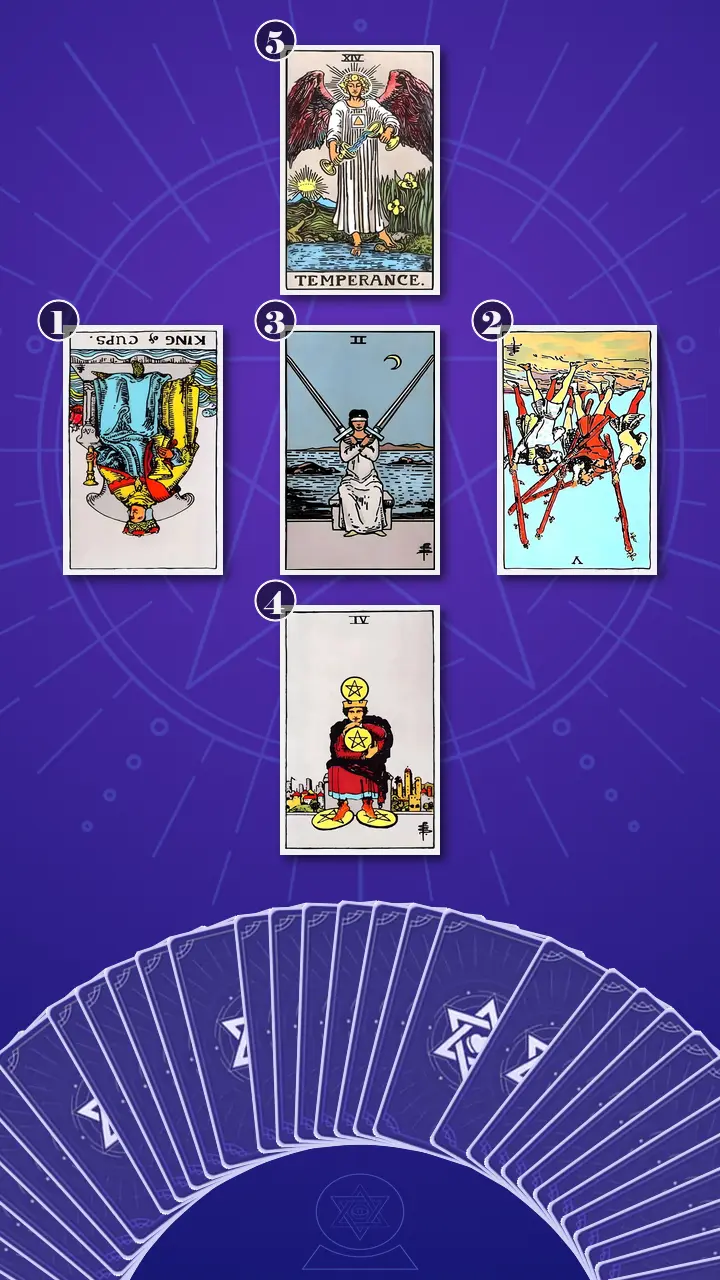
Reading the Map Beneath “It’s Fine”
The Calm Tone That Erases the Feeling
I turned over position one, the card that reveals Maya’s contribution to the presenting problem, specifically how emotional composure becomes the observable behaviour of saying she is fine and withholding anger.
The card was the King of Cups, in reversed position.
In the Rider-Waite-Smith image, the King holds his cup steadily while rough water moves around his throne. Reversed, the emotional regulation is blocked or overcontrolled. Maya’s modern version was the kitchen at 10:45 p.m.: “No, I’m just tired,” an open delivery app, and the anger removed from the conversation before she had identified what it was asking for. Later, her clipped answers or sudden distance carried the feeling her composed sentence had concealed.
I told her, “The calm tone is not the problem. The question is whether the tone is carrying the truth or replacing it. Regulation can help a feeling arrive safely. Overcontrol edits the feeling out so completely that the other person receives no clear incident, need, or request.”
This was where I used my Communication Dissonance Audit. I do not audit an argument by deciding which words sound more reasonable. I listen for a mismatch between emotional tempo and frequency. Maya’s sentence was playing at a careful sixty beats per minute, but her jaw, folded arms, and later withdrawal were holding a much higher note. The dissonance did not prove that she was wrong. It showed that her words and her body were transmitting different information.
I asked her to try the inner sequence aloud: “I notice I’m angry. I edit the anger out. I call the edited version maturity.”
Her breath stopped first. Then her fingertip hovered over the rim of her mug as if she had forgotten what she meant to do. Finally, she gave a short, bitter laugh and looked down at the King. “That is too accurate,” she said. “Almost mean.”
“It is not a judgment,” I said. “It is a pattern with a cost. You are not responsible for the whole dynamic, but you are allowed to notice the part your calm is playing.”
Maya touched her jaw and slowly released it. The first card had not asked her to become louder or more confrontational. It had shown her the difference between sounding composed and communicating clearly. Calm is a tone. Peace is a process.
The Joke That Closes the Comment Thread
I moved to position two, which examines Maya’s perception of the other person’s observable response to tension, such as joking, going quiet, or changing the subject. I repeated that this position could describe behaviour Maya experienced without claiming to know what her partner secretly thought or intended.
The card was the Five of Wands, in reversed position.
The five raised staffs in the image cross without a shared direction. Reversed, the visible contest loses volume, but the competing positions have not found a structure. I connected it to a scene Maya had described: she began to mention a changed weekend plan, her partner looked away, made a joke, and started loading the dishwasher. Maya immediately said it was not a big deal and helped with the plates. The room became quieter, but the different needs had only moved out of view.
I said, “I can work with what you saw: a joke, a look away, a brief answer, a practical task. I cannot use this card to declare why your partner did it. Your next move is to describe the shift and ask what is possible, rather than treating reduced intensity as proof that the issue has disappeared.”
Here, reversed fire represented conflict pushed inward. Maya’s overcorrection was to reassure quickly, agree too soon, or make the concern smaller so the other person would not have to respond. The immediate relief was real, but it taught both people that discomfort ended the discussion. An argument avoided is not a need resolved.
I watched Maya nod, then pause with her hand halfway to her phone. She said, “When they look uncomfortable, I think, ‘They look uncomfortable. I should make this easier. Maybe the problem has disappeared.’”
“That sequence gives you useful information,” I said. “You notice a behaviour, then you take responsibility for lowering the room’s temperature, then you mistake the lower temperature for resolution. Curiosity can interrupt that middle step. You can ask, ‘Do you want a short pause or do you want to keep talking?’ without deciding what the other person feels.”
She set the phone face down. Her shoulders remained lifted, but her attention had shifted from interpreting a hidden motive to naming what could actually be seen. That was a small movement from self-blame toward shared observation.
The Highlighted Sentence Nobody Edits
At the centre, I turned over position three, the card that shows the shared relational pattern created when both people prioritise the absence of visible conflict. It would reveal the knot between surface peace and unresolved anger.
The card was the Two of Swords, in upright position.
The blindfold, the crossed swords over the heart, and the calm water behind the seated figure make the cost of stillness visible. Awareness is restricted so the defensive equilibrium can continue. I connected it to the evening after the kitchen exchange: Maya and her partner eat, choose a show, discuss tomorrow’s schedules, and become careful with tone and touch. The routine resumes, but neither person has relaxed into genuine connection.
I compared it to two people editing around the same highlighted sentence in a shared document. The file stays open, the comment thread remains technically available, and everyone can see the highlighted line, but nobody touches it. In Maya’s relationship, normal routines became cover for the unresolved comment.
“This is the catalyst card,” I said. “Not because it predicts a dramatic event, but because it lets you recognise that stillness is a defended stalemate. You both know something remains active, neither names it, and the ordinary evening becomes evidence that everything is fine.”
Silence can stop a fight without ending the tension.
Maya went completely quiet. Her thumb stopped moving against the edge of her phone, her eyes lost focus, and I could see her mentally replaying an evening that had continued normally after an unfinished exchange. Then she breathed out and said, “We both know. Neither names it. Normal routines become cover.”
I asked her to notice the difference between a ceasefire and repair. A ceasefire may be valuable when two people need time to settle. Repair requires some later movement toward the highlighted sentence. The Two of Swords did not demand that Maya force an immediate conversation. It asked her to stop calling defended stillness proof of resolution.
The Pentacle Held Against the Heart
Below the centre, I turned over position four, the card that identifies the central challenge and deeper fear maintaining the pattern, especially the attempt to preserve belonging and control by holding difficult feelings tightly.
The card was the Four of Pentacles, in upright position.
The Rider-Waite-Smith figure presses one pentacle against his chest and pins two beneath his feet. Protection has become a grip so tight that movement is restricted. I asked Maya to imagine herself on the sofa with her phone locked in both hands, wanting to say, “I felt dismissed when our plan changed and you did not check in,” while also imagining the conversation escalating inside a small apartment with nowhere private to decompress.
“The fear beneath the silence may sound like this,” I said. “If I loosen my grip, this could become a fight. If I keep my grip, I remain connected. Why do I still feel alone?”
I was careful with the language. The card could show Maya’s fear of rejection, loss of control, disrupted routine, or threatened belonging. It could not tell me that her partner would reject her. High rent, overlapping work schedules, and limited private space can make relational tension feel materially bigger, but that context does not mean Maya has to tolerate intimidation, insults, pressure, or an unsafe conversation.
The Four of Pentacles showed me the primary blockage: Maya was holding both the relationship and the grievance as tightly as the figure held the coin. She was protecting belonging through silence while losing access to the reciprocal closeness she wanted. Control gave her short-term stability, then made honest repair harder to reach.
For a moment, I saw her hand tighten around the phone. Her breath caught in her throat, and her chest rose without completing the inhale. Her eyes moved from the card to the locked screen as if a private list of old moments had appeared there. Then her fingers loosened, and a long exhale left her body.
“Your anger does not have to drive the conversation to be allowed in the room,” I said. “It can carry information about hurt, a boundary, or a need. You do not have to unload every receipt from the private spreadsheet, and you do not have to delete the spreadsheet before asking what one entry means.”
Maya gave a small, unsteady smile. “I keep waiting until I can prove the feeling is important enough,” she said. “Then it comes out over a mug.”
“That is the containment loop,” I said. “Avoidance gives you relief, relief lets resentment accumulate, the resentment finds a minor trigger, and the sharp reaction seems to prove that anger is dangerous. The way out is not perfect calm. It is a smaller, clearer path for one piece of information to move.”
When Temperance Let Anger Carry Its Information
The Antidote Is a Measured Exchange
The room changed when I placed the final card above the centre. The refrigerator cycled off, and for a few seconds the apartment became so quiet that Maya and I could hear the faint traffic below the window. I turned over position five, the card that offers a self-directed growth resource for replacing suppression with measured honesty, clear requests, and a repeatable process of repair.
The card was Temperance, in upright position.
Water moves visibly between two cups in the image. One foot rests on land and the other in water, while a path leads toward a bright horizon. This is not a sealed surface pretending to be calm. It is deliberate circulation between feeling and grounded action. Temperance represents the antidote: regulated honesty, patience, emotional integration, and reciprocal communication.
I connected the card to a possible sentence before another tense evening hardened into silence: “When our plan changed without a check-in, I felt dismissed. Could we message each other before changing shared plans?” The sentence names one observable incident, one feeling, and one workable request. It does not present the entire history of the relationship, accuse the other person of a motive, or demand immediate resolution.
At this point I used my signature Reactive De-escalation Mapping. I do not use it to label a villain. I map the specific high notes that can shatter emotional safety: a voice becoming sharp, a sarcastic line, a rushed explanation, a topic change, or the flatness of “I’m fine” when the body is braced. The map shows where the emotional BPM rises and where both people need enough space to hear what is being said.
That led naturally to my Syncopation Pause, a three-second acoustic grounding technique. When the exchange begins to escalate, Maya can stop, feel both feet, allow three seconds of silence, and lower the emotional BPM before choosing whether to continue. The pause is not disappearance, punishment, forced disclosure, or an indefinite delay. It works only when both people can agree on whether and when they will return, and only when the conversation is safe enough to have.
I wrote the key-card hook in my notes: Silence is not balance; practise one measured exchange at a time, like Temperance pouring water between two cups.
At 10:45 p.m., the delivery app is open, dinner options blur past, and both of you have said you are fine. The kitchen is quiet, but your jaw is tight and the unfinished conversation is still setting the temperature.
“Peace is not a room where anger never speaks. It is a relationship where anger can deliver its information without being mistaken for the end of belonging.”
Maya’s face went still. First, her breath paused mid-inhale and her eyes widened slightly. Then her focus drifted past the cards, as if she were replaying the kitchen, the sofa, and the many ordinary evenings that had continued without repair. Finally, her shoulders lowered by a fraction, her clenched fingers opened, and a shaky breath moved all the way out of her chest. Her first response was not relief. “But does that mean I was wrong to call it peace?” she asked, with a flash of irritation beneath the fear.
“It means the word was doing too much work,” I said. “You were naming immediate quiet. You were longing for a relationship that could survive honest information.” Her mouth trembled, then settled. She looked at Temperance again, this time at the water moving between the cups, and whispered, “I don’t have to unload everything. I don’t have to erase everything. I can carry one honest piece across.”
Now I asked her to use this new perspective to remember whether there was a moment last week when this distinction might have made the evening feel different. I offered a private note rather than a performance: up to ten minutes, three lines, and fewer than forty words if possible. “When one observable incident happened, I felt one feeling. What I would like is one workable request.” It could remain unsent. Measured honesty belongs only in conversations where Maya feels emotionally and physically safe.
This was the first step in the emotional transformation from guarded resentment and a defended ceasefire toward regulated honesty, reciprocal communication, and repair-based trust. The cards had not removed uncertainty. They had made one honest movement possible without asking her to surrender autonomy.
From a Defended Ceasefire to Actionable Advice
I read the five cards as one sequence rather than five isolated answers. The reversed King of Cups showed Maya editing emotion out of polished language. The reversed Five of Wands showed visible friction redirected into jokes, chores, or quiet. The Two of Swords showed the shared ceasefire that formed when both people resumed normal routines around the same highlighted sentence. The Four of Pentacles revealed the fear beneath the grip: if anger enters the room, belonging might become uncertain. Temperance offered a different structure, where anger could be translated and exchanged without becoming the driver of the conversation.
The core metaphor was simple: it was like placing a lid on a boiling pot and calling the kitchen quiet. The lid can prevent an immediate spill, but it does not remove the heat. In Maya’s case, the blind spot was mistaking reduced intensity for resolution and mistaking the fear of escalation for evidence that every honest sentence would cause escalation. The key shift was to replace “it’s fine” with one specific feeling, one observable incident, and one workable request before taking a mutually agreed pause.
I told Maya, “These are experiments, not tests of whether you are a good partner. You are the person who decides what is safe, what is fair, and what you will do if a need cannot be met. Tarot can help you see the pattern. You still choose the boundary, the timing, and the next action.”
- Draft one honest pieceBefore one conversation this week, open Apple Notes and choose one recent changed plan or unfinished chore. Spend up to ten minutes writing, “When [observable incident] happened, I felt [one feeling]. Could we [one workable request]?” Keep the first version under forty words, read it aloud once in private, and remove explanations that hide the feeling.If the whole history rushes in, use the minimum version: one incident, one feeling, one request. The note does not have to be sent or spoken today.
- Use the Syncopation PauseThe next time the topic changes, someone becomes quiet, or the emotional tempo rises, say, “I noticed we moved away from what we were discussing. Do you want a short pause or do you want to keep talking?” If both people choose a pause, agree on a realistic return point, such as after dinner or tomorrow morning, and use three quiet seconds to ground before deciding what comes next.A pause needs a named return, but it is not a demand for immediate disclosure. If no return time can be agreed, state one self-directed boundary: “I’m going to stop for tonight, and I’ll check in once tomorrow about when we can revisit it.”
- Run a two-minute surface-calm auditAfter one tense interaction, sit at the kitchen table and set a two-minute timer. Notice one cue from your jaw, throat, breathing, chest, or shoulders. Write two separate lines: “What I observed was…” and “The story I started telling myself was…” Then circle one feeling word, such as angry, hurt, disappointed, dismissed, or afraid.The purpose is information gathering, not proving that anyone was wrong. If body attention feels uncomfortable, write only the observable event and return to the exercise later if you choose.
That was my actionable advice: small enough to begin, bounded enough to stop, and specific enough to reveal whether the relationship can make room for reciprocal communication. A five-card Relationship Tarot Spread for conflict avoidance and unresolved anger cannot guarantee repair. It can help someone move from emotional overcontrol to a measured exchange, where the response from the other person becomes information rather than a verdict on their worth.

The First Clear Sentence
Five days later, I received a message from Maya while she was sitting alone in a café. “I wrote the three lines and asked for twenty minutes tonight.” She had slept better, though she still woke wondering whether she had made things worse. She took one breath, used the pause, and kept the appointment.
I did not read that message as proof that the relationship was fixed. I read it as the first small evidence that she could survive a bounded disagreement without abandoning herself. The cards had offered images, but Maya had supplied the courage, the limits, and the language. Her journey from guarded resentment to regulated honesty had begun with a sentence small enough to hold.
When both of you say “it’s fine” and the room goes quiet, your jaw may still be locked because one part of you wants closeness while another is bracing for honesty to cost you belonging. Noticing that split is not failure. It is the moment the hidden information becomes available.
If one honest sentence could be held without solving everything tonight, what feeling, moment, and small request would you want it to carry?