Calling Coworkers Dramatic: Separate the Tone From the Message

When Suppressing Anger at Work Turns Into “They’re Dramatic”
If you coordinate deadlines on a hybrid Toronto team, keep saying “all good” when the scope changes, and then feel your jaw clench when a coworker says, “I am frustrated,” you may recognize the workplace conflict avoidance trap: the calmest person in the room is not always the least angry.
At 6:20 p.m., our video call connected, and I saw Maya sitting motionless in her Toronto apartment. One hand circled a cold mug while her warm laptop hummed beside it. Condensation chilled her fingers; the screen cast a pale rectangle across her locked jaw and lifted shoulders.
She had just left a tense project meeting. “I’m not angry,” she said, then glanced toward a private Slack chat where she had typed, “That was so dramatic.” She had deleted it, rewritten it, and spent ten minutes polishing a follow-up until every trace of her own disagreement had disappeared.
I watched her press her tongue against the inside of her cheek. The anger in her body felt like steam being forced back under a clamped lid, while every professionally neutral sentence tightened the seal. She wanted to remain composed, but she also feared that acknowledging her anger would make her no different from the coworker she had judged.
“The role of the reasonable one has protected your credibility,” I told her. “I’m not here to take that away or to excuse anyone’s hostility. I want to help you see what that role is costing you. Let’s give this fog a map and find out what your anger has been trying to say.”

Choosing the Cross Beneath the Calm
I invited Maya to place both feet on the floor and take one slower breath than usual. I shuffled while she held the meeting in mind. I treat this preparation as a transition into focused reflection, not as a mystical test she could pass or fail.
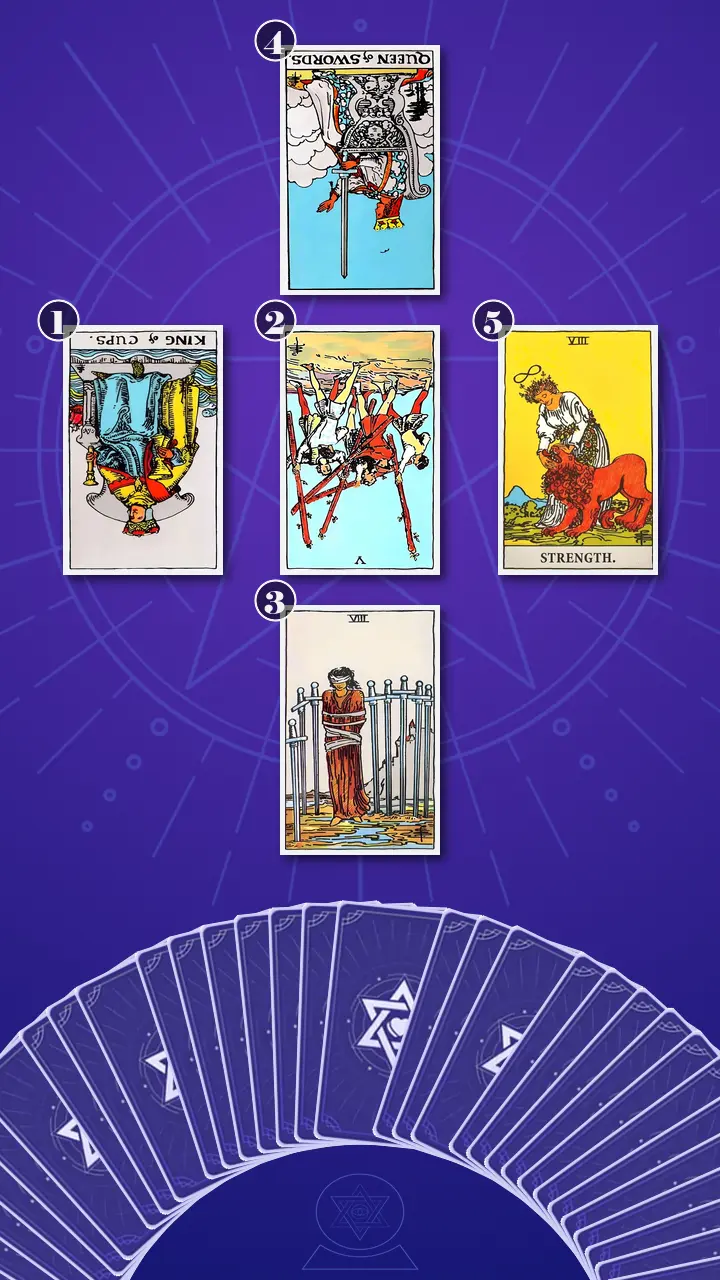
I chose The Shadow Spread, a five-card RWS tarot spread for examining suppressed anger, conflict avoidance, projection, underlying fear, and emotional integration. This is how tarot works in my practice: it does not declare a hidden fate. It gives us structured positions through which sensations, beliefs, and observable facts can be compared without letting the loudest thought dominate.
The spread suited Maya’s question because it followed the entire mechanism with no unnecessary detour. The first position would show the controlled response visible in meetings. The center would reveal the anger and directness she had excluded from her professional identity. The card below would uncover the fear holding that exclusion in place; the card above would show how the fear became a judgment of other people. The final card would offer an integration practice.
I arranged the cards as a cross: one card to the left of the central shadow, one beneath it, one above it, and one to the right. The shape let me trace two stories at once. Horizontally, I could follow Maya from emotional control toward integration. Vertically, I could dive beneath the word “dramatic” and return with a more precise understanding of what it had been covering.
Reading the Waves Above the Meeting
Position One: The Calm Face Above the Water
I began with the card representing Maya’s current trigger and observable response: maintaining controlled composure when a coworker showed anger, then treating that visible emotion as the central problem. I turned over the King of Cups, reversed.
The king sat above an active sea, holding his cup and sceptre while a ship and fish moved through the waves behind him. I pointed to the visual distance between the composed figure and the turbulent water. It mirrored Maya’s video-call presence: a measured voice above the surface, heat and pressure moving underneath.
In the card meaning in context, Maya stayed calm after a deadline changed, said “No worries,” and kept one hand around her mug while her jaw tightened. When a coworker said, “This is ridiculous,” the visible anger felt disproportionately provocative because it exposed the feeling Maya was working not to reveal. Later, she called the coworker dramatic and edited that same frustration out of her own follow-up.
I read the reversed Water as a blockage intensified by excess control. Emotional regulation had hardened into emotional suppression. Her calm presentation brought immediate relief, but the deficient contact with her own anger left the feeling free to influence her judgment from below awareness.
“What are you working so hard not to reveal when you become the unshakable professional?” I asked.
Maya gave a short laugh with no lightness in it. “That’s so accurate it feels a little brutal.” Her fingers rubbed the wet ring beneath the mug. I told her accuracy was not an accusation. The card was describing a strategy that had once felt protective, not issuing a verdict about her character. Composure is not proof that anger is absent.
Position Two: The Argument Moved Into Drafts
I moved to the card representing the anger, directness, and appetite for disagreement Maya had suppressed and struggled to recognize as her own. At the center of the spread, I revealed the Five of Wands, reversed.
The five staffs crossed without a shared direction. Reversed, the noisy clash had not been resolved; it had simply moved out of the shared room. I connected it to the moment Maya said, “That works for me,” while five objections kept colliding in her mind. The disagreement continued in an unsent Slack draft, on the TTC ride home, and in resentment toward the teammate who had voiced the practical problem aloud.
The Fire here showed deficiency in outward participation and excess in private friction. Maya was not eliminating conflict by withholding her view. She was removing useful information from the team’s discussion while keeping the full argument active inside her body.
“What was the smallest disagreement you could have stated before the meeting ended?” I asked.
Her shoulders rose before she answered. “The deadline could stay, or the added scope could stay, but not both.” She paused and looked at the card. “I thought that. I just didn’t say it.”
I noticed her hand loosen around the mug. The direct sentence had not caused an explosion. It had merely placed her actual position among the competing priorities, where her colleagues could have responded to it.
The Slack Status With No Middle Setting
Position Three: The Rule Beneath the Silence
I turned next to the card representing the root fear: the belief that expressing anger would mean losing control and becoming the kind of person Maya judged. The card was the Eight of Swords, upright.
I drew her attention to the blindfold, the loose bindings, and the incomplete enclosure of swords. The figure’s restriction felt absolute, but the image contained open ground. Maya’s professional rule operated in the same way: if she said, “I am angry about this change,” colleagues would supposedly stop seeing her as competent, credible, or in control.
I described the belief as a two-state Slack status. One option was green: available, agreeable, perfectly composed. The other was a flashing red alert: an outburst impossible to take back. Her mind had not created a status for calm, direct frustration, so she remained blind to the middle ground of naming a problem and making a bounded request.
The Air energy was in blockage. Thought, which could have helped her distinguish several response options, had instead constructed a rigid binary: “If I admit I am angry, I lose control; if I stay quiet, I am safe.” The incomplete ring of swords interrupted that rule. Silence preserved an image of safety, but it did not resolve the workload conflict or release the pressure behind her sternum.
Maya’s breath paused. Her thumbnail stopped pressing into the mug; her gaze drifted beyond my screen as though a recent meeting had started replaying there. Then she released a long breath and said, “I honestly thought those were the only two options.”
“That belief may have felt necessary,” I said, “especially if you have seen visible emotion used against people at work. But acknowledging anger does not require disclosing more than you choose, and it never requires staying in a hostile exchange. The open ground on this card is simply another option: a factual sentence, a boundary, a pause, documentation, or support through the appropriate workplace process.”
Position Four: The Sword That Became a Label
I moved upward to the card representing projection: the way Maya’s suppressed anger emerged through the label “dramatic,” allowing a coworker’s delivery to eclipse both the message and Maya’s unmet need. I revealed the Queen of Swords, reversed.
The Queen’s sword is designed to clarify and separate. Reversed, that precision can become a cutting verdict that ends inquiry. I returned to Maya’s private Slack recap. She had repeated the coworker’s sharpest phrase while leaving out the fact that the launch date had moved twice and the workload concern was real.
The modern-life scenario was exact: Maya focused on a raised voice, quoted it as evidence of poor character, and called the conclusion objective. The label relocated her own matching irritation into the coworker. It also protected her from asking what boundary she wanted to set around the project decision.
I read the Queen’s Air as an excess of analysis stripped of balanced discernment. Maya’s attention became highly precise about volume, facial expression, and wording, but deficient in curiosity about content, context, and her own body. The word “dramatic” closed the case before she checked what the anger was carrying.
“Their delivery was hard to hear, and their concern may still be real,” I said. “Try keeping three questions separate: What did they say? How did they say it? What do I need to say? You can question the delivery without deleting the message.”
Maya’s expression tightened. “But she was rude. I don’t want this to turn into me defending her.”
“It doesn’t,” I replied. “Separating content from delivery is not agreement, and it is not permission for hostility, harassment, or intimidation. It lets you preserve two facts at once: the concern may be valid, and the behavior may require a boundary. Precision is more protective than a blanket verdict because it tells you what action belongs to each part.”
Her lips pressed together, then softened. She looked back at the private message and quietly closed the chat without sending it. I saw the catalyst in that pause: judgment had not vanished, but inquiry had reopened.
When Strength Put a Hand on the Lion
Position Five: The Anger That Could Speak Without Attacking
I came to the card representing Maya’s integration practice: meeting anger with compassionate attention, translating it into a clear request or boundary, and retaining discernment about inappropriate conduct. Before I turned it, the laptop fan stopped. The Toronto evening pressed a blue reflection against her window, and the room became unusually still.
The final card was Strength, upright.
I showed Maya the figure’s gentle hands meeting the lion at close range. This was not domination, banishment, or emotional muting. It was conscious contact with instinct. In practical terms, it looked like noticing the heat rise, letting the words “I am frustrated” register internally, and saying, “I am frustrated that the scope changed after sign-off, and I need us to decide what moves.”
Strength restored balance between feeling and choice. Anger could provide energy and information without taking control of the interaction. Maya could question a coworker’s delivery, decline hostile treatment, and still use her own irritation to locate the crossed boundary. Her authority no longer had to depend on appearing calmer than everyone else.
At that moment, I thought of one of my signature diagnostic tools. In career readings, I use Career Cycle Phase Identification to distinguish a personal skill gap from an industry-wide contraction. I applied the same split here: was Maya’s heat evidence that she lacked emotional control, or was it partly a rational response to a team absorbing repeated scope changes?
The facts allowed two truths. The organization was creating real strain, and Maya’s communication habit was keeping her needs out of the discussion. She did not have to take personal responsibility for fixing the whole system. Strength identified her controllable lever: stop treating the dashboard warning as a character flaw, read the signal, and translate it into one bounded request.
I could see Maya still searching for a version of the reading in which being calm meant being innocent. The old equation remained: if anger entered her voice, credibility left the room; if she stayed silent, she could still be the reasonable one.
Composure is not the absence of anger; give anger a clear, bounded voice through the same gentle contact Strength brings to the lion.
I let the sentence remain between us without rushing to explain it.
Her inhalation stopped halfway. Her fingers hovered over the cold mug, then tightened around it as if the sentence had changed its weight. For several seconds, her gaze left the card and fixed on the dark square of the meeting window, replaying something I could not see. Her pupils widened; her jaw shifted once. Then her grip released, and her shoulders dropped in two uneven stages. Her eyes brightened, but relief did not arrive cleanly. “But doesn’t that mean I was wrong about all those meetings?” she asked, irritation sharpening the first words before her voice thinned. “Like I made it worse by being the reasonable one?” I told her that protection can outlive its usefulness without making the person who used it foolish. The point was not to excuse her coworker’s raised voice or blame Maya for the team’s strain. The point was to recover the information her own anger carried. She exhaled from deep in her chest, almost a laugh, then looked briefly unsteady in the new responsibility of having a choice. I asked, “Now, with this new perspective, was there a moment last week when this insight could have made you feel different?”
She returned to a launch meeting where she had agreed to another priority shift. “I would still have hated her tone,” she said. “But I might have noticed that I agreed with the actual complaint. I could have said the new task needed an owner instead of deciding she was the whole problem.”
I set a 90-second timer and asked her to write one private sentence. She did not have to send it. If the exercise became too intense, or if the interaction involved unsafe conduct, she could stop and choose documentation or workplace support instead. As she typed, I saw her jaw tighten, her shoulders lift, and then her breathing deepen.
She read the sentence once: “I am frustrated that the scope changed after sign-off, and I need us to decide which deliverable moves.”
That was the pivotal movement of the reading: from credibility-protecting emotional suppression and projection to compassionate, boundary-aware assertiveness. It did not make Maya certain or permanently comfortable. It gave her a first experience of anger as information rather than evidence of bad character.
The Boundary Hidden Inside the Heat
I gathered the spread into one coherent orbit. Maya had built credibility by being steady and easy to work with, so the reversed King preserved that identity through distance from emotion. The reversed Five of Wands moved every disagreement into drafts and private rehearsals. The Eight of Swords supplied the restrictive rule that anger meant lost control. The reversed Queen converted that internal prohibition into a verdict about coworkers. Strength offered the unused resource: embodied courage precise enough to hold feeling, message, delivery, and boundary apart.
After years of looking at human lives through cycles and planetary movement, I have learned that repetition is not fate. An orbit is a relationship between forces. Change one meaningful response, and the trajectory begins to change. Maya’s cognitive blind spot was equating visible calm with successful regulation and the absence of open conflict with resolution. Her transformation direction was therefore specific: pause before labeling, name her own irritation, and make one request before evaluating the other person’s delivery.
I adapted my Micro-Orbit Observation, normally a 30-day strategy for noticing subtle organizational blueshifts and redshifts, into a light evidence-gathering practice. A blueshift might be a manager responding constructively when Maya named a tradeoff. A redshift might be repeated scope changes without consultation or a pattern of clear boundaries being ignored. I stressed that this was not a prediction of layoffs or conflict. It was a way to distinguish personal communication habits from organizational conditions using observable evidence.
The Two-Minute Micro-Orbit
- The 90-Second Strength SentenceWithin 10 minutes after one tense meeting this week, put both feet on the floor and write three private lines: “I notice...” for the body sensation, “I am frustrated about...” for the specific event, and “I need...” for one request or limit. Underline the concrete event and remove any character judgment. Keep the note unsent unless you genuinely choose to use it.Tip: If the exercise feels embarrassing or dramatic, write only the first line. If the exchange involved hostility, pause, document what occurred, leave the call when appropriate, or use established workplace support.
- The Content-Delivery SplitAfter the next tense interaction, open a three-minute phone note titled “What was said,” “How it was delivered,” and “What I need.” Add one factual sentence under each heading. Circle one valid concern in the first section and one boundary around the delivery in the second. Before a relevant deadline or scope meeting, rehearse the request from the third section once.Tip: Separating the message from the delivery does not defend rudeness. Use the one-entry version first, and keep the sentence as a draft if speaking it aloud feels premature.
I asked Maya to repeat the observation only after a genuinely tense interaction, not to monitor herself all day. The practice needed to create usable evidence, not another standard of perfect self-control. Small steps mattered because the missing Earth energy in the spread called for repeatable behavior rather than more analysis.

A Week Later, One Sentence Stayed in the Room
Six days later, Maya sent me a brief message. In a planning call, the launch scope had shifted again. She felt the familiar pressure behind her sternum, but before judging the coworker who objected sharply, she looked at the sentence in her Notes app.
She said, “I am frustrated that the scope changed after sign-off, and I need us to decide which deliverable moves.” Then she stopped talking long enough for the team to respond. Her manager moved a reporting task to the following week. The coworker’s tone did not suddenly become warm, and Maya did not pretend it had. She recorded the valid workload concern and kept a separate boundary around how she wanted disagreements handled.
She told me she slept through that night. Her first thought the next morning was, “Was that too much?” This time, she noticed the question, smiled once, and opened her calendar.
That was the quiet proof I wanted from this Journey to Clarity. The Shadow Spread had not predicted a better meeting or handed Maya emotional mastery. It had made the orbit visible. Maya changed the trajectory by speaking one bounded sentence, and the agency belonged to her.
If you also keep your jaw tight and your voice flat so nobody can call you dramatic, it may feel safer to place the anger on the coworker who shows it. That calm persona may protect your credibility while leaving your own boundary unspoken. Simply noticing that exchange means you are no longer standing at the exact beginning of it.
If the heat in your jaw entered your Micro-Orbit as information instead of a verdict, what one small, bounded sentence about what you need would you be willing to hear from yourself?