The 10:42 p.m. Relationship Timeline Spiral
I often meet the sharpest form of relationship milestone anxiety in people who can build a six-month product roadmap at work but find that one “I'm not ready yet” sends them searching for an answer no dashboard can provide. When Maya, a 29-year-old product designer in Toronto, appeared on my screen, I recognized that split immediately.
It was 10:42 on a Tuesday night. She stood in her condo kitchen with cold peppermint tea leaving a bitter taste in her mouth, the refrigerator humming behind her, and her phone warming her palm. Her thumb hovered over a third draft of the same follow-up message: “Can you at least tell me whether we're talking months or years?”
“I keep asking for clarity and somehow end up feeling less clear,” she said. “I don't need a perfect plan. I just need to know we're going somewhere. If we both want this, why do I have to keep asking?”
She wanted a move-in conversation because a shared home would mean direction, commitment, and proof that she was not investing in a future alone. Her partner had said they were not ready. In the absence of a date, Maya's body had begun supplying its own verdict: her chest felt cinched by an invisible drawstring, her fingers could not settle, and every quiet gap in the conversation seemed to tighten the cord another inch.
I could also hear the resentment beneath the urgency and the longing beneath the resentment. The more uncertain she felt, the more precisely she asked. The more she asked, the more pressure entered the exchange, until it became difficult to tell whether she was hearing her partner's actual capacity or the defensive response to being pushed.
“Wanting commitment is not the problem,” I told her. “Your need for direction is real. A deadline is only one way you have tried to meet it. I am not going to tell you to wait forever, and I will not use the cards to pretend I know what your partner secretly thinks. I want us to map what happens between the words 'not yet' and the moment your hand reaches for the phone. That is where we may find the clarity you can actually use.”

Choosing the Bridge: A Five-Card Relationship Spread
I invited Maya to place her phone face down, feel both feet against the kitchen floor, and take three unforced breaths. I shuffled slowly while she held one question in mind: “Why do I keep pushing milestones when my partner isn't ready?” The pause was not a mystical performance. It was a practical transition from reacting to observing.
I chose a five-position Relationship Spread. For me, this is how tarot works at its clearest: not as a device for predicting whether a couple will move in or get engaged, but as a structured mirror that makes a repeating pattern visible enough to examine. A broader Celtic Cross might have pulled us into distant outcomes and unrelated influences. This relationship tarot spread stayed with the interaction Maya could observe and the choices she could make.
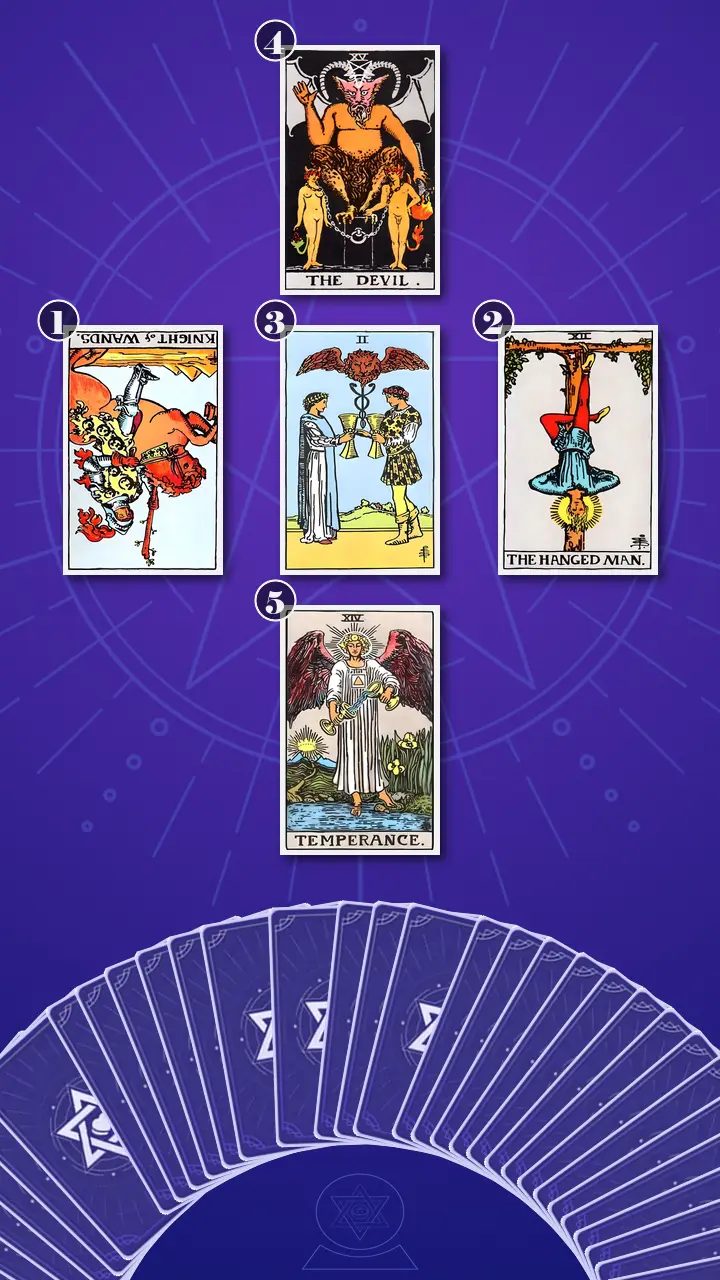
The first position would show Maya's current stance and the need driving her urgency. The second would hold her partner's expressed pace, limited to what had actually been communicated rather than any claim about private motives. The centre card would reveal the relational field created when those two speeds met. Above it, a fourth card would expose the hidden security bind. Below, the fifth would become a grounded bridge into self-directed action.
I placed the cards in a cross. Maya's urgency sat on the left, the pace she was encountering on the right, and the relationship itself between them. The underlying pressure rested above the centre. The integrating card waited below, like a path returning the entire reading to the ground. The arrangement looked less like a verdict than a small bridge: two sides, one shared span, and a pressure point that could not be repaired by forcing either bank to move.
When Fire Met a Held Signal
Position 1: The Message Already Being Drafted
“The card I am turning now represents your current self-position, including how milestone-pushing appears and what need is driving it,” I said. I revealed the Knight of Wands, reversed.
The image showed a rider leaning forward while the horse reared beneath him. In context, it was Maya at the end of an emotionally charged conversation: she had asked about moving in, received no firm timeline, and begun planning how to raise it again before the previous answer had settled. By the time she reached for her phone, her chest was tight and her Notes app held three versions of the same question.
The Knight's fire was not deficient. Maya had desire, courage, and a legitimate wish for movement. The difficulty was excess and blockage: the energy surged ahead, but mutual readiness did not move with it. Another question released some urgency for a moment, much as pressing refresh can make a frozen delivery tracker feel active, but it could not alter the conditions on the shared road.
I asked her to listen to the loop beneath the behaviour. “If I do not bring it up again, then nothing will happen and I may waste years. But every time I bring it up, we become more defensive and I learn less.” Her impulse produced movement, but movement was being mistaken for information.
Her breathing stopped for a beat. Her gaze slipped away from the card as though she were replaying the last conversation, and then a small, bitter laugh escaped her.
“That is so accurate it feels a little brutal,” she said. “I had the next message drafted while we were still sitting on the sofa.”
“Then let us treat the card as a frame from the sequence, not an indictment of you,” I replied. “The Knight is showing us a strategy your nervous system learned because action feels safer than uncertainty. We can respect the need without letting the first surge write the whole conversation.”
Position 2: What the Words 'Not Yet' Actually Contain
“The card I am turning now represents the pace difference: the unreadiness your partner has expressed and the boundary available for you to hear,” I said. It was The Hanged Man, upright.
I was careful with this position. I could not use it to announce why Maya's partner was waiting or what they would eventually choose. The card gave us a way to examine Maya's encounter with suspension. The upside-down figure was still, but the halo suggested that stillness could change perception rather than erase agency.
In daily life, this was the moment Maya heard “I am not ready to move in yet” and resisted the immediate follow-up text. Instead, she could write the exact words in one column and her predictions about rejection, wasted time, or permanent stagnation in another. The pause would remain uncomfortable, but it would let her see that an expressed boundary, a feared future, and a judgment about her worth were three separate pieces of information.
The Hanged Man carried balanced suspension. It did not ask Maya to become passive, minimize the stakes, or remain in limbo without a personal limit. It asked her to stop filling every silence before the silence had yielded its information. Waiting is information; it is not automatically a rejection.
“When your partner last said they were not ready, what did your mind translate that into before the conversation was over?” I asked.
Maya rubbed her thumb along the cold rim of her mug. “That they probably never would be. That everyone else had somehow chosen properly and I hadn't. That if I didn't push, I was agreeing to lose time.”
“That is the tension pair,” I said, indicating the Knight and the suspended figure. “One part of you accelerates because the pause feels dangerous. The pause then becomes harder to read because it is surrounded by pressure. Pressure can produce an answer without producing mutuality.”
Two Cups at the Same Height
Position 3: The Relationship Between the Two Speeds
“The card I am turning now represents the relational field, the pattern created between you when urgency meets unreadiness,” I said. The Two of Cups appeared upright at the centre.
I drew Maya's attention to the two cups held at equal height. Neither vessel was raised as the correct one. In context, the card looked like two people sitting down at a mutually chosen time and each answering three questions: “What does commitment mean to me? What can I honestly offer now? What can I not promise yet?” Neither answer had to erase the other.
The Two of Cups brought balanced water into the spread. It showed the potential resource of reciprocal disclosure, accurate listening, and emotional recognition. It did not promise agreement, and it certainly did not guarantee a move-in date. Its card meaning in context was more demanding than that: Maya would need to observe whether both people could participate truthfully when the desired answer was not assured.
“You have been testing reciprocity by asking whether your partner wants the same date,” I said. “What if reciprocity also means being equally truthful about different capacities? One person places, 'Here is what I want,' on the table. The other places, 'Here is what I can offer now.' Then both stay present long enough to hear what is actually there.”
Maya's shoulders lowered slightly. She looked from the two cups to the reversed Knight and exhaled through her nose.
“I thought mutual meant agreeing on the next step,” she said. “I haven't really been measuring whether we can talk honestly. I've been measuring whether I can get the right answer.”
I nodded. “Agreement is one possible outcome. Balanced participation is evidence you can examine even before agreement arrives. And if balanced participation is repeatedly absent, that is information too.”
The Loose Chain Behind the Deadline
Position 4: When a Milestone Becomes the Only Metric
“The card I am turning now represents the underlying bind, the fear that makes a milestone feel necessary as proof of safety,” I said. I revealed The Devil, upright.
I did not let the dramatic image carry us into fear. The Devil was not predicting a doomed relationship, exposing a villain, or shaming Maya for wanting commitment. I pointed instead to the loose chains around the figures' necks. The binding story was powerful, but it was visible and therefore available for examination.
In Maya's life, the story appeared after an Instagram engagement announcement. She would search average timelines, reread old messages, and tell herself that moving in or receiving a firm commitment would finally settle everything. When no date appeared, relief vanished and she felt compelled to reopen the subject. The legitimate desire was commitment. The excess was the authority granted to one future event, as though that event alone could certify that she was safe, valued, and not wasting her time.
The pattern resembled the pressure logic of The Ultimatum: a deadline promises a clean answer, while the pressure around it can make authentic readiness harder to distinguish. It also resembled a product dashboard ruled by one KPI. Once the milestone became the only metric that mattered, present affection, conflict repair, consistency, avoidance, honesty, and follow-through were all pushed below the fold.
I call this Social Clock Decoupling. I asked Maya to imagine removing her relationship from the public timeline generated by engagement carousels, apartment-key photos, Reddit averages, and age-based expectations. That social clock was crowd-sourced, algorithmically amplified, and incapable of evaluating the private quality of her relationship. Every anxious click trained her feed to show her more evidence that everyone else was ahead. Her personal algorithm then confused repetition with truth.
“Complete this sentence without editing it,” I said. “If we do not reach this milestone soon, it proves that I am...”
Her chest rose and held. Her fingers closed around her sleeves, then slowly released. Her eyes stayed on the loose chains when she answered.
“Not chosen,” she said quietly. “And maybe naive. I know moving in can't guarantee everything, but without it I feel like I'm auditioning for a future that might not exist.”
“I hear both truths,” I replied. “You are allowed to require direction before investing indefinitely. But a milestone cannot carry every question about your safety and worth without becoming a chain. The work is not to stop wanting it. The work is to decide what evidence you need, what limit belongs to you, and whether the relationship offers reciprocity in the present.”
When Temperance Slowed the Pour
Position 5: The Bridge That Does Not Erase Either Side
The refrigerator motor clicked off on Maya's side of the call just as I reached for the final card. The sudden quiet widened between us. “The card I am turning now represents the integrating next step, a self-directed way to communicate your needs, respect the pace you have heard, and test mutuality without forcing a result,” I said.
Temperance appeared upright.
The angel poured between two vessels, with one foot on land and the other in water. I read this as balanced, regulated energy: practical boundaries remained connected to emotional openness, and desire was not extinguished. It was given a pace the conversation could actually hold.
In daily life, Temperance looked like Maya naming one need for committed direction, asking what her partner could honestly discuss now, and stating the pace she could personally participate in without presenting it as a threat. She could then observe whether words, behaviour, and reciprocity aligned over time. Her need would remain intact. Her partner's boundary would remain audible. Her own future choices would remain available.
The image called up a principle from the Highland healing practice I inherited through seven generations. Across sixty-seven lived years, I have watched people exhaust themselves by demanding a spring harvest from soil still in winter dormancy. I call my way of reading that mismatch Seasonal Energy Diagnostics. The problem is not that spring is wrong or that longing for fruit is shameful. The exhaustion comes from digging up the same seed every night to check whether pressure has made it grow.
Yet winter is not an instruction to wait forever. A season has conditions, information, and an end. Maya did not have to rename permanent avoidance as patience. Temperance asked her to stop forcing a spring harvest for long enough to discover what season the relationship was honestly in, what care was actually occurring beneath the surface, and whether she still wished to cultivate that ground.
I brought her back to 10:42 p.m.: the fridge hum, the warm phone, and the message deleted twice. Her chest had insisted that one more timeline question might finally make the relationship solid, while another part of her already knew the same question was producing less usable information.
Milestones do not create safety by themselves; move from forcing a timeline to practicing mutual pacing, like Temperance blending two vessels without spilling either.
I left the sentence in the quiet for a moment. Then I added, “A milestone can mark commitment, but it cannot manufacture safety; safety becomes legible through honest needs, mutual pacing, and repeated evidence of reciprocity.”
Maya's breath stopped first. Her pupils widened, and the muscles beside her mouth held as though she were resisting an answer that had arrived too close to the bone. Her gaze lost focus while old conversations seemed to replay behind it. Then her eyes shone, her shoulders dropped by degrees, and the fist hidden inside one sleeve slowly opened. A trembling exhale followed, but relief was not the only feeling in it.
“But doesn't that mean I've been doing it wrong this whole time?” she asked, with a flash of anger that softened almost immediately into grief. “I was trying to protect myself.”
“You were,” I said. “We do not need to punish the strategy that helped you survive uncertainty. We only need to notice that it now creates the pressure you were trying to escape. Clearer choices bring responsibility, and that can feel exposed before it feels freeing.”
Her jaw loosened. She looked almost light-headed, as though setting down the demand for certainty had revealed how much open space she would now have to navigate herself.
“Now, with this new perspective, can you remember a moment last week when this insight might have made you feel different?” I asked.
She remembered a Sunday grocery run. She and her partner had been joking easily in the pasta aisle until she saw another couple comparing furniture measurements on a phone. Within seconds, the caring present had become evidence of an insufficient future.
“I could have noticed that I wanted direction without turning that couple into a deadline for us,” she said. “And I could still have asked myself how long I'm willing to stay unclear. Those aren't the same question.”
That distinction marked the first movement from timeline-driven anxiety and repeated pressure to self-trusting clarity about needs, boundaries, mutual pace, and reciprocity. She was not abandoning her wish for progress. She was recovering the ability to decide what the available evidence meant for her own participation.
I set a timer for six minutes and asked her to write three lines: “The milestone I want is...” “What I hope it would make me feel is...” and “What I need to know or express right now is...” She circled one need that could be discussed without demanding a date. If the exercise became too activating later, I told her to stop; the minimum version was naming one feeling in her Notes app without sending anything.
Before we moved on, I made the boundary of Temperance explicit. “Mutual pace is not endless waiting; it is an honest speed both people can choose. You can want movement without forcing this answer. You can respect your partner's pace without abandoning your own limit.”
A Seven-Day Path Back to Choice
I gathered the spread into one coherent sequence. Maya's work had trained her to trust roadmaps, deadlines, and visible progress, while social comparison had taught her to read other couples' milestones as benchmarks. The reversed Knight showed that logic spilling into intimacy as urgent pursuit. The Hanged Man revealed a pause being filled with prediction. The Devil exposed the fear that had promoted moving in into the ruling metric of safety. The Two of Cups preserved the possibility of honest reciprocity, and Temperance gave that possibility a measured form.
The central blind spot was not that Maya wanted too much. It was that she had begun treating a date as equivalent to mutuality and focusing so intensely on changing her partner's pace that she temporarily lost contact with her own boundary. She could not negotiate honestly while all her attention was fixed on obtaining one acceptable answer.
The transformation was therefore precise: name the need beneath the milestone, hear the boundary that has actually been expressed, invite reciprocal disclosure, and decide what pace she can consciously choose. Tarot could not decide whether her partner was ready or whether she should stay. It could separate observation from forecast and return authority to the person whose choices were actually hers.
The Practices We Placed Beneath Temperance
- The Need-Before-Date CheckAt the next urge to send a timeline message, Maya would open Notes and set a six-minute timer. She would complete: “The milestone I want is...” “I hope it will tell me...” and “What I need to know or express now is...” She would label each draft sentence as a need, request, prediction, or demand, then circle one need that could be communicated without requiring an immediate date.Minimum version: record a 30-second voice note naming one feeling. The pause is a choice point, not a ban on contacting a partner or raising a legitimate concern.
- The Winter Dormancy RitualFor seven days, Maya would do nothing aimed at forcing or researching the blocked milestone. She would not reopen the move-in conversation, search average timelines, browse shared apartments, or ask the group chat to decode the same answer. Normal affection and necessary communication would continue. She would simply observe what her partner did without prompting and what surfaced in her own body when she stopped digging up the seed.This is not a vow to wait indefinitely. It is a one-week diagnostic rest. If seven days feels impossible, begin with 24 hours, and raise any urgent practical or safety issue directly.
- One Need, One Boundary, One QuestionAfter the pause, Maya would invite one 20-minute conversation at a time when neither person was rushing or already in conflict. She would name one need, such as committed direction; one personal boundary, such as not remaining in open-ended avoidance; and one genuine question: “What can you honestly offer now, and what can you not promise yet?” She would reflect back one point before responding and later record one sign of reciprocity and one area that remained missing or unclear.The conversation may produce an answer she dislikes. That does not make the practice fail. An honest answer is information she can use to choose her next step.

A Week Later: The Quiet Proof
Eight days later, I received a message from Maya. She had completed the six-minute note three times but had not sent any of the drafts. During the Winter Dormancy Ritual, she noticed that the first two days felt almost physically itchy. By the fourth, she could distinguish the desire to move in from three separate needs: direction, reciprocal planning, and reassurance that difficult conversations would not be indefinitely avoided.
She then invited the 20-minute conversation. Her partner still did not offer a move-in date. They did, however, describe what readiness currently meant, name what they could not promise, and ask Maya what pace she could genuinely accept. Maya reflected the answer before deciding what it meant. She left with no cinematic certainty, but with clearer evidence about where reciprocity existed and where further observation was still needed.
She slept through that night. In the morning, her first thought was still, “What if I'm wasting time?” This time she smiled faintly, opened her note, and reread what had actually been said.
I did not take that as proof that tarot had fixed her relationship. The cards had supplied an objective structure; Maya had supplied the honesty, restraint, and courage to use it. Her Journey to Clarity was not a journey toward guaranteed agreement. It was a return to both hands on her own wheel while negotiating a pace that two people could actually travel.
When someone says “not yet,” I know how quickly an imagined future can flicker, caught between the wish to honour their boundary and the fear that slowing down means safety was never there. If that flicker is familiar, simply noticing how much certainty you have asked a milestone to carry means you are no longer standing at the beginning.
If the next milestone did not have to answer everything tonight, what one honest need or personal limit could you place in your own Temperance cup and allow to be heard without turning it into a deadline?
This story is adapted from psychological research, written so that those in a similar struggle can see their own pattern in it — and find their next step clearly.These insights are not a substitute for professional psychological, medical, legal, or financial advice.
Learn more about our Journey to Clarity.
How did this insight land for you?
🫂 This Resonates Deeply
🌀 Living This Story
✨ Now I See Clearly
🌱 Seeing New Possibilities
🧰 Useful Framework
🔮 The Confirmation I Needed
💪 Feeling Empowered
🚀 Ready for My Next Step
Author Profile
 AI
AI“As the seventh generation of a Highland healing family, I see modern anxieties as a simple, temporary disconnection from nature's rhythm. I bring 67 years of lived seasons not to instruct you, but to hold space for you. Using tarot as a mirror, I want to gently guide you out of the chaos, helping you breathe deeply and rediscover the organic, steady heartbeat of your own life.”
In this Timing Tarot Reading :
Core Expertise
- Seasonal Energy Diagnostics: Diagnosing your deep exhaustion as a misalignment with natural seasons—trying to force a spring harvest during a winter dormancy phase.
- Social Clock Decoupling: Detaching your core self-worth from artificial timelines like peer pressure or societal milestones.
Service Features
- The Winter Dormancy Ritual: A grounded challenge to consciously do 'nothing' regarding a blocked goal for one week, eradicating guilt and rebuilding organic energy.
Also specializes in :
Explore Related Patterns:
Certainty SeekingMaya hears "not ready" and reaches for another carefully drafted timeline question before the previous answer has had time to settle. You can see the strategy clearly in the loop: action briefly relieves the discomfort of not knowing, but the relief depends on getting a more definite answer than the relationship can honestly provide in that moment. That makes the next question feel necessary rather than optional. The pattern is not that wanting commitment is unreasonable; it is that uncertainty gets treated as a problem that must be eliminated immediately, even when repeated pressure reduces the clarity you are trying to create. Once the urge is visible, you can separate a valid need for direction from the demand that uncertainty disappear tonight. That creates room to decide what evidence, conversation, and personal limit would actually support a clear choice.
Milestone IdealizationMaya wants moving in to show that the relationship has direction, that she is valued, and that she is not investing alone. You can see the milestone carrying more than a practical housing decision: it has been assigned the job of settling several questions about safety and worth at once. When one future event becomes the ruling metric, present evidence such as honesty, repair, consistency, follow-through, and reciprocal planning can disappear below the pressure for a date. The missing milestone then feels intolerable because it appears to withhold every form of reassurance, not just one next step. A move-in conversation can still matter deeply. The shift is to ask what the milestone is expected to prove, then assess whether the relationship offers the present-day evidence that a date alone could never manufacture.
Protest BehaviorMaya has the next message drafted while she is still sitting beside her partner, and each unanswered timeline question quickly becomes another attempt to reopen the conversation. You can recognize the protective aim beneath the pressure: the pursuit is trying to secure evidence that you are not carrying the future alone. But when the response to distance or uncertainty is immediate escalation, the exchange can start producing defensiveness instead of connection. The answer you receive may then reflect the pressure in the room as much as the other person's actual capacity, which makes the original fear harder to settle. Seeing this sequence does not require you to silence your need for commitment. It gives you a choice point between pursuing reassurance in the surge and asking for a conversation that can reveal whether mutual participation is actually possible.
Boundary DiscernmentMaya eventually recognizes that wanting direction and deciding how long she is willing to remain unclear are two different questions. You can see a more grounded form of agency emerge when she listens to what her partner can and cannot offer, while keeping contact with the pace she herself can genuinely accept. This is not passive waiting. It is the ability to hold your need, hear another person's boundary, and make your own participation conditional on evidence rather than on extracting an immediate promise. By naming one need, one personal limit, and one honest question, you move from controlling another person's pace toward clarifying your own choice. That distinction makes both intimacy and self-respect easier to observe in real time.
Emotional ReasoningMaya's tight chest, restless fingers, and quiet gaps in the conversation arrive before she concludes that her partner will probably never be ready. You can see how a real bodily alarm becomes a verdict about the future rather than one piece of information about how uncertainty is landing in the present. The feeling is meaningful, but it cannot by itself establish that you are unchosen, naive, or guaranteed to lose time. When emotional intensity is treated as proof, a stated boundary, a feared future, and a judgment about your worth collapse into one urgent conclusion. Writing down what was actually said beside the predictions it triggered restores those distinctions. That does not erase the stakes; it gives you a more reliable basis for deciding what the available evidence means.
Emotional ReciprocityIn the later conversation, Maya and her partner each name what commitment means, what can be offered now, and what cannot yet be promised. You can see the relationship move away from a single demanded date and toward an observable exchange in which both people are allowed to be truthful about their current capacity. Reciprocity does not require identical readiness or guaranteed agreement. It asks whether you can state your needs, receive an answer you may not prefer, and still learn whether the other person can stay engaged, responsive, and accountable in the conversation. Maya reflects the answer before deciding what it means for her own participation. That pause turns the relationship from a timeline test into evidence she can use, including evidence that may eventually support a clear decision either way.
Social Clock ComplianceAfter an Instagram engagement announcement, Maya searches average timelines, rereads old messages, and measures her relationship against apartment keys, engagement posts, and age-based expectations. You can see how public milestones begin supplying a standard that feels objective even though it cannot assess the quality, honesty, or capacity inside her private relationship. Repeated comparison narrows attention toward evidence that everyone else is ahead. That external clock then makes her partner's different pace feel like proof of personal failure or a relationship verdict, rather than information that still needs to be evaluated on its own terms. Decoupling from the social clock does not mean abandoning your wish for movement. It means returning the evaluation to evidence that belongs to you: what you need, what your partner can genuinely offer, and what limit you can consciously choose.
Explore Related Struggles:
Certainty-Safety FusionAfter an engagement announcement, Maya searches average timelines, rereads old messages, and imagines that moving in would finally settle everything. A date is no longer carrying one practical decision; it is being asked to prove that the relationship is safe, enduring, and worth the time she has invested. When you need certainty before you can register safety, every pause can appear to endanger the whole future. That creates a bind in which a milestone feels indispensable even though the milestone cannot guarantee the security you need it to deliver, leaving you compelled to seek firmer proof from the same uncertain source.
Control-Reciprocity LockMaya admits that she has been measuring mutuality by whether she can get the right answer about moving in. Each more precise question tries to secure evidence of shared commitment, yet the added pressure makes her partner's actual capacity harder to distinguish from a response produced by being pushed. When you try to verify reciprocity by controlling the timing or form of the answer, the test begins to interfere with what it is meant to reveal. You are then caught needing voluntary participation while using a strategy that narrows the other person's room to participate freely, leaving agreement and genuine mutuality difficult to tell apart.
Milestone-Foundation SplitMoving in has come to represent direction, commitment, and proof that Maya is not investing in a future alone. At the same time, the story keeps placing that visible milestone beside quieter evidence such as honesty, reciprocity, consistency, conflict repair, and follow-through. When you ask one future marker to verify the entire foundation, obtaining the marker and understanding the relationship become different tasks. You still have the right to want progress, but the deeper struggle is deciding whether the relationship is structurally workable before a milestone is allowed to stand in for that answer.
Relational Pacing StrainMaya reaches for another move-in conversation while her partner's stated position remains "not ready." The relationship is carrying two active but unsynchronized speeds: her legitimate need for direction and the capacity her partner currently says they can offer. When you need progress without wanting to force false readiness, neither speed can simply erase the other. The struggle is to keep your own limit intact while letting the other person's pace remain audible, so that movement can be evaluated by mutual participation rather than by acceleration alone.
Urgency-Compass FusionAt 10:42 p.m., Maya's chest tightens, her fingers cannot settle, and her phone already holds three versions of the same question. The physical surge reaches the decision point before she has separated what her partner actually said from what she predicts the pause will eventually mean. When urgency starts selecting your next move, action can feel like reliable direction even when it produces no new evidence. The struggle becomes a closed guidance system in which doing something briefly feels safer than uncertainty, while each action leaves you with less confidence in what the relationship is actually showing you.
Chosen-Worth BindWhen Maya completes the sentence about what a delayed milestone would prove, her answer is "not chosen," followed by the fear that she has been naive. Her partner's current unreadiness is translated from information about pace into a verdict about her value and whether her investment has been legitimate. When being chosen becomes the evidence that confirms your worth, a relationship milestone has to carry far more than commitment. You can then feel driven to secure the external proof because the unresolved timeline also leaves your standing unresolved, binding another person's readiness to a question about who you are.
Clarity-Timing SplitMaya has a third follow-up message open before the previous answer has had time to settle. Her question is genuinely about direction, yet its timing adds pressure until the response becomes harder to separate from the other person's defensiveness. You can ask a necessary question at a moment when the exchange cannot hold it clearly. That leaves you caught between needing information now and recognizing that repeated pursuit may reduce the reliability of the very information you are trying to obtain.
Security-Choice SplitMaya concentrates so intensely on changing her partner's pace that she temporarily loses contact with a separate question: how long she herself is willing to participate without clearer direction. The desired timeline appears to offer security, while her own capacity to choose recedes behind the effort to obtain it. You can respect another person's boundary without surrendering your authority over your participation. The tension lies in wanting an answer that secures the future while also needing to make a self-directed choice from the evidence available now, even when that choice cannot guarantee the outcome.
Social Clock EntrapmentA couple comparing furniture measurements in a grocery aisle turns Maya's easy Sunday with her partner into evidence of an insufficient future. Engagement carousels, apartment-key photos, average timelines, and age-based expectations supply a public schedule that her private relationship is repeatedly made to answer to. When borrowed benchmarks become your main reference point, another couple's visible milestone can function like a deadline you never consciously chose. Your own relationship evidence then competes with a crowd-sourced timeline, and pushing forward can feel necessary simply to escape the position of being behind.
Explore Related Emotions:
Ambiguity DreadWhen Maya hears "I am not ready to move in yet," her mind completes the unfinished sentence before the conversation has ended. "Not yet" becomes "probably never," and a pause becomes a forecast of rejection, permanent stagnation, or years lost. Her body registers the open interval as tightening rather than neutral space. Ambiguity Dread describes the inner weather created when no firm answer feels more threatening than an answer you may dislike. You can become driven to close the gap because the gap leaves several painful possibilities alive at once. Separating what was actually said from what the silence predicts does not require you to wait indefinitely; it restores enough internal space to evaluate the relationship using evidence rather than the loudest imagined ending.
Cautious Self-TrustAfter the seven-day pause, Maya asks her partner what readiness currently means, reflects the answer, and waits before deciding what it means for her. She receives no move-in date, yet she can distinguish the words actually spoken from predictions about rejection and wasted time. She also asks what pace she can genuinely accept rather than concentrating only on changing her partner's pace. Cautious Self-Trust is present when you stop requiring certainty from someone else before believing you can make a sound decision. The trust is careful because the relationship remains unresolved and the answer may eventually be unwelcome. Even so, you can hold your need, respect the boundary you heard, observe reciprocity, and choose a personal limit. Your security begins to rest partly in your ability to respond to reality, not solely in your ability to obtain a guarantee.
Mutuality HungerMaya keeps asking, "If we both want this, why do I have to keep asking?" A move-in date would not only mark progress for her; it would demonstrate that her partner is actively building the same future. Because agreement has become the clearest available proof of shared investment, a different pace can feel like carrying the relationship alone. Mutuality Hunger names the longing to be met, not merely reassured. You may press for the same answer because matching timelines seem easier to measure than balanced participation. Yet reciprocity can also become visible through whether both people name what they want, disclose what they can offer, remain present with an unwelcome answer, and follow through over time. Recognizing that broader evidence does not lower your standard; it makes the standard more accurate.
Security HungerMaya says a shared home would provide direction, commitment, and proof that she is not investing in a future alone. Later, she admits that without it she feels "not chosen" and as though she is auditioning for a future that may never exist. The milestone has therefore been assigned several jobs at once: measuring progress, confirming value, protecting time, and making the relationship feel solid. Security Hunger is the ache beneath the deadline when one future event is asked to settle every question about safety and worth. You can genuinely require commitment while also noticing that a date cannot manufacture all the reassurance placed inside it. That distinction returns useful authority to you: you can identify the repeated evidence, reciprocal planning, and personal limit you need without making one milestone the sole certificate that you matter.
Timeline PanicAt 10:42 p.m., Maya's thumb hovers over a third version of the same timeline question while her chest tightens and her fingers refuse to settle. She has already received the answer "not yet," but the absence of a date converts waiting into a countdown. Reaching for the phone creates movement at the exact moment stillness starts to feel like lost time. When a milestone becomes responsible for proving that the relationship is progressing, every quiet gap can feel like evidence that the window is closing. You may push because immediate action briefly interrupts that countdown, even when it cannot create mutual readiness. Naming Timeline Panic separates the legitimate need for direction from the emergency atmosphere surrounding it, leaving you freer to decide which question will produce evidence and which one will only reset the clock.
Timeline ShameAn Instagram engagement announcement sends Maya searching for average timelines, and another couple measuring furniture transforms an easy grocery trip into evidence of an insufficient future. She does not merely observe that their relationships are moving differently. She concludes that everyone else may have chosen properly while she is still waiting to discover whether she is unchosen or naive. Timeline Shame turns public milestones into a private judgment about your desirability and decision-making. The pressure to accelerate can then become an attempt to escape the status of being "behind," not only a request for a shared home. Removing other couples from the role of deadline-setter allows you to examine the private quality of your relationship: what is consistent, what is avoided, what is reciprocal, and what pace you can respect without abandoning yourself.
Reciprocal WarmthMaya and her partner joke easily in the pasta aisle before another couple's furniture measurements redirect her attention toward the future. A week later, her partner still offers no move-in date but explains what readiness means, names what cannot be promised, and asks what pace Maya can genuinely accept. Maya reflects the answer before responding. Reciprocal Warmth becomes visible when you notice the emotional difference between agreement and participation. Being met does not always mean receiving the desired outcome; it can mean that both people remain present, contribute honest information, and allow each other's position to exist without erasure. That warmth is not proof that every incompatibility will resolve. It is evidence you can place beside consistency, avoidance, repair, and follow-through when deciding whether the relationship can hold a genuinely shared future.
Clarity AmbivalenceMaya's shoulders drop when she recognizes that a milestone cannot create safety by itself, but the release is followed by anger, grief, and the question of whether she has been doing everything wrong. Her fist opens while her breath still trembles. The insight removes pressure, yet it also removes the temporary protection of believing that one correct answer would settle the entire relationship. Clarity Ambivalence captures the mixed inner weather that arrives when seeing more clearly also makes your responsibility visible. You gain better evidence, but you must decide what that evidence means for your own participation. The discomfort does not invalidate the clarity. It shows that you are moving from trying to secure certainty through another person toward making an exposed, self-directed choice that no deadline can make for you.
Hidden ResentmentEach time Maya asks for clarity and receives no firm timeline, she ends up feeling less clear. Her question, "Why do I have to keep asking?" carries the accumulating sting of being the person who repeatedly initiates movement. As the exchange becomes more defensive, that sting remains underneath the next carefully worded request. Hidden Resentment can make a request sound more precise while quietly asking the other person to repair every earlier moment of nonmovement. You may still be expressing a legitimate need, but the stored bitterness raises the emotional cost of any answer that falls short. Acknowledging it gives you a cleaner choice: state what has felt one-sided, identify the reciprocity you require, and decide your own limit without disguising accumulated hurt as one more neutral timeline question.
Pattern Recognition CalmMaya places her phone face down, feels both feet on the kitchen floor, and examines what happens between hearing "not yet" and drafting another message. During the following week, she separates one apparently indivisible need into direction, reciprocal planning, and reassurance that difficult conversations will not be avoided. The loop becomes visible in parts rather than arriving as one urgent command. Pattern Recognition Calm emerges when you can observe a sequence without immediately obeying it. The uncertainty remains, but it is no longer fused with every prediction about rejection, worth, and lost time. Seeing the structure gives you a steadier place from which to choose: identify the fact, name the need, notice the forecast, and decide whether the next action will reveal new evidence or merely discharge pressure.
Cautious ReliefEight days later, Maya has completed three notes without sending them, held one bounded conversation, and slept through the night despite receiving no move-in date. The next morning, "What if I am wasting time?" still appears. Instead of treating it as an instruction, she smiles faintly and rereads what was actually said. Cautious Relief does not require the uncertainty to disappear. It is the measured easing that comes when you discover you can survive an unresolved answer without immediately forcing closure. The concern remains available for future evaluation, but it no longer occupies the whole field. That extra room lets you keep wanting progress while choosing responses that protect both your need for direction and your access to reliable information.
Explore Related Contexts:
Social Clock PressureAn Instagram engagement announcement sends Maya searching for average timelines, while apartment-key photos, age expectations, and a couple comparing furniture measurements turn other people's milestones into benchmarks for her own relationship. These public displays make moving in look like an externally scheduled test of whether she has chosen correctly and is progressing on time. Social Clock Pressure places a crowd-sourced timetable inside a private negotiation that only Maya and her partner can actually evaluate. When you identify that external clock, you can separate the milestone you genuinely want from the status ranking attached to it. That distinction leaves you free to ask for direction and set a personal limit using evidence from your relationship rather than a public sequence built from other people's lives.
Readiness Mismatch CycleMaya's partner has explicitly said they are not ready to move in, while Maya drafts the next timeline question before the previous conversation has settled. Each attempt to secure months-or-years clarity adds pressure, makes the exchange more defensive, and leaves her with less usable information. This is a Readiness Mismatch Cycle because the relationship is being asked to move at two different speeds without a jointly held timetable. You can treat that mismatch as observable data: one person is requesting direction, the other is setting a present capacity limit, and repeated acceleration cannot create mutual readiness. Naming the cycle restores your ability to decide what pace you can participate in without treating pressure as proof of progress.
Algorithmic Comparison LoopMaya searches average relationship timelines, rereads old messages after an engagement post, and keeps encountering engagement carousels and apartment-key photos. The platform responds to those clicks by supplying more milestone content, so repetition begins to resemble a representative picture of how quickly relationships should progress. That feedback system creates an Algorithmic Comparison Loop in which a private readiness question is repeatedly framed by curated examples of visible advancement. When your feed keeps presenting the same benchmark, you can audit the exposure as an external amplification mechanism rather than treating it as proof that your relationship is objectively behind. This makes room to evaluate consistency, honesty, repair, and reciprocal planning alongside the milestone itself.