Signal or Screen?
Explore mixed signals in connection, related tarot cards, and reading insights from sessions where meaning and contact overlap.

Projection-connection Split
What does this feel like?
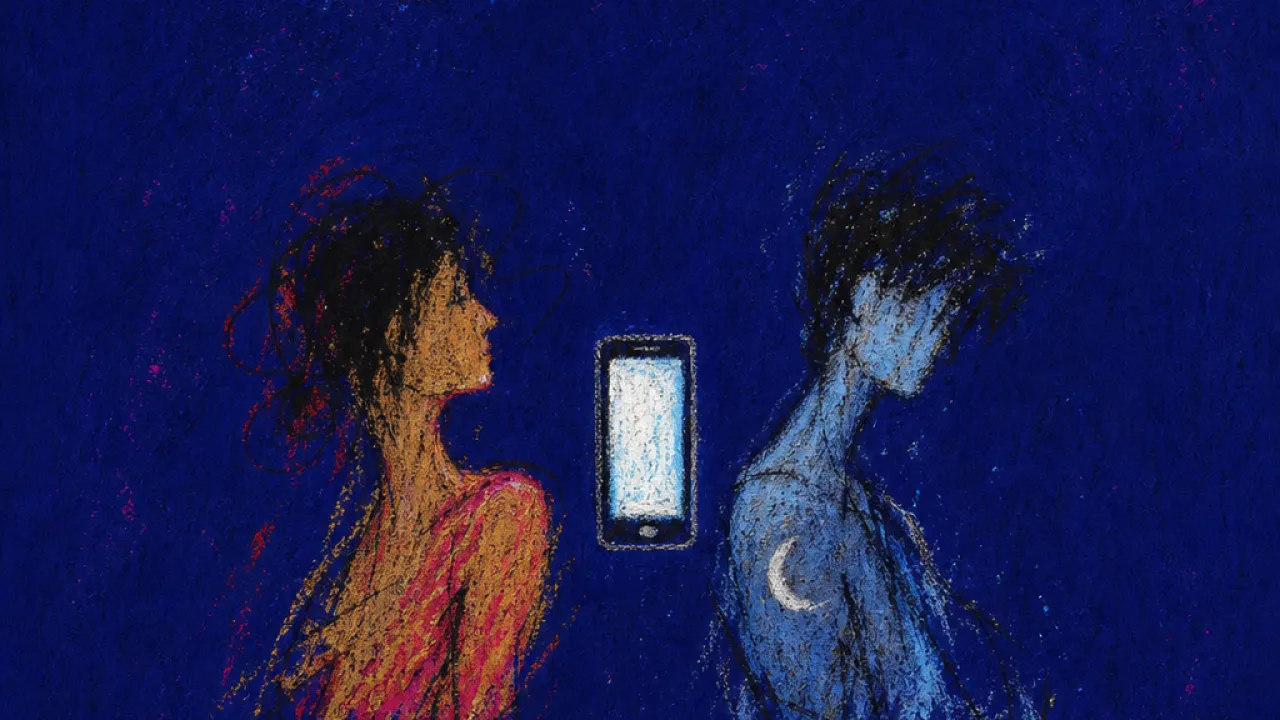
Projection-Connection Split — you feel it when your phone lights up and your body reacts before you have enough information to know what happened. A friend takes six hours to reply, a partner uses a period instead of an emoji, someone compliments you in a tone you cannot quite place, and suddenly the room around you gets quieter while your mind starts building three different versions of what they meant. Your thumb hovers over the message thread, your stomach drops, your throat tightens, and you keep rereading the same sentence until the words stop looking like words and turn into evidence. Part of you wants to trust the connection; another part is already scanning for the hidden meaning, the power shift, the soft rejection, the hook under the kindness. You hate that you cannot just receive something cleanly, because the closeness is not fake: there are warm moments, shared jokes, long talks, looks across crowded rooms that did happen. But the more a bond matters, the more every pause starts carrying extra weight, as if the person in front of you has become both a person and a screen where longing, fear, attraction, comparison, and memory keep projecting their shapes. You can be sitting across from someone who is literally laughing with you and still feel half a step outside the interaction, checking whether the laughter is with you or about you, whether the warmth is care or performance, whether the distance is a boundary or the beginning of being dropped. The cost is not just confusion; it is the loneliness of never being fully inside the moment you wanted to trust, much like The Moon, where the dog and the wolf answer the same light from different bodies while the path between them cannot tell you whether it is revealing the way forward or making every shadow louder.
What's pulling at you?
You are caught between wanting to let contact land and needing to inspect every pause, tone shift, or tiny reply before you trust it. The signal may have something in it, but once it passes through longing, fear, comparison, and the need to belong, it becomes hard to tell what came from the other person and what got added on the way.
How It Shows Up?
- You’re alone at 1:17 AM with your phone on low brightness, rereading a message that was probably harmless until the spacing started to feel loaded. Your thumb pauses above the keyboard, your throat gets tight, and your chest has that small dropping sensation, like you missed a step in the dark. The thread glows like a tiny cup holding more meaning than it can carry. You can let the phone sit face down for a minute; the message does not need to become a verdict tonight.
- You’re with a friend or someone you’re dating, and they look away mid-conversation to answer another notification. You keep nodding, but your jaw locks and your breathing moves higher in your chest while your attention splits between what they’re saying and what their glance might mean. A normal room starts to feel moonlit, with familiar and untamed reactions standing under the same light. It is allowed to notice the spike without turning it into a full map of the bond.
- You’re in class, on a call, or sitting in a shared workspace when someone gives short feedback: “Looks fine.” You smile, say thanks, and then feel heat behind your ears as the sentence turns over and over, trying to decide whether it means approval, annoyance, or distance. Your shoulders creep up, and the screen in front of you becomes harder to read. You can finish the next concrete task before deciding what the tone meant.
- You walk into a party, group hang, or new scene and read the room before anyone has even spoken to you: who seems close, who seems cool, who might be judging, who might let you in. Your stomach tightens, your hands feel too visible, and every laugh across the room starts to look like a sign with your name on it. The whole room becomes a Seven of Cups spread of faces, status, desire, and threat. It is okay to stay with one ordinary detail, like the floor under your shoes, before you read the whole room.
- Someone says something kind about you and you freeze for half a second, because kindness lands with a question mark attached. Your mouth says “thank you” while your ribs tighten, your cheeks get hot, and a second voice starts checking whether they want something, envy something, or saw a version of you they can use. The compliment hangs between you like a sealed chalice, beautiful and unreadable. You can accept the words at surface level for now; you do not have to solve the whole exchange in your body.
Projection-connection Split in Tarot Cards
Projection-Connection Split lives in the moment a silence, delayed reply, compliment, or half-smile becomes both contact and screen. You can feel it in the tight throat, locked jaw, and shallow breath that arrive before you know what you are responding to. From an existential perspective, the structural framework is the struggle to stay open to contact without letting every image take over the person in front of you. The Tarot Cards below make that overlap visible.
Projection-connection Split in Tarot Card Reading Insights
When Projection-Connection Split is active, people often bring the same question into readings: am I meeting the person, or the meaning I placed on them? The readings below move from card images into how others have sat with that same mixed signal. Tarot Reading Insights from sessions.

Feeling Unseen After a Breakup—And the Direct Ask That Followed
Topic:Friendship Tarot Reading
Struggle:Capacity Misalignment
Context:Care Reciprocity Test

Ghosted After Intimacy: From Story Checks to a Phone Face Down
Topic:Love Tarot Reading
Struggle:Projection-Connection Split
Context:Ghosting After Intimacy

When Privacy Feels Like Rejection: Asking for Connection, Not Access
Topic:Love Tarot Reading
Struggle:Projection-Connection Split
Context:Relationship Privacy Negotiation

Pausing the Loom Clip: From Past-Self Projection to Fair Feedback
Topic:Personal Growth Tarot Reading
Struggle:Shadow Integration Strain
Context:Projected Mirror Loop

Calling the Group Story Fake; One Honest Message Tested a Bond
Topic:Social Tarot Reading
Struggle:Belonging-Authenticity Split
Context:Direct Communication Trial

Moving Thursday Dinner Twice: From Imagined Access to a Life That Fits
Topic:Choice Tarot Reading
Struggle:Potential Overidentification
Context:Situationship Ambiguity

Familiarity Was History, Not Proof: Measuring What Fits You Now
Topic:Love Tarot Reading
Struggle:Idealization-Reality Split
Context:Breakup Closure Limbo

Post-Apology Silence Isn't a Verdict: Naming Shame and Setting One Boundary
Topic:Love Tarot Reading
Struggle:Inner Tribunal Lock
Context:Trust Rebuilding Trial

'No Worries' Wasn't a Verdict: How I Learned to Treat Tone as a Hypothesis
Topic:Friendship Tarot Reading
Struggle:Inner Tribunal Lock
Context:Direct Communication Trial

From Good-Morning Text Anxiety to Calm Replies: Practicing Paced Attention
Topic:Love Tarot Reading
Struggle:Projection-Connection Split
Context:Algorithmic Self-Help Spiral