Smiling Through the Family Photo, Then Letting One Truth Stand

The Smile at 7:18
If you can facilitate a tense work meeting but start clearing plates the second family conflict appears, I know how invisible conflict-avoidance resentment can become. Maya was twenty-seven, living independently in Toronto, and trusted at work to make difficult product-design conversations manageable. At family dinner, however, the same skill seemed to erase her from the room.
She brought me back to 7:18 on a Sunday evening. A relative had made a pointed comment, and before Maya could decide whether to answer, someone lifted a phone and said, "Come on, let's get a photo." A fork scraped across ceramic. Roast chicken and fresh coffee hung in the warm condo air. Maya collected two plates, stepped into the frame, rested a steady hand on someone's shoulder, and arranged her face into the version everyone recognized.
"I can feel myself smiling while my jaw locks," she told me. "I keep saying we are fine before I even ask whether I am."
The contained anger sat behind her ribs like a burner left on beneath a tightly fitted lid. Her shoulders stayed braced, her breath became shallow, and the ache in her jaw followed her out of the dining room. Saying, "That was dismissive, and I am angry," felt less like describing an experience and more like pulling the fire alarm in a building where everyone might blame her for the noise.
At 9:42 that night, on the southbound Line 1 train, the emotional bill arrived. Fluorescent lights buzzed over wet coats. The brakes shrieked into each station. Maya opened Apple Notes and typed four paragraphs beginning with, "What I wanted to say was..." Her thumb pressed harder against the glass as the sentences became sharper and more honest. Before her stop, she deleted the draft and heart-reacted to the family photo instead.
She gave me a tired half-smile. "My search history is basically, 'Why am I furious only after I leave my family?' I don't want a blowup. I just don't want to keep disappearing either."
I did not tell her that anger meant she had to confront anyone, cut contact, or force a family reckoning. Anger can identify an injury or a boundary without dictating what must happen next. I told her, "We are not going to use tarot to decide whether your family is good or bad. We are going to map the moment when honesty becomes danger in your mind, and then find the smallest place where you can recover choice."
The photo could look warm while her body remembered the temperature of the room. Our Journey to Clarity would begin inside that mismatch.

Lowering the Mask with the Shadow Spread
With Maya's consent, I invited her to take one ordinary breath and hold the question in plain language: "Why do I act like my family is happy while hiding anger?" I shuffled slowly, not to create suspense, but to give her nervous system a clear transition from replaying the dinner to observing its pattern.
I chose a five-card layout called The Shadow Spread. For anyone wondering how tarot works in a reading like this, I use the cards as a structured pattern-recognition tool, not as a supernatural verdict. Card meanings in context can separate an experience into visible behavior, hidden emotion, underlying belief, maintaining habit, and available response. That makes the spread especially useful when someone is feeling stuck inside a repeated relational loop.
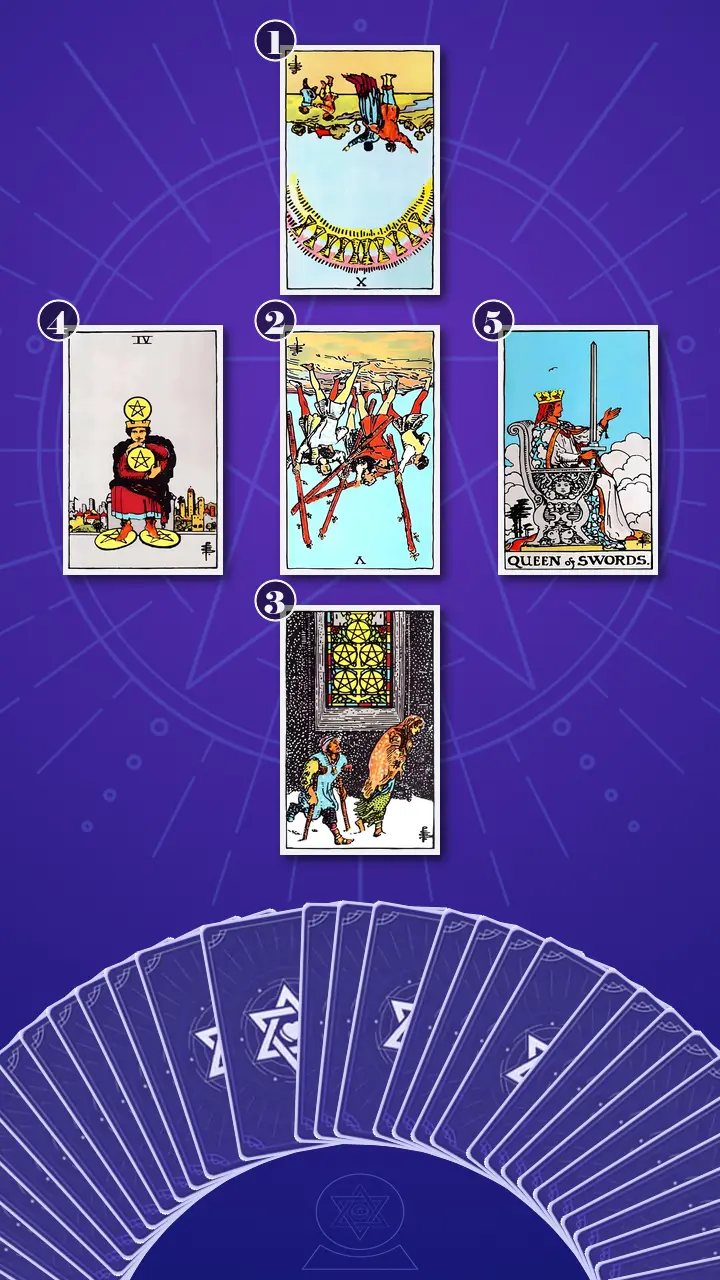
I placed the cards in a cross. The first position would reveal the happy-family mask Maya presented during tense interactions. The second would expose the anger and disagreement redirected into private rumination. The third would identify what she believed honest conflict could cost her. To the left, the fourth card would show the defense that kept the cycle running. To the right, the final card would offer an integrating practice, not a prediction of how her family would respond.
I chose this compact spread because Maya's question was an inner-excavation question. A larger reading could have added future possibilities or other people's influences, but it would have blurred the specific chain we needed to examine: public harmony, hidden fire, fear of exclusion, defensive control, and clear expression.
What the Family Photo Could Not Hold
Position 1: Ten of Cups Reversed and the Public Mask
I turned over the card representing Maya's presenting behavior of acting as though the family was happy during tense interactions. It was the Ten of Cups, reversed.
The familiar scene was still there: ten cups forming a rainbow over a celebrating family, raised arms, dancing children, and a home in the distance. Reversed, the emotional picture remained recognizable, but its stability was compromised. I told Maya that this did not prove her family lacked love. It showed a blockage in emotional alignment and an overcorrection toward appearances. The brighter the public story had to become, the less room there was for an experience that complicated it.
I connected the card to the seconds after the dismissive comment. Someone raised a phone. Maya squeezed into the picture, smiled, and later described the evening as "nice" while her jaw still ached. Like an Instagram carousel that posts the warm group photo and leaves every frame containing the conflict in drafts, the image had become evidence of harmony even when her body held contradictory data.
"The thought beneath the smile may be something like, 'If I can make this look normal, maybe I won't have to find out what happens when I admit it isn't,'" I said. "The reversed Ten of Cups asks whose experience is included in the word 'fine.'"
Maya's breathing stopped for a beat. Her eyes moved from the reversed rainbow to the family photo on her phone, and then she let out a short, bitter laugh. "That is so accurate it feels kind of brutal," she said. "I even adjusted the photo before it went in the chat."
I let the recognition settle without turning it into blame. "You were trying to preserve belonging with a strategy that probably once felt protective. We can respect why you learned it and still examine what it costs now."
Position 2: Five of Wands Reversed and the Argument That Changed Location
I turned over the card representing the anger Maya hid and the conflict energy she redirected into private rumination. It was the Five of Wands, reversed.
Five figures usually cross their staves without shared direction. Reversed, I read the fire as blocked rather than absent. The disagreement did not disappear when Maya spoke faster, proposed a compromise, or volunteered to handle dinner logistics before stating her view. Its location changed. Short-term peace was achieved in the dining room, but the unused energy became hot ribs, a locked jaw, pacing in her apartment, and an hour-long argument conducted alone.
I said, "Unspoken conflict does not disappear; it changes location."
Her workplace skill made the pattern especially easy to miss. In a product critique, finding common ground and moving a team toward a decision was part of her role. At home, that useful professional reflex behaved like a Slack thread marked "resolved" because everyone added a thumbs-up, while the real disagreement continued in private messages.
"Your internal line seems to be, 'Let me solve this before anyone notices that I am angry,'" I said. "You learned to become useful at the exact moment you needed to become audible."
Maya's hand moved toward her coffee and stopped before touching it. Her chest lifted in a shallow inhale, her gaze drifted toward the window as though she were replaying the dinner, and then her fingers slowly relaxed against the table. "I always clear the plates," she said. "I thought I was giving myself something to do. I didn't realize I was ending the conversation before I had entered it."
I emphasized that the reversed Five of Wands was not asking her to create a dramatic confrontation. It invited one manageable difference of opinion to become visible before reassurance or problem-solving took over. That could be as small as, "I see it differently," followed by one breath.
Position 3: Five of Pentacles and the Fear of Emotional Exile
I turned over the card representing the belonging-based fear beneath Maya's suppression of anger and what she imagined honest disagreement might cost. It was the Five of Pentacles, upright.
Two figures moved through snow beneath an illuminated stained-glass window. As I studied the card, snow was beginning to gather along the ledge outside my own window, and the room seemed to collaborate with the image. I could see why the card had arrived at the center of a Toronto winter reading: it captured the experience of standing outside a lit building and deciding that a locked-looking door proved there was no welcome inside.
I did not interpret the card as a forecast that Maya would be rejected. I read it as an excess of anticipated scarcity and a deficiency of tested evidence. She would hover over the sentence, "That comment was not okay with me," and mentally complete the entire rejection before anyone had responded. She imagined being called dramatic, excluded from the next plan, mocked in another chat, or permanently assigned the role of difficult daughter.
"The fear says, 'If I say this, I will be outside the family before the conversation is even over,'" I said. "But disagreement and exile are not the same event. They may feel fused in your body, and we can still separate them conceptually."
Maya exhaled through her nose and looked again at the illuminated window. I asked her to recall one relationship in which she had expressed a difference and remained connected. After a moment, she described telling a close friend that a joke had hurt. The friend had become defensive at first, then apologized the next morning. The conversation had been uncomfortable, but the relationship had survived.
"That does not guarantee your family will respond the same way," I said. "It gives us one piece of evidence that honesty does not automatically cancel belonging. The Five of Pentacles is useful because it makes the feared outcome visible enough to examine. It does not ask you to trust everyone. It asks you to notice when fear is presenting an untested future as an accomplished fact."
Position 4: Four of Pentacles and the Cost of Controlling Every Variable
I turned over the card representing Maya's concrete defense strategy: tightly controlling her expression, the topic, the timing, and her vulnerability to preserve apparent harmony. It was the Four of Pentacles, upright.
The figure held one coin against the chest while two more pinned both feet to the ground. I connected that posture to Maya before a family visit: planning safe topics, checking transit times, monitoring her face, gripping her phone, and steering every tense exchange toward practical details. The strategy reduced immediate uncertainty. It also produced an excess of control that immobilized emotional movement. No one could respond to a feeling she never allowed to become visible.
After a decade of reading human cycles through tarot and astrology, I often think in terms of orbit. A stable orbit can still mean repeatedly falling around the same center. Seeing the Four of Pentacles, I used a diagnostic lens I call Gravity Well Identification. I asked what old rule exerted enough downward pull to bend all of Maya's choices around it.
The gravity well was not her love for her family, and I refused to reduce her family to a single villain. It was the obsolete rule that connection depended on immediate pleasantness: If I control every variable, nothing can break and no one can leave. That rule organized her smile, her helpfulness, her timing, and even the length of her Notes drafts. It protected her from finding out how others might respond, but it also prevented genuine repair from having a chance to occur.
Maya pressed her palm flat against the table. "So I am holding on so tightly that I cannot actually find out whether the relationship can move."
"Yes," I said, "and noticing that is not a reason to shame yourself. Control became your substitute for relational safety. The next card will not ask you to release every truth or surrender your boundaries. We are looking for a more flexible form of protection."
When the Queen of Swords Opened Her Hand
Position 5: The Integrating Resource
When I reached the final position, the radiator clicked off. The small room became quiet enough for us to hear a streetcar bell beyond the window. I turned over the card representing a conscious way to integrate anger through precise communication, self-defined boundaries, and one honest expression without predicting or controlling the family's response.
It was the Queen of Swords, upright.
The Queen held her sword vertically in one hand while extending the other. I read that combination as balanced Air: precision without accusation, receptivity without surrender, and a firm boundary without a demand that every channel close. She did not require Maya to discharge every feeling or win a case. She asked Maya to distinguish an observable event from an assumption, describe its impact, and name an action within her own control.
In ordinary life, that could sound like: "When my reaction was turned into a joke, it landed as dismissive. If that happens again, I will end the conversation and return to it later." It was a concise relationship bug report, not a forty-slide deck proving that Maya's feelings were valid. The sentence did not require a false smile, a courtroom defense, or a guarantee that everyone would agree.
I drew a small loop in my notebook: cutting comment, fear of becoming the problem, smile and practical help, immediate calm, unsent message, resentment, guilt, then stronger certainty that silence was the price of belonging. I call this Cognitive Spiral Mapping. It validates that feeling stuck does not always mean no movement has occurred. Maya had circled the same center, but each pass had produced usable information about the trigger, the reflex, and the cost.
Then I returned to Gravity Well Identification. The force holding the loop in place was anticipated exile. The Queen offered a new trajectory: not escape from the family at any cost, and not a reckless release of everything Maya had withheld, but one bounded sentence strong enough to interrupt the automatic orbit.
I watched Maya look from the upright blade to the open palm. She was still caught inside a false binary: smile through the photo and keep everyone comfortable, or unload months of anger and become the problem she feared. Neither option left room for a precise statement with a chosen limit.
You do not need to protect a flawless family picture; name one clean truth with the Queen's upright sword and keep your hand open without surrendering your boundary.
I stopped speaking and let the sentence remain in the room.
For one beat, Maya did not inhale. Her fingers stayed suspended above the edge of the card, and her pupils widened slightly as though the dinner, the photo, and the Line 1 draft had begun replaying at once. Then her brow tightened. A flash of anger crossed her face before relief could arrive. "But doesn't that mean I have been doing it wrong this whole time?" she asked, her voice low and sharper than before.
"No," I said. "It means you used a protective strategy until its cost became greater than its usefulness. Recognizing that now does not make your earlier self foolish. It gives your present self more options."
Her jaw shifted. Her shoulders descended a fraction, then another. The hand beside the card opened slowly, mirroring the Queen's. Her eyes became glassy, but she did not look fully relieved. I saw the slight disorientation that can follow a real insight: the old burden had loosened, and the new freedom came with responsibility. She could not control the response. She could only choose her words, timing, boundary, and level of contact. Her next exhale trembled at the end.
I asked, "Now, with this new perspective, think back to last week. Was there a moment when this insight could have made the experience feel different?"
Maya looked at her phone. "Tuesday, when everyone was heart-reacting to the photo. I wanted to write, 'Are we really not going to talk about what happened?' I could have written one clean sentence in Notes and not sent it. Even that would have meant I was not lying to myself."
I invited her to try the Queen's three-beat inner language: "I know what happened. I can say how it landed. I do not have to control whether they agree." She repeated it once, quietly, without turning it into a promise to confront anyone.
I named the emotional movement plainly. This was not a leap from anger to perfect harmony. It was one step from contained anger, guilt, and lonely resentment toward clear, boundaried honesty that could treat anger as information. Anger could be information without becoming a weapon. One clean truth could test a relationship more honestly than another perfect photo.
One Clean Truth Instead of the Whole Family Trial
When I read the spread as one story, its logic was direct. The reversed Ten of Cups showed Maya protecting a polished family image. The reversed Five of Wands revealed the fire that the image forced inward. The Five of Pentacles identified the feared cost of expression: emotional exile. The Four of Pentacles showed her response to that fear, which was to grip every variable until neither conflict nor repair could move. The Queen of Swords offered the unused resource: precise language, an open channel, and a boundary she could enforce without controlling anyone else's interpretation.
The elemental progression mattered as well. Blocked Water preserved the emotional image. Blocked Fire became physical tension and private argument. Earth made the fear and defensive grip concrete. Air finally gave the experience language. I did not read that sequence as fate. I read it as a map of why the same family interaction kept producing anger after the visit was over.
I identified Maya's cognitive blind spot as the belief that sufficiently perfect wording could prevent another person's defensiveness and prove she was not difficult. That standard kept her editing until the moment passed. No sentence can guarantee a good response. A boundary is not a tool for manufacturing agreement; it defines Maya's participation if a behavior continues. The response then becomes information about the relationship's current capacity for honesty.
The transformation direction was deliberately small: replace one automatic reassurance with one specific, non-accusatory statement about what happened, how it landed, and what Maya would do next. She retained control over the timing, channel, recipient, scope, and whether the sentence was delivered at all.
The Orbit Expansion Strategy
I translated the insight into my Orbit Expansion Strategy. To change a long-established orbit, Maya did not need to launch herself across the entire family system in one conversation. She needed to alter one point in the trajectory: identify the gravity well, practice one new response, and preserve enough support and exit options to keep the experiment within her control.
- Draft the Five-Minute Fact-Impact-Boundary Sentence.On Wednesday evening, Maya would set a five-minute timer, open a private Notes file, and complete three lines about one recent incident: "What happened," "How it landed," and "What I will do if it happens again." Her minimum version was: "When my reaction became the joke, I felt dismissed, and I will step away if that happens again."She could stop after drafting. Sending was optional. If direct expression might expose her to retaliation, coercion, or an unsafe situation, the note would remain private or be shared only with someone she trusted.
- Take One Breath Before Becoming Useful.At the next dinner or family call, when tension appeared and Maya felt the urge to clear plates, fix logistics, or reassure everyone, she would take one slow breath and ask, "Do I want to respond, leave, or help?" If she chose to respond, she could use a low-stakes sentence of fifteen words or fewer, such as, "I see that differently," or, "That time does not work for me; I can do Saturday afternoon."No immediate compromise or long explanation was required. She could choose an easier topic, arrange a ten-minute check-in with a trusted friend afterward, or skip the experiment on a difficult day.
I asked Maya to measure success by whether she gave her own experience a place to exist, not by whether the family responded perfectly. The smallest valid result could be a private sentence she did not delete.

A Week Later, the Sentence She Did Not Soften
A week later, I received a message from Maya. She had started with a low-stakes family planning exchange rather than the unresolved dinner comment. When a suggested time did not work, she wrote, "Sunday evening doesn't work for me. I can come Saturday afternoon." She did not add "sorry," a laughing emoji, or three paragraphs proving she had a valid reason.
The typing indicator appeared, disappeared, and returned. Then the reply came: "Okay, Saturday works."
"My body reacted like I had done something enormous," Maya wrote. "It was literally a scheduling text. But I let the silence exist, and I did not rush in to make everyone comfortable."
She had also drafted the more difficult fact-impact-boundary sentence about dinner and read it aloud once in her apartment. She had not decided whether to deliver it. I considered that restraint part of the clarity, not a failure of courage. Ownership included the right to choose when, how, and whether another person received access to the truth.
That night she slept through without replaying the family visit. Her first thought the next morning was still, "What if I am making this too big?" This time, she noticed the thought, smiled faintly, and left the draft intact.
The family had not been transformed in a week. Maya's anger had not vanished, and the warm dinner photo still sat in the group chat. The proof was quieter: she had stopped using the photo as evidence against her own experience.
I saw the reading for what it had been: not a prediction and not permission granted by five cards, but an objective map Maya used to recognize a pattern and make a choice. Tarot had supplied images for the mask, the displaced conflict, the feared exile, the protective grip, and the clean boundary. Maya supplied the discernment and the action. She remained the author of what happened next.
If the room turns tense and your jaw locks, it can feel safer to hold up the happy-family picture than risk becoming "the problem," even as you disappear behind it. Simply noticing the moment when you become pleasant and useful is already a small movement out of the old orbit.
If one clean truth did not have to settle your whole family story, what small sentence might you place between the Queen's upright sword and her open hand next time?