Why Asking My Brother to Pay Me Back Felt So Loaded on the 6:18 p.m. Streetcar
When someone can chase a missing invoice at work but still cannot send one clear text about money to a brother after checking her balance on the ride home, I already know I am looking at family money boundary guilt.
That was exactly what Casey brought into my evening video session from Toronto. She described Tuesday at 6:18 p.m. on the TTC streetcar with the precision of someone who had lived the same moment too many times: the overhead light buzzing, her winter coat damp at the collar, her banking app open in one thumb and her brother’s chat in the other, the phone screen warm in her palm. She typed, ‘Hey, can we sort out the $350 from March?’ Then came ‘no pressure,’ then something softer, then nothing at all. Delete. Close. Relief for three seconds. Shame right after.
She lived with one roommate, worked as a marketing coordinator, and knew exactly what rent, groceries, and transit left her each month. The missing money was not theoretical. But the real conflict was sharper than the amount itself: she wanted her money back, and she was terrified that asking would make her the bad sibling in her own head.
As she said, ‘I know it’s my money, but I hate sounding transactional with family,’ I watched her throat work around the sentence like it had edges. Her guilt felt like autocorrect turned against her own voice: every reasonable word kept changing into apology before it could leave the screen. Underneath it sat the knot she already knew by body memory—a tight throat, a stomach drawn into itself, resentment immediately followed by self-correction.
I nodded. ‘That makes sense,’ I told her. ‘And we do not need to shame your nervous system for reacting this way. We just need to map it. Let’s see if we can turn this fog into something readable—and find the clarity inside it.’

Choosing the Compass: A Relationship Spread for Family Money Boundary Guilt
I asked Casey to take one slow breath and hold only one image in mind: the exact second before she deleted the text. Then I shuffled. In my practice, that pause is never about performance. It is a way of helping the body stop bracing long enough for the real pattern to show itself.
For her, I chose a classic five-card Relationship Spread. When people wonder how tarot works with sibling debt, fairness, and family boundaries, they often expect a prediction about whether the other person will pay. I use this spread when the better question is deeper: why does asking feel emotionally loaded inside this bond at all?
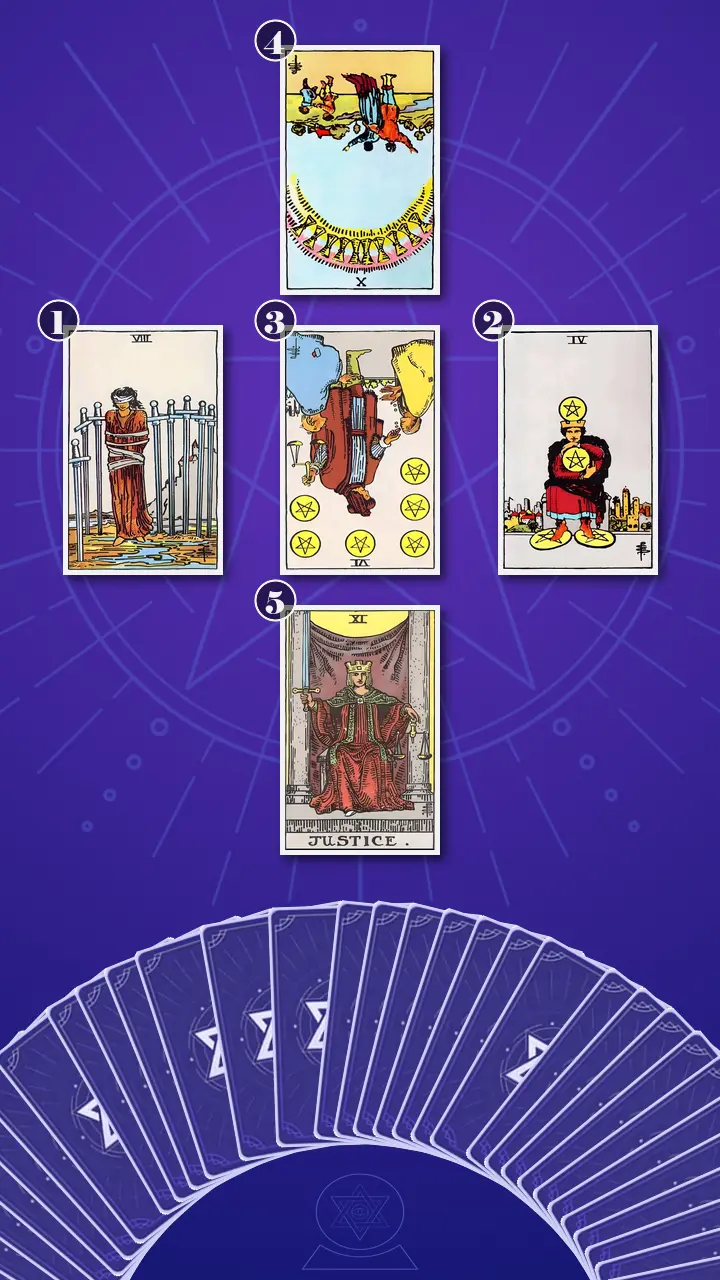
It is the smallest complete structure I trust for a problem like this. One card shows Casey’s current stance inside the relationship. One shows her brother’s role as she is experiencing it. The center card names the actual exchange between them. Above it sits the hidden family script pressing down on the whole situation. Below it rests the healthiest next step—the grounding response. Symptom, dynamic, root pattern, guidance. Clean enough to follow. Human enough to matter.
I laid the cards into a cross. Her card on the left, her brother’s on the right, the shared imbalance in the center, the old family rule above it like weather hanging over the room, and the corrective footing below. Years of guiding people under a planetarium dome have taught me that once a pattern is outlined, scattered lights stop looking like chaos. This spread did the same thing immediately. Even face down, it looked like a balance beam under pressure.
Reading the Frozen Orbit
Position 1: The Draft-Delete Loop
Now turning over the card that reveals Casey’s current self-silencing pattern—the guilt and overthinking that show up the moment she tries to ask for repayment—I found the Eight of Swords, upright.
It was painfully exact. In modern life, this is the commute-home loop: open the chat, type the amount, soften the request, add emotional padding, remove the amount, close the app, feel temporary relief, then feel even more annoyed with yourself later. The blindfold maps to anticipated awkwardness being treated like confirmed disaster. The loose bindings matter too. Nothing external has fully blocked her yet. In energy terms, this is blocked air: too much mental rehearsal, not enough reality-testing.
‘This is the part that gets me,’ I told her. ‘At work, you can send a crisp follow-up about a delayed invoice with zero drama. But with him, every word suddenly needs emotional insurance. It becomes: I know what I need to say. I just can’t say it without feeling mean.’
Casey gave a short laugh that had more sting than humor. ‘Wow,’ she said. ‘That’s so accurate it’s a little rude.’ Her hand tightened around the sleeve of her sweater, then loosened again. That bitter little laugh was useful. It meant the card had landed where it needed to land.
‘Good,’ I said gently. ‘Because the gaps between these swords are still open. Your body feels trapped. The situation is tighter than it should be. But those are not the same thing.’
Position 2: The Warm Chat, Closed Hand
Next I turned over the card showing her brother’s role in the dynamic as Casey has been experiencing it—the posture of delay, guardedness, or non-initiation around the debt. It was the Four of Pentacles, upright.
I do not read this card as villainy in family situations. I read it as holding. Clutching. Stalling movement. Casey had already described it before the card ever appeared: warm everyday conversation, memes, casual check-ins, normal sibling energy—but no volunteered timeline, no update, no first move on the money. The exchange stayed emotionally and practically frozen because he was not opening it, and she had started treating that frozen posture like a cue to make herself smaller too.
In energy terms, this is excess earth. Too much holding. Too much guarding. Not enough circulation. The issue is not that he is evil. The issue is that someone is going to have to name what has been pinned under the feet of the relationship.
Casey looked down. ‘If he was going to bring it up himself, he would have by now.’
‘Probably,’ I said. ‘But his delay is not evidence that your need should shrink. Warmth in the chat is not proof the issue is too small to mention. It may actually be proof the relationship is sturdy enough for a direct sentence.’
Position 3: Six of Pentacles Reversed and the Ledger Living in Her Chest
At the center of the spread—the card mapping the shared pattern between them, the actual imbalance in giving and receiving—I turned over the Six of Pentacles, reversed.
This was the catalyst card, and Casey went very still. In modern life, this is rent week, grocery totals, the Shoppers line, the small humiliation of mentally subtracting what is still missing from your month. It is seeing a patio-night Instagram Story and feeling something hot flip in your stomach, then immediately scolding yourself for noticing. Not because one dinner out is unforgivable. Because the original loan never settled back into balance. The giving happened. The return flow stalled.
‘You are not overreacting,’ I told her. ‘You are carrying an unfinished exchange.’
At the planetarium, when I explain orbital motion, I tell school groups that what looks still is often a system stuck inside forces it has stopped measuring. Seeing this card, I had the same flash. Casey was not being petty. She was living inside interrupted reciprocity—like Splitwise logic that makes perfect sense with friends but, the second the debt is family, gets pushed out of the spreadsheet and into the chest. In energy terms, this is blocked earth again, but more relational: generosity has turned into silent scorekeeping because nobody built a clean structure for the return.
That is why Six of Pentacles reversed in a family loan reading matters so much. It moves the whole question away from morality and back toward structure. The problem is not: Why am I being difficult? The problem is: this relationship is holding an unfinished financial loop.
Casey blinked hard, looked away from the screen for a second, then back. ‘I’m not even mad about one purchase,’ she said quietly. ‘I’m tired of this living in my budget and only in my budget.’ The shift was immediate. Less shame. More accuracy.
Position 4: The Family Photo Nobody Wants to Smudge
Then I turned the card above the center—the one uncovering the hidden family script behind the guilt, especially the belief that honesty about money threatens closeness. It was the Ten of Cups, reversed.
I felt the reading deepen right away. Casey had already given me the scene: Sunday at 5:42 p.m. in her mom’s kitchen, garlic and dishwasher heat in the air, cutlery clattering, everybody laughing, her brother mentioning weekend plans like everything is clean and easy. It had that unmistakable family-dinner tension people clock instantly in shows like The Bear—everybody acting normal while one unresolved thing makes the room heavier than it looks.
‘Everybody is keeping the vibe comfortable,’ I said, ‘and your body is doing the accounting.’
The reversed Ten of Cups is not a lack of love. It is the shadow side of idealized harmony—the belief that being a good sibling means keeping the room so smooth that no honest truth ever lands with a thud. The guilt does not prove you are wrong. It shows where the family script gets loud. In energy terms, this is blocked water: the feeling is real, but instead of moving toward repair, it pools under the table and turns into quiet resentment.
I asked her, ‘At the next family dinner, what feels more dangerous to you—one briefly awkward private conversation, or carrying the resentment home again in silence?’
Her breathing paused. Her gaze lost focus for a beat, as if she were replaying every passed dish and every unsent text. Then came a long exhale, low in the chest. ‘I do this every single time,’ she said. ‘I keep telling myself I’m protecting the relationship.’
‘Maybe,’ I said softly, ‘you’re protecting the image of a relationship that never has uncomfortable conversations. That’s not the same thing.’
When Justice Faced Forward
Position 5: The Clean Edge of the Ask
When I reached for the final card—the one pointing to the healthiest way forward, the boundary-based response that restores fairness without turning the issue into punishment—the whole atmosphere changed. Even over video, there are moments when the air seems to organize itself. My desk lamp caught the red of the card, and behind me the small star projector on my shelf sent a thin ring of light across the ceiling like a planet sliding into view.
The card was Justice, upright.
Casey was still mentally on that streetcar home, checking her balance, opening his chat, deleting one honest line because asking for her own money had somehow started to feel harsher than staying quietly resentful for another week. I could see the old loop trying to restart in her face before I spoke.
‘Listen,’ I said. ‘The guilt is not proof that you are asking for too much. It is what happens when fairness has been taught to sound like disloyalty.’
You do not have to hide the scales to prove you love your brother; lift the sword of clarity, name the agreement, and let fairness do the speaking.
I let the sentence stay in the room for a moment.
Her first reaction was not relief. It was resistance. Her shoulders rose higher, not lower. ‘But if I do that,’ she said, voice tightening, ‘doesn’t that mean I’ve been making this harder than it had to be?’
‘No,’ I told her. ‘It means you were adapting to a system where fairness got coded as danger.’ Then I gave her the framework I use most often in family readings—my Galactic Gravity Analysis. ‘Families build invisible orbits,’ I said. ‘One person keeps the peace. One avoids the hard topic. One carries the unspoken weight. After a while, everyone mistakes the familiar orbit for love, even when it is pulling one person off center. Justice does not blow the family apart. It recalibrates the orbit so closeness is not built on your self-erasure.’
Then I watched the insight move through her in three distinct phases. First, the freeze: her breath caught halfway in, and her fingers hovered against the side of her mug. Then the cognition: her eyes drifted past the screen, unfocused, as if she were replaying the TTC ride, the family dinners, the little ‘haha’ and ‘no pressure’ tacked onto messages that had once been factual. Then the release: her jaw unclenched, her shoulders lowered by an inch, and the sound that came out was half laugh, half shaky exhale.
‘So asking isn’t the betrayal,’ she said.
‘Exactly,’ I answered. ‘Clarity is not cruelty.’
Justice in this spread was pure balance—fair-minded self-respect, clear boundaries, calm accountability. If anyone ever asks me what Justice tarot means for repayment and boundaries, I think of this exact moment: not a lecture, not a guilt dump, not emotional overperformance. Just facts given their proper name. Like turning a messy Slack thread into one clear action item with an owner and a date. The relationship did not need more cushioning. It needed a clear agreement.
‘Now,’ I asked her, ‘with this new lens, think back to last week. Was there a moment when this would have changed how you felt?’
She nodded slowly. ‘Friday at lunch,’ she said. ‘I saw his Story and got instantly mad at myself for caring. If I had thought of it as an unfinished exchange instead of me being petty, I would’ve drafted the text right there.’
That was the true crossing point of the reading: from guilt-driven self-silencing and silent scorekeeping toward the first solid inch of calm self-respect, clearer boundaries, and cleaner connection. Not total ease. Not certainty. Just honest ground.
The Amount-and-Date Text: How Fire Enters the System
When I stepped back from the whole spread, the story was clean. Casey began in Eight of Swords air—overthinking until a simple ask felt morally dangerous. Her brother’s Four of Pentacles posture kept the exchange frozen. Six of Pentacles reversed named the center: generosity had become an unfinished loop. Above it all, Ten of Cups reversed revealed the blind spot—she had been treating surface harmony as the same thing as relational safety. Justice below the spread offered the transformation direction in one sentence: stop protecting the vibe at the cost of the relationship’s actual honesty.
There was one more thing I pointed out. The reading had air, earth, and water—thought, money, feeling—but no fire. Insight was not the missing piece anymore. Action was. Not dramatic action. One clean spark. This is exactly why I trust a classic five-card Relationship Spread for sibling debt, fairness, and family boundaries: it shows where the system is stuck, and where one grounded move restores proportion.
Casey frowned a little. ‘The send is still the worst part,’ she admitted. ‘I can draft it. I just spiral the second it becomes real.’
‘Then we lower the difficulty,’ I said. ‘No courage theatre. Just structure.’ For anyone who has ever searched how to ask a sibling for money back without sounding rude, Justice gave a very simple answer here: amount plus date, in the right container, at the right time. You do not have to make your need sound optional to make it kind. And because timing matters, I borrowed from what I call Comet Cycle Prediction: do not wait for a mythical perfect mood, and do not send it at 11:07 p.m. when your nervous system is tired and dramatic. Choose a daylight window on purpose.’
- The Amount-and-Date DraftDuring your next weekday lunch break, open Notes—not the chat—and write only two sentences: ‘Hey, you still owe me $350 from March. What date can you send it by?’ Read it out loud once in your room, on a walk, or in an empty meeting room. Notice exactly where your body tries to add apologies, jokes, or ‘no pressure.’If it suddenly sounds cold, keep one warm opener if you want, but do not delete the amount or the date question. This is a body-check before send, not a moral test.
- Private, Not PublicBefore the next family gathering, choose one private channel on purpose—text, call, or voice note—and handle the loan there. If it comes up at dinner and you do not want to do it live, use one line only: ‘I’d rather sort this one-on-one later.’The right container lowers the emotional temperature. You are not making it a big deal; you are refusing to make honesty compete with the whole room.
- The Seven-Day Orbit CheckAfter you send the message, mute the chat for 30 minutes so you do not spiral-refresh. Then make one plain note called Loan details with three facts only: amount lent, approximate date, and the repayment outcome you would accept now. Set one calendar reminder for seven days later in case you need a follow-up.Keep it to three lines. Clarity is structure, not scorekeeping.

A Week Later: The Quiet Proof
Six days later, a message from Casey lit up my morning in Tokyo as I was walking past the dark planetarium dome before the first school group arrived. ‘Sent it on my lunch break,’ she wrote. ‘Exact amount. Asked for a date. Muted the chat and went to buy soup like I’d just landed a plane.’ An hour later, her brother had replied, apologized for not bringing it up sooner, sent part of the money, and given her a date for the rest.
That was the proof I cared about. Not that family became frictionless. Not that one text solved every old script. Just that love and fairness had finally been allowed into the same sentence.
That night, she slept through. In the morning her first thought was still, What if I sounded harsh? This time, she smiled, checked the thread, and made coffee anyway.
When I think back on her journey to clarity, I do not remember the tension first. I remember the moment her shoulders dropped and the system inside her stopped treating truth like a threat. Love does not require fuzzy math.
And if you are smiling through dinner with a tight throat and a running total in your head, it may not be because you care too much about money. It may be because fairness has been trained to feel risky inside closeness.
If clear agreements could belong inside love instead of outside it, what is the smallest truthful sentence you might want to try first?
This story is adapted from psychological research, written so that those in a similar struggle can see their own pattern in it — and find their next step clearly.These insights are not a substitute for professional psychological, medical, legal, or financial advice.
Learn more about our Journey to Clarity.
How did this insight land for you?
🫂 This Resonates Deeply
🌀 Living This Story
✨ Now I See Clearly
🌱 Seeing New Possibilities
🧰 Useful Framework
🔮 The Confirmation I Needed
💪 Feeling Empowered
🚀 Ready for My Next Step
Author Profile
 AI
AI“After a decade of guiding people through the stars, I’ve come to see life much like the orbits of planets: everything has its inevitable cycles. When you feel lost, please don't blame yourself; you might just be in a natural low tide. I’m here to sit under the night sky with you, offering a gentle cosmic perspective to distinguish temporary pain from the beautiful breakthroughs just around the corner.”
In this Family Tarot Reading :
Core Expertise
Service Features
Also specializes in :
Explore Related Patterns:
Boundary DiffusionThe warm sibling chat and the unpaid $350 are allowed to occupy the same relationship without a clear edge between them. Casey keeps normal conversation alive, but the actual agreement stays foggy, so the financial boundary gets absorbed into the emotional atmosphere of the family. Boundary Diffusion fits because the issue stops being "a loan needs a repayment plan" and becomes "will I damage closeness if I name the loan?" You can see the boundary blur each time she treats a factual ask as if it were an attack on the bond, even though the story repeatedly shows that love and accountability are separate things that can share the same room.
Guilt ConditioningCasey's sentence, "I know it's my money, but I hate sounding transactional with family," carries the whole guilt structure. The money fact is clean, yet the family meaning attached to it is loaded: asking for repayment starts to feel like becoming cold, disloyal, or difficult. Guilt Conditioning fits because her discomfort behaves like an old rule rather than a fresh assessment of the situation. You can see how fairness has been trained to sound dangerous inside closeness, so a normal repayment request gets filtered through the fear of being the bad sibling before her brother has even had a chance to respond.
Self-SilencingThe TTC draft that turns into "no pressure" and then disappears is the clearest behavioral anchor: Casey has the words, the amount, and the reason, but her voice gets edited down before it reaches her brother. The brief relief after deleting the text shows how silence becomes a short-term regulator, while the shame and resentment afterward show the cost of that regulation. Self-Silencing fits because the pattern is not confusion about whether the money is owed. It is the reflex to protect the sibling bond by muting the part of her that has a valid need. You can see the mechanism tighten when her brother's lack of initiative becomes a cue for her to shrink too, as if his silence has to be matched by her own.
Conflict AvoidanceCasey's contrast is sharp: she can chase a delayed invoice at work, but the same directness collapses when the recipient is her brother. The avoidance is not about lacking communication skills; it appears when the conversation carries the threat of awkwardness, disappointment, or a shift in family tone. Conflict Avoidance fits because the feared conversation becomes larger than the actual message. You can see the tradeoff clearly in the story: avoiding one private ask keeps the surface peaceful for the moment, but it also forces Casey to keep carrying the resentment, the budget pressure, and the unsent sentence by herself.
Relational ScorekeepingThe missing $350 keeps showing up in Casey's rent, groceries, transit math, and reaction to her brother's everyday spending. Because the loan is not openly structured, the accounting does not disappear; it moves into her chest, her budget, and her private interpretation of his choices. Relational Scorekeeping fits because the stalled repayment creates a hidden ledger inside the bond. You can see that Casey is not trying to punish him with the ledger; she is trying to make sense of an unfinished exchange that has no clear container, so resentment becomes the only place the imbalance can register.
Emotional ReasoningCasey's tight throat, pulled-in stomach, and immediate shame arrive before her brother has refused, argued, or judged her. Her body is reacting as if the request itself has already crossed a line, so the feeling starts to masquerade as evidence. Emotional Reasoning fits because guilt becomes treated like a moral verdict instead of a signal to examine. You can see the shift when the story separates the body alarm from the actual facts: the discomfort is real, but it does not prove that asking for repayment is cruel, petty, or too much.
Assertive CommunicationThe lunch-break message with the exact $350 amount and a date question shows the corrective pattern in action. Casey does not turn the ask into a speech, a guilt dump, or a test of her brother's love; she gives the agreement a clean sentence and a clean container. Assertive Communication fits because the directness is bounded rather than aggressive. You can see the difference between clarity and cruelty in the outcome: once the request is specific, private, and factual, the relationship has room for accountability instead of forcing Casey to keep making her need sound optional.
Explore Related Struggles:
Boundary Ambiguity LockAt work, Casey can chase a missing invoice without turning it into a referendum on whether she is kind. With her brother, the same basic structure, amount plus date, suddenly feels too sharp to use. Boundary Ambiguity Lock appears where the rules change without anyone naming them. You know what a clean agreement looks like in other contexts, but inside family, the boundary blurs until directness starts to feel like rudeness and kindness starts to mean making your need optional. The lock is not that you have no boundary. It is that the boundary loses permission in the exact relationship where you most want to stay loving, so the repayment channel closes while the casual sibling channel stays warm.
Fairness-Agency SplitCasey has the banking app open in one thumb and her brother's chat in the other, with the exact $350 already named on the screen. The ask is reasonable, but the moment it becomes a real sentence, she starts adding cushioning, softening the wording, and treating her own clarity like it might turn her into the bad sibling. That is the split: fairness asks for movement, while agency gets framed as relational danger. You can know the money is yours and still feel your hand brake at the point where you would have to claim it out loud. Fairness-Agency Split fits because the pain is not just about the amount. It is about being caught between a clean internal sense of what is fair and a family script that makes acting on that fairness feel like a betrayal of closeness.
Money Shame BindThe debt stops being a simple line item as soon as it belongs to family. With friends or work, Casey understands the structure of repayment; with her brother, the same logic leaves the spreadsheet and lands in her throat, stomach, and apology reflex. You see Money Shame Bind in the way the request becomes morally contaminated before anyone else has even answered. The shame is not proof that the ask is wrong; it is the residue of a rule that says money clarity inside family makes love less pure. That bind keeps the unpaid amount emotionally louder than it needs to be. You are not only asking for money back; you are trying to speak through a script that has trained fairness to sound cold, selfish, or disloyal.
Voice-Safety FusionThe clearest sentence is already typed: 'Hey, can we sort out the $350 from March?' Then the danger signal arrives before her brother has done anything in the present moment. The body treats a possible awkward reply as if it were already proof that the bond is at risk. Voice-Safety Fusion shows up when direct speech and relational safety become welded together. You do not just worry that the message could land badly; you begin to feel that having a direct voice at all might make you unsafe inside the relationship. That is why the draft-delete loop feels so hard to break. The obstacle is not a lack of wording. It is that your voice has been asked to carry the job of keeping the bond comfortable, so even a fair sentence starts to feel like a threat.
Reciprocity DeficitThe $350 never stays abstract in Casey's life. It shows up during rent week, in grocery totals, in the Shoppers line, and in the small mental subtraction that keeps happening because the original exchange never closed. Reciprocity Deficit names the stalled return flow. You gave something real, but the structure for giving it back was never restored, so the balance lives in your budget while the relationship keeps pretending the exchange is neutral. That imbalance is why the ask carries more heat than the number alone explains. Without a clear repayment timeline, generosity turns into a private ledger, and the person who gave becomes the only one managing the consequences.
Performative HarmonyAt her mom's kitchen table, the family scene looks intact: garlic in the air, cutlery clattering, people laughing, weekend plans mentioned like everything is clean. Under that normal surface, the unpaid loan is still sitting in Casey's body, making the room heavier than the conversation admits. Performative Harmony is the struggle of protecting the appearance of closeness while the real exchange stays unresolved. You keep the vibe smooth, but the cost is that one person becomes the place where the tension has to go. This matters because harmony that cannot hold honesty starts asking for self-erasure. The relationship may look peaceful from the outside, but inside you are doing the accounting, swallowing the resentment, and calling that protection.
Explore Related Emotions:
Boundary GuiltOn the 6:18 p.m. streetcar, the banking app and your brother’s chat sit open side by side, and one factual sentence about $350 keeps getting softened until it disappears. The body knows the ask is reasonable, but the relationship field makes it feel heavier than a normal repayment text. That is the shape of Boundary Guilt: a fair limit starts to feel like a personal betrayal because closeness has been trained to mean keeping the surface smooth. You are not confused about the money; you are caught in the moment where asking for what is yours gets translated into being difficult, harsh, or unloving. The emotional logic is especially clear because Casey can chase a missing invoice at work but cannot send one clean sentence to her brother. The problem is not capacity. It is the extra moral charge that appears when family, money, and being a good sibling all collapse into the same text box.
Fairness FatigueCasey names the exact exhaustion when she says she is tired of the money living in her budget and only in her budget. The debt is not abstract; it affects the real math of rent, groceries, and transit while the sibling chat stays warm and untouched. Fairness Fatigue is the worn-down feeling of having to carry balance alone. You are not simply waiting for money. You are maintaining the emotional smoothness, tracking the practical gap, managing your wording, and absorbing the awkwardness that the other person has not picked up. That is why the story feels so loaded around a comparatively specific amount. The $350 becomes a symbol of unequal emotional labor: one person delays, one person stays pleasant, and one person quietly keeps the system from becoming uncomfortable.
Transactional UneaseCasey says she knows it is her money, then immediately names the sharper problem: she hates sounding transactional with family. The sentence exposes the real pressure point, because the loan is concrete, but the language around it feels socially dangerous. Transactional Unease lives in that collision between warmth and accuracy. You want the relationship to stay human, relaxed, and loving, so the clean money sentence starts to sound colder in your head than it actually is. The mind tries to protect the bond by adding softness, disclaimers, and emotional padding, even when the original ask is already fair. The story shows this unease through the tiny edits: amount, apology, softer wording, deletion. Nothing about that sequence suggests greed. It shows how hard it can feel to let practical accountability enter a bond that has been expected to survive on vibes, generosity, and not naming the ledger out loud.
Clarity ReliefCasey’s body changes when the problem is renamed from being petty to carrying an unfinished exchange. Her jaw loosens, her shoulders drop, and the fog around the ask starts to organize into something she can read. Clarity Relief is the release that comes when the situation stops being morally blurry. You still may not feel perfectly comfortable, but you no longer have to argue with yourself about whether the need is real. The facts have a cleaner shape. That relief continues after the text is sent. The next morning, the old question returns, but it does not take over the whole day. Casey checks the thread and makes coffee anyway, which shows a quieter kind of freedom: the ability to stay with reality without getting pulled back into the old loop.
Hidden ResentmentAt Sunday dinner, everyone is laughing, cutlery is clattering, and the room looks normal from the outside. Under that normality, Casey’s body is doing the accounting while the repayment stays unnamed. Hidden Resentment forms when the issue is too present to disappear but too uncomfortable to speak directly. You keep participating in warmth, jokes, and family rhythm, while a second private track keeps running underneath: the missing amount, the stalled return, the fact that the imbalance is living in your month and not in theirs. The story makes the resentment quiet rather than explosive. It shows up in the tight throat, the running total, and the private sting of seeing ordinary spending while the loan remains unsettled. What stays unspoken does not stay neutral; it turns into background heat.
Quiet Self-RespectCasey sends the message on her lunch break with the exact amount and a date question. She does not turn the ask into a lecture, a punishment, or a performance; she simply stops deleting the facts. Quiet Self-Respect shows up in that clean edge. You do not have to become colder to become clearer. You keep the relationship human while refusing to make your need optional just to lower someone else’s discomfort. The outcome reinforces the emotional logic without making it magical or frictionless. Her brother replies, apologizes, sends part of the money, and gives a date for the rest. The real proof is not that everything becomes easy; it is that self-respect can be calm, specific, and still connected.
Self-Betrayal AcheCasey keeps telling herself she is protecting the relationship, but the reading separates the relationship from the image of a relationship that never has uncomfortable conversations. That distinction is where the ache begins. Self-Betrayal Ache appears when keeping the peace starts requiring you to abandon your own facts. You make the ask softer, smaller, less direct, then call that softness love, even though your body keeps the score in your throat and stomach. The story does not frame honesty as aggression. It shows the cost of repeatedly choosing surface comfort over inner accuracy. The pain comes from realizing that you have been asking yourself to disappear a little so the bond can keep looking easy.
Shame SpiralAfter Casey deletes the repayment text, there is a tiny break in pressure, then the heaviness comes right back. Later, a patio-night Story sparks a hot reaction in her stomach, and she immediately turns on herself for caring. That looping movement is why Shame Spiral fits. A legitimate reaction appears, then a second reaction attacks the first one. You are not only dealing with the unpaid money; you are dealing with the internal aftershock of judging yourself for noticing the imbalance at all. The spiral continues even after progress. Casey sends the exact amount and asks for a date, but the next morning her first thought is still whether she sounded harsh. The emotional weather is not simple regret; it is the repeated collapse from clarity into self-questioning whenever your own need becomes visible.
Truth ReliefThe line that lands for Casey is simple: asking is not the betrayal. That sentence lets a truth enter the room without being dressed up as an attack. Truth Relief is different from comfort. It is the feeling of finally letting an honest sentence exist without forcing it to apologize for itself. You can care about your brother and still name the agreement; love does not require fuzzy math. The story makes this relief relational, not just personal. When love and fairness are allowed into the same sentence, the bond becomes sturdier rather than more fragile. The truth stops being treated like a threat and starts functioning as clean ground.
Explore Related Contexts:
Family Financial Boundary NegotiationYou can chase a missing invoice at work and still delete the line asking your brother for the $350 because the issue has moved out of a simple repayment request and into a family boundary. The money is not abstract here; it sits inside a month where rent, groceries, and transit already define the margin you have left. That is why the ask feels heavier than the amount itself. You are trying to keep the bond intact while also insisting that a debt inside a close relationship still needs a clear answer, a date, and a direct sentence.
Family Money Script PressureYou are not only dealing with a debt; you are dealing with a family rule that teaches money talk to sound rude before anyone has even replied. The line about sounding transactional is the script made visible, and the fear of making the relationship feel colder shows how quickly a repayment request gets recoded as a breach of closeness. The dinner scene sharpens that pressure. Everyone can keep the room warm and normal while the unresolved money stays underneath it, which is exactly the kind of setup that makes honesty feel loaded long before the message is sent.