Compulsive Family Mediation: Three WhatsApp Threads, Then One Boundary

When Compulsive Family Mediation Becomes the Night Shift
If you are a London project coordinator who starts translating family texts the second a WhatsApp argument appears, the phrase “family boundary guilt” may describe the moment your workday ends but your emotional shift does not.
Maya sat opposite me with her phone face-down between us. London rain tapped against the window, and one of my bergamot scent strips rested beside the tarot deck. She told me she had searched “how to stop being the family mediator without feeling selfish” after midnight, then deleted the tab as if even asking the question were disloyal.
At 10:45 p.m. the previous Tuesday, she had been sitting on the edge of her bed with three WhatsApp threads open. She copied one relative's hostile sentence into Notes, softened it, and sent a gentler version to someone else. The phone felt warm in her palm, the radiator clicked behind her, and cold tea waited beside an unread book. Every notification cast the same blue light over a night that was supposed to belong to her.
“I know it isn't my argument,” she said, “but somehow it becomes my job. I just need everyone to calm down before I can switch off.”
I heard the contradiction clearly: Maya wanted to protect her own peace, but stepping back felt like risking escalation and perhaps her place in the family. Each ping seemed to hit her body like a smoke alarm wired directly to WhatsApp: jaw locked, shoulders lifted, breath shortened, attention dragged into the room before she had consciously chosen to enter.
“I want to care without being permanently on call,” she added.
I kept my answer simple. “You are not choosing between caring and not caring. We are going to examine the difference between care and carrying. The cards will not decide what you owe your family. I want them to help us draw a map of the role you have been performing, the fear underneath it, and the point where your responsibility can reasonably end.”

Choosing a Bridge Across the Noise
I invited Maya to take one slow breath while holding the question in mind: “Why do I keep mediating family fights at the cost of my own peace?” I shuffled at an unhurried pace. I use this pause as a transition from reaction into observation, not as a ritual for summoning certainty.
For this reading, I chose the five-card The Bridge · Context Edition tarot spread for family conflict and boundary clarity. For me, this is how tarot works at its most responsible: card meanings in context can externalise a relationship pattern so that the person living inside it can inspect the pattern without being swallowed by it. The cards offer a structured perspective, not a prediction and not an order.
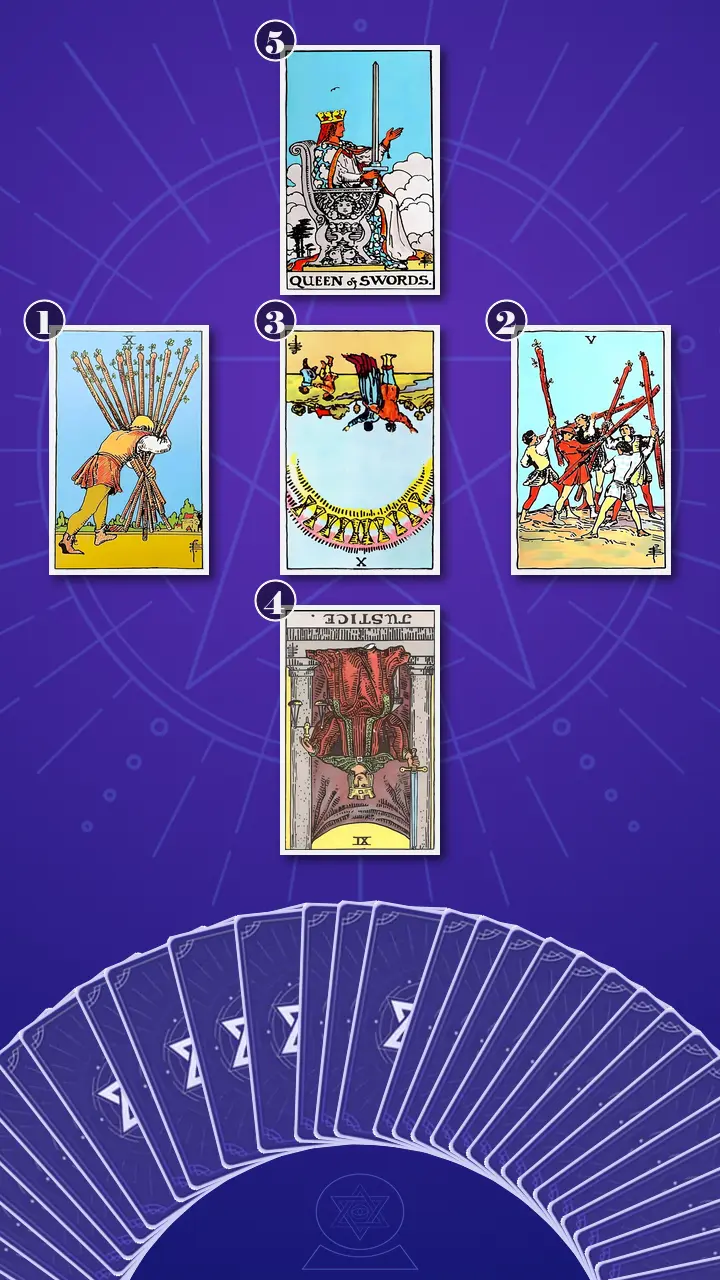
I laid the cards in a cross shaped like a bridge. The first and second positions formed two opposing banks: Maya's observable behaviour on one side and the family's competing conflict patterns on the other. The central card would show the bond keeping her involved. Beneath it, a fourth card would expose the structural imbalance. Above it, the fifth would show a possible bridge built through communication and choice.
I explained that the classic Bridge spread usually examines two people, but I had widened the second position to represent a family system because several relatives were involved. Five positions gave us enough room to separate burden, conflict, belonging, unequal responsibility, and a constructive boundary. That separation mattered: if every element remained bundled together, Maya would continue experiencing the whole situation as one urgent personal assignment.
Reading the Congested Side of the Bridge
Position One: The Project Board With No Off Switch
“Now turning over is the card representing your side of the bridge: the mediator behaviours you can observe, the responsibilities you have accumulated, and what they cost you,” I said. I revealed the Ten of Wands, upright.
I pointed to the figure bent beneath ten bundled staffs. The load did not merely look heavy; it obstructed the figure's view of the road and the distant town. I connected that restricted view to Maya's overfilled project board at 10:45 p.m.: three family chats open, every message labelled urgent, with her reading, sleep, and personal plans pushed beneath forwarded screenshots, rewritten explanations, emotional summaries, and promises to remain available.
I read the upright card as Excess: care had expanded into total operational ownership. Her project coordinator skills made her excellent at anticipating friction, but the family conflict was exploiting the same internal algorithm. Like a work board where every relative's action item had been assigned to Maya, the system contained no column for her capacity. Short-term calm rewarded the behaviour, while every successful rescue made the next rescue more likely.
“When did you last stop your own evening to manage a disagreement,” I asked, “and which part had you actually agreed to own?”
Maya gave a short laugh with a bitter edge. “That is so accurate it feels a bit brutal.” Her thumb rubbed the corner of her phone, although the screen was still dark.
“The image is direct,” I said, “but it is not accusing you. It is showing a load, not a character flaw. The question is not whether you are strong enough to carry it. The question is why all ten staffs became yours before anyone asked for your consent.”
Position Two: Five Conversations and No Shared Thread
“Now turning over is the card representing the family's side of the bridge: the competing voices and recurring conflict patterns that recruit you into managing communication.” I revealed the Five of Wands, upright.
Five figures raised their staffs at conflicting angles. Their clothes differed, their movements collided, and no shared target organised the activity. I asked Maya to remember the three contradictory voice notes she had received outside a Shoreditch pub. She had stood under the station lights while buses hissed through wet traffic, listening to each account twice and building a neutral timeline instead of joining her friends.
I read this card as another form of Excess: scattered fire, repeated interruption, and too many positions demanding airtime. One relative wanted validation, another wanted confrontation, and another sent screenshots from a different part of the exchange. Maya became the only person holding the full thread. Yet each clarification created another message to interpret, just as an algorithmic feed can make more input feel like progress when it is only more input.
“The card does not show a hidden perfect explanation,” I said. “It shows people talking from different versions of the same event. When you enter that field as organiser and referee, does understanding increase, or does the conflict simply acquire a new place to continue?”
Maya's mouth opened, then closed. She looked towards the rain on the window and slowly lowered both shoulders. “They stop talking to each other and start sending everything to me,” she said. “I thought that meant they trusted me.”
“It may include trust,” I replied. “It can also include convenience. Those are not always the same arrangement.”
Position Three: When Harmony Becomes a Status Indicator
“Now turning over is the card representing what keeps you connected to the mediator role: your wish for family harmony and the fear that unresolved conflict could threaten belonging.” I revealed the Ten of Cups, reversed.
I centred the inverted rainbow of cups above the family scene. Maya recognised it through a Sunday afternoon in her shared kitchen. The family chat had gone quiet after an argument, and the silence frightened her more than the original messages. While the kettle clicked off and toast smelled faintly burnt, she sent a cheerful meme and began suggesting lunch. She had told herself, “If they are still upset, maybe the bond is breaking.”
I treated the reversal as Blockage, not as a prediction of family breakdown. The water of emotional connection was being forced through an idealised picture of togetherness: friendly replies, heart emojis, quick apologies, and a polished atmosphere. Visible peace had become the status indicator for whether the relationship was safe. That made every unresolved disagreement feel larger than the people actually having it.
“What if the family staying connected does not require the family staying calm every minute you are awake?” I asked. “A cheerful message can lower the noise, but lowering the noise is not the same as repairing the relationship. Connection can remain real while two adults are still uncomfortable with each other.”
Maya's breath paused. Her fingers tightened around her sleeve, her gaze lost focus as though she were replaying every silent group chat she had tried to revive, and then a quiet “Oh” left her chest. “That is why I keep checking,” she said. “I am not only checking whether the argument is over. I am checking whether I am still inside the family.”
I nodded. “That fear deserves warmth, not ridicule. It also deserves a reality check: what evidence do you have that a relationship disappears whenever an argument remains unresolved for one evening?”
Position Four: The Evidence Missing From the Scales
“Now turning over is the card representing what obstructs a healthier connection: responsibility has been assigned unequally, and your own peace has been excluded from the fairness calculation.” I revealed Justice, reversed.
I showed Maya the destabilised scales, the inverted sword, and the formal figure seated between stone pillars. The card returned us to another late-night kitchen scene: Maya listing what each relative had said and what each one should apologise for while the refrigerator hummed beside her. Beneath the list was a heading she had never written: “What this has cost me.”
I read Justice reversed as Blockage through imbalance. Maya could account for every relative's intention, injury, and reaction, but her lost sleep, postponed plans, anger, emotional labour, and lack of consent stayed off the record. A calmer family chat is not the same thing as a fairer family system. Your lost sleep is evidence too.
The reversed scales took me back to my years formulating perfume. A formula can look precise while remaining fundamentally misleading if it records every aromatic material but ignores the solvent carrying them through the whole composition. Maya had become that invisible carrier: essential to the current arrangement, affected by every ingredient, and omitted from the calculation.
I use an Atmospheric Toxicity Audit at moments like this. I listen for what is quietly polluting a shared emotional climate, such as sarcasm, indirect demands, withheld resentment, and passive-aggressive silence, and then I ask who is expected to ventilate the room. In Maya's pattern, other adults could discharge tension into the family atmosphere while she was expected to filter it. I did not need to declare anyone a villain to identify that the assignment was unequal.
“If your time and consent are never included in the fairness calculation,” I asked, “what exactly is being balanced?”
Maya exhaled and placed her phone farther away. “I keep trying to decide who is right,” she said, “when I have not even decided whether I am available.”
I drew a line down a blank page and wrote Mine on one side and Theirs on the other. “Justice does not require you to produce a perfect verdict. Here, it asks us to restore proportion. Which action did you consent to take, and which consequences belong to the adults who made the choices?”
When One Sword Cleared the Air
Position Five: The Boundary That Keeps Its Hand Open
“Now turning over is the card representing the bridge you can build: a concrete boundary that preserves care while returning conflict management to the relatives involved.”
The radiator clicked off, and the rain against the window thinned to a faint, even rhythm. I turned over the Queen of Swords, upright. Her single sword stood vertically against clearing clouds, while her other hand remained open. The room seemed to make space around that uncluttered line.
I read the card as Balance: mature air expressed through discernment, concise language, and a limit that does not need to become punishment. In Maya's life, the Queen sounded like this: “I care about both of you, but I will not carry messages or decide this for you.” She could decline to forward a screenshot, end a call at the time she had named, and remain a loving family member without becoming the permanent judge.
This was where I used my Enmeshment & Permeability Diagnosis. In perfumery, diffusion is beautiful until one material saturates the entire room and erases the space needed to perceive anything else. Emotional closeness works similarly. Maya's boundaries had become so permeable that one notification could change the atmosphere of her bedroom, her dinner, her commute, and even her body. The Queen did not ask her to seal herself inside a bottle. Her sword established controlled diffusion: she could notice another person's distress without allowing it unrestricted access to every part of her independent life.
I asked her to picture the warm phone at 10:45, the cold tea, and the three threads demanding different versions of one story. She was trapped in the rule that rest could begin only after she had manufactured calm for everyone else.
You do not have to carry every argument to prove that you care; name what is yours, release what is not, and let the Queen's upright sword mark the boundary.
I watched Maya's breath stop. Her fingertips froze around the cuff of her jumper, and her pupils widened before her gaze slipped past the card. For several seconds, I could see her replaying old calls: the slight shake of her head, the jaw setting, the hand slowly opening on her knee. Then resistance arrived before relief. “But doesn't that mean I have been doing this wrong for years?” she asked, anger sharpening the last word while her eyes reddened. I kept my answer level. “It means the strategy once helped you feel useful and close. It does not make you foolish. It means you can choose whether the cost still fits.” Her fist loosened, her shoulders dropped, and a trembling breath left her chest. The relief made her look briefly unsteady, as if clear ground carried the new responsibility of standing on it. I asked, “Now, with this new perspective, can you think of one moment last week when this insight might have changed how you felt?”
Maya returned to the pavement outside the Shoreditch pub. She realised that nobody had asked her to construct a neutral timeline; each relative had sent a version of the argument and relied on her familiar reflex to take over. “I could have said I was meeting friends and that they needed to speak directly,” she said. “The thought makes me feel relieved and slightly sick.”
“Both responses make sense,” I said. “The sickness is the discomfort of interrupting a belonging strategy. The relief is information about your capacity. This is the first movement from contracted vigilance and guilt-driven peacemaking to clear boundaries and steadier family connection without self-abandonment. It is not certainty, and it does not require guilt to disappear before you act.”
Within ten minutes, I asked Maya to open Notes and write one sentence: “I care about you, but I cannot carry messages or mediate this tonight.” She read it aloud once. I reminded her that rehearsal did not obligate her to send it immediately; the choice remained hers. A boundary is allowed to be one sentence long, and she was allowed to stop the exercise if her body became too activated.
The Airlock Between Care and Carrying
I gathered the five cards into one coherent story. The Ten of Wands showed Maya carrying the visible workload. The Five of Wands showed a family conflict field with no single controllable centre. The reversed Ten of Cups revealed the deeper equation: visible harmony had become proof of belonging. Justice reversed exposed the cost of that equation by showing responsibility distributed unfairly. The Queen of Swords supplied the resource already available to Maya: one clear statement, followed by behaviour that respected it.
The bridge metaphor changed as we looked at the whole spread. Maya had believed she needed to become the bridge itself, absorbing every impact so nobody else fell out of connection. I saw a more sustainable structure: direct communication between the people involved, with Maya choosing when and how she crossed. Her cognitive blind spot was not that she cared too much. It was that she treated immediate calm as evidence of secure connection while treating her own time, sleep, and consent as expendable.
The transformation direction was precise: shift from serving as the family's live conflict manager to using one clear boundary statement and allowing each adult to handle their own disagreement. The spread moved from excessive fire, through blocked emotional water, into the Queen's mature air. No Pentacles appeared, so I told Maya that insight needed an earth-like container: a saved script, a timer, and a repeatable responsibility check.
I adapted my Quarantine Zone Protocol into that container. I described it as a psychological airlock between a relative's urgency and access to Maya's evening. The airlock was impenetrable to message-relaying, not to affection. Care could remain on both sides; only the unchosen mediator assignment was denied automatic entry.
- Install the One-Sentence Airlock. Before the next low-intensity family request, spend two minutes saving this in Notes: “I care about you, but I will not carry messages or decide this for you.” If a relative asks you to relay something, send or read the sentence once, direct them back to the other adult, and put the family chat on Focus mode for ten minutes. Read from the note instead of improvising. Do not add five paragraphs to prevent disappointment. If ten minutes feels too large, begin with five and let the timer provide the structure.
- Run the Mine / Theirs Responsibility Reset. During the next disagreement, open a note titled “Mine / Theirs” and sort observable actions for five minutes. Put your sleep, time, consent, and chosen response under Mine. Put their messages, apologies, interpretations, and repair under Theirs. Choose no more than one action from Mine, then close the note. Treat the list as a temporary container, not a verdict on the family. If you start debating who is morally right, return to facts: who acted, who was asked, and what you actually agreed to do.
I told Maya that success would not be measured by whether every relative approved of the boundary. The first measure was whether she could state it once and follow her own next step. Other adults might be disappointed, quiet, or briefly more insistent; none of those reactions automatically made her limit unkind.
I also made one distinction explicit: if a conflict ever involved immediate physical danger or a credible threat, the appropriate next step would be emergency or professional support, not solo mediation. A boundary practice is not a substitute for safety resources, and Maya was never required to manage a dangerous situation alone.

Six Days Later: A Quiet Edge of Peace
Six days later, I received: “I sent the sentence, muted the chat for thirty minutes, and finished my chapter.” The argument was still unresolved. Maya slept, woke thinking, “What if I got it wrong?” and told me she smiled before leaving the phone face-down.
I did not take that message as proof that one tarot reading had solved her family system. I took it as a small, credible sign that her Journey to Clarity had moved from insight into authorship. The cards had made the pattern visible, but they had not protected Maya's peace; Maya had begun doing that herself.
I want to leave you with this: when a family fight lights up your phone and your jaw locks before you have even read the message, you can want everyone to stay connected and still feel trapped by the fear that protecting your own peace will cost you your place. Noticing the difference between care and carrying means you are already no longer at the starting point.
If one Queen of Swords sentence could mark the edge of your responsibility tonight, without being diluted into a full case for the defence, what would you want that sentence to sound like?